Home Blog Page 5998

LANDBANK cuts Link.BizPortal payment fees to P7 from P15

LAND BANK of the Philippines (LANDBANK) reduced Link.BizPortal transaction fees to provide more accessible services and meet the growing digital needs of its customers.

“We continue to encourage our customers to make cashless payments in a convenient, safe and cost-effective manner. The lowered LinkBiz transaction rates form part of LANDBANK’s contribution towards building a cash-lite society,” said Cecilia C. Borromeo, the bank’s president and chief executive, in a press release on Sunday.

Starting on June 1, its customers will enjoy lower transaction fees when making online payments using the Link.BizPortal digital payment platform.

The state-run bank lowered fees to P7 from P15 per transaction on its digital payment platform and Overseas Filipino Bank’s ATM account and prepaid cardholders.

Customers who use LANDBANKPay, the bank’s recently launched all-in-one mobile wallet, will also be charged P7 per Link.Biz transaction, with additional P2 rebate.

Additionally, transaction fees using other payment options will be reduced to P17 from P25 except over-the-counter cash and credit card payments.

“The Link.BizPortal is LANDBANK’s web-based payment channel that allows clients to pay for products and services online to over 870 government and private partner merchants nationwide,” the bank said.

Link.BizPortal facilitated 660,490 transactions with value of P1.39 billion for the first three months of 2022. Year on year, transactions and value increased by 37% and 41%, respectively, as more customers prefer online banking.

“LANDBANK’s digital transformation fully supports the National Government’s digital and financial inclusion agenda in line with its expanded mandate of serving the nation,” the state-run bank said. – Keisha B. Ta-asan

India’s protectionist moves spark concern rice may be next

REUTERS

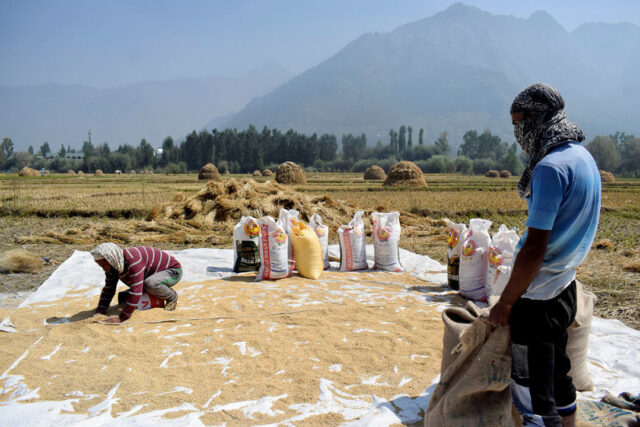
RICE may be India’s next food protectionism target after it restricted wheat and sugar exports, analysts say, a move that could have a devastating impact on global food security as it’s an important staple.

India’s curbs on wheat and sugar exports sent shock waves through global markets as it marked an escalation in food protectionism that’s seen countries choke off flows of locally-grown supplies to the world. A similar move on rice by the No. 1 exporter at a time when crops like wheat and corn are soaring would threaten to plunge millions more into hunger and boost inflation risks.

“The government has already imposed restrictions on wheat exports; it’s a matter of time when restrictions on rice exports might be considered,” said Radhika Piplani, an economist at Yes Bank Ltd. The challenge will be to see if such curbs will lower food prices and within what time frame, she added.

The situation of rice stocks was discussed at the meeting of an inter-ministerial committee that tracks prices of essential commodities, according to a person familiar with the matter. But the committee decided there’s no need to restrict rice shipments for now because India has huge inventories, said the person, who asked not to be identified as the information is confidential.

A spokesperson who represents both the trade and food ministries didn’t immediately respond to an e-mail seeking comment. The food secretary didn’t immediately respond to a request for comment.

“Restricting exports of rice is a possibility,” said Poornima Varma, assistant professor at the Centre for Management in Agriculture at the Indian Institute of Management, Ahmedabad. “The government may feel there’s a need to substitute wheat with rice to curb domestic inflation and safeguard food security,” she said.

Rice is closely related to wheat in Indians’ diet and the food ration system. Government purchases of wheat for the food aid program are expected to be less than half than year-ago levels and authorities plan to distribute more rice, spurring expectations that they will want to ensure ample supplies of cheap rice. India has stockpiled more than enough rice and prices have been stable.

“These public reserves of rice are more than adequate to meet the country’s public distribution needs, even with the enlargement of rice rations due to the prevailing wheat situation,” said Shirley Mustafa, an economist at UN Food and Agriculture Organization.

Rice has been the one staple grain that’s helping to keep the world food crisis from getting worse. Unlike wheat and corn, which have seen prices skyrocket as the war in Ukraine disrupts supplies from a major breadbasket, rice prices have remained subdued due to ample production and existing stockpiles.

That outlook can change if India decides to curb rice exports. It may spur other countries to follow a similar playbook, as it did during the 2008 food crisis, when Vietnam also restricted rice shipments. Asia produces and consumes about 90% of rice, with India accounting for 40% of global trade.

“Rice supplies are ample in the country and there is no need to ban or restrict exports,” said B.V. Krishna Rao, president of the Rice Exporters Association. “If the government still wants to impose a quantitative restriction it can be a political call and the trade will welcome that in the national interest.”

Economic leaders under Prime Minister Narendra Modi are taking a coordinated move to tackle inflation, seeking to slow price increases and ease the impact on consumers. Retail inflation, which is tracking at an eight-year high, is a politically-sensitive issue and can influence how people vote in elections.

History offers some guide on how a rice export curb might play out. During the 2007-08 food crisis, India faced soaring wheat prices and decided to limit exports. The government bought more rice for its food distribution program instead of wheat. To ensure cheap and plentiful supply of rice, officials blocked exports of non-Basmati rice in October 2007.

A decision to limit rice exports will depend on how prices fare in the coming weeks, said Suvodeep Rakshit, senior economist at Kotak Institutional Equities. Rice is about to be sown and output depends on the weather. If the monsoon is erratic and rice prices jump, it’s likely that exports will be curbed, he said.

Rice is identified by its length and shape. Basmati is a long-grain rice known for its distinct aroma. Basmati rice exports totaled 3.95 million tons in 2021-22 while non-basmati shipments reached 17.26 million tons. — Bloomberg

Honda Cars opens La Union service center, breaks ground on Sta. Rosa dealership

PHOTO FROM HONDA CARS PHILIPPINES

HONDA CARS Philippines, Inc. (HCPI) recently opened its relocated service center in Rosario, La Union, and broke ground on a new dealership in Sta. Rosa, Laguna — part of the firm’s continued thrust to bolster the Honda presence in Luzon.

Formerly located in Baguio, the service center has been moved to La Union, and is now open for business. The Rosario, La Union Service Center of Honda Cars Pangasinan rises on a 2,800-sq.m. parcel of land, and offers after-sales services including preventive maintenance, general repairs, as well as body and paint for current and future Honda owners. The facility is strategically located along MacArthur Highway, Subsub, Rosario, La Union 2506 and is open from Monday to Saturday, 8:30 a.m. to 5:30 p.m. For inquiries, contact 0917-584-4747, 0908-886-9128, or (072) 619-7305.

Meanwhile, the ceremonial groundbreaking on the soon-to-rise Honda Cars Sta. Rosa was held last May 20. The new facility, to be managed by the ANC Group, will be built near the existing service center, which will be converted into a full dealership. Part of upgrades include a five-car display area or showroom where customers can check out Honda’s latest vehicles, along with a service reception where Honda consultants and advisers are on standby and ready to serve. The service center remains open for customers while the construction of the new dealership is in progress.

Honda Cars Sta. Rosa, the 39th dealership of the brand here, will also feature a dedicated service area where owners are welcome to take in their vehicles for preventive maintenance. Honda Cars Sta. Rosa is slated for soft opening by December.

Honda Cars dealerships and service centers are staffed by highly skilled technicians using state-of-the-art tools and equipment. Periodic maintenance service (PMS) at authorized Honda dealers guarantees genuine chemicals, parts and accessories, and service quality aligned with global standards to ensure workmanship and safety. “These facilities are for the service and convenience of our customers. We hope to reach more and serve more families with Honda’s dealer network expansion efforts. With the Honda Dealers, we want to enhance the ‘Power of Dreams’ experience for each customer. It is very important to us that we can keep them safe and satisfied that they chose Honda,” said HCPI President Masahiko Nakamura. For more information, visit www.hondaphil.com or its Virtual Showroom.

SEAG medalist athletes will receive their cash incentives tomorrow

WHEN it rains, it pours.

Filipino athletes who medaled in the 31st Southeast Asian Games (SEAG) in Hanoi, Vietnam will receive cash incentives from the Philippine Olympic Committee (POC) on Monday and the government on Tuesday in Malacañang Palace.

“To honor and recognize the athletes, the POC is rewarding them with incentives,” said POC President Abraham Tolentino, who presided over the POC Executive Board meeting on Saturday at the East Ocean Palace Restaurant in Pasay City.

The PhilCycling Chief will officially announce the release of the cash bonus to the 52 gold, 70 silver and 105 bronze medalists at the Knights Templar Hotel in Tagaytay on Monday.

The next day, it will be the government’s turn to reward the triumphant Filipino sporting heroes and heroines as based on law, a gold winner will receive P300,000 and P150,000 and P60,000 to the silver and bronze medalists, respectively.

And there is a strong chance President Rodrigo R. Duterte could shell out more rewards as he had done in the past during his six-year term.

Of all the athletes, gymnast Carlos Yulo emerged the biggest winner as he is will take home more or less P1.7 million for pocketing five mints and a pair of silver.

Mr. Tolentino said he hopes the Nationals could sustain, if not improve, when they return to action next year’s Phnom Penh Games.

“We’re hopeful that when the 32nd SEA Games are hosted by Cambodia in May 2023, our athletes will remain in gold medal form,” said the congressman from Tagaytay. — Joey Villar

CTA affirms Sonoma Services’ P5-M refund

THE Court of Tax Appeals (CTA) has affirmed Sonoma Services, Inc.’s refund of P5 million representing its excess and unutilized creditable withholding tax (CWT) for the calendar year 2015.

In a 13-page decision on May 25 and made public on May 27, the CTA full court said it found no reason to reverse its previous decision granting the company’s claim for a refund.

“This court has time and again ruled that the presentation of certificates of creditable withholding tax at source (CCWTS) is sufficient to prove the fact of withholding; and, that proof of remittance of the taxes withheld to the BIR (Bureau of Internal Revenue) as well as the testimony of various payers and withholding agents who issued the CCWTS are not needed to prove the taxpayer’s entitlement to the claim for refund,” according to the ruling written by CTA Associate Justice Roman G. Del Rosario.

Sonoma Services, a domestic corporation located in Makati City, is engaged in tax preparation, bookkeeping, and payroll services.

The commissioner of internal revenue (CIR) previously filed an appeal to reverse a division ruling granting the company’s claim for refund. The official argued that the company failed to present documents that represented its customers and withholding agents to validate its claim to refund its CWT.

The tax court noted that under the BIR’s own laws, there is no mention of denying a taxpayer’s claim for refund due to non-submission of these documents.

“There is, therefore, no legal basis for the CIR to insist that the alleged non-submission of Summary Alphalist of Withholding Agents of Income Payments Subjected to Withholding Tax (SAWT) and Monthly Alphalist of Payees (MAP) should result in the denial of Sonoma’s claim for tax refund or credit,” the CTA said.

The CIR said in its petition that the absence of these documents renders the certificates of CWT submitted by the company as hearsay.

The CTA said the Supreme Court previously established that the taxpayer making a claim for excess CWT does not need to present the individual who prepared the CCWTS.

“It cannot be denied that these documents (CCTWS) are admissible in evidence and are competent proof of the fact of withholding of income taxes from the income payments made to petitioner and of the amount of tax withheld,” the court said, citing its previous ruling. — John Victor D. Ordoñez

Philippines lags in national technological strength list

The Philippines fell by seven notches to 61st out of 64 in the 2022 edition of most technologically advanced countries ranking by international magazine Global Finance. The report ranks a country’s technological strength across four metrics: internet users as a percentage of a country’s population; LTE users as a percentage of the population; IMD World Competitiveness Center’s Digital Competitiveness Score; and share of a country’s research and development spending to its economic output. Among 11 East and Southeast Asia countries included in the report, the Philippines ranked second lowest, ahead only of Mongolia (63rd).

Philippines lags in national technological strength list

Yields on gov’t debt end mixed after BSP signal, June borrowing plan

YIELDS on government securities (GS) were mixed last week following the latest signal from the Bangko Sentral ng Pilipinas (BSP) to increase borrowing cost anew next month and the higher June borrowing plan.

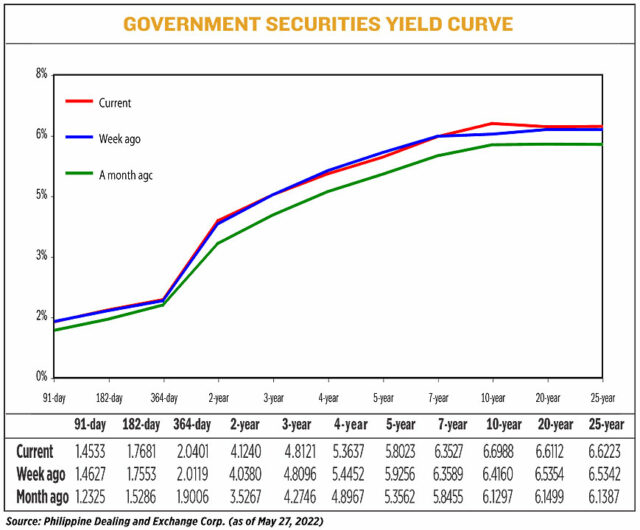
Debt yields, which move opposite to prices, increased by 3.23 basis points (bps) on average week on week, based on PHP Bloomberg Valuation Service Reference Rates as of May 27 published on the Philippine Dealing System’s website.

Yields across the board ended mixed. At the short-end of the curve, the 91-day papers dipped by 0.94 basis point (bp) to 1.4533%, while the 182- and 364-day Treasury bills (T-bills) went up by 1.28 bps and 2.82 bps to fetch 1.7681% and 2.0401%, respectively.

Rates at the belly of the curve saw mixed results as the two- and three-year Treasury bonds (T-bonds) edged up by 8.60 bps (to 4.1240%) and 0.25 bp (4.8121%), respectively. Meanwhile, the four-, five- and seven-year T-bonds dropped by 8.15 bps (to 5.3637%), 12.33 bps (5.8023%), and 0.62 bp (6.3527%).

On the other hand, the long end of the curve moved upwards as yields on 10-, 20- and 25-years debt papers rose by 28.28 bps (to 6.6988%), 7.58 bps (to 6.6112%), and 8.81 bps (to 6.6223%), respectively.

Total GS volume reached P13.677 billion on Friday, higher than P7.105 billion seen last May 20.

“Bid/offer spread remains very wide [last week]. Aggressive debt supply kept speculators at bay, limiting secondary market action,” a bond trader said in an e-mail.

“To some extent, portfolio demand provided support at these attractive levels. Hints of incumbent BSP Governor [Benjamin E.] Diokno that a rate hike is possible next June was shrugged off as this was fully priced in,” the bond trader added.

“It is still better to load up on auctions as the BTr (Bureau of the Treasury) seems aggressive enough to award higher this June.”

On May 19, the Monetary Board increased the benchmark rate by 25 basis points (bps) to 2.25%. The BSP hiked its key interest rate to control soaring inflation.

Rates on the overnight deposit and lending facilities were also hiked by 25 bps to 1.75% and 2.75%, respectively.

Last Thursday, the central bank chief signaled that he was inclined to hike key rates by another quarter percentage point at the next policy meeting on June 23.

The BTr plans to borrow P250 billion from domestic debt market in June, 25% more than the P200 billion it programed for May. The government just borrowed P141.31 billion this month.

Broken down, the Treasury will offer P15 billion and P35 billion in its weekly auctions of T-bills and T-bonds in June.

“There were some downward movements in the belly of the curve [last week] due to some market positioning ahead of next week’s BTr auctions on those tenors,” another bond trader said in an e-mail.

The second bond trader added that the increase in the GS volume traded last week compared with two weeks ago could be attributed to investors staying on the sidelines prior to the noted market developments.

For this week’s trading session, the first bond trader sees weak GS yields on the three-year and five-year area due to incoming debt supply.

“The 10-year area will trade sideways and will be well bid, 5 bps lower. Yields to consolidate, probably a little higher on the three-year to five-year area. BTr borrowing behavior for June and May inflation spiking above 5% is already priced in.”

For the second bond trader, domestic yields might move higher as likely upbeat US labor data could further support hawkish US monetary policy views and ease global growth worries.

“However, the increase in local yields might be capped by policy uncertainties by the next Philippine administration,” the second bond trader added. — A. M. P. Yraola


National government fiscal performance

The National Government’s (NG) budget gap swung to a surplus in April as revenue collection grew by double digits, while spending inched up by single digits, the Bureau of Treasury (BTr) reported on Friday. Read the full story.

National government fiscal performance

Brazil gets critical fertilizer shipments in time for soy planting

REUTERS

BRAZIL is importing record amounts of fertilizer for its massive soybean crop, relieving concerns about supply chain disruptions for products from Russia, its No. 1 supplier.

There was worry that the South American nation wouldn’t be able to get enough fertilizer because of sanctions against Russia for the war in Ukraine, as well as shipping chaos that’s unfolded in the region. Brazil is the world’s biggest shipper of several crops including soybeans, and a shortfall of fertilizers could result in smaller harvests. That would drive up food prices around the globe, which are already at all-time highs, pushing more people into hunger.

Total Brazilian fertilizer imports from January to April are higher than they were in 2021, when there were record purchases, according to data by both the government and companies that track imports.

“We’ve already received over 70% of all our purchases for the soybean crop, and the rest of the deliveries are scheduled within the normal wait,” said Leandro Bianchini, commercial supervisor for Coacen, the largest agriculture cooperative in Mato Grosso. “On corn we still have lots to buy and a smaller window to operate.”

The stakes are significant. Fertilizer supplies will determine how many hectares of soybeans Brazilian farmers will seed, according to Marcela Marini, a senior analyst at Rabobank in Sao Paulo. If fertilizer shipments continue to flow in June and July, months when imports peak, producers may increase plantings by 3.7% to 42 million hectares even amid skyrocketing crop nutrients prices, she said. Margins from soybean sales are seen at 56% over operational costs next season, above the five-year average and the third largest ever reported, according to a Rabobank estimate.

Initially, Rabobank estimated that the South American nation would have to deal with a lack of about a third of its potash needs. Now, in the worst-case scenario, Rabobank sees a shortage of as much as 20%, said Rabobank’s farm inputs analyst Bruno Fonseca.

Potash is nearly three times as expensive as last year, according to data by Green Markets, a Bloomberg company. The chemicals are expensive for a host of reasons including runaway pricing for natural gas, the key ingredient for nitrogen fertilizer, sanctions on a major Belarusian potash producer, and Covid-19 restrictions that have disrupted every global supply chain, including chemicals. The invasion of Ukraine by Russia, a huge exporter of every major fertilizer, has sent the market into further chaos.

Different crops need different nutrients. In September Brazil will plant soybeans, which need phosphate and potash that comes mainly from Russia and Belarus. Those imports are the ones that are booming. Another, nitrogen, used heavily in corn, is still scarce. However, that crop won’t be planted until March 2023, and nitrogen imports are seasonally smaller for this time of year and should increase, according to Marina Cavalcante, an analyst at Bloomberg’s Green Markets.

“The geopolitical conditions make it very difficult for products to come from Russia and Belarus, there was also a price variation, but Nutrien will be able to serve all customers in Brazil,” said Andre Dias, the chief executive officer of fertilizer giant Nutrien Ltd. in Latin America.

Lineup companies, whose job it is to track what products move by ship and where they go, are also seeing more fertilizer imports coming to Brazil from Russia compared to last year.

To be sure, there are no “guarantees” this year for any product, given the strong necessity of imports, said Cavalcante. Brazil imports more than 85% of the fertilizer that it consumes.

Logistics headaches at ports could still be a problem. Arthur da Anunciação Neto, the commercial director for agricultural lineup company Alphamar, said wait times for ships sitting in Brazilian ports are nearly double those in 2021. — Bloomberg

New economic team, policies seen to boost trading

REUTERS

SHARES are seen to move upwards this week as the next administration has begun revealing its economic team and fiscal policy direction, and amid the acceleration of the country’s vaccination drive.

The benchmark Philippine Stock Exchange index (PSEi) climbed by 80.62 points or 1.21% to close at 6,726.14 on Friday, while the broader all shares index rose by 27.48 points or 0.77% to close at 3,596.13.

Week on week, the PSEi ended lower by 20.19 points from its close of 6,746.33 on May 20.

“After the positive reception to the incoming administration’s choice of economic managers, we think the market will trade sideways with an upward bias on expectations of policy continuity and further economic reopenings,” RCBC Securities, Inc. Head of Research Erwin Rommel C. Fuentes said in an e-mail.

Rizal Commercial Banking Corp. (RCBC) Chief Economist Michael L. Ricafort said that the appointment of certain Cabinet members thus far was taken positively by the local market, since the appointees were “seasoned, experienced, with good track record, well respected, and recognized by the local and international investment communities.”

“In view of the transition phase before the new administration takes office on June 30, the financial markets and general public are still waiting for more details on the rest of the Cabinet members of the new administration,” he said in an e-mail.

Reuters reported that Philippine President-elect Ferdinand “Bongbong” R. Marcos, Jr. gave strong indications that he will maintain continuity in economic policy through his picks for central bank governor and Finance secretary last Thursday by adding familiar faces to his Cabinet.

Benjamin E. Diokno, the central bank governor, would become Mr. Marcos’ Finance chief, with Felipe M. Medalla, a current monetary board member, to take over as Bangko Sentral ng Pilipinas governor. The two will be tasked with tackling inflation and joblessness.

Reuters added that Mr. Marcos faces a delicate balancing act to ensure economic recovery is sustained and rising inflation, driven by politically sensitive increases in rice and fuel costs, is kept in check after he starts his six-year term. Still, the economy is seen to be manageable with debt stock at acceptable levels, foreign reserves at record highs, and growth at healthy rates.

Meanwhile, RCBC’s Mr. Ricafort said that the possibility of an additional accelerated vaccination or booster program would also contribute to further reopening of the economy.

“Population protection is already achieved nationwide and this could eventually reach herd immunity,” he said.

In April, the Philippines started giving second coronavirus disease 2019 (COVID-19) booster doses for immunocompromised adults, joining a growing number of Asian countries offering a fourth vaccine shot, Reuters reported.

The government also already opened inoculations for children 12-17 years old, in preparation for the resumption of face-to-face schooling.

Nearly 61% of the Philippines’ 110 million population have been vaccinated, while nearly 13 million people have received first booster doses, according to government data.

For the coming week, RCBC’s Mr. Ricafort placed the PSEi’s immediate support between 6,530 and 6,570 levels, and resistance at 6,800 to 6,900 levels. — Luisa Maria Jacinta C. Jocson with Reuters

Changan CS35 Plus nets ‘above-market’ fuel efficiency in AAP test

PHOTO FROM CHANGAN PHILIPPINES

THE NEW Changan CS35 Plus registered “above-market” fuel efficiency ratings during a recent fuel economy run conducted by the Automotive Association Philippines (AAP). The fuel tank was filled with unleaded 95RON at the start of the test, and then refueled to the same level to measure the amount used. All standard OEM equipment was present in the vehicle. Tire pressure was set to 2.2 bar, while air-conditioning was at full thermostat with “the lowest blower setting that was comfortable for the occupants.” The radio was not turned on.

For the highway test route, the CS35 Plus registered fuel consumption of 21.495 kpl over a distance of 180.652 kilometers — running at 60 kph to 80 kph along NLEx from Balagtas in Bulacan to Tarlac City and back. The odometer reading at the start of the run was at 2,163 km and finished at 2,341 km. When refueled, only 8.408 liters were added, coming from a full tank.

In the urban test route, the vehicle consumed 15.254 kpl after traveling 86.8 km at the same range of speed through Makati City, Manila, Quezon City, and back, with the odometer starting at 2,374 km and finishing at 2,460 km. After the run, the car was refueled with 5.69 liters of gas.

Changan Philippines, in a release, attributed the performance and efficiency to the vehicle’s Blue Core technology “behind this latest iteration of Changan’s best-selling SUV.” A 1.4-liter turbocharged gasoline direct injection mill delivers 160hp and 260Nm of torque, paired with a seven-speed dual clutch transmission system. Changan Blue Core is said to provide “a powerful, clean, and quiet driving experience, building upon a number of powertrain technologies, such as TGDi and Dual VVT wet type dual clutch transmission.” An optimized internal combustion system results in 20% less fuel consumed and a 40% reduction in carbon emission.

The new Changan CS35 Plus, launched last March, boasts significant enhancements in its safety system, dubbed “Safe-tech.” This advanced safety and protection technology consists of active safety features considered as above its class and price point. For more information, visit https://www.changanphil.com/ or the Changan Philippines official Facebook page https://web.facebook.com/ChanganPhil.

Goodfellas actor Ray Liotta, 67

RAY LIOTTA in a scene from the 1990 film Goodfellas.

SANTO DOMINGO — American actor Ray Liotta, 67, who starred in the 1990 blockbuster crime film Goodfellas, died in his sleep on Thursday in the Dominican Republic, the Dominican Republic General Directorate of Cinema confirmed to Reuters.

Liotta died in bed at a hotel where he was staying with his fiancée Jacy Nittolo while filming Dangerous Waters, said his publicist Jennifer Allen. He had a leading role in the film about a sailing holiday that goes awry when family secrets are revealed.

A cause of death was not specified, cinema officials said. According to media reports, an emergency service team had entered the hotel. His body was transferred to the forensic institute of Santo Domingo.

Liotta was born Dec. 18, 1954, in Newark, New Jersey. His many starring roles included playing mobster Henry Hill in Goodfellas and baseball player Shoeless Joe Jackson in Field of Dreams. He is also known for films including The Many Saints of Newark and Something Wild.

He leaves behind a daughter, Karsen Liotta, 23. — Reuters