Home Blog Page 5981

Better distribution system key to agriculture sector growth — senator

BW FILE PHOTO

IMPROVING the countrys logistics for agricultural produce is needed to ensure stable food supply and the sectors growth, a senator said on Tuesday. 

Senator María Imelda ImeeR. Marcos, who chairs the Senate Economic Affairs Committee, said an effective distribution system will improve the country’s cycle of food production and supply. 

A poor distribution system creates scarcity amid bounty, waste amid want,she said.  

With an efficient delivery of farm products from source to consumers, authorities would be able to determine where real shortages are and the import volume needed for such goods as rice, sugar, vegetables, pork, beef, poultry, and fish.  

We need to redirect the flow of income from import cartels toward our local farmers and provide the lowest food prices possible for the public, she said.  

The senator also called for the expansion of the Young Farmers Challenge program to increase the national food supply and encourage the youth to farm using modern technology and develop new ideas.   

This advocacy must become more than a prize-giving contest supported by the Department of Agriculture. To make a bigger difference, other government departments and all local government units should be involved,she said.  

We need more young farmers with new ideas for a dying vocation whose practitioners now average 57 years old,she added. Alyssa Nicole O. Tan 

Vote counters

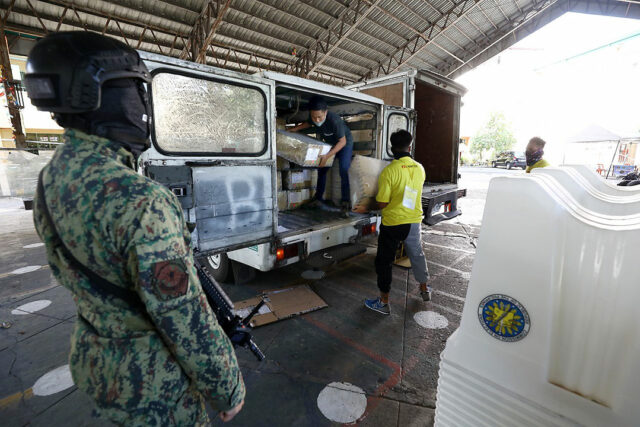
PHILIPPINE STAR/ MIGUEL DE GUZMAN

A SECURITY officer watches over the unloading of vote counting machines at the Dr. Rafael Palma Elementary School in Manila on May 3. The equipment will be tested and sealed before the voting on May 9.

Suns’ balance overcomes Mavs’ Luka Doncic in Game 1

PHOENIX Suns guard Devin Booker (1) and Phoenix Suns center Deandre Ayton (22) slap hands against the Dallas Mavericks during the first half of Game 1 of the second round for the 2022 NBA playoffs. — REUTERS

DEANDRE Ayton scored a team-high 25 points and the Phoenix Suns dominated the visiting Dallas Mavericks on the boards en route to a 121-114 victory in Game 1 of their Western Conference semifinal series on Monday night.

Devin Booker contributed 23 points to a balanced attack, with nine rebounds and eight assists. Chris Paul had 19 points, Cam Johnson 17, Mikal Bridges 13 and Jae Crowder 11 as the top-seeded Suns held serve in a best-of-seven that continues on Wednesday in Phoenix.

Luka Doncic finished with 45 points — one shy of his postseason career-high — for the Mavericks, who were outrebounded 51-36 and lost despite outscoring the host 48-33 on 3-pointers.

Coming off a hard-fought win over the New Orleans Pelicans in six games, the Suns wasted no time gaining the upper hand on the fourth-seeded Mavericks, scoring the game’s first nine points. Crowder contributed a 3-pointer to cap the run.

Phoenix went on to lead by as many as 15 later in the first quarter, 18 in the third period and 106-85 on a dunk by JaVale McGee with 8:48 remaining before coasting home.

With Ayton hitting 12 of his 20 shots, the Suns outshot the Mavericks 50.5% to 47.1%. Phoenix led the NBA with a 52.3% shooting percentage in the first round, while Dallas allowed just 44.3% shooting, third-best in the league, in its opening-round win over the Utah Jazz.

The Suns also helped themselves with 13 offensive rebounds and a perfect (18-for-18) at the free throw line, with Booker going 8-for-8.

Ayton picked up right where he left off in the first round, when he had four 20-plus-point games, with a high of 28. He and Crowder each had eight rebounds.

Doncic was the game’s leading rebounder with 12, completing his ninth double-double in 17 playoff games. He missed a fourth career postseason triple-double by two assists.

His 45 points gave him six 40-point playoff games. His postseason career-high of 46 came last year in Game 7 of Dallas’ opening-round loss to the Los Angeles Clippers.

Maxi Kleber chipped in with 19 points for Dallas, which also lost Game 1 in the Utah series before rallying to take four of the next five. Dorian Finney-Smith added 15 points and Jalen Brunson 13. — Reuters

Heat pull away for series-opening win against 76ers

TYLER HERRO scored 25 points, Bam Adebayo added 24 points and 12 rebounds and the host Miami Heat defeated the Philadelphia 76ers 106-92 in Game 1 of an Eastern Conference semifinal series on Monday.

Miami’s Jimmy Butler contributed 15 points and nine rebounds, while P.J. Tucker and Gabe Vincent had 10 points apiece. Kyle Lowry sat out due to a strained left hamstring.

The 76ers played without Most Valuable Player candidate Joel Embiid, who is in the concussion protocol and also is dealing with an orbital fracture and a torn ligament in his right thumb.

Tobias Harris led Philadelphia with 27 points, and Tyrese Maxey added 19. James Harden had 16 points and nine rebounds.

Game 2 of the best-of-seven series will be played Wednesday in Miami.

The Heat led by 14 points in the first quarter and by 13 in the second before the 76ers rallied. Consecutive layups from Maxey and Harden gave Philadelphia a 51-50 advantage and that wound up being the score at half time.

Herro and Adebayo each had 12 first-half points for the Heat, who managed only two points in the final 4:39 of the second period.

Harris paced the Sixers with 14 before the break, and Harden had 12.

After the Sixers went ahead 55-50, the Heat came back with a 20-6 run to take a 70-61 lead midway through the third.

Harris ended the run with a trey from the wing and added a short jumper to close the gap to 70-66.

The Heat led 80-72 at the end of the third.

Miami’s Victor Oladipo opened the fourth with a difficult runner in the lane.

After Philadelphia’s Paul Reed missed from point-blank range, Herro dropped in a 31-foot 3-pointer for an 85-72 advantage.

The Heat’s lead ballooned to 98-77 after Max Strus threw down a dunk with 6:15 left. Philadelphia went nearly five minutes without a field goal while Miami extended its advantage.

The Heat cruised to the victory in the final minutes as both teams emptied their benches. — Reuters

Halep storms into Madrid quarters; Sinner advances after great escape

FORMER world number one Simona Halep stepped up her French Open preparations with a 6-4, 6-4 victory over American Coco Gauff to march into the quarterfinals of the Madrid Open on Monday.

Halep, who won the French Open in 2018 and the Madrid title twice, is unseeded after her ranking fell last year following a series of injuries but she has yet to drop a set in the tournament this year.

The Romanian, now ranked 21st in the world, was at her aggressive best on the red clay and showed determination to win the longer rallies but was unable to break until the American teenager made a series of unforced errors to go down 5-4.

Halep served out the set but it only fired up Gauff as the 18-year-old suddenly grew in confidence and found success at the net to race into a 3-0 lead in the second set.

But the Romanian counter-puncher quickly recovered and fought back as Gauff’s error count continued to climb, breaking twice to go up 5-4 before wrapping up the contest in 77 minutes.

“I felt like I played the exactly what I had to play. In the second set, she changed a little bit,” Halep said in a post-match interview.

“She’s been more aggressive and it was not easy to adjust, but in the end, I pushed her back and I did what I wanted to do… We played a few times so I knew what to expect.”

Halep will face Tunisian eighth seed Ons Jabeur who beat Belinda Bencic 6-2, 3-6, 6-2 in an earlier match where the final set was played under the roof due to rain.

“Just a reminder guys, Simona won against Paula (Badosa in the previous round) and she’s Spanish. So if she wins you have to cheer for me,” Jabeur said.

In the men’s tournament, Italian 10th seed Jannik Sinner fought back from a set down and then saved three match points to dispatch American Tommy Paul 6-7(4), 7-6(4), 6-3 in a three-hour battle to move into the second round.

“It was a very difficult situation. I was up in the first set 5-2 and then I lost it,” said Sinner, who will next face Alex de Minaur. “He played a very good tie-break. I made a couple of unforced errors at the beginning and the second set was kind of a rollercoaster also.” — Reuters

Norman says Mickelson’s remarks hurt Saudi-backed breakaway tour

GREG NORMAN, a former two-time major championship winner who is fronting a new golf league backed by Saudi Arabian investors, confirmed on Monday that Phil Mickelson’s recent comments complicated things for the upstart operation.

“There’s no question (it) hurt,” Norman told ESPN. “It hurt a lot of aspects. It hurt the PGA Tour. It hurt us. It hurt the game of golf. It hurt Phil. So yeah, across all fronts. It wasn’t just specifically to us. But it definitely created negative momentum against us.”

Norman is the CEO of the LIV Golf Invitational Series, formerly known as the Super Golf League. As the venture was trying to get rolling, comments from Mickelson published on Feb. 15, after a November interview with author Alan Shipnuck, caused a firestorm.

Mickelson referenced the killing of Washington Post reporter Jamal Khashoggi and called the Saudi Arabians “scary motherf—s to get involved with.” He went on to explain why he still had interest in joining the Saudi-backed league.

“(They) have a horrible record on human rights,” Mickelson was said, according to Shipnuck. “They execute people over there for being gay. Knowing all of this, why would I even consider it? Because this is a once-in-a-lifetime opportunity to reshape how the PGA Tour operates.”

“They’ve been able to get by with manipulative, coercive, strong-arm tactics because we, the players, had no recourse.”

Norman said on Monday that nearly one third of the top 50 players in the world were committed to playing in the new golf tour.

When Mickelson’s comments were revealed, many top players reaffirmed their commitment to playing on the PGA Tour.

“Quite honestly, we were ready to launch (in February),” Norman said to ESPN. “We had enough players in our strength of field, or minimal viable product, ready to come on board. And when all of that happened, everybody got the jitters, and the PGA Tour threatened people with lifetime bans and stuff like that.”

Originally set to be a 14-event schedule, the LIV Golf Invitational Series has restructured itself with a potential eight-event season. Of those, five are expected to take place in the United States.

A total of $255 million is expected to be up for grabs. Mickelson has since filed a request to play in an event that conflicts with the PGA Tour, signaling his desire to still play in the LIV Golf Invitational Series.

A June 9-11 tournament is set for London and will be open to 48 players set to compete on 12 four-man teams. — Reuters

The Draymond Green flagrant foul

It isn’t hard to see why Draymond Green was ejected in the Warriors-Grizzlies set-to the other day. With one minute and change left in the second quarter, he moved to stop the drive of third-year forward Brandon Clarke first with a hack above the neck and then with a jersey grab that impaired momentum and caused loss of balance.

After a review, the contact was deemed excessive enough to merit the assessment of a Flagrant 2 foul on him, resulting in an automatic ejection and, just as importantly, getting him two Flagrant 1 fouls or one Flagrant 2 foul away from an automatic one-game suspension.

Green would go on to mock the decision; he reflected his teammates’ and coaches’ incredulity by egging on the 17,794-strong crowd at the FedExForum to boo him while dancing his way to the dugout. And so fired up was he in opposition to the call that he went on to record an episode for The Draymond Green Show in his hotel room after the match.

In the podcast, he explained that he “actually tried to hold (Clarke) up… (G)uys were told I was ejected for throwing him down, which is very interesting because even once he hit the ground I still was holding his jersey.”

Significantly, he used the very replays that justified his ejection and subsequently led to the league’s front office upholding the call to prove his point.

Which, in a nutshell, highlights the fact that Green’s reputation precedes him, for better or for worse. Not for nothing is he deemed one of the best defenders in the National Basketball Association, but his style of play treads the fine line between what is legal and what is illegitimate.

As he himself noted, if he could get suspended in Game Five of the 2016 Finals, then he could get suspended in a second-round series.

In any case, league honchos had reason not to rescind the flagrant foul. He did instigate a hit above the neck, and he did hold on to Clarke’s jersey while the latter was airborne — both dangerous actions that, absent a ruling, would have been emulated, especially coming from a former Defensive Player of the Year awardee.

For the Warriors, the good news is that they won the contest anyway. And because they did so, they now possess the added confidence to withstand the challenge a possible Green suspension brings.

Then again, he’s such an integral part of their system on both ends of the court that his absence cannot but be considered a handicap. In other words, he needs to dial down on his antics even as he stays true to himself. And only he knows, and only time can tell, if it’s easier said than done.


Anthony L. Cuaycong has been writing Courtside since BusinessWorld introduced a Sports section in 1994. He is a consultant on strategic planning, operations and Human Resources management, corporate communications, and business development.

Strategic reform pillars in governance

FABRIKASIMF-FREEPIK

Filipinos have suffered the consequences of the COVID-19 pandemic for more than two years. It has certainly exacerbated the many long-standing ills confronting our people.

With elections just a few days away, this is an opportune time to think about not only who we will vote into office, but the reforms our new leaders should undertake to reverse our losses in the past, enable us to recover and sustainably grow, and bring a decent life to as many Filipinos as possible.

The problems are so daunting that one is moved to ask: Where do we even start?

We at Stratbase ADR Institute thought we would start with the release of special papers — authored by policy experts and esteemed names in their fields — that dissect the current situation, view it from many angles, and then propose solutions and recommendations that we hope our next leaders would heed or at least consider.

These papers, produced painstakingly by scholars untainted by politics and other vested interests, seek only to suggest ways in which we could move forward better and stronger as a nation.

Last week we held a virtual town hall discussion where four of the authors presented their papers’ recommendations. More than that, we had a candid and free-wheeling discussion about where we are, where we should ideally be, and how we believe we should get there.

It was a good two hours with my friends Dr. Francisco Magno, Zy-za Nadine Suzara, Dr. Sherwin Ona, and Dr. Rizal Buendia, who provided their sage insights into politics, governance, fiscal policy, and digitalization.

Alas, we have not gone far beyond mere rhetoric. This will not win the fight against corruption. Governance has several measurable, observable indicators and the rhetoric of politicians does not count as one of these indicators.

I agree with Dr. Magno who said corruption is not just a matter of having corrupt individuals. No, it is much bigger, more systemic, than that. It is an entire mechanism of government that allows, encourages, and even rewards corrupt acts and dishonest mindsets.

True change will only come in the form of stronger institutions and strategies that keep monopolistic power to a minimum, limit discretion, and promote accountability. In this environment, with the certainty of being found out, shamed, and punished, corrupt officials would know they would be taking a great risk — and thus may end up not doing the corrupt acts at all and be forced to contain their corrupt mindset.

Digital technology is a powerful tool that has given us some sense of normalcy even during the height of the lockdowns. But we also became more exposed to fake news, hatred, and vile commentary, even threats to our personal security.

Dr. Ona believes that digital transformation should not be pursued for its own sake but as a tool to achieve inclusion, innovation, resilience, and good governance.

We must think long-term about digitalization. Beyond building digital infrastructure, it’s a mindset that allows us to imagine a well-run government because the people are able to participate in nation-building and exact accountability.

Meanwhile, Ms. Suzara shared her critique of the Duterte administration’s skewed spending tendencies, favoring infrastructure even at a time when the pandemic was taking its greatest toll on our healthcare system and economy — a glaring imbalance ignoring social protection and human capital development.

Who decides these things? Aren’t legislators supposed to represent the interests and the needs of their constituents? And shouldn’t ordinary citizens be given the space to participate in the budget process for the plain fact that it is their money to be spent for their benefit?

Finally, radicalism.

During the campaign we hear this talk about being radical when we express our love for our country. “Radical” measures are exactly what Dr. Buendia believes it would take to change the course of decades of personalistic governance that has corroded political institutions.

Indeed, these times call for extraordinary measures. These drastic measures should come in the way we do politics, carry out our elections, and even converse about the state of our nation.

Governance is not just the business of the government. It is a whole-of-society undertaking, where the people themselves are given the opportunity to articulate what they need, assert the accountability of their leaders, and participate in the crafting of policy.

In the next few days, we will decide not just for ourselves but for the next generation of Filipinos. Who among the candidates is the most predisposed to undertake radical reforms, listen to the people, empower them to own their participation on government, and make them proud to be Filipinos again?

Let us then take our answer to the ballot on Monday.


Victor Andres “Dindo” C. Manhit is the president of the Stratbase ADR Institute.

The future of the Philippine film industry

STARLINE-FREEPIK

(Part 2)

In the presentation made by Film Development Council of the Philippines (FDCP) Chairperson and CEO Mary Liza B. Diño, a strategic planning framework was presented to answer the question: “What does it take for a country to be a global production hub?” Five elements were enumerated: 1. Structure (film-related policies and enabling laws); 2. Financial incentives (funding and rebates for the service structure and content creation); 3. Skilled workers (technical crew, both above the line and below the line); Infrastructure (sound stages, equipment, special facilities such as post-production services, effects, etc.); and, 5. Private investments (film financing services, venture capital investments, and financial bonds).

As regards Structure, the legislative and executive departments of the Philippine Government over the last few years have come out with the following:

A. Republic Act 9167: An act creating the Film Development Council of the Philippines. Defining its powers and functions. Appropriating funds therefore, and for other purposes.

B. Executive Order No. 674: Creating the Philippine Film Export Services Office.

C. FDCP-DoLE (Department of Labor and Employment) Memorandum Circular No. 1: Guidelines on Governing the Working Conditions and Occupational Safety and Health of Workers in the Audiovisual Production Sector.

Already proposed in previous legislative bodies but still to be enacted into law are the following possible bills:

A. The Eddie Garcia bill

B. The PH Creative Industries Act

C. Road Mapping of the Philippine Creative Industries

D. The FilmPhilippines Bill

E. The Film Industry Incentives Act

To address the increased internationalization of the local film industry, the following treaties have been signed:

A. Canada x PH Audiovisual Co-Production Agreement

B. Portugal x PH Co-production treaty

C. France x PH Co-production treaty

Other countries with whom we should have similar treaties of co-production are those who share some cultural traits with the Philippines, such as Spain, Mexico, Argentina, and the United States. In this regard, the most ambitious target we should have is to convince South Korean film producers to make use of our abundant cinematic talents in their global productions. As I have written elsewhere, South Korean capital and technology partnering with Filipino creative talents will be unbeatable in the global film market. We can give the Indians a run for their money!

Under the FilmPhilippines Incentives program, the following are the incentives provided by the Government to private investors in film productions:

A. Film Location Incentive Program (FLIP): Open to audiovisual content, this program provides a 20% cash rebate with a cap of P10 million to selected productions that have a minimum Qualified Philippine Production Expenditure of P8 million within the country. Among the more notable projects under FLIP are Almost Paradise, Bionic Max, and Electric Child.

B. Film Location Engagement Desk (FLEX): FLEX serves local and foreign productions with inter-agency assistance for government permits, locations, and production logistics in the Philippines, and engagement with Philippine production companies, technical suppliers, and crew. It is the single-window clearance office that provides a general endorsement to productions to assist in their transactions with government offices across the country.

C. International Co-production Fund (ICOF): Open to feature films, this is a selective fund for international co-production with the Philippines, of up to P10 million with a minimum projected spending of P5 million in the Philippines. Among notable projects under ICOF are Whether the Weather is Fine and Nocebo.

D. ASEAN Co-production Fund (ACOF): Open to feature films with a director of ASEAN nationality (including the Philippines), this is a selective fund that will support each chosen project from $50,000 to $150,000 with at least 50% of the fund to be spent in qualified Philippine production expenditures. An example of a film funded under ACOF is Autobiography.

E. CreatePhFilms: Launched in September 2020, CreatePhFilms is a funding program administered by the FDCP to encourage the production of quality films and the artistic creation of Filipino filmmakers through financial support for project development, production, post-production, and distribution.

Government support is especially crucial in helping Philippine-produced films obtain international exposure and attention. The FDCP provides support to Filipino films and producers to participate and promote Philippine Cinema for festival and commercial distribution. It also helps promote the Philippines as a filming location. The FDCP’s participation allows for alignment with international film commissions and organizations for cooperation. Among the film festivals and markets where there was a Philippine Pavilion were: Sundance Film Festival, Berlin International Film Festival and European Film Market, Hong Kong Filmart, the Cannes International Film Festival and Marche Du Film, Annecy International Animation Film Festival — MIFA, the Venice Film Festival and Venice Production Bridge, the Toronto International Film Festival, the Busan International Film Festival and Asian Contents and Film Market, the American Film Market, and Focus London.

In today’s data-centric world in which Big Data is one of the key components of Industrial Revolution 4.0, it is of utmost importance for the film industry. For this reason, the FDCP launched in 2017 the FDCP National Registry (NR) which aims to organize a veritable database of all active film and television workers, audio-visual companies, audio-visual organizations, and film festivals all over the country in order to open up avenues for opportunities and activities that will promote the growth and development of the local audio-visual industry and foster its participation in both domestic and world markets. NR also seeks to consolidate efforts as an empowered community of stakeholders so that film and audio-visual workers’ voices may be heard in the formulation of legislation and policies in matters affecting the audio-visual sector, especially as regards education, social welfare, training, protection of intellectual property rights, and freedom of expression.

The data bank will include, among others, the National Registry for Audiovisual Workers (NRAW), the National Registry of Companies (NRC), the National Registry for Events and Film Festivals (NREF), the National Registry for Entertainment Press (NREP), and the National Registry for Organizations (NRO).

The services to be rendered by the NR are: a.) to facilitate access of registered members to available government social services such as PhilHealth, SSS, and Pag-Ibig Fund; b.) give financial and non-financial assistance; and, c.) organize skills training programs for industry professionals (workshops, seminars, etc.).

There is also the Skills Training Education Program for Upskilling Professionals (STEP UP) that is in line with a shift in human resource development away from formal degree courses that often overeducate (or miseducate) workers, towards more nonformal and informal ways of providing workers with the skills and attitudes they need to excel in their roles in the film and audiovisual industry. An example of an educational institution that was able to break away from the usual degree-oriented and academic approach to college education is the De La Salle-College of St. Benilde of the La Salle brothers. Starting several decades ago, this school has been imparting very relevant skills in the creative industries, including the film industry, to talented Filipino youth. In this educational institution, skills are more important than degrees.

(To be continued.)


Bernardo M. Villegas has a Ph.D. in Economics from Harvard, is professor emeritus at the University of Asia and the Pacific, and a visiting professor at the IESE Business School in Barcelona, Spain. He was a member of the 1986 Constitutional Commission.

bernardo.villegas@uap.asia

Fire-at-will

KATEMANGOSTAR-FREEPIK

As a general proposition in the United States, particularly in the State of California, employment, having no specified term, may be terminated at the will of either party on notice to the other. An “at-will” employment may be ended by either party “at any time without cause,” for any or no reason, and subject to no procedure except the statutory requirement of notice.1 Interestingly enough, the requirement of “cause” in their jurisdiction is the exception rather than the rule, on a ratiocination based on the fundamental freedom of parties to freely contract. The statute does not prevent the parties from agreeing to any limitation, otherwise lawful, on the employer’s termination rights.

The existence or permissibility of an at-will employment arrangement in our jurisdiction is quite a common point of inquiry. After all, the arrangement leaves much freedom on the part of the employer. If the agreement is such that “the employment relationship will continue indefinitely, pending the occurrence of some event such as the employer’s dissatisfaction with the employee’s services or the existence of some cause for termination,” then the employee essentially serves, in its fundamental sense, at the pleasure of the employer — termination becomes a matter of course at the employer’s mere whim.

The Philippines does not recognize this type of arrangement. As an aspect of due process under the Labor Code, an employer cannot terminate the services of an employee except for just or authorized cause, which arises out of the fault of the employee, or from business exigency, respectively. There must also compliance with procedural due process, i.e., twin notice and conduct of administrative hearing.

This is security of tenure, enshrined as a matter of policy in no less than the 1987 Constitution of the Philippines.2 Contrary to other jurisdictions, our laws expressly require that such cause exists as a precondition to termination of employment. The existence of cause cannot be waived through contractual stipulations or otherwise, as such a waiver is contrary to law. Note that security of tenure is not limited to regular employment as may be inferred from Art. 294 of the Labor Code. All employees in the Philippines possess security of tenure, but employees who are not “regular” in the legal sense may be dismissed for other causes in addition to the causes under the law (e.g., a probationary employee may be dismissed due to failure of the employee to qualify in accordance with the regularization standards made known to him/her at the time of engagement, in addition to just and authorized causes).

Termination without cause exposes the employer to significant liabilities, i.e., reinstatement with full back wages and other benefits or its monetary equivalent computed from the time compensation was withheld up to the time of actual reinstatement.3 Damages and attorney’s fees may also be awarded to the illegally dismissed employee.

Interestingly, however, in GMBT v. Malinao (July 2015), the Supreme Court upheld the right of the employer to dismiss a Filipino migrant worker based on an employment contract which provides that the “contract may be terminated by either party, at any time and for no cause by giving three months’ notice to the other party.”

The Supreme Court ruled that “the Contract of Employment signed by the respondent [therein] is first and foremost a contract, which has the force of law between the parties as long as its stipulations are not contrary to law, morals, public order, or public policy.” Citing Avon Cosmetics v. Luna, where the Court held that either party may terminate a contract even without cause is legitimate if exercised in good faith. Thus, while either party has the right to terminate the contract at will, it cannot act purposely to injure the other. However, it is important to note that the Avon Cosmetics case involves an independent retailer/dealer governed by the general contract law, not an employer-employee relationship governed by the Labor Code. Thus, it is the opinion of this author that Avon was improperly cited in this case.

To be sure, parties to overseas employment contracts are allowed to stipulate other terms and conditions and other benefits not provided under these minimum requirements; provided the whole employment package should be more beneficial to the worker than the minimum. It must be emphasized though that the same cannot be contrary to law, public policy, and morals.

Following a legal luminary’s disquisition on the matter, we should note that the GMBT case cannot and should not be interpreted to allow contract stipulations providing for at-will employment in the Philippines. That case was decided based on the circumstance that a contract was voluntarily agreed upon by the employee to perform work in a country (Ethiopia) where at-will employment is permissible. Although questions may be raised as to why a contract with such a stipulation was approved by the POEA despite public policy concerns, it remains true that employment-at-will does not have a leg to stand on under Philippine law.

1 Guz v. Bechtel, Inc., 24 CAL. 4th 317 (2000).

2 See 1987 CONST., art. XIII § 3.

3 Labor Code, art. 294.

This article is for informational and educational purposes only. It is not offered and does not constitute legal advice or legal opinion.


Miguel Antonio N. Alonzo is an associate of the Labor and Employment (LED) of the Angara Abello Concepcion Regala & Cruz Law Offices or ACCRALAW.

(632) 8830-8000

mnalonzo@accralaw.com

US Supreme Court potential shock move on abortion sparks protests

REUTERS
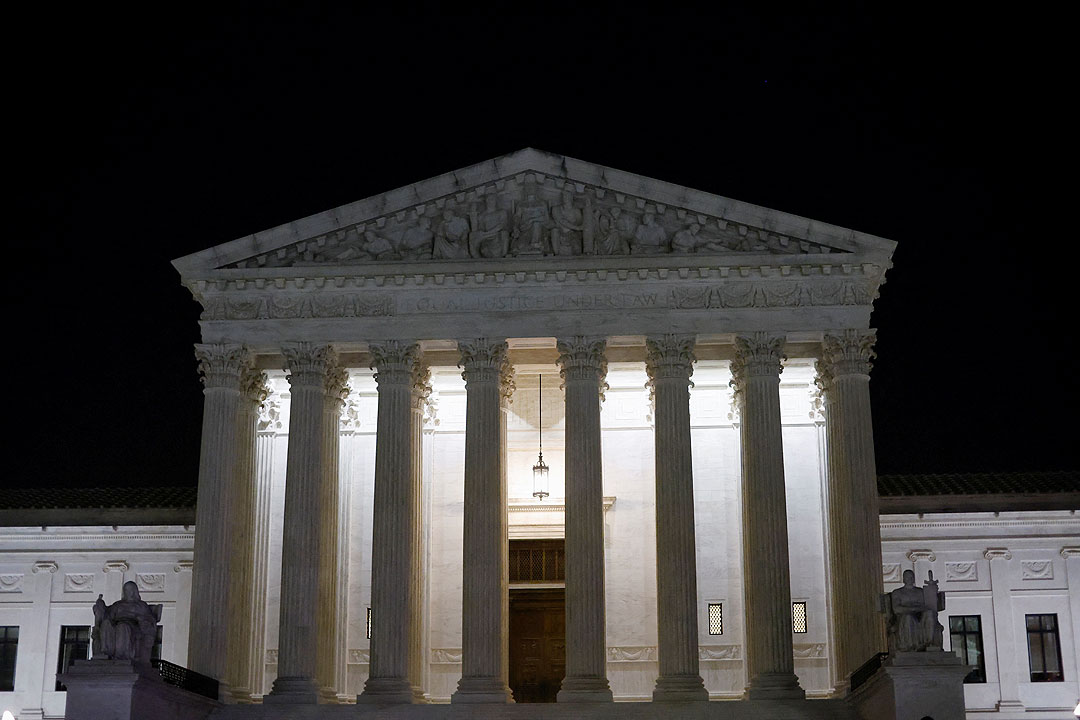
THE US Supreme Court is seen as protestors react outside to the leak of a draft majority opinion written by Justice Samuel Alito preparing for a majority of the court to overturn the landmark Roe v. Wade abortion rights decision later this year, in Washington, US, May 2, 2022. — REUTERS

WASHINGTON — Anti-abortion activists and pro-abortion supporters took to the streets of Washington on Tuesday after news that the US Supreme Court may overturn the 1973 Roe v. Wade ruling which legalized abortion nationwide.

A leaked initial draft majority opinion suggests the court has voted to overturn Roe v. Wade, Politico reported on Monday.

Reuters was not immediately able to confirm the authenticity of the draft opinion. The Supreme Court and the White House declined to comment.

Within hours of the news, anti-abortion activists chanting “hey, hey, ho, ho, Roe v. Wade has got to go” and abortion rights supporters shouting “abortion is healthcare” were facing off outside the court.

Abortion is one of the most divisive issues in US politics and has been for nearly a half century.

A 2021 poll by the Pew Research Center found that 59% of US adults believed it should be legal in all or most cases, while 39% thought it should be illegal in most or all cases.

“Roe was egregiously wrong from the start,” conservative Justice Samuel Alito wrote in the draft opinion which is dated Feb. 10, according to Politico, which posted a copy online.

Based on Mr. Alito’s opinion, the court would find that the Roe v. Wade decision that allowed abortions performed before a fetus would be viable outside the womb -— between 24 and 28 weeks of pregnancy — was wrongly decided because the US Constitution makes no specific mention of abortion rights.

“Abortion presents a profound moral question. The Constitution does not prohibit the citizens of each state from regulating or prohibiting abortion,” Mr. Alito said, according to the leaked document.

The unprecedented leak sent shock waves through the United States, not least because the court prides itself on keeping its internal deliberations secret and leaks are extremely uncommon.

The news stunned abortion providers.

On Monday night, Andrea Gallegos, executive administrator at Tulsa Women’s Clinic in Oklahoma, had just finished calling some 25 patients scheduled for abortions on Tuesday to tell them that their appointments would need to be canceled because of a soon to be enacted Oklahoma law modeled on a highly restrictive Texas abortion ban.

“I can’t say that I’m surprised,” she said.

“Now all these other conservative states like Oklahoma are passing the exact same legislation that Texas did, I have to say I became less optimistic and way more scared for what the future of Roe looks like.”

CONSERVATIVE MAJORITY
The ruling would be the court’s most sweeping since former President Donald Trump succeeded in naming three justices to the court, cementing a 6-3 conservative majority.

“The Republican-appointed Justices’ reported votes to overturn Roe v. Wade would go down as an abomination, one of the worst and most damaging decisions in modern history,” said US House of Representatives speaker Nancy Pelosi and Senate majority leader Chuck Schumer, both Democrats.

The news broke a little more than six months before the midterm elections that will determine if Democrats hold their razor-thin majorities in the US Congress for the next two years of President Joseph R. Biden’s term in office.

The decision appeared based on an oral argument in December on Mississippi’s bid to revive its ban on abortion starting at 15 weeks of pregnancy, a law blocked by lower courts.

The report said a court majority was inclined to uphold Mississippi’s abortion ban and that there could be five votes to overturn Roe. An official ruling is expected sometime before the end of June.

Four of the other Republican-appointed justices — Clarence Thomas, Neil Gorsuch, Brett Kavanaugh and Amy Coney Barrett — voted with Mr. Alito in the conference held among the justices, the report added.

After an initial vote among the justices following an oral argument, one is assigned the majority opinion and writes a draft. It is then circulated among the justices.

At times, in between the initial vote and the ruling being released, the vote alignment can change. A ruling is only final when it is published by the court.

The Roe v. Wade decision recognized that the right to personal privacy under the US Constitution protects a woman’s ability to terminate her pregnancy.

Christian conservatives and many Republican officeholders have long sought to overturn it.

If Roe is overturned, abortion is likely to remain legal in liberal states. More than a dozen states currently have laws protecting abortion rights. Numerous Republican-led states have passed various abortion restrictions in defiance of the Roe precedent in recent years.

Republicans could try to enact a nationwide abortion ban, while Democrats could also seek to protect abortion rights at the national level.

Democrats said the draft opinion undermines the importance of this year’s elections, in which they are seeking to maintain control of the House and Senate. Republican lawmakers criticized the leak, suggesting it was an attempt to inappropriately pressure the court into changing course. — Reuters

Hong Kong to further ease coronavirus restrictions, bars to open until 2 a.m.

REUTERS

HONG KONG — Hong Kong will further ease COVID-19 restrictions, allowing bars to open until 2 a.m. and raising the number of diners permitted at a table to eight from four, as cases in the global financial hub continue to ease, leader Carrie Lam said on Tuesday.

Beaches and swimming pools would reopen from Thursday, when restaurants could also cater to four more people at each table, Ms. Lam said at a regular news briefing.

The extended hours for bars, as well as the reopening of karaoke rooms and some other venues, would take effect from May 19.

Hong Kong health authorities reported 283 cases of COVID-19 on Monday, the first time the daily tally has dropped below 300 in nearly three months. The city has recorded more than 1.2 million infections and over 9,300 deaths since the start of the pandemic.

“The COVID number has dropped to three digits in mid-April and didn’t rebound, despite foot traffic increasing during two holidays,” Ms. Lam said, adding that it was not right to prevent people from swimming when the weather was so good.

She said she hoped people could enjoy Mother’s Day on Sunday as more family members could dine together.

Coronavirus restrictions have battered business in Hong Kong and helped fuel a net outflow of around 70,000 people in February and March, up from nearly 17,000 in December.

For some, the easing of restrictions may be too late as many businesses in the food and beverage industry have had to lay off staff as they struggle to pay rent in one of the world’s most expensive property markets.

Life in the Chinese-ruled city is gradually returning to normal, with schools resuming face-to-face classes and many people back working from offices. — Reuters