Home Blog Page 5962

Clarity on tax audits sought after BIR-Megaworld issue

By Luisa Maria Jacinta C. Jocson, Reporter

LAWMAKERS are seeking clarity on handling tax disputes and audits after the confusion created by the closure order issued last week by the Bureau of Internal Revenue (BIR) on Megaworld Corp.

On May 17, the BIR released an advisory regarding the issuance of a closure order against the listed property developer. But on the same day, the agency announced that the closure order would be on hold until further notice.

In a hearing led by the House Ways and Means Committee on Monday, BIR Regional Director Eduardo L. Pagulayan, Jr. said that the bureau received reports from condominium owners on discrepancies with their taxes.

“There have been reports that condominium owners who already deposited their payments with real estate developers but [said] that they did not see their taxes being remitted,” Mr. Pagulayan said.

He also said some buyers reported that in their final deed of sale, a different name is on the property documents, and not the name of original buyer.

Mr. Pagulayan said that the BIR saw the issue of potential tax leakages, so it was authorized to conduct an investigation.

In October, a special audit tax force was formed to investigate real estate developers’ tax issues. BIR Deputy Commissioner Arnel SD. Guballa said that the task force’s investigation involved other real estate developers, and not just Megaworld.

“In the case of Megaworld, they refused to receive the LoA (letter of authority). Mr. Pagulayan resorted to exert pressure because he saw there was a joint venture with the Bases Conversion and Development Authority (BCDA), which was not registered with the BIR,” Mr. Guballa said.

“He used this as a weapon or tool to add pressure to audit Megaworld,” he added.

However, as the BIR was about to serve the closure order, Mr. Guballa said that “for some unknown reason, it got leaked to the media.”

“Megaworld then said they would cooperate, so the [BIR] set aside the closure order to begin the verification of the audit,” he added.

In the same hearing, Megaworld top officials Kevin Andrew L. Tan and Andrew L. Tan said in their opening statement that they were in “complete surprise, disbelief, and dismay over the actions done last week.”

“It’s our desire to resolve this a soon as possible. Our company has always been a compliant company. We have also been committed to sound corporate governance,” Kevin said.

“We were surprised by the media advisory,” he said, citing continuing correspondence with the BIR. “We do not believe this order was warranted, as no audit was done prior to that.”

He said that as news of the supposed closure order came out, there was a selldown of more than P400-million worth of Megaworld shares.

Andrew said that when the LoA was issued, the company wrote back to the regional office.

“We wrote a letter to the commissioner and before it was even resolved, here comes the action. We [were] waiting for the commissioner to resolve this issue because we believe this is unnecessary,” he added.

Regarding the joint venture, he said that Megaworld had only managed property for BCDA, a government-owned and controlled corporation.

“Megaworld managed the property for [them]. If the [BIR] is questioning the land transfer, who is the taxpayer? It’s not Megaworld, it’s the BCDA. If there are tax issues, they should approach BCDA,” he said.

He also said that reports of name changes in the final deeds were “petty issues.”

“That is really a non-issue. The question is, can we tax them again because of the change of name? The answer is no, because the time the name was changed, the property was not even there. There is no turnover, no occupancy. There is no property ownership to speak of,” he said.

House Ways and Means Chairperson Jose Clemente S. Salceda said that the government would seek clarity on due process on tax disputes to avoid issues related to the Megaworld and BIR case.

“As I said before, this was not an investigation for its own sake but for the benefit of the taxpaying public, and in aid of legislation. So, while we sought facts on the matter, the aim was really to know how policy can be changed to avoid similar incidents,” Mr. Salceda said.

“I am thus pleased to report to the public that we now have a way forward, which the committee will recommend to the tax agencies,” he added.

Mr. Salceda said that the main recommendations were a need for a promulgated common procedure on taxpayer dispute, codifying the rights and responsibilities, as well as timelines and procedures, for resolving taxpayer disputes on jurisdiction, coverage, applicability and other matters.

“Second, we recommend simplifying and finalizing the rules on whether joint ventures should be registered as separate entities for tax purposes. The situation seemed to arise primarily out of a confusion as to whether Megaworld or the BCDA should settle the taxes on their joint venture. The best solution is to just require joint ventures to be registered as separate taxpayers,” he said.

Last week, Finance Secretary Carlos G. Dominguez III had also ordered the BIR to halt the creation of special audit task forces despite being authorized by the BIR commissioner.

Mr. Salceda said that taxpaying entities need to know what can get them closed, what to expect during an audit proceeding, and what dispute mechanisms are available.

“The BIR did follow a process, to be fair to them. On the other hand, Megaworld deserved an answer on jurisdiction from the BIR commissioner because the clarification would have had implications on other companies as well. And of course, as I said earlier, the press conference organized on the closure was very bizarre,” he said.

“Conflict comes out of violated expectations. Both parties had expectations that the other party violated. So, let’s just clarify what the expectations are so we can avoid conflict between tax agency and taxpayer,” he added.


UnionBank looking to raise at least P1 billion from digital bond offering

BW FILE PHOTO
UNIONBANK of the Philippines, Inc. wants to raise at least P1 billion from its offering of digital peso bonds. — BW FILE PHOTO

UNIONBANK of the Philippines, Inc. (UnionBank) on Monday started offering digital peso bonds, the first of its kind in the country, to raise at least P1 billion in fresh funds.

“The offering is the first digital bond issuance in the Philippines, a result of UnionBank’s partnership with the Philippine Depository & Trust Corp. (PDTC) to be a pilot user of PDTC’s Proof of Concept Digital Registry & Digital Depository that utilize the distributed ledger/blockchain technology for registry and depository operations,” the lender said in a disclosure to the stock exchange on Monday.

The digital bonds have a 1.5-year tenor and carry a fixed interest rate of 3% per annum.

The offer will be issued out of UnionBank’s P39-billion bond program.

The bonds will be offered from May 23 to May 27, unless adjusted by the bank. They will be issued and listed on the Philippine Dealing and Exchange Corp. on June 2 for trading in the fixed-income market.

The joint lead arrangers and bookrunners for the transaction are The Hongkong and Shanghai Banking Corp. Ltd. and Standard Chartered Bank. They will also be selling agents along with UnionBank.

Blockchain uses fully digital and decentralized ledgers to record transactions. This distributed ledger also serves as the platform where virtual currencies are transacted.

The storage units used in blockchain are continuously updated and secured using cryptography, making data management and other data-driven processes decentralized, tamper-proof and more transparent.

Use cases in the financial industry that involve blockchain technology include fraud reduction, Know-Your-Customer processes, trading platforms, and even payments.

In 2019, UnionBank launched a cross-border remittance service for rural banks using blockchain technology. The lender also said in 2018 that it is using blockchain for some of its internal processes.

UnionBank recorded a lower net profit in the first three months of the year as trading gains normalized. Its net income dropped by 45% to P2.6 billion in the first quarter from P4.72 billion in the same period of 2021.

Shares in the Aboitiz-led bank declined by P1 or 1.23% to close at P80 apiece on Monday. — K.B. Ta-asan

Entertainment News (05/24/22)

Big Dome hosts Begin Again: KPOP Edition

The Big Dome — a.k.a. the Smart Araneta Coliseum — is opening its doors once again to foreign acts as it hosts the country’s first live international show in two years, Begin Again: KPOP Edition. The concert will be on May 29, 5 p.m., and feature South Korean artists NCT Dream, and SHINee’s Key, WEi and ALICE in a night that starts the return of live K-pop entertainment in the Philippines. Headlining the show is the group NCT Dream, who has just released their latest album, Glitch Mode, and sold 2 million copies. The concert marks the group’s return to Manila after their February 2020 concert at the New Frontier Theater — they were the last K-pop act to hold a show in the country before the pandemic. Also joining the concert are Key (the lead dancer and rapper of K-pop band SHINee), the six-member boy group WEi (which recently released their fourth mini-album, Love Pt.1: First Love), and the seven-member act ALICE (which was named best rookie group at the 2018 Korean Entertainment Arts Awards). Tickets to the concert are available online at https://ticketnet.com.ph and at all Ticketnet outlets nationwide.

GMA’s Legal Wives streams on Netflix

GMA NETWORK’s top-rating drama series Legal Wives is now on Netflix Philippines. The series, which aired in July last year, joins the growing list of GMA shows and movies on the streaming platform including Descendants of the Sun, I Can See You, Love of my Life, Owe My Love, Heartful Café, and Family History. Legal Wives stars Dennis Trillo as Ismael, an honorable Muslim man who will equally love three women out of obligation, dedication, and compassion; Alice Dixson who stars as the virtuous and pious daughter of a sultan and Ismael’s first wife; Andrea Torres as Ismael’s second wife who is a feisty modern Catholic woman; and Bianca Umali as a smart lady who becomes Ismael’s third wife in hopes of saving her family’s reputation.

Hwang In Youp coming to QC in June

KOREAN DRAMA star Hwang In Youp will be meeting his Filipino fans on June 19 at the New Frontier Theater in Quezon City. A model, Hwang In Youp made his acting debut in the web drama, W.H.Y., followed by several television dramas including Freshman (2019), The Tale of Nokdu (2019), and 18 Again (2020). He gained further recognition in True Beauty (2020), which is based on the Line Webtoon of the same title. The hallyu star’s latest Netflix series is The Sound of Magic (2022). His next project, Why Her? (2022), is set to premiere in June. Last September, BYS Philippines signed Hwang In Youp as its endorser and he headlined the #UncoverTrueBeauty campaign that coincided with the launch of the Skin by BYS Minis. To attend Hwang In Youp’s BYS Fun Meet in Manila, purchase BYS products via TicketNet.com.ph. The products are to be claimed at the venue on June 19.

Globe, Google, CANVAS launch exhibit on online safety for kids

GLOBE, together with Google and the Center for Art, New Ventures, and Sustainable Development (CANVAS), has launched an exhibit for children about online safety and data privacy as part of its #AtinAngSecurity month-long celebration in support of the National Privacy Commission’s (NPC) Privacy Awareness Week. The exhibit is based on the NPC-awarded book, Safe Space: A Kid’s Guide to Data Privacy. The activity book teaches children aged six to 12 about personal data and how to protect it. Using child-friendly language, Safe Space shows how social media, online gaming, and other platforms collect and use personal data. A digital copy of the book is available for free at the Globe eLibrary. The experiential event, which runs until May 27 at The Globe Tower (32nd St, Taguig), allows the audience to develop their appreciation for privacy and security in a creative environment.

BPO-friendly office towers may see surge in take-up

ORTIGAS Technopoint Two is located along Julia Vargas Avenue in Ortigas Center. — COMPANY HANDOUT

THE Philippine office market is expected to grow faster with 358,000 square meters (sq.m.) of ongoing transactions likely to be concluded in the next six months, Leechiu Property Consultants (LPC) said.

“Live requirements for office space are the highest they have ever been in any quarter since COVID-19 (coronavirus disease 2019) took its toll and IT-BPM (information technology-business process management) friendly spaces are likely to be among the first to benefit from this resurgence,”  Mikko Barranda, LPC director for commercial leasing, said in a statement.

LPC noted that of the 358,000 sq.m. of live requirements, more than half or 195,000 sq.m. are from IT-BPM firms.

There is strong demand for buildings accredited by the Philippine Economic Zone Authority located in strategic locations.

For instance, Ortigas Technopoint Two along Julia Vargas Avenue in Ortigas Center has seen a high number of inquiries for its few available spaces.

Mr. Barranda said the building’s floor plates that are typically 4,000 sq.m. would mean greater floor efficiencies for locators. “This allows a 1:5 density ratio or one person for every five square meters of space and has been key in attracting established IT-BPMs to locate there,” he added.

Miguel Manipol, LPC director for commercial leasing, said IT-BPM firms are driven to keep their costs low, but also provide a conducive work environment for their employees.

“Workplaces like Ortigas Technopoint Two, which is highly accessible via public transportation from the residential communities of Quezon City, Pasig City and Mandaluyong City, are thus preferred locations,” he said.

The building is accessible to a six-storey parking facility, and offers branding rights and ground floor space for recruitment purposes to tenants who will take up spaces in the second and third floors.

Ortigas Technopoint Two is also located close to malls and other recreational establishments.

“Especially now that the industry employs 1.8 million nationwide, IT-BPMs seek work environments that are part of mixed-use communities to retain their employees,” Mr. Barranda said.

UAAP men’s volleyball kicks off on Thursday; other events follow next month

THE UAAP

WITH the men’s basketball and cheerdance competition already on the board, the University Athletic Association of the Philippines (UAAP) turns its focus to other events starting this week for the nearing culmination of its compressed Season 84 amid the pandemic.

The men’s volleyball action fires off this weekend and on June 3-5 at the Sands SM By The Bay, rolling side-by-side with the ongoing women’s volleyball tournament entering its second round also this week.

In between those events is poomsae at the Mall of Asia Arena on May 31 followed by the men’s and women’s 3×3 basketball on June 1 and 2 in Calatagan, Batangas.

Right after that, men’s and women’s chess in a still to be determined venue will run from June 1 to 15.

But first thing’s first as the UAAP volleyball returns to action this Thursday featuring another loaded four-game bill after a week-long break to give way for the cheerdance competition.

Unbeaten National University (NU) (7-0) eyes to assert mastery of No. 3 La Salle (5-2) in the main game at 6:30 p.m. after the clashes of Adamson-Santo Tomas, University of the East-University of the Philippines (UP) and Ateneo-Far Eastern University (FEU).

FEU Cheering Squad over the weekend just ruled the first UAAP cheerdance tilt in three years, ending its own drought of 13 years behind a Queen-inspired routine. Adamson and reigning champion NU completed the podium.

In men’s basketball last week, UP snapped a longer dry spell by dethroning Ateneo in an epic three-game series to win its first UAAP title since 1986.

The UAAP settled for a limited calendar for the first time this season due to pandemic restrictions after cutting short the remainder of Season 82 in 2020 and scrapping the entire Season 83 last year. — John Bryan Ulanday

How PSEi member stocks performed — May 23, 2022

Here’s a quick glance at how PSEi stocks fared on Monday, May 23, 2022.


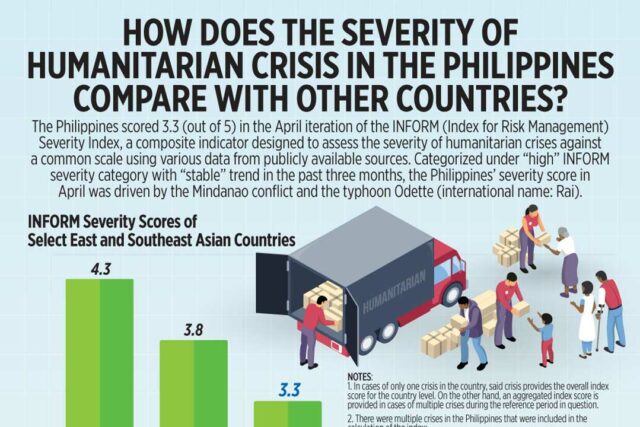
How does the severity of humanitarian crisis in the Philippines compare with other countries?

The Philippines scored 3.3 (out of 5) in the April iteration of the INFORM (Index for Risk Management) Severity Index, a composite indicator designed to assess the severity of humanitarian crises againsta common scale using various data from publicly available sources. Categorized under “high” INFORM severity category with “stable” trend in the past three months, the Philippines’ severity score in April was driven by the Mindanao conflict and the typhoon Odette (international name: Rai).

How does the severity of humanitarian crisis in the Philippines compare with other countries?

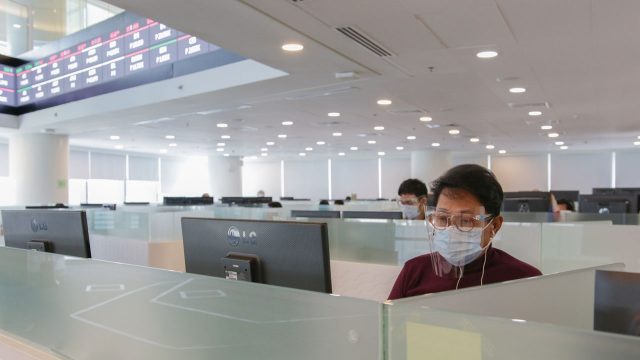
Shares drop on fears of surge in COVID-19 cases

SHARES declined on Monday amid fears of another surge in coronavirus disease 2019 (COVID-19) cases in the country and ahead of key economic data releases this week.

The benchmark Philippine Stock Exchange index (PSEi) went down by 58.48 points or 0.86% to close at 6,687.85 on Monday, while the broader all shares index slid by 22.03 points or 0.61% to 3,591.21.

“Philippine shares opened the week on a sour note as investors cashed in from the previous week’s rally. The market took note of the rising COVID-19 cases in some areas in Metro Manila… This could hurt the recovery of the economy already reeling from the impact of higher inflation,” Papa Securities Corp. Equities Strategist Manny P. Cruz said in a Viber message.

The Health department reported 191 new COVID-19 cases in the country for the past week on Sunday, with 55 of these new infections recorded in Metro Manila. Active cases stood at 2,252.

An expert from OCTA Research Group earlier forecasted that the country might experience another surge in coronavirus infections by May or June.

Health authorities last week confirmed the local transmission of a more contagious Omicron subvariant that has become dominant in the United States.

BA.2.12.1 can evade immune protections and is highly transmissible, according to health experts. The Philippines has detected 17 cases of the subvariant, 16 of which were locally acquired while one was a returning Filipino who lives in central Philippines.

Meanwhile, Regina Capital Development Corp. Head of Sales Luis A. Limlingan said investors were cautious ahead of economic data releases this week, such as the US’ durable goods and core personal consumption expenditure (PCE) inflation reports as well as the minutes of the US Federal Reserve’s May meeting.

US durable goods data and the minutes of the Fed’s latest meeting are due for release on Wednesday, while the US PCE inflation report is set to be released on Friday.

The majority of sectoral indices ended in the red on Monday except for mining and oil, which rose by 72.45 points or 0.62% to 11,759.15.

On the other hand, financials declined by 29.39 points or 1.81% to 1,594; industrials gave up by 93.31 points or 0.98% to end at 9,357.86; services dropped by 13.33 points or 0.70% to 1,882.39; holding firms fell by 26.50 points or 0.42% to 6,163.82; and property went down by 12.92 points or 0.42% to 3,056.07.

Decliners outnumbered advancers, 113 versus 72, while 58 names ended unchanged.

Value turnover decreased to P6.64 billion on Monday with 1.22 million shares changing hands from the P7.16 billion with 2.92 billion issues seen on Friday.

Net foreign selling was at P305.97 million on Monday, a reversal of the P357.55 million in net buying seen the previous trading day. — L.M.J.C. Jocson

Peso down on oil prices, hawkish Fed

BW FILE PHOTO
THE PESO declined against the dollar on Monday due to higher oil prices and hawkish signals from a US Federal Reserve official. — BW FILE PHOTO

THE PESO weakened versus the greenback on Monday after an increase in global oil prices and hawkish signals from a US Federal Reserve official.

The local unit closed at P52.27 per dollar on Monday, down by four centavos from its P52.23 finish on Friday, Bankers Association of the Philippines data showed.

The peso opened Monday’s session at P52.22 against the dollar. Its weakest showing was at P52.37, while its intraday best was at P52.15 versus the greenback.

Dollars exchanged decreased to $1.19 billion on Monday from $1.29 billion on Friday.

The peso weakened as global oil prices continued to rise, Rizal Commercial Banking Corp. Chief Economist Michael L. Ricafort said in a Viber message.

Oil prices gained on Monday with a high fuel demand and tight supply amid US peak driving season traditionally beginning at the end of May and ends in September, Reuters reported.

Brent crude futures rose 97 cents to $113.52 a barrel at 0651 GMT, while US West Texas Intermediate (WTI) crude futures climbed 80 cents or 0.73% to $111.08 a barrel, adding to last week’s small gains for both contracts.

Mr. Ricafort said hawkish statements from Federal Reserve Bank of St. Louis President James Bullard also supported the dollar, causing the peso to depreciate.

Mr. Bullard last week said the US central bank should front-load rate hikes at as high as 50 or 75 basis points to quell rising inflation and bring the funds rate to 3.5% by yearend.

Mr. Ricafort said the weaker peso also reflects market uncertainties following the detection of an Omicron subvariant in the country.

Health authorities last week confirmed the local transmission of a more contagious Omicron subvariant that has become dominant in the United States.

BA.2.12.1 can evade immune protections and is highly transmissible, according to health experts. The Philippines has detected 17 cases of the subvariant, 16 of which were locally acquired while one was a returning Filipino who lives in central Philippines.

The Health department also detected a case of Omicron subvariant BA.4 in a Filipino citizen who arrived in the country from the Middle East on May 4.

For Tuesday, Mr. Ricafort gave a forecast range of P52.15 to P52.35 per dollar. — K.B. Ta-asan with Reuters

Senate ratifies bicam report on agri-agra amendments

PHILSTAR

THE SENATE on Monday ratified the consolidated version of a bill amending Republic Act 10000 or the Agri-Agra Reform Credit Act of 2009, which recognized more activities for bank financing that allow institutions to meet the agricultural lending quota.

The bicameral report reconciles Senate Bill 2494 and House Bill 6134. The bill, certified as urgent by President Rodrigo R. Duterte, is known as “An Act Strengthening the Financing System, including Capacity-Building and Organization, for Agriculture, Fisheries, and Rural Development in the Philippines.”

“I am pleased to report on the successful outcome of the bicameral conference,” said Senator Cynthia A. Villar, who chairs the Senate Agriculture, Food and Agrarian Reform committee and was the primary sponsor of the bill, in plenary session.

“The conference committee decided to use the Senate version as the working draft of the discussion,” she added.

According to the report accompanying the consolidated bill, a new paragraph was added to the declaration of policy highlighting the importance of designing and implementing capacity-building programs to develop competencies of farmers, fisherfolk, and agrarian reform beneficiaries.

The objective of the capacity-building program is to get agricultural workers to operate productive, profitable and viable ventures while enhancing their ability to pay when they tap formal financing channels.

Under the proposed law, administrative sanctions and other penalties will be computed at one-half percent or at rates prescribed by the BSP Monetary Board. A revision was made to the penalty clause, where instead of 10%, 5% of penalties collected will be retained by the Bangko Sentral ng Pilipinas (BSP) to cover administrative expenses.

“Twenty percent shall be allocated as a fund for agricultural- and fishery-related organizational-, capacity-, and institution-building programs and activities to be implemented equally by the LBP (Land Bank of the Philippines) and DBP (Development Bank of the Philippines),” Ms. Villar said.

According to the bill, a portion of the Special Fund managed by the LBP and DBP will be used to fund capacity-building programs developing the knowledge, skills and income of agricultural stakeholders.

If signed into law, all banking institutions, except newly established banks, must set aside at least 25% of their total loanable funds for agricultural and fisheries-related sectors after they have been operating for five years.

Banks will be expected to design and offer financial products and services that suit the specific requirements of agricultural clients appropriate to their cash flows and production cycles. 

The bill also includes special lending arrangements for agribusiness enterprises with qualified agricultural borrowers and agricultural value chain financing, which cover production, distribution, manufacturing, and processing of agricultural products.

Banks can comply with the credit quota by lending to rural community beneficiaries to finance agricultural and fishery-related activities, as well as by investing in securities where the proceeds are meant to finance these activities. 

Other modes of compliance include opening deposit accounts with or investing in fixed-term deposit products of rural financial institutions (RFI), investing directly in RFIs, lending for the construction and upgrade of agriculture infrastructure, extending credit to agri-businesses that have commodity supply-chain arrangements with rural community beneficiaries, as well as engaging in sustainable finance.  

The BSP may also identify other activities that will qualify as part of the quota and is authorized to monitor and provide reports on the banks’ compliance with the measure.

The House has also ratified the bicameral report and the measure will be sent to the Palace for signing by President Rodrigo R. Duterte. — Alyssa Nicole O. Tan

Senate passes Bulacan Airport ecozone authority bill on second reading

SAN MIGUEL CORP.

THE SENATE on second reading on Monday passed the bill establishing the Bulacan Airport City Special Economic Zone and Freeport Authority (BACSEZFA).

Committee Report 438 which amends House Bill 7575 was passed with revisions made by Senator Maria Imelda Josefa R. Marcos, the bill’s primary sponsor.

BACSEZFA will be responsible for establishing, building, operating, and maintaining public utilities and other services and infrastructure in the Bulacan Ecozone.

The Bulacan Ecozone will be managed and operated as a separate customs territory to ensure the free flow or movement of goods and capital within, into and out of its territory. The chamber gave it the power to offer incentives such as tax and duty-free importation of raw materials and capital equipment to registered enterprises under the terms laid out by Republic Act (RA) 11534, otherwise known as the Corporate Recovery and Tax Incentives for Enterprises Act.

A provision allowing BACSEZFA to operate tourism-related activities, either directly or through license to others, was deleted.

“We are deleting it outright because of certain objections regarding the possibility of setting up gambling outfits as well as the objection also to unregulated power production,” Ms. Marcos said during the session.

An update was also inserted to define the regulatory framework for registered enterprises within the Bulacan Ecozone as the National Internal Revenue Code of 1997 as amended, instead of the Omnibus Investments Code of 1987.

The revision effectively puts Bulacan Ecozone within the purview of the CREATE law, instead of RA 10708 or the Tax Incentives Management and Transparency Act, in matters of administration, implementation and monitoring of incentives.

The corporate life of the authority was 50 years from the effectivity of the law.

BACSEZFA is required by the bill to spell out its development goals for the airport and allied businesses.

The authority will have an authorized capital stock of P2 billion, with the government holding at least 60%.

Any foreign national investing at least $200,000 in either cash or equipment will be entitled to an investor’s visa. A registered entity or enterprise within the Bulacan Ecozone will be allowed to remit earnings from the foreign investment in the currency in which the investment was made.

If the bill becomes law, the Department of Trade and Industry, Department of Finance, and National Economic and Development Authority were tasked with drafting the implementing rules and regulations of this act. — Alyssa Nicole O. Tan

Philippine creative industry council bill hurdles Senate

TOPDRAWANIMATION.COM

THE SENATE on Monday passed on third and final reading a bill establishing the Philippine Creative Industry Development Council, which is tasked with promoting the development of creative content and protecting creators from intellectual property infringement.

Senate Bill 2455 or the Creative Industries Charter of the Philippines was passed unanimously with 21 affirmative votes, no negative votes and no abstentions. The council is tasked with managing the industry’s long-term development.

The council, which will be attached to the Department of Trade and Industry, will have 18 members, nine from the private sector and nine from various government agencies. The members will draft and implement a Philippine Creative Industries Development Plan which must be submitted to the President within a year after the effectivity of the act and reviewed every three years.

They must also harmonize plans and programs with National Government agencies that operate in the culture and arts spheres, while constantly consulting with accredited business support organizations and creative associations.

The bill, if signed, will provide infrastructure, research and development, and innovation support to the creative industry.

Micro, small and medium enterprises (MSMEs) and other stakeholders will also be granted access to digital services and digital training platforms, along with technical and financial assistance.

Government-owned, -controlled, or -supported financial institutions will be required to prioritize creative industries in the provision of credit assistance and guarantee schemes. A creative voucher system will be established to systematize the granting of support, aid, and other incentives to such entities.

Upon signing into law, the measure will require government agencies to devise a creative educational plan geared towards the development of the country’s creative-industry human resources.

A one-stop registration center will be set up to assist creative industry MSMEs and entrepreneurs avail of applicable government services including intellectual property registration, product and business registration, loans, grants and benefits programs.

A special account called the creative industry development fund will be made and administered by the council for research and development, trade promotion, and human resource development. It will source funds from loans, contributions, grants, bequests, gifts, and donations, whether from local or foreign sources.

Creative industries covered by the bill include audio and audiovisual media; digital interactive media; creative services; design; publishing and printed media; performing arts; visual arts; traditional cultural expressions; and cultural sites.

The House of Representatives passed its bill on final reading in September last year. The bill will now be sent to the appropriate bicameral committee for consolidation.

Separately, the Senate also passed a bill regulating private security agencies (PSA) on third and final reading.

With 21 affirmative votes, Senate Bill 2423 was passed unanimously. If signed into law, the measure repeals Republic Act 5487 and establish a new set of quality standards for PSAs.

“The urgency of this bill is not to be found on the surface,” said Senator Ronald M. dela Rosa, primary sponsor of the bill, during the plenary session. “Instead, its urgency lies in the almost unseen, seldom appreciated actions of its stakeholders — our security officers, our security guards, all of our security professionals.”

“By saying yes to this measure, we are giving the industry the legislative support which has been lacking all this time, when it was relying on a law that was 52 years old,” he added.

The bill set a cap of 2,000 for a PSA’s security personnel, and recognizes Filipinos or juridical entities as eligible to organize a PSA. Licenses to operate and manage a PSA and a Private Security Training Agency are to be issued by the head of the Philippine National Police and are valid for five years.

The bill also sets a minimum administrative fee charged by PSAs of at least 20% of the total contract cost, with additional fees to be charged for the acquisition and maintenance of equipment needed for security operations and the deployment of professionals in hazardous conditions.

Each professional will only be allowed one firearm and will be licensed for five years.

Penalties for violators have been set at a maximum of six years’ imprisonment or a fine of up to P1 million, or both. Licenses are also subject to cancellation or suspension, with the forfeiture of the bond posted by the license applicant.

The House of Representatives passed the bill on third reading in March last year. The bill will now go before the bicameral conference committee. — Alyssa Nicole O. Tan