Home Blog Page 5907

Physical distancing in schools may be relaxed in August

PHILIPPINE STAR/ MICHAEL VARCAS

THE GOVERNMENT might ease physical distancing rules in schools holding limited face-to-face classes this school year in areas under the lowest coronavirus alert level, according to Philippine health authorities.

This would allow educational institutions to admit more students attending schools physically, Education Undersecretary Nepomuceno Malaluan told a televised news briefing on Monday.

“There’s a limitation now on the number of students that we can accommodate in a classroom so they can observe the physical distancing requirement,” he said in Filipino. “In the next school year, physical distancing can be relaxed if a school is in an area under Alert Level 1, according to the new protocol issued by the Department of Health (DoH).”

Mr. Malaluan said the Department of Education (DepEd) is crafting guidelines for learning in the next school year, including blended learning.

“The extent [of blended learning] will be contained in the guidelines — how many days will be face-to-face and how many will be allowed for remote learning,” he added.

Schools now know how to deal with a potential surge in coronavirus infections and a higher alert level that goes with it, Mr. Malaluan said.

Only schools under Alert Levels 1 and 2 may hold physical classes in basic education.

“It really works like our storm signal,” he said. “Our schools know the protocols for each of these alert levels.”

Schools will open on Aug. 22.

Meanwhile, incoming Vice-President Sara Duterte-Carpio said President-elect Ferdinand R. Marcos, Jr. had asked her to review the country’s K-12 educational system.

“He already gave instructions with regard to the review of the implementation of the K-12 program of the Department of Education,” she separately told a televised news briefing. K-12, enacted in 2012, cannot be decided overnight, she added.

Some civic groups pushing for the abolition of K-12 earlier said the “congested curriculum” was a failure.

Ms. Duterte-Carpio also expressed hope that policymakers would push the revival of a mandatory training program for Filipino students.

“The Executive and legislative agenda will be decided between the president and Congress so I hope that will be included since there are many pending bills in Congress with regard to that,” she said.

The program was abolished in 2002 after the death of a university student who exposed the anomalies in the training corps.

Investigations led by Congress showed that the program had enabled implementers to commit abuses in schools.

Raymond Basilio, secretary-general of the Alliance of Concerned Teachers, urged Ms. Duterte-Carpio to address the “problem of learning loss, learning poverty and the quality of and access to education” instead of reviving the mandatory military training for students. — Norman P. Aquino and Kyle Aristophere T. Atienza

Typhoon-prone households in 2 provinces to get pre-disaster aid under DSWD-UNICEF program

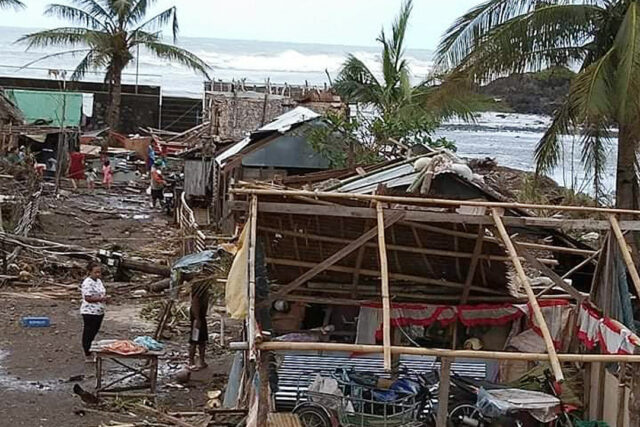
HOMES built with light materials at a coastal community in Catanduanes were destroyed during Typhoon Goni, known locally as super typhoon Rolly, which made its first landfall on the island province on Nov. 2, 2020. — LGU PANDAN-MAYOR’S OFFICE 

THE PHILIPPINE Social Welfare department and the United Nations Childrens Fund (UNICEF) have launched a program that will provide financial assistance to vulnerable households on the path of an incoming typhoon to help them prepare better for the disasters impact.    

Around 22,000 households have been identified as beneficiaries of the unconditional cash transfer, which will be distributed three days before a predicted landfall of a Category 4 typhoon, UNICEF said in a statement on Monday.  

Tropical cyclones under this category have winds of 118 to 184 kilometers per hour (km/h) within 12 hours.  

This is the first time that we will test the concept of anticipatory action through a shock responsive social protection model,UNICEF Philippines Deputy Representative Behzad Noubary said in a statement.  

The support for typhoon-vulnerable areas was finalized after the Department of Social Welfare and Development (DSWD) and UNICEF sealed the agreement on June 14 under the United Nations Central Emergency Response Fund for Anticipatory Action for predictable hazards.  

Through this intervention, the most at-risk communities will have better financial resources to bounce back after a typhoon,Mr. Noubary said.   

Traditional disaster response, when complemented with anticipatory actions, can significantly reduce the impact of disasters and allow for a faster recovery.”  

Every family will receive P1,000, which was calculated based on a childs minimum expenditure needs for nutrition, education, water, sanitation, hygiene and protection services.  

The cash assistance will be provided through the LANDBANK of the Philippines, the governments depository bank.  

UNICEF will test the provision of the anticipatory multi-purpose cash transfers using existing national government social protection systems. It aims to contribute to DSWD policy development for improved humanitarian and disaster response.  

Beneficiaries are those listed under the DSWDs Pantawid Pamilyang Pilipino Program in Catanduanes, including the municipalities of Baras, Bato, San Andres and Virac; and Northern Samar, specifically the municipalities of Catarman, Catubig, Gamay, Mondragon, and San Roque.   

The provinces of Catanduanes and Northern Samar, both located on the eastern side of the country facing the Pacific Ocean, are often on the path of typhoons.   

The Philippines, situated within the typhoon belt, is struck by an average of 20 typhoons per year. Alyssa Nicole O. Tan 

De Lima undergoes major surgery 

OFFICE OF SEN. LEILA DE LIMA/RELEASE

SENATOR Leila M. De Lima arrived on Monday at the Manila Doctors Hospital for a major surgery after being granted a five-day medical furlough by a Muntinlupa Regional Trial Court.  

Ms. De Lima was advised by her personal doctor, Errol Rhett A. Santelices, to undergo the surgery “at the soonest possible time.” 

The doctor also suggested that at least 120 hours be given to observe the status of her health, noting the need to evaluate her heart condition since her hospital confinement in April due to suspected mild stroke.  

The outgoing senator has promised the court that she will not be staying in the hospital longer than what is called for or necessary.”   

Officers from the Philippine National Police Custodial Service Unit escorted Ms. De Lima to the hospital.   

Ms. De Lima, who has been jailed at the Philippine National Police Custodial Center since 2017, is on trial for allegedly allowing the illegal drug trade in the countrys jails when she was still Justice secretary.     

At least four key witnesses have retracted their allegations relating to her supposed crime. Alyssa Nicole O. Tan 

2 Abu Sayyaf members surrender in Basilan 

TWO Abu Sayyaf group members surrendered in Basilan on Sunday, according to the military. 

In a statement on Monday, the Western Mindanao Command (WestMinCom) said the two were under the Abu Sayyaf faction of the late Furuji Indama, who replaced Isnilon Hapilon, a long-time leader of the Islamic State-affiliated group who was killed during the Marawi siege in 2017.  

Indama, who took over command of the Basilan-based Abu Sayyaf members, was killed in an encounter with government forces in 2020.  

Since then, the kidnap-for-ransom and terrorist group has weakened, WestMinCom said. 

We continuously encourage those who are still hiding in the hinterlands of Basilan to come out,WestMinCom commander Alfredo V. Rosario, Jr. said in the statement.

The armed forces and the local government units will never cease to provide all necessary assistance during their reintegration into mainstream society. We will guide them during the process to ensure that they will not be lured to join any lawless group again, he said.

Earlier this month, 12 members of the Abu Sayyaf in Sulu, another island province southwest of the Philippines, also turned themselves. 

The militarys Sulu Task Force said it has recorded 823 Abu Sayyaf returnees since 2017. MSJ

Comelec starts returning ballot boxes used for random manual audit

PHILIPPINE STAR/EDD GUMBAN

THE COMMISSION on Elections (Comelec) on Monday started returning the ballot boxes used for the random manual audit to the respective districts of origin.  

In a video streamed live on the Comelec Facebook page, Helen Maureen V. Graido, a policy consultant for election watchdog Legal Network for Truthful Elections, said members of the media, citizens’ arm group representatives, and other stakeholders were invited to the kick-off ceremony for transparency.  

“While these ballot boxes were being taken care of during the random manual audit teams, it can be assured that these were carefully handled and taken note of in our inventory,” she said. 

The election body had partnered with civil society organizations and the Philippine Statistics Authority for the vote verification process.  

Ms. Graido noted that as of Monday, they had verified 746 out of 757 ballot boxes from randomly chosen clustered precincts.   

She added that some ballot boxes no longer need to be audited, while some had also been mislabeled. 

The random manual audit process, which started on May 10, verifies if vote-counting machines had tallied votes correctly. Comelec said the accuracy rate of the audited votes was 99.9%.  

Ms. Graido earlier said the process checks for over-voting or under-voting during the elections, since some people vote for more or less than the required number of positions. John Victor D. Ordoñez 

France’s Macron hunts for way to salvage majority, reforms

French President Emmanuel Macron delivers a speech at the Elysee Palace in Paris, France, February 1, 2022. — REUTERS

PARIS — President Emmanuel Macron on Monday was faced with trying to salvage a ruling majority and with it, his economic reform agenda after voters punished his centrist ‘Ensemble’ alliance in France’s parliamentary election.

While Ensemble secured the largest number of lawmakers in the 577-seat National Assembly, it fell comfortably short of the threshold required for an absolute majority in a vote that saw a leftwing alliance and the far-right perform strongly.

Final figures showed Mr. Macron’s centrist camp got 245 seats — short of the 289 needed for an absolute majority.

The vote was a painful setback for Mr. Macron, 44, who was re-elected in April and wants to deepen European Union integration, raise the retirement age and inject new life into France’s nuclear industry.

There is no set script in France for how things will unfold.

Mr. Macron’s options include forming a ruling coalition or presiding over a minority government that has to enter into negotiations with opponents on a bill-by-bill basis. The alternative, if no agreement can be found, is for the euro zone’s second biggest economy to be plunged into paralysis.

“We will be working from tomorrow towards forming a majority of action … to guarantee stability for our country and carry out the necessary reforms,” Prime Minister Elisabeth Borne said as results filtered through late on Sunday.

Mr. Macron became in April the first French president in two decades to win a second term, as voters rallied to keep the far-right out of power.

But, seen as out of touch by many voters, he presides over a deeply disenchanted and divided country where support for populist parties on the right and left has surged.

Marine Le Pen’s far-right National Rally party won its largest ever representation in the lower house while a resurgent left-wing bloc, Nupes, headed by the hard-left Jean-Luc Melenchon will form the largest opposition force.

“The rout of the presidential party is complete,” Mr. Melenchon told supporters.

Even so, his own unlikely alliance may now fsind holding together harder than winning votes.

After a first presidential mandate marked by a top-down government style that Mr. Macron himself compared to that of Jupiter, the almighty Roman god, the president will now have to learn the art of consensus-building.

“This culture of compromise is one we will have to adopt but we must do so around clear values, ideas and political projects for France,” Finance Minister Bruno Le Maire said. — Reuters

Colombia’s first leftist president targets inequality, leaves investors on edge

SUPPORTERS of Colombian left-wing presidential candidate Gustavo Petro of the Historic Pact coalition hold the national flag in Bogota, Colombia, May 22. — REUTERS

BOGOTA — The election of Colombia’s first leftist president, Gustavo Petro, is indicative of widespread yearning for a more equal and inclusive society, analysts and business leaders said, but the former guerrilla will need to act fast to reassure investors.

Mr. Petro, a 62-year-old former mayor of the capital Bogota and current senator, won some 50.4% of votes on Sunday, handily beating construction magnate Rodolfo Hernandez.

The election of a former guerrilla marks a radical change for a country still scarred by decades of conflict and highlights the depth of frustration with the right-leaning political establishment accused of overseeing a wide gap between rich and poor.

Mr. Petro has pledged to fight inequality with free university education, pension reforms and high taxes on unproductive land in the Andean country, where nearly half the population lives in poverty.

His proposals — especially a ban on new oil projects for environmental reasons — have startled some investors, though he has promised to respect current contracts. This campaign was Mr. Petro’s third presidential bid and his victory adds the Andean nation to a list of Latin American countries that have elected leftists in recent years.

Mr. Petro will take office at a time when Colombia is struggling with low credit ratings, a large trade deficit and national debt which is predicted to end the year at 56.5% of gross domestic product (GDP). Oil accounts for nearly half of exports and close to 10% of national income.

“Colombia was governed for so many years by the economic and political elite,” said Gimena Sanchez-Garzoli, Andes Director for the think tank Washington Office on Latin America. “In many ways this election is basically the voice of most of the population in the country, especially the rural poor, women, Afro-Colombians, the indigenous.”

“People didn’t want a change at any cost, they wanted a change that would actually be with actual proposals which include making the peace accord a priority,” said Sanchez-Garzoli referring to the 2016 peace deal with the Revolutionary Armed Forces of Colombia (FARC), which brought an end to that group’s role in the nearly 60-year-old internal conflict.

Mr. Petro has pledged to fully implement the FARC accord — which detractors accuse current President Ivan Duque of failing to adequately support — and to seek talks with the still-active ELN rebels.

“Petro’s election may have just saved the peace process,” said Oliver Kaplan, associate professor at the University of Denver’s Josef Korbel School of International Studies.

On Sunday night, as he celebrated his win, Mr. Petro told his supporters: “Peace is someone like me being able to be president.”

BUSINESS JITTERS
Mr. Petro regularly praises the mostly young protesters who have taken to the streets over the last three years to decry inequality and police violence, in demonstrations where more than 40 people were killed.

The president-elect, who was arrested by the military in 1985 while carrying weapons for the M-19 rebels, has said he was tortured during his 16-month detention. His victory has high-ranking armed forces officials bracing for change.

“There’s a segment of the population that is totally opposed to him because of his M-19 past,” Mr. Kaplan said. “Maintaining security and protection of civilians will depend on good civil-military relations, and it’s uncharted waters in that regard.”

But Mr. Petro’s proposals will face challenges, not least because of a deeply divided congress where a dozen parties hold seats.

“Petro is going to have a very strong opposition from day one, we’re going to have a congress that all of a sudden is disjointed from the executive branch,” said Colombia Risk Analysis founder Sergio Guzman.

“I think this means people’s priorities have moved beyond the conflict,” Mr. Guzman said. “This marks a really stark departure from where we’ve been as a country.”

Business leaders and the market were awaiting ministerial appointments, especially for key positions like finance minister, and have predicted volatility in the peso and in bonds when trading opens on Tuesday after a holiday weekend.

“It will be very important that total confidence between everyone is restored, that there is confidence for businesses, citizens, that there is confidence for investors, that there is confidence with the rule of law,” Bruce Mac Master, president of the Colombian Business Association (ANDI), said in a statement following Mr. Petro’s victory.

“In us he can expect a constructive partner,” he said.

Mr. Petro was emphatic that business and development had important roles to play under his government. He has pledged to strengthen agriculture, tourism and manufacturing.

“We are going to develop capitalism in Colombia,” told supporters on Sunday. Development is needed to overcome the “feudalism” and “pre-modernity” from which Colombia still suffers, he said. — Reuters

Ukraine to restrict Russian books, music

REUTERS

KYIV — Ukraine’s parliament on Sunday voted through two laws which will place severe restrictions on Russian books and music as Kyiv seeks to break many remaining cultural ties between the two countries following Moscow’s invasion.

One law will forbid the printing of books by Russian citizens, unless they renounce their Russian passport and take Ukrainian citizenship. The ban will only apply to those who held Russian citizenship after the 1991 collapse of Soviet rule.

It will also ban the commercial import of books printed in Russia, Belarus, and occupied Ukrainian territory, while also requiring special permission for the import of books in Russian from any other country.

Another law will prohibit the playing of music by post-1991 Russian citizens on media and on public transport, while also increasing quotas on Ukrainian-language speech and music content in TV and radio broadcasts.

The laws need to be signed by President Volodymyr Zelensky to take effect, and there is no indication that he opposes either. Both received broad support from across the chamber, including from lawmakers who had traditionally been viewed as pro-Kremlin by most of Ukraine’s media and civil society.

Ukraine’s Culture Minister Oleksandr Tkachenko said he was “glad to welcome” the new restrictions.

“The laws are designed to help Ukrainian authors share quality content with the widest possible audience, which after the Russian invasion do not accept any Russian creative product on a physical level,” the Ukrainian cabinet’s website quoted him as saying.

DERUSSIFICATION
The new rules are the latest chapter in Ukraine’s long path to shedding the legacy of hundreds of years of rule by Moscow.

Ukraine says this process, previously referred to as “decommunization” but now more often called “russification,” is necessary to undo centuries of policies aimed at crushing Ukrainian identity.

Moscow disagrees, saying Kyiv’s policies to entrench the Ukrainian language in day-to-day life oppress Ukraine’s large number of Russian speakers, whose rights it claims to be upholding in what it calls its “special military operation.”

This process gained momentum after Russia’s 2014 invasion of Crimea and support for separatist proxies in Ukraine’s Donbas, but took on new dimensions after the start of the full-scale invasion on Feb. 24.

Hundreds of locations in Ukraine’s capital, Kyiv, have already been earmarked for renaming to shed their associations with Russia, and a Soviet-era monument celebrating the friendship of the Ukrainian and Russian people was torn down in April, eliciting cheers from the assembled crowd. — Reuters

Europe’s summer of discontent reveals travel sector labor crisis

An Airbus A330neo aircraft performs at the 53rd International Paris Air Show at Le Bourget Airport near Paris, France, June 17, 2019. — REUTERS/BENOIT TESSIER/

AMSTERDAM/PARIS/DOHA — After 21 years as a service agent at Air France, Karim Djeffal left his job during the COVID-19 pandemic to start his own job-coaching consultancy.

“If this doesn’t work out, I won’t be going back to the aviation sector,” says the 41-year-old bluntly. “Some shifts started at 4 a.m. and others ended at midnight. It could be exhausting.”

Mr. Djeffal offers a taste of what airports and airlines across Europe are up against as they race to hire thousands to cope with resurgent demand, dubbed “revenge travel” as people seek to make up for vacations lost during the pandemic.

Airports in Germany, France, Spain and the Netherlands have tried offering perks including pay rises and bonuses for workers who refer a friend.

Leading operators have already flagged thousands of openings across Europe. But the industry says European aviation as a whole has lost 600,000 jobs since the start of the pandemic.

Yet the hiring blitz can’t come fast enough to erase the risk of canceled flights and long waits for travellers even beyond the summer peak, analysts and industry officials say.

The summer when air travel was supposed to return to normal after a two-year pandemic vacuum is in danger of becoming the summer when the high-volume, low-cost air travel model broke down — at least in Europe’s sprawling integrated market.

Labor shortages and strikes have already caused disruption in London, Amsterdam, Paris, Rome and Frankfurt this spring.

Airlines such as low-cost giant easyJet are cancelling hundreds of summer flights and new strikes are brewing in Belgium, Spain, France and Scandinavia.

As industry leaders head to a summit in Qatar this week, a major theme will be who bears responsibility for the chaos between airlines, airports and governments.

“There is a lot of mud-slinging but every side is at fault in not coping with the resurgence of demand,” said James Halstead, managing partner at consultancy Aviation Strategy.

The aviation industry says it has lost 2.3 million jobs globally during the pandemic, with ground-handling and security hardest hit, according to Air Transport Action Group which represents the industry.

Many workers are slow to return, lured by the ‘gig’ economy or opting to retire early.

“They clearly have alternatives now and can switch jobs,” said senior ING economist Rico Luman.

While he expects travel pressure will ease after the summer, he says shortages may persist as older workers stay away and critically, there are fewer younger workers willing to replace them.

“Even if there is a recession, the labor market will remain tight at least this year,” he said.

LOW MORALE
A major factor slowing hiring is the time it takes new workers to get security clearance, in France up to five months for the most sensitive jobs, according to the CFDT union.

Marie Marivel, 56, works as a security operator screening luggage at CDG for around 1,800 euros a month post-tax.

She says shortages have led to staff being overworked. Stranded passengers have been turning aggressive. Morale is low.

“We have young people who come and leave again after a day,” she says. “They tell us we’re earning cashiers’ wages for a job with so much responsibility.”

After much disruption in May, the situation in France is stabilizing, said Anne Rigail, chief executive of the French arm of Air France-KLM.

Even so, Paris’ Charles de Gaulle and Orly airports, where one union has called a strike on July 2, still need to fill a total of 4,000 vacancies, according to the operator.

And in the Netherlands, where unemployment is much lower at 3.3%, unfilled vacancies are at record highs and KLM’s Schiphol hub has seen hundreds of canceled flights and long queues.

Schiphol has now given a summer bonus of 5.25 euros per hour to 15,000 workers in security, baggage handling, transportation and cleaning — a 50% increase for those on minimum wage.

“That’s of course huge, but it still isn’t enough,” said Joost van Doesburg of union FNV.

“Let’s be honest, the last six weeks have not really been an advertisement for coming to work at the airport.”

Schiphol and London’s Gatwick last week unveiled plans to cap capacity during the summer, forcing more cancellations as airlines, airports and politicians bicker over the crisis.

Luis Felipe de Oliveira, head of global airports association ACI, told Reuters airports are being unfairly blamed and airlines should work harder to address queues and rising costs.

Willie Walsh, head of the International Air Transport Association, the global airline industry group meeting in Qatar, has dismissed talk of a breakdown in air travel as “hysteria”.

Walsh in turn blames part of the disruption on the actions of “idiot politicians” in places like Britain where frequent changes in COVID policy discouraged hiring.

The IATA meeting is expected to signal relative optimism about growth tempered by concerns over inflation.

Such gatherings have for years portrayed industry as the positive face of globalization, connecting people and goods at ever more competitive fares.

But the European labor crisis has exposed its vulnerability to a fragile labor force, with the resulting rise in costs likely to push fares higher and add pressure for restructuring.

In Germany, for example, employers say many ground workers have joined online retailers such as Amazon.

“It’s more comfortable packing a hair dryer or a computer in a box than heaving a 50-pound suitcase crawling into the fuselage of an airplane”, said Thomas Richter, chief of the German ground-handling employers’ association ABL.

Analysts say the labor squeeze may raise costs beyond the summer but it is too early to tell whether the industry must step back from the pre-pandemic model of ever-rising volumes and cost-cutting, which generated new routes and kept fares low. — Reuters


Englishman Matt Fitzpatrick holds on to win US Open for first major title

THE 2013 US Amateur featured a cluster of young players who were about to grow up and become the best golfers in the world: Scottie Scheffler, Justin Thomas, and Xander Schauffele.

Matt Fitzpatrick beat them all that week at The Country Club in Brookline, Mass. As if it were written in the stars, the Englishman came back to the same course nine years later and did it all over again.

Fitzpatrick returned to the site of his US Amateur victory and claimed his first major championship, shooting a 2-under-par 68 on Sunday to secure a one-shot win at the US Open.

Fitzpatrick, 27, posted a 6-under 274 for the week, beating Will Zalatoris and Scheffler by a stroke. Fitzpatrick is the first player from England to win a US Open since Justin Rose in 2013; it also counts as his first PGA Tour win after previously claiming seven titles on the DP World Tour.

Fitzpatrick outdueled Will Zalatoris down the stretch with crucial birdies at the par-4 13th and 15th holes. His drive at No. 18 found a bunker down the left side, but he managed to land his second shot on the green just 12 feet from the pin.

After Fitzpatrick two-putted for par, Zalatoris had a birdie putt to force a playoff that missed a hair to the left.

Hideki Matsuyama of Japan shot the low round of the week, a 5-under 65, to take fourth place at 3 under. Collin Morikawa (66) and Rory McIlroy of Northern Ireland (69) tied for fifth at 2 under.

Scheffler, the No. 1 player in the world, wrapped up with a final-round 67. He charged ahead early with four birdies in his first six holes to take the lead at 6 under, where Fitzpatrick eventually matched him.

Denny McCarthy (68), Keegan Bradley (71) and Canada’s Adam Hadwin (71) tied for seventh at 1 under. Gary Woodland (69) and Joel Dahmen (71) finished at even par and tied for 10th. — Reuters

Jennifer Kupcho wins three-woman playoff at Meijer LPGA Classic

JENNIFER Kupcho tapped in for birdie on the second playoff hole to defeat Ireland’s Leona Maguire and world No. 2 Nelly Korda and win the Meijer Ladies Professional Golf Association (LPGA) Classic on Sunday in Belmont, MI.

The trio went to a playoff, replaying the par-5 18th hole, after all three carded 18-under-par 270 for the week at Blythefield Country Club. Kupcho and Maguire birdied the first playoff hole to knock out Korda and keep going.

The second time down, after Kupcho two-putted for birdie, Maguire watched her 3-foot birdie putt lip out, ceding the victory to Kupcho.

“I thought she was going to make it,” Kupcho said. “When she hit it by the hole and I still had to putt from the fringe, I thought to myself, ‘That’s not a gimme,’ because I was just shaking and missed essentially a same-length putt. But then once I made the tap-in, I mean, I was already looking at the rules official to go to the next hole, which was No. 4. I thought she was in.”

It marked Kupcho’s second victory of the year after she earned her maiden LPGA Tour title at the Chevron Championship, the first major of the season.

“I’ve been really close, but, I mean, this leaderboard was stacked,” Kupcho said. “I think that’s what I’m most proud of, is the players that were up there with me. It was a very close battle to the end, and I’m proud of it.”

Kupcho led after the first and second rounds before Korda slipped past her to take the 54-hole lead. On Sunday, Kupcho shot a 1-under 71 with a colorful card that included an eagle, a double bogey, three birdies and two bogeys.

Korda, aiming to defend her title at this event, managed an even-par 72. This week was her second tournament back after missing four months to recover from a blood clot in her arm.

“Unfortunately, sometimes you have it and sometimes you don’t,” Korda said. “If you told me I think three, four months ago when I was in the ER that I would be here, I would be extremely happy.”

Maguire joined the party with her fourth straight round in the 60s, a 7-under 65 with eight birdies and just one bogey. She birdied No. 18 to set herself up for playoff participation.

Lydia Ko of New Zealand shot a 68 Sunday and finished alone in fourth at 17-under 271. Tying for fifth at 16 under were Nelly Korda’s sister — Jessica Korda (67) — Carlota Ciganda of Spain (67), Atthaya Thitikul of Thailand (68) and Lexi Thompson (70).

It was the final tour stop before next week’s major, the KPMG Women’s PGA Championship. Nelly Korda is the defending champion. — Reuters

Demand management

PEXELS-PIXABAY

I was listening to outgoing Management Association of the Philippines (MAP) President and incoming Trade and Industry Secretary Fred Pascual on TV the other day and was pleasantly surprised that he believed in managing demand to address the current challenges of a high import food bill.

He spoke about our rice situation and how we could “massage” demand so as to import less of the staple. He suggested using corn as a substitute, especially for those who grew up eating corn grits — and the host agreed as he grew up in Negros Island. I was waiting for Mr. Pascual to mention adlai, a grain not known to many, especially here in the Metro. Adlai is a grain also called Job’s tears (it is grown also in China and in ASEAN countries) and is now a good substitute to the famous quinoa of South America. It is also touted to be lower in the glycemic index and is healthier for diabetics.

Chefs have used adlai as an alternative to rice in rice-based dishes like paella, risotto, and arroz caldo (congee)or maybe it should now be called adlai caldo. It can also be used, of course in champorado (chocolate rice porridge), too. More importantly, it can be used steamed as a substitute for everyday rice.

The other important commodity is flour, more specifically, wheat flour. As a tropical country, we do not grow wheat so all of the wheat we consume in our pan de sal (a bread roll) is imported. Mr. Pascual mentioned using some substitutes like coconut flour for even 10% of our wheat recipes to manage demand. And 10% for Filipinos who eat pan de sal and “tasty” or American-style loaf bread every day is a lot. Imagine the burgers and spaghetti we consume every day in fast food chains! But substitutions like this need the approval of franchisors in changing recipes and we hope that our very own Filipino fast-food chains lead the way. That could really change the import demand, one burger at a time.

I have seen mango flour, camote flour, and coconut flour. Many food trendsetters have also used these for gluten-free recipes, as wheat (along with barley and rye) contains gluten which triggers Celiac disease or gluten intolerance in those sensitive to it. Our substitute flours do not contain gluten. Now, we only have to develop the industries of mango and camote flour, and we will need less wheat in the years to come.

Mr. Pascual mentioned coffee, but I will now offer the substitute to instant coffee — and that is brewing your own cup. Besides soluble coffee, a big part of our imports also is importing coffee in capsules, the trendier imported brand of ready-to-brew with the push of a button. While the machines are affordable, the capsules are expensive given that they are filled abroad and also create much waste via their disposable single-use aluminum canisters. We produce coffee in the Philippines, albeit short for our demand, but shifting demand to roast and ground coffee can make a difference. Imagine how much coffee you can buy with each capsule you stop using. And you will be supporting the local coffee industry in a more sustainable manner.

Besides rice, flour, and coffee, we can also manage the amount of instant noodles we consume. These wheat-based convenience food packs contribute to wheat imports and may soon be priced beyond the common man’s budget. Instead, we can shift to our own convenience food like boiled bananas and camote (sweet potato) — definitely healthier but just as filling. Convenience stores have started to sell ripe bananas (export seconds but just as good) and they can now offer boiled bananas, camote, and hard boiled eggs as a healthier snack alternative to instant noodles.

I may be sounding like or thinking of Utopia, but demand is shaped by information and trends on social media and traditional ones like this column. In our humble farm, we get a regular supply of saba bananas (perfect for boiling or frying) and coconut (for meat, juice, and more). If we get more people to eat less imported food, we can definitely shape demand and manage it, like Mr. Pascual suggested.

And finally, let’s manage our dependence on palm oil because we have coconut oil. Palm oil is imported, even if it is cheaper. The manner in which it is produced is also not eco-friendly as it has destroyed many forests and fertile land. It may be a generalization, but if we have coconut oil in our backyards (meaning our country), let us prefer coconut oil. Did you know that even the scraps of grated coconut in the market can be dried and still produce 30% more coconut oil like olive oil’s pomace? This can be good for frying — if only industrious “waste champions” collect them and process them to make more oil. But we choose to buy imported palm oil rather than squeeze the last bit from our coconuts. The same with waste like the coconut shell. Did you know we could gather them and sell them to be made into charcoal briquets?

Let us manage our demand for imports and think of ways to substitute what we have on hand. Let’s start in our homes, and our businesses, and soon we can heave a sigh of relief as we develop more local industries, instead of just pressing a button to make another order for imports.

Think about it when you eat or drink today. Think of your bread, your rice, and your coffee. And, of course, your cooking oil. You are a co-producer. What you eat or drink is what farmers will grow.

This article reflects the personal opinion of the author and does not reflect the official stand of the Management Association of the Philippines or MAP.


Chit U. Juan is a member of the MAP Diversity and Inclusion Committee, and the MAP Agribusiness Committee. She is chair of the Philippine Coffee Board, councilor of Slow Food for Southeast Asia, and is an advocate for organic agriculture.

map@map.org.ph

pujuan29@gmail.com