Home Blog Page 5902

Crypto app mistakenly transfers $7M to woman owed $70 refund

Representations of virtual currency Bitcoin are placed on US dollar banknotes in this illustration taken on May 26, 2020. — REUTERS/DADO RUVIC/ILLUSTRATION

CRYPTO.COM, the digital currency app that was fronted by Matt Damon in a Super Bowl TV ad, is seeking the return of about A$10.5 million ($7.2 million) it accidentally transferred to a woman in Melbourne.

But some of it has already been spent, including on a A$1.35 million five-bedroom property in suburban Melbourne.

The firm discovered during an audit in December that it had made an error in processing a A$100 refund seven months earlier, according to court documents first reported by Channel 7. An account number had been accidentally entered into the payment amount field, according to the court.

The state of Victoria’s Supreme Court has ordered the home, which was bought by the woman’s sister, to be sold and the money returned to the company. The case is expected to return to court in October.

Crypto.com didn’t immediately comment when contacted by email. — Bloomberg

Vegetable prices spike in flood-hit Pakistan amid looming food crisis

LAHORE, Pakistan — Vegetable and fruit prices have soared in markets across Pakistan as devastating rains ruin crops and disrupt supplies, an early sign of how the worst floods in decades are creating food shortages at a time of financial crisis.

Pakistan’s 220 million people are already facing rampant inflation, with consumer prices up 24.9% year-on-year in July. The economy is in turmoil, with fast-depleting foreign reserves and a record depreciation of the rupee against the US dollar.

That leaves the country particularly vulnerable as it counts the cost of extreme monsoon rains through August that have killed more than 1,100 people.

Damage to homes and infrastructure will run into billions of dollars, while losses in the key farming sector have yet to be fully assessed.

In the eastern city of Lahore, close to the border with India and far from the worst floods in Sindh province, prices of some vegetables have tripled.

“Last week, I sold onions for 90 rupees a kg and today the government price is 300 per kg,” said vegetable seller Ahmad Ali. The Pakistani government sets prices for some fresh produce, although traders often ignore the guidelines.

Tomatoes and onions are among the most common ingredients in Pakistani cooking, and tens of thousands of tons of each are consumed each month.

“The supply of vegetables and fruit to Lahore is getting lower day by day because of the flood, rains and destruction to roads,” said Malik Salim Awan, a supplier at Lahore’s fruit and vegetable market.

“Before the current scenario, we were receiving over 100 trucks (of fresh produce) daily. Now, we receive 10 to 15 trucks only,” Awan said.

Officials say that more than two million acres (809,371 hectares) of agricultural land have been flooded, destroying most standing crops and preventing farmers from sowing new ones.

WAREHOUSES EMPTYING
Hundreds of kilometers (miles) from Lahore, people must clear up flooded homes at the same time as worry about where the next meal will come from.

“Tomatoes were 60 rupees a kg, and now they are more than 200 … even the price of flour is double now,” said Sain Bukash Husain, 20, whose home in the village of Garhi Yasin in the southern province of Sindh has been badly damaged.

“What can we do?”

Sindh, with a population of 50 million, has been hardest hit, with 697 mm of rain thus far in the monsoon period, or 466% above the 30-year monsoon average. Pakistan as a whole has seen nearly 190% more rain than the 30-year average.

In Dera Ismail Khan, in central Pakistan along the Indus River, warehouses storing vegetables are already emptying out.

The government of Prime Minister Shehbaz Sharif is scrambling to secure supplies.

“The rice crop has been washed away,” Sharif told reporters after visiting northern Pakistan. “Fruit and vegetables are gone.” He said flood waters had swept away 700,000 livestock.

Pakistan’s agrarian sector powers the economy and feeds the people, accounting for more than a fifth of the country’s output, employing up to 40% of the workforce and producing goods worth around $80 billion annually.

Commerce Minister Naveed Qamar said on Wednesday that the government was close to an agreement to import vegetables and other edible goods from Iran and Afghanistan, and an urgent request had gone to the cabinet to approve it.

“Prices are up already. If you go to buy onions you wouldn’t get it. If you go to buy tomatoes you will get it at a much higher price,” Qamar told a news conference, citing the fallout of the floods. — Reuters

Australia needs workers but a million are stuck at the door

REUTERS

SYDNEY — A blowout in visa processing times in Australia has left about a million prospective workers stuck in limbo, worsening the acute staff shortages that have crippled businesses and dampened economic sentiment. 

Strict border controls for two years and an exodus of holiday workers and foreign students have left corporate Australia struggling to fill jobs and keep their businesses going. 

However, a seemingly simple solution to the problem of letting more migrants enter has hit a roadblock due to a backlog of over 914,000 applications for permanent and temporary visas as of Aug. 12, according to immigration data seen by Reuters. 

Of these, about 370,000 are visas in key temporary categories of visitors, students and skilled visas that are key for the country’s economic recovery. It also includes applicants already in Australia and looking to change their visa status to a more permanent one. 

The delays are largely due to resource shortages at immigration offices and a huge backlog of applications that were left unattended for two years as the pandemic forced the government to seal the borders. 

Australia’s labour squeeze comes as competition for skilled labor intensifies around the world, especially in industries where the coronavirus disease 2019 (COVID-19)

 pandemic forced employers to cut jobs or push staff to work remotely. 

Industrialized nations like the United States and others in the EU and Asia have been looking to loosen immigration rules and sweeten offers to attract the best talent. New Zealand is also making temporary changes to immigration rules to fill a labor gap 

The new Australian government led by Prime Minister Anthony Albanese is bringing together politicians, business, unions and others to thrash out the problem at a national Jobs and Skills Summit this week. 

“The Government acknowledges the importance of immigration and visitors in addressing current labor shortages and stimulating economic activity,” a spokesperson for the Department of Home Affairs told Reuters. 

“We are committed to reducing on-hand visa applications to pre-COVID-19 levels, and have ramped up activity to accelerate processing times,” the spokesperson added. 

The department has brought more than 180 new staff into visa processing roles since May to tackle the massive backlog. In the last two months it has managed to process nearly 1.14 million applications of people who are outside Australia. 

But with more than 600,000 temporary visa holders leaving the country since the pandemic, a lot more needs to be done to fill the large gaps in the health, construction and hospitality industries. 

Mr. Albanese’s government has blamed the previous administration for the delays. 

“The former Government devalued immigration, with the visa application backlog increasing to nearly 1,000,000 on their watch,” Immigration Minister Andrew Giles said in a statement in July. 

According to recent government data, for the first time, there are more jobs in the Australian market than job seekers. Wage growth rose at the fastest pace in almost eight years in the second quarter, and the unemployment rate hit a fresh 48-year low in July. 

EXTREME MEASURES
Meanwhile, the wait for those wanting to get to Australia has been excruciatingly long. Migration agents who spoke to Reuters complained that waiting periods for various types of visas can go up to six months or more. 

Australian companies facing losses, and in some cases closure, are resorting to desperate measures to attract and retain talent. 

A Sydney cafe rented an electronic billboard on a main highway to advertise its vacancy. 

“No Nights. No Weekends,” said the advertisement for a head chef. 

“In our local trading area alone there are 300 positions vacant for similar positions,” said Kristy Bannister, who manages Bay Ten Espresso. 

“The investment was higher than we would usually spend, but we felt we had no choice but to try an unusual measure under an extreme circumstance,” Bannister said. 

The cafe was eventually successful in hiring a chef who found out about the position through the billboard. 

Coal miner Whitehaven Coal said last week it would build its own residential properties in remote areas, to attract talent to sites that are not near adequate housing. 

“I don’t see it easing at all. If anything, it is continuing to tighten,” Whitehaven managing director Paul Flynn told of the skills shortage in a media briefing. 

“We have the added dimension of being considered remote by some people and when there are competing opportunities in cities, then we have to do something a little different,” he said. — Reuters

OPEC+ sees tighter market in 2022, risks to oil demand growth

PIXABAY

LONDON/MOSCOW — The oil market will have a small surplus of just 0.4 million barrels per day (bpd) in 2022, much less than forecast earlier, according to OPEC+, due to underproduction of its members, OPEC+ sources said. 

The report comes days ahead of an OPEC+ policy meeting on Sept. 5 and over a week after OPEC leader Saudi Arabia said the group may cut oil output. 

The Joint Technical Committee (JTC), which met on Wednesday, advises the Organization of the Petroleum Exporting Countries and allies led by Russia, collectively known as the OPEC+ group of oil-producing nations, on market fundamentals. 

Ahead of its Wednesday meeting, the JTC had issued a report, seen by Reuters, suggesting the oil market surplus would amount to 0.9 million barrels per day in a best-case scenario. 

After the meeting the figure was put at 0.4 million bpd, two OPEC+ sources said as the group decided to include in balances significant underproduction numbers by its own members. 

OPEC+ is ready to cut output amid volatility in the oil futures market, driven by thin liquidity and a disconnect with physical markets, Saudi Energy Minister Prince Abdulaziz bin Salman said last week. 

Five sources told Reuters that discussions are yet to begin on production policy beyond September and whether the producer group would cut output. 

Oil prices have been extremely volatile in recent weeks. While Prince Abdulaziz’s comments helped propel prices to a one-month high above $105 a barrel on Monday, Brent crude on Wednesday traded $10 a barrel below those levels, on expectations for lower demand. 

At its last meeting, OPEC+ agreed to raise production targets by 100,000 bpd for September, having unwound record cuts of about 10 million bpd that it agreed in 2020 to help counter the impact of the pandemic. 

The JTC report said oil demand — which it sees growing 3.1 million bpd this year — faces major uncertainties particularly from rising inflation and tightening monetary policy which are eating into consumers’ budgets. 

“Rising energy prices pose another risk going forward,” the report said. “The latter may lead to a more significant reduction in consumption than currently anticipated, especially towards the end of the year.” 

A Reuters monthly OPEC survey showed on Wednesday production rose in August to its highest level since the early days of the pandemic in 2020 but was still 1.4 million bpd below the August target, versus a 1.3 million bpd shortfall in July. 

Many OPEC and OPEC+ producers are lacking the capacity to raise output due to insufficient oilfield investment as well as various Western sanctions in the case of Iran, Venezuela and Russia. — Reuters

US FDA green lights Omicron-targeted COVID boosters ahead of revaccination campaign

The US Food and Drug Administration (FDA) on Wednesday authorized updated coronavirus disease 2019 (COVID-19) booster shots from Pfizer/BioNTech and Moderna that target the dominant BA.4 and BA.5 Omicron subvariants, as the government prepares for a broad fall vaccination campaign that could begin within days. 

The new vaccines also include the original version of the virus targeted by all the previous COVID shots. 

The FDA authorized the shots for everyone ages 12 and older who has had a primary vaccination series and is at least two months out from a previous booster shot, shorter than prior recommended intervals. 

Dr. Peter Marks, a senior FDA official overseeing vaccines, said he hopes the shots will restore the very good protection against symptomatic disease that the original vaccines offered when launched in late 2020 and early 2021. 

“We don’t know for a fact yet whether we will get to that same level, but that is the goal here,” Dr. Marks said. 

The government has begun working on the fall rollout, which could start soon after the US Centers for Disease Control and Prevention’s (CDC) outside expert panel meets on Thursday and agency Director Rochelle Walensky makes a final recommendation. 

The United States has secured more than 170 million doses of the two shots in an attempt to stave off the worst effects of a potential surge in infections as schools reconvene and people spend more time indoors due to colder weather. 

This could be the last COVID vaccine provided for free to all Americans as the government plans to shift them to the commercial insurance market next year. 

Moderna’s retooled vaccine was authorized for those aged 18 and above, while the Pfizer/BioNTech shot will be available for those aged 12 and above, the FDA said. 

Pfizer said it has some doses ready to ship immediately and can deliver up to 15 million doses by Sept 9. Moderna said it expects its new shot to be available “in the coming days.” 

Experts have said that the updated vaccines will be important for older people and the immunocompromised, but noted there is limited data to support the level of protection the government is hoping for. 

“For people who haven’t been infected whose last dose was a year ago, yes, it’s going to benefit them. How much, I can’t tell you,” said Dr. Gregory Poland, a vaccine expert at the Mayo Clinic. He said the new shots are unlikely to help those who have been recently infected. 

The revaccination campaign this fall is expected to target many more people than the previous boosters authorized by the FDA earlier this year. Concerns about long COVID was one reason younger and healthier Americans should get the shot, officials said. 

“If anything is going to prevent transmission and long COVID, it’s going to be a variant specific vaccine for the variant that’s currently circulating,” FDA Commissioner Robert Califf said.  

DIFFERENT VACCINES IN OTHER COUNTRIES
About 50% of those in the United States over the age of 12 — some 107 million people — have received at least one COVID-19 booster dose so far. 

Some scientists were critical of the recommendation that would allow for a new booster just two months after a prior shot, saying a longer gap would improve immune responses. FDA officials said the vast majority of Americans are significantly more than two months out from their most recent shot. 

Other countries including Canada and the UK also have ordered updated Omicron vaccine boosters for fall campaigns, although some have purchased shots tailored to the BA.1 Omicron subvariant that caused the record surge in COVID cases last winter. 

The FDA in June asked vaccine makers to tailor shots to the BA.4/BA.5 subvariants of the virus responsible for the most recent surge in infections worldwide. The BA.5 subvariant accounts for more than 88% of US infections. 

The vaccine makers have not completed testing of the updated BA.4/BA.5-based boosters in humans. The FDA is basing its decision on safety and effectiveness data from the original shots as well as from clinical trials conducted on boosters using the BA.1 Omicron subvariant. — Reuters

As Pakistan drowns, better climate planning urged to cut risks

PUNJAB EMERGENCY SERVICE DEPARTMENT/FACEBOOK

LONDON — A third of Pakistan is underwater, with at least 1,100 people dead — including 380 children — but monsoon rains “on steroids,” likely fuelled by climate change, are not the only cause of the nation’s misery. 

As with many of the increasingly common disasters around the world, problems from a lack of investment in warning systems to the building of homes in danger zones and a failure of political will to cut fossil fuel use are key drivers, analysts said. 

“Disasters are not natural. We are contributing to them with our actions and our inactions,” said Zita Sebesvari, who leads work on environmental vulnerability at the United Nations University (UNU) in Germany. 

The good news — as rising fossil fuel use drives stronger floods, heatwaves, droughts, and wildfires in almost every part of the world — is that “there is a lot that can be done to reduce the impacts of a disaster happening,” she said. 

The UNU on Wednesday released a study suggesting that measures from better protecting nature to reducing inequality, boosting early warning systems, cutting overconsumption and improving planning for surging risks could have huge payoffs. 

A wide range of scientific and economic studies now argue that rising losses caused by climate change will soon far outstrip the costs of boosting resilience and cutting emissions to curb disasters, Ms. Zita said. 

In Pakistan alone, losses from the current flooding have been estimated at $10 billion, a figure the government expects will rise with more rain in the forecast. 

“The financial arguments are on the table. The scientific arguments are on the table too” for moving now to cut risks, Ms. Zita told the Thomson Reuters Foundation. 

Johan Rockström, director of the Potsdam Institute for Climate Impact Research, warned that “pretending business as usual is possible (will) eventually end business as usual”. 

PAKISTAN’S RISKS
Besides endless monsoon rains this summer, dramatic heatwaves in April and May contributed heavily to Pakistan’s drowning, scientists believe. 

The heatwaves — which were 30 times more likely to occur as a result of climate change, scientists from the World Weather Attribution group found — accelerated melting of the country’s vast mountain glaciers, leaving waterways fuller than normal. 

When months of heavy monsoon rains then poured into streams and rivers already swollen with large volumes of water, floods were the inevitable result, they said. 

A lack of consistent government efforts to boost preparedness and cut risks were also a contributor to the losses, according to analysts. 

After heavy floods between 2010 and 2012 drowned significant parts of the country, Pakistan’s government promised new monitoring systems for glacier melt and flood early warning systems, to help avoid such disasters in the future. 

But while some early warning systems saved lives this month, Pakistan has seen five changes of government since 2010 and not all the plans have been implemented, with the debt-ridden nation’s limited cash not consistently prioritised for such efforts. 

Globally, spending to cut climate risks is only rarely a top priority for countries, analysts say. 

“We have seen with the COVID-19 pandemic that we can unlock quite remarkable amounts of money if (an issue) is prioritized,” Ms. Zita said, stressing that this has not happened with climate change for the most part. 

“I wonder if the losses we are experiencing and seeing now will push us to do that,” she added.  

FINANCE FEARS
International finance to help at-risk countries such as Pakistan boost their resilience to climate threats and adopt clean energy has also largely failed to emerge. 

The United States has said it will supply $30 million in support for Pakistan, and UN Secretary-General Antonio Guterres this week launched an appeal for $160 million in aid. 

“The Pakistani people are facing a monsoon on steroids — the relentless impact of epochal levels of rain and flooding,” he said in a video address. 

But as disasters — many at least partially driven by climate change – surge globally, humanitarian aid groups are increasingly failing to raise the resources needed, with gaping shortfalls growing. 

Furthermore, the $100 billion a year by 2020 promised by rich countries responsible for most of the emissions driving climate shifts to help poorer nations deal with climate change remains undelivered, despite promises that it will happen soon. 

Efforts to create a global fund to help poorer nations cope with the growing “loss and damage” from climate disasters have also floundered — although Pakistan is likely to help bring this to the forefront at the UN climate talks in Egypt in November. 

“The cost of the long-term recovery for a cash-strapped country like Pakistan will be enormous,” said Teresa Anderson, climate justice lead at charity ActionAid International. 

“The flooding in Pakistan clearly demonstrates why the UN climate talks need to urgently agree on a new funding facility,” she said in a statement, noting that “it’s past time for wealthy, industrialized countries who have done the most to heat the planet to step up”. 

Rockström, of the Potsdam Institute, agreed that is likely “there will be drama” at the upcoming UN summit in Sharm el-Sheikh after such dramatic losses and damage in Pakistan.  

DIVERSIFYING SOLUTIONS
One way of making money to cut risks stretch further is ensuring cash spent looks at more than one threat at once, the UNU report noted. 

The university examined 10 disasters in 2021–2022, from floods in Lagos to an unexpected heatwave in British Columbia and food shortages in Madagascar, and found that common problems such as destruction of nature, economic inequality and poor planning contributed to many of them. 

In Madagascar, for instance, deforestation has contributed to erosion, sandstorms and worsening drought, suggesting that efforts to protect forests could cut food security risks and inequality as well, said Ms. Zita, a lead author of the report. 

Worsening global inequality, biodiversity loss and climate change all need attention, but “if we try to address them individually we will fail,” she predicted. 

Similarly, countries that save cash by limiting their options — from European nations too heavily reliant on Russian gas to Tonga, which lost its sole undersea communications cable to an undersea volcanic eruption in January — may need to invest in more diversity to build genuine resilience, Ms. Zita noted. 

“If you’re putting your money in one solution — like Germany on Russian gas — it’s quite cheap as long as it’s actually available,” she said. “Diversifying your basket … is sometimes more expensive at the beginning but it can pay off.” — Thomson Reuters Foundation

Globe blocks 784 million spam, scam texts from January – July, continues vigilance amid rise of new text scam with users’ personal details

Globe is one with the National Telecommunications Communication (NTC) in its goal of stopping the spread of spam and scam text messages. It is complying with NTC’s latest order to issue a warning against a new breed of scam messages that bear users’ full names while making fake job offers or cash prizes.

Globe continues to aggressively fight scam and spam messages. Its anti-spam and scam operations continue 24/7, and it has put in place necessary filters on the various interconnects and channels to block suspicious sources, including erring numbers, SIMs, and domains used in the latest modus.

Globe blocked some 784 million scam and spam messages from January to the end of July this year through its intensified filtering efforts.

Within the same period, Globe also deactivated 14,058 scam-linked mobile numbers and blacklisted 8,973 more.

“We have coordinated with our industry partners to ensure that we can jointly protect the public from these types of scams. We’re also continuing to help drive awareness to ensure that our customers do not fall for these types of malicious campaigns even if seemingly personalized,” said Anton Bonifacio, Globe Chief Information Security Officer.

“At the end of the day, it’s a business for them, and as long as there are people who fall for their schemes, they’ll continue to bombard us with these nuisance messages despite all our prevention efforts,” he said.

Globe is urging customers to report spam and scam messages they receive to its Stop Spam web portal. Android phone users are also encouraged to set up spam filters on their devices. Just follow these simple steps:

  1. Download Google’s “Messages” app
  2. Set it as your default Android SMS messenger
  3. Go to Settings and enable Spam Protection

Mr. Bonifacio also reminded the public to never open or click on links from unknown numbers nor engage these spammers by replying with personal information.

Globe stepped up its cybersecurity efforts in 2014 by building its capabilities to prevent attacks and threats to its infrastructure and protect its customers. It has a security operations center that works 24/7 to fend off and detect attacks or breaches very quickly and over 100 people dedicated to cybersecurity efforts.

Meanwhile, Globe encourages the public to be more vigilant. Through its #MakeITsafePH campaign, the company regularly provides its customers with relevant information about cybersecurity and responsible use of the Internet to boost awareness and help them protect themselves.

To learn more about Globe, visit www.globe.com.ph.


Spotlight is BusinessWorld’s sponsored section that allows advertisers to amplify their brand and connect with BusinessWorld’s audience by enabling them to publish their stories directly on the BusinessWorld Web site. For more information, send an email to online@bworldonline.com.

Join us on Viber to get more updates from BusinessWorld: https://bit.ly/3hv6bLA.

Singapore sees the rise of million-dollar public housing

PIXABAY

SINGAPORE — Hundreds of public housing apartments in Singapore, one of the world’s most expensive cities, are being sold for over one million Singapore dollars ($716,000) as COVID-related construction delays create a shortage of new units. 

At least two units have surpassed the million-dollar mark in US dollars, and the high prices are fueling talk of new government measures to try to cool thriving property markets. 

The Southeast Asian city-state’s public housing system — which sells government-built apartment units directly to citizens on a 99-year lease — has led to over 80% of Singaporeans owning their homes, one of the world’s highest rates. Many units — known as Housing & Development Board (HDB) flats — are conveniently located near train stations and malls and cater to various socioeconomic groups. 

As ownership is transferable to both citizens and permanent residents after five years, a resale market has emerged. Some apartments originally purchased for around S$500,000 are now fetching double that, depending on size and location. 

The most expensive resale public flat — a spacious 122-square meter unit close to train stations and schools and with 92 years’ lease left —  sold this year for S$1.418 million. 

For decades, Singaporeans have used their HDB flats for extra cash by renting them out or reselling at a profit. 

“Million-dollar HDB flats are here to stay, as there will always be people who like to live in central locations or larger spaces,” said Clarence Long, who brokered a 113-sqm public flat sale for S$1.4 million in May. 

“If you’re looking at a private condo of similar size in the same location, the price could easily be S$2.5 million,” Mr. Long said. 

Unlike HDB flats, private condos in Singapore typically have security guards and facilities including swimming pools and gyms. 

Most first-time public flat buyers can apply for government housing grants and loans, making them less affected by rising bank interest rates, and keen to exit the rental market that has also soared amid the pandemic. 

“The monthly mortgage for my HDB flat is about S$3,400, this is much cheaper as the rental for a similar flat now will be about S$5,000,” said Rajiv Malhotra, 45, who bought a 94-sqm public flat for S$1.08 million last year. 

The proportion of monthly income used for mortgage payments has for three years remained at about 23% on average for public flat buyers with government loans, the government said late last year. 

RISING PRICES 

Singapore’s construction sector, heavily reliant on foreign labor, has experienced major disruptions amid the COVID-19 pandemic, with tight supplies of materials also leading to delays. 

Analysts expect tight supply to ease in early 2023. 

While million-dollar flats are still less than 2% of total transactions, a record 259 public flats have been sold for S$1 million or more last year, official data shows, and there have already been about 230 by August this year. 

Those finding the resale market unaffordable can seek to buy off-plan public flats directly from the government, known as HDB Built-To-Order (BTO) public flats, typically selling for about S$300,000 to S$700,000. 

However, most popular BTO projects are overly subscribed and take around five years to complete construction, pushing many to the resale market. 

When contacted by Reuters about any new cooling measures in the pipeline, HDB did not comment but referred to earlier government statements. 

The Ministry of National Development said last month the government planned to ramp up supply of new BTO flats to meet demand. 

Singapore announced cooling measures on property markets last December, including raising stamp duties and tightening loan limits and transaction volumes have seen some softening. 

“There is a possibility that the government may consider another round of cooling measures given the rising prices in both public and private residential markets,” said Christine Sun, the senior vice president of research and analytics at OrangeTee & Tie. 

“But it won’t be easy … because it’s willing seller, willing buyer,” Ms. Sun added. ($1 = 1.3961 Singapore dollars) — Reuters

G20 climate talks in Indonesia fail to agree communique

Residents wade through floodwaters amid heavy rainfall in Zhengzhou, Henan province, China July 20, 2021. — CHINA DAILY VIA REUTERS

NUSA DUA, Indonesia — Officials from the Group of 20 (G20) major economies meeting on Wednesday for climate talks in Bali have been unable to agree on a joint communique, amid objections over language used on climate targets and the war in Ukraine, two sources told Reuters.

Indonesia’s Environment Minister Siti Nurbaya Bakar had started the meeting by urging countries to cut emissions and prevent the planet from being pushed to a point “where no future will be sustainable.”

But some countries, including China, had objected to previously agreed language in the Glasgow climate pact and past G20 agreements on efforts to limit global average temperature rises to 1.5 degrees Celsius, said an official with knowledge of the meeting, declining to be identified because they were not authorized to speak to the media.

China’s foreign ministry did not immediately reply to a request for comment.

Another diplomatic source told Reuters there had been disagreements about language around climate and also references to the war in Ukraine.

Ms. Siti had earlier said she hoped a joint communique would be signed by the end of the day, but made no mention of it in her press conference later on Wednesday.

A spokesperson for Indonesia’s environment ministry was not immediately available for comment on the matter.

The G20 climate meeting, hosted by this year’s chair Indonesia, comes as extreme weather events — fires, floods and heat waves — pummel several parts of the world, including unprecedented flooding in Pakistan in recent weeks that has killed at least 1,000 people.

Scientists say most such extreme weather events are attributable to human-caused climate change and will only increase in severity and frequency as the globe edges closer to the warming threshold of 1.5 degrees Celsius above pre-industrial levels.

Environment officials from Australia, Brazil, India, Japan, South Korea, and US Special Presidential Envoy for Climate John Kerry, were among those attending the talks in Bali, with more bilateral meetings expected on Thursday.

Indonesia as current G20 chair invited representatives from the African Union to join the talks for the first time, said Ms. Siti, adding that voices from all countries, regardless of their wealth and size, must be heard.

Also in attendance was Alok Sharma, president of last year’s 26th United Nations Climate Change Conference (COP26), who said the war in Ukraine had increased the urgency of a need to shift to renewable sources of energy. The COP27 climate summit will be held in Egypt this November.

“The current energy crisis has demonstrated the vulnerability of countries relying on fossil fuels controlled by hostile actors,” he said in a statement on Tuesday.

“Climate security has become synonymous with energy security and the chronic threat of climate change is not going away,” he said. — Reuters

SSI Group, Inc. to hold annual meeting of stockholders virtually on Sept. 22


Spotlight is BusinessWorld’s sponsored section that allows advertisers to amplify their brand and connect with BusinessWorld’s audience by enabling them to publish their stories directly on the BusinessWorld Web site. For more information, send an email to online@bworldonline.com.

Join us on Viber to get more updates from BusinessWorld: https://bit.ly/3hv6bLA.

BSP sees 5.9-6.7% inflation in Aug.

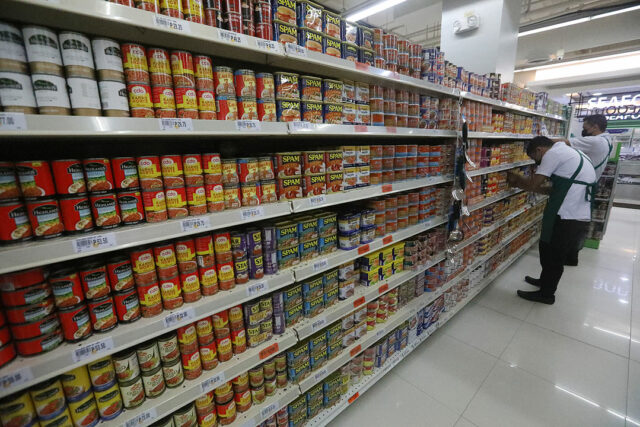
Employees arrange canned goods on a shelf at a supermarket, Aug. 26. — PHILIPPINE STAR/EDD GUMBAN

HEADLINE INFLATION likely settled within 5.9% to 6.7% in August as food prices continued to rise, the Bangko Sentral ng Pilipinas (BSP) said on Wednesday.

“Inflation for the month was driven by the continued increase in key food prices, but could be offset in part by the decline in global oil prices, the reduction in electricity rates, lower meat and fish prices, and appreciation of the peso,” it said in a statement.

If realized, August inflation would exceed the central bank’s 2-4% target for the fifth straight month.

The upper end of the inflation forecast or 6.7% would be the fastest in 45 months, or since 6.9% in October 2018.

Headline inflation stood at 6.4% in July.

The Philippine Statistics Authority (PSA) will release August inflation data on Sept. 6.

Global oil prices fell for a third straight month in August over concerns that monetary tightening will hurt economic growth.

As of Aug. 23, pump price adjustments for the month stood at a net decrease of P0.75 a liter, diesel by P1.25 and kerosene by P0.95.

On Tuesday, oil companies raised diesel prices by P6.10 a liter and gasoline by P1.40 a liter.

Meanwhile, Manila Electric Co. (Meralco) said the overall rate for a typical household went down by P0.2087 to P9.5458 per kilowatt-hour (kWh) in August.

The BSP also said inflation could be offset by the peso’s appreciation against the US dollar.

The peso remained at the P56-a-dollar mark in August, closing the month at P56.145 on Wednesday, down by P5.145 or 10.08% from its P51 finish on Dec. 31, 2021.

“Looking ahead, the BSP will continue to monitor closely emerging price developments to enable timely intervention that could prevent further broadening of price pressures, consistent with BSP’s mandate of price stability conducive to sustainable economic growth.”

The central bank has increased borrowing costs by 175 basis points since May as it seeks to bring inflation back within target.

At its August meeting, the Monetary Board raised its average inflation forecast for 2022 to 5.4% from 5%, exceeding the 2-4% target band.   

For 2023, the BSP’s inflation forecast was lowered to 4% from 4.2%, as well as the 2024 outlook to 3.2% from 3.3%. — KBT

IT-BPM sector targets 1.1M new jobs in 6 years

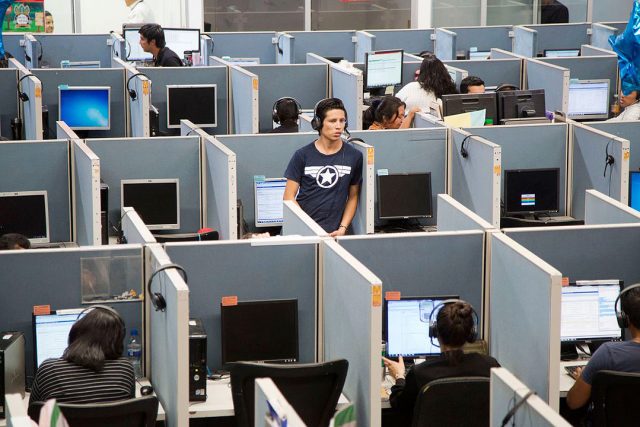
PHILSTAR FILE PHOTO

By Luisa Maria Jacinta C. Jocson, Reporter

THE PHILIPPINES’ information technology and business process management (IT-BPM) sector is expected to boost its revenues by as much as 10% this year, and create over 1.1 million jobs in the next six years, as the economy recovers from the coronavirus pandemic.

“The IT-BPM industry has become an indispensable pillar of the Philippine economy… and a very potent source of foreign exchange and exports,” IT and Business Process Association of the Philippines (IBPAP) President and Chief Executive Officer Jack Madrid said at a virtual press conference on Wednesday.

“We can create more impact in the lives of Filipinos and become an engine of transformation that promises an even brighter future for our country.”

IBPAP is projecting an 8-10% increase in revenues and a 7-8% rise in the number of full-time employees by the end of 2022.

In 2021, the IT-BPM industry posted $29.5 billion in revenues, up by 10.5% from $26.7 billion in the previous year. The industry’s headcount stood at 1.44 million in 2021.

“The Philippine IT-BPM industry is poised to fulfill the vision of the roadmap for 2028 and grow over one million new jobs in the coming six years,” Mr. Madrid said.

The target to create 1.1 million direct jobs in the IT-BPM sector by 2028 is part of the Philippine IT-BPM Industry Roadmap 2028. It will be unveiled during the IBPAP’s 14th International Innovation Summit on Sept. 27-29.

To achieve these targets, Mr. Madrid noted the importance of favorable government policies on incentives and remote work, more reliable digital infrastructure, talent development and improved ease of doing business.

“There has never been a more important time to address the mismatch of talent supply and demand. We are in a global war for talent,” he said. “Our biggest challenge: upskilling and reskilling the existing workforce, and rebranding the Philippines to retain dominance as a provider of high-value digital services.”

Mr. Madrid said they need partners in the telecommunication industry to build infrastructure to support the IT-BPM industry outside Metro Manila, where many companies are now keen on expanding.

“As a whole the Philippines is more than holding its own and in retaining its position. What’s more important in the coming six years is how much more market share we can capture. It’s there and it’s ours for the taking,” he said.

Meanwhile, Mr. Madrid expressed support for a hybrid work setup for the IT-BPM sector, saying the majority of workers favor this arrangement.

“Our industry has been the focal point of what I believe to be a global desire for more flexible work, location-independent setups. The future of work is already happening… It’s loud and clear that an overwhelming majority in the Philippines, but even across other parts of the world have shown that the future is going to be about finding that optimal balance,” he said.

The Philippine Economic Zone Authority (PEZA) board has approved in principle the extension of the 30% work-from-home arrangement for registered IT-BPM firms to March 2023.

“The IT-BPM sector is a prime source of remittances as well as job generation, on top of the OFW component. As such it is a prime driver of economic growth, and as such of the recovery we are in,” Security Bank Corp. Chief Economist Robert Dan J. Roces said in an e-mail.

Rizal Commercial Banking Corp. Chief Economist Michael L. Ricafort said in a text message the Philippines is one of the biggest outsourcing destinations of in the world. The IT-BPM sector has continued to fuel economic growth amid the pandemic, he added.

Mr. Ricafort said major growth areas for BPOs are the new township projects outside Metro Manila, especially in areas with universities or colleges that can provide a steady supply of workers.

“The cost of operations such as rent and property prices are much lower in these areas outside Metro Manila that helps realize more cost savings for locators, create more jobs in the localities and accelerate economic growth and development in the regions,” he added.