Home Blog Page 5901

Senate bill sets out incentive scheme for companies enabling tech-voc training

PHILSTAR FILE PHOTO

A BILL seeking to better match technical and vocational (tech-voc) education and training to the needs of the job market has been filed in the Senate, granting tax deductions to companies that offer apprenticeship-style training.

Senate Majority Leader Emmanuel Joel J. Villanueva said his Senate Bill 363, or the proposed Enterprise-based Education and Training to Employment Act, seeks to introduce an apprenticeship and dual training system to better prepare trainees for the workforce.

Enterprises that organize and implement enterprise-based training will be eligible for additional deductions against taxable income equivalent to 75% of the training expenses incurred; with donations, contributions, subsidies, bequests, or financial aid extended to a participating training institution fully deductible from gross income and exempt from donor’s tax.

“The bill can help the government continue to meet the changing needs of the market and put in place good governance mechanisms that can expand partnership with industry associations and companies through enterprise-based training,” he said.

Strengthening private sector participation through a national enterprise-based training system will resolve the job-skills mismatch and ensure the adequate supply of workers with skills vital to industry, he added.

The bill contemplates trainees who are high school graduates or the equivalent, and tested for vocational aptitude and capacity, and the ability to comprehend and follow oral and written instructions.

Participating enterprises are required to register their programs with the Technical Education and Skills Development Authority (TESDA) before entering agreements with trainees.

Participating employers must also establish an Enterprise-Based Education and Training Committee which will monitor and recommend measures for effective program implementation, and settle differences between management and trainees.

No enterprise will be allowed to engage trainees beyond 20% of the total number of regular employees. Trainees must also be given appropriate life and accident insurance, free of charge.

Every four years after the effectivity of the law, TESDA must conduct a review of its implementation, accomplishments and recommendations for further improvement.

Mr. Villanueva pushed employers and companies to invest in technical vocational graduates, noting that “our technical vocational education is among the best in the world” as “we have a pool of talent that can get every job done.” — Alyssa Nicole O. Tan

Stuff to do (08/26/22)

Sweet Escape dessert fair at SHANGRI-LA Plaza

Shang holds Sweet Escape dessert fair

SHANGRI-LA Plaza wraps up a #DealightfulAugust with the sweetest event of the year at the Sweet Escape, a dessert fair whipped up in partnership with The Honest Harvest community market. It is being held at the mall’s Grand Atrium on Aug. 25-28 and will feature everything from cotton candy sculptures to Filipino desserts. Among the participants are Lollipuffs Cotton Candy, Zachy’s Pastillas (with flavors like milky, ube, mango, and buko pandan and unique offerings like avocado, matcha, strawberry, cookies and cream, and chocolate mint), Homemade by Rita (mini pecan pies), The Creamery Catering (Filipino desserts in tubs like Hot Taro Sago, AvoCoco, and Coffee Jelly); C&M Coffee; Auntie Anne’s; Big Chill (healthy juices and smoothies), and Gorae (Korean-style hotdogs and bungeoppang or fish-shaped pastries stuffed with sweet filling). These are just a part of the entire dessert spread that guests can taste at the #SweetEscapeattheShang. More merchants that serve other types of sweets like doughnuts, cookies, tarts, chocolate truffles, and other baked goods and other treats. For updates and inquiries, follow Shangri-La Plaza on Facebook at www.facebook.com/shangrilaplazaofficial and on Instagram @shangrilaplazaofficial.  


Rustan’s online anniversary sale

LUXURY retailer Rustan’s marks its 70th anniversary this month. Celebrations include in-store events, special anniversary offers, new brands and collections, and a weekend-long sale exclusively at Rustans.com on Aug. 27 to 28. On that weekend, Rustan’s brings the anniversary celebration online offering a selection of brands and merchandise from fashion, fine jewelry, beauty, kids, and home, while treating customers with limited offers and promotions of up to 50% off on selected items. The online sale features 100+ products from Rustans.com’s top brands including Longchamp, Kate Spade New York, SPANX, Michael Kors, Furla, Samsonite, Bally, Superga, Montblanc, Maison Margiela, Estée Lauder,  L’Occitane, Shiseido, Tefal, Breville, and Pyrex. Women will find brands like Anne Klein, Kurt Geiger, LeSportsac, Coccinelle, Triumph, and HOFF with merchandise up to 30% off, while Rustan’s Private Brands Lady Rustan, Luna, and Lotus Resortwear are offering 15% off on regular-priced items. For a little self-care, there are numerous offers and complimentary gifts from the likes of Jo Malone London, La Mer, Viktor&Rolf, Kanebo, Perricone MD, Anastasia Beverly Hills, Murad, and Mario Badescu. For men, brands on sale up to 25% off include Jack Nicklaus, Cross, Hackett, American Tourister, Kenneth Cole, and Dune London. Silver Vault brands have a special offer for customers. Lacor, Cuisinart, Corelle, TruSens, and AirMaster also have offers for the home. Find gifts for children with sale items from Jellycat, Melissa & Doug, Malabar Baby, Baa Baa Sheepz, and Bonjour Baby offering items up to 50% off. Spend a minimum of P30,000 and receive free Philips Audio True Wireless Earbuds. Customers will also be treated to 10% off and free shipping when their purchases reach a minimum spend of P2,000 after using the exclusive codes provided by banks BDO, BPI, Chinabank, EastWestBank, HSBC, PNB, RCBC, and Security Bank. Discounts are capped at P1,000. For more information visit rustans.com.  


Woven Networks holds forum

WOVEN Networks Sharing Sessions is an online webinar happening on Aug. 30 to Sept. 2 featuring craft changemakers from the Philippines and the UK. Speakers will present stories and findings from Woven Networks, a research grant program aiming to grow forest resources and livelihood by strengthening the role of artisans in sustainable development. Malaya del Rosario, Head of Arts at the British Council, said in a statement: “In partnership with the Forest Foundation, we awarded grants to trusted intermediaries — designers, academics and development experts. We were able to map 15 craft communities in the Philippines, from weaving cooperatives in Isabela to the indigenous Higaonon weavers in Bukidnon.” The grantees also involved artisans, foresters and UK-based counterparts in their projects. Representatives from Panublix Social Enterprise, University of Santo Tomas, and the Royal College of Art in London, among many others, will also be speaking at the event. The webinar will culminate on Sept. 2 with the launch of the virtual exhibition, “From land to loom, from fibre to form: Woven Networks research projects,” curated by Tessa Maria Guazon. It will celebrate program highlights and feature objects from the National Museum of Anthropology collection. The four-day webinar is free but registration is required via the British Council Philippines’ webpage. It will be held on Aug 30 to Sept. 2 via Zoom from 4 to 5:30 p.m. (PH) / 9 a.m. to 10.30 a.m. (UK). For more information, e-mail at Arts@britishcouncil.org.ph.   


Paws N’ Play in UP Town Center

AYALA MALLS is using its platform and facilities to support animal welfare through Paws n’ Play, the mall’s annual pet festival at UP Town Center (UPTC). Now in its 5th year, Paws n’ Play continues to promote humane treatment for animals through pet fairs, dog obedience training sessions, and workshops on responsible pet ownership. The festival begins in August and will run until October on the weekend before World Animal Day. Ayala Malls partnered with the Quezon City Local Government to launch the two-month long festival Paws n’ Plays Year 5 to support five groups: Philippine Animal Welfare Society (PAWS); CARA Welfare; the Philippine Pet Birth Control Center Foundation (PPBCC); Hound Haven PH; and, Cats of Manila. On Sept. 10, Paws n’ Play will hold the Gotcha Gala, an exclusive meet-up of rescued and adopted pets with their owners. The families will be pre-selected from a pool of online entries in response to Ayala Malls’ call for stories of hope and successful pet adoptions. Winners and pets will meet at the BarkYard on the day of the event, followed by a photo and video presentation on their respective adoption journeys. Paws n’ Plays is holding a week-long photo exhibit of Gotcha Gala winning entries at the Gotcha Gallery. From Sept. 10 to 17, Ayala Malls encourages viewers to interact with the photos by leaving notes on the space provided. The festival culminates on Oct. 2 with Paw It Forward, a series of workshops to be held for the benefit of select animal welfare shelters. The workshops are open to all, with a registration fee of P500 as donation to the participant’s chosen organization. The proof of donation serves as the individual’s workshop pass. Visit @UPTownCenterAyalaMalls on Facebook and @iloveuptowncenter on Instagram for updates and announcements on Ayala Malls’ Paws n’ Play festival in UP Town Center.


Improving margins to boost Philippine banks’ profitability, Fitch Ratings says

THE COUNTRY’S big banks will continue to see improved profitability for the rest of the year on better margins following the central bank’s tightening, Fitch Ratings said.

“The solid financial performance of the Philippines’ large banks in 1H22 reflects continued improvement in loan demand, with system loan growth reaching the fastest pace since the onset of the COVID-19 pandemic at 9.1% year on year,” the debt watcher said in a report written by Fitch Asia-Pacific Financial Institutions Directors Willie Tanoto and Tamma Febrian dated Aug. 25.

“We expect credit growth to taper in 2H22 as demand is curbed by inflation and a 175-bp (basis point) year-to-date increase in the policy rate. However, banks’ earnings should be supported by wider lending margins as variable rate loans are repriced. We have maintained our improving outlook on the banking sector against the backdrop of rising returns,” Fitch said.

Philippine banks’ improving profitability is positive for their standalone credit profiles, the debt watcher said. Still, this does not strengthen their issuer default ratings, as this is sensitive to changes in the sovereign’s “BBB” rating, which has a “negative” outlook.

Fitch said banks’ interest margins and profits have yet to reflect most of the Bangko Sentral ng Pilipinas’ (BSP) rate increases as it began to tighten only in May.

“Further improvement, nevertheless, may be tempered by rising loan competition, especially within the corporate sector that remains the dominant segment of the banks’ loan portfolio, as the banks’ risk appetite returns,” it said.

Funding costs also remain low amid high levels of liquidity in the system, which will support banks’ loan growth, Fitch said.

It said it expects banks’ capital levels, which have declined due to faster loan growth and revaluation losses on banks’ bond holdings, to remain steady “as stronger profits lead to capital accretion.”

However, rising inflation, which may affect consumers’ purchasing power and, in turn, the economy’s recovery, could result in weaker asset quality for lenders.

“Non-mortgage consumer lending is among the most vulnerable to impairments, but we expect the rated large private banks to weather incremental weakness in loan quality relatively well, helped by their loan loss coverage ratios of 138%-196%,” the debt watcher added.

Latest BSP data showed outstanding loans by big banks, net of reverse repurchase placements with the central bank, rose by 12% in June to P10.19 trillion in the same month last year.

As lending growth continued to pick up, M3 — the broadest measure of liquidity in an economy — expanded by 6.9% to P15.4 trillion in June. — K.B. Ta-asan

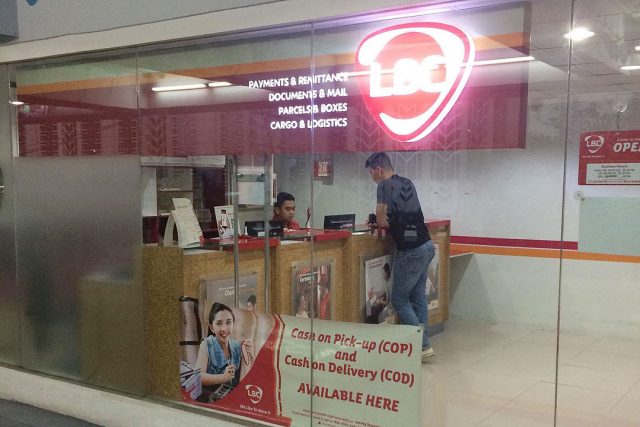
LBC Express Holdings swings to nearly P132-million net loss

BW FILE PHOTO

LISTED LBC Express Holdings, Inc. swung to losses in the second quarter of the year, primarily due to a decline in volume.

The company, which is involved in logistics and money transfer services, lost P131.86 million for the quarter, compared to an attributable profit of P170.83 million during the same period last year, its second-quarter financial performance results showed.

Second-quarter service revenue fell 6.9% to P3.78 billion from P4.06 billion previously.

“There was a negative growth for domestic logistics segment by 7%,” the company noted. “This is partly countered by the improvement in overseas sales by 6%.”

Meanwhile, cost of services declined 3.9% to P2.98 billion from P3.10 billion in the same period in 2021.

There was a “shortfall in volume leading to lower cost of delivery and remittance by 9%,” according to the company.

“Decreases were noted for trucking cost and contracted jobs while these were counterbalanced by the increase in domestic and international shipping lines and fuel rates.”

The company’s gross profit dropped 16.6% to P800.44 million from P960.12 million previously, “primarily attributable to decrease in volume and increase in cost of freight sea and fuel.”

For the first half of the year, LBC Express Holdings swung to an attributable net loss of P82.99 million from a profit of P310.56 million in the same period last year.

First-half service revenue declined 8% to P7.74 billion from P8.41 billion previously, “mainly from domestic logistics segment which were partially covered by 8% growth in sales from overseas as there was steady growth in air cargo volume and rate alignment in several countries.”

Meanwhile, cost of services for the period reached P6.03 billion, down 4.3% from P6.30 billion in the same period a year earlier.

The company attributed the decrease to “lower cost of delivery and remittance by 11%.”

Gross profit for the first six months decreased 19.8% to P1.70 billion from P2.12 billion previously, “primarily attributable to decrease in volume and increase in the cost of freight sea as well as fuel.” — Arjay L. Balinbin

Managing working capital in difficult times

SINCE 2020 and the onslaught of the pandemic, businesses have faced major challenges in the management of working capital.  The problem is aggravated in the case of small and medium enterprises (SMEs).  Most SMEs suffered from a decrease in cash flow and disruptions in the supply chains.  The lockdowns affected consumer mobility and demand plummeted.  Despite efforts to open the economy and the proclamation of the new President about his no lockdown policy, working capital issues continue to surface.

Let us go back to the basics.  As defined, working capital is the difference between a company’s current assets and its current liabilities. The essence of working capital management is to ensure that the company possesses appropriate resources for its daily activities while keeping resources invested in a productive way.

The components of current assets include cash, accounts receivables and inventories. Current liabilities include accounts payable, short-term borrowings and accrued liabilities. The working capital policy of the firm will concern the levels that should be maintained in each of the components.  A second policy calls for how the working capital should be financed.

The first component is the level of cash and how much of it to keep addressing liquidity concern. The company needs enough cash resources for its ordinary business needs and unexpected needs. Cash provides four important functions – transaction, precaution, compensating balance for loans/services and speculation. The goal of cash management is to meet these functions, yet not have any unnecessary excess cash.

As we know, this is the first casualty of the pandemic crisis — cash flow.  Given its significance, the strategy for cash management is critical. The company needs to determine the capital needed from important transactions, the length of time it can be maintained and contingency measures to source cash during emergencies.

Liquidity must be maintained as it helps in the face of financial distress and builds the company’s credit worthiness.  But too much cash reflects poor allocation of resources because it is generally non-earning. Cash is like inventory with two opposite behaving costs — carrying cost and ordering costs. At the margin, orders costs are reduced when larger orders are placed, but carrying costs rise. The economic solution is to order the needed cash such that marginal reduction in order cost equals marginal carrying cost.

Cash budgeting becomes an important exercise. Ideally, the cash budget should show a positive cash flow with more money coming in than going out. Cash could have been used overstocking real inventory despite less demand.  Giving lengthy payment terms to clients can lead to cash shortage. Overspending on clients and overtrading related to new business prospects can have the same effect.

In a crisis setting, there is the tendency to err on overstocking of cash despite its cost. Large increase in cash is not surprising given the errors in forecasting of demand. At this stage, it is better to err on the conservative side because of greater volatility in the environment. Measures to decrease cash outflow through prudent management of variable costs are also warranted.

The firm must improve the receivable process. The organization needs to generate faster cash flows from receivables and technology can be a major support. Digital payments, online deliveries and internet/smartphone transactions have been a boost to speed up the process. In many instances, the use of digital solutions can be a life saver. In fact, it is now the new normal.

The inventory audit should help determine appropriate supply issues and avoid shortages. Changes in the supply chain will impact on the modes and timing of deliveries.  While just-in-time models appeal in normal times, the likelihood of shortage and absence of key inputs will lead to lost sales.  The changes in the logistical setup will require taking a precautionary stance in inventory buildup as order-taking time adjusts to the new reality.

Buttonwood of The Economist made this commentary on inventory cycles that apply, in general, to all working capital components.  He wrote: “Just-in-time production assumes a largely frictionless world — of open borders, predictable demand and low transport costs. This can no longer be relied upon.  Inventory is a form of insurance against unexpected delays. The trade-off between efficiency and self-insurance, between just-in-time and just-in-case, has shifted markedly towards the latter.”

A major challenge is making alternative financing options available to ensure the steady flow of working capital.  Prudent management of short term financing preserves liquidity amidst uncertainty.  The firm should explore the right financing instruments — regular credit lines, revolving credit agreement, collateralized loans, discounting of receivables, factoring, inventory financing, and yes, even trade credits.   A good environment scan should reveal the firm’s access and availability to banking service, the level of interest rates, inflation in the economy and the level of competitiveness within one’s industry.

Payables represent a fund source but note how trade credit can be expensive especially if discounts were offered. The firm must compute properly the cost of not taking such discounts against commercial debt. Advance planning will allow fulfillment of credit needs beyond the ordinary. Relationships with suppliers must be protected.

In sum, working capital management requires a balancing act of the levels involved in the major components cited — cash, receivables, inventory, payables, and financing options. In all components, the tradeoffs are between ordering and holding costs. Management of working capital these days require a more conservative stance that favors the just-in-case philosophy.

The views expressed herein are his own and does not necessarily reflect the opinion of his office as well as FINEX.


Benel Dela Paz Lagua was previously EVP and chief development officer at the Development Bank of the Philippines.  He is an active FINEX member and an advocate of risk-based lending for SMEs.  Today, he is independent director in progressive banks and in some NGOs.

Union appoints management expert to CBA panel

We have an upcoming negotiation with the employees’ union for a new Collective Bargaining Agreement (CBA). Last week, the union president sent us a list of their negotiating panel members, including a management expert from a high-end business school. I checked on the expert with my industry colleagues, who could provide no information. As the human resource head, I’m weighing the pros and cons of this new development. What are your thoughts? — Rainbow Connection.

There’s nothing new under the sun. Even the preceding statement is not new as it comes from Ecclesiastes 1:9, which reads: “What has been will be again, what has been done will be done again as there’s nothing new under the sun.” The world is round and everything will come to us in different forms and times, but the substance will remain the same.

But that’s not the issue. A management expert sitting on a union panel indicates that the union appears to be distrustful of management and line executives. It’s a bad start. Why would they hire an outsider to validate your claims and counter-proposals in the upcoming CBA negotiation?

Another thing to consider is whether the union is trying to play a psychological trick upon management.

FOUR OPTIONS
The outcome of the CBA will depend on a well-crafted management plan faithfully executed during the negotiation process. That means having a good roadmap that identifies potential hazards along the way. Speaking of hazards, what damage could an external management expert do to your negotiation process?

Such a union expert could derail the negotiating process if the expert decides to start lecturing the management panel and treat them like students. The expert’s behavior can be circumscribed by the negotiation ground rules, but there are no guarantees.

It’s very important to understand the underlying circumstances. The following suggestions may be helpful:

One, acknowledge the union proposal. Do it without delay. Request clarification of the union’s decision to involve an external management expert. I’m sure they have a reason. The question is whether the reason is valid to management. You must understand the entire picture and prepare a considered reply or offer a better option.

Two, reject the union proposal. If management is not convinced, it might be better to reject the proposal, but without being blunt. It might be necessary to initiate an informal discussion with union officials before finalizing your reply. You might bring up the potential for endless debate when an outsider is involved, resulting in unreasonable delays to the conclusion of the CBA.

Three, agree but limit the expert’s participation. This can be easily justified by the need for confidentiality in the negotiation process. Any information accessed by an outsider, no matter how professional, must be restricted, limited, or even denied in certain cases.

If necessary, accept only economic experts on a one-time engagement, who can talk about the consumer price index and inflation forecasts for the next three to five years. The trouble is that there is no consensus even among economic experts about the course of future events. This newspaper can attest to that.

Last, hire your own expert. If the union insists on the participation of its expert, management may propose its own third-party expert from the University of the Philippines School of Labor and Industrial Relations, the National Wages and Productivity Commission, or the National Conciliation and Mediation Board.

You may be tempted to propose hiring an expert from a competing trade federation. Don’t even think about it unless you want to antagonize the union negotiating panel.

BAD PRECEDENT
In conclusion, reject the proposal as best you can. Let the union agonize about justifying its proposal. If management is firm in its position and has explained it well, the union will surely come around to the folly of its position. Whatever you do, be professional and respectful in dealing with the union to avoid antagonizing the other side and complicating the negotiations.

Keep the discussion to what’s practical, right and inexpensive. Labor and management don’t need external experts unless they’re discussing technical issues; such experts are freely available from independent and reputable sources.

If you’ll agree, the presence of experts could be taken as precedent, and might embolden the union to propose more meaningless ideas.


Chat your questions with Rey Elbo on Facebook, LinkedIn or Twitter or send your feedback to elbonomics@gmail.com or via https://reyelbo.com

Entertainment News (08/26/22)

Mercury

Spider-man: No Way Home returns to PHL cinemas

ALL THREE Peter Parkers — played by Tom Holland, Andrew Garfield, and Tobey Maguire — are swinging back into theaters with the re-release of Spider-Man: No Way Home. Arriving in Philippine cinemas on Sept. 7, Spider-Man: No Way Home will feature extended scenes and 11 minutes of never-before-seen footage. The return engagement comes in celebration of 60 years of the Spider-Man comic book character, in addition to the last two decades of Spider-Man films gracing the big screen. The movie’s first release back in January saw theaters with seating capacity limited and children still not allowed outside their homes due to the COVID-19 pandemic. With the re-release, fans who were unable to experience the movie on the big screen will now have a chance to. The film is directed by Jon Watts, written by Chris McKenna and Erik Sommers, and based on the Marvel Comic Book by Stan Lee and Steve Ditko.


The Bootleg Beatles show cancellations

CONCERT Republic announced that The Bootleg Beatles concerts scheduled for Oct. 27 at the SMX Convention Center, Davao, and Oct. 29 at the Waterfront City Hotel & Casino, Cebu have been canceled. “Regrettably we have to cancel our forthcoming concerts in Davao and Cebu due to unforeseen production logistics, however our Manila show at Philippine International Convention Center (PICC) Sunday 30th October 2022 will proceed as advertised,” the statement on Concert Republic’s Facebook page wrote. “We apologize for any inconvenience caused and look forward to seeing you all in Manila.” Tickets for the canceled Davao and Cebu shows will be refunded at the point of purchase. For more information and updates, visit www.facebook.com/concertrepublic.


Pinoy band Mercury releases new single

FILIPINO alternative soul and rock band Mercury tackles love that knows no bounds in their new single “Enough.” Written collectively by the band, the song deals with acknowledging how relationships grow stronger over time when compromising and weathering storms. Co-produced by frequent collaborator and former bandmate knōwmaad, “Enough” marks the band’s return to their rock-leaning roots, incorporating a bass-heavy sound. The song, which serves the second track from of Mercury’s upcoming EP Changin Vol. 3, was conceived during the band’s remote songwriting session in Tagaytay City during the quarantine. “Enough” is available on all digital music platforms worldwide.


Discover songs by Pinays on Spotify   

SPOTIFY is making it easier for local listeners to belt out hit tracks, with a power list of anthems by established and up-and-coming Pinay artists. Beyond the platform’s EQUAL campaign, which spotlights female artists on the global stage, Spotify is featuring Filipina artists in playlists such as Tatak Pinoy (fronted by Moira Dela Torre), magmuni-muni, OPM Rising, and Mabuhay, Pilipinas!.


Netflix’s Seoul Vibe out this week

THE NEW KOREAN action film Seoul Vibe premieres on Netflix on Aug. 26. It is about young drivers who dreamed of the American dream during the 1988 Seoul Olympics. Directed by Moon Hyun-sung, it stars Yoo Ah-in, Koh Kyung-Pyo, Lee Kyoo-hyung, Park Ju-hyun, Ong Seong-wu, Oh Jung-se, Jung Woong-in, and Moon So-ri.


Enola Holmes 2 out in November

AFTER the triumph of solving her first case, Enola Holmes (played by Millie Bobby Brown) follows in the footsteps of her famous brother, Sherlock (Henry Cavill), and opens her own agency — only to find that life as a female detective-for-hire isn’t as easy as it seems. Enola Holmes 2 is directed by Harry Bradbeer, it stars Millie Bobby Brown, Henry Cavill, David Thewlis, Louis Partridge, Susan Wokoma, Adeel Akhtar, Sharon Duncan-Brewster, and Helena Bonham Carter. The series premieres on Nov. 4 on Netflix.

JETRO says PHL offers many opportunities for Japanese firms 

JETRO.GO.JP

THE Philippines has various opportunities that can be offered to interested Japanese firms such as its workforce and policies, the Japan External Trade Organization (JETRO) said.

“The Philippines still has much to offer to Japanese companies,” JETRO Executive Director Kazuo Nakamura said during the information session organized by the Board of Investments (BoI) on Aug. 19.

“Apart from the young and English-speaking workforce which is one of the many reasons why the Philippines remains to be an attractive investment destination for Japanese, the Philippines remains an attractive investment destination with its business-friendly environment and game-changing, liberalized laws and policies,” he added.

Mr. Nakamura was referring to policies such as the amendments to the Retail Trade Liberalization Act, the Foreign Investment Act, and the Public Service Act. These measures seek to further open up the country’s economy to foreign investors.

Tomohiro Ando, JETRO Manila investment and economic partnership agreement advisor, said that the quality of employees in the Philippines is better compared with those of other countries.

“Human resources are one of the assets of the Philippines in attracting Japanese investors,” Mr. Ando said.

Meanwhile, BoI Director Maria Rosario J. Dominguez said that it is important for the Philippines to consult stakeholders as part of enticing more investments.

“We must get as much information from our stakeholders to help us direct our efforts and judiciously tap resources in eyeing and getting quality investments in priority and focused sectors which will impact the investment landscape of the Philippines,” Ms. Dominguez said.

JETRO is a Japanese government-related organization that aims to promote mutual trade and investment between Japan and other countries. It also seeks to promote Japanese exports in other countries and to help small- and medium-sized Japanese firms in maximizing their global export potential.

Japan is among the third country with the biggest approved foreign investments in the second quarter of 2022, at P6.51 billion, only trailing the Netherlands at P19.04 billion and Singapore at P15.89 billion, based on data from the Philippine Statistics Authority.  — Revin Mikhael D. Ochave 

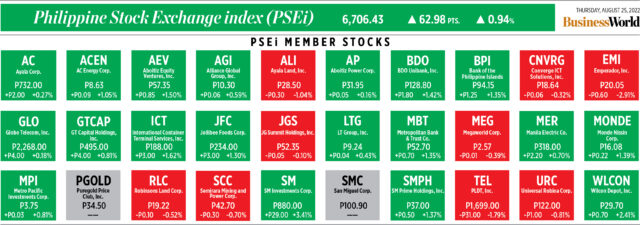
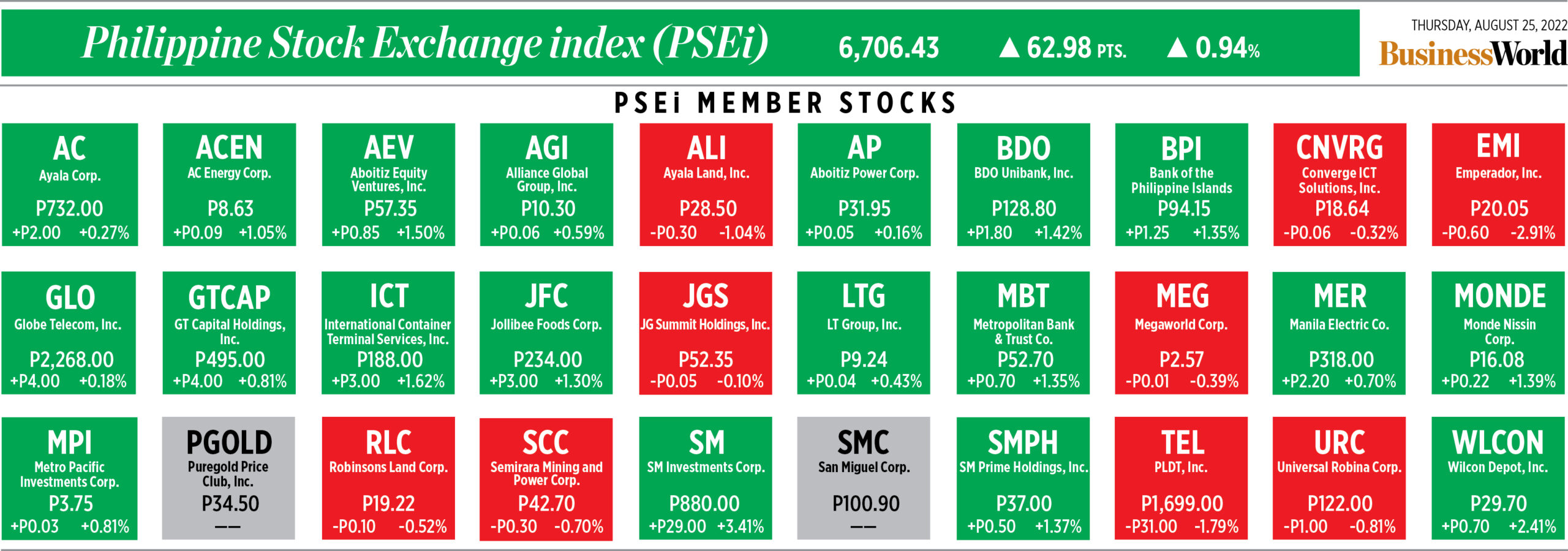
How PSEi member stocks performed — August 25, 2022

Here’s a quick glance at how PSEi stocks fared on Thursday, August 25, 2022.


Philippines most food insecure in East and Southeast Asia

The Philippines placed 146th out of 171 countries in the Global Food Security Index Q2 2022 developed by consultancy agency Deep Knowledge Analytics. The index was constructed from 40 food security indicators divided into three main dimensions: food accessibility; crisis level; and food system and economy resilience. With an overall food security index score of 5.05 out of the possible 10, the Philippines ranked last among its peers in the East and Southeast Asia.

Philippines most food insecure in East and Southeast Asia

Peso flat ahead of second US GDP estimate

BW FILE PHOTO

THE PESO inched higher against the dollar on Thursday as market players await the release of a new estimate for the United States’ second-quarter economic performance.

The local unit closed at P56.06 per dollar on Thursday, gaining a centavo from its P56.07 finish on Tuesday, based on data from the Bankers Association of the Philippines.

There was no foreign exchange trading on Wednesday as work was suspended due to severe tropical storm Florita.

The peso opened Thursday’s session at P55.95 versus the dollar. Its weakest showing was at P56.09, while its intraday best was at P55.90 against the greenback.

Dollars exchanged rose to $1.06 billion on Thursday from $864.05 million on Tuesday.

“The peso closed almost flat due to some caution ahead of the second release of the second-quarter US GDP (gross domestic product) report,” a trader said in an e-mail.

Real GDP decreased at an annual rate of 0.9% in the second quarter, according to the advance estimate released by the US Bureau of Economic Analysis last month. In the first quarter, real GDP contracted by 1.6%.

The advance GDP estimate is based on source data that are incomplete or subject to further revision. The second estimate for the second quarter, based on more complete data, was set to be released overnight.

The peso was also stronger after the local stock market went up higher for the second straight day, Rizal Commercial Banking Corp. Chief Economist Michael L. Ricafort said in a Viber message.

The bellwether Philippine Stock Exchange index climbed by 62.98 points or 0.94% to close at 6,706.43 on Thursday, while the broader all shares index went up by 23.95 points or 0.67% to 3,565.28.

“The peso also slightly stronger amid progress on tax reform proposals at the House of Representatives related to mining and rationalizing the tax exemption of pick-up trucks, among others,” Mr. Ricafort added.

The House Ways and Means Committee on Wednesday approved the new fiscal regime for the mining sector, as well as the fourth package of the Comprehensive Tax Reform Program that includes the removal of the excise tax exemption on pickup trucks.

Under the approved version, a royalty tax of 5% will be slapped on the market value of gross output of all large-scale mining operations.

The bill also seeks to improve transparency through a government system for the public disclosure and scrutiny of all mining tax and revenue data in the extractives value chain.

For Friday, the trader said the peso may weaken on expectations of hawkish remarks from Federal Reserve Chair Jerome H. Powell at the Jackson Hole symposium that was set to start overnight.

The trader and Mr. Ricafort expect the peso to move from P55.95 to P56.15 versus the dollar on Friday. — Keisha B. Ta-asan

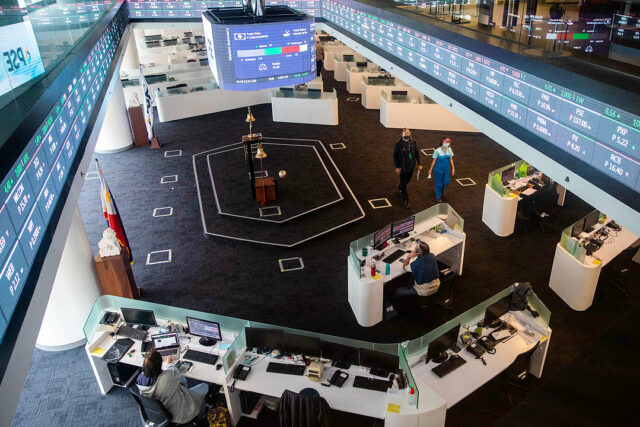
PSEi tracks Wall St.’s rise ahead of Fed conference

REUTERS

STOCKS climbed on Thursday, tracking Wall Street’s rise overnight, as investors await the annual gathering of global central bankers hosted by the US Federal Reserve.

The bellwether Philippine Stock Exchange index (PSEi) went up by 62.98 points or 0.94% to close at 6,706.43 on Thursday, while the broader all shares index went up by 23.95 points or 0.67% to 3,565.28.

“The local market went up by 62.98 points or 0.95% to 6,706.43 following the performance of the US markets overnight,” Philstocks Financial, Inc. Research Analyst Claire T. Alviar said in a Viber message.

“PSEi edged up by 0.95%, tracking US market sentiment, on the back of continued bargain hunting and as some investors dial down their expectations of more hawkish signals from the Fed in their upcoming annual gathering,” AP Securities, Inc. Equity Research Analyst Carlos Angelo O. Temporal said in a Viber message.

Both analysts said most investors stayed on the sidelines due to cautiousness ahead of the Jackson Hole conference, as evident in the weak value turnover seen on Thursday.

Value turnover declined to P3.99 billion on Thursday with 1.28 billion shares changing hands from the P5.44 billion with 603.19 million issues seen on Wednesday.

Wall Street closed higher on Wednesday as investors awaited the US Federal Reserve’s Jackson Hole conference this week.

The S&P 500 climbed by 0.29% to 4,140.77 points; the Nasdaq gained by 0.41% to 12,431.53 points; and the Dow Jones Industrial Average rose by 0.18% to end the session at 32,969.23 points.

The three-day Jackson Hole Economic Symposium was set to begin overnight, with Fed Chief Jerome H. Powell slated to speak on Friday.

Mr. Powell is expected to discuss the Fed’s outlook for the world’s largest economy, which could give investors clues on its policy path moving forward.

Investors are divided between expecting a 50-basis-point (bp)hike and a 75-bp hike by the US central bank.

The Fed next meets to review policy on Sept. 20-21.

Back home, the majority of sectoral indices ended in the green on Thursday except for mining and oil, which declined by 47.46 points or 0.39% to close at 11,901.95.

Meanwhile, holding firms jumped by 103.50 points or 1.62% to 6,460.09; financials increased by 19.76 points or 1.24% to 1,605.71; industrials climbed by 38.34 points or 0.39% to 9,869.19; property went up by 10.45 points or 0.35% to 2,992.41; and services inched up by 5.19 points or 0.30% to 1,725.40.

Advancers outnumbered decliners, 100 versus 86, while 34 names were unchanged.

Net foreign selling increased to P213.04 million from the P183.6 million seen the previous trading day.

AP Securities’ Mr. Temporal placed the PSEi’s immediate support at 6,500 and resistance at 6,800. — Justine Irish D. Tabile