Home Blog Page 588

Bill seeks mandatory 14th month pay for workers

PHILIPPINE STAR/MIGUEL DE GUZMAN

A MEASURE seeking to mandate a 14th month pay for all private sector workers has been filed in the Senate amid the rising costs of basic goods and services.

“The needs and cost of living of every Filipino worker have drastically changed, thus it is high time that employees in the private sector receive their 14th month pay,” Senator Vicente C. Sotto III said in a statement on Sunday.

Under Senate Bill No. 193, the 14th Month Pay bill, Mr. Sotto proposed that the minimum amount of the 14th month pay should not be less than one-twelfth of the total basic salary earned by the employee within the calendar year. He had filed a similar bill during the 18th Congress.

It covers all non-government rank-and-file employees, workers under Republic Act No. 10361, the Kasambahay Law, and others already entitled to a 13th month pay, provided they have worked for at least one month during the calendar year.

Presidential Decree No. 851 of 1976 already requires employers to pay workers a 13th month pay.

The bill also proposed the release of the 13th month of workers should not be later than June 14, while their 14th month pay should be received not later than Dec. 24 of every year.

The proposed payment schedule is intended to help parents in shouldering educational expenses and the incoming year-end holiday celebrations, Mr. Sotto said.

He noted that the frequency of payment of the benefit should be the subject of agreement between employer and employee or any recognized collective bargaining agent of employees.

Meanwhile, the bill exempts distressed employers, the government, employers already providing a 14th month pay, or its equivalent.

“The bill has exemptions for qualified employers so as not to burden struggling businesses as they are equally important for our economy,” he added. — Adrian H. Halili

DBCC to present economic outlook to Congress as budget talks begin

PHILIPPINE STAR /KJ ROSALES

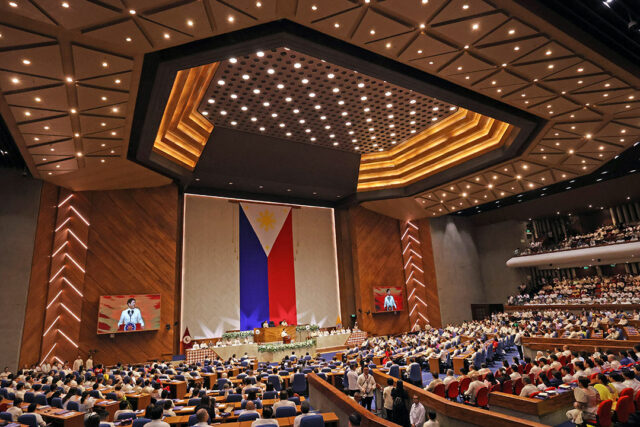
THE Development Budget Coordination Committee (DBCC) will brief lawmakers on the Philippines’ economic outlook today, as Congress begins deliberations on the proposed P6.793-trillion national budget for next year, House Speaker Ferdinand Martin G. Romualdez said on Sunday.

He said Budget Secretary Amenah F. Pangandaman, Finance Secretary Ralph G. Recto, Socioeconomic Planning Secretary Arsenio M. Balisacan and Central Bank Governor Eli M. Remolona, Jr. would present the country’s macroeconomic assumptions for the 2026 budget at the House of Representatives, where they are also expected to respond to congressmen’s queries.

The 2026 National Expenditure Program, submitted to Congress last week by the Budget department, saw double-digit budget hikes for the Education, Health and Transportation departments, with funding slashes to the Public Works department.

Next year’s budget is equivalent to 22% of the country’s gross domestic product and is 7.4% higher than the P6.326-trillion national budget this year.

Mr. Romualdez said the House would adhere to the commitments it made to make the budget process more transparent, like inviting civil society groups to join the hearings and abolishing the “small committee” that has traditionally consolidated proposed amendments to the spending plan after plenary debates.

“If we’re talking about the people’s money, then the people should also know about it and benefit from it,” he said in Filipino. “We will not hide anything from them.”

The lower chamber would also focus on prioritizing allocating funds for food security, infrastructure and education, he added.

Lawmakers would also strengthen their oversight over government agencies once President Ferdinand R. Marcos, Jr. signs the budget bill into law, requiring authorities to submit reports timely and provide real-time updates on major projects.

In a separate statement, House Deputy Minority Leader and Party-list Rep. Antonio L. Tinio said next year’s proposed budget fails to address the “fundamental causes” of poverty and inequality in the country.

“There is no funding or program for national industrialization,” he said in Filipino. “We cannot achieve genuine progress without developing our domestic manufacturing industry. That’s what will create long-term jobs.”

The proposed 18.7% hike in the Education department’s 2026 budget to P928.5 billion falls short of solving the persistent lack of classrooms in government schools, he added, taking note that the government plans on adding only 4,869 new classrooms next year. “Why is the construction target so low?”

Congressmen have nearly two months to scrutinize and approve the budget bill before submitting it to the Senate, with Nueva Ecija Rep. Mikaela Angela B. Suansing, who heads the House appropriations committee, earlier saying the chamber is keen on a thorough review. — Kenneth Christiane L. Basilio

BI modernizes border security

PHILSTAR FILE PHOTO

THE Bureau of Immigration (BI) detailed its ongoing border security modernization efforts during a regional immigration meeting in Brunei last week, highlighting new digital systems aimed at streamlining travel while tightening security.

BI Commissioner Joel Anthony M. Viado led the Philippine delegation to the 28th Association of Southeast Asian Nations (ASEAN) Directors-General of Immigration Departments and Heads of Consular Affairs Divisions of Ministries of Foreign Affairs Meeting, held from Aug. 12 to 14 in Bandar Seri Begawan.

The annual forum brings together Southeast Asian officials to discuss immigration and border management issues.

Among the projects presented were the Advance Passenger Information System, Cruise Visa Waiver program, eServices portal, eTravel system, and electronic gates.

The bureau also reported progress on the Civil Aviation and Immigration Security Services Project, developed to strengthen airport and seaport security.

The BI, in coordination with the Department of Foreign Affairs, also briefed delegates on the Digital Nomad Visa and the planned e-Visa system, measures aimed at attracting foreign travelers and remote workers while maintaining tighter oversight.

Apart from the main gathering, the Philippine delegation took part in the ASEAN forums on immigration intelligence, human smuggling, and checkpoint operations, and held bilateral consultations with immigration counterparts from Australia, China, Japan, and South Korea. — Chloe Mari A. Hufana

DoE bats for waste-to-energy bill

REUTERS

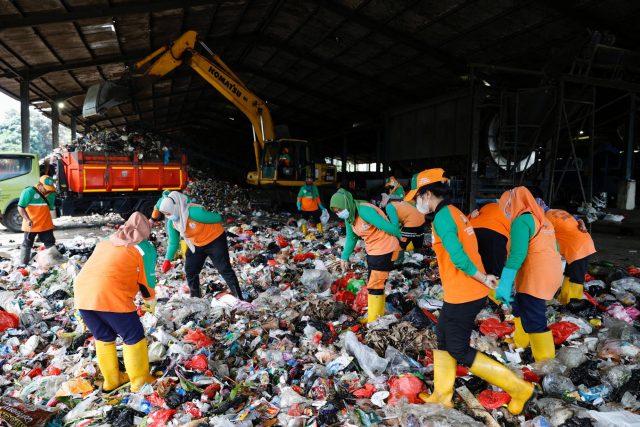
THE Department of Energy (DoE) is hoping for the immediate passage of a measure that will further support the use of waste-to-energy (WTE) technology to help solve flooding problem in the country.

“We pushed for it in the last three years… I think (President Ferdinand R. Marcos) is very supportive of this, so hopefully, the waste-to-energy law will finally be passed,” Energy Secretary Sharon S. Garin told reporters last week.

A waste-to-energy bill is among the priority bills identified by the Legislative-Executive Development Advisory Council in the 19th Congress. The measure was approved on third reading by the House of Representatives but remained pending for second reading in the Senate before it adjourned sine die in June.

WTE is a process that burns waste materials to produce steam and generate electricity.

“One thing about WTE is that it is more of an environmental activity rather than an energy one. What we’re really doing is making the environment cleaner by using waste and transforming it into energy,” Ms. Garin said.

“We’re hoping that with the support of Sen. (Sherwin T. Gatchalian) and Sen. (Pia S. Cayetano), there will be renewed interest in the WTE bill,” she said.

The Bases Conversion and Development Authority earlier said that Indian engineering firm Uttamenergy Ltd. and its local partners Global Heavy Equipment and Construction Corp. and ATD Waste-to-Energy Corp. will invest P4 billion in a WTE facility in New Clark City.

The group is targeting to commence construction within two years and start commercial operations within three years of contract signing. — Sheldeen Joy Talavera

CoA orders audit of Bulacan flood control projects

PHILIPPINE STAR/ MICHAEL VARCAS

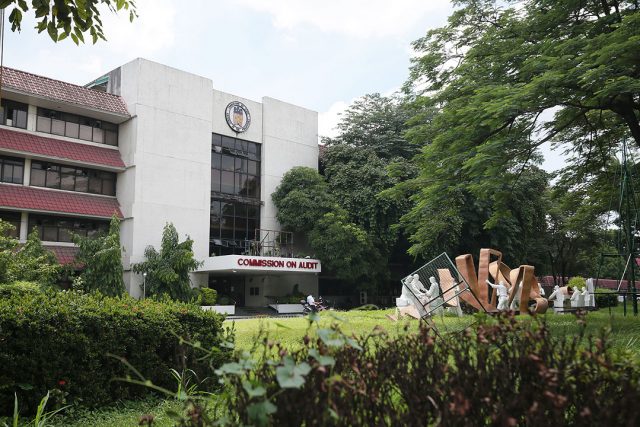
THE Commission on Audit (CoA) has ordered a fraud audit of P44 billion worth of flood control projects in Bulacan province, following President Ferdinand R. Marcos, Jr.’s call to investigate alleged anomalies in infrastructure spending.

CoA Chairman Gamaliel A. Cordoba directed state auditors overseeing district engineering offices in Central Luzon to submit all documents necessary for the fraud audit.

“Given the critical issues raised by Mr. Marcos regarding the implementation of these projects, particularly in the Province of Bulacan, a fraud audit is an immediate and unequivocal necessity,” he said in the Aug. 12 memorandum.

Central Luzon received P98 billion in flood control funding between July 2022 and May 2025, the highest among regions and accounting for 18% of the P548-billion national total, amid government efforts to mitigate flooding.

Mr. Marcos last week revealed that 6,021 flood control projects beginning in 2022 lacked basic details specifying the type of infrastructure to be built, flagging about 50 separate projects that shared an identical contract price of P150 million.

In his fourth State of the Nation Address, the President ordered the Department of Public Works and Highways to investigate flood control projects that failed. — Kenneth Christiane L. Basilio

Sotto back on court to rejoin the training camp of Alphas

KAI SOTTO — JAPAN B.LEAGUE

KAI SOTTO’s much-awaited comeback is on the horizon.

Mr. Sotto, at last, returned to non-contact training in Japan on Sunday to turn the next page in his recovery journey from an unfortunate anterior cruciate ligament (ACL) tear on his left knee last January.

He went under the knife for surgery in the same month and now with seven months at bay, Mr. Sotto is back on the court to rejoin the training camp of the Koshigaya Alphas in Saitama before the 2025-2026 Japan B.League opens in October.

The 7-foot-3 Filipino sensation was seen conducting solo shooting and dribbling skills according to his social media posts, signaling an inch closer to a return not only for the Alphas but also for Gilas Pilipinas.

Mr. Sotto, who did not join Gilas’ trip for the 2025 FIBA Asia Cup in Saudi Arabia to continue his rehab in Japan, averaged 13.8 points, 9.6 rebounds, 2.0 steals and 1.3 blocks for Koshigaya, which deeply felt his absence en route to early elimination at 20th place with a 19-41 slate.

But the hole he left for Gilas was bigger after a mammoth campaign in the FIBA Asia Cup Qualifiers, where the Nationals finished second with a 4-2 slate to book an Asia Cup ticket.

Alongside naturalized player Justin Brownlee, Mr. Sotto served as Gilas’ anchor with double-double norms of 15.5 points and 12.5 rebounds laced by 3.8 assists, 0.5 steal and 2.3 blocks for an all-around brilliance in four games.

His best game was a 19-point, 10-rebound, two-block showing as Gilas beat New Zealand, 93-89, at home for the first time ever.

Without Mr. Sotto in the Asia Cup, Gilas struggled early including tough defeats to Chinese Taipei and New Zealand anew before grinding through the quarterfinals, where its campaign ended with an 84-60 loss to two-time reigning champion Australia.

Gilas eventually finished at No. 7, just behind Chinese Taipei, South Korea and the semifinalists Australia, China, Iran and New Zealand, to improve from its ninth-place finish in 2022, the country’s first quarterfinal miss since 2007.

But with Mr. Sotto slowly but surely coming back to fine form, all signs lead to the charges of coach Tim Cone having a full force unit once again in time for the start of the 2027 FIBA World Cup Qualifiers in November and possibly the Southeast Asian Games in December. — John Bryan Ulanday

Sinner ends Atmane’s dream run in Cincinnati Open

TERENCE ATMANE — REUTERS/JASON WHITMAN/NURPHOT

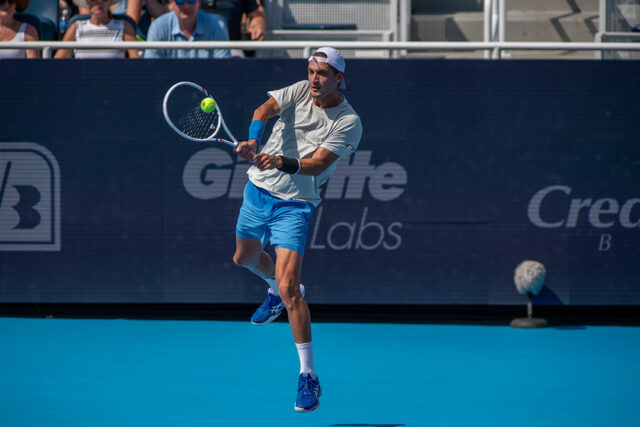
TOP seed and defending champion Jannik Sinner, playing on his 24th birthday, ended French qualifier Terence Atmane’s dream run at the Cincinnati Open with a 7-6(4), 6-2 win on Saturday to reach the final of the US Open tune-up event.

In the other semifinal, Carlos Alcaraz advanced with a 6-4, 6-3 win over German third seed Alexander Zverev, who struggled physically during the match, to set up a rematch of this year’s French Open and Wimbledon finals.

Sinner won a remarkable 91% of his first-serve points, did not face a single break point during the 86-minute match and converted two of five break points in his first career meeting with world number 136 Atmane.

“Very, very tough challenge,” Sinner said on court after being serenaded with “Happy Birthday” by the crowd. “Every time when you play against someone completely new it’s very difficult.”

The Italian world number one had his hands full throughout a tightly contested first set which featured an imperious serving display from both men and not a single break point opportunity for either player.

Sinner, who lost just three points on serve in the opening set, held to love for a third consecutive game to force the tiebreak where Atmane gifted his opponent the opening point with a double fault. From there the Italian never looked back.

The reigning US Open, Australian Open and Wimbledon champion opened the second set with a nine-minute hold of serve, then held to love before finally breaking for a 3-1 lead that gave him the cushion he needed.

Sinner followed that with another hold to love to go 4-1 up and all but end any hope for Atmane, who beat top-10 players Taylor Fritz and Holger Rune en route to his maiden ATP Masters 1000 semifinal.

With Atmane serving to stay in the match, Sinner quickly jumped ahead 0-40 before sealing the win on his third match point when the Frenchman sent a forehand into the net.

The Alcaraz-Zverev encounter was interrupted for 11 minutes early in the first set while paramedics tended to a spectator as the two players stood and watched together from the net.

Shortly after play resumed, Alcaraz saved three consecutive break points to reach 2-2. Three games later the Spaniard sent a brilliant low backhand volley to the open court for a break and 4-3 lead before closing out the frame on his serve.

Alcaraz broke to open the second set but gave it right back in a game during which he gifted four double-faults to Zverev, who was suddenly struggling to move around the court and after the game sat against the back wall grimacing in pain.

Zverev did well to finish the match but was barely going through the motions in the latter stages as Alcaraz had a love hold to go 5-3 up and then sealed the match with a break at love.

“Happy for the final but feeling bad for Sasha,” Alcaraz wrote on the camera lens after his win. “Wish you all the best.” — Reuters

Lionel Messi, Inter Miami add to LA Galaxy’s rough season

LIONEL MESSI — MLSSOCCER.COM

LIONEL MESSI returned from injury on Saturday night and finished with a goal and an assist to propel host Inter Miami to a 3-1 victory over the Los Angeles (LA) Galaxy in Fort Lauderdale, Florida.

Luis Suarez and Jordi Alba also scored to help Inter Miami (13-5-6, 45 points) bounce back following a 4-1 loss last Sunday against host Orlando City SC and secure a much-needed three points in the chase for the Supporter’s Shield.

Messi, who had missed Miami’s previous three matches across all competitions with a thigh injury, did not start but entered the game at the start of the second half.

With the match knotted 1-1 in the 84th minute, Messi took a ball at the top of the box and delivered one of his signature individual efforts to put Miami ahead for good.

Messi juked past the Galaxy’s Lucas Sanabria and dribbled past another defender before firing a shot on target from distance past Galaxy goalkeeper Novak Micovic.

Five minutes later, another rush upfield ended with Messi delivering a beautiful back heel to Suarez, who knocked another ball home to secure the club’s first league win since July 19.

It was Suarez’s first goal in run of play in his past nine matches across all competitions and sixth in league play this season.

A rough campaign following a Major League Soccer (MLS) Cup championship last year continued for the Galaxy (3-16-7, 16 points), who are winless in their past four league matches — although LA will play Pachuca of Mexico in the Leagues Cup quarterfinals on Wednesday.

Despite Messi’s presence, the Galaxy gave themselves a chance to secure at least a point when Joseph Paintsil equalized the match in the 59th minute on his own brilliant individual effort.

Paintsil dribbled past two defenders and ripped a shot that bounced off Inter Miami goalkeeper Oscar Ustari and into the net.

But Messi answered in the clutch with his MLS-leading 19th goal.

Despite outshooting LA 28-5 and 8-3 on shots on goal, Inter Miami didn’t find the back of the net until Alba scored in the 43rd minute off a great through ball by Sergio Busquets.

Suarez hit the post on a strong attempt early in the match, and Miami had a goal by Telasco Segovia disallowed after a review determined he was offside. Reuters

Ben Rice’s 7-RBI night helps Yankees outscore Cardinals

BEN RICE drove in seven runs and scored twice as the visiting New York Yankees outslugged the St. Louis Cardinals 12-8 on Saturday night.

Rice recorded a three-run homer, a three-run double and a run batted in (RBI) single as the Yankees won for the fourth time in five games.

Aaron Judge had a homer, a double and two RBIs for New York. Trent Grisham went 4-for-5 with four runs, and Jose Caballero was 2-for-4 with two stolen bases and three runs.

Yankees starter Max Fried (13-5) allowed seven runs on eight hits in five innings. David Bednar got the final out for his 20th save of the year.

Masyn Winn hit a three-run home run, Nolan Gorman had a two-run homer, and Pedro Pages belted a solo shot for the Cardinals, who lost their fourth straight.

Cardinals starter Sonny Gray (11-6) allowed six runs on nine hits in five innings.

St. Louis outfielder Victor Scott II left the game with a left ankle sprain he suffered while attempting a leaping catch on Judge’s homer.

The Yankees took 2-0 first-inning lead as Judge ripped an RBI double, followed shortly thereafter by a Jasson Dominguez run-scoring single.

The Cardinals cut the lead to 2-1 in the bottom of the inning on Alec Burleson’s triple and Ivan Herrera’s RBI single. St. Louis, though, surged ahead 5-2 in the second inning on Scott’s RBI single and Winn’s three-run blast.

Judge’s third-inning homer cut the deficit to 5-3. Then the Yankees moved ahead 6-5 in the fourth on Caballero’s bunt single, Grisham’s single and Rice’s three-run homer.

Austin Wells, Caballero and Grisham loaded the bases with singles in the sixth inning, setting the table for Rice’s bases-clearing double to put New York up 9-5.

The Cardinals trimmed their deficit to 9-7 in the bottom of the inning on Jordan Walker’s double and Gorman’s homer.

New York pushed its lead to 12-7 in the seventh inning on Ryan McMahon’s homer, which was followed by Rice’s RBI single and Jazz Chisholm Jr.’s sacrifice fly.

Pages’ homer in the ninth inning made it 12-8.

DODGERS WIN AGAIN
The Los Angeles Dodgers turned six walks in the first two innings into five runs and moved back into sole possession of first place in the National League West with a 6-0 victory over the visiting San Diego Padres on Saturday.

Left-hander Blake Snell (3-1) went six scoreless innings against his former club as the Dodgers won consecutive games following a four-game losing streak. Los Angeles has not won three consecutive since a four-game winning streak June 29-July 3.

Dylan Cease (5-11) struggled with his command as the Padres right-hander gave up five runs (three earned) in 3 1/3 innings. San Diego center fielder Jackson Merrill dropped a fly ball at the warning track with two outs in the second inning that led to the two unearned runs for the Dodgers.

San Diego, which moved into sole possession of first place earlier in the week, has lost seven times in nine games against the Dodgers this season.

The Dodgers took advantage of a wild Cease from the outset. Shoei Ohtani, Mookie Betts and Will Smith walked in succession to open the bottom of the first. Teoscar Hernandez had a sacrifice fly for a run and Michael Conforto added a two-run single.

Ohtani and Smith also walked in the second inning then scored for a 5-0 lead when Merrill dropped Freddie Freeman’s fly ball to the warning track in right-center.

Los Angeles moved in front 6-0 in the fifth inning when Hernandez hit a home run to center off right-hander David Morgan, his 20th of the season. Hernandez has 20 home runs in each of the last seven full seasons, not counting the shortened 2020 pandemic campaign.

In his first appearance against the Padres since winning a National League Cy Young Award with them in 2023, Snell gave up five hits with two walks and three strikeouts. — Reuters

Final Draft

Under the cold light of a snowy mountain, they gather not as rookies on the rise, but as athletes once crowned and summoned back for another climb. Loaded with backpacks, they stumble uphill to a finish line that marks the first of a series of competitions promising ¥30 million to the last one standing. It is Final Draft, Netflix Japan’s answer to the survival-competition craze, and its conceit is equally blunt and compelling. What becomes of former champions when the games they hitherto excelled in have relegated them to the dustbins of history?

On paper, the format is brazenly familiar.

Final Draft borrows liberally from Physical: 100 and trades in the same mix of spectacle and strain. The difference lies in its cast. Twenty-five ex-athletes — ranging from Olympians to baseball stars to street workout specialists — are thrown into contests that test not only stamina but identity. Each stage is as much about how contestants wear their past as it is about who gets to meet with success in the immediate term. On tap are such events as a sit-up marathon that tilts into the absurd, a tug-of-war crawl that reduces pride to inches, and chase-tag set-tos that punish hesitation.

Final Draft works because it acknowledges that muscle alone cannot carry it. The competitors, stripped of the aura of youth, engage in stakes that redefine victory. The likes of an Olympic gold medalist juggling motherhood, a former baseball “superhuman” trying to justify the title, and niche athletes eager to be seen in a wider light endure the physical strain. In the process, they expose their fragile mental states. Viewers tune in for collisions of strength, but stay for glimpses of vulnerability.

That said, Final Draft wobbles under its own ambition. Some challenges feel overwrought or uneven, marred by technical glitches and questionable eliminations. The mountain climb that opens the series, designed for drama, plays flatter than intended. At times, the polish betrays the grit; edits push mood over momentum, and the pacing drags where tension should rise. And while the missteps don’t ruin the experience, they highlight the difficulty of balancing spectacle with sincerity. The show wants to parade unforgiving contests and portraits of candor in equal measure, but, in straddling the line, it sometimes loses its footing.

Still, the final impression is hard to shake. When Yoshio Itoi, the ex-baseball standout, literally claws his way to the end and pledges his winnings to support wheelchair athletes, the denouement feels earned. The series may stumble in its execution, but it sticks the landing all the same. Glory fades, the body declines, and yet the drive to compete — to matter again — remains. In highlighting athletes caught between what was and what might still be, Final Draft reminds us that the hardest battles are fought not for trophies, but for relevance.


Anthony L. Cuaycong has been writing Courtside since BusinessWorld introduced a Sports section in 1994. He is a consultant on strategic planning, operations and human resources management, corporate communications, and business development.

Putin wins Ukraine concessions but did not get all he wanted

RUSSIAN President Vladimir Putin holds a press conference with US President Donald J. Trump following their meeting to negotiate an end to the war in Ukraine, at Joint Base Elmendorf-Richardson in Anchorage, Alaska, US, Aug. 15. — REUTERS/JEENAH MOON

MOSCOW — In a few short hours in Alaska, Vladimir Putin managed to convince Donald J. Trump that a Ukraine ceasefire was not the way to go, stave off US sanctions, and spectacularly shatter years of Western attempts to isolate the Russian president.

Outside Russia, Mr. Putin was widely hailed as the victor of the Alaska summit while at home, Russian state media cast the US president as a prudent statesman, even as critics in the West accused him of being out of his depth.

Russian state media made much of the fact that Mr. Putin was afforded a military fly-over, that Mr. Trump waited for him on the red carpet, and then let the Russian president ride with him in the back of the “Big Beast,” the US presidential limousine.

“Western media are in a state that could be described as derangement verging on complete insanity,” said Maria Zakharova, Russia’s foreign minister spokeswoman.

“For three years, they talked about Russia’s isolation, and today they saw the red carpet rolled out to welcome the Russian president to the United States,” she said.

But Mr. Putin’s biggest summit wins related to the war in Ukraine, where he appears to have persuaded Mr. Trump, at least in part, to embrace Russia’s vision of how a deal should be done.

Mr. Trump had gone into the meeting saying he wanted a quick ceasefire and had threatened Mr. Putin and Russia’s biggest buyer of its crude oil — China — with sanctions.

Afterwards, Mr. Trump said he had agreed with Mr. Putin that negotiators should go straight to a peace settlement and not via a ceasefire as Ukraine and its European allies had been demanding — previously with US support.

“The US president’s position has changed after talks with Putin, and now the discussion will focus not on a truce, but on the end of the war. And a new world order. Just as Moscow wanted,” Olga Skabeyeva, one of Russian state TV’s most prominent talk show hosts, said on Telegram.

Russia launched its full-scale invasion of Ukraine in February 2022, saying Kyiv’s embrace of the West had become a threat to its security, something Ukraine has dismissed as a false pretext for what it calls a colonial-style land grab.

The war — the deadliest in Europe for 80 years — has killed or wounded well over a million people from both sides, including thousands of mostly Ukrainian civilians, according to analysts.

NO ECONOMIC RESET
The fact that the summit even took place was a win for Mr. Putin before it even started, given how it brought him in from the diplomatic cold with such pomp.

Mr. Putin is wanted by the International Criminal Court, accused of the war crime of deporting hundreds of children from Ukraine. Russia denies any wrongdoing, saying it acted to remove unaccompanied children from a conflict zone. Neither Russia nor the United States are members of the court.

Dmitry Medvedev, Russia’s former president and a close Putin ally, said the summit had achieved a major breakthrough when it came to restoring US-Russia relations, which Mr. Putin had lamented were at their lowest level since the Cold War.

“The mechanism for high-level meetings between Russia and the United States has been restored in its entirety,” he said.

But Mr. Putin did not get everything he wanted and it’s unclear how durable his gains will be.

For one, Mr. Trump did not hand him the economic reset he wanted — something that would boost the Russian president at a time when his economy is showing signs of strain after more than three years of war and increasingly tough Western sanctions.

Yuri Ushakov, Mr. Putin’s foreign policy aide, said before the summit that the talks would touch on trade and economic issues.

Mr. Putin had brought his finance minister and the head of Russia’s sovereign wealth fund all the way to Alaska with a view to discussing potential deals on the Arctic, energy, space and the technology sector.

In the end, though, they didn’t get a look in. Mr. Trump told reporters on Air Force One before the summit started there would be no business done until the war in Ukraine was settled.

It’s also unclear how long the sanctions reprieve that Mr. Putin won will last.

Mr. Trump said it would probably be two or three weeks before he would need to return to the question of thinking about imposing secondary sanctions on China, to hurt financing for Moscow’s war machine.

Nor did Mr. Trump — judging by information that has so far been made public — do what some Ukrainian and European politicians had feared the most and sell Kyiv out by doing a deal over the head of Ukrainian President Vladimir Zelensky.

Mr. Trump made clear that it was up to Mr. Zelensky as to whether he would agree — or not — with ideas of land swaps and other elements for a peace settlement that the US president had discussed with Mr. Putin in Alaska.

Although as Mr. Trump’s bruising Oval Office encounter with Mr. Zelensky showed earlier this year, if Mr. Trump thinks the Ukrainian leader is not engaging constructively, he can quickly turn on him.

Indeed, Mr. Trump was quick to start piling pressure on Mr. Zelensky, who is expected in Washington on Monday, saying after the summit that Ukraine had to a deal because, “Russia is a very big power, and they’re not.”

“The main point is that both sides have directly placed responsibility on Kyiv and Europe for achieving future results in the negotiations,” said Mr. Medvedev, who added that the summit showed it was possible to negotiate and fight at the same time.

DONBAS DEMAND
While deliberations continue, Russian forces are slowly but steadily advancing on the battlefield and threatening a series of Ukrainian towns and cities whose fall could speed up Moscow’s quest to take complete control of the eastern region of Donetsk, one of four Ukrainian regions Russia claims as its own.

Donetsk, some 25% of which remains beyond Russia’s control, and the Luhansk region together make up the industrial Donbas region, which Mr. Putin has made clear he wants in its entirety.

Mr. Putin told Mr. Trump he’d be ready to freeze the front lines in Zaporizhzhia and Kherson, two of the other regions he claims, if Kyiv agreed to withdraw from both Donetsk and Luhansk, a person familiar with the matter told Reuters.

Mr. Zelensky rejected the demand, the source said.

According to the New York Times, Mr. Trump told European leaders that Ukrainian recognition of Donbas as Russian would help get a deal done. And the US is ready to be part of security guarantees for Ukraine, German Chancellor Friedrich Merz said.

Some Kremlin critics said it would be a mistake to credit Mr. Putin with too much success at this stage.

“Russia has re-established its status and got dialogue with the US,” said Michel Duclos, a French diplomat who formerly served in Moscow and who is an analyst at the Institut Montaigne think-tank. “But when you have a war on your hands and your economy is collapsing, these are limited gains.”

Russian officials deny the economy, which has been put on a war footing and has proved more resilient than the West forecast despite heavy sanctions, is collapsing. But they have acknowledged signs of overheating and have said the economy could enter recession next year unless policies are adjusted.

“For Putin, economic problems are secondary to his goals, but he understands our vulnerability and the costs involved,” said one source familiar with Kremlin thinking.

“Both sides will have to make concessions. The question is to what extent. The alternative, if we want to defeat them militarily, is to mobilize resources more deeply and use them more skillfully, but we are not going down that road for various reasons,” the person said.

“It will be Trump’s job to pressure Ukraine to recognize the agreements.” — Reuters

Trump says he will set tariffs on steel and semiconductor chips in coming weeks

ABOARD AIR FORCE ONE — US President Donald J. Trump said on Friday he would announce tariffs on imports of steel and semiconductor chips in coming weeks.

“I’ll be setting tariffs next week and the week after on steel and on, I would say, chips,” Mr. Trump told reporters aboard Air Force One as he headed to a meeting with Russian President Vladimir Putin in Alaska.

He said the rates would be lower at the start to allow companies to build up domestic manufacturing in the US, rising sharply later, following a pattern he has also outlined for tariffs on pharmaceuticals. He gave no exact rates.

“I’m going to have a rate that is going to be lower at the beginning — that gives them a chance to come in and build — and very high after a certain period of time,” he said.

Mr. Trump said he felt confident that companies would opt to manufacture in the United States, rather than face high tariffs.

Mr. Trump has upended global trade by imposing sharply higher duties on nearly all countries’ exports to the United States, along with tariffs on specific sectors, such as automotive.

Mr. Trump in February raised tariffs on steel and aluminum to a flat 25%, but he announced in May that he would double the rate to 50% to boost domestic manufacturers.

It was not immediately clear if another tariff increase on the metals was in the offing.

Mr. Trump said last week he would impose a tariff of 100% on imports of semiconductors, but companies that committed to building up manufacturing in the United States would be exempt.

His remarks were made in tandem with an announcement that Apple would be investing an additional $100 billion in its home market. — Reuters