
How PSEi member stocks performed — August 15, 2025

Here’s a quick glance at how PSEi stocks fared on Friday, August 15, 2025.


Here’s a quick glance at how PSEi stocks fared on Friday, August 15, 2025.

PHILIPPINE STOCKS may continue to move sideways this week and get a lift from hopes of further monetary easing and bargain hunting as investors wait for new catalysts.
On Friday, the bellwether Philippine Stock Exchange index (PSEi) rose by 0.38% or 24.08 points to close at 6,315.93, while the broader all shares index increased by 0.21% or 8.20 points to 3,751.23.
Week on week, however, the PSEi fell by 0.37% or 23.45 points from the 6,339.38 finish on Aug. 8.
“The PSEi closed marginally lower [last] week as investors sifted through second-quarter earnings data while weighing a potential Federal Reserve rate cut,” online brokerage 2TradeAsia.com said in a market note.
“Profit taking took over last week as local economic concerns weighed on sentiment. The local market has been alternately moving between gains and losses for 10 weeks already as investors remain indecisive of its direction,” Philstocks Financial Inc. Research Manager Japhet Louis O. Tantiangco said in a Viber message.
For this week, Philippine shares could remain range-bound, he said.
“With the market at attractive levels, we may see some bargain hunting in this week’s trading,” Mr. Tantiangco said. “A strong rally is not expected, however, unless we see fresh positive leads. Investors are still expected to maintain a cautious stance while waiting for new catalysts.”
He added that expectations of a rate cut at the Bangko Sentral ng Pilipinas’ (BSP) Aug. 28 policy meeting could give the market support.
Last week, BSP Governor Eli M. Remolona, Jr. said a rate cut is “quite likely” at their meeting this month as inflation is likely to settle within its annual target.
The central bank has lowered borrowing costs by 125 basis points (bps) since it began its easing cycle in August 2024, bringing the benchmark rate to 5.25%.
Mr. Remolona said they are expecting to deliver two more rate cuts this year. However, three reductions are “unlikely.”
Mr. Tantiangco said the PSEi is expected to trade between 6,150 and 6,400 this week. “From a technical standpoint, the local market is still bearishly biased as it continues to form lower highs.”
Meanwhile, Rizal Commercial Banking Corp. Chief Economist Michael L. Ricafort put the PSEi’s support at 6,204.04 and resistance at 6,591.94.
“BSP Governor Remolona reiterated dovish signals on possible monetary easing in terms of possible two 25-bp rate cuts for the rest of 2025 amid benign inflation and external uncertainties that could slow down local economic growth, signaling policy priority of boosting the local economy,” Mr. Ricafort said in an e-mail.
2TradeAsia.com placed the PSEi’s immediate support at 6,250 and resistance at 6,550.
“The divergence between a potential global risk-on rally and local market lull creates a tactical consideration for market participants… The impending easing cycle may be a significant potential catalyst for equities,” it said. — Revin Mikhael D. Ochave
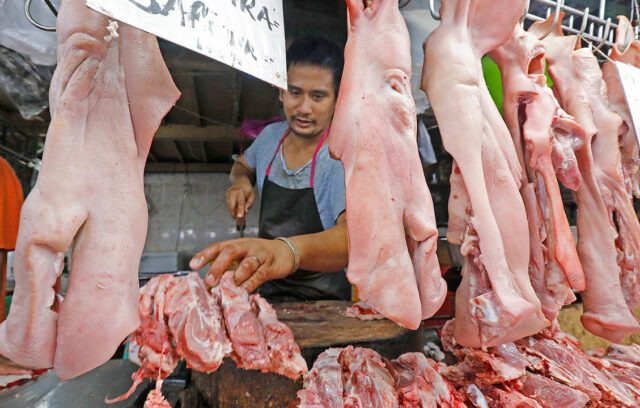
THE average retail price of rice fell to P47.15 per kilogram in the Aug. 1-5 period, which the Philippine Statistics Authority (PSA) calls the first phase of August, against P48.20 per kilo in the second phase of July.
The PSA said in a report that the month-earlier price had averaged P48.51.
The PSA said fresh bone-in pork averaged P333.74 per kilo at retail in the first phase of August, against P337.74 in the second phase of July and P338 in the first phase of July.
Meanwhile, the average retail price of galunggong (round scad) rose to P227.60 per kilo in early August from P220 in the second phase of July and P216.01 a month earlier.
A kilo of carrot fetched P169.69 at retail in the first phase of August, against P120.91 in the second phase of July and P115.38 in the first phase of July.
It said- carabao mango retailed for P164.07 per kilo in the first phase of August against P160.30 in late July and P156.33 in early July.
The average retail price of cooking oil rose to P184.47 per liter in early August from P182.72 in the second phase of July P182.16 a month earlier. — Kyle Aristophere T. Atienza

THE National Grid Corp. of the Philippines (NGCP) said it will require support to obtain expedited permits to connect offshore wind projects to the grid.
NGCP Assistant Vice-President Cynthia P. Alabanza said in a recent briefing that it is “very critical… to provide support to the transmission service provider in terms of approvals and cost recovery.”
The Philippines is aiming to unlock the potential of offshore wind for gigawatt-scale power generation, with the grid capacity deemed adequate for the projects being lined up.
She noted that the typical timeline for bringing offshore projects online is “7-10 years… even in developed countries,” but added that the grid can accommodate the projects currently being developed.
To date, the NGCP has 10,260 megawatts (MW) worth of capacity available for new power generation assets.
“Our actions in planning generation should be aligned and moving in the same direction (with transmission), so we can identify which areas to prioritize when new plants are quickly coming online,” Ms. Alabanza added.
The Department of Energy is preparing for the auction stage of the fifth green energy auction round (GEA-5) focused on offshore wind. This round will offer 3,300 MW of capacity, with installation targeted for between 2028 and 2030.
The NGCP recently started to recover its maximum allowable revenue and under-recovery, equivalent to an increase of P0.1013 per kilowatt-hour in the transmission charge.
This forms part of NGCP’s fourth regulatory period reset, spanning the 2016 to 2022 period. — Sheldeen Joy Talavera

By Justine Irish D. Tabile, Reporter
URBANIZATION outside Metro Manila is expected to drive demand for building modernization and elevator and escalator solutions, according to Finland’s KONE Corp.
“The megatrends are all positive, like urbanization, gross domestic product growth, the relatively young population, and how it’s driving people to the cities,” KONE Managing Director for the Philippines Petteri Kyrklund said on the sidelines of KONEct 2025 on Friday.
“There’s the trend that digitalization is also something that is helping the smart city initiatives. Many cities have already existing initiatives to make the cities smarter, greener, and sustainable. So all the megatrends are supporting long-term growth,” he added.
In particular, KONE projects the size of the Philippines’ elevator and modernization market to hit $52.6 million by 2030.
However, Mr. Kyrklund said he expects developments outside Metro Manila to drive growth for companies like KONE.
“I think it’s going to be more and more outside. Of course, most of the projects are still in Metro Manila. Modernization is 90% probably in Metro Manila, but the new-building growth will be more and more outside,” he said.
“This makes sense to me because why would you want to over-congest one place over others? So we already see massive growth in Bacolod, Cebu, Iloilo, and Davao. There are many places where the growth is going to be more and more,” he added.
He estimated the urbanization rate in the Philippines at about 49%, indicating that about 50 million people living in cities.
“By 2050, it is estimated to double, so it is going to be over 100 million. So, obviously this will put a lot of pressure on urbanization and the need to build taller and to have smart cities,” he said.
“The Philippines is a sizable market. It is a good market to be in because there are opportunities, and there is growth. The modernization market, I think, after Singapore, is very big here because there are also a lot of old buildings here,” he added.
He said that residential projects remain the industry’s biggest market.
“That is not specific to the Philippines. I think that is everywhere. So then we have office, retail, and hotels. And one that is growing very fast is medical. But residential continues to be the biggest,” he said.
He said most developers have been moving towards retail and hospitality but noted that the trend might be short-lived.
“In the long term I expect all of these residential buildings will bounce back. There is a lot of need for residential buildings in the Philippines, especially outside Metro Manila,” he added.
On Friday, the company introduced its KONE High-Rise MiniSpace DX elevator, which is designed for new and existing buildings over 150 meters.

THE Philippine Competition Commission (PCC) said that it has cleared the acquisition of Japan’s INFRONEER Holdings, Inc.’s of Sumitomo Mitsui Construction Co., Ltd.
“In its review, the PCC found that the two companies do not have horizontal overlaps — that is, they do not operate in the same line of business — and no vertical relationships, such as one company supplying goods or services to the other,” the PCC said in a statement sent over the weekend.
INFRONEER plans to acquire Sumitomo through a public takeover bid.
INFRONEER is involved in infrastructure services, while its subsidiaries are involved in construction, paving, manufacturing, and construction machinery sales.
According to the PCC, INFRONEER does not have direct construction operations in the Philippines.
“Because of this, the Commission concluded that the transaction is unlikely to result in a substantial lessening of competition in the local construction and infrastructure sector,” it added.
Sumitomo Mitsui Construction is active in Philippine infrastructure projects funded by Japanese official development assistance.
Its completed projects in the Philippines include the Taganito Hydrometallurgical Processing Plant Project, the Agas-Agas Bridge Project, and the Northern Negros Geothermal Power Plant.
It is also involved in the Metro Manila Subway Project and the North-South Commuter Railway Project.
“This assessment is part of the PCC’s mandate to ensure that mergers and acquisitions do not harm competition, restrict consumer choice, or hinder innovation in Philippine markets,” the PCC said.
“The PCC can also review transactions involving foreign entities if these meet the notification thresholds under the Philippine Competition Act,” it added.
If realized, the transaction will make Sumitomo Mitsui Construction a wholly owned subsidiary of INFRONEER along with Maeda Corp., Maeda Road, Maeda Seisakusho, and Japan Wind Development.
According to a notice dated May 14, the company aims to start the process of business integration in December. — Justine Irish D. Tabile

THE feeling of financial security and confidence in the short term is growing, though long-term confidence is weaker, according to the findings of a survey by Sun Life of Canada, Inc.
“These findings highlight both the resilience and the vulnerability of Filipino households. We are encouraged by the growing financial confidence and commitment to saving, but it’s clear that more support is needed to help families plan for the long term. Sun Life remains committed to empowering Filipinos through financial education, innovative products, and community engagement,” Sun Life Philippines Chief Executive Officer and Country Head Benedict C. Sison said in a statement.
Sun Life surveyed 1,000 respondents from the Philippines between April and May 2025.
Some 66% said they were confident in their ability to manage month-to-month finances, up from 57% a year earlier.
However, long-term financial confidence fell to 64% from 72% due to limited emergency savings.
“One in three Filipinos say that they could not last more than three months without external support following income loss or serious illness,” Sun Life said.
The survey also indicated that respondents are forced to delay major purchases to focus on day-to-day survival.
Some 61% said they are focused on managing day-to-day expenses over the next 12 months, with 45% saying they are building emergency funds. Starting a business and paying or saving for their children’s education tied at 34%.
When asked what respondents will focus on in the next three to five years, the top priority was building financial security.
About 45% said their long-term priority is saving for retirement, followed by saving for a home and building a financial legacy for their children at 39%, then building an emergency fund at 37%.
“This shift underscores the impact of inflation and cost-of-living concerns on financial planning.
Nearly all respondents reported that inflation has affected their ability to cover monthly expenses. The biggest cost increases were seen in food (73%), energy (60%), health (43%), and transportation (41%). In response, many are cutting non-essential spending and educating themselves about personal finance,” Sun Life said.
“Trust in banks (55%) remains high but has slightly declined, and cost remains a barrier to seeking professional advice. The rise of AI and digital sources reflects growing comfort with self-guided learning,” Sun Life said.
The survey also found a growing commitment to financial discipline, with 67% of respondents saying they save or invest at least 10% of their income, with 78% reviewing their investments at least monthly. — Aaron Michael C. Sy
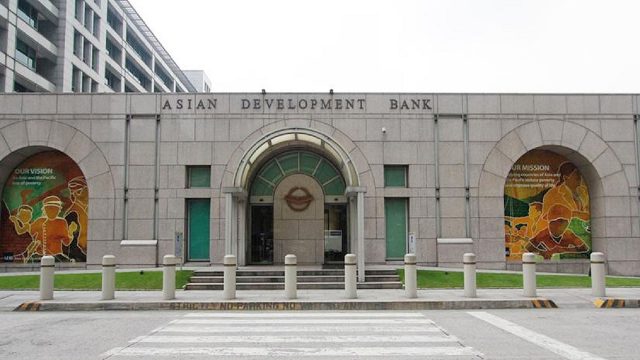
THE ASIAN Development Bank (ADB) said it included agriculture projects in the 2025 edition of its public-private partnerships (PPP) monitor for the Philippines.
“We have conceived this product as a comprehensive reference document of developing member countries’ PPP environment. It has details on the PPP regulatory and legal framework at the national and local level and also detailed analysis of sectors that are covered in the monitor, including transport, energy, as well as solid waste, health, education, housing, and financial. And for the first time, and for the Philippines, it includes agriculture and fishery. The reason for that is because we aligned the document with the country partnership strategy between Philippines and ADB, which highlights the catalytic role of the private sector in food security,” Isabelle Chauché, ADB Office of Markets Development and PPP, said in a speech on Friday.
A flagship ADB publication, the PPP Monitor profiles a country’s ability to successfully build and sustain PPPs.
The downloadable documents can be used by investors to identify priority sectors and helps governments identify gaps in legal, regulatory, and institutional frameworks.
“Agriculture is an important and timely focus. It is a priority for the government. It’s a priority for the Asian Development Bank. We together with the Department of Agriculture and other partners have been engaging with the private sector in ventures, such as the Dali supermarket chain. We are exploring opportunities in aquaculture and fishing ports etc.,” ADB Southeast Asia Department Director General Winfried F. Wicklein said.
The ADB noted that challenges remain in the Philippines’ PPP landscape, including delays in right-of-way or site acquisition by the government, political and regulatory risks, challenges within the implementing agencies such as weak absorptive capacity and coordination, and climate impacts.
Ms. Chauché added that climate change also poses a risk to PPPs in the Philippines, and cited “the need to properly assess any PPPs structure before processing.”
From 1990 to 2023, Ms. Chauché said 305 Philippine projects qualified as PPPs, valued at $25 billion to $50 billion.
“The PPP market growth has been driven by an active private sector and availability of liquidity.
57% of the PPP procurement has been done through unsolicited proposals. So as the capacity of the government and the LGU (grow), we expect this number to decrease to the single digits, as is the case of most of the PPP markets in the developed world,” she said.
“We are increasingly ramping up our work also with private sector on a non-sovereign basis,” Mr. Wicklein said. — Aaron Michael C. Sy

IN BRIEF:
• CMEPA introduces significant changes aimed at optimizing the taxation of capital markets through a simplified and equitable tax system.
• The law seeks to level the playing field by promoting a fairer tax structure that will empower ordinary Filipinos to participate in the capital markets and diversify their sources of income.
At the core of a civilized society lies a sound and progressive tax system that empowers the state to fulfill its functions and advances public welfare. In the Philippines, taxes accounted for approximately 86% of government revenue in 2024, supporting public expenditures across vital sectors such as education, healthcare, infrastructure, and national defense. This underscores the fundamental principle known as the lifeblood doctrine — that taxation is essential to survival of a nation.
However, beyond its primary role in fiscal adequacy, tax policy is also increasingly used as a tool in strategically regulating economic growth and development. Various governments place much emphasis on the design of tax structures that would not only raise the necessary revenue, but also influence investment and consumption, improve efficiency, and promote equity. Over time, the Philippine tax system has sought to achieve this through the introduction of landmark reforms, such as TRAIN, EoPT, CREATE and CREATE MORE, RPVARA, VAT on digital services, and, recently, Republic Act No. 12214, or the Capital Markets Efficiency Promotion Act (CMEPA).
Signed into law by President Ferdinand R. Marcos, Jr. on May 29, CMEPA introduces significant changes aimed at optimizing the taxation of capital markets through a simplified and equitable tax system.
KEY AMENDMENTS UNDER CMEPA
Effective July 1, CMEPA introduced a range of reforms that incentivize investments in capital markets and reduce transaction costs.
1. The uniform 20% final tax rate eliminates the exemption on interest income earned by individuals from time deposits with a maturity of at least five years (and consequently, the tiered rates upon pre-termination). Likewise, the 15% preferential rate on interest income from foreign currency deposits is increased. However, tax exemption and preferential rate on financial instruments issued or transacted prior to July 1 becomes subject to the prevailing tax rate at the time of its issuance for the remaining maturity of the relevant agreement.
2. CMEPA repeals the income tax exemption previously granted on gains derived from the sale and other disposition of bonds with a maturity period of more than five years.
3. Foreign shares not traded through a stock exchange are subject to the 15% capital gains tax.
4. Significant reduction in stock transaction tax from 0.6% to 0.1% of the gross selling price or gross value in money. Notably, the scope is expanded to cover not only the sale or exchange of shares listed and traded through a local stock exchange, but also the disposal of domestic shares listed and traded on foreign stock exchanges.
5. The documentary stamp tax for the original issuance of shares of stock has been reduced from 1% to 0.75% based on the par value of such shares of stock (now comparable to the rate on debt instruments).
CMEPA UNDER A CRITICAL LENS
While CMEPA is relatively new, it has generated considerable buzz. Although generally praised by policymakers and market stakeholders, the law has also drawn controversy, fueled in part by the rapid spread of misleading information on social media. The alleged imposition of taxes on savings prompted strong backlash and panic from the general public. The Department of Finance (DoF) has since clarified that the law merely standardizes existing tax rates and does not impose a new tax on savings. Instead, CMEPA corrects a long-standing imbalance in the tax system that disproportionately favored the wealthy. According to the DoF, the law seeks to level the playing field by promoting a fairer tax structure that will empower ordinary Filipinos to participate in the capital markets and diversify their sources of income.
Despite this clarification, skepticism remains. Critics argue that many of the law’s benefits, such as simplified tax rates, lower transaction costs, and alignment with regional markets, disproportionately favor the high-income earners who are more likely to own and invest in stocks and bonds. Even tax reforms that seem neutral, such as the flat 20% final tax rate, may have a regressive impact, especially for small savers to whom every peso of interest income counts.
These criticisms highlight deeper systemic issues in economic disparity. As of 2024, the Bangko Sentral ng Pilipinas (BSP) reported that only 25% of households had savings, majority of which kept their money in a bank. With the remaining 75% of households lacking the necessary disposable income to save, investing is not just hard; it seems impossible. In addition to economic disparity, the Philippines also faces the problem of financial literacy. In 2021, only 2% of Filipinos were able to correctly answer all six basic financial literacy questions in the Financial Inclusion Survey conducted by the BSP.
The inadequacy in financial knowledge renders the general public vulnerable to predatory financial schemes, poor investment decisions, and fake news — as seen in the recent backlash over the misinterpretation of CMEPA’s provisions. Given the current situation, even the most well-intentioned tax reform remains out of reach to the ordinary Filipino. The question remains, then: who is best positioned to take advantage of and benefit from efficient capital markets?
Despite these challenges, the government has made strides toward building a more inclusive financial system. The National Strategy for Financial Inclusion (NSFI) developed a roadmap that aims to improve access to finance, especially for the underserved. Since its launch, account ownership in the Philippines has increased from 29% in 2019 to 56% in 2021, with over 22 million Filipinos gaining access to formal accounts (e.g., e-money, bank deposit, accounts with microfinance NGO, cooperatives and savings & loan associations, etc.). The NSFI also reported key milestones in the promotion of digital finance, strengthening financial education, and consumer protection.
A LONG-TERM VISION OF FINANCIAL INCLUSION
It is important to recognize that CMEPA is part of a broader, long-term strategy. As the Organisation for Economic Co-operation and Development (OECD) acknowledges in one of its tax policy studies, while certain tax reforms are intended to improve economic performance, they can also lead to temporary inequities in the tax system. Particular groups may benefit more in the short run while others bear a disproportionate share of the costs. Since the economic benefits of these tax reforms are usually realized over time, the efficiency gains cannot immediately offset the additional burden felt by the marginalized.
As policymakers navigate the trade-offs between efficiency and equity, they must remain vigilant to ensure that tax reforms do not deepen existing inequalities. A truly progressive tax system isn’t just about growth — it’s about growth that includes everyone, especially the underserved and vulnerable communities.
While many Filipinos may not immediately benefit, the goal is to gradually open the capital markets to a wider base of participants through lower transaction costs, optimized tax structures, and simplified compliance. These tax reforms can eventually create a more accessible financial system where even smaller Filipino investors can start to build wealth.
While there is still much work to be done, the goal to democratize access to wealth-building opportunities is clear. If implemented in tandem with inclusive strategies, CMEPA may truly realize its goal of efficient and accessible capital markets.
This article is for general information only and is not a substitute for professional advice where the facts and circumstances warrant. The views and opinions expressed above are those of the authors and do not necessarily represent the views of SGV & Co.
Jay A. Ballesteros is a financial services tax partner and Karenza Marie S. Gonzales is a financial services tax senior associate, both of SGV & Co.

By Kenneth Christiane L. Basilio and Chloe Mari A. Hufana, Reporters
PRESIDENT Ferdinand R. Marcos, Jr. should consider prioritizing the pending Freedom of Information (FOI) bills in Congress to help push for its approval, analysts said on Sunday, after he challenged investigative journalists to probe alleged irregularities in flood control projects.
“When the President acknowledges the role of investigative journalism, it naturally opens the door to FOI. Otherwise, it risks sounding like empty praise,” Ederson DT. Tapia, a public administration professor at the University of Makati, said in a Facebook Messenger chat.
“FOI is the institutional backbone of transparency; without it, rhetoric remains theoretical,” he added.
The President last week unveiled a list of top contractors that bagged most flood control infrastructure projects. Asked whether the firms had links to government officials, Mr. Marcos said it was the job of investigative journalists to dig deeper into the issue.
The Philippines lacks an FOI regime that would allow Filipinos access public information despite the 1987 Constitution recognizing the people’s right to know. An enabling law is needed for its full implementation.
Multiple FOI proposals filed since 1992 have failed to pass, primarily due to a lack of legislative urgency. A 2016 executive order by former President Rodrigo R. Duterte established FOI mechanisms for the Executive branch, but not for Congress or the Judiciary.
Its passage, however, comes with political risks, Mr. Tapia said.
“It can expose weaknesses not only in the executive but also in Congress and local governments,” he said.
“Allies may resist. But the benefits are strategic: it signals seriousness in fighting corruption, strengthens the President’s reformist image, and creates a legacy measure that future leaders cannot easily roll back.”
Anthony Lawrence A. Borja, an associate political science professor at the De La Salle University, said the lack of an FOI law keeps civil society groups “having limited capacity” to keep an eye on government transactions.
It may also hamper Mr. Marcos’ transparency initiatives, he added. “Without an external force, government ‘self-correction’ can end up being subject to patronage and partisanship, with the most loyal, useful, and powerful being excluded from the pursuit of accountability.”
Beyond FOI, the government should also look at coming up with programs that could improve interest towards demanding for public information, said Mr. Borja.
“This must be tied to stronger protection for investigative journalists if not a subsidy for this field to encourage its growth as an independent arm for transparency and accountability,” he said.
“Anything short of a comprehensive policy addressing both the supply and demand for transparency and accountability is nothing more than the perversion of good governance practices for partisan cleansing and patronage politics,” he added.
Other reforms should target tougher campaign finance transparency, stronger whistleblower protections, and stricter disclosure of statements of assets, liabilities and net worth (SALN), Mr. Tapia added.
The President last week launched the “Sumbong sa Pangulo” website, which serves as a platform for the public to track and report issues on flood control projects in their areas.
Data from the Presidential Communications Office showed the portal received 1,148 reports, 823 feedback entries, and nearly 85,000 views within three days.
This is in line with Mr. Marcos’ pronouncement during his fourth State of the Nation Address, during which he lambasted those involved in alleged anomalies.
2028 ELECTION NARRATIVE
Meanwhile, the President’s efforts to deliver on his policy agenda, specifically on anti-corruption and transparency, could help him carve out a distinct political identity while strengthening his chances of shaping the 2028 presidential race, according to a political analyst.
“Mr. Marcos delivering on this policy has the potential to cover two grounds: it gives his base a narrative of achievement and policy leadership that cannot be undermined by the perceived dominance of his cousin, [House] Speaker [Ferdinand Martin G.] Romualdez, and it will bolster the narrative of succession if they so push that,” Hansley A. Juliano, political science lecturer at the Ateneo de Manila University, said via Facebook Messenger.
Such a move could also appeal to voters hesitant to back the Marcos brand, particularly those from the opposition, if the President projects himself closer to reform-oriented or technocratic leaders rather than his populist allies, he added.
The stakes are high as Mr. Marcos seeks to cement his legacy amid intensifying political maneuvering ahead of 2028. His ability to project stability and reformist credentials could define not only his administration’s standing but also shape the broader contest between the Marcos and Duterte camps — two dynasties whose rivalry is increasingly setting the terms of Philippine politics.
Once a formidable tandem that resulted in a landslide win during the 2022 presidential race, Mr. Marcos and Vice-President Sara Duterte-Carpio’s “UniTeam” last year broke up after the revelations of Ms. Duterte’s alleged fund misuse and her threats against the First Family. These have been cited as grounds for the impeachment of Ms. Duterte in February, which was declared unconstitutional by the Supreme Court in July.
The Philippines’ surrender of Ms. Duterte’s father to the International Criminal Court for alleged crimes against humanity for his deadly war on drugs in March, further soured the two top government officials’ relationship.
Still, Mr. Juliano warned that economic headwinds remain a major obstacle.
“Inflation and bigger ‘food on table’ issues do not go away [easily],” he said. “This may not automatically translate to the youth and the public — with a whole lot of our people terminally online, it’s likely to go up against the strong disinformation network still servicing the Dutertes.”
To offset this, Mr. Marcos and his allies may lean on traditional political influence centers such as local government networks, churches and community organizations, Mr. Juliano added.
Allowing greater freedoms for civil society groups could also prove strategic, especially as many have grievances directed at the Vice-President and her camp.
“Mr. Marcos has no shortage of issues himself, but the narrative against Ms. Duterte’s corruption spending has clearly stuck. It is in his interest not to be seen as no different,” Mr. Juliano noted.

By Adrian H. Halili, Reporter
MANILA should take advantage of its defense ties with Tokyo to improve its self-reliant capabilities, analysts said, as the Japan-Philippines reciprocal access agreement (RAA) is set to take effect next month.
Chester B. Cabalza, founding president of Manila-based think tank International Development and Security Cooperation said that the RAA will support the Philippines’ attempt at improving its defense posture.
“The RAA will become an equalizer for the Philippines in its bid to succeed in its second attempt for self-reliance defense posture and building a robust industrial defense complex,” Mr. Cabalza said in a Messenger chat.
Last week, the Philippines and Japan exchanged diplomatic notes on the implementation of the RAA on Sept. 11.
The RAA, signed by Manila and Tokyo in July last year, allows for the entry of equipment and troops for military drills and disaster responses on each other’s soil.
It was ratified by the Philippine Senate in December 2024, while Japan’s National Diet ratified it in early June.
“By operationalizing the RAA, these defense plans and strategies will be tested to maintain a free and open Indo-Pacific with Japan and the Philippines creating game-changing norms in the region,” he said.
He added that the pact not only expands strategic relations between the Philippines and Japan militarily but also to diplomatic and economic significance.
“By enforcing the RAA, Japan and the Philippines pledged to train their soldiers in both countries, exchange security information, and boost its defense relations,” Mr. Cabalza said.
It also allows the Philippines to adopt best practices, in support of its self-reliant defense aspiration, Josue Raphael J. Cortez, a diplomacy lecturer at De La Salle-College of St. Benilde said.
“Forging such alliances may help out our troops to learn and share best practices with foreign counterparts, and at the same time allow our very own to gain access to defense assets that are integral for us to attain our goals and promote our national interests,” Mr. Cortez said in a Messenger chat.
He added that once the RAA is effective next month Japanese warships can now support patrolling over the South China Sea amid increasing Chinese presence.
“Despite us not aiming to employ force to promote our territorial integrity, it is high time that the Philippines further strengthen its presence over what is rightfully ours as Beijing seemingly props up its effort to challenge our sovereignty,” he said.
Manila can also utilize the defense partnership by getting Japan’s support for its modernization efforts, Lucio B. Pitlo III, a research fellow at the Asia-Pacific Pathways to Progress Foundation, said.
“Manila can leverage this RAA to obtain support for its coast guard and military modernization through donations or favorable arms sales or concessional loans to finance construction of new patrol ships,” he said in a Facebook Messenger chat.
Mr. Pitlo said that the Philippines can also encourage more Japanese investors to develop its domestic defense and shipbuilding industry through the expansion of existing shipyards and creating a maintenance and repair hub for Japanese-transferred ships or providing technology.
“This can potentially provide Japan access to strategic Philippine sites where it can deploy assets. The agreement is expected to increase interoperability between the two-armed forces and their readiness to work together, likely alongside other allies and partners, to respond to contingencies,” he added.
The Philippine-Japan access deal is the first of its kind to be signed by Japan in Asia and coincides with increased Chinese assertiveness in the South China Sea, where Beijing’s expansive claims conflict with those of several Southeast Asian nations.
Manila has been seeking to bolster its defense capabilities amid worsening tensions with China in the South China Sea. It has also increased its defense budget, with about $35 billion allotted to modernize its military in the next decade.
A MEASURE seeking to mandate a 14th month pay for all private sector workers has been filed in the Senate amid the rising costs of basic goods and services.
“The needs and cost of living of every Filipino worker have drastically changed, thus it is high time that employees in the private sector receive their 14th month pay,” Senator Vicente C. Sotto III said in a statement on Sunday.
Under Senate Bill No. 193, the 14th Month Pay bill, Mr. Sotto proposed that the minimum amount of the 14th month pay should not be less than one-twelfth of the total basic salary earned by the employee within the calendar year. He had filed a similar bill during the 18th Congress.
It covers all non-government rank-and-file employees, workers under Republic Act No. 10361, the Kasambahay Law, and others already entitled to a 13th month pay, provided they have worked for at least one month during the calendar year.
Presidential Decree No. 851 of 1976 already requires employers to pay workers a 13th month pay.
The bill also proposed the release of the 13th month of workers should not be later than June 14, while their 14th month pay should be received not later than Dec. 24 of every year.
The proposed payment schedule is intended to help parents in shouldering educational expenses and the incoming year-end holiday celebrations, Mr. Sotto said.
He noted that the frequency of payment of the benefit should be the subject of agreement between employer and employee or any recognized collective bargaining agent of employees.
Meanwhile, the bill exempts distressed employers, the government, employers already providing a 14th month pay, or its equivalent.
“The bill has exemptions for qualified employers so as not to burden struggling businesses as they are equally important for our economy,” he added. — Adrian H. Halili
