Home Blog Page 5879

Korean pop band BTS taking a break to work on solo projects

BTS danced its way through the United Nations — SCREENSHOT FROM YOUTUBE.COM/UNITEDNATIONS

BTS, the South Korean band that spearheaded a global K-pop craze, is taking a break as a group to work on solo projects, the singers announced on Tuesday.Band member RM, speaking at the annual FESTA dinner that celebrates the group’s founding, said he had been feeling a need to explore his own work without the constant recording and performing required of BTS.“The problem with K-pop and the whole idol system is that they don’t give you time to mature. You have to keep producing music and keep doing something,” said RM, seated at a table with his six fellow band members and speaking in Korean.A video of the dinner was posted on the band’s official Twitter handle.An English translation of the remarks showed one of the members calling the break a “hiatus,” a description a representative for the band disputed in a statement.“To be clear, they are not on hiatus but will take time to explore some solo projects at this time and remain active in various different formats,” the statement said.BTS made its debut in June 2013 and became a worldwide sensation with its upbeat hits and social campaigns aimed at empowering young people. The group released its new album, “Proof,” on Friday.Last year, BTS became the first Asian band to win artist of the year at the American Music Awards. The group met U.S. President Joe Biden at the White House in May to discuss hate crimes targeting Asians. — Reuters


Energizing winds blow at Okada Manila with new changes

Kazuo Okada delivers inspiring message during town hall meeting

A whiff of fresh air is blowing through Okada Manila, one of the biggest casino resort and hotel complexes within the Entertainment City. Tiger Resort Leisure and Entertainment, Inc. (TRLEI) was granted a license to operate a casino in 2007. The integrated resort formally opened to the public on March 31, 2017.

After a five-year hiatus, Kazuo Okada, its founding Chairman, is now back at the helm bringing a renewed vibrancy and excitement to this iconic integrated resort.

Fondly called “Daddy O,” Kazuo Okada addressed employees at a recent town hall after being back at the helm to bring a renewed vibrancy and excitement to the iconic integrated resort.

On June 6, Mr. Okada warmly addressed the Board of Directors and valued team members of Okada Manila during its first-ever Town Hall Meeting in five years. In his speech, Chairman Okada stated that he wants nothing more than for Okada Manila’s senior management to have greater interaction and an “at arm’s length” accessibility with his Board of Directors. He also emphasized that it is his fervent desire for all stakeholders to know that his Board of Directors is sincere in its pursuit to better serve the needs of its employees while at the same time elevating Okada Manila to greater heights of success.

Mr. Okada considers all employees as his Okada Manila family. He encouraged everyone to remain steadfast and unified in their commitment to the company as well as the esteemed guests they serve. He expressed his immense gratitude for their continued service and support throughout the transition, and was extremely pleased to let them know how much they are valued. Mr. Okada considers each single employee’s contribution to the company as being worthy of recognition.

Meanwhile, Okada Manila is pleased to announce — Business As Usual. Borders are opening up and international travel and tourism are primed for a comeback. Under the able leadership of Mr. Okada, whom employees fondly call “Daddy O,” Okada Manila is poised to seize the opportunity for business growth with enhanced services and exciting new attractions and promotions. Awarded the Forbes Five Star for two consecutive years, Okada Manila invites you to come and experience for yourself the distinctive brand of luxury, world-class amenities, as well as the hallmark Japanese hospitality — “Omotenashi.


Spotlight is BusinessWorld’s sponsored section that allows advertisers to amplify their brand and connect with BusinessWorld’s audience by enabling them to publish their stories directly on the BusinessWorld Web site. For more information, send an email to online@bworldonline.com.

Join us on Viber to get more updates from BusinessWorld: https://bit.ly/3hv6bLA.

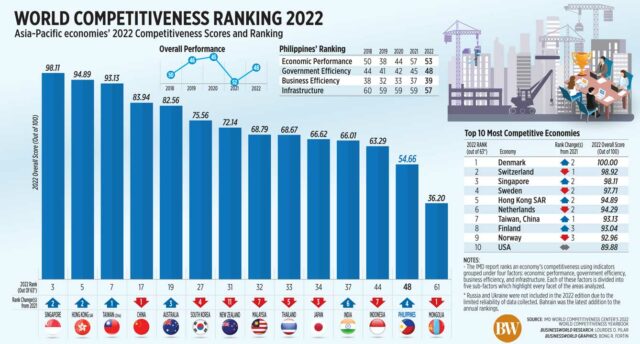
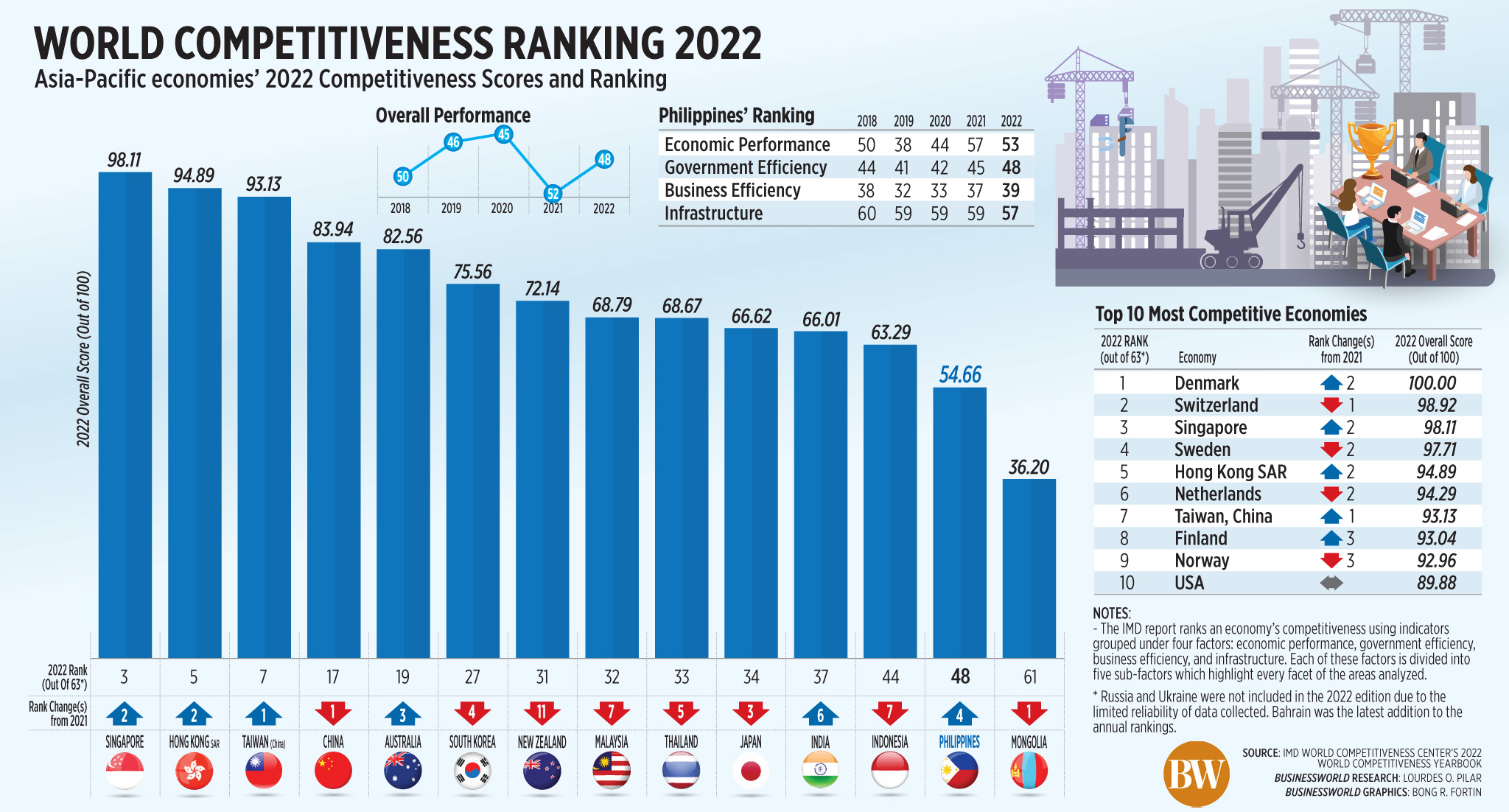
World Competitiveness Ranking 2022

THE PHILIPPINES climbed four spots in an annual global competitiveness report by Switzerland-based International Institute for Management Development (IMD), due to the economy’s improved performance. Read the full story.


PHL competitiveness ranking improves

Paper lanterns are displayed to form the Philippine flag at a mall in Manila, June 12. — PHILIPPINE STAR/KRIZ JOHN ROSALES

By Revin Mikhael D. Ochave, Reporter

THE PHILIPPINES climbed four spots in an annual global competitiveness report by Switzerland-based International Institute for Management Development (IMD), due to the economy’s improved performance.

IMD’s 2022 World Competitiveness Yearbook ranked the Philippines 48th out of 63 economies, from the 52nd spot out of 64 economies in 2021. This was the Philippines’ highest ranking in two years or since placing 45th in 2020.

However, the country continued to lag behind its neighbors, placing 13th among the 14 Asia-Pacific economies in the index for the fifth straight year.

IMD ranked each country’s competitiveness using 333 indicators grouped under four factors: economic performance, government efficiency, business efficiency, and infrastructure.

“The Philippines saw improvements in its Economic Performance, wherein the country currently ranks at 53rd, a jump from 57th in 2021,” the Asian Institute of Management (AIM) Rizalino S. Navarro Policy Center for Competitiveness said in a statement. The center has been the IMD’s Philippine partner institute in producing the competitiveness yearbook since 1997.

The country’s GDP expanded by 5.7% in 2021, as the economy gradually reopened after strict lockdowns. In the first quarter of 2022, GDP grew by 8.3%.

While infrastructure ranking rose two places to 57th spot, it is still the lowest among the competitiveness factors for the Philippines, particularly in terms of health and education infrastructure.

However, the Philippines slid to 48th in terms of government efficiency from 45th in 2021, due to the decline in public finance to 51st from 45th in 2021. This was mainly due to the deterioration of the budget deficit and outstanding debt as the government ramped up spending and borrowings to finance its coronavirus disease 2019 (COVID-19) pandemic response.

The budget deficit stood at P311.9 billion as of end-April, while outstanding debt rose to a record P12.76 trillion.

The Philippines also saw a drop in business efficiency, slipping to 39th from 37th last year, as productivity and efficiency declined six spots to 56th place. Overall productivity plunged to 57th place in this year’s ranking, from 10th in 2021, which IMD said reflected the negative impact of the COVID-19 pandemic.

IMD said the Philippines will continue to face challenges this year, such as implementing effective strategies to drive recovery from the pandemic while strengthening fiscal responsibility and reducing poverty.

The country also needs to promote “innovative governance” and ensure smooth post-election transition of power, as well as develop “future-ready” health and education systems. It also has to invest in sustainable infrastructure and reduce climate change vulnerability, the IMD said.

University of Asia and the Pacific (UA&P) Senior Economist Cid L. Terosa said in an e-mail interview with BusinessWorld that the country’s improved ranking sends a positive signal to potential investors. 

“The ranking of the Philippines improved because of its better economic performance and improved state of infrastructure. In particular, increasing real GDP growth, higher gross capital formation, evident macroeconomic stability, and greater employment creation propelled the Philippines to a higher ranking,” he said.

Foundation for Economic Freedom (FEF) President Calixto V. Chikiamco in a mobile phone message attributed the higher ranking to the government’s better handling of the pandemic, fiscal management, strong foreign exchange reserves, and the continuing attractiveness of its workforce.

European Chamber of Commerce of the Philippines (ECCP) President Lars Wittig said in a mobile phone message that businessmen keep a close eye on these international benchmarks since they provide “a snapshot of the economic health of the country which guide business and investment decisions.”

“The ECCP recognizes substantive benefits of the government’s recent milestones that will further drive global competitiveness and economic development. This includes the amendments to the Public Service Act (PSA), Foreign Investment Act (FIA) and Retail Trade Liberalization Act (RTLA) which will make the Philippines a more attractive destination for trade and investments,” he added.

Rizal Commercial Banking Corp. Chief Economist Michael L. Ricafort said in a Viber message that the continued economic reopening increased business activity.

“The country’s improved ranking may have to do with the further reopening of the economy towards greater normalcy after some pockets of hard lockdowns and other restrictions last year. This increased economic/business activities in the country, allowed many businesses/industries to reopen again, operate at higher capacity, hire more workers, book more sales and income, thereby fundamentally leading to better economic recovery prospects,” Mr. Ricafort said.

According to UA&P’s Mr. Terosa, the incoming administration of President-elect Ferdinand “Bongbong” R. Marcos, Jr. can further boost the competitiveness ranking by addressing corruption, sustaining infrastructure development, lowering unemployment, stabilizing inflation, reducing poverty, among others.

Mr. Marcos is set to take his oath of office on June 30.

ECCP’s Mr. Wittig said that the incoming Marcos administration should build on the gains made by the previous administrations in order to improve the country’s competitiveness ranking.

“Building on the gains of the previous administrations is imperative to cushion socioeconomic shocks and advance recovery, coupled with the continued widespread deployment of the national vaccination program,” Mr. Wittig said. 

“More sustainability-related reforms, investments in human resources (education, nutrition, wellness) as well as institutional reforms on good governance and transparency should also be in the front and center of policy priorities to improve the country’s ranking moving forward,” he added.

MOST COMPETITIVE
Denmark topped the competitiveness index, followed by Switzerland, Singapore, Sweden and Hong Kong. The rest of the top 10 included the Netherlands, Taiwan, Finland, Norway, and the United States.

Singapore had the highest competitiveness ranking among the Asia-Pacific economies, followed by Hong Kong, Taiwan, China, and Australia.

Many economies are now feeling inflationary pressure, according to Christos Cabolis, IMD World Competitiveness Center chief economist.

“Other global challenges having an impact on the competitiveness of countries include variants of COVID-19 appearing under different intensity with respect to the number of infected people around the world; differing national policies to address COVID (the ‘zero-tolerance COVID’ policy versus the ‘moving on from COVID’ policy); and the invasion of Ukraine by Russia,” Mr. Cabolis said.

The countries covered by the 2022 World Competitiveness ranking were different from the 2021 report after Bahrain was included while Russia and Ukraine were excluded in this year’s report because of the ongoing war.

Cutting infrastructure spending will hurt economy’s recovery, DoF says

PHILIPPINE STAR/ MICHAEL VARCAS

THE GOVERNMENT should not reduce infrastructure spending as this may hurt the economy’s recovery, the Finance department said.

In an economic bulletin on Tuesday, Department of Finance (DoF) Chief Economist Gil S. Beltran said it is important to continue infrastructure investments “due to its positive impact on competitiveness and economic recovery.”

“Cutting infrastructure spending may narrow down the deficit momentarily but will definitely be counter-productive in the long-run as far as economic recovery is concerned,” Mr. Beltran said.

“Simply put, a half-finished bridge does not cut travel time even by a minute. Stopping construction works midway through the project cycle deprives the economy of the opportunity to immediately benefit from the catalytic effects of infrastructure investments.”

The budget deficit stood at P311.9 billion as of end-April, narrowing by 14.75% from a year ago as tax revenues reached P1 trillion, up 12% year on year. Expenditures, on the other hand, rose by 6.6% due to higher interest payments and allotments for local government units (LGUs).

In the first quarter, public infrastructure spending went up by 4% to P252.8 billion, despite the election ban on new projects. The government is planning to spend P1.27 trillion, equivalent to 5.9% of gross domestic product (GDP), on infrastructure this year.

The incoming Marcos administration has already signaled it will continue the Duterte administration’s infrastructure program.

Mr. Beltran said the medium-term fiscal program shows a declining trend in the deficit, “largely on account of expenditures rising more slowly than GDP but that infrastructure spending is not sacrificed.”

The Development Budget Coordination Committee (DBCC) lowered slightly the budget deficit target to 7.6% of GDP this year, from 7.7% previously, which reflects the impact of the Russia-Ukraine war, China’s slowdown, and monetary policy normalization in the United States.

The DBCC set the deficit goal at 6.1% of GDP for 2023, 5.1% for 2024, and 4.1% for 2025.

Infrastructure spending is projected at 5.4% of GDP for 2023 and 2024, and 5.3% of GDP for 2025.

Fiscal consolidation and recovery will be key in preserving fiscal stability, Mr. Beltran said.

“The planned fiscal consolidation rests on shoring up tax revenues, winding down pandemic-related spending, and cutting non-priority expenditures,” he said.

Finance Secretary Carlos G. Dominiguez III last month proposed a fiscal consolidation plan that involves imposing new tax measures, repealing some tax exemptions, and deferring  personal income tax reductions.

Mr. Dominguez has said the government cannot cover the existing debt incurred during the pandemic by borrowing more or reducing spending every year.

The National Government’s outstanding debt stood at a record-high P12.76 trillion at the end of April.

Mr. Beltran also said the devolution of functions to LGUs and reforms in the pension system of the military and uniformed personnel, is expected to ease the fiscal burden on the National Government.

“Resuming pre-pandemic economic growth rate calls for safely living with the virus and fast-tracking the recovery process. We already have an ongoing infrastructure program and have cut corporate income taxes in a bid to attract more investments,” Mr. Beltran said.

The DBCC set a 7-8% GDP growth target for 2022, as the economy continues to recover from the pandemic.

PHL seen to expand 6% this year

PHILIPPINE STAR/ MIGUEL DE GUZMAN

THE PHILIPPINE economy is likely to expand by 6% this year, taking into account the headwinds that would likely affect growth, incoming Socioeconomic Planning Secretary Arsenio M. Balisacan said.

“[The] inflation that we are seeing is very much imported, and obviously, will temper our growth a bit. We were expecting growth at the beginning of the year to be around 7-8%, but many things have happened since then, and we are still confident that we’ll achieve 6% growth, and that already takes into account the problems in the global and domestic markets,” he said in a Bloomberg TV interview on Monday.

Last month, the Development Budget Coordination Committee (DBCC) lowered the gross domestic product (GDP) growth target to 7-8%, from 7-9% previously, reflecting the impact of the Russia-Ukraine war, the economic slowdown in China, and monetary policy tightening in the United States.

Inflation accelerated to 5.4% in May, the highest in three and a half years, as fuel and food prices continued to climb amid the ongoing Russia-Ukraine war and supply chain disruptions.

The DBCC also raised the average inflation rate assumption to 3.7-4.7% for 2022, from 2-4% previously.

“The goal is to rapidly ramp up our economic recovery while living with the uptick in prices,” Mr. Balisacan said.

“We’ll have to improve our capacity to address supply bottlenecks. We’ll need to work closely with our trading partners, and make sure we have access to food supply in particular, and basic inputs needed for manufacturing and other industries.”

Mr. Balisacan, who is currently the chairman of the Philippine Competition Commission, said the incoming administration will continue the Duterte administration’s flagship infrastructure projects.

“Given the backlogs in our infrastructure programs, and the infrastructure needs for our economic development, we definitely need to sustain the ramping up of our infrastructure development,” he said.

The Department of Public Works and Highways said only 12 out of 119 flagship projects have been completed as of April.

Asked how the government will fund these projects, Mr. Balisacan said: “We will resort to other means, both internal and external… By external, I mean bilateral and multilateral sources. By internal, I mean the government sources and with our private sector.”

“We will invigorate our public-private partnership thrust to building infrastructure,” he added.

Mr. Balisacan said the private sector’s participation in infrastructure projects is obvious, “given the fiscal bind we are facing.”

“Besides, we also believe this private sector can bring in innovations, technologies in the improvement and management in our public services. There is much that can be gained from getting the private sector involved in our infrastructure development.”

For this year, the government has set aside P1.199 trillion, or 5.5% of GDP, for its infrastructure program. — TJT

Raw material snarls in Korea to ripple across Asia factories

STOCK PHOTO | Image by Vitamin from Pixabay

SOUTH KOREA’S trucker strikes are threatening to disrupt wider supply chains in Asia as warehouses fill up with undelivered raw materials used to make everything from clothing to cars.

Petrochemicals have been one of the hardest hit sectors by the week-long action by truck drivers. Prolonged disruptions to logistics are likely to force South Korean companies that supply a diverse array of chemical products to cut production, impacting factories elsewhere in Asia that use the material to make consumer goods.

LG Chem Ltd. and Hanwha Totalenergies Petrochemical Co. warned Monday that they would most likely have to at least partly suspend output at some plants if the strike continues. Hanwha Solutions Corp. has reduced shipments of polyvinyl chloride and polyethylene by 50%, while its solar panel exports have also been affected, the company said Tuesday.

Companies told authorities they are cutting output at Yeosu National Industrial Complex — home to some 297 petrochemical firms — as they have little room for stockpiles, according to a city official.

The situation is concerning as South Korea is a major exporter of the chemical paraxylene to the Chinese textile industry and one of the largest sellers of PVC to Asian factories, according to Parsley Ong, the head of Asia energy and chemicals research at JPMorgan Chase & Co. The nation also exports synthetic latex and acrylonitrile butadiene styrene used in the auto industry to Northeast Asia and elsewhere in the region.

“The trucker strike increases the challenges that chemical producers are already facing from high feedstock costs and a demand slowdown,” Ong said in an e-mailed reply to queries.

The disruption is dealing a further blow to ethylene cracker operators, which transform naphtha from refineries into plastic products. About 20 million tons per annum of ethylene capacity across Asia has already cut operating rates due to a slowdown in the global economy, according to JPMorgan estimates.

Shipping delays may add to the problems. At the port of Busan, wait times for export containers have surged to 11 days, compared with the median dwell time of three days in the past three months, according to logistics intelligence provider Project44.

The logistics snarls may also impact raw materials coming into South Korea. Import containers are waiting 14 days at the port, up from four days before the strikes, according to Project44.

Yard capacity at the world’s seventh-biggest container port is fast approaching 80%, compared with about 70% in May, as container boxes stack up, according to data from the transport ministry Tuesday. South Korea’s HMM Co. said that while its ships are loading and unloading cargo at Busan without major issues, operations will start to be affected should the strike drag on into this week. — Bloomberg

Copyright fight: Ballet Philippines risks losing ‘treasure trove’ of dance

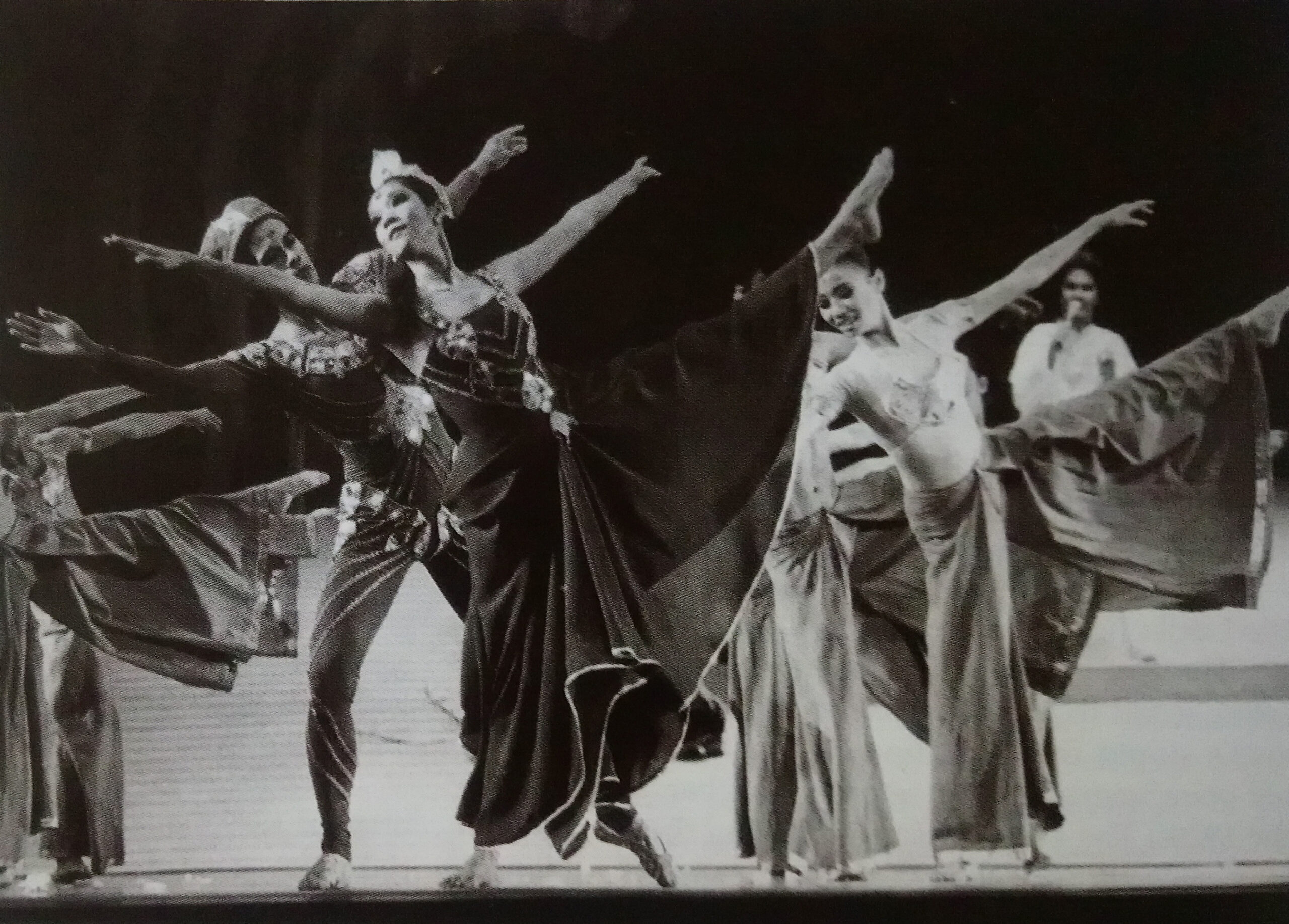
THE 1980 staging of Rama Hari, choreographed by Alice Reyes who also performed. — PHOTO COURTESY OF RUDY VIDAD, BALLET PHILIPPINES COLLECTION

By Sam L. Marcelo, Multimedia Editor

THE ACRIMONIOUS relationship between the board of Ballet Philippines (BP) and the company’s founder, National Artist for Dance Alice G. Reyes, has turned litigious, prompting choreographers to copyright their creative work to prevent BP from claiming ownership of their dances.

Ms. Reyes, who was named a Gawad Yamang Isip Awardee by the Intellectual Property Office of the Philippines (IPOPHL) on June 6, has been helping dance artists protect their work. Her crusade picked up steam after one of her pieces became the subject of a cease-and-desist letter sent by BP.

“Filipino artists just want respect,” said Ms. Reyes, in a conversation with BusinessWorld. “Royalties would be nice but, really, we just want respect.”

Until the dispute is settled, BP’s status as a resident company of the Cultural Center of the Philippines (CCP) is “on hold,” said Chris B. Millado, outgoing CCP vice-president and artistic director, via Zoom on June 8.

Mr. Millado, whose last official day with the CCP is on June 15, added that BP’s privileges, such as subsidies from the CCP and the use of its venues, have been under evaluation since the beginning of 2022.

The ballet company launched its 53rd season in Gallery by Chele in Taguig City this May with the theme “Dance Where No One Else Has.

“Ballet Philippines is going somewhere where no one has danced before. … It does not just pertain to destination or location. We’re talking about the new mindset and that is collaborations with like-minded people and institutions,” said BP President Kathleen “Maymay” L. Liechtenstein, in a speech delivered at the event.

‘STAKING A CLAIM’
On Oct. 16, 2021, two days after Ms. Reyes’s 79th birthday, BP wrote a cease-and-desist letter to Mr. Millado demanding that CCP stop broadcasting the dance Itim Asu — a work that Ms. Reyes choreographed in 1970 and remounted in 2020 as part of the show Alice and Friends.

(See “‘Total fail’: How communication breakdown broke Ballet Philippines’ leg”)

“BP has intellectual property rights to the ballet work as it was created for BP,” stated the letter signed by Ms. Liechtenstein.

The letter also reiterated that BP “does not give consent to CCP to stream in CCP’s virtual platforms” five productions that were mounted by, or choreographed in whole or in part by Ms. Reyes.

Aside from the aforementioned Itim Asu, and Alice and Friends, BP named three shows that were produced during Ms. Reyes’s return as BP artistic director from 2017 to 2020: A Gala Celebration (2017), The Exemplars (2017), and Tales of the Manuvu (2019).

To wit: BP, a resident company of the CCP, sent a cease-and-desist letter to the CCP over Itim Asu, a dance that BP founder Ms. Reyes:

  • choreographed in 1970, at the behest of the League of the Filipino Composers and the CCP, and
  • remounted in 2020 with the help of a CCP grant.

“You own it from the moment you create it,” said Ms. Reyes, referring to a choreographer’s rights to a piece — in this case, Itim Asu, which is based on Virginia R. Moreno’s award-winning play The Onyx Wolf (also known as La Loba Negra). “In fact, I have the copyright.”

Ms. Reyes is quoting the IP Code, which “grants authors, artists, and other creators, automatic protection for their literary and artistic creations, from the moment they create it.”

WHO OWNS WHAT?
While BP got several important details wrong in its demand (such as when Ms. Reyes created Itim Asu and for whom), the unresolved issue between BP and the coalition of CCP and Ms. Reyes raises larger questions: Who owns a dance and who should profit from it?

It’s complicated.

If Ms. Reyes wishes to mount a new production of Itim Asu — with a different look and feel — she can. And it is also Ms. Reyes who has the power to decide who gets to restage Itim Asu.

As summarized by Mr. Millado, while Ms. Reyes owns the rights to the choreography of Itim Asu — the dance itself — she does not own the rights to the sets, the costumes, and the lighting design of the 1970 production; or the music of Alfredo S. Buenaventura.

If she wants a faithful restaging of the 1970 original, she will have to get permission from her artistic collaborators or their estates since the production’s different parts are owned by different people. And the entire production itself is owned by its producer. (Ms. Reyes got the required permissions for her 2020 restaging. Ms. Moreno was sitting in the audience, as was painter Jaime De Guzman, who designed the sets.)

Neither does Ms. Reyes own the digital file of the 2020 performance that was streamed, or the storage medium (which might be a USB stick, a flash memory card, a CD, or a VHS tape) that it was recorded on — the CCP owns those.

If she wants to upload and stream CCP’s 2020 recording on her own platforms, she will have to ask permission from the CCP.

The CCP, on the other hand, will also have to get permission from the artists and companies involved if they want to stream recordings of live performances (which it did). If the CCP decides to charge people for viewing the streamed works, then artists can ask for royalties.

And if the CCP (or BP) wants to restage Ms. Reyes’ work, they will have to get her permission as well.

Complicating matters: there was no intellectual property system in the Philippines in the 1970s — IPOPHL just celebrated its 25th anniversary on June 6 (hence Ms. Reyes’s award) — and contracts then didn’t account for, say, YouTube and other streaming services.

Goodwill was the grease that kept artistic projects going (spoiler: it still is).

“No copyright rules existed during that time, no written contracts covered ownership,” said CCP’s Mr. Millado. “It’s all retroactive — what’s happening now — and people are staking a claim.”

The pandemic, which forced the creative sector to pivot online when restrictions shuttered live performances, highlighted how recordings — previously thought of as archival material — can be monetized.

According to Mr. Millado, there are several compensation models depending on the circumstances of the broadcast. If a show is uploaded and distributed for free to the public on a specific platform for a limited period of time, the CCP informs artists and offers a token fee, which is often waived.

If the CCP charges audiences for streaming a show, then it might offer its creator a one-time royalty of 15% of their original fee for mounting the production; or pay a minimum amount, with the promise of a percentage of the profit, assuming the show earns.

“It’s more work for arts managers but that’s how you make the sector sustainable. That’s where you enter into ‘creative industry,’” he said.

“They [artists] see that there is an economic opportunity in asserting their moral rights to their intellectual property,” added Mr. Millado. “Performing artists and choreographers are still quite ambiguous about their rights, that’s why they are usually at the mercy of the ‘producers.’ … They need to know what they own, how to protect it, and how they can earn from it.”

Commenting on Ms. Reyes’ Itim Asu, the CCP artistic director said: “If there are no written contracts that say that a company owns a commissioned work or that the artist gives up moral and economic rights to a certain piece, then what prevails is the intellectual property rights law, which is that the work is the ownership of the original creator.”

According to the IPOPHL website, “registration and deposit of works isn’t necessary but authors and artists may opt to file for the copyright registration of their work with IPOPHL for the issuance of the appropriate certificate of copyright registration.”

This is a gross oversimplification of a thorny issue that is still with the CCP’s legal department and other agencies. It is also for this reason that IPOPHL cannot comment on the cease-and-desist letter.

BP did not reply to multiple requests for comment.

A BREAKUP IN THREE ACTS (AND COUNTING)

Act 1.

Cracks first began to show when the BP board passed over Ms. Reyes’ recommendations for her successor and instead appointed Mikhail “Misha” Martynyuk, a dancer of The Kremlin Ballet in Russia, as artistic director of the dance company in February 2020. (See: “The Russians are coming, the Russians are coming”)

Act 2.

Over the pandemic, the rift widened: vocal “pro-Alice” BP dancers, some with careers spanning more than a decade, were frozen out of work.

Ms. Reyes took in these displaced BP dancers, along with retrenched professionals from other dance companies, and formed a group that, through several lockdowns, conducted online classes, mounted shows, and premiered new work with support from the CCP.

Ms. Reyes mentors a corps of 18 dancers; BP, meanwhile, lists 16 on its website.

Act 3.

The tussle over intellectual property rights escalates the schism between the BP board and Ms. Reyes, taking a disagreement over artistry, tradition, and legacy into legal territory with accompanying financial ramifications.

“It’s our right as choreographers to protect our pieces and be given due credit for the hard work we put into creating them,” said Monica A. Gana, a former BP soloist and dancer-choreographer now under Ms. Reyes’ wing.

With Itim Asu turning into a cautionary tale, Ms. Gana and young choreographers like her decided to take control of their pieces, some of which were created and staged under the auspices of BP.

From 2021 to present, the Bureau of Copyright and Related Rights has issued 21 certificates of copyright registrations for literary and artistic works. Out of this number, four fall under “choreography.”

In a June 12 e-mail to BusinessWorld, Ms. Gana continued: “I felt relieved that I had an official document saying that I, as the choreographer, have the right to decide who can dance it [my piece] and where it can be danced.”

LOST TREASURE, SWALLOWED PRIDE
As word of Ms. Liechtenstein’s demands made the rounds in the dance community, artists were dismayed but not surprised at the BP board’s actions.

“I don’t think they realize that choreography is a skill,” said Agnes D. Locsin, a pioneering neoethnic choreographer, via Zoom on June 5. “They’re destroying the name [of Ballet Philippines]. … I’m waiting for them to collapse. It’s just money that’s keeping them alive.”

Named a National Artist for Dance on June 10, Ms. Locsin has been copyrighting her work since 1988.

On June 13, the BP board congratulated Ms. Locsin on its platforms, saying: “Some of Agnes’ greatest and most influential works were created with Ballet Philippines.”

The “current BP” — as Ms. Locsin calls the company under Ms. Liechtenstein — might find that showcasing the work of the newly minted National Artist a less collegial affair than it used to be.

With the “old BP,” restaging requests would be met with a nonchalant “yeah, sure,” from Ms. Locsin, a former artistic director and resident choreographer of BP.

A request from Ms. Reyes herself is even weightier: “You can’t say no,” said Ms. Locsin, trying to explain how esteemed the BP founder is by generations of dancers.

And while she is still open to working with the current BP, Ms. Locsin won’t be as accommodating: “For professional reasons, I feel like I will need to say ‘yes,’” she replied. “However there will definitely be conditions that they will have to meet — which I am sure they will have difficulty meeting.”

Ms. Locsin trusts only three dancers with the restaging of her work. After performing her pieces hundreds of times, their bodies remember the jagged angles of Ms. Locsin’s choreography.

“My restagers can explain dance the way I explained it to them,” she said.

This, in a nutshell, illustrates “the distinct difference between the preservation of dance and other artistic media” as the New York Times put it: “choreography often depends on an oral tradition to uphold its integrity through style, motivation and content.”

Ms. Locsin no longer sees the current BP as part of the oral tradition that she is steeped in, in part because of the way it treated Ms. Reyes.

“They have no knowledge of dance in the Philippines if they don’t value Alice Reyes,” said Ms. Locsin. “Even if you remove the title National Artist — this is Alice Reyes, the founder of Ballet Philippines.”

Ms. Reyes, in a Viber message to BusinessWorld on June 7, went as far as to call BP, the dance company that has been tied to her name since 1969, “Ballet Russe”: “Ballet Russe has lost a treasure trove, blindly insisting that it’s theirs — unless they can swallow their pride, ask permission to stage, pay a teeny royalty.”

By sending the cease-and-desist letter, BP has traded its crown jewels — its vast repertoire of modern and contemporary Filipino pieces — for a gaggle of swans.


PLDT seeks clarification on proposed open access law

By Arjay L. Balinbin, Senior Reporter

PLDT, Inc. on Tuesday said lawmakers should clarify the difference between data transmission players and telecommunications companies (telcos) under the proposed Open Access in Data Transmission Act.

The bill will “open the data transmission industry to data transmission participants who will be allowed to own and operate a network without obtaining a franchise, or a certificate of public convenience, or a provisional authority unlike the telcos,” said Marilyn A. Victorio-Aquino, PLDT’s corporate secretary and chief legal counsel, during the company’s annual stockholders’ meeting.

“When a data transmission industry player owns and operates a network, it will be allowed to compete for the scarce frequencies which are available to players like us,” she pointed out.

“When that happens, you ask yourselves, so what happens between the business of a data transmission player and the telcos when they can operate and own a network and they can compete [for] our frequency? There’s not much difference.”

House Bill No. 8910, also known as the Open Access in Data Transmission Act, hopes to promote fair and open competition by lowering barriers to entry for the telecommunications industry. It is expected to reduce the cost of internet services.

“So, why will they be treated differently? Why will they be allowed to operate and conduct business without obtaining a franchise and a certificate of public convenience and necessity? Both requirements are imposed on telcos, which somehow restrict our operations in such a way that these regulators subject us to. So, these are the questions that need to be asked in case this bill is reintroduced in the new Congress,” Ms. Victorio-Aquino also said.

The bill was approved by the House of Representatives on July 28 last year and received by the Senate the following day.

The bill is among the measures that local business groups and foreign chambers have asked the 18th Congress to pass in its remaining session days.

The Department of Information and Communications Technology (DICT) supports the bill, as it “mandates interconnection among data transmission participants to avoid dominance by a single player or by a group of data providers.”

“The bill also mandates that there should be at least two providers at any given layer,” it said in a statement.

Under the bill, the DICT, together with the National Telecommunications Commission (NTC), is “mandated to promulgate policies, rules and regulation to ensure and promote infrastructure sharing and co-location,” the department noted.

At the same time, the NTC is mandated to “maximize the utilization of radio spectrum resources by ensuring that spectrum is made available for the use of all registered data transmission industry participants.”

“The agency is also tasked to require all data transmission industry participants and public telecommunication entities providing data transmission services to comply with the prescribed performance standards,” it added.

Hastings Holdings, Inc., a unit of PLDT Beneficial Trust Fund subsidiary MediaQuest Holdings, Inc., has a stake in BusinessWorld through the Philippine Star Group, which it controls.

Michael Jackson and the moonwalk: copyright and dance

WHILE the Intellectual Property Office of the Philippines (IPOPHL) declined to comment on the cease-and-desist letter sent by Ballet Philippines to the Cultural Center of the Philippines in relation to Itim Asu — a dance choreographed by National Artist Alice G. Reyes — since “it may result in conflict of interest in the event that the case is filed before the IPOPHL for adjudication,” still, in this June 14 e-mail to BusinessWorld, IPOPHL’s Bureau of Copyright and Related Rights did explain the finer points of copyright.

Q: Who owns a piece of creative work and what are some of the misconceptions about intellectual property?

A: The creator or the author is generally considered the owner of the copyright.

Note, however, that ownership of the copyright is different from ownership of the object of copyright (the actual work itself).

This follows from the legal principle that copyright is distinct from the object of copyright. This means that a person may own an object that is subject of copyright but is not the owner of the copyright thereof. Example: one may own a copy of a book but this does not mean that the owner of the copy of the book also owns the copyright of the book.

Generally, it is the author or creator of a work who owns both the actual work and the copyright over it from the moment of creation.

However, there are certain cases wherein both may be owned by another. For example, when a work is created by an employee during and in the course of employment, it is the employer who owns both the work and the copyright, if the work was the result of the employee’s regularly assigned duties, unless there is an express or implied agreement to the contrary.

There may also be instances where the copyright is owned by the author/creator while the actual work is owned by another. For example, the copyright over the contents of a letter is owned by the writer while the actual letter itself is owned by the person to whom it is addressed.

Q: How does the Philippines compare to other countries when it comes to artists’ rights over their work?

A: The Philippines is at par — if not better — than most jurisdictions when it comes to the legal framework for artists’ protection over their work. Artists’ copyrights are laid down in the Intellectual Property Code (IP Code). It grants both exclusive rights and moral rights to creators of works. It even grants protections to holders of related rights, i.e., performers, sound record producers and broadcasters. The rights granted by the IP Code are in accordance with international treaties and conventions, most of which the Philippines is a contracting party to.

Q: What are the unique considerations for dance/choreography that set it apart from other works of art that can be copyrighted?

A: The choreography is what is protected.

Traditionally, dance is protected when it is written (“fixed”) in the form of ballet notation.

Nowadays, it is common for the copyright of a choreographic work to be registered by means of capturing it in an audiovisual work or fixed by recording it.

In this case, the audiovisual work is not the main work but only the means of capturing the choreography in a tangible medium for purposes of depositing it since copyright registration requires the deposit of copies of the copyrighted work for archival purposes. i.e., at least in the Philippines, there is no explicit requirement (silent) for a choreography to be fixed; but it needs to be fixed in case the choreographer wants it to be registered.

The silence may have been caused by the dropping of the requirement of fixing choreography in the Stockholm Amendment of the Berne Convention.

Additionally, for dance, like music, choreography can be reduced to writing as in the Benesh Movement Notation or Labanotation wherein a choreographer can document his or her creative work in a fixed and tangible medium through the method of recording bodily movements.

This is described as a system for analyzing and recording human movement. The inventor of Labanotation was Rudolf von Laban. He was known to be the central figure in European modern dance and developed his notation ideas on movement in the 1920s.

Q: Could Michael Jackson have copyrighted the moonwalk?

A: No. The moonwalk is only a dance move, not a choreography. Being merely an individual move, it is not copyrightable.

While the moonwalk is closely associated and popularized by Michael Jackson, it is considered as a social dance step or simple routine because according to the US Patent Office, the elements of a copyrightable dance work includes “rhythmic movements of one or more dancers’ bodies in a defined sequence and a defined spatial environment, such as a stage; a series of dance movements or patterns organized into an integrated, coherent, and expressive compositional whole; a story, theme, or abstract composition conveyed through movement; a presentation before an audience; a performance by skilled individuals; and musical or textual accompaniment.”

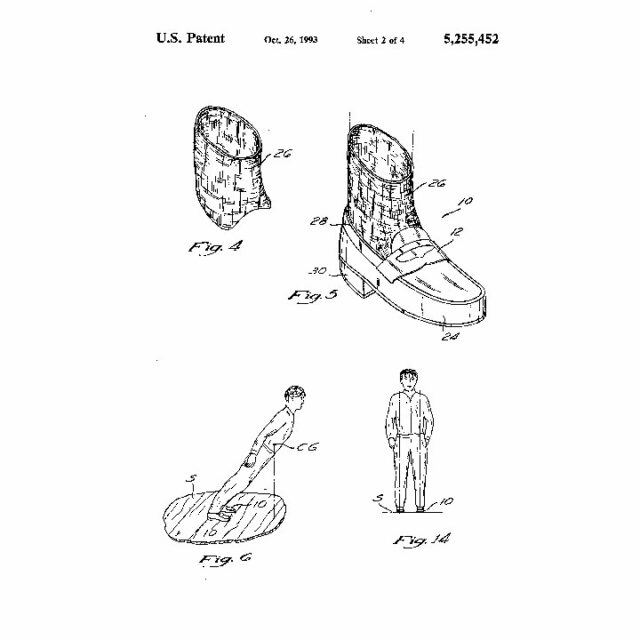
However, MJ does hold a patent for the shoes that allowed him to perform his famous “anti-gravity lean” move as seen in the music video of “Smooth Criminal.” See here: https://patents.google.com/patent/US5255452A/enSam L. Marcelo

Balai ni Fruitas slashes IPO share price to P0.70

BALAI ni Fruitas, Inc. announced on Tuesday a 6.7% cut in the price of its initial public offering (IPO) shares to P0.70 apiece from P0.75 previously, resulting in a reduction in the size of its market launch.

In the latest advisory posted by the Philippine Stock Exchange (PSE), the food and beverage company, a unit of listed holding firm Fruitas Holdings, Inc., did not disclose the reason for the reduction.

Balai ni Fruitas will offer up to 412.5 million common shares, consisting of 325 million primary shares to be offered and issued by the company; 50 million secondary shares to be offered by Fruitas Holdings, the selling shareholder; and up to 37.5 million option shares to be offered by the selling shareholder.

The final offer price brings down the IPO size to P288.75 million from P309.38 million had it retained the previous price.

In its preliminary prospectus posted last month, Balai ni Fruitas placed its IPO share price at P0.75. It said the offer price had been determined after taking into consideration the prospects, the market prices for shares of companies engaged in similar businesses, and prevailing market conditions.

The company will list on the Small, Medium and Emerging (SME) Board of the PSE under the trading symbol BALAI. It has secured the nod of both the PSE and the Securities and Exchange Commission (SEC) for the IPO.

“We are on track to have the most number of SME Board listings in a year with the IPO of Balai ni Fruitas. The company’s debut will also expand the mix of SME firms listed as Balai is the first food and beverage business to list on this Board,” PSE President and Chief Executive Ramon S. Monzon said in an earlier statement.

Proceeds from the IPO will be used for store network expansion, commissary setup, and potential acquisition opportunities.

According to the latest timetable, the shares will be sold from June 17 to 23 with a temporary listing date of June 29.

The company tapped First Metro Investment Corp. as issue manager, bookrunner, and underwriter for the offer.

Balai ni Fruitas is a food and beverage company that offers coconut-based beverages and desserts through brands such as Buko ni Fruitas, Fruitas House of Desserts, and Balai Pandesal. It is a wholly owned subsidiary of Fruitas Holdings.

Fruitas Holdings serves as the holding company of food and beverage kiosk operators. It has more than 25 active brands in its portfolio.

In 2021, Fruitas Holdings entered the baked goods industry through the acquisition of Balai Pandesal assets in June by its unit Balai ni Fruitas. The asset acquisition included initial inventories, technical know-how, equipment and vehicle, trademark, and franchise agreements for five stores.

Balai ni Fruitas was able to grow the Balai Pandesal store network to 31 community stores by the end of December last year. The network covers 25 company-owned and six franchised stores, all of which were accomplished within six months after the acquisition. — Luisa Maria Jacinta C. Jocson

Eight new National Artists named

FAITH ANNE YANGYANG / NCCA PUBLIC AFFAIRS AND INFORMATION OFFICE

MALACAÑANG Palace on June 10 recognized eight new National Artists for 2022.

The artists are: Agnes Locsin for Dance; Nora Villamayor (a.k.a Nora Aunor); Ricardo “Ricky” Lee and Marilou Diaz-Abaya for Film and Broadcast Arts; Gemino Abad for Literature; Fides Cuyugan-Asensio for Music; and posthumously, Antonio “Tony” Mabesa for Theater and Salvacion Lim Higgins for Fashion Design.

No awards were conferred this year in the fields of Visual Arts, and Architecture and Allied Arts.

The date of the awarding ceremonies is yet to be announced.

Fashion designer Salvacion Lim Higgins founded Slim’s Fashion & Arts School in 1960. Dancer and choreographer Agnes Locsin is known for her neo-ethnic dance choreography. Opera singer, actress, and librettist Fides Cuyugan-Asensio was the former Chairman of Voice and Music Theater Department at the UP College of Music. Nora Aunor is an acclaimed actress in films such as Himala, Tatlong Taon Walang Dios, Bona and Bulaklak sa City Jail, among many others. Marilou Diaz-Abaya directed such acclaimed films such as Brutal, Ang Bagong Buwan and the biographical film Jose Rizal. Screenwriter, author, and mentor Ricardo “Ricky” Lee wrote Filipino films such as Himala, The Flor Contemplacion Story, and Sa Kuko ng Agila. Director, actor, and mentor Tony Mabesa was the founder of the theater groups Dulaang UP and the UP Playwright’s Theater. Poet Gemino Abad, who has served in the University of the Philippines in various capacities through the years, co-founded the Philippine Literary Arts Council, edited landmark anthologies of Filipino poetry, and published his own works including poetry, critical essays, and critical theory.

The National Artist Award is jointly administered by the National Commission for Culture and the Arts (NCCA) and the Cultural Center of the Philippines (CCP) by virtue of Proclamation No. 1390.

In 1972, the Order of National Artist was established under Proclamation No. 1001. It is the highest national recognition conferred upon Filipinos who have made distinct contributions to the development of the Philippine arts and culture.

The National artists receive a National Artist gold-plated medallion minted by the Bangko Sentral ng Pilipinas and a citation.

The conferment to living National Artists also comes with privileges including a minimum cash award of P200,000 (net of taxes); a minimum lifetime personal monthly stipend of P50,000; medical and hospitalization benefits not exceeding P750,000 annually; coverage with a life insurance policy by the Government Service Insurance System and or/ private insurance companies; and a state funeral. Meanwhile, posthumous awardees are given a one-time minimum cash award of P150,000 (net of taxes), payable to the legal heir/s. — MAPS