Home Blog Page 5847

House body swiftly OK’s Ombudsman budget 

OFFICE OF THE OMBUDSMAN PHILIPPINES FACEBOOK PAGE

CONGRESSMEN on Thursday swiftly approved the Office of the Ombudsman’s P4.78-billion budget for next year. 

The House of Representatives committee on appropriations approved the 1.5% increase, citing the office’s fiscal autonomy under the Constitution. 

Under the budget, P3.05 billion will go to personnel services, P1.43 billion to maintenance and other operating expenses and P230 million to capital outlays. 

Party-list Rep. France L. Castro asked the Office of the Ombudsman to clarify its policy on the disclosure of state official’ statement of net worth. 

She also asked for a performance report on cases handled by the Ombudsman in the past five years. 

Meanwhile, lawmakers at a separate hearing also promptly approved a 9.8% increase in the Civil Service Commission’s 2023 budget to P2.04 billion as a courtesy to its head, Karlo Alexei B. Nograles, who is a former congressman. Matthew Carl L. Montecillo 

House seeks clear rehab process for buildings 

OFFICE OF REP. CHING BERNOS

THE HOUSE disaster resilience committee on Thursday urged disaster agencies to streamline the rehabilitation process for destroyed infrastructure. 

There is no clear process of funding for destroyed infrastructure including seawalls and buildings, and the P400-million budget is insufficient for rehabilitation, Surigao del Norte Rep. Francisco Jose F. Matugas II said at a House of Representatives hearing. 

The Office of Civil Defense sought the establishment of a Department on Disaster Resilience to streamline and simplify the rehabilitation process. 

The office has a P30-billion budget for disaster resilience and P1 billion for the rehabilitation of Marawi City in southern Philippines. — KAB 

AFP modernization delayed 

PHILIPPINE STAR/EDD GUMBAN

THE SECOND phase of the Armed Forces of the Philippines’ (AFP) modernization program might have to be extended for lack of budget, a congressman said on Thursday. 

“If the fund is not increased, there might be a need to extend the law on the revised AFP modernization program,” Oriental Mindoro Rep. Arnan C. Panaligan said at a House of Representatives hearing. 

Defense officer-in-charge Jose C. Faustino, Jr. told lawmakers the program, which is supposed to end this year, is only 14% finished. 

The first phase of the modernization program ran from 2013 to 2017, while the second phase started in 2018. The third phase is supposed to run from 2023 to 2028. — Kyanna Angela Bulan 

Senate bill to outlaw online gambling 

A SENATOR has filed a bill that seeks to make online gambling illegal in the Philippines. 

“The social cost of gambling is too high — bankruptcy, broken families and criminal activities, among others,” Senator Emmanuel Joel J. Villanueva said in Senate Bill 1281’s explanatory note. 

The social cost for each pathological gambler is $9,393 yearly or about half a million pesos, he said, citing a 2011 study from Baylor University in Texas. 

“This bill seeks to prohibit online gambling and the placing of wagers or bets through the internet or any form of online gambling activities to prevent further deterioration of morals and values, encourage people to work instead of relying on a game of chance, stop addiction and save lives,” he added. 

Under the Anti-Online Gambling bill, a person who places, receives or transmits a bet or wager through the internet will be imprisoned for up to six months or fined as much as P500,000. 

If the offender is a company, its president, director, manager and other officers will be fined P500,000 or jailed for five years. 

Phone makers told to educate users on scams 

KELLI-MCCLINTOCK-UNSPLASH

THE NATIONAL Telecommunications Commission (NTC) has ordered mobile phone makers, distributors and dealers to educate users about text scams.  

In a Sept. 4 memo, NTC Commissioner Gamaliel A. Cordoba said users should be taught how to block texts and create spam folders.  

“These directions shall be disseminated through manufacturer’s websites and social media accounts,” the NTC said in its memo.  

The regulator also said mobile phone makers should include leaflets on how to use and enable text blocking, filtering and similar features.  

“Mobile phone manufacturers, distributors and dealers shall put up posters in their physical stores,” it said.  

On Sept. 12, NTC directed telecommunication companies to block and deactivate domains and uniform resource locators (URL) from malicious sites. — Ashley Erika O. Jose 

Peso drops further on oil’s rise, slower remittance growth

BW FILE PHOTO

THE PESO weakened further against the greenback on Thursday after the latest correction in global oil prices and slower growth in cash remittances in July.

The local unit closed at P57.16 per dollar on Thursday, shedding five centavos from its P57.11 finish the day prior, data from the Bankers Association of the Philippines showed.

This is just two centavos stronger than its all-time low of P57.18 recorded on Sept. 8.

The peso opened the session at P57.10 per dollar. Its intraday best was at P56.975, while its weakest showing was at P57.175 against the greenback.

Dollars traded declined to $909.8 million on Thursday from the $989.9 million logged on Wednesday.

The local unit’s depreciation came after an upward correction in global oil prices, according to Rizal Commercial Banking Corp. Chief Economist Michael L. Ricafort.

Oil prices edged up by 1% on Wednesday. Brent crude futures rose 93 cents or 1% to $94.10 a barrel, while West Texas Intermediate crude ended $1.17 or 1.3% higher at $88.48.

“The peso was also weaker after the modest growth in OFW remittances data, partly due to elevated inflation and higher interest rates in the United States and in other countries that weighed on OFW employment,” Mr. Ricafort said.

Data released by the Bangko Sentral ng Pilipinas (BSP) on Thursday showed cash remittances sent through banks stood at $2.92 billion in July, 2.3% up from $2.85 billion in the same month in 2021.

This amount is the biggest monthly inflow since the $2.99 billion logged in December 2021. However, the growth in cash remittances in July was the slowest in two months or since the 1.8% seen in May and also eased from the 4.4% in June.

For the first seven months of 2022, cash remittances rose by 2.8% to $18.26 billion from $17.77 billion in the comparable year-ago period. The BSP expects remittances to grow by 4% this year.

The peso also continued to weaken amid continued current and financial account outflows, ING Bank N.V. Manila Senior Economist Nicholas Antonio T. Mapa said in a Viber message.

“The Philippines is now running a deep current account deficit, due largely to the stark widening of the trade deficit,” Mr. Mapa said.

“Meanwhile, investors remain wary of the now very hawkish Fed, with interest rate differential collapsing as the Fed hikes rates aggressively. Peso to remain on the back foot until either one or both of these dynamics change,” he added.

The US Federal Reserve is widely expected to fire off another 75-basis-point (bp) hike at their Sept. 20-21 meeting to curb inflation, which would mark its third straight increase of that magnitude. The Fed has hiked rates by a cumulative 225 bps since March.

The BSP will hold its own review on Sept. 22. The Monetary Board has raised benchmark interest rates by 175 bps so far since May.

For Friday, Mr. Ricafort expects the peso to move from P57.05 to P57.25 per dollar. — Keisha B. Ta-asan

PSE index slips ahead of Fed, BSP policy meetings

BW FILE PHOTO

THE benchmark index slipped to the 6,500 level on Thursday on profit taking and cautious trading ahead of central bank meetings next week and the rebalancing of Financial Times Stock Exchange (FTSE) on Friday.

The Philippine Stock Exchange index (PSEi) inched down by 7.19 points or 0.1% to close at 6,575.67 on Thursday, while the broader all shares index slipped by 0.31 point to 3,496.90.

“The market failed to manage to stay in the green and above the 6,600 support level as investors took some gains amid a lack of positive catalysts while waiting for the decision of the US Federal Reserve and Bangko Sentral ng Pilipinas (BSP) on interest rates,” Philstocks Financial, Inc. Research Analyst Claire T. Alviar said in a Viber message.

“The index spent most of the day in positive territory as spurred by optimism on robust remittance data. However, investors’ cautiousness prevailed at the close, with a surge of market-on-close selling wiping out the day’s gain,” China Bank Securities Corp. Research Director Rastine Mackie D. Mercado said in an e-mail.

“This move could be attributed to investors’ risk-off stance ahead of key policy meetings by the Fed and the BSP next week, especially following the sell-off induced by US inflation data reported last Tuesday,” Mr. Mercado added.

The Fed will meet to review policy on Sept. 20-21, where markets expect another aggressive hike amid still elevated inflation. It has raised rates by 225 basis points (bps) so far since March, including back-to-back 75-bp hikes in June and July.

Meanwhile, the BSP is holding its own meeting on Sept. 22. It has hiked borrowing costs by 175 bps since May to rein in rising prices.

“Philippine shares ended the session trading slightly lower as investors rebalanced ahead of a handful of economic reports scheduled to come out Thursday night and the FTSE rebalancing tomorrow,” Regina Capital Development Corp. Head of Sales Luis A. Limlingan said in a Viber message. He said these reports include data on US retail sales, import prices, and jobless claims, among others.

Majority of sectoral indices closed lower on Thursday except for property, which climbed by 20.56 points or 0.7% to 2,959.36, and mining and oil, which went up by 14 points or 0.12% to 11,469.45.

Meanwhile, financials went down by 9.31 points or 0.58% to 1,594.17; industrials lost 42.73 points or 0.44% to end at 9,617.39; holding firms decreased by 4.92 points or 0.07% to 6,342.88; and services inched down by 0.56 point or 0.03% to 1,686.91.

Advancers outnumbered decliners, 90 against 74, while 51 names closed unchanged.

Value turnover climbed to P5.48 billion on Thursday with 662.91 million shares changing hands from the P5.29 billion with 821.23 million issues seen the previous trading day.

Net foreign buying was at P23.52 million on Thursday, a turnaround from the P23.71 million in net selling recorded on Wednesday.

China Bank Securities’ Mr. Mercado placed the PSEi’s support at the 6,500 to 6,550 range and resistance at 6,720. — Justine Irish D. Tabile

Philippine competitiveness lags ASEAN due to high business costs

THE cost of doing business is causing the Philippines to lag in regional competitiveness, the Management Association of the Philippines (MAP) said on Thursday.  

Mary Jade Roxas-Divinagracia, MAP Ease of Doing Business Committee vice chairperson, told BusinessWorld Live on One News Channel that the decline in competitiveness comes despite the passage of measures in the previous administration seeking to attract more investors.

She said some of the measures include Republic 11534 or the Corporate Recovery and Tax Incentives for Enterprises (CREATE) Law, which lowered the corporate income tax, and amendments to the Public Service Act, the Retail Trade Liberalization Act, and the Foreign Investment Act. 

“We are still losing competitiveness in ASEAN, because we are facing a lot of challenges (such as) the high cost of doing business, high power cost,” Ms. Roxas-Divinagracia adding that issues with human capital are also a factor, like availability of talent, the workforce’s aptitude for innovation, critical thinking, and business and digital skills.

Ms. Roxas-Divinagracia also cited the need to improve infrastructure and connectivity.

“It used to be that having a pool of young English-speaking workers was enough. But not anymore because our neighbors are also leveling up when it comes to that. We need to address the other areas where we are falling behind,” Ms. Roxas-Divinagracia said.  

“We also need to improve our quality of infrastructure and logistical services, including connectivity and digital infrastructure. We also need to invest more on research and development, transparency, respect for sanctity of contracts, and overall ease of doing business,” she added.

Ms. Roxas-Divinagracia said business executives are concerned about corruption, citing the PwC Philippines-MAP 2022 CEO survey. The study found that 67% of business executives cited corruption as a factor that may delay the economic recovery.

“The problem of corruption has been there for so long. Unfortunately, we’ve not made significant progress… This is a very valid concern that chief executive officers are facing as corruption scares away investors,” she said.

“(Corruption) can complicate doing business in the country. It can lead to unfair competition, delay some of the business processes. It will increase costs. Overall, it can hurt business viability. Whether corruption is perceived or real, it is making the country unattractive to investors both foreign and domestic,” she added. — Revin Mikhael D. Ochave

ACEF seen benefiting importers, not farmers

JCOMP-FREEPIK

THE Agricultural Competitiveness Enhancement Fund (ACEF), which is funded by import tariffs on farm goods, contains a built-in incentive to import more food and generate more revenue for the government, to the detriment of the farmers it was designed to help, legislators said.

The House committee on agriculture and food, which is evaluating proposals to extend ACEF, heard allegations from legislators that traders and importers are benefiting, and not farmers.

“We need a consultative assembly so resources will be directed to measures that will respond to the problems of our agriculture industry. I appreciate the value of ACEF. Out of the import taxes, we are able to support our agri-fisheries. However, it appears that this program is not being felt by our individual farmers and even our consumers,” Batangas Rep. Gerville R. Luistro told the committee on Thursday.

“If there is anyone benefiting from this, it appears to be the traders and importers. It’s like we are giving them permission or license to go for more imports. We should focus on agri-sustainability,” she added.

Quezon Rep. Wilfrido Mark M. Enverga, who also chairs the committee, said that the program is not intended to promote imports.

“Unfortunately, it’s a reality and we do have to make the most out of it. (The funds) must be given back to the affected sectors in agriculture,” he added.

ACEF proceeds fund the development of farm machinery and infrastructure, as well as other support projects to improve the lives of farmers.

Collections routed to ACEF between 2000 and March 2022 are at P20.07 billion.

Mr. Enverga introduced House Bill No. 2385, which seeks to extend the implementation period for ACEF.

“Tariffs collected were not envisioned to be distributed as dividends, Conditional Cash Transfer (CCT) style. Instead, they are intended to be used to build, and, as provided in the law, ‘irrigation, farm-to-market roads, post-harvest equipment and facilities, credit, research and development,’” according to the bill.

Also covered are marketing infrastructure, provision of market information, retraining, extension services, and other forms of assistance and support to the agricultural sector. 

“The idea was to use the very same taxes levied on imports to finance projects that would boost agriculture and allow it to compete with imports,” it added.

The bill calls for extending ACEF and backed the earmarking of tariffs for farm development as a valid concept.

“What is needed is not to write the requiem to ACEF, but a law reforming and extending its validity to help farmers and fisherfolk improve their productivity and competitiveness… our produce has to be competitive, as integration enlarges markets for both local and regional firms,” according to the bill.

The bill hopes to “debug” ACEF “of corruptive and corrosive practices. Stringent safeguards against deliberate acts that go against the purpose of the program have been put in place as the overarching principle that only legitimate farmers and fisherfolk must benefit from ACEF,” it added.

The bill also highlighted that ACEF’s mandate is not just to ramp up agriculture production, but also to produce graduates of agriculture courses. 

“In hindsight, the scholarship component of ACEF is one of its few bright spots. Some loans for production capital may have been misappropriated but by and large, the tuition to train human capital was not. While some borrowers may have left debt notes, ACEF scholars have diplomas as proof of grants well spent,” it added.

Agriculture Undersecretary Rodolfo V. Vicerra proposed that ACEF measures be routed through farmers’ cooperatives and associations (FCAs).

The Department of Agriculture (DA) has been handicapped by devolution which keeps DA technical assistance outreach at the regional level. “It’s going to be much easier to implement this program and reach out to more farmers (through cooperatives),” he said.

“We can reach more farmers and effectively assist in the development of our rural sector… there is a big gap with the DA’s centralized system. We need to be able to reach out directly to farmers and fishers and strengthen partnership between the DA and local government units,” he added.

Land Bank of the Philippines (LANDBANK) Assistant Vice-President Edgardo S. Luzano also recommended a capacity-building fund to be allotted to strengthen FCAs and technology transfer.

“We are only able to extend credit assistance to 33,000 farmers and fishers that are individual borrowers. This is a small segment being targeted by the DA for the program,” Mr. Luzano said.

“We agree to the statement to increase our penetration of FCAs although the bank has assigned officers to cover all municipalities in the country; we recognize that FCAs serve as an additional touchpoint to increase reach to farmers and fishers,” he added.

Rolando Ortega, a farmer from San Jose, Occidental Mindoro, told the committee that forming more FCAs would speed up the application process.

“I benefited from the ACEF loan program. I support the continuation of this program… It would be easier if there were formed groups. What happens right now is that farmers go straight to LANDBANK. It would be more efficient if every region has a group or cooperative to easily process the documents,” he said.

Mr. Vicerra also said program administrators should be treating farmers as borrowers or enterprise groups and refrain from describing the funding as ayuda or government-provided assistance.

Nicanor M. Briones, Agricultural Sector Alliance of the Philippines, Inc. president, proposed that instead of providing credit, the funds be used for specific farm machinery or equipment.

“We need to put more into indemnification by those hit by African Swine Fever, bird flu and (machinery) like dryers and cold storage,” he added. — Luisa Maria Jacinta C. Jocson


DA to expand area devoted to salt production

PHILIPPINE STAR/EDD GUMBAN

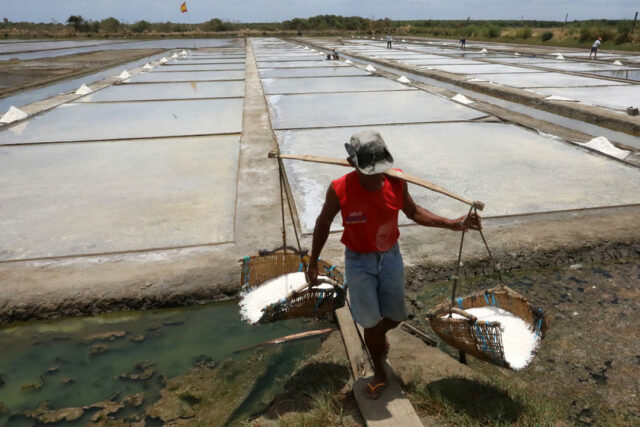
THE Department of Agriculture (DA) said it hopes to upgrade salt production by increasing the area devoted to salt-making, describing the current shortage as a food security issue.

“Salt is a food security issue. Not being able to produce salt will hurt the country’s competitiveness and ability to become a successful agro-industrial economy,” the DA said in a memorandum circular.

“It is clear that increasing salt production (means an increase) in salt producing areas. Having the resources for identification, regulatory approval, construction and partnership, the government should lead the way in stimulating the salt industry by identifying, constructing and preparing the necessary salt-producing areas and make it ready for the private sector to operate them,” it said.

The Development of Salt Industry Project (DSIP) aims to produce “excellent quality” salt through process enhancement and improved salt making practices, while complying with food safety standards.

Under the plan, the National Fisheries Research and Development Institute (NFRDI) will compile a comprehensive profile of salt farmers, producers, traders, distributors, importers, and consumers.

“In order to realize the program’s goal of reviving the salt industry through technology development and research initiatives, the NFRDI will focus its activities on boosting and sustaining local salt production by providing necessary production, post-harvest, and marketing-related interventions to the selected salt farmers/project beneficiaries,” according to the plan.

These initiatives include the development and standardization of processing methods, consumer acceptability tests, and market research to develop sea salt products, and the overhaul of policy and rules governing the industry. 

The plan also includes capacity-building activities and training for qualified beneficiaries in food safety standards and production methods.

It also seeks to introduce various production techniques to the traditional pond-drying method, like the use of high-density polyethylene geomembrane. It also hopes to promote the use of greenhouses and cooking.

The DSIP will also upgrade post-harvest and storage facilities. — Luisa Maria Jacinta C. Jocson

CMA CGM, Plastic Flamingo renew waste deal 

Worker clean up San Juan river filled within Sevilla Bridge in Kalentong Mandaluyong. — PHILIPPINE STAR/ MICHAEL VARCAS

FRENCH shipping company CMA CGM Group and social enterprise Plastic Flamingo on Thursday said they have renewed a partnership to reuse trash and ease plastic pollution in Metro Manila. 

In three years, the project aims to collect and reuse 600 metric tons of plastic waste from the streets, coastlines and the Pasig River in the capital region, they said in a statement. 

The Plastic Flamingo will collect and reuse riverine plastic, which requires more cleaning and handling to separate from marine debris.  

The plastics will join the hard-to-recycle plastic sachets on the CMA CGM-funded recycling line to be transformed into eco-planks and boards. 

The partnership was first launched in 2021 in the Philippines, where single-use plastics are a major source of ocean pollution. — LMJCJ

Senate panel hears proposal to tap 2024 payables

PHILSTAR

SENATORS explored the possibility of “frontloading” a P715-billion allocation in the proposed 2023 budget which is intended to fund obligations due in 2024.

Senator Ana Theresia N. Hontiveros-Baraquel made the inquiry of the Department of Budget and Management (DBM) at a Senate finance committee hearing.

The budget scrutiny comes as the National Government (NG) scrambles to fund its obligations after taking on record debt to fund the economic recovery and as local governments expand their cut of NG revenue.

Congress is examining the proposed P5.268-trillion budget for 2023.

“The P715 billion stated in the circular is the estimated obligations that we expect not to be paid within the year, but instead are accounts payable the following year because some projects will not be completed within the year so we cannot disburse or pay for them on that year,” Budget Secretary Amenah F. Pangandaman replied.

Ms. Hontiveros had asked whether the amount can be reallocated by issuing a Multi-Year Contracting Authority (MYCA), a DBM certification of the availability of funds to cover the full contract cost of multiyear projects.

Resorting to a MYCA will allow the government to “frontload appropriations for faster-moving projects that the departments deem urgent,” she said.

“If we possess the information on what the slow-moving projects types were in recent years, could Congress add to the list of projects covered by MYCAs, so that fiscal space can be created for fast moving projects.”

Ms. Pangandaman said MYCA items in agency budget proposals are still subject to the agencies’ absorption capacity — “whether they can disburse the funds even (with) MYCA.”

“This is part of our budget management considering that we have limited fiscal space in our budget,” she added.

Separately, Sen. Joseph Victor G. Ejercito also flagged the budget increase for the Department of Transportation (DoTr) despite its low disbursement rate last year.

“DoTr posted a disbursement rate of only 41.5% in 2021. The low disbursement rate indicates delay and non-completion of big-ticket items,” Mr. Ejercito said.

The proposed 2023 budget for the DoTr stood at P167.121 billion, which is a 122.1% increase from its P75.248-billion allocation this year.

“With the new leadership, we expect that they will move much faster than the previous years,” Ms. Pangandaman said, explaining the higher allocation.

“In addition to the P100+ billion appropriated to DoTr, there’s another P300+ billion in the unprogrammed (funds). So as soon as they can implement, we will give them money,” Finance Secretary Benjamin E. Diokno added.

The debt-to-gross domestic product ratio rose to 62.1% in the second quarter from 39.6% in 2019, reflecting the need to borrow in responding to the pandemic.

The National Government’s outstanding debt is expected to top P13.43 trillion by the end of the year. At the end of July, the debt stood at P12.89 trillion.

Despite the need for more sources of revenue to narrow the budget deficit, Mr. Diokno said that he is willing to forego revenue from Philippine Offshore Gaming Operators (POGOs).

“If you ask my personal opinion on this, let’s discontinue the POGOs because of the social costs,” he said.

“In fact, the total revenue for 2021 is down to P3.9 billion. At its peak, it was P7.2 billion in 2020… China has discontinued, even Cambodia… it also has a reputational risk.” — Diego Gabriel C. Robles