Home Blog Page 5817

BoC conducts 333 internal corruption investigations in first half

THE Bureau of Customs (BoC) said it conducted 333 internal investigations of personnel suspected of corruption in the first half, some of which produced disciplinary measures like dismissal, suspension, relief, and reassignment.

The investigations, conducted by the Customs Intelligence and Investigation Service (CIIS), “resulted in seven filed administrative cases before the BoC Legal Service and another seven cases transmitted to the National Bureau of Investigation (NBI),” the agency said.

The investigations resulted in three dismissals, seven suspensions, and one reprimand. The Bureau added that it relieved 27 from their posts and transfered 249 “due to irregular activities.”

Separately, the BoC also said 13 of its ports and subports have received the ISO 9001:2015 quality certification.

Certified were the ports of Manila, Clark, Batangas, Davao, Legaspi, Tacloban, Cebu, and the Ninoy Aquino International Airport (NAIA), along with their respective Customer Care Centers (CCC), as well as the subports of Dumaguete, Iligan, Mactan, CCC-Subic, and CCC-Limay.

CCCs, which are components of all 17 ports and subports, are centers for document receiving and releasing, inquiry, payment, and other BoC services.

It added that ” 91.76% of Customs processes are digitized (in alignment with) the no-contact policy of the BoC, Ease of Doing Business Act, and the Anti-Red Tape Act.”

Last month, the BoC said that it launched the online i-Declare system through its eCBCD portal.

The site hosts Electronic Customs Baggage Declaration Forms (eCBDFs) and Electronic Currency Declaration Forms (eCDFs), which are required of travelers and crew members, and are now accomplishable before travel. — Diego Gabriel C. Robles

Transfer pricing policies are a must-have

Businesses typically have policies for dealing with many things critical to their everyday operations, such as workplace health and safety, employee conduct, and compensation and benefits policies. These set behavioral and performance standards, help protect the business from internal and external risks, ensure compliance with laws and regulations, and help defend the business against claims.

To this list we must add a policy governing intercompany transactions between domestic corporations or among members of multinational companies (MNCs). In the current business environment, a transfer pricing policy is a must-have.

What is a transfer pricing policy?

A transfer pricing policy generally outlines the nature of intercompany transactions (such as the provision of goods and services, interest payments, and transfer and utilization of tangible and intangible assets), application of the arm’s length principle, and implementation of transfer pricing rules and regulations.

A transfer pricing policy is like a manual or a handbook that ensures that each member of the broader organization is aligned and coordinated in carrying out intercompany transactions. It also enumerates the responsibilities and accountability of the concerned business departments, and how the specific department will implement it. Likewise, it helps the tax or finance department to ensure compliance with the arm’s length pricing.

It must be emphasized that such a policy is not the transfer pricing documentation (TPD) nor is it equivalent to an intercompany agreement. These are three separate documents that complement each other.

Why is a transfer pricing policy important?

A transfer pricing policy addresses alignment within the members of the MNC or each separate business department and compliance with laws and regulations. It ensures that everyone involved in the intercompany transactions is on the same page in carrying out the transaction. Likewise, it demonstrates to the tax authority that the arm’s length principle has been considered and implemented in accordance with the transfer pricing rules. It also displays the taxpayer’s proactive or cooperative attitude, which is advantageous during tax investigations as it signifies the taxpayer’s preparedness to comply with the transfer pricing rules. In fact, the local or global transfer pricing policy is one of the documents that the BIR Revenue Officer will request and review during tax investigations. As stated in RAMO No. 1-2019. Having one means being one step ahead.

ADDED VALUE
The transfer pricing policy adds value to the overall transfer pricing strategy, compliance, and implementation of the intercompany transactions. How? Let’s illustrate.

Say for example that a taxpayer has a robust TPD and intercompany agreements, but no transfer pricing policy is in place. Because of the lack of such a policy, the taxpayer’s various departments and the related party have no manual or handbook to guide them on what to do in carrying out the intercompany transaction.

In such a scenario, the following events are likely to happen:

• The accounting or finance department issues billing invoices for the intercompany transaction for amounts higher than what is stated in the TPD and intercompany agreement;

• The nature, terms, and conditions described in the TPD and intercompany agreement are not exactly what were actually undertaken by the parties. There’s a disconnect between the terms of the agreement and the actual conduct of the related parties. This is a classic example that the economic substance of the transaction differs from its form and this poses potential risk to the parties. As a result, the BIR Revenue Officer may re-characterize the transaction or the characterization of the tested party and impose adjustments to the income or expense;

• The taxpayer extends a non-interest-bearing loan and advances to its related party, which the tax/finance department was not aware of nor informed. Hence, the loan and advances were not included in the taxpayer’s TPD; and

• The taxpayer performs routine support services to a related party such as accounting, payroll, collection and other general administrative support, free of charge.

The above-described events are red flags and pose transfer pricing risks to the taxpayer. These could have been avoided if the taxpayer had clearly laid down a transfer pricing policy. By having such a policy, each party and department would gain clarity on how much to invoice, how to time an invoice, how to book, treat and classify the transactions, and which parties to inform and what to do when an intercompany loan or advances and routine support service arrangements arise.

The worst thing that could happen to the taxpayer is it may be held liable to pay deficiency taxes and penalties that could arise from the transfer pricing audit adjustments of the BIR. As the saying goes, prevention is better than cure.

KEY CONSIDERATIONS IN PREPARING A TRANSFER PRICING POLICY
There are many considerations in preparing a transfer pricing policy. One is to ensure that the TPD, intercompany agreements, and the policy are aligned and complement each other and that they are consistent with the actual conduct of the parties. Material inconsistencies might raise questions from internal parties and the BIR as well.

Likewise, the relevant departments should be involved in the process of creating the policy so that they are aware of and guided on their responsibilities. Finally, approval from and the commitment of top management to fully support and implement the policy must also be sought.

TAKEAWAY
Having a transfer pricing policy in place is a proactive strategy in ensuring that intercompany transactions comply with transfer pricing rules. It strengthens the taxpayer’s preparedness in the ever-changing dynamics of intercompany transactions and transfer pricing. After all, transfer pricing audits by the BIR are expected to kick off soon. As the saying goes “prepare and prevent, don’t repair and repent.”

Let’s Talk Tax is a weekly newspaper column of P&A Grant Thornton that aims to keep the public informed of various developments in taxation. This article is not intended to be a substitute for competent professional advice.


Nikkolai F. Canceran is a partner from the Tax Advisory & Compliance division of P&A Grant Thornton, the Philippine member firm of Grant Thornton International Ltd.

pagrantthornton@ph.gt.com

Ice-cool Djokovic tames fiery Kyrgios to continue Wimbledon love story

NOVAK Djokovic (Serbia) defeated Nick Kyrgios (Australia) in the men’s single final of Wimbledon 2022. — REUTERS

LONDON — Novak Djokovic stayed serene amid a frenzied atmosphere to tame fiery Australian Nick Kyrgios in an engrossing final on Sunday, lifting a seventh Wimbledon trophy and taking his Grand Slam title count to 21.

Rallying from a set down, Djokovic exhibited ice-cool nerves in sweltering conditions to win 4-6, 6-3, 6-4, 7-6(3) for his fourth consecutive trophy at the grasscourt major to close in on Rafa Nadal’s record 22 Grand Slam titles.

By lifting the Challenge Cup once again, Djokovic drew level with his childhood idol Pete Sampras in the all-time winners list and is now just one shy of Swiss Roger Federer’s record eight Wimbledon titles.

After finishing 2021 one win short of a rare calendar-year Grand Slam, Djokovic’s season has not panned out exactly as he would have envisaged after being deported from Melbourne ahead of the Australian Open and losing to Nadal in the French Open quarterfinals.

“Certainly, this year has not been the same like last years,” he said. “It has started the way it has started and it has affected me definitely in the first several months of the year.

“I was not feeling great generally. I mean, mentally, emotionally, I was not in a good place.”

The Serbian’s refusal to be vaccinated against coronavirus disease 2019 (COVID-19) could prevent him from entering the United States to compete at the year’s final Grand Slam in New York, but the air of uncertainty had no bearing on his love affair with the lawns at the All England Club.

Djokovic said he had no plans to get vaccinated and only hoped the entry restrictions will be eased for him to play at Flushing Meadows next month.

After completing victory in just over three hours, Djokovic raised his arms to the sky and after shaking hands with Kyrgios, he bent down to pluck some grass from the famous old court and tasted it before running up to his player’s box to kickstart the celebrations.

“It always has been and always will be the most special tournament in my heart, the one that motivated me, inspired me to start playing tennis in a small mountain resort in Serbia where my parents used to run a restaurant,” said an emotional Djokovic, who was also celebrating his eighth wedding anniversary with wife Jelena on Sunday.

“Every single time, it gets more meaningful and more special, so I’m very blessed and very thankful to be standing here with the trophy.”

Competing in a men’s record 32nd major final on a sun-bathed Centre Court, the 35-year-old was facing an unseeded opponent who had never previously been beyond the quarterfinals at a Grand Slam.

In their only two meetings —both in 2017 — Djokovic did not win a set, failed to break the Kyrgios serve and had only a single break point opportunity. — Reuters

Operationalizing ‘Independent Foreign Policy’: The Philippines’ response as an emergent Asian middle power

PHILIPPINE STAR/EDD GUMBAN

Prior to his inauguration in June, President Ferdinand R. Marcos, Jr. said that he would entwine a policy of strengthened partnership with China and alliance with the US with the pursuit of an independent foreign policy.

Critics of the previous administration’s foreign policy have argued that former President Rodrigo Duterte’s policies of distancing from the US and of appeasement of China have cultivated instead a dependency on a new hegemonic regional power. As the former Secretary of Foreign Affairs Teodoro Locsin, Jr. metaphorically said in an interview by Asia Society Policy Institute President Kevin Rudd “(i)t is not independent foreign policy if you simply switch the master before whom you have been kneeling. You’re still on your knees before another pair of trousers.”

Thus, how would an emergent Asian middle power such as the Philippines exercise strategic autonomy from the US and China, when its capabilities remain limited? Foremost a position in the hierarchy of powers, middle powers’ capabilities are far more significant than their counterparts amidst small or minor states but they are underwhelmed in the face of the influence of great powers. The Asia Power Index 2021 of the Lowy Institute, identifies the Philippines as a low-ranking middle actor of Asia, with defense and regional alliance networks as our major assets, while military capability and institutional resilience are our paramount weaknesses.

Our diplomatic response should take into consideration the interplay between structure and agency, particularly the structure of the hub and spokes system that shapes the emergent regional order, and the role of agency in operationalizing our position as an emergent Asian middle power.

Scholars Lee Jaehyon (Asan Institute for Policy Studies) and Bong Youngshik Daniel (Yonsei University) argue that unlike the cold war system, the emerging order defined by the two competing and opposing hub and spoke systems led by the US and China, is a fluid one. It is not bound by the strict ideological allegiance that defined the US-USSR-led spheres of influence of the cold war. Instead, the hub and spoke system is governed by the competing narratives and practices of the US geostrategic construct of the Indo Pacific and China’s Belt and Road Initiative.

Additionally, middle powers with varying levels of agency and influence are not compelled by their foreign policies to attach to a singular hub. This is true of the Philippines which under the Duterte administration, continued to be a military ally of the US and a major economic partner of China. In 2019, Locsin Jr. Stated: “My president’s foreign policy seeks to explore the enlarging opportunities offered by the rise of the biggest economy of the world… The US retains the distinction by many orders of magnitude… A military guarantee of our sovereign independence…” The spokes’ relations with the hub in this emergent regional order, therefore is not only fluid but nuanced, illustrated by how the Philippines downgraded the Philippines-US alliance relations while preserving the Mutual Defense Treaty, Visiting Forces Agreement and Enhanced Defense Cooperation Agreement — the key pillars of the alliance between our two countries.

A middle power like the Philippines must articulate its middle power role and vision in Southeast Asia in order to thrive in this volatile hub and spokes system. Through the years, political regimes have focused on balancing relations against the impact of the US-China hegemonic rivalry, through structure-reactive strategies that have ranged from equi-balancing (under Macapagal-Arroyo) to hard balancing (under Aquino III) and soft balancing (under Duterte) of an assertive China. These strategies are diplomatic responses to structural changes and are usually defined by the regime’s preference for a specific power.

Beyond a structurally determined response, it is important for the Philippines to purposely construct its role as an archipelagic and maritime nation strategically located in the Indo Pacific region. To begin with are a number of proposed undertakings based on the deepening of functional cooperation in regional maritime security that build on ASEAN’s evolving communities of practice in search and rescue, prevention of unplanned encounters at sea, and the more robust strategic information sharing and anti-piracy communities. These are inclusive platforms where ASEAN member states share networked spaces simultaneously with China and the US.

Domestically, the Philippines should continue to develop credible deterrence-ready naval and air forces, as part of our primary obligation to enforce the UN arbitral ruling on the South China Sea. The Philippines should enhance efforts to rebuild our shipbuilding industry, protect our marine resources against illegal, unreported, and unregulated (IUU) fishing, and give further due attention to the Coast Guard and to fisheries and resource management institutions.

Former Foreign Secretary Locsin Jr.’s words are again relevant here: “An independent foreign policy means getting off your knees and on your feet, and standing up for your country and never to be used by others to fight their quarrels.” With a well-conceptualized role as an emergent middle power, the Philippines is able to promote a foreign policy that caters first to the nation’s interest.


Alma Maria O. Salvador, PhD is an Associate Professor of Political Science at the Ateneo de Manila University, Philippines.

How Progressive is your board?

JCOMP-FREEPIK

Despite many initiatives for diversity in the workplace, the place that seems to be still impenetrable is the Board Room. Here the macho Chair will not want to listen to other opinions, especially spoken in a woman’s voice. After all, the other directors may just be “rubberstamp,” token board members who collect large per diem allowances and who say “aye, aye sir” to the Chair.

And this happens in many family boards as well as publicly-listed companies’ boards. It’s because there is no consciousness about diversity, making the subject relevant only in 17% of our boardrooms in the country. Sometimes, even women chairs declare “meritocracy” as the entrance pass and will snub ideas about needing to include women for diversity as a goal.

We recently established an organization to gather women who have been fortunately selected to join corporate boards and it is called NOWCD or the NextGen Organization of Women Corporate Directors (www.nowcdphils.com). We would like to increase the number of women in boards across the publicly-listed companies to at least 25% (having women on board) over the next two years. How will we do this? Well, we have to get to know more women who are willing to serve in boards after retirement from the C-Suite or even during their best years as career women serving as consultants to various firms.

Imagine the number of women executives who have about 20 years of experience in an industry tucked under their belts yet retire quietly to become homemakers or inactive bystanders. Imagine all that wealth of information and experience they have which is data that could go to waste. Imagine the wisdom gained over the years which will not be put to good use.

This is why we need to check the pipeline of young women charting a path in a business career, whose end goal after a fruitful time in management would be to serve in boards. In the past, we could count the women in boards just with our two hands because it was not a path many chose or thought to be possible. But today there are global alliances, networks of women who believe in the same goals.

NOWCD is the Philippine chapter of Women Corporate Directors International (www.womencorporatedirectors.org) and members are offered not just board seats in the country but in other locations as well. So, it would be a good move for our career women in the executive suite to start thinking of a board seat as a future plan.

After our recent elections I was very pleased to see many women executives in government, too. We have a lot of lady mayors, Congress representatives, governors, and even senators. These public servants can also help corporate boards, especially NGOs, when their terms expire or when they wish to continue their service to the public, albeit in a private capacity.

Women corporate directors are also important in NGOs because these organizations need sustainability, too. And a diverse board has been studied and proven as a key to staying power especially for non-profits. It is not because women are the stronger sex, but women do contribute a different perspective in decision-making. Male and female brains are wired differently and approaches to problem-solving can be better and faster when there are opposing or diverse opinions which make for a healthy discourse.

So, how do we now inspire women mid-level executives to aspire to become board directors? We must show them models to emulate. There are just a handful of women who serve on boards which is why you may see familiar names in various annual reports of PLCs. But this is not their fault. In fact, some multilaterals limit the number of directorships one can hold but due to a perceived dearth of women directors, the same names come up when a search is made in the different industries.

NOWCD now has over 30 members but we would like to grow steadily to include, hopefully, all PLCs and NGOs. Meantime we will endeavor to attract more women to join our group so they can be included in a roster such as that of the Institute of Corporate Directors (www.icd.ph) which lists both male and female graduates of its Professional Directorship course who then call themselves Fellows of ICD or FICD appended to their names.

My personal mission is to influence the non-believers or those who are not even conscious that their boards are too male or too old, or, put simply, could use some diversity in gender and age. If you check the boards of progressive companies, they do mix gender, age, and experience especially in relevant fields like health, tech, and digitalization. It is no longer about keeping it within the family, or appointing only next of kin to board seats. After all, stakeholders now care who sits on the board. Shareholders also look at the corporation’s ESG policies and these of course prescribe diversity.

So, if you want to make a checklist of how your company is performing, check your Board composition first. Maybe it’s the only thing you need to do to make a real difference in your industry. Or make a difference in your kind of leadership.

Then check your competition. Maybe they found the secret sauce sooner and now have diverse boards. It’s time to play catch up. And start at the top.

This article reflects the personal opinion of the author and does not reflect the official stand of the Management Association of the Philippines or MAP.


Chit U. Juan is a member of the MAP Diversity and Inclusion Committee, and the MAP Agribusiness Committee. She is chair of the Philippine Coffee Board, councilor of Slow Food for Southeast Asia, and is an advocate for organic agriculture.

map@map.org.ph

pujuan29@gmail.com

The SC on Meralco rate hike, Bidenflation and Peso depreciation

A number of interesting developments happened last week. I will discuss three of them.

THE SC RULING ON MERALCO RATE HIKE
On July 4, the Supreme Court (SC) upheld the Meralco rate hike of December 2013 and allowed it to collect a staggered amount of P22.64 billion, and junked the petition by Bayan Muna and the National Association of Electricity Consumers for Reforms (Nasecore) which argued there was lack of due process in the Energy Regulatory Commission’s (ERC) approval of the power rates increase.

In 2013, the ERC approved a staggered increase of P7.67 per kilowatt hour (kWh) for the December 2013 billing of Meralco consumers and ordered an additional P1/kWh increase in the February 2014 billing. These were not implemented after the SC issued an indefinite temporary restraining order (TRO) on April 22, 2014.

The SC was wrong in issuing such a TRO, wrong in doing price control and intervention. Recall that many power plants had planned or scheduled maintenance shutdowns from October to December 2013. The Malampaya gas field had a scheduled maintenance shutdown in mid-2013 but the Department of Energy (DOE) requested that it postpone this to late 2013 due to the May 2013 elections. Then a number of old plants had unplanned or unscheduled extended shutdowns, resulting in a huge power undersupply.

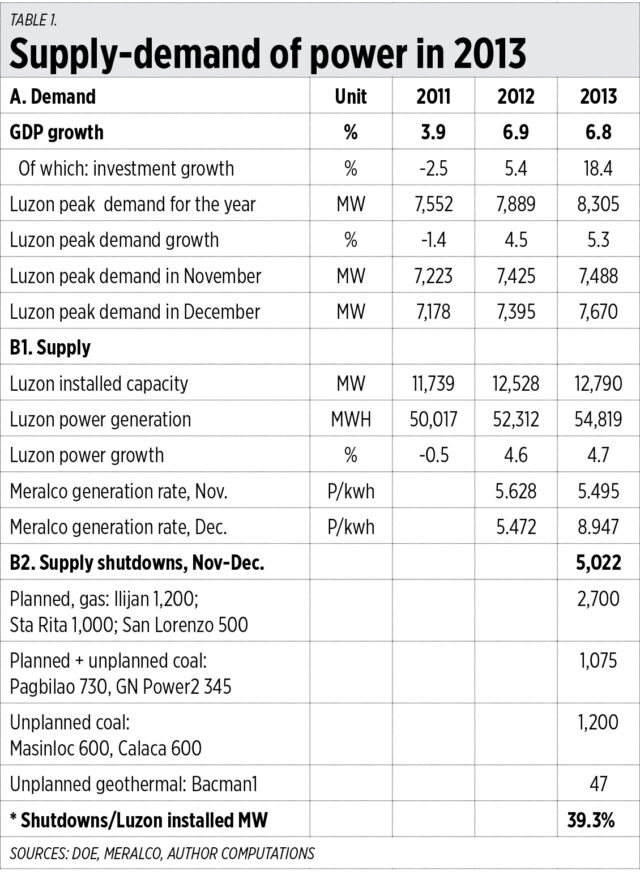
But power demand was high in 2013. GDP growth that year was 6.8%, of which investment growth was 18.4%. Peak demand growth in the Luzon grid was 5.3% that year, and yet the combined power under-generation was 5,000 MW comprising 39% of total installed capacity in Luzon (Table 1).
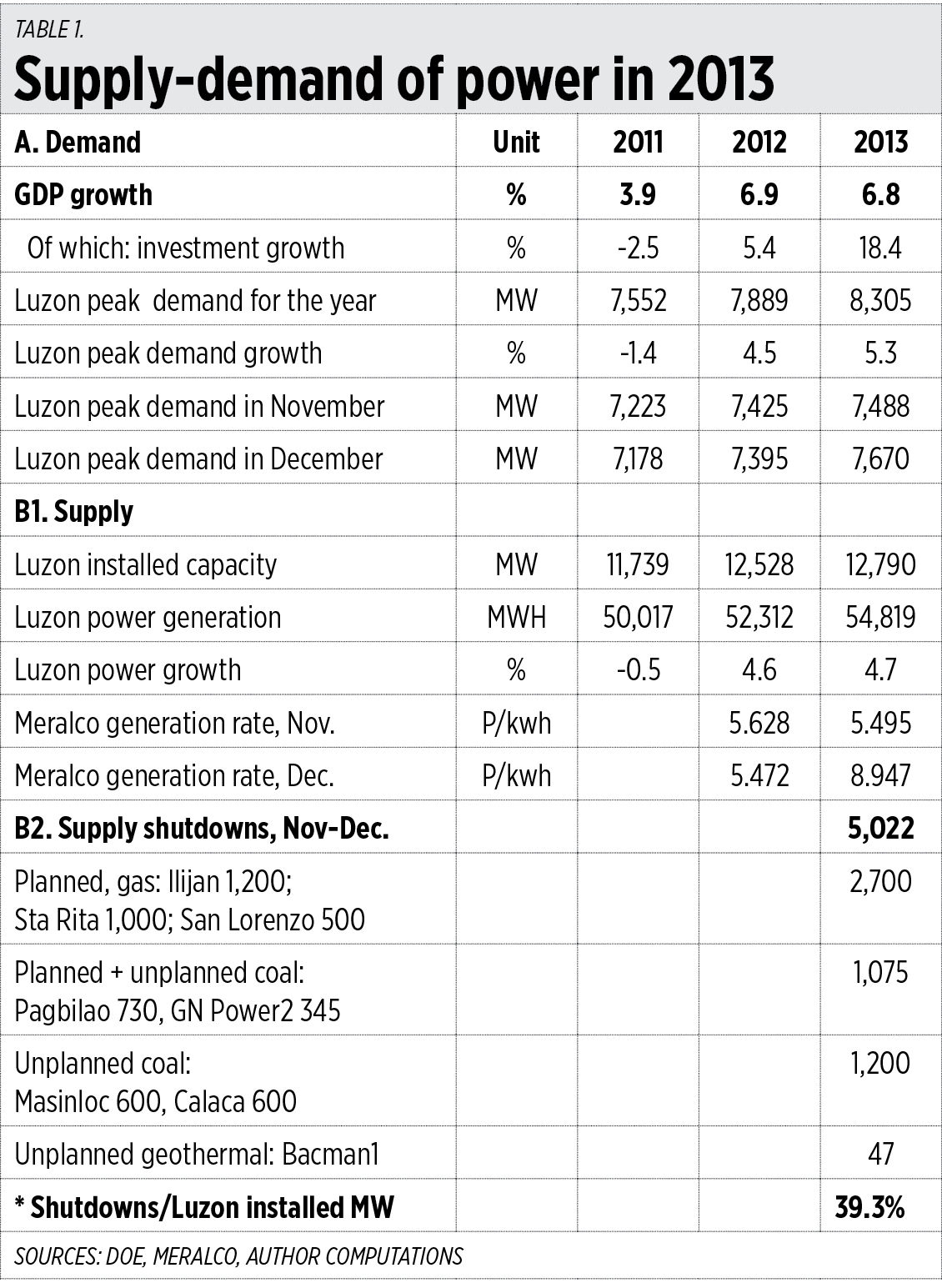
So Meralco and many other distribution utilities and electric cooperatives in Luzon had to source more power from the Wholesale Electricity Spot Market (WESM) at higher prices due to the very tight supply and very thin reserves. Yes, higher power prices are bad, but power blackouts are worse. And if people think that “blackout if power rates do not adjust” was just blackmail in 2013-2014, then consider these recent reports in BusinessWorld this year:

“NGCP declares 2 yellow alerts over Luzon grid” (July 5),

“Power outage leaves Panay, Guimaras in darkness” (July 6),

“Businesses concerned over rising electricity rates” (July 7).

It is already 2022 and the threats of blackouts remain until now. Power supply is tight and reserves thin as demand for power is rising as the economy recovers from two years of lockdown from the COVID-19 pandemic.

It is good that the SC has realized the mistake it made eight years ago and upheld the electricity rate hike. Good decision. And I hope that the SC will avoid the same problem of price intervention in the future, whether in electricity, food, transportation, and other sectors.

BIDENFLATION, NOT PUTINFLATION
There is a continuing narrative that the high inflation in the US, Europe, and rest of the world is “Putin caused” via Russia’s invasion of Ukraine last February. This is not true; this is a dishonest narrative. The truth is that from January 2021 to January 2022, 12 months of US President Joseph R. Biden’s being in power and prior to the Russian invasion of Ukraine, the inflation rates in the US and Europe had been rising fast (Table 2).
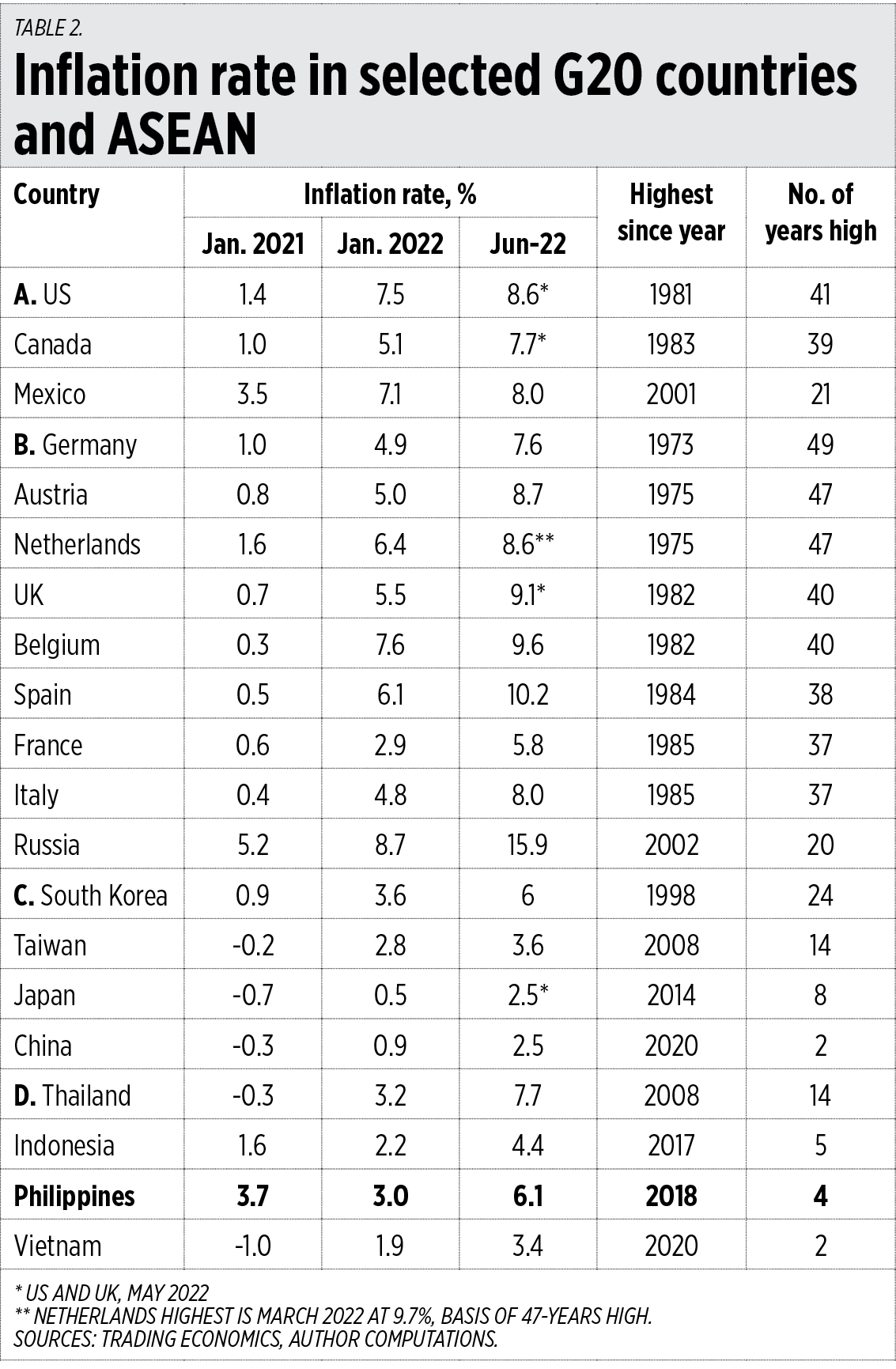
I arranged the countries into four groups: A is North America, B is Europe, C is North Asia, and D is ASEAN. Other countries do not have June 2022 inflation numbers yet as of this writing.

So, the Philippines’ 6.1% inflation rate in June, a four years-high, was bad — but it was not as bad as other countries, especially in North America and Europe. Bidenflation policies like reducing US fossil fuel production, increased money printing and government spending are the main causes of high global inflation, exacerbated by the Russia-Ukraine war and strong economic sanctions against Russia.

FEF FORUM
Last Friday, I attended the Foundation for Economic Freedom (FEF) forum, “Is the sky falling? The weakening peso, inflation and the fiscal challenge,” at the Holiday Inn Hotel in Makati.

Three of the four speakers are BusinessWorld columnists: Romy Bernardo, FEF Vice-Chairman and former Finance Undersecretary; Diwa Guinigundo, former Bangko Sentral ng Pilipinas Deputy Governor; and Raul Fabella, former Dean of the UP School of Economics. The fourth speaker was Vaughn Montes, former Chief Economist of Citibank Philippines.

Romy showed the Mundell Fleming “policy trillema,” also known as the “impossible trinity” — an economy cannot simultaneously maintain these three policies: fixed exchange rate (for predictability of returns), free capital mobility (to finance investments), and autonomous or independent monetary policy (adjust policy interest rates to stabilize inflation). An economy can only maintain two of the three at the same time. Romy also argued that Philippines inflation at this time is more cost push, coming primarily from supply chain bottlenecks and the “Putin war impact.”

I like the chart and explanation that Romy gave. As a free market advocate, I do not support a fixed exchange rate. It has to be market-determined and will lead to quick adjustments by all economic players — exporters, importers, consumers of imported goods like oil, families of OFWs, and so on. I also agree that this is cost-push inflation, not demand-pull inflation.

Diwa discussed, among others, the exchange rate pass through (ERPT) in prices and inflation. He showed a table in which the short-run ERPT from 1990-2002 (before inflation-targeting or IT) was 0.269. But ERPT from 2002-2017 (under IT) was only 0.042. Meaning that for every P1 depreciation, there was 26.9 centavos increase in prices before IT, and only 4.2 centavos increase under IT. So, the “signal value” of peso exchange rate depreciation has been reduced, the consumers and other market players look at exchange rate shocks as merely transitory. I like that point.

Sir Raul (he was my teacher in UPSE undergrad in the 1980s) discussed the “Iron law of progress,” that simple currency depreciation does not change investment behavior. About the Philippine peso weakening to P56/$ last week, he said it was bad but not worrisome — we had experienced that level in December 2004 or 18 years ago and it was temporary, the peso later strengthened and reached P41/$ in January 2008. He also reiterated the need for the rule of law, in particular honoring contracts on big public private partnership (PPP) projects like water rate adjustments to the water concessionaires.

Vaughn also discussed inflation and peso depreciation, and he expanded the discussion to PPP, the essence of which is to transfer significant risk to the private sector and away from government and taxpayers. Then he discussed recent issues in PPP especially the recently revised implementing rules and regulations (IRR) of the Built-Operate-Transfer (BOT) law. Among them: 1.) less definite process for setting user charges, no parametric formula; 2.) restrictive provisions on Material Adverse Government Action that impose more regulatory risk to the private sector; and, 3.) ambiguous definition of reasonable rate of return. These issues can dampen investor interest and reduce competition among bidders of big projects. Good points, Vaughn.


Bienvenido S. Oplas, Jr. is the president of Minimal Government Thinkers.

minimalgovernment@gmail.com

Inflation is raging because globalization is fading

FREEPIK
FREEPIK

INFLATION prognostication tends to come down to reading statistical tea leaves. Friday’s report of strong US job growth looks like a sign of economic strength that keeps inflationary pressure high. Recent declines in commodity prices reassured some analysts that the danger could be receding.

This focus on short-term price movements and the resulting interest-rate manipulations of central banks is only natural. But it obscures larger tectonic forces that dictate inflationary trends over years, even decades, and that can’t be controlled by the US Federal Reserve or European Central Bank. Though there’s no shortage of causes for these cycles, one stands out: globalization. Understanding this connection can help solve some of the economic puzzles of recent years — and suggest what’s in store for the future.

A good place to start is this year’s Tawney Lecture, delivered at Cambridge University in April at the annual meeting of the Economic History Society. The 2022 honoree, Princeton University historian Harold James, used the opportunity to investigate the “causal relationships and interdependence between inflation and globalization.”

James noted that he was hardly the first person to make this connection. In 2005, former Fed Chair Alan Greenspan had raised the unsettling possibility that the era of low inflation and reduced volatility that defined the years following the inflationary blastoff of the 1970s might owe as much to globalization as to the competence of central bankers like himself.

Greenspan noted in a speech that year that the increase of cross-border trade meant that “many economies are increasingly exposed to the rigors of international competition and comparative advantage.” He added, “In the process, lower prices for some goods and services produced by our trading partners have competitively suppressed domestic price pressures.”

This hypothesis was at odds with much of the economic literature of the day, which held that globalization had almost no impact on inflation. But James pointed out that this view of cause and effect is rooted in a focus on short-term forces rather than historical trends that play out over many years.

He argued that the increased flow of capital, people and goods across national borders has the power to keep inflation in check. It just takes time.

Consider, for example, what happened in the 19th century.

In the 1840s, England and other nations wrestled with food shortages. After struggling with inflation and misguided policies, they began removing restrictions in order to allow the import of cheaper food from abroad. The lowering of trade barriers went hand in hand with increased international migration, and then the adoption of the gold standard, which encouraged more cross-border capital investment.

The result was an era of globalization between 1870 and 1914 characterized by what my Bloomberg Opinion colleague, the historian Niall Ferguson, once described as “relatively free trade, limited restrictions on migration, and hardly any regulation of capital flow.”

Significantly, inflation remained low during this period, with some countries even registering sustained periods of mild deflation. This was understandable: As transportation costs fell and competition played out on a global scale, prices dropped while volatility subsided.

World War I smashed the international order, and the pieces wouldn’t be reassembled until many years later. Yet the globalization cycle would restart in the 1970s, when the oil shock set off by a Saudi-led embargo aimed at supporters of Israel helped spark inflation. James described this as “the same move to an initial inflation, then a push to globalize to alleviate scarcity, and then a long disinflation.” The dynamic of the mid-19th century repeated itself.

The features of this wave of globalization included the cross-border movement of funds accumulated by oil-producing nations; the expansion of international capital markets; the near-universal adoption of standardized shipping containers; and, eventually, the expansion of intricate global supply chains.

While Paul Volcker, Fed chair during most of the 1980s, is often credited with slaying inflation with punishingly high interest rates, this narrative obscures the fact that he happened to take charge in 1979, at precisely the moment when the forces of globalization had achieved a critical mass. In 1970, global trade in goods represented 9.5% of global GDP. A decade later, that number had risen to nearly 15%. Other measures of globalization tell a similar story.

Over the course of the 1980s, globalization accelerated, as did offshoring and other cost-cutting moves that depressed the power of workers and put further downward pressure on prices. The end of the Cold War integrated previously isolated swaths of the global economy. At the same time, China became increasingly integrated into the rest of the world, culminating in its membership in the World Trade Organization in 2001.

For the next 20 years, inflation remained largely in check. Policy makers actually worried more about deflation, particularly in the wake of the 2008 financial crisis. Somewhat belatedly, a growing number of economists began to explore the ways that globalization, as much as domestic conditions, can determine inflation rates.

But eras of globalization don’t last forever. An earlier one ended with a bang in 1914. Our own may die a more protracted death. Well before the recent inflation scare, cracks began appearing in the globalization facade. After the Great Recession, more economists and scholars began to talk about “onshoring.” US President Donald Trump launched a trade war, curtailed immigration and began chipping away at the foundations of the international order. The UK left the European Union in 2020. All of this was before the coronavirus pandemic, the collapse of global supply chains, and the outbreak of a land war in Europe.

These developments don’t all spring from related causes, but they work toward a common end, throwing one wrench after another into the carefully calibrated global economic machinery built over the past five decades.

Perhaps the recent inflation scare will prove transitory after all. But if the assault on globalization continues, history suggests that the days of stable low prices are likely to become a thing of the past.

BLOOMBERG OPINION

China warns Asian nations to avoid being used as ‘chess pieces’ by major powers

PIXABAY

JAKARTA — China’s foreign minister Wang Yi warned on Monday during a policy speech in the Indonesian capital that countries should avoid being used as “chess pieces” by major powers in a region at risk of being reshaped by geopolitical factors.

Speaking at the Association of Southeast Asian Nations (ASEAN) secretariat in Jakarta, Mr. Wang, who was speaking through a translator, said many countries in the region were under pressure to take sides.

“We should insulate this region from geopolitical calculations… from being used as chess pieces from major power rivalry and from coercion,” he said, adding: “The future of our region should be in our own hands.”

Southeast Asia has long been an area of geopolitical friction between major powers given its strategic importance, with some countries in the region wary of choosing sides in the current US-China rivalry.

Mr. Wang’s speech comes just days after he attended a Group of 20 (G20) foreign ministers’ meeting in Bali and amid intense Chinese diplomacy that has seen him make string of stops across the region in recent weeks.

On the sidelines of the G20, Mr. Wang held a five-hour meeting with US Secretary of State Antony Blinken with both describing their first in-person talks since October as “candid.”

Mr. Wang said on Monday he had told Mr. Blinken both sides should discuss the establishment of rules for positive interactions and to jointly uphold regionalism in the Asia-Pacific.

“The core elements are to support ASEAN centrality, uphold the existing regional corporation framework, respect each other’s legitimate rights and interests in the Asia-Pacific instead of aiming to antagonize or contain the other side,” Mr. Wang said.

Responding to a question about Taiwan after his speech, Mr. Wang said Washington “by distorting and hollowing out the One China policy, is trying to play the Taiwan card to disrupt and contain China’s development.”

Tensions between Beijing and Taipei have escalated in recent months as China’s military conducted repeated air missions over the Taiwan Strait, the waterway separating the island from China.

China considers Taiwan its “sacred” territory and has never renounced the use of force to ensure eventual unification.

Washington says it remains committed to its One China policy and does not encourage Taiwan’s independence, but the US is required to provide Taiwan with the means to defend itself under its US Taiwan Relations Act.

“The two sides across the (Taiwan) Strait will enjoy peaceful development. But when the one-China principle is arbitrarily challenged or even sabotaged, there will be dark clouds or even ferocious storms across the strait,” Mr. Wang said. — Reuters

Japan PM Kishida poised to consolidate ruling party power as Shinzo Abe mourned

Japanese Prime Minister Fumio Kishida — KYODO/VIA REUTERS

TOKYO/NARA — Japanese Prime (PM) Minister Fumio Kishida looked set to consolidate authority within his ruling party after a strong election result virtually ensured him three more years as premier, even as the party mourned the killing of leading power broker Shinzo Abe.

The ruling conservative coalition, led by Kishida’s Liberal Democratic Party (LDP), extended its majority in the upper house of parliament just two days after Abe, Japan’s longest-serving prime minister before resigning in 2020, was gunned down while giving a campaign speech.

The crime stunned a nation where gun violence is extremely rare, setting off a wave of mourning that included a visit by US Secretary of State Anthony Blinken on Monday to offer condolences on behalf of President Joseph R. Biden.

“I shared with our Japanese colleagues the sense of loss, the sense of shock that we all feel — connected people feel — at this horrific tragedy,” he said at the end of the brief stopover, which included a meeting with Mr. Kishida.

“But mostly, I came at the president’s behest because more than allies, we’re friends. And when a friend is hurting, other friends show up.”

The LDP and its junior partner Komeito won 76 of the 125 seats contested in the chamber, up from 69 previously. The LDP alone won 63 seats, up from 55, to win a majority of the contested seats, though it fell short of a simple majority on its own.

With no elections set for another three years, Mr. Kishida has gained unusually large breathing space to attempt to implement an ambitious agenda that includes expanding defense spending and revising Japan’s pacifist constitution — a long-held dream of Abe’s before ill health led to his resignation in 2020.

Abe led the largest faction within the LDP, and analysts said his death could lead to potential turmoil within the party that might challenge Mr. Kishida’s control.

Asked about constitutional revision on Sunday evening, Mr. Kishida said he would focus on putting together a bill to be discussed in parliament.

What would normally have been a celebratory mood at LDP headquarters on Sunday night turned sombre. A moment of silence for Mr. Abe was offered in his memory, and Kishida’s face remained grim as he pinned rosettes next to winning candidates’ names on a board in a symbol of their victory.

Chief Cabinet Secretary Hirokazu Matsuno said on Monday flags would be flown at half-mast for Mr. Abe, whose wake was set for Monday and his funeral for Tuesday.

As the nation grappled to come to terms with the killing, authorities continued their investigations into the suspect, 41-year-old Tetsuya Yamagami, who was arrested at the scene in Nara, western Japan.

The Nara prefectural police said on Monday the suspect had told them that on the morning of the day before the shooting he had test-fired the apparently home-made weapon used to attack Abe outside an unidentified organization’s building in Nara prefecture.

The suspect told police he spent months planning the attack, accusing the former prime minister of links to a religious group he blames for his mother’s financial ruin, according to Japanese media. — Reuters

‘We’re not the devil’: France Inc. grapples with new political order

A VIEW of the Eiffel Tower in Paris, France, Nov. 28, 2015. — REUTERS

AIX-EN-PROVENCE, France — France’s business elite is grappling to live with a new more hostile political order a month after far-right and hard-left parties robbed President Emmanuel Macron’s government of its control of parliament.

The country’s corporate leaders, who were gathered for an annual business conference in southern France, spent the last five years safe in the knowledge that Macron’s government could push its pro-business reform agenda largely unobstructed.

Not only can Macron’s government no longer expect parliament to rubber stamp its plans, but opposition parties are impatient to wield their new power to substantially rewrite its proposed legislation.

A chief executive officer (CEO) at one of France’s largest industrial companies said that they had contact with some of the new lawmakers and meanwhile were paying closer attention to legislation in the pipeline.

“We are going to have to explain to a lot of new people in parliament that we are not the absolute devil and that we do some good things,” the CEO told Reuters during a break at France’s answer to the Davos forum.

With the anti-capitalist France Insoumise (France Unbowed) part at its head, the leftwing Nupes alliance is particularly eager to flex its new-found muscle in parliament.

The far-right Rassemblement National (National Rally) has yet to indicate how obstructive it intends to be. It also remains to be seen whether Macron’s party can win cooperation from the conservative Les Republicains.

Meanwhile, memories of large-scale “yellow vest” street protests and violence in 2018 remain seared in ministers’ minds, leaving the government eager to avoid the possibility of adding a political crisis to a cost-of-living crisis.

That means the government and the public finances are vulnerable to pressure to ease households’ inflation pain with costly new measures to support their incomes, said Paul Hermelin, chairman of French IT consultancy Capgemini.

“Let’s not downplay the fact that the results of the recent elections have created a chaotic situation with a very combative leader on the left,” he said.

“That can lead the government to make salary concessions in order to avoid strikes,” he said.

Mr. Macron’s government has already aggressively rolled out inflation relief, most recently with a new 20 billion euro ($20.4-billion) package of measures ranging from a 4% hike in welfare and pension benefits and 3.5% salary hike for civil servants.

While some companies seek to build bridges with opposition parties, others are counting on their public support eroding away as the voters who elected them come to the conclusion that their most radical promises cannot be implemented.

“I told the prime minister, we are in a outlandish situation … But the French will realize the futility of what they’re being told,” the chairman of another French industrial company told Reuters.

Meanwhile, other business leaders were confident that the political imperative of getting laws passed in the middle of a cost of living and energy crisis would force more radical parties to back down.

“There’s parties in parliament with more drastic positions than others, and they’re just going to have to learn to be responsible,” the chairman of a major French company said. — Reuters

S. Korea’s Yoon suspends informal media briefings, citing COVID

South Korean President Yoon Suk-yeol. — REUTERS

SEOUL — South Korea’s president will suspend informal media briefings that he has held nearly every day since taking office in May, his office said on Monday, citing rising numbers of COVID-19 infections as a survey showed a fall in his approval ratings.

The end of the free-wheeling briefings, which broke with years of tradition as President Yoon Suk-yeol sought to step up transparency, also comes amid growing questions over scandal and party turmoil.

Mr. Yoon’s approval ratings stood at 37%, pollster Realmeter’s survey showed on Monday, down from more than 52% in the first week of June, while 57% now disapproved of his performance.

In its statement, Mr. Yoon’s office said other coverage of the president would also be limited, with spokespersons switching to mainly written comments, along with photographs and videos of his events, rather than holding in-person briefings.

“In view of the vulnerability to the spread of infectious diseases, we ask for your understanding,” it added.

Health authorities have warned the country is facing a new wave of infections, with some experts predicting hundreds of thousands of new cases in coming weeks.

Monday’s 12,693 new COVID-19 infections took South Korea’s tally to 18,524,583, with 18 deaths for a toll of 24,661 since the pandemic began.

After holding down infections and deaths for much of the pandemic with strict tracing, tracking and quarantine measures, the country dropped most curbs this year despite a huge wave of Omicron-variant infections.

Scandal has cost Mr. Yoon two nominees for a single ministerial position, a first in South Korea’s history, and ethics questions have plagued several other picks for top office.

On Friday, his conservative People Power Party (PPP) was forced to suspend its leader Lee Jun-seok, 37, over accusations of sexual misconduct in 2013.

Mr. Lee has denied the allegations, vowed to appeal the suspension, and accused the party of using him for political gains, saying it waited until after the March election to look into punishing him.

His election last year as the youngest head of a major party in the country’s history was seen as a bid to woo young people concerned over rising home prices, graft and the risk of being disadvantaged by government policies to benefit women.

Mr. Yoon’s popularity has taken a particular hit among young people, with approval from just 30.9% of those in their 20s, the survey showed. — Reuters

On Tinder, Gen Z singles prefer ‘simple dates’

Ivan Radic/Flickr/CC BY 2.0

DETERMINED to curb the loneliness that set in during the pandemic, 24-year-old Manila-based graphic designer Diane put time and effort into meeting people via dating apps, having conversations over chat, and eventually going on dates IRL (in real life). 

“Though I was happy making friends in Tinder and Bumble, I knew that I really wanted to find someone for a serious relationship. I have friends who were able to do it,” shared Diane, who gave only her first name, via direct message on discussion site Reddit.  

After two years in a pandemic, young daters have come to prefer flexible and practical modes of communication and bonding. For Diane, who’s in a serious talking phase with someone she’s dating, affection comes in the form of streaming a movie, playing a game while on voice call, or having food delivered to the other’s doorstep. 

Gen Z Filipinos are now developing a new dating style and veering away from traditional conventions and expectations, according to dating app Tinder, which conducted a survey in the Philippines with users aged 18 to 25 years old. 

“They factor in many considerations in their dating choices, and their preferences reflect their lived experiences and pop culture influences as diverse as Hallyu Wave to Hollywood,” said Papri Dev, Tinder’s senior communications director for Asia Pacific, at a July 1 roundtable that presented the survey’s insights. 

“I think what we’re seeing is they’re not just fluid about their own identity and sexuality, but they’re also open to many different kinds of relationships,” she explained. 

SIMPLE YET MEANINGFUL
Tinder’s survey found that 73% of Filipino young adult daters prefer simple dates like grabbing coffee or strolling in urban spots, with food dates coming in second and movie dates coming in third.  

Still, over 60% said they can create meaningful connections with someone through virtual dates, with many claiming they can tell the connection is genuine via video call. 

Ms. Dev explained: “They find joy in doing simpler activities for their dates and meeting new folks with similar interests that our newest feature Explore is based on with sections on Foodies, Coffee Date, Thrill seekers and so on.”  

Tinder’s Explore feature is a way of helping the 56% who don’t like making the first move and the 43% who feel awkward doing so. 

The latest upgrade will allow our members to tag up to 20 interests in their profiles. 

And when it comes to showing interest, Gen Z daters employ techniques across the board: 78% will frequently message through chat, 59% will ask out their matches to spend more time with them, while 57% send memes, stickers, and GIFs.  

Most importantly, 86% of young Filipinos shared that they are looking for “the one” or, at the very least, a long-term relationship. 

This is the same for Diane, who told BusinessWorld: “Over the pandemic I started to see that it’s not just me and my friends. There’s really a growing number of Filipino women my age who are hopeful about meeting someone meaningful online.” 

She also echoed the recent insights of dating app Bumble, which found that 73% of Filipinos value respect and equality in long term relationships. Over half (63%) of women in particular even said it’s important to address equality early in dating. 

“It’s really a priority nowadays that both parties are not just compatible and open with each other and having fun, but also very respectful and aware of each other’s needs and wants,” Diane said. — Brontë H. Lacsamana