Home Blog Page 574

PSEi rises as Fed, BSP cut rates to boost growth

PHILIPPINE STAR/KJ ROSALES

THE BELLWETHER INDEX moved higher on Thursday as both the US Federal Reserve and the Bangko Sentral ng Pilipinas (BSP) cut benchmark rates again to help support economic growth.

The Philippine Stock Exchange index (PSEi) went up by 0.5% or 30.06 points to end at 5,990. Meanwhile, the broader all shares index decreased by 0.26% or 9.27 points to 3,453.43.

“The market crept higher as the simultaneous policy rate cuts from both the US Fed and BSP retained the differential between the two while trying to stimulate economic growth, which investors ultimately welcomed,” AP Secu-rities, Inc. said in a note.

“The local bourse edged higher as the market digested the recent rate cuts from both the Fed and the BSP. Investors welcomed the move, viewing it as supportive for growth and liquidity,” Regina Capital Development Corp. Head of Sales Luis A. Limlingan said in a Viber message. “Overall sentiment improved as traders positioned ahead of upcoming economic data.”

The US Federal Reserve cut interest rates by a quarter-percentage point on Wednesday in an uncommonly divided vote, but signaled it would likely pause further reductions in borrowing costs as officials look for clearer signals about the direction of the job market and inflation that “remains somewhat elevated,” Reuters reported.

Wednesday’s cut brought the policy rate to a range of 3.5%-3.75%.

Meanwhile, the BSP on Thursday likewise lowered its benchmark rates by 25 basis points (bps) to bring the policy rate to 4.5%, the lowest level in more than three years, as expected by 17 out of 18 analysts in a BusinessWorld poll. It has now delivered 200 bps in reductions since August 2024.

BSP Governor Eli M. Remolona, Jr. said benign inflation gives them room to help support weak domestic demand amid lingering governance concerns that have affected investments, but stressed that they are nearing the end of their current easing cycle, with further cuts — if any — likely to be limited and dependent on data.

He added that economic prospects have darkened further, with the slowdown in third-quarter growth likely to extend to this quarter.

Most sectoral indices closed higher on Thursday. Financials rose by 1.4% or 26.99 points to 1,947.21; services increased by 0.83% or 20.83 points to 2,508.26; industrials went up by 0.51% or 43.92 points to 8,518.91; and holding firms inched up by 0.01% or 0.87 point to 4,656.91.

Meanwhile, property declined by 1.11% or 25.1 points to 2,217.80, and mining and oil went down by 0.65% or 91.06 points to 13,895.37.

Decliners narrowly beat advancers, 103 to 100, while 62 names closed unchanged.

Value turnover went up to P7.06 billion on Thursday with 864.5 million shares traded from the P6.75 billion with 657.57 million issues dealt on Wednesday.

Net foreign selling decreased to P761.25 million from P787.08 million. — Alexandria Grace C. Magno with Reuters

Yellow alert raised over Visayas grid

PHILSTAR FILE PHOTO

THE Visayas grid was briefly placed on yellow alert following outages at several power plants, the National Grid Corp. of the Philippines (NGCP) said.

In an advisory, the NGCP said the yellow alert period was between 5 p.m. and 6 p.m., though it had been lifted as of 1 p.m.

A yellow alert is issued when the operating margin is insufficient to meet the transmission grid’s contingency requirement.

Peak demand was estimated at 2,535 megawatts (MW) on available capacity of 2,578 MW.

A total of 482.41 MW was unavailable to the grid after 13 power plants went on forced outage while 16 were running on derated capacity.

Other contributing factors were the increase in demand in Mindanao, limiting the power exported to Visayas via Mindanao-Visayas Interconnection Project.

The Luzon and Mindanao grids are operating normally, the NGCP said. — Sheldeen Joy Talavera

Luzon, Mindanao power supply to remain stable

PHILSTAR FILE PHOTO

LUZON and Mindanao are expected to enjoy stable power conditions next year, though the Visayas could be developing an excessive dependence on the other two island grids, according to the Independent Electricity Market Operator of the Philippines (IEMOP).

In a briefing on Thursday, Isidro E. Cacho, Jr., IEMOP vice-president for trading operations, said: “When it comes to the Visayas, we’re seeing an issue because it’s now becoming dependent on Luzon and Mindanao.”

The national grid has become unified following the start of full commercial operations at the Mindanao-Visayas Interconnection Project last year. This allowed power sharing across the Luzon, Visayas, and Mindanao grids.

Mr. Cacho said that any forced outages on Luzon and Mindanao could affect power supply in the Visayas.

“The Visayas is a net importer of power from Luzon and Mindanao, so when the interconnections from Mindanao and Luzon are limited, power plants end up setting higher prices in the Visayas,” Mr. Cacho said.

For next year’s dry season, Mr. Cacho said prices on the Wholesale Electricity Spot Market (WESM) could range from P5-6 per kilowatt-hour (kWh) on Luzon and P4-5 per kWh in Mindanao.

WESM prices in the Visayas, on the other hand, could range between P6 and P7 per kWh.

Mr. Cacho said that the Department of Energy’s Grid Operation and Maintenance Program has scheduled plant maintenance in the first, third, and fourth quarters of 2026.

Planned outages are not allowed in the second quarter, during the year’s hottest months.

IEMOP operates the WESM, where energy companies can buy power if their long-term contracted power deals prove inadequate for their needs.

Last month, the average power rate in the WESM declined 12.4% to P3.98 per kWh in November. — Sheldeen Joy Talavera

P20-per-kilo rice program rolled out to 82nd province

PHILIPPINE STAR/EDD GUMBAN

THE Department of Agriculture (DA) said it completed the nationwide rollout of its P20-per-kilo rice program, which is now present in all 82 provinces following launches in Sultan Kudarat and Maguindanao.

The latest launches covered Barira, Buldon, Matanog, Sultan Kudarat, and Sultan Mastura, Maguindanao del Norte.

“This is about uplifting every Filipino, boosting local production, and ensuring no one — regardless of culture or religion — is left behind in our nation’s progress,” Assistant Agriculture Secretary Genevieve Guevarra was quoted as saying in a statement.

The DA said the rollout of the program in the region reflects cooperation between the National Government and the Bangsamoro Autonomous Region in Muslim Mindanao.

The DA has said it eventually hopes to establish P20 rice outlets in all Philippine cities and municipalities nationwide to serve 15 million households.

The target pace would require the DA to open roughly five new sites per day in 2026.

The DA said the program’s next phase will focus on sustaining supply, expanding farmer support and expanding access to affordable rice for underserved communities. — Vonn Andrei E. Villamiel

DA unit seen lacking powers to enforce compliance in farm infra

PHILSTAR FILE PHOTO

By Vonn Andrei E. Villamiel, reporter

QUESTIONS have been raised about the Department of Agriculture’s (DA) new oversight unit for agricultural infrastructure, which analysts said could lack the authority or resources to ensure that works undertaken by the DA are compliant and scandal-free.

The interim Social and Environmental Safeguards (SES) Unit, formed under Department Order 22, is tasked with integrating environmental and social standards into all DA infrastructure projects after the department takes over farm-to-market road (FMR) projects next year from the Department of Public Works and Highways (DPWH).

Jesus Enrique A. Africa, executive director of think tank IBON Foundation, told BusinessWorld that the new SES unit risks becoming ineffective without adequate funding and clearer accountability mechanisms.

“Design-wise, the proposal seems well-intentioned but is actually structurally weak with some substantial gaps. Funding is uncertain and likely going to be insufficient. Funding being charged to ‘available funds’ is a red flag be-cause this means no dedicated new budget line, no new staffing positions, and no boost in MOOE (maintenance and other operating expenses) budgets,” he said via Viber.

He added that the SES has no enforcement powers to suspend projects, require design changes or impose sanctions.

“An underfunded unit with no enforcement powers that can’t even mobilize public pressure strongly risks irrelevance and being a mere paper mill,” he said.

Roehlano M. Briones, senior research fellow at the state think tank Philippine Institute for Development Studies, also raised concerns about compliance.

“The risk of non-compliance is there … Best we can hope for is that the opinion of the SES is taken seriously by top management so that the entire rank and file will do their best for compliance,” Mr. Briones told BusinessWorld via Viber.

Mr. Africa also cautioned that the effectiveness of the SES will be influenced by broader accountability across government.

“Unless the government holds probably hundreds of lawmakers and perhaps thousands of line agency officials accountable, selective prosecution will continue to undermine even the best-designed technical reforms. Procedural fixes will always fail in a system where impunity remains the rule,” he said.

The SES will conduct environmental assessments, review social risks, and work with the Department of Environment and Natural Resources (DENR), the National Commission on Indigenous Peoples, and development partners.

The DA touts the SES as a “watchdog” that will strengthen transparency and safeguard standards in agriculture-related infrastructure, following recent scandals involving infrastructure projects.

“The recent controversy surrounding flood control projects underscores why we need a strong safeguards system. This watchdog unit ensures that every DA project is transparent, accountable, and fully aligned with environ-mental and social standards,” Agriculture Secretary Francisco P. Tiu Laurel, Jr. has said.

Former Agriculture Secretary William D. Dar told BusinessWorld that the SES unit will improve the implementation of the agency’s FMR program.

“Overall, it will increase transparency and reduce corruption in the process. This will give the opportunity for DA to be guided by its formulated National Network of FMR Plan,” he said via Viber.

The DA’s national FMR roadmap identifies the need for 131,000 kilometers of rural roads, more than 60,000 kilometers of which remain unbuilt. The DA said the FMRs are needed to lower transport costs and reduce post-harvest losses.

Former Agriculture Undersecretary Fermin D. Adriano told BusinessWorld via Viber that the unit must operate closer where the projects are being executed, with full participation by stakeholders.

“It is better to organize an infrastructure monitoring group at the provincial level where key local government officials, where the project is being implemented, are part of the group.”

He said the private sector, civil society organizations and sectoral representatives should also serve as members of the monitoring group to discuss the progress of infrastructure projects.

Mr. Adriano said such a model will be more transparent and inclusive and will also help address right-of-way issues and extortion by local government officials, among other issues.

Speaking on The Big Story program on One News, Mr. Laurel said the DA will enlist farmers themselves to keep watch on projects.

“We’ll have memoranda of understanding with farmers’ cooperatives and organizations. We’ll have a farm-to-market website portal with an FMR watch system. We already have a software; it’s just a matter of us doing it properly with the help of government agencies and the public,” he said.

Meanwhile, analysts welcomed the DA takeover of FMR projects, but cautioned the agency might face challenges due to a lack of technical capacity.

“The DA’s takeover of FMR construction from the DPWH appears sensible because the DA is closer to farmers and understands agricultural needs better, while the DPWH likely treated FMRs as generic roadworks,” Mr. Africa said.

Mr. Adriano also said the DA takeover will follow an FMR masterplan, unlike the current practice, where legislators “are the ones dictating where they will be constructed.”

In his One News appearance, Mr. Laurel acknowledged the political pressures accompanying FMR allocation. “The reality is that every mayor and congressman has parochial interests, and even senators who won in a particular area want farm roads built for the communities that voted for them,” he said.

Mr. Laurel said the takeover will allow the DA to set priorities in light of its limited budget, with 2026 funding expected to cover only 2,000 of the 60,000 kilometers of FMRs needed.

While the DA has some engineering expertise in the Bureau of Agriculture and Fisheries Engineering, analysts said more capacity is needed.

“The DA will have to hire many civil engineers to supervise and monitor FMR construction because it does not have that capability,” Mr. Adriano said.

Mr. Africa also said the DA would need to first develop technical experience in engineering, procurement, screening contractors and field inspections.


AI adoption to mitigate impact of any slump in IT-BPM industry on broader economy — AMRO

PHILSTAR FILE PHOTO

THE information technology and business process management (IT-BPM) industry must embrace artificial intelligence (AI) to mitigate any impact of an industry slowdown on the broader Philippine economy, the ASEAN+3 Macroe-conomic Research Office (AMRO) said.

In a commentary issued Dec. 10, AMRO former associate economist Zhan Guo noted that the Philippine IT-BPM industry’s continued reliance on legacy outsourcing operations is a risk to Philippine employment, consumption and growth.

According to AMRO, contact center services accounted for 83% of industry revenue and 89% of its employment last year.

“Beyond potential job displacement, uneven AI adoption could exacerbate skill mismatches and labor market inequality, particularly between traditional business process outsourcing workers and higher-skilled professionals whose tasks are more complementary to AI application,” Ms. Guo said.

“Given the sector’s size and importance, such disruptions could have macro-critical spillovers on growth, employment, and consumption,” she added.

Still, she said the industry can integrate AI in data analytics and healthcare services to improve productivity and expand business opportunities.

“AI, therefore, is both a disruptor and a catalyst to the IT-BPM sector of the Philippines,” Ms. Guo said. “While it challenges the established business models, AI also opens the door to more complex, innova-tion-driven functions, provided that firms and workers can adapt swiftly.”

Ms. Guo added that IT-BPM should invest in human capital, infrastructure, innovation, and regulatory reform to ensure it does not lag its global competitors.

“Scaling up reskilling and upskilling programs, including those under the Trabaho Para sa Bayan Act, will be essential for short-term workforce adaptation,” she said. “Over the medium term, strengthening STEM and soft skills education will reinforce readiness for emerging roles.”

On infrastructure, Ms. Guo said the government must enhance broadband connectivity, lower utility costs, and broaden research and development initiatives between the industry and academia.

Since 2022, the industry has generated 450,000 jobs and $10.5 billion in revenue, according to IT & Business Process Outsourcing Association of the Philippines (IBPAP) President and Chief Executive Officer Jonathan R. Madrid.

IBPAP targets $42 billion in export revenue and staffing of 1.97 million next year. — Katherine K. Chan

Weak factory data seen boosting argument for further BSP easing

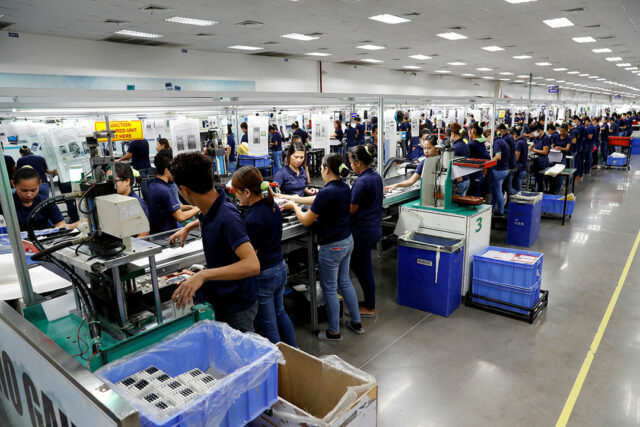
Workers at the assembly line of a factory in Malvar, Batangas in this file photo taken on Aug. 10, 2018. — REUTERS/ERIK DE CASTRO

WEAK manufacturing sales growth in October is serving to fortify the case for further monetary policy easing because of the signals it is giving off of a limited rebound, Pantheon Macroeconomics said.

In a note dated Dec. 10, Pantheon Macroeconomics chief emerging Asia economist Miguel Chanco and Asia economist Meekita Gupta said a robust gross domestic product (GDP) rebound is now seen as less likely after growth in the volume of net sales index for manufacturing fell to -0.01% from 2.9% in September and 0.2% a year earlier.

“It’s early days in terms of hard numbers for (the fourth quarter), but this result suggests strongly that GDP growth will struggle to muster any bounce from (the third quarter’s) grim 4% pace,” they said.

The third quarter reading was the weakest in over four years, easing from 5.5% during the previous quarter and 5.2% a year earlier.

GDP growth averaged 5% in the nine-month period, leading economic managers to concede that the government’s 5.5%-6.5% growth target for 2025 is now out of reach.

“The ongoing slump in sales underscores the limitations of still-rapid consumer credit growth in fueling spending — on aggregate — as household loans ex-property remain a small share of GDP, at about 6.5%,” they said.

Mr. Chanco and Ms. Gupta said the signals being sent out by manufacturing could prompt additional interest rate cuts by the Bangko Sentral ng Pilipinas (BSP).

The Monetary Board delivered its fifth straight 25-basis-point (bp) policy rate cut on Thursday, bringing it the lowest level in over three years at 4.5%. It has so far lowered benchmark borrowing costs by 200 bps since August 2024.

Pantheon Macroeconomics expects the Monetary Board to end its current easing cycle once it reaches a terminal rate of 4.25%.

Mr. Chanco and Ms. Gupta likewise noted that overseas Filipino worker remittances have maintained steady growth but are providing limited impulse in boosting manufacturing.

“Remittances, while continuing to hold steady in terms of growth on a dollar basis, are still not rising fast enough in peso terms to provide any meaningful support to headline sales growth,” they said.

They added that remittances would have to post double-digit growth to reflect in the manufacturing data.

In September, cash remittances rose 3.7%, the strongest in five months, to $3.12 billion.

Cash remittances in the first nine months came in at $28.97 billion, up 3.2% from a year earlier. — Katherine K. Chan

‘We just lost a battle. The war is not over yet,’ said UP coach Monteverde

GOLDWIN MONTEVERDE, UAAP

NO RETREAT, no surrender.

That’s the marching order of mentor Goldwin Monteverde for reigning champion University of the Philippines (UP) as the Fighting Maroons enter an uncharted territory following a defeat in Game 1, their first under the great tactician’s watch in a stellar era marked by five straight finals appearances and two championships so far.

“We just lost a battle. The war is not over yet,” declared the embattled tactician following UP’s 74-70 loss to rival De La Salle University (DLSU) in the opener of their finals trilogy witnessed by more than 18,000 fans on Wednes-day at the Mall of Asia Arena.

Mr. Monteverde, since taking over the Diliman hoops program in 2022, beat Ateneo de Manila University twice and La Salle twice in the opener of the last four titular showdowns, winning half of it eventually including last sea-son at the expense of two-time MVP Kevin Quiambao.

The second-seeded UP, with a week-long rest after dispatching University of Santo Tomas in one attempt compared to La Salle that had to beat National University twice in the Final Four, was on poise to keep that streak and shore up its second straight title bid by controlling the majority of the match, including a nine-point lead entering the fourth period before melting down. Prior to that, UP was 9-1 this season when leading after three quarters.

But a new hero for the DLSU Green Archers rose to hunt them this time around in the name of second-generation player Jacob Cortez, who’s out to deliver a title to Taft just like his dad Mike. Mr. Cortez thrusted a dagger on the Maroons’ hearts in Game 1 with the game-sealing triple in the last 30 seconds to finish with 21 points.

Mr. Cortez’ heroics negated the 34-point eruption of UP ace Harold Alarcon, the league’s highest since Thirdy Ravena’s 38 in 2018. For UP to retaliate and drag the series to another winner-take-all next week, the entire Fighting Maroons need to show up and Mr. Monteverde brims with confidence that they will.

“’Yung 34 points ni Harold (Alarcon), of course, the team need that. But then, its not all Harold. It’s just that as a team, we need others too,” Mr. Monteverde rallied, calling on his usual gunners Gerry Abadiano, Terrence Fortea, Rey Remogat, Gani Stevens and Francis Nnoruka to rediscover their fiery form — now or never.

“This is not the first time we lost, so we’re just reminding ourselves that we started the season in 0-2. And I believe the team knows how to bounce back from this situation. In every finals game, we should just want it more.” — John Bryan Ulanday

San Beda seeks to overturn Agjanti Miller suspension

Game on Friday
(Smart Araneta Coliseum)
2 p.m. – Letran vs. San Beda (Srs)

CAN a player be suspended for flopping?

That is the question the San Beda University Red Lions would like to clarify after they wrote the league letter seeking to overturn the suspension that their talented rookie Agjanti Miller would be meted out after being thrown out in the fourth quarter of their 89-70 NCAA Season 101 Finals Game One win over the Colegio de San Juan de Letran on Wednesday at the Smart Araneta Coliseum.

The high-scoring athletic Fil-Am wing was tossed out for a pair of technical fouls he incurred for flopping, which should merit an automatic one-game suspension as per league rules.

Mr. Miller, an integral part in San Beda’s meteoric rise to the finals, will serve the ban in Game Two on Friday also at the Big Dome.

But the Red Lions are hoping the league would reverse it.

“Not an act of violence. Just flopping. Too petty to be suspended,” San Beda manager Jude Roque told The STAR on Thursday when asked for their reasons why Mr. Miller shouldn’t be sanctioned.

But with or without Mr. Miller, San Beda coach Yuri Escueta is still confident they would still pull through.

“We have to be ready with or without him (Mr. Miller),” he said.

Mr. Escueta also said Mr. Miller should have just taken the contact instead of flopping.

“He should absorb hits like a man next time,” said Mr. Escueta. — Joey Villar

Gin Kings and Bolts eye Philippine Cup top four against Dyip, Fuel Masters

Games on Friday
(Ninoy Aquino Stadium)
5:30 p.m. – Terrafirma vs. Ginebra
7:30 p.m. – Phoenix vs. Meralco

IT WILL take a luck for Barangay Ginebra and Meralco to still get into the top four for playoff bonuses but they want to at least keep that smallest of chances when they clash against separate foes in the heating up PBA Season 50 Philippine Cup on Friday at the Ninoy Aquino Stadium.

Way behind the race at seventh to eighth place with similar 4-4 slates, the only way up for the Gin Kings and the Bolts is to jack up as many wins as they can regardless of where they would end up, needing the stars to align with the losses of those ahead of them just to earn a shot at the coveted twice-to-beat incentives.

Rain or Shine (ROS) (7-2) leads the bumper-to-bumper race so far with reigning champion San Miguel Beermen (SMB) not far behind at 6-2. Magnolia, Converge and NLEX share the third spot at 6-3 for the first five playoff tickets and inside tracks to the Top 4. Lurking behind is Talk ‘N Text (TNT) (5-3). Then there’s Ginebra and Meralco, former rivals in a bevy of finals streaks, now in an unfamiliar territory at the cellar of the jungle.

But while coaches Tim Cone and Luigi Trillo keep their hopes up for that bonus chance, first things first and that’s to zero in on a sure playoff seat. Ginebra takes a shot at it at 5 p.m. against the also-ran Terrafirma (1-8) followed by Meralco’s similar bid at 7:30 p.m. against the ninth-running and fellow hopeful playoff Phoenix (3-6), in a do-or-die set-to to dodge seventh loss.

“Every game is a playoff game for us. We’re still in the middle of standings. I would not say we’re groping for form but we’re still searching for strides at this point so it’s cruial for us to win this before we go to Bahrain against a tough team in ROS,” said Mr. Cone, needing a win to strike within coattails of TNT and the rest of the gang.

“All these games are crucial for us for number one, just to get into the playoffs. We want to win as many games as we can, see where we are and maybe get lucky to get into the Top 4. We have to get lucky to have a lot of things break our way for that to happen. The bottomline is we gotta continue winning games.”

The Gin Kings are on a two-game streak including a 103-85 whipping of Blackwater, already out of contention at 1-8, after roller-coaster campaign that sent them to as low as 10th place.

And it’s the same situation for the Bolts coming off a two-game slid before snapping out of it with a 120-87 dashing of the Dyip. Their return to the PBA winner’s circle mirrored a hot tear in the EASL with three straights win and letting up in this pivotal stretch is not on their plans, especially if they wish to come back on top after winning the 2024 All-Filipino title at the expense of the mighty SMB.

“The quarterfinal ticket is there (for the taking) but I think we need to win two of the last three games. Kung maipanalo namin lahat, it might put us into a situation na may chance pa kami sa top four. Every game is a playoff game for us,” said Mr. Trillo. — John Bryan Ulanday

Sanchez and company top the 4×100-meter relay in SEA Games

Kayla Sanchez, facebook.com/OlympicPHI

CHONBURI — How do you make a big splash on your Southeast Asian Games (SEAG) debut?

For Olympian Kayla Sanchez, it’s helping the Philippines to a milestone in the swimming relays.

“(It’s) very special, with all my teammates, my whole family with me here. I’m very excited to make the country proud,” said Ms. Sanchez who opened her SEAG account with gold in the women’s 4×100-meter (m) relay in part-nership with Heather White, Chloe Isleta and Xiandi Chua on Wednesday in Bangkok.

This marked the first time for the country to rule the 4×100 m freestyle — or any women’s relay event for that matter — in the biennial meet.

Ms. Sanchez, who previously won silver in the same event in the Tokyo Olympics while still swimming for Canada, threw down a 53.79 split as anchor to create a two-second gap against defending champion and eventual run-ner-up Singapore.

The final clocking of Ms. Sanchez and Co. stood at 3:44.26 — a record that eclipsed the old 3:44.31 that the Fil-Canadian herself set alongside Ms. Chua, Jasmine Alkhaldi and Teia Salvino at the Hangzhou Asian Games.

“My first race (in the SEAG) is a relay so it wasn’t just me, it’s the team and they made me less nervous. It was much more fun as a first race to be with the relays so I’m happy,” said Ms. Sanchez.

After getting approval from World Aquatics to switch sporting nationality in 2023, the 24-year-old Ms. Sanchez began representing the Philippines at the Hangzhou Asian Games.

She then swam for the country at the 2024 Paris Olympics, setting a new national mark of 53.67 and reaching the semifinals of the 100m free.

Last Wednesday, it was time to take her act to the SEAG.

“Atmosphere is the same. It’s a smaller competition, heats go by really fast and I’m still learning. I have my teammates here to teach me and to keep me grounded. So I’m excited for the rest of the competition,” she said.

And the two-time Olympic podium finisher and multiple medalist in world championships is just warming up.

VALDERAMA SETTLES FOR BRONZE
Like downhill bronze medalist John Farr before him, Mark Louwel Valderama did the honor of touching off Team Philippines’ medal harvest on Thursday.

Mr. Valderama pedaled to a podium finish in the 33rd SEA Games men’s cross-country eliminator event behind Indonesian winner Rendy Varera Sanjaya and Malaysian runner-up Zulfikri Zulkifli in the opening hostilities of Day 2 here.

It was a breakthrough for the 24-year-old mountain bike rider from Sta. Maria, Bulacan, who was fifth in XCE last time in Cambodia and 10th in cross country in the preceding SEAG in Vietnam.

When he crossed the finish line, Mr. Valderama was awash with emotion, drained physically and mentally after going all out in the big final at the 400-meter track built inside the Khao Kheow Open Zoo.

Mr. Valderma got in good position in the four-man finale when he overtook top contender Watcharakorn Onthuree of Thailand for second place at the first turn with the home bet crashing and falling way behind the medal chase. Eventually Mr. Zulkifli edged past a tiring Mr. Valderma at second and forced the latter to settle for third. — Olmin Leyba

Thousands rally again in Bulgaria to demand government’s resignation

STOCK PHOTO | Image by FREEPIK

SOFIA — Thousands of Bulgarians rallied on Wednesday evening against the country’s minority government and what they say is its failure to tackle endemic corruption in the European Union’s poorest member state.

The protests in the capital Sofia and dozens of other towns and cities across the Black Sea nation are the latest in a series of rolling demonstrations and come as Bulgaria prepares to adopt the euro on January 1.

Protesters used lasers to project the words “Resignation”, “Mafia Out”, and “For Fair Elections” on the parliament building in central Sofia.

“I think the energy of the people will gradually force them (the government) to step down because many reforms are needed,” said Dobri Lakov, 64, a Sofia resident.

“First and foremost, judicial reform. If the judicial system is fixed, everything else will fall into place, absolutely everything.”

Bulgaria’s parliament will hold a vote of no-confidence on Thursday in the government of Prime Minister Rosen Zhelyazkov, the sixth such vote since it took power on January 15 this year.

Last week, the government withdrew its 2026 budget plan, the first drafted in euros, due to the mass protests. Opposition parties and other organizations said they were protesting against plans to hike social security contributions and taxes on dividends to finance higher state spending.

Despite the government’s retreat over the budget plan, the protests have continued unabated in a country which has held seven national elections in the past four years – most recently in October 2024 – amid deep political and social divisions.

“It is finally time for normality to come to Bulgaria and for us to free ourselves from the oligarchy, the mafia, and the forces that represent them,” said Angelin Bahchevanov, an IT specialist.

Bulgarian news agency BTA reported on Wednesday that Boyko Borissov, a former prime minister and leader of the ruling GERB party, said the ruling coalition partners had agreed not to resign before Bulgaria joins the euro zone on January 1.

However, Assen Vassilev of the reformist opposition party “We Continue the Change”, which was among the organizers of Wednesday’s protest, said: “We will enter the euro zone, even if the government has resigned.”— Reuters