Home Blog Page 5730

What to See This Week (07/15/22)

Doraemon: Nobita’s Little Star Wars 2021

DIRECTED by Susumu Yamaguchi, the Japanese animated film Doraemon: Nobita’s Little Star Wars 2021 follows Nobita, who picks up a small rocket from which a small humanoid alien named Papi comes out. He came to Earth to escape from the army of his planet. When the army follows Papi to Earth, Doreamon and friends end up going off-world to save Papi and his planet. The film features the voices of Megumi Ohara, Wasabi Mizuta, and Yumi Kakazu.

MTRCB Rating: PG

What to do with an adverse employee morale survey

Low compensation and toxic boss-subordinate relations are major employee issues that came out from the recent employee opinion survey conducted by our human resource (HR) department. However, the department does not seem to want to recognize the validity of those issues. If you’re the HR head, how would you handle this situation? — Banana Boat.

The first question you should answer is, how do these two issues affect the company’s attrition rate? If the turnover rate is in the single digits, in the vicinity of 7%, then it’s a healthy number and is no cause for alarm. Employee resignations are not exactly bad.

What is worrisome is any direct correlation between the two issues you mentioned alongside a two-digit turnover rate. Definitely, you could conclude that employees are not happy with their salary and work relations with their boss.

But why does HR refuse to acknowledge the result of its work? This is worrisome. If HR doesn’t want to believe its own work, then who will? One option for you would be to hire a third-party service provider to lend an independent view and an objective opinion that will be accepted by both labor and management.

HR should not be the sole arbiter of the survey findings. If the result is contrary to management expectations, then it has more reason to publish it to improve employee trust and as a manifestation of proactive, two-way communication.

WHAT TO DO
The most important part of people management is generating employee trust. If you collect feedback and don’t act on it, then what’s the use? Next time, you may not be able to get the information you want. Of course, everything has its limits and much depends on the organization’s capacity to meet employee expectations.

However, it requires honest management commitment, along with a considerable amount time and effort. To do this, management may have to take the following steps:

One, summarize the survey result for sharing with employees. Focus on the adverse findings and how management intends to resolve those issues. At the same time, highlight all positive feedback and acknowledge the cooperation of employees in making the organization a vibrant workplace.

Going back to the two issues, if employee perception shows that salary is low, then cite an independent industry survey showing the contrary. In most cases, wrong perceptions are debunked by calculating the annual total equivalent for the right context.

Likewise, identify the most common issues between line executives and their workers without naming names.

Two, release the survey result within a reasonable time. Avoid giving the impression that management is indecisive or hiding something. Any delay gives the impression that management is not serious in seeking feedback. It may be better to admit sometimes that management has no ready answer rather than provide a haphazard reply that destroys its credibility. If more time is needed, explain the reason for the delay.

Always be professional and polite. Make everything clear. Avoid using any buzzwords or jargon unless everyone is familiar with those terms. If necessary, translate your message into Taglish (Tagalog-English) to be easily understood by factory workers.

Last, conduct the employee survey every year. This way, you can detect improvements from year-to-year. Ensure the anonymity of respondents and aim for as much as 70% of the work force.

Having a greater number of workers in the survey is imperative as it would help diminish minor issues that are often magnified by few disgruntled workers. Regardless of the issue, whether it’s low pay or internal conflicts between bosses and subordinates, a quick resolution will prevent escalation and keep bystanders from improperly intervening.

TWO-WAY COMMUNICATION
Sharing information and allowing the workers to participate in management up to a certain extent is the key to a proactive, two-way communication process. Giving people a voice will help them build confidence in working with management. However, this is easier said than done.

Part of the problem is when top management extols the virtues of communication without actually implementing practical approaches to convert their “inspirational” talks into reality. In fact, many of their actions often translate into a command-and-control approach to management, rather working in a way that shows trust and confidence in the workers.

There are many things to be done to promote two-way communication, not only within departments but throughout the company. Having an annual survey taking in the opinions of a majority of employees must be supported by individual engagement dialogue and team kaizen problem-solving.

Whatever you do, distinguish between data and facts. Data are important, but facts are more important. Consider this: High attrition rates are data while low salary and toxic bosses are facts.


Consult with Rey Elbo on Facebook, LinkedIn or Twitter or send your questions to elbonomics@gmail.com or via https://reyelbo.consulting

SL Agritech pushes hybrid rice research to boost production

SCREENGRAB FROM YOUTUBE/SL AGRITECH CORPORATION

SL AGRITECH Corp. is ramping up efforts to enhance hybrid rice technology in the country to further boost production and provide more income for farmers.

“Our team is committed to pioneering research and development initiatives with the hope to continuously discover high-yielding rice varieties that would meet the demand of our countrymen while uplifting the lives of our farmers,” SL Agritech Senior Vice-President Michelle L. Gankee said in a statement.

“With these varieties, we are one step ahead of battling the threat of food shortages because farmers can then produce rice crops with robust panicles and stems, which eventually translates to a higher yield,” she added.

The firm said it is helping farming communities through several agri-programs that aim to double or triple their harvest.

“Food stability in the Philippines has been a continuing problem that is projected to lead to a food crisis by the end of this year,” SL Agritech said.

“It is inevitable for public and private entities to work hand-in-hand in supporting the industry through sustainable initiatives that will help our farmers while stabilizing the prices of rice in the market,” it added.

In 2020, SL Agritech launched the Masaganang Ani 300 program which aimed to increase the country’s rice productivity. 

“Through the program, farmers were able to produce 300 to 339 cavans of rice, equivalent to more than 15 metric tons (MT) of rice production using hybrid rice seeds,” it added.

SL Agritech also previously launched the high-yielding SL-8H seed variety.

“Since then, other SL varieties have been introduced with new yields ranging from 7 to 15 MT per hectare that thrive even at the most unfavorable climatic condition,” it added.

SL Agritech Chief Executive Henry Lim Bon Liong said the firm’s technology is capable of meeting the country’s growing demand for rice.

“My goal, not just for SL Agritech but also for the country, is to enable the utilization of hybrid rice technology that would boost our rice production while increasing the net income of our farmers,” he added.

SL Agritech is engaged in the research, development, production and distribution of hybrid rice seed and premium quality rice. — Luisa Maria Jacinta C. Jocson

Business communications in the new normal

FOR the first time during the pandemic, the International Association of Business Communicators (IABC) decided to hold a face-to-face global convention. The IABC World Conference 2022 took place at the Marriott Marquis in New York City on June 26-29 with the theme, “Communication Can!”

More than 70 sessions were lined up by IABC featuring experts from over a dozen countries. Topics ranged from inclusive communications and purpose transformation to climate science and sustainability.  The keynote speakers were Microsoft Corporate Vice-President of Communications Frank Shaw and Edelman US Chief Executive Officer Liza Osborne Ross.

Hundreds of delegates from Asia-Pacific, Africa, North America, Europe and the Middle East attended this in-person conference, which was the first since 2019. The Philippine delegation was led by former Socioeconomic Planning Secretary Ernesto Pernia, University of the Philippines (UP) President Danilo Concepcion, UP Vice-President for Public Affairs Dr. Elena Pernia, and Metro Pacific Foundation President Melody Del Rosario.

Since the conference venue is right at the heart of Manhattan’s Theater District, delegates had the opportunity to watch Broadway shows and experience the myriad entertainment offerings of Times Square. It is just a stone’s throw away from Central Park and also close enough to Wall Street in the Financial District of Lower Manhattan.

Highlighting the four-day convention was the IABC Gold Quill Awards recognition night where winners over the last three years were invited to celebrate together with the conference delegates. Several Filipino entries won the Gold Quills, including the 50th anniversary coffee-table book of the Financial Executives Institute of the Philippines.

TOKENIZATION PROJECT OF THE YEAR
Last month, a Filipino fintech firm bagged the Tokenization Project of the Year Award during the 2022 Artificial Intelligence and Blockchain Conference (AIBC) World Summit in Toronto, Canada.

iWave Advanced Research Group, Inc. (iWAR) was the recipient of the AIBC award for its Oz Finance project, a proprietary blockchain protocol under iWAR’s Global Trade Exchange (GTX) located at the Freeport Area of Bataan (FAB), the Philippines’ oldest and fastest-growing ecozone.

A pioneering FAB-registered enterprise, iWAR also developed the world’s first residency enabled token with real-world utility known as TOTOZ. This will bolster the bid to position FAB as a global offshore financial center that will integrate emerging fintech markets.

In 2019, the Authority of the Freeport Area of Bataan (AFAB) opened its doors for the registration of offshore fintech companies. Subsequently, it granted iWAR an exclusive license to operate GTX, a platform for cross-border trade and exchange of digital assets between international investors.

AFAB, a government agency attached to the Office of the President, commissioned the development and launch of Oz to provide operators access to credit and seed capital for business and operations. Commending iWAR for garnering the AIBC award, AFAB Chairman Pablo Gancayco said: “This recognition clearly shows Oz as a financial instrument that can change the way global citizens, companies, and governments interact.”


J. Albert Gamboa is the chief finance officer of Asian Center for Legal Excellence and chairman of the FINEX Media Affairs Committee. The opinion expressed herein does not necessarily reflect the views of these institutions and BusinessWorld. #FinexPhils www.finex.org.ph

How PSEi member stocks performed — July 14, 2022

Here’s a quick glance at how PSEi stocks fared on Thursday, July 14, 2022.


Peso strengthens on aggressive BSP hike

THE PESO continued to strengthen against the dollar on Thursday as the Bangko Sentral ng Pilipinas (BSP) delivered its biggest-ever rate hike amid growing inflation pressures.

The local unit closed at P56.15 per dollar on Thursday, gaining 11 centavos from its P56.26 finish on Wednesday, based on Bankers Association of the Philippines data.

Still, year to date, the local unit has weakened by 10.09% or by P5.15 from its close of P51 versus the dollar on Dec. 31, 2021.

The peso opened Thursday’s session at P56.30 per dollar. Its weakest showing was at P56.45, while its intraday best was at P55.98 against the greenback.

Dollars exchanged surged to $1.65 billion on Thursday from $994 million on Wednesday.

“The peso appreciated following the off-cycle large 75-bp (basis point) policy rate hike from the BSP today,” a trader said in an e-mail on Thursday.

The BSP Monetary Board on Thursday delivered an all-time high hike of 75 bps in an “urgent action” amid signs of “sustained and broadening price pressures.”

The hike was done outside of their scheduled policy meetings and was the first off-cycle increase since April 16, 2020. Following Thursday’s move, the BSP has now raised rates by a total of 125 bps this year and the key rate is now at 3.25%, matching the March 2020 level.

The central bank in 2020 cut borrowing costs by a cumulative 200 bps to support the economy amid the coronavirus pandemic.

The BSP has become more aggressive as headline inflation reached 6.1% in June, the fastest in nearly four years. This brought the first-half average to 4.4%, above the central bank’s 2-4% goal but still lower than its 5% forecast for the year.

This also comes as the Federal Reserve is expected to continue being hawkish, especially after US consumer prices jumped by 9.1% annually in June, the fastest in more than 40 years, data released on Wednesday showed.

BSP Governor Felipe M. Medalla last week said the Fed’s aggressive stance has put pressure on the peso, with the local currency’s weakening adding to inflation pressures.

Rizal Commercial Banking Corp. Chief Economist Michael L. Ricafort said in a Viber message that the rate increase could help support the peso but could also lead to higher lending costs.

MUFG Bank analyst Sophia Ng said reaction to the BSP’s move was felt immediately in the market on Thursday. 

“It is also due to this tightening move that the peso is one of the only two AXJ (Asia ex-Japan) currencies that is strengthening against the dollar so far today while most others are under pressure from a stronger dollar driven by rising market expectations of more aggressive tightening by the Fed,” Ms. Ng said in a note.

“Prospects of more rate hikes by the BSP do not change our overall outlook on the PHP, as other factors such as ongoing dollar strength and widening trade deficits will continue to be key drivers of the peso’s weakness in 2H22,” she added.

For Friday, the trader said the peso may weaken anew against the dollar due to a potentially elevated US producer inflation report overnight.

The trader sees the peso moving between P56.00 and P56.20 on Friday, while Mr. Ricafort gave a slightly wider forecast range of P56 to P56.25 per dollar. — Keisha B. Ta-asan

PSEi slips as BSP raises rates in surprise move

BW FILE PHOTO

LOCAL SHARES slipped on Thursday, recouping earlier losses, following a surprise rate hike by the Bangko Sentral ng Pilipinas (BSP) amid growing inflation risks.

The benchmark Philippine Stock Exchange index (PSEi) went down by 7.24 points or 0.11% to close at 6,248.13 on Thursday, while the broader all shares index retreated by 7.57 points or 0.22% to 3,367.

The PSEi reached a low of 6,166.61 intraday but managed to recoup its losses before the closing bell.

“Philippine shares managed to finish almost flat, following a surprise move of the BSP to tame inflation, as [the] key policy rate [was] increased 75 bps (basis points) to 3.25%,” Regina Capital Development Corp. Head of Sales Luis A. Limlingan said in a Viber message.

“For a substantial part of trading, the PSEi was down more than 1% as analysts became worried about the impact of a US recession,” he said.

“Much of today’s market performance was driven by the off-cycle 75-bp interest rate hike, which the market did not expect to happen today.” Unicapital Securities Equity Research Analyst Ralph Jonathan B. Fausto said in a Viber message on Thursday.

Mr. Fausto said the BSP’s move was likely prompted by faster June US inflation, which fueled bets of an even bigger hike by the Federal Reserve this month. US consumer prices jumped 9.1% annually in June, the fastest in more than 40 years, data released Wednesday showed.

The BSP Monetary Board on Thursday delivered an all-time high hike of 75 bps in an “urgent action” amid signs of “sustained and broadening price pressures.”

The hike was done outside of their scheduled policy meetings and was the first off-cycle increase since April 16, 2020. Following Thursday’s move, the BSP has now raised rates by a total of 125 bps this year and the key rate is now at 3.25%, matching the March 2020 level.

Headline inflation reached 6.1% in June, the fastest in nearly four years. This brought the first-half average to 4.4%, above the central bank’s 2-4% goal but still lower than its 5% forecast for the year.

The majority of sectoral indices ended in the red on Wednesday, except for financials, which went up by 25.32 points or 1.69% to 1,521.96, and services which increased by 0.53 point or 0.03% to 1,658.90.

Meanwhile, property retreated by 34.83 points or 1.23% to 2,785.39; holding firms dropped by 40.58 points or 0.69% to 5,785.59; mining and oil went down by 45.11 points or 0.40% to 11,077.48; and industrials lost 24.73 points or 0.26% to end at 9,333.04.

Value turnover inched lower to P5.3 billion on Thursday with 680.44 million shares changing hands from the P5.55 billion with 1.28 billion issues seen the previous day.

Decliners outnumbered advancers, 124 versus 69, while 34 names closed unchanged.

Net foreign selling climbed to P826.86 million on Thursday from the P706.88 million seen the previous trading day.

Mr. Fausto placed the PSEi’s support at the 6,000-6,100 range and resistance at 6,400 to 6,500. — J.I.DP. Tabile

Legislators consider new tax, privatization bills

By Diego Gabriel C. Robles
and Alyssa Nicole O. Tan, Reporter

MEMBERS of Congress are exploring untapped sources of potential funds, ranging from taxes on digital transactions, single-use plastics, and carbon emissions as signaled by economic managers, as well as privatizing government-owned and -controlled corporations (GOCCs) and public land.

Albay Rep. Jose Ma. Clemente S. Salceda backed legislation taxing online transactions, saying that digitization in business processes is outpacing government efforts to tax the activity.

“Digital transactions are getting cheaper by the year, as innovation leads to efficiencies. But our tax collections aren’t keeping pace with the growth in digital sales,” Mr. Salceda told BusinessWorld in a Viber message.

“As more of the bricks-and-mortar economy moves to the digital space, we could see revenue erosion- leading to depleted tax resources for basic services. So, we need to plug that gaping hole,” he added.

“The top 1% of the population consumes 87% of paid digital services, so the effect on the general public will be extremely minimal.”

The Marcos government is seeking new sources of revenue to shrink the fiscal deficit and pay down about P3.2 trillion in additional debt incurred during the pandemic. The Bureau of the Treasury (BTr) has estimated that the government needs to raise P249 billion annually in incremental revenue to avoid new borrowing and reduce the debt load.

The House of Representatives approved in September 2021 a bill seeking to impose a 12% VAT on online advertisements, subscription services, and others. However, the Senate did not approve its counterpart measure.

Senator Sherwin T. Gatchalian said the lack of value-added tax (VAT) in online services makes such legislation necessary.

Ako sang-ayon ako diyan dahil for example ’pag bumibili ka sa Amazon, walang VAT. Pero ’pag bumili ka sa SM ng kaparehas na bagay, may VAT (I am for taxing the industry because if you buy from Amazon, you won’t be charged VAT, but if you buy the same thing from SM, you will),” he said in an interview with DWIZ radio on Saturday.

“So, lugi naman ’yung mga nagbebenta dito sa atin. Kasi mas mura sa labas at di naman kumikita ang gobyerno (Vendors here face unequal competition because goods sold online are cheaper, and the government earns nothing from their transactions),” he added.

ENVIRONMENTAL TAXES
Congress is also considering taxing activities that have a negative impact on the environment.

The Philippines is one of the world’s largest polluters of single-use plastics because plastics are cheap, Mr. Salceda said.

“Along with the looming effectivity of the Expanded Producer Responsibility Act which would make businesses more accountable for the plastic waste they produce, plastic taxation, the promotion of alternatives, and other non-tax measures are a basket of policy tools we want to enact to reduce our plastic waste,” he said.

“Alternatives to single-use plastics are widely available. Encouraging consumers to bring reusable packaging would actually result in consumer savings of between P200 to P740 per year for the average consumer, since supermarkets and even vendors charge as much as P2 to P3 pesos per bag.”

Mr. Gatchalian, whose family runs a major plastics business and represents Valenzuela, the hub of the industry, said taxes on single-use plastics could have implications on jobs.

Dapat pag-aralan na mabuti iyan dahil maraming plastic factory sa ating bansa at maraming umaasa dito sa trabaho. Ako aminin ko sa Valenzuela, marami kaming mga plastic factories na marami ang empleyado libo ang kinukuha nila na empleyado (That has to be studied carefully because there are many plastics factories that provide jobs. I will admit that in Valenzuela, we have many plastics factories that employ thousands),” Mr. Gatchalian said.

“So dapat tingnan natin ang anggulo na ’yan, dahil baka naman na mawalan tayo ng trabaho at mataas ang unemployment rate natin ngayon pumapalo ng 6% (We have to consider the employment angle, because the job losses could add to our 6% unemployment rate),” he added.

Mr. Salceda, however, said the developed world needs to do its share in reducing carbon footprints, and the Philippines should not be left to solve the problem using its own resources.

“Without equity from the developed world, who caused and continue to exacerbate climate change, it could be detrimental to our national development,” Mr. Salceda said.

“Even if we curtail our already low per-capita emissions, the global needle will not move (while) our energy and industrialization will get more expensive,” he explained.

Finance Secretary Benjamin E. Diokno last week said the economic team is considering the taxes on digital or online transactions, single-use plastics, and carbon emissions.

Under the previous administration’s fiscal consolidation plan, a P20 excise tax per kilogram of single-use plastics was estimated to generate P1 billion in revenue annually.

On the other hand, a 12% VAT on online advertisement services and other digital and online services was projected to generate P13.2 billion annually.

Antonio A. Ligon, a law and business professor at De La Salle University, said that given the government’s fiscal bind and debt load, “it’s not easy to say whether (we) will avoid new taxes.”

“We cannot avoid new taxes because of the need to pay back our huge debt incurred during the pandemic. Economic growth alone will not be sufficient to raise the necessary revenue,” added economist Bernardo M. Villegas of the University of Asia and the Pacific.

“I support the suggestions about taxing single-use plastic products and digital transactions. The government can also increase sales taxes on luxurious consumption of the wealthy,” he said in an e-mail.

Terry L. Ridon, a public investment analyst and convenor of think tank InfraWatch PH, said that “new taxes should only be limited to segments which do not cover a wide swath of the population, such as sin taxes, gambling, (and) luxury goods.”

PRIVATIZATION
Aside from imposing new taxes, the government should also consider privatizing GOCCs and public land, Mr. Gatchalian said.

“I think privatization was frowned upon in the past. But I think this is an area to raise revenue, considering that the government is probably the biggest landowner in the Philippines,” Mr. Gatchalian said in an interview with the ABS CBN News Channel on Tuesday.

“There are a lot of GOCCs that are inefficient. My concept here is that government should not be in the business of business, government should be in the business of governance. There’s so many GOCCs that can be privatized; let the private sector run it,” he added.

When asked about a specific government asset that is being considered, Mr. Gatchalian singled out the Philippine Amusement and Gaming Corp. (PAGCOR).

“I think PAGCOR is a good company or a good GOCC but the private sector can unlock the value and unlock the potential even further. I think that’s one area that the private sector can participate in.”

“Land is also another privatization opportunity. There’s a lot of land. For example, the old domestic airport. If we move to Bulacan, then the old domestic airport can be privatized for developers to come in,” he added.

The Privatization Council of the Department of Finance declined to comment, telling BusinessWorld the office is still in the process of transition after the new government took over.

Mr. Ligon added: “government should not be doing business because the primary intent of business is to make profit.”

“If we want government asset(s) and corporations to engage in profit-making, then let’s leave it to (the) private sector. Conflicts of interest will be avoided because profitability sometimes is not consistent with social concern,” Mr. Ligon said in a Viber message.

“If privatized, these new private enterprises can also contribute to raising revenue from income and business taxes.”

“In principle, it is better to privatize government corporations that have a business mission. Government should stick as much as possible to regulating monopolies and oligopolies and public utilities, as well as delivering public services such as public education and public health,” Mr. Villegas said.

However, there are only a handful among more than 70 GOCCs that can be privatized as most GOCCs “run special economic zones, airports, large infrastructure projects, or regulate critical sectors such as housing, food and tourism,” Mr. Ridon said.

“These types of GOCC activities cannot be surrendered to the private sector, even at a high premium, because there is a clear public purpose being served by these entities which may conflict with the objectives of private enterprise,” he said.

With PAGCOR in particular, while privatization can raise revenue, its role as a regulator is more important, Mr. Ridon added.


DTI’s Pacual calls RCEP a Marcos priority

REUTERS

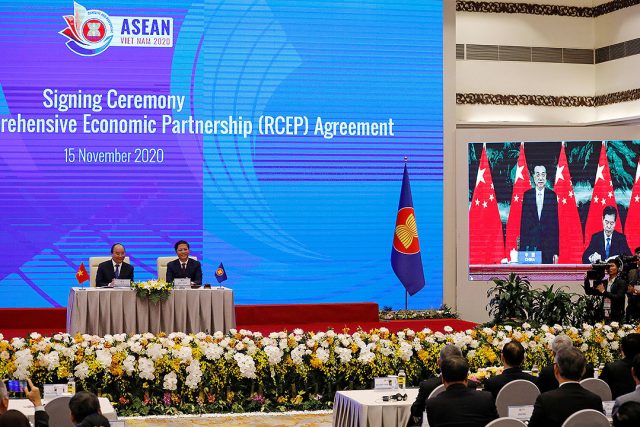
PARTICIPATION in the Regional Comprehensive Economic Partnership (RCEP) is a government priority, Trade Secretary Alfredo E. Pascual said on Thursday.

“RCEP is a priority of the administration. We have clarified this in one of our Cabinet meetings,” Mr. Pascual said during the general membership meeting of the Management Association of the Philippines (MAP) in Taguig City. 

RCEP, a trade deal which started coming into force on Jan. 1, involves Australia, China, Japan, South Korea, New Zealand and the 10 members of the Association of Southeast Asian Nations (ASEAN). It is billed as the world’s largest trade agreement as it represents about 30% of global gross domestic product.

However, the entry of Philippines into RCEP failed to obtain Senate in the 18th Congress after some senators expressed concern over the lack of protections for the agriculture industry. It is now up to the 19th Congress to decide on ratification. The first day of the new session is July 25.

“(The) Department of Trade and Industry (DTI) will continue to push for the immediate ratification of the RCEP and other trade agreements. With only 10 FTAs, the Philippines has the least number of FTAs among the ASEAN six countries,” Mr. Pascual said.

“Singapore signed 27 FTAs, Malaysia 17, Thailand 15, Indonesia 15, and Vietnam 15. These agreements will diversify the country’s exports in terms of products and services and destinations and enhance the country’s attractiveness to foreign investment,” he added.

Mr. Pascual added that the Philippines will not become an attractive location for export-oriented enterprises without RCEP and FTAs.

“Most foreign investments in China, for instance, are export-oriented industries. They are from big multinationals having transferred their production facilities to China and using China as a production place. Without these FTAs and RCEP, the Philippines would not be an attractive location for such types of export-oriented enterprises,” Mr. Pascual said.

President Ferdinand R. Marcos, Jr. has said he wants an assessment of the RCEP to ensure the protections for the agriculture sector.  — Revin Mikhael D. Ochave

PEZA announces appointment of OIC

THE Philippine Economic Zone Authority (PEZA) said Tereso O. Panga has been named officer-in-charge (OIC) director general, with effect from July 1, succeeding former chief Charito B. Plaza. 

In a Facebook post on Thursday, PEZA said Mr. Panga’s designation as OIC is outlined in Memorandum Circular (MC) No. 1, issued by the Office of the President over the signature of Executive Secretary Victor D. Rodriguez on June 30.

Mr. Panga still serves as the PEZA’s deputy director-general for policy and planning.

“Mr. Panga will head the (agency) until July 31, 2022 or until a replacement is appointed/designated, whichever comes first,” the PEZA said. 

“In view thereof, all applications, requests, concerns, and matters needing action or approval by the Head of the Authority following the guidelines of MC No. 1 shall be addressed to the duly assigned OIC,” it added. 

Asked to comment, Ms. Plaza said in a Viber message that the position is coterminous with the appointing administration.

Ms. Plaza was appointed director-general in September 2016.

“PEZA director general is (a) Presidential appointee (and is) coterminous,” Ms. Plaza said. — Revin Mikhael D. Ochave

Bill proposes 30-year timeline for infrastructure projects

PHILIPPINE STAR/ MICHAEL VARCAS

A BILL seeking to create a 30-year planning horizon for infrastructure and establishing a National Infrastructure Program has been filed at the Senate, Senator Mark A. Villar said in a statement.

“It is important that we advance the Build, Build, Build program in the Senate, because having a long-term plan for our infrastructure program can grow the economy… It will (make it easier to improve) roads, bridges, and other structures, (generating) thousands of jobs,” he added.

Build, Build, Build was the former government’s P8.4-trillion flagship program designed to address the Philippines’ lack of competitiveness due to gaps in its infrastructure.

Mr. Villar is being tipped as a possible chairman of the Senate Trade, Commerce and Entrepreneurship Committee.

The bill focuses on the process for identifying the core infrastructure projects the government plans to pursue in transport, energy, water resources, information and communications technology, social infrastructure systems, and others.

“I am certain that with the passage of this bill, we will encourage investors, facilitate job creation, boost economic growth, and most importantly, improve the quality of life in both urban and rural areas,” Mr. Villar said.

The Department of Public Works and Highways (DPWH), which Mr. Villar used to head, estimates that in the 2016-2020 period, Build, Build, Build generated 6.5 million jobs. It also tallied 1.6 million hires between March 2020 and the end of 2021.

“In the past six years, the Filipino people have seen and experienced the impact of the Philippines’ Golden Age of Infrastructure. The Build, Build, Build program resulted in the creation of hundreds of ports, thousands of roads and bridges, and millions of jobs,” he said.

Separately, Albay Rep. Jose Ma. Clemente S. Salceda, who is expected to retain the chairmanship of the House Ways and Means Committee, filed a joint resolution on Thursday adopting Build, Build, Build as a national infrastructure development framework with a set minimum annual spending target.

According to House Joint Resolution 6, between 2023 and 2028, at least 5% of gross domestic product (GDP) must be spent on infrastructure, with an eventual target of 6% of GDP. 

Mr. Salceda, in the resolution, said that “proper planning and design, adequate funding, efficient implementation, and timely and effective completion of infrastructure projects will be crucial to economic recovery from the scarring effects of the COVID-19 pandemic and the attendant global economic slowdown.”

If passed, the government will be required to complete infrastructure projects in the pipeline and promote locally funded infrastructure development. — Alyssa Nicole O. Tan

No sugar shortage, industry says; high prices blamed on ‘hoarding’

SUGAR producers said on Thursday that the supply of sugar is ample and blamed the prevailing high prices on “manipulation and hoarding.” 

United Sugar Producers Federation President Manuel R. Lamata blamed the manipulation on some traders he did not identify.

“Definitely, there is manipulation and hoarding going on,” Mr. Lamata said in a Viber message.

The average retail price of refined sugar in wet markets was P87.50 per kilo on July 8, according to a report by the Department of Agriculture (DA). The price was as high as P90 in some markets.

The average price of raw sugar in wet markets, meanwhile, was P66.86 per kilo.

Mr. Lamata projects a possible shortage “in the long run.”

Philippine Chamber of Commerce and Industry President George T. Barcelon said the increase in sugar prices is the result of various factors, including surging prices of fertilizer and the impact of previous typhoons on sugar-producing provinces.

“(We should) consider the devastation that was brought about by Typhoon Odette in mid-2021, which hit the Visayas and Northern Mindanao, where sugar is grown extensively,” he said in a Viber message. “This affected production for the first half of 2022.”

“There is limited supply coupled with high cost of fertilizers. Farmers fertilized less of their farms, thus affecting productivity,” he said. “That is what is happening now.”

He noted that the DA’s plan to import 500,000 metric tons of sugar did not materialize, affecting supply.

“So, I think, only 200,000 metric tons was allowed for import and this was fully absorbed by industrial users,” he said. “No imports reached the retail side; thus, high prices are now being felt.”

Mr. Barcelon said the “only recourse” now for the short term is to import from Thailand and other Southeast Asian countries.

Mr. Lamata, who said the greed of some sugar traders triggered surging prices, urged the government to impose a suggested retail price of P60 per kilo of raw/brown sugar and P75 for refined sugar.

He said traders should “immediately” import 100,000 metric tons of refined sugar and “bring the imports to the DA and Sugar Regulatory Administration’s rolling stores with suggested retail prices and sell them directly to (consumers) and bakers.”

“(The government) should ensure that it will be exclusive to the palengke (wet markets) and housewives, not to the industrials and bottlers.”

Negros Oriental is one of the Philippines’ largest sugar producers. Its Vice Governor Jeffrey P. Ferrer said he will consult with sugar refineries to gauge their willingness to “restart their operations as soon as possible” ahead of a possible shortage.

“There have been reports that low sugar stocks are due to hoarding, but this is an allegation that needs to be verified first,” he said in a statement. “On the other hand, if indeed true, I will reach out to various refineries in the province if they are willing to open their mills to refine raw sugar in order to address the perceived shortage in the market.”

Mr. Ferrer said while some officials, including those that will serve under the Department of Agriculture, have yet to be named by President Ferdinand R. Marcos, Jr., “we have to hit the ground running and prepare for the coming crop year by ensuring that we will have sufficient sugar supply in the coming months.” — Kyle Aristophere T. Atienza