Home Blog Page 5726

Port users group declares support for Marcos administration 

BW FILE PHOTO

A GROUP of port users has committed to support the administration of President Ferdinand R. Marcos, Jr., vowing to help the government with its programs related to port operations.  

We are a key cog in the logistics chain, and we can, in a modest but determined and purposive way, facilitate the fruition of Your Excellency’s hope and promise of prosperity,the Port Users Confederation of the Philippines, Inc. (PUCP) said in a statement.  

[We] are available to help your government with its program, especially those related to port operations,it added.  

The statement was signed by representatives from its member organizations, including the Philippine Integrated Exporters, Inc., Philippine Chamber of Arrastre and Stevedoring Operators, Inc., Federation of Air Customs Brokers and Forwarders of the Philippines, and the Association of Paper Traders of the Philippines, Inc., among others.  

During the campaign, Mr. Marcos vowed to make the Philippines a shipping and logistics powerhouse in Asia.  

Global and local supply chains have been disrupted by the coronavirus pandemic, and problems in the logistics sector have been aggravated by Russias invasion of Ukraine. Kyle Aristophere T. Atienza 

Cebu City mayor revives call for dam project for water supply

CEBU CITY PIO

CEBU City Mayor Michael L. Rama is reviving his request to the national government to build a dam for reliable and sustainable water supply after the citys distributor announced last week a plan to increase rates by 70% starting July 2023.  

This issue brings to forth what I have been calling for, to build a dam that would collect abundant rainfall so that a surplus in supply would mean lower rates for the consumers,Mr. Rama said in a statement on Friday.   

Citing a presentation from the Metropolitan Cebu Water District (MCWD), he said the planned tariff adjustment would mean a 60% increase by July 2023 and 10% by July 2024.  

The mayor noted that he initially proposed the dam project earlier this year after the city was among the areas hit hardest by typhoon Odette in mid-December last year.  

Let us refresh such project. As we first raised to President (Rodrigo R.) Duterte after (typhoon) Odette hit us hard, we will bring this project to the attention of President BBM (Ferdinand R. Marcos, Jr.) for the national government to pour its resources and help realize it,he said. 

The proposal also included the construction of surface water retaining systems as part of the national governments recovery assistanceto the city.  

Mr. Rama has also directed the City Agriculture Office to work on the construction of gabion dams in remote parts of the city, which would help slow down the flow of water in rain runoff channels or ditches.  

He said this is part of the target accomplishments within his administrations first 100 days from July 1. 

He has also directed the city council to hold public consultations on MCWDs planned rate hike.  

The mayor also asked MCWD to reassess its proposal and implement the increase over a longer period.   

I ask the MCWD Board to further review its planned imposition of new tariff and consider seeking adjustments, only if it must, on a staggered basis to spare the consumers any adverse effects until 2025,he said.  

MCWD, a self-sustaining government-owned and controlled corporation, last increased rates in 2015.   

Water districts are regulated by the Local Water Utilities Administration, including rates setting.   

The utility is currently constructing a P1.1-billion bulk water supply project, which is expected to be operational by September.   

Cebu City, the regional hub of Central Visayas in central Philippines, is part of the Metro Cebu area which is the second biggest urban district in the country after the capital region Metro Manila. MSJ

Parañaque public hospital to provide free dialysis, other services through PPP  

OSPITAL NG PARANAQUE I FB PAGE

THE CITY-RUN Ospital ng Parañaque will start providing free hemodialysis and other medical services next month, the local government announced at the weekend.  

Mayor Eric L. Olivarez said the delivery of free services using new facilities and equipment is under a public-private partnership (PPP) arrangement.  

We will have the blessing of our new CT scan, hemodialysis machine and other facilities in one,he said in a statement.   

Ospital ng Parañaque Director Jefferson R. Pagsisihan said a private company will operate the hospitals facilities, including the pharmacy and laboratory under the PPP contract.  

Expenses will be covered by funds from the Philippine Health Insurance Corp., Department of Health, and Malasakit Center. 

“We want our services to be affordable, and if the hospital has the capacity, the medicines and services will be free as long as our doctors at OsPar1 order them,” said Mr. Pagsisihan. 

“We are ready, and we are just waiting for the relevant permits and licenses for the operation of our new equipment and facilities,” he added.  

Mr. Olivarez, a former congressman and was one of the main authors of the House bill that would become the Universal Health Care Act, also announced that the hospitals intensive care unit, which had been under renovation, will be reopened at the same time.   

The city government is also planning to build a new six-storey building to expand the hospitals capacity.

P91.57-M Nueva Ecija town flood control projects near completion  

DPWH

THREE flood control projects intended to protect residential and farm areas in the town of San Leonardo in Nueva Ecija are almost complete, the Department of Public Works and Highways (DPWH) announced on Sunday.

The three structures have a combined cost of P91.57 million, the department said in a statement.  

One project, a 135.2-linear meter flood control structure along Tabuating Creek, has been completed ahead of its August deadline.  

This will be complemented by two others: a 222.4-lineal meter structure in Barangay Tabuating along the Pampanga River, which is 83% done; and a 180-lineal meter wall along Peñaranda River, currently at almost 80% completion.   

The completion of the projects will not only ensure protection of lives in times of calamities. It can also help prevent massive damage on the localssource of livelihood, which is heavily reliant on farming and other agricultural industries,said DPWH Regional Office 3 Director Roseller A. Tolentino. 

San Leonardo, classified as a first-class municipality, is prone to flooding during typhoons as it is a flatland surrounded by active waterways the Tabuating Creek in the north, Pampanga River in the west, and Peñaranda River from its northeast to southwest tip. 

Supreme Court finds manpower agency liable for illegal dismissal 

PHILSTAR FILE PHOTO

THE SUPREME Court has ruled in favor of a terminated worker who filed a case against a manpower agency for illegal dismissal. 

The High Court’s ruling reversed the Court of Appeals (CA) decision, which overturned a resolution by the National Labor Relations Commission (NLRC). 

In an 18-page decision on July 14, the court’s third division said petitioner Marlon B. Agapito, a former housekeeper, was verbally dismissed without a valid reason or due process by Aeroplus Multi-Services, Inc. (Aeroplus). 

The court pointed out that the CA committed a reversible error when it accepted delayed affidavits from the company officers. It added that Aeroplus did not explain why the sworn statements were submitted late. 

“More so since these affidavits containing a plain denial of the otherwise prompt, positive, and detailed narrative of petitioner are simply self-serving, hence, devoid of any probative weight,” Associate Justice Amy C. Lazaro-Javier said in the ruling. 

The tribunal ordered Aeroplus to pay Mr. Agapito full back wages from when he was terminated, separation pay equivalent to one month’s pay for every year of service, 13th-month pay reckoned from three years back, attorney’s fees, and moral and exemplary damages worth P40,000.  

The company was also ordered to reimburse with 6% interest the P200 amount illegally deducted from his monthly wages as a supposed cash bond.  

Under the country’s labor code, employers “cannot interfere with the freedom of any employee to dispose of his or her wages.”  

The case was remanded to a labor arbiter for the computation of the total monetary award and to notify the Labor department to investigate the company’s unlawful practice of making deductions from its employees’ wages.  

Mr. Agapito’s dismissal stemmed from an incident in an open forum, where he raised a concern about his alleged mistreatment in the company.  

Aeroplus suspended him for insubordination shortly after the incident.  

After his suspension, Mr. Agapito reported for work only to be told by the officer-in-charge of the personnel department that he had been fired.  

He then appealed to the NLRC, which ruled in his favor. 

In his ruling, the labor arbiter said Aeroplus failed to present substantial evidence of a loss of trust and confidence in Mr. Agapito, adding the company did not even challenge the petitioner’s protest that his right to due process was violated. John Victor D. Ordoñez 

VP Leni and hope

PHILIPPINE STAR/ MICHAEL VARCAS

Citizens of the Philippines, kakampinks (fellow pinks), let’s listen to this: “Despite the fact that we didn’t make it, it was the happiest campaign I’ve been involved in.”

That isn’t me talking.

Further: “2022 was the first loss ever for the family, pero it was the most fun of all and also the most meaningful.”

That’s VP Leni. And truly Leni.

I still call her VP even though she is no longer the Vice-President. It is an expression of respect. I could likewise address her “Ma’am.” In the Pinoy context, “Ma’am” is a courteous address usually reserved for elderly women, but I’m older than the VP.

So, I feel more comfortable addressing Leni, our former Vice-President, as VP. VP can stand for “virtuous parent.” Hasn’t VP Leni been called ina ng bayan (mother of the nation)? Hasn’t she been the paragon of parenthood — the caring and loving mom who has likewise assumed the traditional paternal role of being protector and provider to daughters Aika, Tricia, and Jillian?

VP also stands for “valiant Pinay.” For hasn’t she demonstrated indomitable spirit in pursuing the impossible? Walang imposible (nothing is impossible)! Hasn’t she shown boldness and heroism in leading a krusada (crusade) to “fight the unbeatable foe and to bear with unbearable sorrow?”

Yet, with authenticity and spontaneity, she tells her supporters how happy she is, how she had fun during the campaign.

Moreover, VP Leni said that if she ever had to do it all over again knowing the outcome, she would still do it. “I believe we were able to start something very special… hindi lang ako, ako lang ang naging mukha nun (not just me. I was just it’s face). A lot that happened during the campaign was not because of me, pero  (but) it was because people became invested.”

VP Leni gives credit to the mass of volunteers. But it is also a loop. Isa Rodrigo, a young radical intellectual reared by liberal parents, observes: “Most of Leni’s following is due to her impressive cult of personality.”

VP Leni inspires people. She is authentic and spontaneous. She has a heart; she has empathy. She has a vision: angat buhay lahat (elevate everyone’s quality of life).

So dear kakampinks, let’s not despair despite our electoral loss. Let’s emulate VP Leni who radiates happiness because she is overjoyed by the boundless commitment and energy of people to realize change. That movement is everywhere, and even though it was not able to carry us to victory in 2022, its momentum is irreversible.

Never in my life as an activist have I seen such magnitude and intensity of voluntarism and collective action during an electoral campaign. The people power of 1986 that toppled the dictatorship remains unprecedented, but it happened in the aftermath of brazen election cheating that angered the people.

The April 6 noise barrage that shook the Marcos dictatorship happened on the eve of the 1978 Interim Batasang Pambansa (IBP) elections. Nonetheless, the outcome of sham elections was a foregone conclusion. The party of Marcos swept the elections.

But arguably, the strategic objective of the opposition, then and now, is not limited to winning the elections. An equally important objective, then and now, is to awaken and organize our people to undertake collective action.

One can find a parallel here between the 1978 and 2022 campaigns. Although the united democratic opposition was trounced in the rigged 1978 elections, the exercise gave the masses an experience of what a movement could do. The widespread spontaneous protest on April 6, 1978 in metropolitan Manila became the dress rehearsal for the explosion of the parliament of the streets that culminated in the people power revolution in 1986.

But unlike the 1978 noise barrage that happened in metro Manila, the 2022 pink movement was palpable all over the country. In major towns and cities, the Leni rallies attracted tens of thousands if not hundreds of thousands of people.

VP is the magnet. She is the symbol of decency, of integrity, of radikal na pagmamahal (radical love), of hope.

Said VP Leni during the launch of the Angat Buhay program through the Angat Pinas Foundation:

Tandaan lang po natin, lahat ng ginagawa natin at gagawin pa, nag-uugat lagi sa pag-asa. Pag-asa ang nasa likod ng lahat ng pagsisikap at pagtataya noong nakaraang kampanya. Pag-asa na kung magmahal tayo, kung itodo natin ang pagmamahal na ito, may maaabot tayong pagbabago.

(“Let us remember that what we are doing as well as what we will be doing is rooted in hope. During the campaign, hope underlay all our efforts and judgments. There’s hope when we love, and when we fill life with love, we will realize change.”)

VP calls on us to “move forward.” Moving forward, she envisions a movement with three planks: the socio-economic struggle, the political movement, and the campaign for truth and against disinformation. Angat Buhay focuses on social development. The political party that emerged during the 2022 election is being consolidated. And perhaps the biggest task of all is building and expanding the coalition to combat networked disinformation.

This kind of strategy reminds me of the struggle led by Rizal, Bonifacio, and others against Spanish colonialism and tyranny. Angat Buhay is similar to La Liga Filipina, an organization for mutual aid and protection. The political struggle then was led by the Katipunan. Today, it takes the form of the coalition of reformist politicians and the people’s councils. And the fight for truth has to find expression in a new La Solidaridad and Propaganda Movement.

Ours is indeed a long struggle. It is still a continuation of the great struggles in our history.

As Rizal said, “joy blossoms from suffering, and redemption is a product of sacrifice.” And VP Leni assures us that hope will deliver change.


Filomeno S. Sta. Ana III coordinates the Action for Economic Reforms.

www.aer.ph

A first look at the medium-term fiscal program

RUTHSON ZIMMERMAN-UNSPLASH

I am pleased to share with readers a post that Christine Tang and I wrote for Globalsource Partners (globalsourcepartners.com) subscribers on the Philippines fiscal outlook. We are their Philippine Advisers.

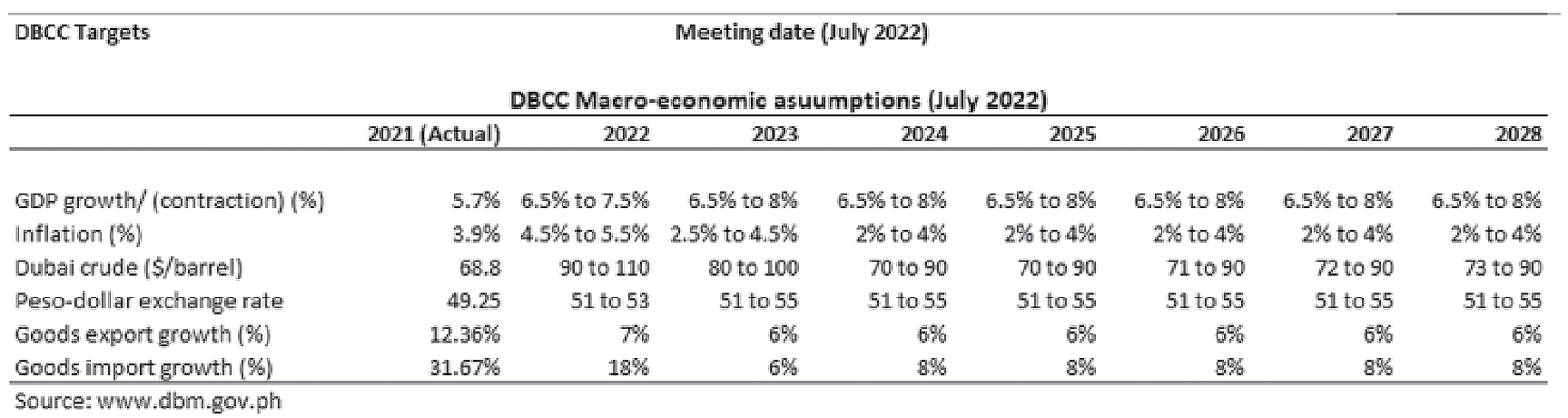
Last Friday, the Development Budget Coordination Committee (DBCC), an inter-agency body made up of the departments of budget, finance, planning and the BSP (Bangko Sentral ng Pilipinas), presented the new administration’s fiscal program for 2022 to 2028. The medium-term program hinges on the economy sustaining its growth clip at 6.5% to 8% starting 2023 and inflation returning to the BSP’s 2% to 4% target starting 2024.

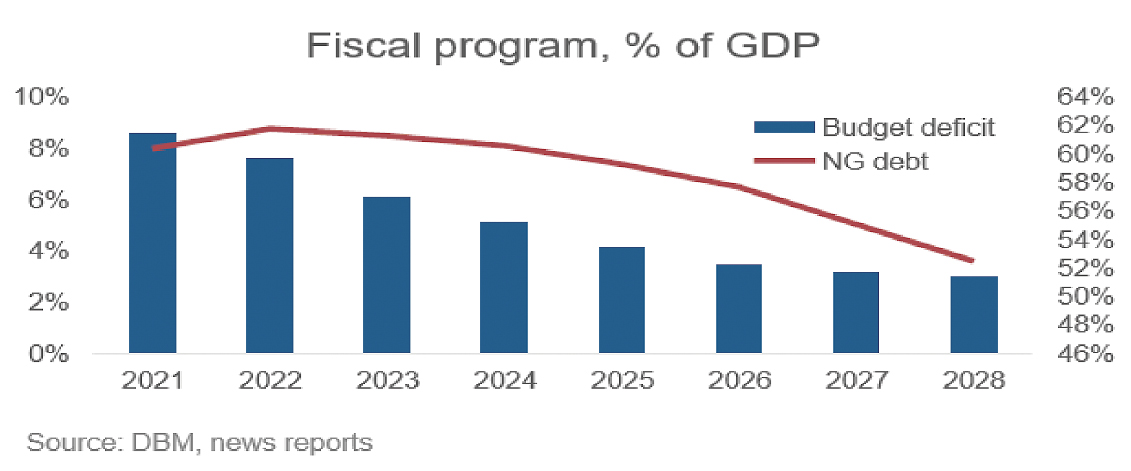
Given nominal GDP growth of 9% to 10%, the fiscal program aims to reduce the overall national government (NG) budget deficit, which reached 8.6% of GDP last year, by 1 ppt every year until it falls to 3% of GDP, the pre-pandemic deficit target. With this performance, it expects the NG debt ratio, which is anticipated to creep up to 61.8% of GDP this year, to gradually drop to 52.5% of GDP by the end of the administration.

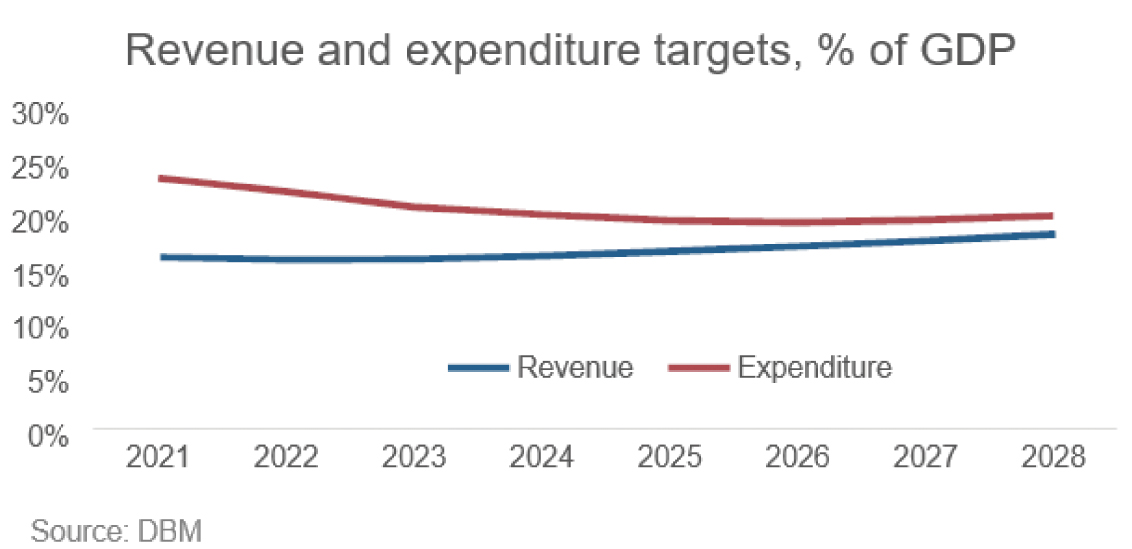
The reduction in the deficit and debt ratios to GDP will be done through a combination of raising revenues and cutting expenditures relative to GDP. The revenue effort is programmed to rise from 15.5% last year to 17.6% by 2028 or an increase of 2.1 ppt, while spending as a share of GDP is programmed to fall from 24.1% last year to 20.6% in 2028, equivalent to a decrease of 3.5 ppt. Despite the reduction in expenditures, government intends to keep infrastructure spending at 5% to 6% of GDP.

OUR VIEW
As far as the numerical targets are concerned, the latest medium-term fiscal program is basically an extension of the last one, crucial mainly in terms of signaling to markets that the new administration is committed to pursuing fiscal consolidation. The 2028 target for the debt ratio, i.e., 52.5% of GDP, is certainly more realistic and supportive of post-pandemic recovery needs, than a promise of quickly paring it to the pre-pandemic ratio of 39.6%.

We are looking forward to the nuts and bolts of the fiscal program, particularly:

1. New economic growth drivers that will keep the medium-term GDP growth rate at 6.5% to 8%, an ambitious target for the post-pandemic period especially with the lingering effects of the pandemic, the many external headwinds (end of cheap credit, elevated commodity prices, slowing global economic growth) and government’s more limited macro policy space (both fiscal and monetary) to support domestic consumption and investments.

We note that the 6% growth target for goods exports is itself unaspiring, especially in light of the new laws liberalizing foreign investments.

2. Sources of new revenues that will keep revenue growth above nominal GDP growth from 2023 onwards. The Finance secretary said recently that the economic team will pursue the remaining tax packages of the Duterte administration, dealing with property valuation and financial sector taxation which, while revenue neutral, will make the tax system more efficient. He is also in favor of imposing taxes on digital transactions but did not specify expected revenue inflows.

3. Expenditure reforms that will create space for continuing social protection programs, especially in health and education, and maintaining infrastructure spending at 5-6% of GDP, even as government pared its overall spending as a share of GDP. The budget for military pension liabilities alone is expected to take up about 1% of GDP annually during the term of this administration.

We await the President’s State of the Nation Address later this month where he is expected to present his administration’s economic program.

End.

POSTSCRIPT:
Although we expect GDP growth this year to reach 6.8% (driven by base effects and election spending), we think the government’s 6.5% to 8% growth target through 2028 is rather ambitious.

My own gut feel is medium-term growth potential is now much lower, closer to 4-5%, the long-term Philippine growth rate rather than the 6-7% of the past decade pre-pandemic. As mentioned in our post, this is because of the drag from scarring from the pandemic (closed businesses, education, and labor mismatches) and considering the end of decade long credit cycle (cheap credit), elevated inflation everywhere affecting consumption and investments, global economic slowdown, even risk of recession, and government’s more restricted fiscal space.

But I would like this government to prove me wrong. The way I think it can do this is if it can quickly earn investors’ trust to attract more FDIs, especially job creating ones, and revive PPP (public-private partnerships) as a way of sustaining infrastructure investments, including digital ones. Moving us towards more investment rather than consumption driven growth.

On PPP, there are immediate to do’s:

1) Signal respect for sanctity of contracts and the rule of law by complying soonest with the terms of the MWSS concession agreements and the international arbitration ruling. (See the column of National Scientist and UP Economics Professor Raul Fabella  https://bit.ly/Fabella060622).

2) Scrap the midnight revisions on IRR (implementing rules and regulations) on build-operate-transfer (BOT) projects and PPPs. The flawed revisions include overly restrictive MAGA coverage (material adverse government action), and removal of provisions on parametric formula for rate setting, and on international dispute settlement. (Please see the Op Ed that summarizes the specific concerns of the Foundation for Economic Freedom and the Makati Business Club https://bit.ly/BOT_amendments ).


Romeo L. Bernardo was finance undersecretary from 1990-96. He is a trustee/director of the Foundation for Economic Freedom, Management Association of the Philippines, and FINEX Foundation. He is Philippines principal adviser to Globalsource Partners

globalsourcepartners.com

romeo.lopez.bernardo@gmail.com

Changes in retail and the property sector

SNOWING-FREEPIK

The economy is slowly but surely opening up. As of the end of May, vehicular traffic was already at 81% of pre-COVID levels. Foot traffic in shopping centers was 65% of its 2019 peak. More people are back to work as unemployment decreased from 7.1% in March 2021 to 5.8% last April. Local and foreign tourism is rebounding too, thanks to fewer restrictions.

Our consumer-led economy is pulsating again, albeit with permanent changes in some sectors resulting from the two-year lockdown. Nowhere are these changes more pronounced than in the retail and property sectors.

Jon Canto of McKinsey and Company provided valuable insights in BusinessWorld’s recently concluded economic forum entitled, Revolutions 2022.

IN RETAIL
The pandemic accelerated the evolution of the retail landscape. Consumer behavior shifted, now fully embracing e-commerce. McKinsey’s survey shows that more than 90% of consumers in ASEAN’s six largest economies have continued patronizing at least one digital retail service even after their lockdowns were lifted. That number was highest in the Philippines where 95% said they continued purchasing products online. Filipinos were the second highest adaptors to e-commerce during the pandemic, following Indonesia.

Growth of pureplay e-commerce sites like Lazada and Shopee are seen to slow down as consumers migrate to purchasing directly from the e-commerce sites of their preferred brands. The number of consumer brands entering the digital space is growing at quantum rates.

This is not to say that brick and mortar stores have lost their relevance. Consumers will still visit physical stores to test, touch, and sample products, to avail of in-store promotions, and to window shop. Thus, physical stores continue to play an important role in branding, in creating product experiences, and as fulfillment centers for brands. Most retailers will maintain both physical and digital stores.

Consumers are looking for more convenience when visiting physical stores, says the McKinsey report. Convenience comes in the form of automated checkouts, personalized offers sent to mobile devices, scannable codes to track inventory levels, and product customization.

Another emerging trend is a decrease in brand loyalty. The McKinsey report reveals that 70% of Filipinos are willing to switch brands if they discover better value for money elsewhere. High inflation rates have underlined the need to seek savings wherever one can find them.

Essentials like packaged food, personal and home care products still dominate the shopping baskets of Filipinos. Given the razor-thin number of wealthy families in the Philippines, sales of luxury goods and services have dropped by 6% and 50%, respectively, from pre-pandemic levels. Full recovery is still three to four years away.

With these emerging trends, McKinsey offers three bits of advice to retailers. First, adopt an omnichannel (and online-led) strategy with respect to marketing. Second, align products and services towards greater value for money. Third, enhance the customer experience by offering greater conveniences.

PROPERTY/REAL ESTATE
Two key trends have emerged in the real estate sector. The first is the permanency of “hybrid operating models.” The second is the overarching trend towards sustainability and reducing carbon emissions.

How does one define a “hybrid operating model?” It is a working model where schedules are flexible; where working hours or working days are reduced; where employees work part time in the office and part time at home.

Eighty-seven percent of Filipino workers prefer a hybrid operating model given its convenience and workability (improved internet service has made remote working more efficient). In fact, the preferred ratio is three days of remote work and two days in the office. Filipinos put value on working from home given the time and cost of commuting.

Studies show that there will be 10 times more employees working from home in 2023 than there were in 2017. That said, there is a need for companies to re-imagine, re-design and re-equip their offices to adapt to the new hybrid operating model. Office spaces will be of smaller configurations as employees report on a round-robin basis. What is essential are common spaces where employees can gather, collaborate, and co-create. As of the moment, only 29% of all office space in Metro Manila is configured for hybrid work. Thousands of offices are seen to downsize in the next few years.

So, what is the impact of this on demand for office space? In Metro Manila, demand plunged by 183,100 square meters in 2020 and 273,100 in 2021 but will recover by +350,000 (forecast) in 2022. Meanwhile, 1,881,300 square meters of supply have come on line in the last three years. All things being equal, it will take five years for demand to catch up with supply.

Take-up of commercial spaces will be sluggish as e-commerce encroaches on the customer base of physical stores. Commercial lessors and malls will have no choice but to rationalize their lease rates if only to keep their tenants.

In as far as sustainability is concerned, Filipino property developers are hard-pressed to become more environmentally efficient given government’s nationally determined commitment (NDC) to the United Nations Framework Convention on Climate Change (UNFCCC) to reduce the country’s greenhouse gas emissions by 75% by 2030.

Developers are encouraged to reduce their power consumption by 25% to 35%. Although 35% of new office buildings will be LEED certified by next year, the number is seen to increase rapidly due to governmental pressure.

So, while it is a buyers (or renters) market as supply for office space exceeds demand, there is pressure to increase property prices as LEED certification could be expensive, what with the mandatory adoption of power saving technologies. Ultimately, the forces of demand and supply will determine prices.

Welcome to the new normal in retail and property.


Andrew J. Masigan is an economist

andrew_rs6@yahoo.com

Facebook@AndrewJ. Masigan

Twitter @aj_masigan

Going electric doesn’t have to be so complicated

EREN GOLDMAN-UNSPLASH

IT MAY NOT HAVE enough electric vehicles (EVs), powerpacks, or the capital, but India has found a way towards mass electrification: swap batteries.

The solution, where empty batteries can be exchanged for charged-up ones, is still in nascent stages in China, the world’s largest EV market, where it is anchored in strong government policy. Elsewhere, it hasn’t quite taken off. But for India, it could help leap-frog the nation’s bid to reduce transport emissions and boost its electric footprint.

Across the Indian capital’s dense localities, battery swapping stations are becoming a frequent sight at local provision stores and small retail outlets. Meanwhile, the government has pushed out an EV battery swapping policy draft in recent months to bolster adoption and supply. It’s also scouting sites along India’s emission-heavy highways for new stations for swapping and charging.

For the most part, ambitious Indian startups have pushed their way forward. Sheru, a technology platform, allows electric autorickshaw drivers to swap batteries at retail stores or pay as they use them. It’s working with stakeholders across the energy storage value chain. Meanwhile, Battery Smart, which just raised $25 million in a funding round led by Tiger Global, is focused on quickly building a swapping network and is working with domestic battery manufacturers. Sun Mobility is partnering with Amazon India in the state of Maharashtra — home to the financial capital, Mumbai — to put swapping stations at its warehouses.

For now, it’s showing promise because the Indian vehicle market is dominated by two and three wheelers, making it simpler to charge and swap out the smaller powerpacks. It brings down the costs of commute sharply for users while increasing energy efficiency. These smaller vehicles are also responsible for a significant share of the emissions. This way could prove to be a model for other emerging markets across the world struggling to meet their green promises.

The policy draft, while a progressive step, will need to be backed by state governments and big bucks to be adopted in smaller, denser and more polluted second and third tier cities. It’ll also need to get meatier on details on the types of batteries to maintain quality, insurance for the safety of drivers and manufacturers, and providing better tax incentives for increasingly pricey powerpacks. In addition, state enterprises need to get involved, as they have in China.

The longer-term challenge for India will be whether it can use battery swapping for cars effectively when mass adoption reaches the four-wheeler category.

Even the likes of Tesla, Inc. have tried battery swapping. But Musk’s company abandoned the project after setting up just one battery station. Other attempts include a Renault-Nissan alliance that had agreed to manufacture 100,000 EVs to the specifications of Better Place, the now defunct venture capital-backed firm that developed and sold battery charging and switching stations.  The firm launched its first station in Israel in 2011 and eventually filed for bankruptcy two years later because it was expensive and batteries needed to be common to drive utility.

In China, Nio, Inc. has had to make significant capital investments. As of the first quarter, the firm had installed over 960 battery swapping stations in 197 cities across the country . But it’s still running operating losses because of the rising depreciation and expenses. Nio expects losses associated with swap stations to increase for now, executives noted on the latest earnings call.

That stands as a question — and a warning — for India when it eventually transitions battery swapping to four-wheel vehicles. Battery swapping is effectively buying New Delhi time to get its act together on broader decarbonization and clean power generation. In addition, as batteries get better or the variety of chemistries in use change, charging times will fall and range will increase. Over time, this could slow growth for swapping.

Still, lithium ion batteries are proving to be in short supply, and expensive. Policymakers are already looking to move on from the widespread but costly lithium ion variety, towards those that are made from more abundantly available materials.  For now though, there is enough to supply two and three-wheelers.

If policymakers can drive investment and capital towards the startups pushing through swapping, the rising awareness and utilization will ensure consumers are prepped for more electric vehicles in the future and hooked to the longer-term cost efficiencies. Without that, India could lose a prime opportunity to go electric and get cleaner.

BLOOMBERG OPINION

Russia preparing for next stage of offensive — Ukraine military

Army soldier figurines are displayed in front of the Ukrainian and Russian flag colors background in this illustration taken, Feb. 13, 2022. — REUTERS/DADO RUVIC/ILLUSTRATION

KYIV — Russia is preparing for the next stage of its offensive in Ukraine, a Ukrainian military official said, after Moscow said its forces would step up military operations in “all operational areas”.

Russian rockets and missiles have pounded cities in strikes that Kyiv says have killed dozens in recent days.

“It is not only missile strikes from the air and sea,” Vadym Skibitskyi, a spokesman for Ukrainian military intelligence, said on Saturday. “We can see shelling along the entire line of contact, along the entire front line. There is an active use of tactical aviation and attack helicopters.

“There is indeed a certain activation of the enemy along the entire front line… Clearly preparations are now underway for the next stage of the offensive.”

The Ukrainian military said Russia appeared to be regrouping units for an offensive towards Sloviansk, a symbolically important city held by Ukraine in the eastern region of Donetsk.

Ukraine says at least 40 people have been killed in Russian shelling of urban areas in the last three days, as the war launched by Russian President Vladimir Putin on Feb. 24 intensifies.

Rockets hit the northeastern town of Chuhuiv in Kharkiv region on Friday night, killing three people including a 70-year-old woman and wounding three others, said regional Governor Oleh Synehubov.

“Three people lost their lives, why? What for? Because Putin went mad?” said Raisa Shapoval, 83, a distraught resident sitting in the ruins of her home.

To the south, more than 50 Russian Grad rockets pounded the city of Nikopol on the Dnipro River, killing two people who were found in the rubble, said Governor Valentyn Reznichenko.

Moscow, which calls the invasion a “special military operation” to demilitarize and “denazify” its neighbor, says it uses high-precision weapons to degrade Ukraine’s military infrastructure and protect its own security. It has repeatedly denied targeting civilians.

Kyiv and the West say the conflict is an unprovoked attempt to reconquer a country that broke free of Moscow’s rule with the break-up of the Soviet Union in 1991.

Russian Defense Minister Sergei Shoigu ordered military units to intensify operations to prevent Ukrainian strikes on eastern Ukraine and other areas held by Russia, where he said Kyiv could hit civilian infrastructure or residents, according to a statement from the ministry.

His remarks appeared to be a direct response to what Kyiv says is a string of successful strikes carried out on 30 Russian logistics and ammunitions hubs, using several multiple launch rocket systems recently supplied by the West.

The strikes are causing havoc with Russian supply lines and have significantly reduced Russia’s offensive capability, Ukraine’s defense ministry spokesperson said on Friday. — Reuters

Biden disputes account of Khashoggi murder discussion

OFFICIAL WHITE HOUSE PHOTO BY ADAM SCHULTZ

US PRESIDENT Joseph R. Biden on Saturday differed with Saudi Arabia on discussions at a bilateral summit about the 2018 murder of journalist Jamal Khashoggi, a key controversy between the two nations.

Answering reporters as he arrived at the White House from his first Middle East trip as president, Mr. Biden disputed the Saudi foreign minister’s account that he did not hear Biden blame Saudi Crown Prince Mohammed bin Salman for the killing of the Washington Post columnist, a harsh critic of his native Saudi Arabia.

Asked whether the minister of state for foreign affairs, Adel al-Jubeir, was telling the truth in recounting the exchange between Mr. Biden and the crown prince, the president said “No”.

US intelligence agencies believe the crown prince ordered the killing of Khashoggi, a US citizen, which the de facto Saudi ruler denies.

Mr. Jubeir said the crown prince, known as MbS, had told Mr. Biden the kingdom had acted to prevent a repeat of mistakes like Mr. Khashoggi’s killing and that the United States had also made mistakes.

The minister told Fox News on Saturday that he “didn’t hear that particular phrase” from Mr. Biden blaming the crown prince.

Mr. Biden, asked whether he regretted exchanging a first bump with MbS on Friday, replied: “Why don’t you guys talk about something that matters? I’m happy to answer a question that matters.” — Reuters

Beer for sunflower oil? Munich pub finds way to beat frying crunch

ENGIN AKYURT-UNSPLASH

BERLIN — A Munich brewpub has found a novel way to beat Europe’s cooking oil shortages — letting customers pay for their beer with sunflower oil to ensure plentiful stocks for frying schnitzels.

With Ukraine and Russia accounting for about 80% of global exports of sunflower seed oil, many European countries including Germany have seen supplies dwindle since Russia invaded its neighbor in February.

Managers at the Giesinger Brewery, a brewhouse and pub in the southern city of Munich, think they may have the answer, offering beer lovers a liter of their favorite brew for the same quantity of sunflower oil.

“The whole thing came up because we simply ran out of oil in the kitchen and that’s why we have to be inventive,” the pub manager, Erik Hoffmann, told Reuters TV.

Bottles of rapeseed and sunflower oil have often been missing from supermarket shelves in Germany since Russia’s invasion of Ukraine, and many shops ration the number of bottles per customer.

“Getting oil is very difficult … if you need 30 liters a week and only get 15 instead, at some point you won’t be able to fry a schnitzel any longer,” Mr. Hoffmann said, adding that customers have swapped 400 litres so far.

While a liter of beer costs about 7 euros ($7) in German pubs, a one-liter bottle of sunflower oil retails for about 4.5 euros — making the offer tempting for many customers.

Customer Moritz Baller bought 80 liters of sunflower oil in Ukraine during a trip to deliver humanitarian aid, swapping his shipment for eight crates of beer for his birthday party.

“The campaign is cool,” he said. “We can get cheap beer and yes, Giesinger Brewery is also helped.” — Reuters