Home Blog Page 5727

Putin downplays Ukraine grain blockade, rejects claims Russia to blame

REUTERS

RUSSIAN President Vladimir Putin denied that Moscow was blocking Ukrainian grain exports and questioned the impact of missing Ukrainian agricultural goods on the world food market.

“We do not prevent the export of Ukrainian grain. The Ukrainian military has mined the approaches to their ports, no one prevents them from clearing those mines and we guarantee the safety of shipping grain out of there,” Mr. Putin said, speaking alongside visiting Indonesian President Joko Widodo.

Mr. Putin repeated Russia’s assertion that Western sanctions are to blame for problems on the global food market and rising prices.

The United Nations has said the world is facing an “unprecedented hunger crisis” due to plunging grain exports as a result of the conflict in Ukraine, and that ensuring Ukraine can export agricultural products is key to resolving the issue.

But Mr. Putin downplayed Ukraine’s impact on the global market, saying there were only 5 million tons of wheat currently stuck in the country.

“This is a quantity which does not affect the world markets in any way,” he added, saying it represented just 0.5% of global production.

The United Nations estimated in early May that 22 million tons of grain was stuck in Ukraine. Ukrainian President Volodymyr Zelenskiy said on June 6 that this could rise to 75 million tons by this autumn.

Mr. Putin also said he wanted Russia to maintain its position as the world’s largest wheat exporter. It currently accounts for around a fifth of global sales. — Reuters

Yields on government debt mixed

By Bernadette Therese M. Gadon, Researcher

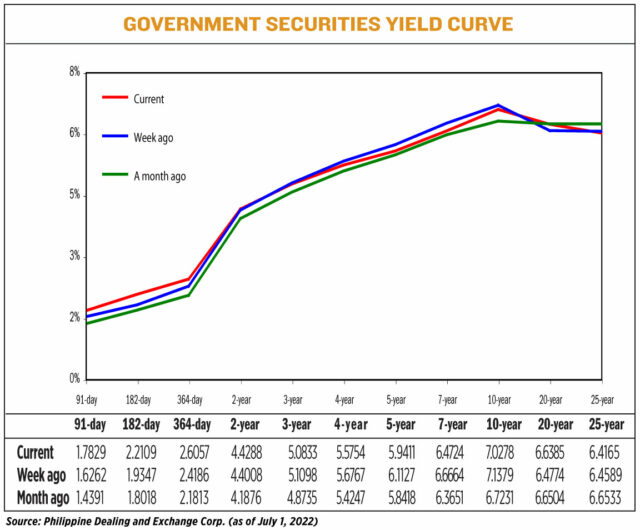
YIELDS on government securities ended mixed last week as the market remained defensive after the Bangko Sentral ng Pilipinas’ (BSP) dovish move.

Debt yields, which move opposite to prices, increased by an average of 1.48 basis points (bps) week on week, based on the PHP Bloomberg Valuation (BVAL) Service Reference Rates as of July 1 published on the Philippine Dealing System’s website.

Yields were mixed across the board on Friday, with the short end of the curve ending higher. The rates of the 91-, 182-, and 364-day Treasury bills rose by 15.67 bps, 27.62 bps, and 18.71 bps week on week to 1.7829%, 2.2109%, and 2.6057%, respectively.

Yields at the belly of the curve edged lower, except for that on the two-year debt, which increased by 2.80 bps to 4.4288%. Meanwhile, rates of the three-, four-, five-, and seven-year Treasury bonds (T-bonds) fell by 2.65 bps (to 5.0833%), 10.13 bps (5.5754%), 17.16 bps (5.9411%), and 19.4 bps (6.4724%).

The long end of the curve was mixed as the 20-year debt gained 16.11 bps to yield 6.6385%, while the rates of the 10- and 25-year papers decreased by 11.01 bps (7.0278%) and 4.24 bps (6.4165%), respectively.

GS volume reached P7.51 billion on Friday, higher than the P5.25 billion seen on June 24.

“Peso bond yields ended mixed [last] week, but sentiment remained defensive over expectations for BSP policy rate to be lower than Fed by yearend,” First Metro Asset Management, Inc. (FAMI) said via Viber message.

“The relatively dovish move of BSP [on June 23] has led to further peso depreciation and widened the risk and term premiums for local bonds,” it added.

FAMI added that this resulted in the seven-year T-bonds offered last week being rejected as the market has “excessively priced risk premium.”

Likewise, a bond trader said in an e-mail that the Bureau of the Treasury’s (BTr) rejection of all bids for its T-bond offer last week triggered a rally that brought yields about 15 to 20 bps lower.

BSP Governor Felipe M. Medalla last week said the central bank may consider a more aggressive rate hike at its Aug. 18 meeting if inflation keeps its upward momentum, but noted the decision will remain data dependent.

Early in June, ahead of the US Federal Reserve’s decision to increase its own rates by 75 bps at its own meeting that month, Mr. Medalla said he is not keen on raising borrowing costs by more than 25 bps per meeting.

The BSP on June 23 raised benchmark interest rates by 25 bps for a second straight meeting to cool rising prices. At that meeting, it raised its average inflation forecast for this year to 5% from 4.6% previously, well above its 2-4% target.

Meanwhile, on Tuesday, the Treasury rejected all the offers for its offer of reissued seven-year T-bonds with a remaining life of 6.9 years and a coupon rate of 6.5% after the market asked for higher yields due to inflationary pressures and expectations of further monetary tightening.

Bids for the papers reached P62.253 billion, almost double the P35 billion on offer.

Rates bid by banks reached 6.849% to 7%. Had the BTr made a full award, the tenor would have fetched an average rate of 6.947%.

For the week, analysts said that the market will be mostly taking cues from the upcoming release of May inflation data.

The bond trader expects the curve to move sideways, adding that the maturity of three-year bonds worth P104 billion on July 4 may increase liquidity in the market.

“Inflation path would keep investors on the edge as the prints in the coming months are likely to be above 6%,” FAMI said.

“The rebound of oil prices beyond $120/bbl (barrel), the peso depreciating above P55 as well as the pass-through effects of these two would likely lead to faster clips of inflation. With that, we think that bond yields may still surprise on the upside in the third quarter,” it added.

The central bank sees headline inflation picking up further and settling within the 5.7-6.5% range in June. Inflation stood at 5.4% in May, the fastest in three and a half years.

The Philippine Statistics Authority will release June inflation data on July 5.

Shares to move sideways ahead of inflation data

PHILIPPINE STAR/KRIZ JOHN ROSALES

PHILIPPINE STOCKS may move sideways this week ahead of the release of June inflation data, which may continue to dampen investor sentiment.

The benchmark Philippine Stock Exchange index (PSEi) inched up by 9.92 points or 0.16% to close at 6,165.35 on Friday, while the broader all shares index improved by 3.89 points or 0.11% to 3,340.12.

Week on week, the PSEi declined by 52.21 points from its close of 6,217.56 on June 24.

China Bank Securities Corp. Research Director Rastine Mackie D. Mercado said the PSEi’s one-day reversal on Friday despite the substantial sell-off on Thursday underscores investors’ continuing risk aversion as growth concerns mount.

“Furthermore, we continue to view rallies as a temporary reprieve in selling pressure over the near term… For [this] week, investors will likely focus on the release of the June inflation data on Tuesday,” Mr. Mercado said.

“The market has already declined for four consecutive weeks with a total loss of 8.54%. Thus, episodes of bargain hunting could be seen in [this] week’s trading. Still, the market could move with a bearish bias due to the lingering downside risks to the local economy,” Philstocks Financial, Inc. Senior Research Analyst Japhet Louis O. Tantiangco said in a Viber message.

“Investors are expected to look towards the upcoming June inflation data. An inflation print significantly faster than May’s 5.4% could lead to more selling pressures in the market,” Mr. Tantiangco said.

He added that the peso’s poor performance last week also weighed on market sentiment, and a continued depreciation could continue to affect Philippine stocks.

“Aside from these, the market may also take cues from our upcoming labor market figures. Finally, worries over the global economy amid the monetary tightening of the Federal Reserve and rising commodity prices caused by the Russia-Ukraine war may continue to dampen sentiment,” Mr. Tantiangco said.

The Philippine Statistics Authority will release its June consumer price index report on Tuesday, July 5.

A BusinessWorld poll of 16 analysts last week yielded a median estimate of 6% for June inflation, within the 5.7-6.5% forecast given by the Bangko Sentral ng Pilipinas (BSP) last week.

If realized, this would be well above the BSP’s 2-4% target and 5% projection for the year.

In May, headline inflation was at 5.4%, fueled by rising food and transport costs.

Meanwhile, the peso closed at P55.09 per dollar on Friday, losing 11.5 centavos from its P54.975 finish on Thursday, based on Bankers Association of the Philippines data.

This was the local unit’s worst showing in more than 16 years or since it closed at P55.26 versus the greenback on Oct. 25, 2005.

Mr. Tantiangco put the PSEi’s support for the week at the 6,100 to 6,150 range and resistance between 6,350 and 6,400.

Meanwhile, China Bank Securities’ Mr. Mercado placed the PSEi’s immediate support between 6,050 and 6,100. — Luisa Maria Jacinta C. Jocson

Style (07/04/22)

Escada and Escada Sport

Longchamp presents Fall/Winter 2022 Collection

FOR the Longchamp Fall/Winter 2022 ready-to-wear collection, Creative Director Sophie Delafontaine draws from the sporty and cocooning ambiances of winter in the Alps. The collection includes pieces such as reversible gilets, blousons, coats, and quilted miniskirts. Meanwhile, the cocooning section features warm-colored plaid jackets, suits, dresses, and sweaters. Being Longchamp, the collection of course also features a new line of bags to match the season. Longchamp is exclusively available at Rustan’s Makati, Rustan’s Shangri-La, Rustan’s Cebu, Greenbelt 5 and Rustans.com.

New Balance releases Grey Day 2022 Collection

NEW Balance is celebrating Grey Day, its annual celebration of its classic and famous grey colorway. This year, the sneaker brand is coming out with three new models in different shades of grey: the 57/40, the XC-72 and the 327. To take a look at the new Grey Day line of sneakers, visit the New Balance stores in Powerplant Mall, Glorietta, Trinoma, Cebu, Bonifacio High Street, Alabang Town Center, and Ermita or join the Viber community: http://bit.ly/NBPHViber

Uniqlo launches campaign for a better world

GLOBAL apparel retailer Uniqlo announced the launch of Join: The Power of Clothing, a global campaign to support activities for a better world. The campaign kicked off in Japan on July 1. The aim of the campaign is to encourage customers to be a part of the environmental sustainability activities that Uniqlo conducts. The two main initiatives, conducted at both physical and online Uniqlo stores, are “Buy and Join” and “Learn and Join,” which raise awareness among customers of global problems such as ocean pollution, and inspire action to make the world a better place. As part of the campaign, Uniqlo will sell products made with 100% recycled fibers (plush toys, pocketable bags, T-shirts), featuring designs with Doraemon Sustainability Mode, the Uniqlo Global Sustainability Ambassador. Uniqlo parent company, Fast Retailing, will donate up to $1 million to the Nippon Foundation to support activities that reduce ocean waste, by donating the profits of sales of the campaign items: products made with recycled materials and Blue Cycle Jeans. Uniqlo has also opened a special website where visitors can learn about environmental issues and take action. The site includes messages from Uniqlo Global Brand Ambassadors and a video with LifeWear Special Ambassador Haruka Ayase outlining some of the brand’s sustainability focus areas. There is also a wide range of special content to learn about ocean-related issues, including an interview with biological oceanographer Ryota Nakajima, a talk with Yoko Koga on reducing the use of plastics in everyday life, and an interview with environmental specialist Dr. Keith Alverson.

Escada celebrates jet-set lifestyle

THIS season luxury apparel brand Escada focuses on modern and contemporary looks that celebrate an elegant, jet-set lifestyle. New items are coming out from both Escada and Escada Sport. Key pieces from both lines showcase soft and structured tailoring in classic neutrals and ultra-wearable essentials, from timeless separates to elegant evening wear. Escada and Escada Sport’s 2022 collection are available at the Escada boutique at Greenbelt 5, Makati.

M&S’s activewear line now at Glorietta

MARKS & SPENCER’S (M&S) Goodmove, the brand’s in-house activewear line for women, has just arrived at the M&S Glorietta branch. The products, made from lightweight sustainable recycled polyester, are designed to feel like a second skin. The collection was created with performance in mind, and there are pieces for walking, running, strength training, and gym workouts. The leggings and tops offer clever innovations such as moisture-wicking, quick-dry and breathable fabrications. Shop in-store and earn Loyalty points via the M&S Philippines Viber Community at bit.ly/MSPH-VC.

Rustan’s celebrates health in July

THIS July, Rustan’s encourages customers to remember the timeless motto “health is wealth,” by offering time-limited wellness promos and activities. Customers can channel their inner Poseidon with Speedo and get a Speedo swimming wristwatch for every single receipt worth P4,000, and a waterproof bag for every single receipt worth P6,000. Adidas, Champion, Converse, Hoka, New Balance, and Nike offer discounts of up to 50% off on selected items. On top of discounts, Nike patrons can also get a Swoosh headband for every single receipt purchase worth P1,500. Train with innovative sports apparel from Under Armour, and get 50% off on selected items, as well as an Under Armour water bottle, shaker bottle, or socks for every single receipt purchase worth P1,500. Jack Nicklaus golf gear is 50% off this month. Shoppers will get a Banz’s Sunhat with every minimum purchase of P1,500 worth of Banz products. Get a Cartridge Filter Pump by Intex with every purchase of any participating Intex product. Ensembles from Crane and Mommy Hugs are 10% off. Healthguard items are available with discounts of up to 40%. Euky Bear Cough & Cold Remedies and essential oils are 10% off. Rustan’s The Beauty Source (RTBS) is also participating, offering Heathcote & Ivory, Fruit Works, and Palmer’s products with a 10% discount. Selected fragrances from Giorgio Armani and Viktor&Rolf are at 10% off. Get exclusive gifts and offers for up to 10% off from beauty brands like Stila, L’Occitane, Acca Kappa, Sisley and Diptyque, and many more. These are just some of the specials available at Rustan’s for the whole month of July. In addition to the discounts and gifts, the department store will present special setups highlighting fitness and wellness products at the Grand Atrium of Shangri-La Plaza from July 16-31. It will also host Karatedo and Gymnastics Workshop by Madison for youngsters on July 31 at 2 p.m. The workshop is on a first come first serve basis and can accommodate up to 20 kids.

UP Diliman students win L’Oreal Brandstorm

THREE students from the University of the Philippines – Diliman won this year’s L’Oréal Brandstorm, a global innovation competition. The innovative idea of Roque Mercado, Kara Santiago, and Julianne Ong of “Roque, Paper, Sisters” won the best pitch in the Green Track, granting them the all-expense-paid three-month entrepreneurial internship at L’Oréal Group global headquarters in Paris. The team of three college students pitched the idea of Pocket Block it! Dissolving Sunscreen Wipes under the Green (Sustainability) Track which challenges participants to invent the next dimension of sustainable beauty. The product idea of Dissolving Sunscreen Wipes are sunscreen sheets that dissolve through contact with the heat and natural oils of the skin and are packaged in refillable post-consumer recycled plastic pods. This stemmed from the team’s realization that while there is a universal need for sunscreen, there are also gaps in the current market where consumers are forced to compromise between effectivity, convenience, and sustainability. With the theme “Disrupt Beauty 2030,” Brandstorm 2022 drew record-breaking participation, with more than 83,000 youth from 65 countries registered, as well earning official certification by EFMD Global as an online learning course. Nine teams representing Argentina, France, Germany-Austria, India, Indonesia, Italy, Mexico, the United States, and the Philippines advanced to the finals after 20 weeks of intense competition at both the local and international levels. At the end of the competition, three teams representing the Inclusion, Green, and Tech Tracks were selected as Brandstorm 2022 winners. As part of their entrepreneurship, the winners will continue to develop projects with support from L’Oréal.

Bicol trade fair at Shangri-La Plaza

A TOTAL of 63 Bicolano micro, small and medium enterprises are joining the Orgulo kan Bikol-Regional Fair on July 6-10 at the Grand Atrium of the Shangri-La Plaza mall in Mandaluyong. Organized by the Department of Trade and Industry Regional Office 5, the fair is an opportunity for Bicol’s home-grown entrepreneurs to promote their products and expand their networks. Handcrafted wearable and home items and food items like pili nut confections, pinangat, Bicol Express, ginger, turmeric, moringa and lemon grass brew will be available at the fair.


National Government outstanding debt

National government outstanding debt

Cool Smashers reactivate Gumabao, acquire rookie Lorie Bernardo

CREAMLINE has reactivated Michele Gumabao and acquired rookie Lorie Bernardo to shore up its roster for the Premier Volleyball League Invitational Conference set on Saturday at the Filoil Flying V Arena.

Ms. Gumabao, an opposite hitter, returns to her old team after trying her luck in politics while Ms. Bernardo is a middle blocker who played for the University of the Philippines team that finished sixth in this year’s UAAP.

Ms. Gumabao last played in pro league’s Open Conference last year in Bacarra, Ilocos Norte where Creamline finished second behind eventual winner, a Jaja Santiago-powered Chery Tiggo.

The two new additions further strengthened the already formidable Sherwin Meneses-mentored Creamline crew that reigned supreme in the Open Conference last May.

The two will join the Cool Smashers that already have reigning MVP Tots Carlos, skipper and the face of Philippine volleyball Alyssa Valdez, Jia Morado, Jema Galanza and Jeanette Panaga.

Creamline tackles this year’s Open third-placer Cignal on July 12. — Joey Villar

Suzuki Auto Mactan reopens as a 2S facility

PHOTO FROM SUZUKI PHILIPPINES, INC.

SUZUKI PHILIPPINES, INC. (SPH) has announced that the construction work on Suzuki Auto Mactan in Cebu is now complete. The facility now boasts its own after-sales service department ready to provide assistance to its patrons.

Suzuki Auto Mactan is located in Mactan Breeze, Soong, Lapu-Lapu City — standing on a 100-sq.m. lot and boasting a 48-sq.m. showroom that can accommodate two vehicles for display. Operated by Cebu Autocentrale and Suzuki Philippines, the facility’s launch was livestreamed via Suzuki Auto Cebu’s Page through Facebook Live. Said SPH General Manager for Automobile Norihide Takei, “The demand for our products and services in Cebu makes it evident that the dedication of our partner, Cebu Autocentrale Corp., continues to be recognized by our patrons. This partnership is testament that the market’s support toward our brand reaches across islands and braves distances. We will continue to be the reliable mobility partner especially in areas that are vital for the development of the Philippines as a country.”

For inquiries, call at (032) 263-7878. For further information, visit any of the 74 authorized Suzuki Auto dealerships nationwide or http://suzuki.com.ph/auto/. For daily updates on Suzuki, like Suzuki Auto Philippines’ Facebook page at https://www.facebook.com/SuzukiAutoPh, follow on Twitter at https://twitter.com/SuzukiAutoPh and Instagram at
@suzukiautoph.

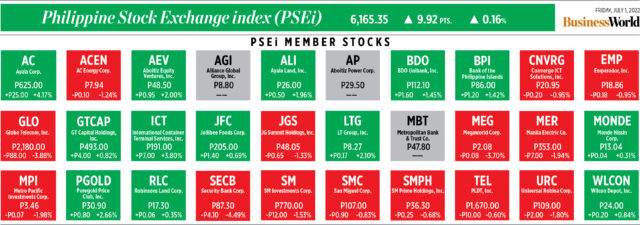
How PSEi member stocks performed — July 1, 2022

Here’s a quick glance at how PSEi stocks fared on Friday, July 1, 2022.


Business chambers endorse Trade dep’t position on joining RCEP, MSME support

REUTERS

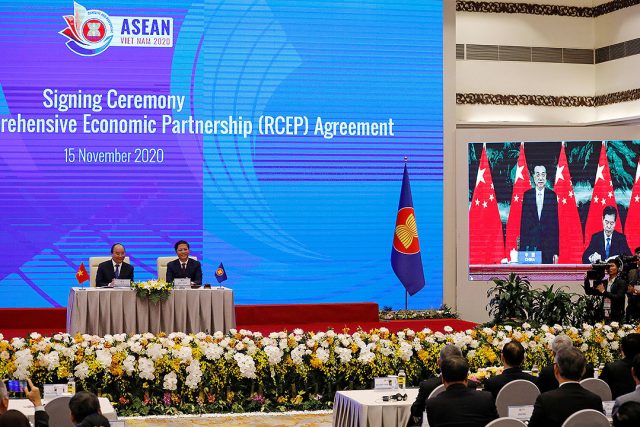
TRADE Secretary Alfredo E. Pascual’s intention to join more free trade agreements received backing from major business chambers, who declared support for participating in the Regional Comprehensive Economic Partnership (RCEP).

Makati Business Club (MBC) Executive Director Francisco Alcuaz, Jr. said in a mobile phone message that the MBC supports Mr. Pascual’s plan to push for immediate RCEP ratification.

“We believe RCEP’s ratification is an important part of the open-for-business story we recently advanced with (the amended) Public Service Act (PSA), Retail Trade Liberalization Act, and Foreign Investments Act (FIA),” Mr. Alcuaz said.

British Chamber of Commerce Philippines Executive Director Chris Nelson said by mobile phone that while the priorities of the new Trade chief are generally on the right track, the Department of Trade and Industry (DTI) needs to push for further economic liberalization.

“We’ve seen (liberalization in) three key legislation that were passed, (amendments to the) Retail Trade Liberalization Act, the FIA, and PSA. We’d like to see that momentum continue,” Mr. Nelson said.

“I had a one-on-one discussion (with Mr. Pascual) and we agree on these priorities,” Philippine Chamber of Commerce and Industry President George T. Barcelon said.

Mr. Pascual announced his priorities during the DTI’s turnover ceremony on July 1.

“We will continue to push for the immediate ratification of the RCEP agreement and other trade agreements… These agreements will diversify the country’s exports… and enhance the country’s attractiveness to foreign investment,” Mr. Pascual said.  

RCEP failed to obtain Senate approval in the 18th Congress after some senators objected to the lack of protections for parts of the farm industry. It is now up to the 19th Congress to decide on RCEP ratification. The session is set to open on July 25.

RCEP, which started taking effect on Jan. 1 in jurisdictions that approved it early, involves Australia, China, Japan, South Korea, New Zealand and the 10 members of the Association of Southeast Asian Nations.

Mr. Pascual also expressed his intent to sustain the development of micro, small, and medium enterprises (MSMEs) and improve the food value chain.  

Calling MSMEs “the backbone of our economy,” he said he wants to “enable small businesses to grow and graduate from micro to small, from small to medium, and from medium to large.”

“To help address food security challenges, we will collaborate with the Department of Agriculture to improve the food value chains through upgraded transport and logistics facilities, including cold storage and cold chain facilities (and) increased community value adding,” he added.

“Increasing production and untangling bottlenecks are the effective way to fight inflation. Price controls and delayed suggested retail price adjustments will only squeeze production and result in actual, serious shortages,” the MBC’s Mr. Alcuaz said. — Revin Mikhael D. Ochave

GOCC subsidies decline 82.31% as NIA gets P6.2B

NATIONAL IRRIGATION ADMINISTRATION PHOTO RELEASE

SUBSIDIES provided to government-owned and -controlled corporations (GOCCs) declined by 82.31% year on year to P7.905 billion in May, the Bureau of the Treasury (BTr) reported.

Budgetary support to GOCCs also fell 54.49% compared to the April total. They amounted to P32.296 billion in the year to date, according to preliminary data from the BTr.

Subsidies are granted to GOCCs to cover operational expenses not supported by their revenue.

The National Irrigation Administration (NIA) was the top beneficiary, receiving P6.262 billion or 79.22% of total subsidies in May. The NIA received P1.303 billion in April providing a low base for the 380% month-on-month rise.

The National Housing Authority (NHA), the National Food Authority (NFA), and the National Privacy Commission were among the major non-financial GOCCs that did not receive subsidies.

The NFA was the top beneficiary in April, when it was given P2.055 billion. The NHA was the top beneficiary in March, when it received P2.979 billion.

The Light Rail Transit Authority received P6 million, down 97.6% month on month.

Other top recipients in May were the Civil Aviation Authority of the Philippines (P400 million), the Small Business Corp. (P200 million), the Philippine National Railways (P161 million), and the Philippine Heart Center (P147 million).

Other GOCCs that were given more than P50 million were the Philippine Children’s Medical Center (P115 million), the National Kidney and Transplant Institute (P107 million), the Philippine Coconut Authority (P74 million), the Local Water Utilities Administration (P61 million), and the Lung Center of the Philippines (P58 million).

Other GOCCs that received no subsidies during the month were the Bases Conversion and Development Authority, the Philippine Crop Insurance Corp., the Philippine Fisheries Development Authority, the Subic Bay Metropolitan Authority, the Social Housing Finance Corp., and the Sugar Regulatory Administration.

The year-to-date subsidy total was down 59.6% from a year earlier. The top recipient year to date was the NIA, which was given P15.263 billion, the most of any GOCC, accounting for 47.26% of all subsidies.

This was followed by the NFA and the NHA, which got P3.243 billion and P3.194 billion respectively.

Government subsidies to GOCCs totaled P184.77 billion in 2021, a 19.3% decline from the previous year. In 2021, the Philippine Health Insurance Corp. received P80.98 billion, nearly 44% of the total. — Diego Gabriel C. Robles

Agri policy needs more bottom-up planning to meet farmers’ needs, study concludes

PHILIPPINE STAR/ MICHAEL VARCAS

AGRICULTURE and fisheries planning needs to be more “bottom-up” to better meet the needs of farmers and fisherfolk, steering away from “top-down” programs imposed from above, especially those concerning rice, according to a study by the Philippine Institute for Development Studies (PIDS).

According to the report, in order to pursue modernization, the government must abandon elements of traditional industrial policy.

Another recommendation is to terminate expenditure programs based on distortionary subsidies to give way to funding a modern industrial policy for the agri-food system.

“There is also a need to apply area-based, bottom-up planning in determining strategic interventions to meet the needs of farmers and rural enterprises along the value chain,” the report’s author and PIDS Senior Research Fellow Roehlano M. Briones said.

“We must shift from a top-down and banner program-centric type of planning especially focused on rice as customary in many (Department of Agriculture) strategies and move to bottom-up planning and area-based approach as originally envisioned in the Agriculture and Fisheries Modernization Act (AFMA),” he said.

“In terms of the share of the agri-fisheries sector in the country’s gross domestic product, it declined to 9% in 2019 from 19% in 1990 then rose slightly to 10% in 2020 when the COVID-19 pandemic happened. The agriculture employment share shed 22 percentage points from 1991 to 2019,” the study found.

The study sought to track the effects or impacts of the AFMA since its passage in 1997.

The AFMA provides guidelines for the sustainable and equitable development of the agriculture and fisheries sector.

According to the study, growth in crops, the biggest subsector, started strong in the 2000s but slowed down over the past two decades, hindering the overall growth of agriculture.

The fisheries and livestock subsectors also suffered in the last decade. The poultry subsector, on the other hand, has been a consistent growth performer since the late 1990s.

Mr. Briones said that the interventions to further the modernization of agriculture since AFMA’s passage have fallen short.

“One is introducing an area-based approach to agricultural development planning based on delineated zones. However, the failure to properly delineate the strategic agriculture and fisheries development zones hindered the pursuit of this approach,” he said.

“The AFMA reinforced an ongoing market-oriented reform in the agricultural credit system. Although this resulted in a gradual shift in the source of small farmer loans from informal to formal lenders, smallholder agriculture financing remains inadequate,” he added.

Mr. Briones said many smallholder farmers are also unlikely to borrow from the formal sector because of documentary requirements as well as the lenders’ unwillingness to absorb risk and their perception of the high risk of agriculture. — Luisa Maria Jacinta C. Jocson