Home Blog Page 5720

Vape law draft IRR imposes obligation on online sellers to verify buyer age, identity

SNOWING-FREEPIK

THE draft implementing rules and regulations (IRR) of Republic Act No. 11900 or the Vaporized Nicotine and Non-Nicotine Products Regulation Act (Vape Law) will impose age and identity verification requirements on customers ordering such products online.

According to a draft of the IRR posted on the Department of Trade and Industry (DTI) website, e-commerce platforms, online marketplaces, and e-retailers are required to implement an “access restriction mechanism” for the products that is approved by the DTI.

The draft also requires online sellers to deliver directly only to the buyer or an authorized representative, who must be at least 18 years old, as verified via a government-issued ID.

“Sellers may redeliver the product at the expense of the buyer in case the authorized representative is not of legal age,” according to the draft.

“It shall not be a defense for the e-commerce platforms, online marketplaces, and e-retailers selling or distributing that the buyer self-declared his/her age or that she did not know or was not aware of the real age of the purchaser. Neither shall it be a defense that he or she did not know nor had any reason to believe that the product was for the consumption of a person below 18 years of age with both the buyer and the representative showing proof of age,” it added.

The rules seek to ensure that minors have no access to vaporized nicotine and non-nicotine products, their delivery devices, and novel tobacco products.

The Vape Law lapsed into law on July 25. The version that passed Congress allows purchasers to be 18, down from 21 in previous drafts.

The draft IRR also requires online sellers to register their business name with the DTI, the Securities and Exchange Commission, or the Cooperative Development Authority.

The draft also bans the sale of vaping products via telephone or text message.

“The seller should refer buyers to visit onsite or online stores for proper age verification,” according to the draft.

The draft will be subject to virtual public consultation on Oct. 27-28, the DTI said.

The draft will be implemented as a joint administrative order, as yet unnumbered, to be issued by the DTI, Department of Health (DoH), Food and Drug Administration (FDA), and Bureau of Internal Revenue (BIR).

According to the draft, the DoH has the authority to enforce Republic Act No. 10643 or the Graphic Health Warning Law, while the FDA oversees the registration of products containing tobacco, and exercises authority over products making therapeutic, medicinal, or reduced risk claims, except in cases of deceptive, unfair and unconscionable sales practices.

The draft empowers the BIR to register industry participants for taxes, while the DTI monitors compliance with product selling rules.

Various groups have opposed the law’s passage, alleging that vaping products pose a health risk to young people.

The DTI contends that the risk can be mitigated via product testing.

The Federation of Philippine Industries said that the law will protect consumers from counterfeit products. — Revin Mikhael D. Ochave

Consumers eager to normalize seen boosting economy towards yearend

PHILIPPINE STAR/ MICHAEL VARCAS

THE boost to the economy typically provided by the year-end holidays will be given added impetus by consumers seeking to return to normal after the pandemic, First Metro Investment Corp. (FMIC) and the University of Asia and the Pacific (UA&P) said in a report.

“With consumers and firms eager to normalize, the coming Christmas season should further boost employment for more jobs especially in the trade, transport, and storage sub-sectors,” according to the two institutions’ market call report on Tuesday.

“Hiring, especially in services which were particularly hit by the pandemic, should remain positive as businesses prepare for the Christmas season, given the itch of people, both young and old, to get out of their two-year incarceration,” they added.

In August, unemployment was 5.3%, slightly higher than the 5.2% jobless rate posted in July but lower than the year-earlier level of 8.1%.

FMIC and UA&P economists said gross domestic product growth for 2022 will come in at 6.5%, in line with the government’s target range of 6.5-7.5%.

Robust tax collections by the Bureau of Internal Revenue (BIR) also suggest lively economic activity in the second half despite the absence of election-related spending, the report added.

The BIR was able to collect P426.327 billion in July and August, surpassing the bureau’s collection goal of P421.069 billion for the period by 1.25%.

However, the report noted that elevated inflation will persist.

“Its negative effect on consumer spending should be muted by higher peso incomes of overseas Filipino workers, call center workers and exporters. We may expect an inflation rate of 6.9% in October,” it added.

Headline inflation hit 6.9% in September amid higher food, fuel, and transport costs.

National Government spending, especially on infrastructure and agriculture and key projects is also expected to accelerate in the coming months.

“We expect manufacturing output to rise further in the fourth quarter even as the National Government ratchets up spending on infrastructure and agriculture,” it added. — Luisa Maria Jacinta C. Jocson

Legislation to revive salt industry goes before TWG

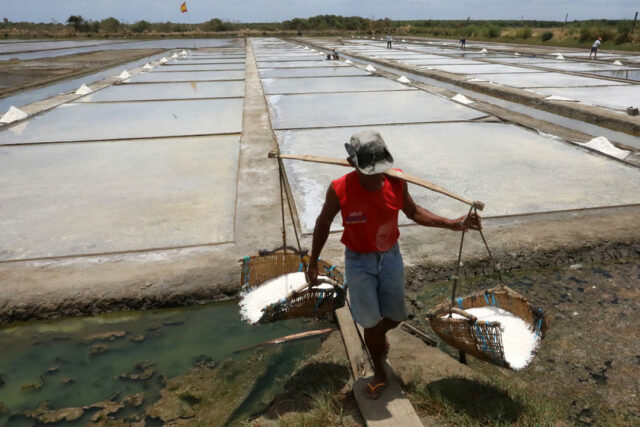
PHILIPPINE STAR/EDD GUMBAN

THE House Committee on Agriculture and Food has tasked a technical working group (TWG) to work on the draft of House Bill 1976, which seeks to revive the salt industry.

“This bill is a product of numerous consultations with… salt producers and representatives from government agencies,” Kabayan Party-list Representative Ron P. Salo, the author of the bill, said at the committee meeting.

The bill requires the government to provide technical, physical, and financial assistance to salt farmers, including artisanal salt farmers, to expand their output and to make the industry export-ready.

“(The bill) recognizes that the Philippines imports around 93% of its salt requirement, despite having 36,000 kilometers of shoreline, the fifth longest shoreline in the world, which can be utilized for massive salt production,” Mr. Salo said.

“(The bill requires) the government to invest in the identification and construction of salt farms for lease to qualified salt farmers, whether individuals, cooperatives, or corporations,” he added.

Annual salt imports between 2019 and 2020 averaged 628,500 metric tons, valued at P3.14 billion, Gerard C. Khonghun, president of the Philippine Association of Salt Industry Networks, told the committee.

Australia is the top exporter of salt to the Philippines, followed by China and Thailand, he said.

Mr. Khonghun said Philippine salt production declined over the decades due to urbanization, increasing salt demand due to a rising population, lack of upgrades to salt farms and the failure to develop new salt farms.

Philippine Chamber of Commerce and Industry Chairman Sergio R. Ortiz-Luis, Jr. said no opposition to the bill is expected.

“We would like to see that not only we are able to produce our salt requirement but that we are also able to export it,” he said. “Maybe include the implementation of an export development council for representation (in the bill).”

Leyte Rep. Richard I. Gomez flagged a possible conflict with Republic Act 8172 or an Act for Salt Iodization Nationwide (ASIN) and raised the need to harmonize the two measures.

Mr. Salo said the bill complements the ASIN law, adding that the TWG will smooth out any points of conflict.

Separately, AGRI Party-list Representative Wilbert T. Lee, the committee’s co-chairman, filed House Bill 5676 or the proposed Philippine Salt Industry Development Act.

The measure seeks to establish a Philippine Salt Industry Development Task Force which will draft a salt industry roadmap.

“This bill seeks to reduce our reliance on imports by providing salt stakeholders ample support and protection so they can develop,” Mr. Lee said in a statement. — Kyanna Angela Bulan

Canneries urged to pay fair prices to municipal fisherfolk

Shoppers check out canned goods at a supermarket in Quezon City, Sept. 11. — PHILIPPINE STAR/ MIGUEL DE GUZMAN

THE canning industry needs to pay fair prices to the municipal fisherfolk keeping their factories supplied during the closed fishing season, an association of small fishermen said.

The Pambansang Lakas ng Kilusang Mamamalakaya ng Pilipinas (PAMALAKAYA said the price paid to fisherfolk for herring (tamban) used by the canneries should be about 70% of the retail price.

“This is one of the supports that our small fishers have always sought — for the government to intervene in the (pricing) system and remove the many layers of middlemen that manipulate farmgate and retail prices to unreasonable rates,” PAMALAKAYA Chairman Fernando L. Hicap said in a statement on Tuesday.

On Oct. 24, the Bureau of Fisheries and Aquatic Resources (BFAR) signed a memorandum of agreement with the Canned Sardines Association of the Philippines (CSAP), which is seeking to secure its supply of fish during the closed fishing season imposed on the waters of the Zamboanga Peninsula between Dec. 1 and March 1. The supply deal also covers Sorsogon.

The agreement allows selected registered municipal fisherfolk to supply the canneries.

“The retail price of tamban in Sorsogon ranges from P120-P130 per kilogram, thus the farmgate price should be not less than 70% of the retail price, which is favorable to producers,” PAMALAKAYA said.

The group is also seeking a significant rollback in fuel prices.

“The price of diesel in the past two weeks increased by P6-P8 per liter to an all-time high. Now oil companies are giving us a mere P1/liter decrease,” PAMALAKAYA Spokesman Ronnel S. Arambulo said.

“The Marcos administration can pursue doable measures to stabilize oil prices through the suspension of the excise tax on fuel products, reversing the deregulation of the oil industry through the repeal of Oil Deregulation Law, and the immediate rollout of production subsidies to the marginalized,” it said. — Revin Mikhael D. Ochave

Legislator touts e-commerce bureau measure as key to growing online economy

BW FILE PHOTO

HOUSE BILLS proposing the creation of an e-commerce bureau at the Department of Trade and Industry (DTI) will safeguard internet transactions and promote the healthy growth of an online economy, one of the bills’ authors said on Tuesday.

Davao Rep. Paolo Z. Duterte said in a statement that such a measure will also encourage micro, small and medium enterprises (MSMEs) to expand via online sales.

“In order to protect the merchant and the consumer, effective regulation of commercial activities through the internet or electronic means must be established,” Mr. Duterte said in House Bill 3057’s explanatory note.

According to the 2021 e-Conomy report by Google, Temasek and Bain & Co., the Philippines was the fastest-growing e-commerce market in Southeast Asia. The Philippine market added 12 million new digital consumers between the beginning of the pandemic and the first half of 2021.

According to the bill, the e-commerce division set up within the DTI will be abolished and replaced by the E-Commerce Bureau.

The bill authorizes the bureau to require the registration of e-commerce entities with the DTI’s Online Business Registry. It will also propose policy aimed at promoting the growth of the industry.

Mr. Duterte said such an agency will “build trust between online merchants and consumers via secure and reliable e-commerce platforms.” — Matthew Carl L. Montecillo

Manila to scrap mask mandate to lure more foreign travelers

BW FILE PHOTO

By Kyle Aristophere T. Atienza, Reporter

PHILIPPINE President Ferdinand R. Marcos, Jr. will make mask-wearing indoors optional, as the Southeast Asian nation tries to attract more foreigners into its tourism industry.

He was expected to issue an executive order about the policy after meeting with Cabinet officials on Tuesday, Tourism Secretary Ma. Esperanza Christina Codilla Frasco told a televised news briefing.

“It was agreed that the president would be issuing an executive order to make indoor mask wearing also voluntary all over the Philippines with a few exceptions,” she said.

People should still wear face masks in public transportation and medical facilities, Ms. Frasco said. Unvaccinated people, those with health complications and senior citizens are still “highly encouraged” to wear face masks, she added.

“The direction of the Marcos administration is to lift the remaining travel restrictions in the Philippines,” she said. “That includes easing of our mask mandate.”

Ms. Frasco said the move was aimed at making the Philippines at par with its regional neighbors that have long done away with mask requirements.

Pre-departure RT-PCR testing for inbound travelers would also be removed. “As far as unvaccinated foreigners are concerned, they would henceforth be allowed entry into the Philippines with only the requirement of presenting an antigen test taken 24 hours before departure or an option of taking an antigen test upon arrival into the Philippines,” she added.

“The overarching direction of the Marcos administration is to allow our country to convey an openness and readiness to the world to receive tourists and investments so that we would give our fellow Filipinos an opportunity to regain all the livelihood and losses that were incurred during the pandemic,” the Tourism chief said.

Noe Lineses, who owns an online platform that organizes trips and tours in Puerto Galera, a popular beach destination south of the Philippine capital, expects the move to boost tourist arrivals in his hometown.

“Time to come out of our shells and showcase our readiness to accept tourists and compete with other Asian countries,” he said in a Facebook Messenger chat. “Tourism can help get us out of the current economic quagmire.”

But not everyone is happy, given that the announcement came in the absence of a full-pledged Health secretary. Experts said the lack of proper ventilation in business establishments should not be underestimated.

Joshua C. Agar, a wind engineer from the University of the Philippines, said the government should realize that the coronavirus is still here.

SARS-CoV-2-laden aerosols “are transmitted over short-range and long-range” and easily accumulate within poorly ventilated indoor spaces,” he said in a Twitter message. “Well-filtering mask, when used properly, filters the air that we breathe, catching these aerosols before getting into our lungs,” Mr. Agar said.

“And on top of the incoming variants? The virus can never mutate past physical measures,” he added, citing the filtration offered by face masks.

Joey Francis Hernandez, treasurer of the Philippine Society of Public Health Physicians, said the relaxation of pandemic rules were not being complemented by efforts to ensure proper ventilation in business establishments.

“Making mask-wearing voluntary indoors should go hand in hand with enforcing or encouraging business establishments to ensure that ventilation indoors is okay and won’t make unmasked individuals sick,” he said in a Messenger chat. “We are not seeing this move to complement this loosening of the mask mandate.”

He said the Cabinet decision is risky since businesses appeared to be unprepared for the holiday season. “Establishments are not prepared to add ventilation safeguards.”

“While there are existing recommendations for ventilation, there are few establishments that are willing to invest in it,” he said. “It’s not even mandatory as part of licensing business establishments.”

In a statement, the Department of Health said the state’s pandemic task force had taken into consideration the concerns of all sectors.

“The more layers of protection we employ, the more protected we are against COVID-19,” it said. The decision to ease masking gives everyone the liberty to decide “based on personal context.”

“With this freedom to choose, it is therefore important for us to assess our individual risk thoroughly before deciding if it is safe and wise to remove our masks,” DoH said.

John Ryan R. Canlas, a 24-year-old researcher who loves traveling, said he would rather wear a mask especially indoors.

“Being masked up is still the simplest method to protect myself and others from the virus,” he said in a Messenger chat.

He worries that making masks optional would do more harm than good. “They are rushing things. It affects the public in a negative way, that we should not be afraid of the virus anymore.”

Mr. Marcos, 65, has yet to appoint his Health chief. Last week, he told reporters he would only name his Health secretary once the Philippines’ COVID-19 situation has returned to normal.

The Philippines posted 11,995 coronavirus infections in the past week, with a daily average of 1,714 cases. The country has detected its first cases of the new Omicron XBB subvariant and XBC variant, which is said to be a recombinant of the Delta and BA.2 variants.

China open to joint oil talks with Marcos gov’t

MALAMPAYA GAS FIELD — PHILSTAR FILE PHOTO

CHINA will continue joint oil and gas exploration talks with the Philippines under President Ferdinand R. Marcos, Jr., its envoy said on Tuesday. 

“We are ready to work with this administration,” Chinese Ambassador Huang Xilian told a news briefing. “We hope that we will find some way out to handle the remaining differences, so that we could begin that kind of common oil and gas development.” 

The Chinese envoy said the Filipino and Chinese way of settling differences is similar, citing Mr. Marcos’s remarks in his first address to Congress in July. 

“We will be a good neighbor — always looking for ways to collaborate and cooperate with the end goal of mutually beneficial outcomes,” the president said at that time. “If we agree, we will cooperate and we will work together. And if we differ, let us talk some more until we develop a consensus.” 

“If we cannot solve the differences, then we should try to create a good environment for us to handle the differences,” Mr. Huang said. “We should also seek to settle and manage our differences through direct, friendly consultations and dialogue.” 

He said the Philippines under ex-President Rodrigo R. Duterte and China had made “significant progress” in joint oil and gas exploration talks even if they failed to reach a deal. 

“We have been negotiating the common development of oil and gas according to the memorandum of understanding signed between our two governments in 2018,” he said. “We have made significant progress, but we have yet to conclude it for the benefit of our people. Our cooperation in oil and gas will help meet the energy needs of our two countries.” 

Mr. Huang made his remarks when asked if China was agreeable to a 60-40% sharing agreement in favor of the Philippines. 

In September, Foreign Affairs Secretary Enrique A. Manalo said China was pushing a 50-50% or 51-49% division, and wanted conditions in accordance with Chinese domestic laws that were unacceptable to the Philippines. 

The South China Sea, a key global shipping route, is subject to overlapping territorial claims involving China, Brunei, Malaysia, the Philippines, Taiwan and Vietnam. Each year, trillions of dollars of trade flow through the sea, which is also rich in fish and gas. 

The official talks did not go beyond initial discussions, which were done during the visits of State Councilor and Foreign Minister Wang Yi and International Department of Communist Party of China Minister Liu Jianchao, Philippine Foreign Affairs spokesperson Ma. Teresita C. Daza earlier said. 

Meanwhile, Mr. Huang said China “has no objection” to the Philippines developing a “normal relationship with any country in the world,” when asked about strengthened ties between the Philippines and US. 

He said the relationship should not be “directed against China.” 

US Ambassador to the Philippines Mary Kay L. Carlson has said the US wants to enhance joint maritime defense activities with the Philippines to keep the South China Sea safe. 

“Whatever we can do, military to military or people to people, that ensures that we secure our territorial integrity and that we make our waters safe is what we’re going to do,” she said this month. 

China has rejected a 2016 arbitral ruling by a United Nations-backed tribunal that voided its claim to more than 80% of the South China Sea. 

The Permanent Court of Arbitration based in the Hague upheld the Philippines’ rights to its exclusive economic zone within the disputed waterway. It rejected China’s claim to most of the sea based on a 1940s nine-dash line map. — Alyssa Nicole O. Tan 

Education department not seeking to revise history, VP Carpio says

PHILIPPINE STAR/ RUSSELL PALMA

VICE-President (VP) and Education Secretary Sara Duterte-Carpio on Tuesday said her agency was not seeking to revise Philippine history by rebranding the martial law regime of the late dictator Ferdinand E. Marcos. 

“As the Education secretary, it is not part of my mandate to ruin the integrity of our history,” she said in a statement. The Department of Education (DepEd) is preoccupied with education programs and does not have time for historical revisionism, she added. 

“DepEd is not in the business of erasing these facts and replacing them with something else.” 

Ms. Carpio, who teamed up with the late dictator’s son for the top two government posts in the May elections, issued the statement after reports that martial rule was being reintroduced in schools as the “period of the New Society.” 

A senior high school student from Marinduque island earlier posted on social media, including a photo of a DepEd module, that her class was being taught to call the dictatorship from 1972 to 1981 the “period of the New Society.” 

Ms. Carpio said the terms New Society and martial law involve “historical facts” that have been used “within their proper context” in DepEd textbooks since 2000. 

She accused critics of using the agency to incite feelings against the dictator’s martial rule. 

“The period of the New Society started on Sept. 21, 1972,” according to a copy of the module obtained by BusinessWorld

During that period, “newspapers donned new forms.” “News on economic progress, discipline, culture, tourism and the like were favored more than the sensationalized reporting of killings, rape and robberies.” 

More than 70,000 people were jailed, about 34,000 were tortured and more than 3,000 people died under martial rule, according to Amnesty International. The dictator shuttered television stations, newspapers and radio stations. 

The Marcoses have been accused of living lavishly in the Philippine presidential palace while Filipinos suffered from a collapsing economy, which declined by 7.3% in 1984 and 1985. 

“It is a historical fact that New Society refers to the program launched by former President Ferdinand Marcos, Sr. during his administration,” Ms. Carpio said. “And it is another historical fact that martial law refers to the 14-year rule of the former president.” 

Michael Henry Ll. Yusingco, a policy analyst, said the “obvious misrepresentation” of the martial law period “warrants a congressional investigation.” “This matter is very serious because it involves the education of young Filipinos,” he said in a Facebook Messenger chat. 

Arjan P. Aguirre, a political science professor at the Ateneo de Manila University, said there should be “a proper investigation about what happened and a quick and appropriate correction of the error made in the module.” 

He said the public should be informed about revisionist attempts “especially now that our democratic ideals, institutions and practices are being undermined by political forces that aim to have more control.” 

“It may not be a surprise if the current DepEd secretary will not do anything for now,” Maria Ela L. Atienza, a political science professor at the University of the Philippines, said in a text message. 

Different groups and political players want to change history books to paint the dictatorship in a better light, she said. 

“There are also political elites and petty bureaucrats who want to win favors from the current leadership and they think changing modules may be one way,” she added, noting that there are also groups standing up against attempts to distort history. — Kyle Aristophere T. Atienza and Matthew Carl L. Montecillo 

Gatchalian pushes for long-term solutions to work overload among teachers 

DEPED.GOV.PH

A SENATOR said the government should find long-term solutions to the problem of work overload among teachers to help address the education crisis in the country.   

“One of the steps to take care of the quality of education that our young people receive is to make sure that our teachers have enough time to teach,Senator Sherwin T. Gatchalian, who chairs the Senate Basic Education Committee, said in Filipino in a statement on Tuesday. 

But we cannot do this if teachers remain burdened with other tasks that have nothing to do with actual teaching,” he added.  

Even before the disruptions brought by the coronavirus pandemic, the Philippine Institute for Development Studies (PIDS) already pointed out in a 2019 study that the quality and delivery of education is affected by administrative and student support roles handled by teachers. 

Teachers are also required to participate in government programs such as mass immunization, deworming, and election.  

Mr. Gatchalian urged the Education department to adopt a proposal from the state think tank to conduct studies on teacher workload, as it will help rationalize their job and allow them to allocate more time for teaching.  

The senator also filed the Digital Transformation in Basic Education Act to promote efficiency in delivering basic education services.  

Senate Bill 383, if passed, will help streamline teachers’ workflow through the use of technology.  

Mr. Gatchalian is also pushing for amendments to the 56-year-old Magna Carta for Public School Teachers to improve provisions on benefits as well as make it more responsive to present challenges. Alyssa Nicole O. Tan 

Cagayan province declares state of calamity after series of typhoons

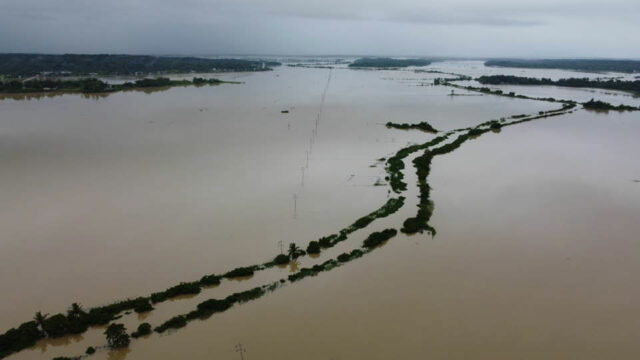
FLOODED farm areas in the town of Allacapan on Oct. 12. — ALLACAPAN MAYOR HARRY D. FLORIDA

CAGAYAN in northern Philippines has been placed under a state of calamity following damage from four typhoons since August, the provincial government announced on Tuesday.  

The provincial council unanimously approved on Oct. 24 the state of calamity declaration, which paves the way for the release of local disaster response funds to assist affected residents.  

The provincial disaster management office recommended the declaration, citing the impact of severe tropical storm Florita (international name: Florita) in August; and typhoons Mamay, Neneng (international name: Nesat), and Obet in October.   

Persistent rains brought by the shear line, or the meeting of cold and hot air, has also aggravated flooding and landslides, the disaster management office said.  

Overall damage to crops, mainly rice, was estimated at over P565.8 million and another P4 million in livestock.   

Infrastructure damage reached 78.4 million.  

Around 66,510 families or 232,982 individuals have been affected.   

Cagayan, composed of 28 towns and the capital city of Tuguegarao, has a population of 1,268,603 based on the 2020 census. MSJ 

NGCP tower bombing leaves western Mindanao areas without power 

NGCP
NGCP

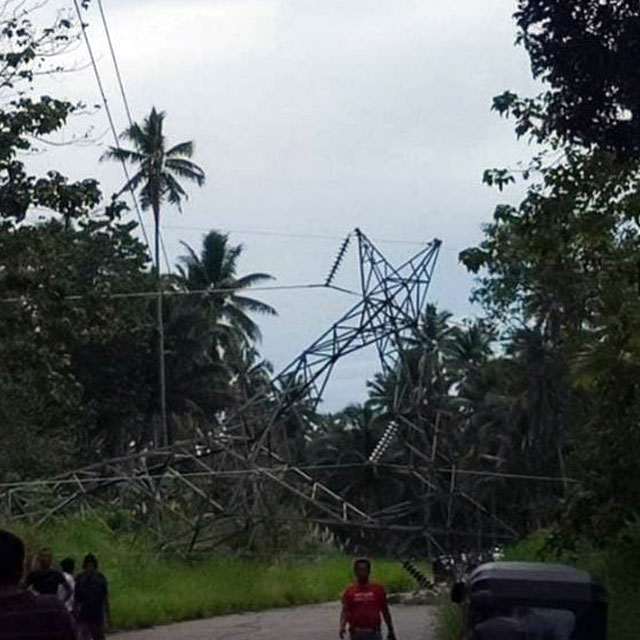
A POWER transmission tower in Kauswagan, Lanao del Norte was bombed on Monday, causing supply interruptions in western parts of the southern Philippine island of Mindanao, the country’s grid operator reported on Tuesday. 

The National Grid Corp. of the Philippines (NGCP) said Tower No. 8 of the Baloi-Aurora 138-kiloVolt (kV) line was bombed, which prompted rotational brownouts to prevent overloading of the remaining line.   

The tripping was due to the bombing of Tower No. 8 of the said line located in Sitio San Isidro, Brgy. Bagombayan, Kauswagan, Lanao del Norte. The bombing resulted in the toppling of the said tower,NGCP said in a media release.   

The transmission firm said affected areas are the provinces of Zamboanga del Norte, including the cities of Dipolog and Dapitan; Zamboanga del Sur, including the cities of Pagadian and Zamboanga; Zamboanga Sibugay; Misamis Occidental; and several areas of Lanao del Norte.   

Power restoration in affected areas may take two to three days, NGCP spokesperson Cynthia P. Alabanza said in a Viber message on Tuesday.   

“NGCP is currently coordinating with local law enforcement to secure the area as repairs are to be done by NGCP personnel,the company said.    

Preliminary investigation by authorities show that improvised explosive devices (IEDs) were used.    

A still unidentified individual was found at the scene with fatal injuries, but “it is unclear if this is related to the bombing,NGCP said.    

The transmission firm warned that “suspicious activities within or along the power transmission corridor which may disrupt the transmission of power is punishable by law, with a penalty of as much as P200,000 or 12 years imprisonment, or both.”Ashley Erika O. Jose 

Sister of middleman in broadcaster’s murder placed under witness protection

BW FILE PHOTO

THE SISTER of the alleged middleman involved in the killing of a local broadcaster has been placed under the Witness Protection Program, the Department of Justice (DoJ) said on Tuesday. 

“When she arrived here at the DoJ, she gave Justice Secretary Jesus Crispin C. Remulla information about her dead brother and we found that the information was relevant to his death, DoJ spokesman Jose Dominic F. Clavano IV told reporters in mixed English and Filipino, based on a video posted by state-run media People’s Television Network on Twitter. 

Senator Rafael Raffy” T. Tulfo said in a statement on Tuesday that the woman sought his help on Monday. She later revealed during the lawmaker’s radio program that her brother told her before his death that three individuals may kill him in the national penitentiary. 

The senator and his brother, Social Welfare Secretary Erwin T. Tulfo, put her in contact with the Justice department. 

“There were names mentioned but all of these are allegations as of now,” Mr. Clavano said. “So now we have to verify and vet this information.” 

The Justice secretary earlier said one of the middlemen who contracted the killers died of unknown causes. He also said there was a second middleman whom police had detained.  

Last week, the alleged gunman in the murder of 63-year-old Percival Mabasa surrendered to authorities and said he had been hired by someone inside the national penitentiary. He and three other accomplices supposedly got paid P550,000.  

The broadcaster’s YouTube channel which had more than 200,000 subscribers showed he had been critical of ex-President Rodrigo R. Duterte and some policies of current officials.  

Meanwhile, the Philippine National Police said it will ask for help from the Tulfo brothers to examine the woman’s mobile phone for possible leads.  

“Maybe they can help us with the turnover of the sister’s cellphone so we could conduct a forensic examination and it would form part of the evidence that would lead to the mastermind, national police chief Rodolfo S. Azurin told ABS-CBN Teleradyo on Tuesday. John Victor D. Ordoñez