Home Blog Page 5648

DTI’s Pacual calls RCEP a Marcos priority

REUTERS

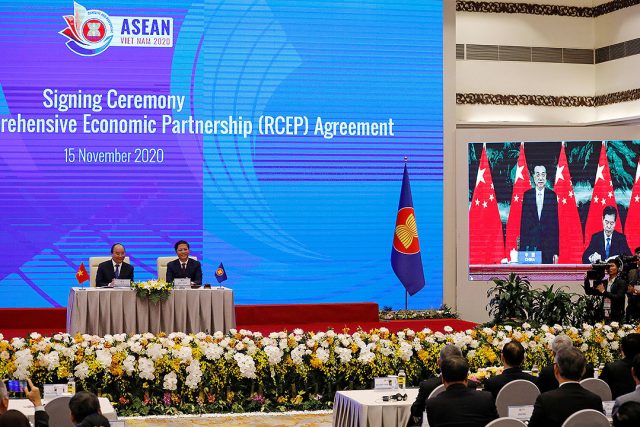
PARTICIPATION in the Regional Comprehensive Economic Partnership (RCEP) is a government priority, Trade Secretary Alfredo E. Pascual said on Thursday.

“RCEP is a priority of the administration. We have clarified this in one of our Cabinet meetings,” Mr. Pascual said during the general membership meeting of the Management Association of the Philippines (MAP) in Taguig City. 

RCEP, a trade deal which started coming into force on Jan. 1, involves Australia, China, Japan, South Korea, New Zealand and the 10 members of the Association of Southeast Asian Nations (ASEAN). It is billed as the world’s largest trade agreement as it represents about 30% of global gross domestic product.

However, the entry of Philippines into RCEP failed to obtain Senate in the 18th Congress after some senators expressed concern over the lack of protections for the agriculture industry. It is now up to the 19th Congress to decide on ratification. The first day of the new session is July 25.

“(The) Department of Trade and Industry (DTI) will continue to push for the immediate ratification of the RCEP and other trade agreements. With only 10 FTAs, the Philippines has the least number of FTAs among the ASEAN six countries,” Mr. Pascual said.

“Singapore signed 27 FTAs, Malaysia 17, Thailand 15, Indonesia 15, and Vietnam 15. These agreements will diversify the country’s exports in terms of products and services and destinations and enhance the country’s attractiveness to foreign investment,” he added.

Mr. Pascual added that the Philippines will not become an attractive location for export-oriented enterprises without RCEP and FTAs.

“Most foreign investments in China, for instance, are export-oriented industries. They are from big multinationals having transferred their production facilities to China and using China as a production place. Without these FTAs and RCEP, the Philippines would not be an attractive location for such types of export-oriented enterprises,” Mr. Pascual said.

President Ferdinand R. Marcos, Jr. has said he wants an assessment of the RCEP to ensure the protections for the agriculture sector.  — Revin Mikhael D. Ochave

PEZA announces appointment of OIC

THE Philippine Economic Zone Authority (PEZA) said Tereso O. Panga has been named officer-in-charge (OIC) director general, with effect from July 1, succeeding former chief Charito B. Plaza. 

In a Facebook post on Thursday, PEZA said Mr. Panga’s designation as OIC is outlined in Memorandum Circular (MC) No. 1, issued by the Office of the President over the signature of Executive Secretary Victor D. Rodriguez on June 30.

Mr. Panga still serves as the PEZA’s deputy director-general for policy and planning.

“Mr. Panga will head the (agency) until July 31, 2022 or until a replacement is appointed/designated, whichever comes first,” the PEZA said. 

“In view thereof, all applications, requests, concerns, and matters needing action or approval by the Head of the Authority following the guidelines of MC No. 1 shall be addressed to the duly assigned OIC,” it added. 

Asked to comment, Ms. Plaza said in a Viber message that the position is coterminous with the appointing administration.

Ms. Plaza was appointed director-general in September 2016.

“PEZA director general is (a) Presidential appointee (and is) coterminous,” Ms. Plaza said. — Revin Mikhael D. Ochave

Bill proposes 30-year timeline for infrastructure projects

PHILIPPINE STAR/ MICHAEL VARCAS

A BILL seeking to create a 30-year planning horizon for infrastructure and establishing a National Infrastructure Program has been filed at the Senate, Senator Mark A. Villar said in a statement.

“It is important that we advance the Build, Build, Build program in the Senate, because having a long-term plan for our infrastructure program can grow the economy… It will (make it easier to improve) roads, bridges, and other structures, (generating) thousands of jobs,” he added.

Build, Build, Build was the former government’s P8.4-trillion flagship program designed to address the Philippines’ lack of competitiveness due to gaps in its infrastructure.

Mr. Villar is being tipped as a possible chairman of the Senate Trade, Commerce and Entrepreneurship Committee.

The bill focuses on the process for identifying the core infrastructure projects the government plans to pursue in transport, energy, water resources, information and communications technology, social infrastructure systems, and others.

“I am certain that with the passage of this bill, we will encourage investors, facilitate job creation, boost economic growth, and most importantly, improve the quality of life in both urban and rural areas,” Mr. Villar said.

The Department of Public Works and Highways (DPWH), which Mr. Villar used to head, estimates that in the 2016-2020 period, Build, Build, Build generated 6.5 million jobs. It also tallied 1.6 million hires between March 2020 and the end of 2021.

“In the past six years, the Filipino people have seen and experienced the impact of the Philippines’ Golden Age of Infrastructure. The Build, Build, Build program resulted in the creation of hundreds of ports, thousands of roads and bridges, and millions of jobs,” he said.

Separately, Albay Rep. Jose Ma. Clemente S. Salceda, who is expected to retain the chairmanship of the House Ways and Means Committee, filed a joint resolution on Thursday adopting Build, Build, Build as a national infrastructure development framework with a set minimum annual spending target.

According to House Joint Resolution 6, between 2023 and 2028, at least 5% of gross domestic product (GDP) must be spent on infrastructure, with an eventual target of 6% of GDP. 

Mr. Salceda, in the resolution, said that “proper planning and design, adequate funding, efficient implementation, and timely and effective completion of infrastructure projects will be crucial to economic recovery from the scarring effects of the COVID-19 pandemic and the attendant global economic slowdown.”

If passed, the government will be required to complete infrastructure projects in the pipeline and promote locally funded infrastructure development. — Alyssa Nicole O. Tan

No sugar shortage, industry says; high prices blamed on ‘hoarding’

SUGAR producers said on Thursday that the supply of sugar is ample and blamed the prevailing high prices on “manipulation and hoarding.” 

United Sugar Producers Federation President Manuel R. Lamata blamed the manipulation on some traders he did not identify.

“Definitely, there is manipulation and hoarding going on,” Mr. Lamata said in a Viber message.

The average retail price of refined sugar in wet markets was P87.50 per kilo on July 8, according to a report by the Department of Agriculture (DA). The price was as high as P90 in some markets.

The average price of raw sugar in wet markets, meanwhile, was P66.86 per kilo.

Mr. Lamata projects a possible shortage “in the long run.”

Philippine Chamber of Commerce and Industry President George T. Barcelon said the increase in sugar prices is the result of various factors, including surging prices of fertilizer and the impact of previous typhoons on sugar-producing provinces.

“(We should) consider the devastation that was brought about by Typhoon Odette in mid-2021, which hit the Visayas and Northern Mindanao, where sugar is grown extensively,” he said in a Viber message. “This affected production for the first half of 2022.”

“There is limited supply coupled with high cost of fertilizers. Farmers fertilized less of their farms, thus affecting productivity,” he said. “That is what is happening now.”

He noted that the DA’s plan to import 500,000 metric tons of sugar did not materialize, affecting supply.

“So, I think, only 200,000 metric tons was allowed for import and this was fully absorbed by industrial users,” he said. “No imports reached the retail side; thus, high prices are now being felt.”

Mr. Barcelon said the “only recourse” now for the short term is to import from Thailand and other Southeast Asian countries.

Mr. Lamata, who said the greed of some sugar traders triggered surging prices, urged the government to impose a suggested retail price of P60 per kilo of raw/brown sugar and P75 for refined sugar.

He said traders should “immediately” import 100,000 metric tons of refined sugar and “bring the imports to the DA and Sugar Regulatory Administration’s rolling stores with suggested retail prices and sell them directly to (consumers) and bakers.”

“(The government) should ensure that it will be exclusive to the palengke (wet markets) and housewives, not to the industrials and bottlers.”

Negros Oriental is one of the Philippines’ largest sugar producers. Its Vice Governor Jeffrey P. Ferrer said he will consult with sugar refineries to gauge their willingness to “restart their operations as soon as possible” ahead of a possible shortage.

“There have been reports that low sugar stocks are due to hoarding, but this is an allegation that needs to be verified first,” he said in a statement. “On the other hand, if indeed true, I will reach out to various refineries in the province if they are willing to open their mills to refine raw sugar in order to address the perceived shortage in the market.”

Mr. Ferrer said while some officials, including those that will serve under the Department of Agriculture, have yet to be named by President Ferdinand R. Marcos, Jr., “we have to hit the ground running and prepare for the coming crop year by ensuring that we will have sufficient sugar supply in the coming months.” — Kyle Aristophere T. Atienza

Marcos urged to appoint sugar regulator before Sept.

REUTERS

THE GOVERNMENT must appoint the next set of officials at the Sugar Regulatory Administration (SRA) before the start of the next milling season in September to firm up possible plans to import the commodity, a legislator representing Bacolod said.

“By September this year, we start the new crop year and we need to appoint the new administrator,” Representative and former SRA board member Emilio Bernardino L. Yulo said in an interview.

“Our stock balance will be tight at the end of the crop year, which is August. We need a new sugar board to determine if there’s a need to import,” he added.

He also recommended that the next SRA chief be from Negros, as 50% of the land devoted to sugar farming is on the island.

“Sugar is a political commodity. It’s important we appeal to the ground level. We need to hear (the farmers) out. If you are there, you will be able to at least talk to them,” he added.

Mr. Yulo said that the next SRA board must also address rising input costs.

“The problem is the high input costs. (There are) high fertilizer costs; crude oil affects all aspects of production — it was P27 during the pandemic and now it’s P80-90. We (also) cannot blame our laborers if they ask for a corresponding wage (increase),” he said.

“It’s imperative for the sugar industry. If the drive of the administration is good food security, they need to bring down fertilizer prices. Since it’s a worldwide problem, we need to put up mechanisms for farmers to be compensated,” he added.

In July, the average price of refined sugar in wet markets rose to P87.50 per kilogram from P74.84 a month prior, according to the SRA.

“Our problem is the retail market. They were already supposedly included under Sugar Order (SO) No. 3, (but) it is more important for us to resolve the retail market, that’s where the majority of our consumers are. Again, we don’t want the sugar industry to be one of the culprits of high inflation,” Mr. Yulo said.

SO No. 3 authorizes the import of 200,000 MT of refined sugar to serve as a supply buffer.

Mr. Yulo added that the incoming imports from the order will not bring down retail prices, as these are earmarked for industrial users.

The United Sugar Producers Federation led by President Manuel R. Lamata sought a temporary restraining order on SO No. 3.

In February, the Sagay City and Himamaylan City Regional Trial Courts issued separate preliminary injunctions against SO No. 3.

Former SRA chief Hermenegildo R. Serafica issued a statement in June that SO No. 3 was issued after due consultation with millers, refiners, and cane planters.

“Sugar prices would not be this high if the sugar import program was not stalled. If not for the legal impediments caused by the group of Mr. Lamata, which caused delays in our import program, the imported sugar would have come in by May to June which (would have eased) the pressure on the supply and demand situation,” Mr. Serafica said.

“As early as February we projected a deficit in our sugar supply, largely because of weather disturbances such as Typhoon Odette (international name: Rai), excessive rain and overcast skies which have been detrimental to the growth and sugar content of the sugarcane in the majority of producing areas,” he added. — Luisa Maria Jacinta C. Jocson

China says Philippines’ 2016 arbitral award illegal 

BW FILE PHOTO

By Alyssa Nicole O. Tan, Reporter

CHINA on Wednesday said a 2016 arbitral ruling by a United Nations-backed tribunal that voided its claim to more than 80% of the South China Sea violates international law.

“China neither accepts nor recognizes it and will never accept any claim or action based on the award,” Chinese Foreign Ministry spokesman Wang Wenbin said at a press briefing, according to a transcript posted on the agency’s website.

“By doing so, we are upholding international rule of law,” he added, calling the ruling “illegal, null and void.”

Philippine Foreign Affairs Secretary Enrique A. Manalo has said the findings of the arbitration court “are no longer within the reach of denial and rebuttal, and are conclusive as they are indisputable.”

“The award is final,” he said on the sixth anniversary of the ruling on July 12. “We firmly reject attempts to undermine it; nay, even erase it from law, history and our collective memories. At the same time, we welcome the support of a growing list of countries for the award.”

In 2016, the Permanent Court of Arbitration based in the Hague upheld the Philippines’ rights to its exclusive economic zone within the waterway. It rejected China’s claim to most of the sea based on a 1940 nine-dash line map that Mr. Manalo said “had no basis in law and is without legal effect.”

Several countries have backed the Philippines’ sea claims. Some of the more vocal supporters include the United States, United Kingdom, Germany, Italy, Australia, Canada, France, Japan, New Zealand and Timor Leste.

But Mr. Wang said China had received “broad understanding and support” from the international community on its position.

“Those who attempt to infringe on China’s sovereignty, rights and interests by implementing this illegal award will not succeed,” he said. “China will respond to such attempts in accordance with law.”

The Department of Foreign Affairs did not immediately reply to a WhatsApp message seeking comment.

China also called out the US, saying it violated and distorted international law.

“It has broken its public commitment of taking no position on sovereignty claims in the South China Sea, and sought to drive a wedge between regional countries and undermine peace and stability in the region,” Mr. Wang said. “This is extremely irresponsible.”

He urged the US to respect its sovereignty, rights and interests in the South China Sea, and to stop “stirring up trouble” and “sowing discord between regional countries.”

The US Embassy did not immediately reply to a Viber message seeking comment.

China and the Association of Southeast Asian Nations are fully and effectively implementing the Declaration on the Conduct of Parties in the South China Sea and working to advance the consultations on a code of conduct in the waterway, Mr. Wang said.

He noted that all sides have agreed to handle the issue through a “dual-track approach” where maritime disputes are handled properly by countries directly concerned through dialogue and consultation. 

The South China Sea, a key global shipping route, is subject to overlapping territorial claims involving the Philippines, China, Brunei, Malaysia, Taiwan and Vietnam. Each year, trillions of dollars of trade flow through the sea, which is also rich in fish and gas.

Mr. Manalo said China had violated the Philippines’ sovereign rights in its exclusive economic zone through its large-scale reclamation and construction of artificial islands that destroyed the environment, in violation of international conventions.

He also cited China’s large-scale harvesting of endangered marine species and actions that aggravated the dispute.

“The award benefits the world across the board,” Mr. Manalo said. “We do not see it as directed at any other country, near or far. We see it as it should be seen — as favoring all which are similarly situated by clarifying definitively a legal situation beyond the reach of arms to change.”

“It puts this aspect of international law beyond the limit of prescription,” he added. “And so we say once again: The present that we need and the future that we want is a peaceful South China Sea. The Philippines is committed to this for as long as it exists.”

Chinese State Councilor and Foreign Minister Wang Yi last week said he expects relations between China and the Philippines to reach a “golden era” under the Marcos administration.

“I’m confident that with both sides working together, we can surely open up a new golden era for the bilateral relationship,” he said in Chinese during a meeting with Philippine envoys in Pasay City near the capital, a voice recording of which was sent to reporters by DFA.

The Chinese state councilor was the first foreign counterpart to be received by Mr. Manalo, who used to be the country’s permanent representative to the United Nations.

Mr. Wang said he appreciates Philippine President Ferdinand R. Marcos, Jr., who called China the country’s “strongest partner.”


DPWH completes P92-M flood control project in Sampaloc, Manila

DPWH.GOV.PH

THE Department of Public Works and Highways (DPWH) said on Thursday that it completed a flood control project in Sampaloc, Manila.

The department “recently completed the rehabilitation of drainage structure along E. Quintos Street in Sampaloc, Manila,” it said in a statement.

The area, home to a number of universities and commercial establishments, is prone to flooding during the rainy season, causing road congestion and leaving commuters stranded.

“The improvement of drainage system utilized a series of 2.40 by 1.80 meter of reinforced concrete box culverts that will significantly increase the capacity of Josefina-Lepanto and Lepanto-Gov. Forbes Drainage Mains to ensure smooth drain and flow of floodwaters in the event of heavy rainfall,” the department said.

“Funded under the 2021 General Appropriations Act, the P92-million project was implemented by DPWH North Manila District Engineering Office,” it added.

Many areas in Metro Manila are low-lying and designated flood prone, with insufficient protection against frequent inundation, while natural drainage is often restricted during rainfall events by high river and sea water levels, according to the World Bank.

The DPWH said in May that civil works had started on a major pumping station serving a flood-prone area of Valenzuela City. The station is being implemented by DPWH Metro Manila 3rd District Engineering Office and is “expected to address the city’s perennial flooding problem as well as of neighboring areas along Meycauayan River,” it said in a statement.

In the DPWH’s flood management master plan for the Greater Metro Manila area, among the considered measures was the application of rainwater catchment system that will enable some communities to store rainwater for reuse instead of allowing it to run off into a waterway.

The World Bank estimates that the Philippines was visited by 94 destructive typhoons between 2011 and 2015, or 9.3% more than the number of typhoons between 2006 and 2010.

The DPWH also announced on Thursday the completion of the construction of a P49-million slope protection structure along San Fernando-Bagulin Road in Barangay Bacsil, San Fernando City, La Union.

“With the completion of this eco-friendly mitigation structure, motorists and residents can now safely pass through the mountainous portion of San Fernando-Bagulin Road without worrying about accidents,” DPWH Region 1 Director Ronnel M. Tan said. — Arjay L. Balinbin

BAI seeking new system to improve early warning on bird flu

BW FILE PHOTO

THE GOVERNMENT is seeking an improved system that will encourage early reporting from poultry farms of Avian Influenza (AI) outbreaks, while also helping it monitor poultry prices.

“The current Life Cycle Model on both layer and broiler chicken may not be reflective of actual situation as there have been some ‘interventions’ made by importer-producers of breeder stock due to Avian Influenza,” Bureau of Animal Industry (BAI) Director Reildrin G. Morales said in a statement.

“Other factors that have resulted in a disparity in supply and demand are the rising cost of inputs such as feed ingredients and fuel, the changing weather conditions and nutritional formulation adjustments by companies that led to stunted growth and prolonged growing periods,” he added.

According to United Broilers Raisers Association President Elias Jose M. Inciong, the government should shorten indemnify farmers with affected birds faster.

“The BAI should consider streamlining the indemnification process to enable the affected growers to immediately resume production and recover,” he said.

He also recommended that the Local Price Monitoring Council be restored in order to monitor prices of commodities.

The Departments of Agriculture (DA) and Interior and Local Government were also encouraged to harmonize and unify policy on movement guidelines for live birds, poultry products and by-products during the AI outbreak.

“It would be best if DA can come up with clear policies on proposed tariffs on meat, to firm up the confidence of farmers and producers,” Mr. Inciong added.

Based on this year’s food supply outlook, the total supply of poultry will hit 580,415 metric tons (MT) in the third quarter and 610,696 MT in the fourth quarter, with demand projected at 405,017 MT and 435,100 MT respectively, according to the DA.

“Poultry self-sufficiency ratio will remain at 92% by the end of the year, with ending stock of 175,596 MT, good for 39 days,” Mr. Morales said. — Luisa Maria Jacinta C. Jocson

VP rejects calls to delay classes until September

PHILIPPINE STAR/ MIGUEL DE GUZMAN

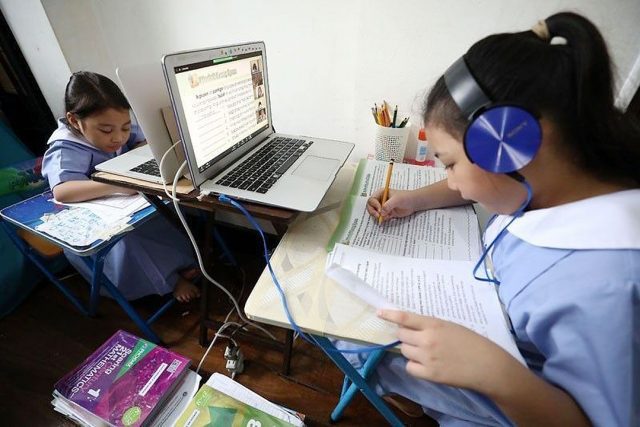
VICE President and Education Secretary Sara Duterte-Carpio on Thursday said classes would start on Aug. 22 amid a coronavirus pandemic, despite calls to move the new school year to September.

President Ferdinand R. Marcos, Jr. had approved the plan and the Department of Education (DepEd) already released an order to enforce it, she told a news briefing on Thursday. “We will proceed with the plan.”

The Teachers’ Dignity Coalition earlier asked DepEd to move the school year to mid-September or the first week of October to give teachers more time to rest and prepare, saying they had been working even during the break.

Under the order, all public and private schools must transition to five days of face-to-face classes.

“Starting Nov. 2, all public and private schools shall have transitioned to five days of in-person classes,” according to the order made public on Tuesday. Pure distance or blended learning except for schools that are implementing an alternative mode won’t be allowed.

DepEd said it would give schools “ample time to slowly transition” by implementing any of the following options: five days of face-to-face classes, blended learning, three days of in-person classes and two days of distance learning, four days of in-person classes and a day of distance learning or full distance learning. Schools may enforce these until Oct. 21.

But Ms. Carpio said private schools that fail to start physical classes on Nov. 2 won’t be penalized.

Some private schools have said they would not implement five days of in-person classes, citing their dialogues with parents.

Ms. Carpio’s first order Education chief suggests physical distancing “whenever possible,” fueling discussions about staff and classroom shortages. 

Ms. Carpio said the state does not want to burden schools by mandating physical distancing and requiring them to build more classrooms.

She said the co-mingling of vaccinated and unvaccinated children against the coronavirus would not be a problem once physical classes resume.

Unvaccinated students would not be discriminated against, she added.

“We gave the recommendation to the president and he approved it,” she said. “There should be no segregation and discrimination against unvaccinated learners because our COVID-19 vaccination program is not mandatory.”

“We do not see any problem with co-mingling in schools,” she added. “Once students leave schools, they would all share spaces — in homes, malls, churches and private transportation.”

Meanwhile, 94% of Filipino adults want their children to return to physical classes, according to a Pulse Asia Research, Inc. survey.

Only 4% were neutral and 2% disagreed, Senator Sherwin T. Gatchalian, who commissioned the survey, said in a statement.

“If we listen to our countrymen, we will see a very strong call for the return of face-to-face classes,” Mr. Gatchalian, who heads the Senate education committee, said in Filipino. “We can no longer postpone the return of our youth to school and we must no longer let the education sector lag behind as we rise above the pandemic.”

He said postponing physical classes could cause deeper economic scars due to learning loss.

Pulse Asia interviewed 1,200 adults on June 24 to 27 for the survey, which had an error margin of ±2.8 points.

A year of school closures costed about P10.8 trillion in productivity and wage losses over the next 40 years, according to the National Economic and Development Authority.

Mr. Gatchalian cited the need to boost school-based vaccination to protect students from the coronavirus.

Vaccination among children 5 to 11 years old remained low, he said. As of July 7, only 3.6 million or 26% of the target 14 million children have been fully vaccinated. For minors aged 12-17, however, 9.6 million or 86% of the target 11.4 million have received their first dose. — Kyle Aristophere T. Atienza and Alyssa Nicole O. Tan

Marcos appoints DoH OIC pending final pick of chief

FACEBOOK.COM/BONGBONGMARCOS

PRESIDENT Ferdinand R. Marcos, Jr. has appointed an officer-in-charge (OIC) at the Health department, according to the presidential palace.

Health Undersecretary Maria Rosario S. Vergeire will be the officer-in-charge pending the president’s final pick of the Health secretary, Press Secretary Rose Beatrix “Trixie” Cruz-Angeles told a televised news briefing on Thursday.

In his first memorandum circular, Mr. Marcos Jr. said government agencies where he has yet to name a head would be led by an officer-in-charge, who should be  most senior official.

Ms. Vergeire was tapped to head the National Vaccination Operations Center in June. As a Health official, she has spoken on behalf of the government’s pandemic response team.

The Health agency acknowledged Mr. Marcos for tapping one of its career executives.

“Each and every member of the DoH family shall work together to continue the gains instituted by previous administrations,” it said in a statement. “We look forward to continuing our recovery from the pandemic, and working towards universal health care for all Filipinos.” — KATA

Marcos orders fast-tracking of national ID printing, distribution 

OFFICE OF THE PRESIDENT

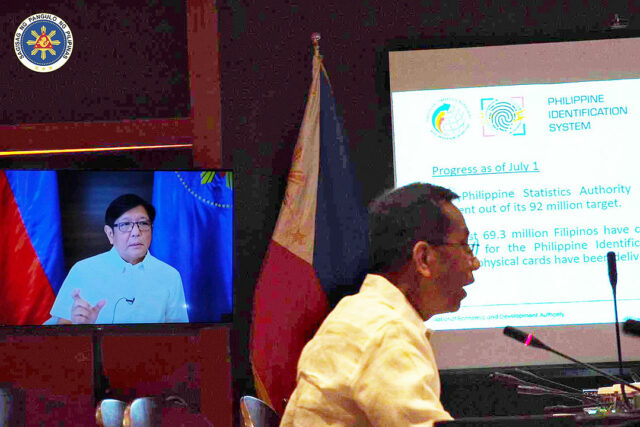
PRESIDENT Ferdinand R. Marcos, Jr. has ordered his socioeconomic planning chief to speed up the printing and distribution of more than 50 million national identification cards so these can be used by early 2023.  

In a Facebook post on Thursday, Mr. Marcos said the plan to boost the countrys centralized identification system was discussed in his virtual meeting with National Economic and Development Authority (NEDA) Director-General Arsenio M. Balisacan. 

Press Secretary Trixie Cruz-Angeles said separately in a news briefing that the system was the “main purpose” of the President’s meeting with Mr. Balisacan. 

Ms. Cruz-Angeles said the national ID system is part of the government’s economic recovery plan. 

This is essential especially for the banking system, in setting up small businesses for small entrepreneurs,she said in mixed English and Filipino. In the credit system, the ID system is also important.”  

A total of 14.3 million Philippine Identification System (PhilSys) cards have been released as of early June, according to the Philippine Statistics Authority.  

The former president, Rodrigo R. Duterte, had also ordered to quicken the rollout of PhilSys, which he signed into law in 2018.  

The national ID system law institutionalizes a single official identification for all citizens and foreign residents in the country. It incorporates the PhilSys number of every Filipino in all identification systems of government agencies.  

The law allows registered individuals to use the ID in renewing passports, licenses, and state clearances, among other state-authorized requirements that need to be presented to avail of certain public and private services.   

The government has said the centralized system would improve the delivery of public services.  

The law also complements the governments financial inclusionprogram that seeks to boost peoples access to a wide range of financial services, which are mostly offered by the private sector.  

The proportion of Filipino adults with bank accounts reached 53% in the first quarter of 2021 from 29% in 2019. These comprised basic deposit and e-money accounts.  

Data from the Philippine central bank showed that deposit accounts rose by 19% to 7.9 million in the last quarter of 2021 from 6.6 million in the same period the previous year.  

The Philippine government considers financial inclusion as a key driver of economic recovery towards a post-pandemic world.   

The central bank is aiming to transform 50% of the total volume of retail payments into digital and bring 70% of Filipino adults into the banked population by 2023 under its Digital Payments Transformation Roadmap. Kyle Aristophere T. Atienza 

Lotilla’s nomination as Energy chief lawful — DoJ 

THE DEPARTMENT of Justice (DoJ) on Thursday said the nomination of Raphael P.M. Lotilla as Energy secretary does not violate a legal provision concerning private sector affiliation.   

In a statement, the DoJ said it believes that the nomination is valid and lawful,citing that his position as independent director in two private companies does not fall within the proscription of Section 8 of the Department of Energy Act of 1992.   

Under the law, an officer, external auditor, accountant, or legal counsel of any private company or enterprise primarily engaged in the energy industry could not be appointed as Energy secretary within two years from the end of engagement.   

Mr. Lotilla had been an independent director of Aboitiz Power Corp. and ACE Enexor, Inc.  

The DoJ said subsequent laws on corporations as well as the two companiesby-laws do not consider an independent director as an officer by functions and responsibilities.  

President Ferdinand R. Marcos, Jr. named Mr. Lotilla as the next Energy chief on Tuesday.   

He previously served as head of the DoE under former President Gloria Macapagal-Arroyo from 2005 to 2007. He was also president of the state-run Power Sector Assets and Liabilities Management Corp. 

Mr. Marcos earlier said the role of the next Energy Secretary will be crucial as the Philippines continuously faces surging fuel and energy prices. John Victor D. Ordoñez