Home Blog Page 5643

Analysts: National security should improve lives

Fisherfolks in Scarborough Shoal area in Masinloc, Zambales. — REUTERS

By Kyle Aristophere T. Atienza, Reporter

The Philippines’ national security strategy should also protect strategic industries, political analysts said on Sunday, as the government resumes free trade talks.

Threats posed by global events such as foreign interventions and cyberattacks should also be considered in the country’s security planning, they added.

“In terms of national security, the contemporary conversation now is on human security at large,” said Hansley A. Juliano, a political economy researcher studying at Nagoya University’s Graduate School of International Development in Japan.

“Developing countries are being confronted with the question of how secure the quality of life of people really is,” he said in a Facebook Messenger chat.

Mr. Juliano said the coronavirus pandemic, climate change and other environmental challenges “already showed us how nontraditional threats to quality of life can cause greater damage than just mere external military invasion or insurgencies.”

Clarita A. Carlos, President Ferdinand R. Marcos, Jr.’s national security adviser, has said the government would veer away from the US concept of national security, which she said has a bias for the military perspective.

The previous government had been criticized for using militarist solutions to national problems, including the global pandemic.

National security should also focus on the “economic life” of the country, Ms. Carlos said last month. Access to food, energy and water should also be considered as a security concern, she added.

The Philippine Senate failed to ratify a free trade agreement involving Australia, China, Japan, South Korea, New Zealand and other Southeast Asian countries.

Senators did not approve the trade deal due to fears that it might damage the agriculture sector and other local industries. Aside from the Philippines, Indonesia and Myanmar also did not approve the trade.

Joseph Purugganan, program coordinator at the policy research group Focus on the Global South, said the Philippines must be prepared because there is “a geopolitical agenda” seeking to cement a free trade agreement landscape in Asia.

“All the big economies are pursuing their own trade and investment strategies using a host of bilateral, regional and international platforms and arrangements in order to advance their economic and security interests,” he said in an e-mail.

“Both the European Union and US are looking at Asia in developing their economic pivot strategies to counter China’s influence in the region and advance their own strategic interests.”

Mr. Purugganan said the government must build and strengthen its domestic economy and manufacturing capacity, while cutting its overdependence on global supply chains.

“Our economic resilience depends  on strengthening our own capacities to withstand global and regional shocks,” he said. “While we should not retreat from international cooperation, our engagement should be driven more by this goal to strengthen the domestic economy rather than a more outward, export-oriented strategy.”

Mr. Marcos, 64, has committed to strengthen the country’s industries, vowing to boost local food production and limit imports as much as possible.

Mr. Purugganan said the government should identify the minerals key to the economic and national security of the Philippines and plan how they should be extracted, used locally and exported. “The big powers are doing that and so should developing countries like the Philippines.”

“Mega free trade agreements pry open our economies, including critical areas that impact food security, natural resource utilization, land ownership, energy and water,” he said. “Yet the government approaches these talks primarily through the lens of corporate interests.”

The experts said the country’s security plan should also consider how the open data market, which is controlled by private companies, poses threats to public security.

“The main currency of the global economy is not exactly material goods or finance anymore, but data,” Mr. Juliano said. “Any data and metadata being produced right now by the global economy is controlled, utilized and upcycled by big tech companies.”

“We are inevitably on the path to digitalization, which means that cyber-security must be a top national security priority,” said Michael Henry Ll. Yusingco, a policy analyst who used to worke with the Ateneo Policy Center.

‘BLUE ECONOMY’

“A lot of great things have been done on this front, but the goal should be for our country to be a leader in this field and not merely the recipient of aid from other nations.”

Mr. Yusingco said the country’s security planners should also consider the fact that the Philippines is an island nation. “This means securing our seas and protecting our maritime resources must be the top priority.”

He said the national security framework should also meet the demands of a blue economy paradigm, which calls for the sustainable use of ocean resources for economic growth.

“There is a vast pool of human resources that can be tapped for national security goals,” Mr. Yusingco said. “This means strategically utilizing this resource to make the country a maritime and cyber-security power.”

Academics have said the Philippines’ security management in relation to its foreign policy has been bogged down by political partisanship and the failure of administrations to involve nongovernment sectors.

Mr. Marcos has canceled China’s funding commitment for railway projects worth $4.9 billion after it failed to respond to the Philippine government’s loan application struck by ex-President Rodrigo R. Duterte.

Mr. Duterte had been criticized for gambling Philippine territories in exchange for investment pledges, most of which have never materialized into actual projects.

“The underpinning principle of the national security framework should always be to protect and defend our maritime resources,” Mr. Yusingco said.


Lawmakers refile House bill to repeal libel law

RACOOL_STUDIO-FREEPIK

SEVERAL congressmen have refiled a bill that seeks to decriminalize libel, which they said has been used to harass journalists.

Congress should repeal that law against libel as part of its “sworn duty to uphold and strengthen the democratic rights of the Filipino people,” Party-list Reps. France L. Castro, Arlene D. Brosas and Raoul Daniel A. Manuel said in House Bill 1769.

Filipinos should have unfettered access to information involving matters of public concern, they added. In a separate statement, Ms. Castro said the bill was refiled after the Court of Appeals’ guilty verdict against Rappler founder Maria A. Ressa and former Rappler researcher Rey Santos. “The libel law has been increasingly used by public officials and public figures as a tool to cow and muzzle the independent press, to shield themselves from critical reportage,” she said.

“With the passage of Republic Act 10175 or the Cyber-crime Law of 2012 and its criminalization of cyber-libel, the threat to the people’s right to free expression and free press has even become more serious and real,” Ms. Castro said.

The bill cited a dissenting opinion by Supreme Court Senior Justice Marvic Mario Victor Leonen in a 2014 libel case, where he said libel is used “not so much to prosecute but deter speech.”

“It is time that we now go further and declare libel as provided in the Revised Penal Code and in the Cyber-crime Prevention Act of 2012 as unconstitutional,” Mr. Leonen said in the dissenting opinion. — Kyle Aristophere T. Atienza

Booster program eyed before plan to ease protocols

PHILIPPINE STAR/ RUSSELL PALMA

PRESIDENT Ferdinand R. Marcos, Jr. at the weekend said his government would start a campaign to encourage more Filipinos to get booster shots against the coronavirus.

The program is part of preparations for face-to-face classes and full economic reopening, he said in his latest video blog.

“This is the message that we are working on right now,” he said. “This is a preparation for the resumption of face-to-face classes and the plan to relax more safety protocols.”

The Health, the Interior and Local Government, and Education departments would lead the campaign to increase the country’s booster uptake, he said.

Mr. Marcos, 64, recently finished his seven-day isolation on Friday after he tested positive for the coronavirus.

“This is the second time I got COVID-19 and I think, if it weren’t for the vaccine and booster shot, my infection and condition would have been worse,” he said in the vlog.

The  government has said the country’s low booster uptake is among the factors that triggered an increase in infections that experts call a “weak surge.”

The coronavirus infection rate has also risen in recent weeks, sparking discussions on whether it is safe to resume full face-to-face classes.

As of July 15, the infection rate in Metro Manila, which is under Alert Level 1, stood at 12.6%, up from 10.9% on July 9, OCTA Research Group fellow Fredegusto P. David tweeted.

“In provinces where the positivity rate is very high, i.e., above 20%, the public is strongly advised to practice necessary caution to prevent COVID-19 infection,” he said.

The government enforces a five-tier alert system that is being updated every 15 days. Authorities failed to update the alert level status on July 15.

“The status quo holds for our alert levels, which the Inter-Agency Task Force will be reviewing on Monday,” Mr. Marcos’ office said on Saturday. — Kyle Aristophere T. Atienza

Labor chief tells gov’t workers to be more open to rightsizing plan 

BUREAU of Internal Revenue workers receive income tax papers filed at the BIR office in Intramuros, Manila on April 18, 2022. — PHILIPPINE STAR/ RUSSELL A. PALMA

LABOR Secretary Bienvenido E. Laguesma on Sunday called on state workers to be more open to the Department of Budget and Management’s (DBM) plan to streamline the government workforce, which could cut public expenditure by P14.8 billion annually.   

The DBMs rightsizing plan may affect job positions but will not automatically lead to downsizing the public sector labor force, he said.  

“When you talk of streamlining, its all about making work in a business easier and fruitful,” he said. 

“On the other hand, structural reforms imply changes to how the government works, and I dont see a downsizing of workforce in those definitions.”  

Budget Secretary Amenah F. Pangandaman told DZBB Radio last week that the administration would assess which of the 187 government agencies, including state-owned companies, have repetitive or overlapping functions and cut down by merging, restructuring, or abolition.  

She also said DBM would endorse the rightsizing bill as one of the agency’s legislative priorities.  

Last week, Mr. Laguesma told an online briefing that his department would review the Budget department’s proposal. 

Whatever happens, the Department of Labor and Employment would always champion the security and safety of our workers, whether they are government servants or employees of private institutions,” he said. 

Lets be more positive with rightsizing where the possibility of transferring or even hiring more people by a government with lots of tasks to perform is very high.  

The Civil Service Commission (CSC), meanwhile, has given assurance that it would thoroughly study the rightsizing proposal with the welfare of government workers in mind.  

The CSC, in a statement on Friday, said it would support any measure to ensure increased efficiency within the public sector, with the goal of a “future-ready civil service.”  

Several senators have also expressed support to the DBM’s proposal saying it would likely lessen unnecessary expenses and increase the efficiency of government agencies.  

Leonardo A. Lanzona, director of the Ateneo Center for Economic Research and Development, said trimming the bureaucracy will result in greater savings for the government.  

Public sector labor unions have expressed opposition to the DBM plan.   

These include the Kawani Laban sa Kontraktwalisasyon, Confederation for Unity Recognition and Advancement of Government Employees (COURAGE), and Tanggol Trabaho, National President of Social Welfare Employees of the Philippines (SWEAP). John Victor D. Ordoñez 

Port users group declares support for Marcos administration 

BW FILE PHOTO

A GROUP of port users has committed to support the administration of President Ferdinand R. Marcos, Jr., vowing to help the government with its programs related to port operations.  

We are a key cog in the logistics chain, and we can, in a modest but determined and purposive way, facilitate the fruition of Your Excellency’s hope and promise of prosperity,the Port Users Confederation of the Philippines, Inc. (PUCP) said in a statement.  

[We] are available to help your government with its program, especially those related to port operations,it added.  

The statement was signed by representatives from its member organizations, including the Philippine Integrated Exporters, Inc., Philippine Chamber of Arrastre and Stevedoring Operators, Inc., Federation of Air Customs Brokers and Forwarders of the Philippines, and the Association of Paper Traders of the Philippines, Inc., among others.  

During the campaign, Mr. Marcos vowed to make the Philippines a shipping and logistics powerhouse in Asia.  

Global and local supply chains have been disrupted by the coronavirus pandemic, and problems in the logistics sector have been aggravated by Russias invasion of Ukraine. Kyle Aristophere T. Atienza 

Cebu City mayor revives call for dam project for water supply

CEBU CITY PIO

CEBU City Mayor Michael L. Rama is reviving his request to the national government to build a dam for reliable and sustainable water supply after the citys distributor announced last week a plan to increase rates by 70% starting July 2023.  

This issue brings to forth what I have been calling for, to build a dam that would collect abundant rainfall so that a surplus in supply would mean lower rates for the consumers,Mr. Rama said in a statement on Friday.   

Citing a presentation from the Metropolitan Cebu Water District (MCWD), he said the planned tariff adjustment would mean a 60% increase by July 2023 and 10% by July 2024.  

The mayor noted that he initially proposed the dam project earlier this year after the city was among the areas hit hardest by typhoon Odette in mid-December last year.  

Let us refresh such project. As we first raised to President (Rodrigo R.) Duterte after (typhoon) Odette hit us hard, we will bring this project to the attention of President BBM (Ferdinand R. Marcos, Jr.) for the national government to pour its resources and help realize it,he said. 

The proposal also included the construction of surface water retaining systems as part of the national governments recovery assistanceto the city.  

Mr. Rama has also directed the City Agriculture Office to work on the construction of gabion dams in remote parts of the city, which would help slow down the flow of water in rain runoff channels or ditches.  

He said this is part of the target accomplishments within his administrations first 100 days from July 1. 

He has also directed the city council to hold public consultations on MCWDs planned rate hike.  

The mayor also asked MCWD to reassess its proposal and implement the increase over a longer period.   

I ask the MCWD Board to further review its planned imposition of new tariff and consider seeking adjustments, only if it must, on a staggered basis to spare the consumers any adverse effects until 2025,he said.  

MCWD, a self-sustaining government-owned and controlled corporation, last increased rates in 2015.   

Water districts are regulated by the Local Water Utilities Administration, including rates setting.   

The utility is currently constructing a P1.1-billion bulk water supply project, which is expected to be operational by September.   

Cebu City, the regional hub of Central Visayas in central Philippines, is part of the Metro Cebu area which is the second biggest urban district in the country after the capital region Metro Manila. MSJ

Parañaque public hospital to provide free dialysis, other services through PPP  

OSPITAL NG PARANAQUE I FB PAGE

THE CITY-RUN Ospital ng Parañaque will start providing free hemodialysis and other medical services next month, the local government announced at the weekend.  

Mayor Eric L. Olivarez said the delivery of free services using new facilities and equipment is under a public-private partnership (PPP) arrangement.  

We will have the blessing of our new CT scan, hemodialysis machine and other facilities in one,he said in a statement.   

Ospital ng Parañaque Director Jefferson R. Pagsisihan said a private company will operate the hospitals facilities, including the pharmacy and laboratory under the PPP contract.  

Expenses will be covered by funds from the Philippine Health Insurance Corp., Department of Health, and Malasakit Center. 

“We want our services to be affordable, and if the hospital has the capacity, the medicines and services will be free as long as our doctors at OsPar1 order them,” said Mr. Pagsisihan. 

“We are ready, and we are just waiting for the relevant permits and licenses for the operation of our new equipment and facilities,” he added.  

Mr. Olivarez, a former congressman and was one of the main authors of the House bill that would become the Universal Health Care Act, also announced that the hospitals intensive care unit, which had been under renovation, will be reopened at the same time.   

The city government is also planning to build a new six-storey building to expand the hospitals capacity.

P91.57-M Nueva Ecija town flood control projects near completion  

DPWH

THREE flood control projects intended to protect residential and farm areas in the town of San Leonardo in Nueva Ecija are almost complete, the Department of Public Works and Highways (DPWH) announced on Sunday.

The three structures have a combined cost of P91.57 million, the department said in a statement.  

One project, a 135.2-linear meter flood control structure along Tabuating Creek, has been completed ahead of its August deadline.  

This will be complemented by two others: a 222.4-lineal meter structure in Barangay Tabuating along the Pampanga River, which is 83% done; and a 180-lineal meter wall along Peñaranda River, currently at almost 80% completion.   

The completion of the projects will not only ensure protection of lives in times of calamities. It can also help prevent massive damage on the localssource of livelihood, which is heavily reliant on farming and other agricultural industries,said DPWH Regional Office 3 Director Roseller A. Tolentino. 

San Leonardo, classified as a first-class municipality, is prone to flooding during typhoons as it is a flatland surrounded by active waterways the Tabuating Creek in the north, Pampanga River in the west, and Peñaranda River from its northeast to southwest tip. 

Supreme Court finds manpower agency liable for illegal dismissal 

PHILSTAR FILE PHOTO

THE SUPREME Court has ruled in favor of a terminated worker who filed a case against a manpower agency for illegal dismissal. 

The High Court’s ruling reversed the Court of Appeals (CA) decision, which overturned a resolution by the National Labor Relations Commission (NLRC). 

In an 18-page decision on July 14, the court’s third division said petitioner Marlon B. Agapito, a former housekeeper, was verbally dismissed without a valid reason or due process by Aeroplus Multi-Services, Inc. (Aeroplus). 

The court pointed out that the CA committed a reversible error when it accepted delayed affidavits from the company officers. It added that Aeroplus did not explain why the sworn statements were submitted late. 

“More so since these affidavits containing a plain denial of the otherwise prompt, positive, and detailed narrative of petitioner are simply self-serving, hence, devoid of any probative weight,” Associate Justice Amy C. Lazaro-Javier said in the ruling. 

The tribunal ordered Aeroplus to pay Mr. Agapito full back wages from when he was terminated, separation pay equivalent to one month’s pay for every year of service, 13th-month pay reckoned from three years back, attorney’s fees, and moral and exemplary damages worth P40,000.  

The company was also ordered to reimburse with 6% interest the P200 amount illegally deducted from his monthly wages as a supposed cash bond.  

Under the country’s labor code, employers “cannot interfere with the freedom of any employee to dispose of his or her wages.”  

The case was remanded to a labor arbiter for the computation of the total monetary award and to notify the Labor department to investigate the company’s unlawful practice of making deductions from its employees’ wages.  

Mr. Agapito’s dismissal stemmed from an incident in an open forum, where he raised a concern about his alleged mistreatment in the company.  

Aeroplus suspended him for insubordination shortly after the incident.  

After his suspension, Mr. Agapito reported for work only to be told by the officer-in-charge of the personnel department that he had been fired.  

He then appealed to the NLRC, which ruled in his favor. 

In his ruling, the labor arbiter said Aeroplus failed to present substantial evidence of a loss of trust and confidence in Mr. Agapito, adding the company did not even challenge the petitioner’s protest that his right to due process was violated. John Victor D. Ordoñez 

VP Leni and hope

PHILIPPINE STAR/ MICHAEL VARCAS

Citizens of the Philippines, kakampinks (fellow pinks), let’s listen to this: “Despite the fact that we didn’t make it, it was the happiest campaign I’ve been involved in.”

That isn’t me talking.

Further: “2022 was the first loss ever for the family, pero it was the most fun of all and also the most meaningful.”

That’s VP Leni. And truly Leni.

I still call her VP even though she is no longer the Vice-President. It is an expression of respect. I could likewise address her “Ma’am.” In the Pinoy context, “Ma’am” is a courteous address usually reserved for elderly women, but I’m older than the VP.

So, I feel more comfortable addressing Leni, our former Vice-President, as VP. VP can stand for “virtuous parent.” Hasn’t VP Leni been called ina ng bayan (mother of the nation)? Hasn’t she been the paragon of parenthood — the caring and loving mom who has likewise assumed the traditional paternal role of being protector and provider to daughters Aika, Tricia, and Jillian?

VP also stands for “valiant Pinay.” For hasn’t she demonstrated indomitable spirit in pursuing the impossible? Walang imposible (nothing is impossible)! Hasn’t she shown boldness and heroism in leading a krusada (crusade) to “fight the unbeatable foe and to bear with unbearable sorrow?”

Yet, with authenticity and spontaneity, she tells her supporters how happy she is, how she had fun during the campaign.

Moreover, VP Leni said that if she ever had to do it all over again knowing the outcome, she would still do it. “I believe we were able to start something very special… hindi lang ako, ako lang ang naging mukha nun (not just me. I was just it’s face). A lot that happened during the campaign was not because of me, pero  (but) it was because people became invested.”

VP Leni gives credit to the mass of volunteers. But it is also a loop. Isa Rodrigo, a young radical intellectual reared by liberal parents, observes: “Most of Leni’s following is due to her impressive cult of personality.”

VP Leni inspires people. She is authentic and spontaneous. She has a heart; she has empathy. She has a vision: angat buhay lahat (elevate everyone’s quality of life).

So dear kakampinks, let’s not despair despite our electoral loss. Let’s emulate VP Leni who radiates happiness because she is overjoyed by the boundless commitment and energy of people to realize change. That movement is everywhere, and even though it was not able to carry us to victory in 2022, its momentum is irreversible.

Never in my life as an activist have I seen such magnitude and intensity of voluntarism and collective action during an electoral campaign. The people power of 1986 that toppled the dictatorship remains unprecedented, but it happened in the aftermath of brazen election cheating that angered the people.

The April 6 noise barrage that shook the Marcos dictatorship happened on the eve of the 1978 Interim Batasang Pambansa (IBP) elections. Nonetheless, the outcome of sham elections was a foregone conclusion. The party of Marcos swept the elections.

But arguably, the strategic objective of the opposition, then and now, is not limited to winning the elections. An equally important objective, then and now, is to awaken and organize our people to undertake collective action.

One can find a parallel here between the 1978 and 2022 campaigns. Although the united democratic opposition was trounced in the rigged 1978 elections, the exercise gave the masses an experience of what a movement could do. The widespread spontaneous protest on April 6, 1978 in metropolitan Manila became the dress rehearsal for the explosion of the parliament of the streets that culminated in the people power revolution in 1986.

But unlike the 1978 noise barrage that happened in metro Manila, the 2022 pink movement was palpable all over the country. In major towns and cities, the Leni rallies attracted tens of thousands if not hundreds of thousands of people.

VP is the magnet. She is the symbol of decency, of integrity, of radikal na pagmamahal (radical love), of hope.

Said VP Leni during the launch of the Angat Buhay program through the Angat Pinas Foundation:

Tandaan lang po natin, lahat ng ginagawa natin at gagawin pa, nag-uugat lagi sa pag-asa. Pag-asa ang nasa likod ng lahat ng pagsisikap at pagtataya noong nakaraang kampanya. Pag-asa na kung magmahal tayo, kung itodo natin ang pagmamahal na ito, may maaabot tayong pagbabago.

(“Let us remember that what we are doing as well as what we will be doing is rooted in hope. During the campaign, hope underlay all our efforts and judgments. There’s hope when we love, and when we fill life with love, we will realize change.”)

VP calls on us to “move forward.” Moving forward, she envisions a movement with three planks: the socio-economic struggle, the political movement, and the campaign for truth and against disinformation. Angat Buhay focuses on social development. The political party that emerged during the 2022 election is being consolidated. And perhaps the biggest task of all is building and expanding the coalition to combat networked disinformation.

This kind of strategy reminds me of the struggle led by Rizal, Bonifacio, and others against Spanish colonialism and tyranny. Angat Buhay is similar to La Liga Filipina, an organization for mutual aid and protection. The political struggle then was led by the Katipunan. Today, it takes the form of the coalition of reformist politicians and the people’s councils. And the fight for truth has to find expression in a new La Solidaridad and Propaganda Movement.

Ours is indeed a long struggle. It is still a continuation of the great struggles in our history.

As Rizal said, “joy blossoms from suffering, and redemption is a product of sacrifice.” And VP Leni assures us that hope will deliver change.


Filomeno S. Sta. Ana III coordinates the Action for Economic Reforms.

www.aer.ph

A first look at the medium-term fiscal program

RUTHSON ZIMMERMAN-UNSPLASH

I am pleased to share with readers a post that Christine Tang and I wrote for Globalsource Partners (globalsourcepartners.com) subscribers on the Philippines fiscal outlook. We are their Philippine Advisers.

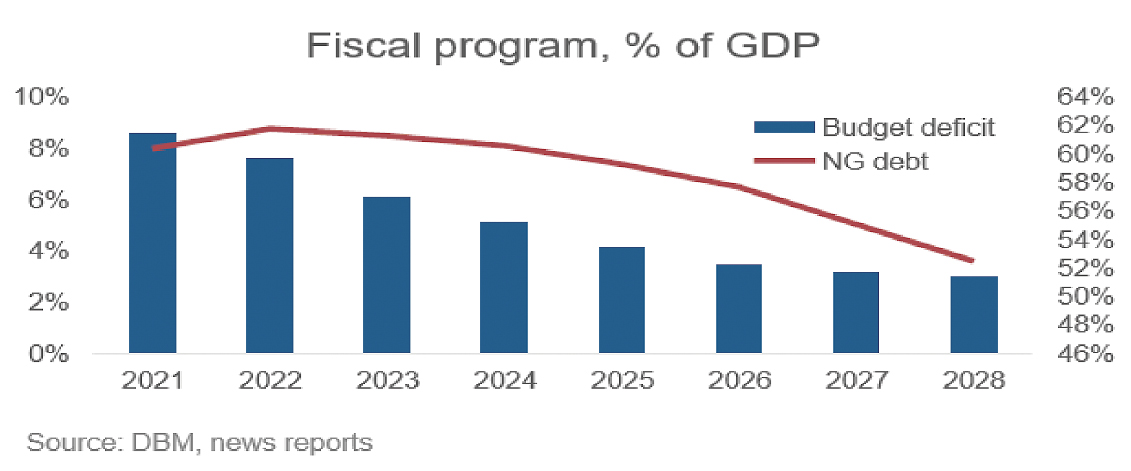
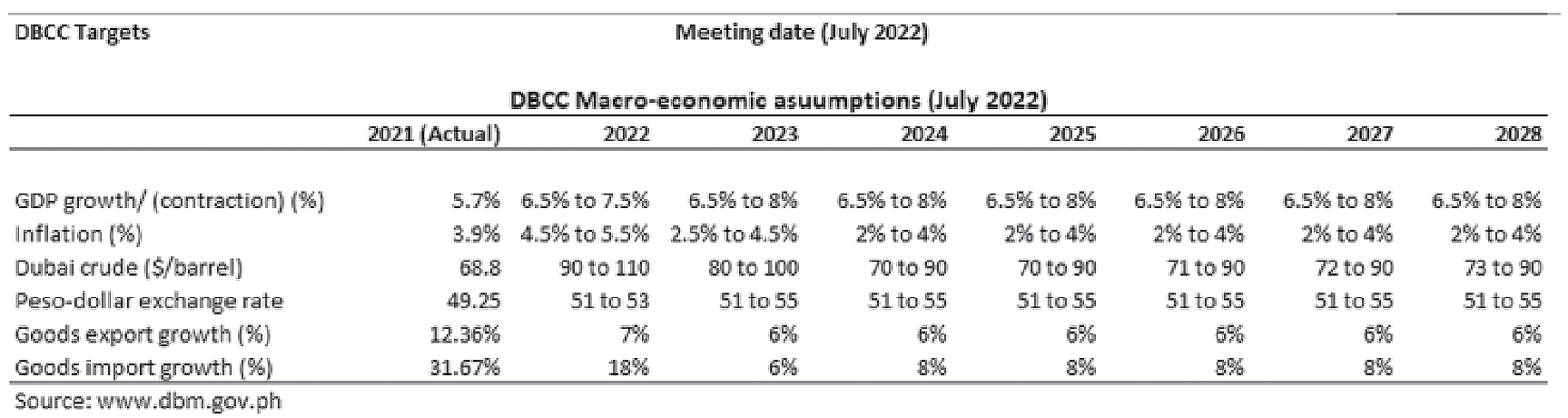
Last Friday, the Development Budget Coordination Committee (DBCC), an inter-agency body made up of the departments of budget, finance, planning and the BSP (Bangko Sentral ng Pilipinas), presented the new administration’s fiscal program for 2022 to 2028. The medium-term program hinges on the economy sustaining its growth clip at 6.5% to 8% starting 2023 and inflation returning to the BSP’s 2% to 4% target starting 2024.

Given nominal GDP growth of 9% to 10%, the fiscal program aims to reduce the overall national government (NG) budget deficit, which reached 8.6% of GDP last year, by 1 ppt every year until it falls to 3% of GDP, the pre-pandemic deficit target. With this performance, it expects the NG debt ratio, which is anticipated to creep up to 61.8% of GDP this year, to gradually drop to 52.5% of GDP by the end of the administration.

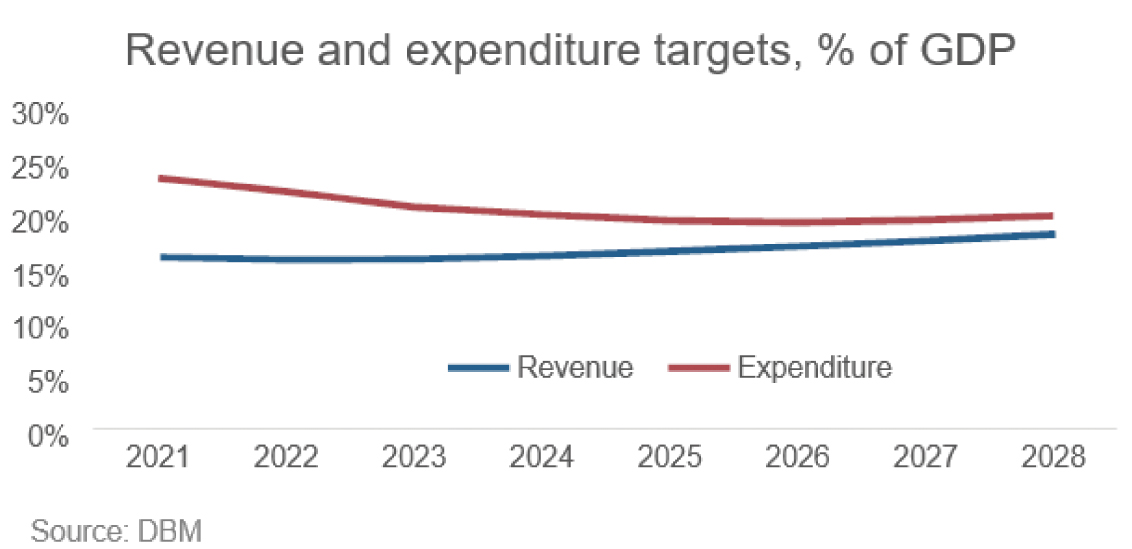
The reduction in the deficit and debt ratios to GDP will be done through a combination of raising revenues and cutting expenditures relative to GDP. The revenue effort is programmed to rise from 15.5% last year to 17.6% by 2028 or an increase of 2.1 ppt, while spending as a share of GDP is programmed to fall from 24.1% last year to 20.6% in 2028, equivalent to a decrease of 3.5 ppt. Despite the reduction in expenditures, government intends to keep infrastructure spending at 5% to 6% of GDP.

OUR VIEW
As far as the numerical targets are concerned, the latest medium-term fiscal program is basically an extension of the last one, crucial mainly in terms of signaling to markets that the new administration is committed to pursuing fiscal consolidation. The 2028 target for the debt ratio, i.e., 52.5% of GDP, is certainly more realistic and supportive of post-pandemic recovery needs, than a promise of quickly paring it to the pre-pandemic ratio of 39.6%.

We are looking forward to the nuts and bolts of the fiscal program, particularly:

1. New economic growth drivers that will keep the medium-term GDP growth rate at 6.5% to 8%, an ambitious target for the post-pandemic period especially with the lingering effects of the pandemic, the many external headwinds (end of cheap credit, elevated commodity prices, slowing global economic growth) and government’s more limited macro policy space (both fiscal and monetary) to support domestic consumption and investments.

We note that the 6% growth target for goods exports is itself unaspiring, especially in light of the new laws liberalizing foreign investments.

2. Sources of new revenues that will keep revenue growth above nominal GDP growth from 2023 onwards. The Finance secretary said recently that the economic team will pursue the remaining tax packages of the Duterte administration, dealing with property valuation and financial sector taxation which, while revenue neutral, will make the tax system more efficient. He is also in favor of imposing taxes on digital transactions but did not specify expected revenue inflows.

3. Expenditure reforms that will create space for continuing social protection programs, especially in health and education, and maintaining infrastructure spending at 5-6% of GDP, even as government pared its overall spending as a share of GDP. The budget for military pension liabilities alone is expected to take up about 1% of GDP annually during the term of this administration.

We await the President’s State of the Nation Address later this month where he is expected to present his administration’s economic program.

End.

POSTSCRIPT:
Although we expect GDP growth this year to reach 6.8% (driven by base effects and election spending), we think the government’s 6.5% to 8% growth target through 2028 is rather ambitious.

My own gut feel is medium-term growth potential is now much lower, closer to 4-5%, the long-term Philippine growth rate rather than the 6-7% of the past decade pre-pandemic. As mentioned in our post, this is because of the drag from scarring from the pandemic (closed businesses, education, and labor mismatches) and considering the end of decade long credit cycle (cheap credit), elevated inflation everywhere affecting consumption and investments, global economic slowdown, even risk of recession, and government’s more restricted fiscal space.

But I would like this government to prove me wrong. The way I think it can do this is if it can quickly earn investors’ trust to attract more FDIs, especially job creating ones, and revive PPP (public-private partnerships) as a way of sustaining infrastructure investments, including digital ones. Moving us towards more investment rather than consumption driven growth.

On PPP, there are immediate to do’s:

1) Signal respect for sanctity of contracts and the rule of law by complying soonest with the terms of the MWSS concession agreements and the international arbitration ruling. (See the column of National Scientist and UP Economics Professor Raul Fabella  https://bit.ly/Fabella060622).

2) Scrap the midnight revisions on IRR (implementing rules and regulations) on build-operate-transfer (BOT) projects and PPPs. The flawed revisions include overly restrictive MAGA coverage (material adverse government action), and removal of provisions on parametric formula for rate setting, and on international dispute settlement. (Please see the Op Ed that summarizes the specific concerns of the Foundation for Economic Freedom and the Makati Business Club https://bit.ly/BOT_amendments ).


Romeo L. Bernardo was finance undersecretary from 1990-96. He is a trustee/director of the Foundation for Economic Freedom, Management Association of the Philippines, and FINEX Foundation. He is Philippines principal adviser to Globalsource Partners

globalsourcepartners.com

romeo.lopez.bernardo@gmail.com

Changes in retail and the property sector

SNOWING-FREEPIK

The economy is slowly but surely opening up. As of the end of May, vehicular traffic was already at 81% of pre-COVID levels. Foot traffic in shopping centers was 65% of its 2019 peak. More people are back to work as unemployment decreased from 7.1% in March 2021 to 5.8% last April. Local and foreign tourism is rebounding too, thanks to fewer restrictions.

Our consumer-led economy is pulsating again, albeit with permanent changes in some sectors resulting from the two-year lockdown. Nowhere are these changes more pronounced than in the retail and property sectors.

Jon Canto of McKinsey and Company provided valuable insights in BusinessWorld’s recently concluded economic forum entitled, Revolutions 2022.

IN RETAIL
The pandemic accelerated the evolution of the retail landscape. Consumer behavior shifted, now fully embracing e-commerce. McKinsey’s survey shows that more than 90% of consumers in ASEAN’s six largest economies have continued patronizing at least one digital retail service even after their lockdowns were lifted. That number was highest in the Philippines where 95% said they continued purchasing products online. Filipinos were the second highest adaptors to e-commerce during the pandemic, following Indonesia.

Growth of pureplay e-commerce sites like Lazada and Shopee are seen to slow down as consumers migrate to purchasing directly from the e-commerce sites of their preferred brands. The number of consumer brands entering the digital space is growing at quantum rates.

This is not to say that brick and mortar stores have lost their relevance. Consumers will still visit physical stores to test, touch, and sample products, to avail of in-store promotions, and to window shop. Thus, physical stores continue to play an important role in branding, in creating product experiences, and as fulfillment centers for brands. Most retailers will maintain both physical and digital stores.

Consumers are looking for more convenience when visiting physical stores, says the McKinsey report. Convenience comes in the form of automated checkouts, personalized offers sent to mobile devices, scannable codes to track inventory levels, and product customization.

Another emerging trend is a decrease in brand loyalty. The McKinsey report reveals that 70% of Filipinos are willing to switch brands if they discover better value for money elsewhere. High inflation rates have underlined the need to seek savings wherever one can find them.

Essentials like packaged food, personal and home care products still dominate the shopping baskets of Filipinos. Given the razor-thin number of wealthy families in the Philippines, sales of luxury goods and services have dropped by 6% and 50%, respectively, from pre-pandemic levels. Full recovery is still three to four years away.

With these emerging trends, McKinsey offers three bits of advice to retailers. First, adopt an omnichannel (and online-led) strategy with respect to marketing. Second, align products and services towards greater value for money. Third, enhance the customer experience by offering greater conveniences.

PROPERTY/REAL ESTATE
Two key trends have emerged in the real estate sector. The first is the permanency of “hybrid operating models.” The second is the overarching trend towards sustainability and reducing carbon emissions.

How does one define a “hybrid operating model?” It is a working model where schedules are flexible; where working hours or working days are reduced; where employees work part time in the office and part time at home.

Eighty-seven percent of Filipino workers prefer a hybrid operating model given its convenience and workability (improved internet service has made remote working more efficient). In fact, the preferred ratio is three days of remote work and two days in the office. Filipinos put value on working from home given the time and cost of commuting.

Studies show that there will be 10 times more employees working from home in 2023 than there were in 2017. That said, there is a need for companies to re-imagine, re-design and re-equip their offices to adapt to the new hybrid operating model. Office spaces will be of smaller configurations as employees report on a round-robin basis. What is essential are common spaces where employees can gather, collaborate, and co-create. As of the moment, only 29% of all office space in Metro Manila is configured for hybrid work. Thousands of offices are seen to downsize in the next few years.

So, what is the impact of this on demand for office space? In Metro Manila, demand plunged by 183,100 square meters in 2020 and 273,100 in 2021 but will recover by +350,000 (forecast) in 2022. Meanwhile, 1,881,300 square meters of supply have come on line in the last three years. All things being equal, it will take five years for demand to catch up with supply.

Take-up of commercial spaces will be sluggish as e-commerce encroaches on the customer base of physical stores. Commercial lessors and malls will have no choice but to rationalize their lease rates if only to keep their tenants.

In as far as sustainability is concerned, Filipino property developers are hard-pressed to become more environmentally efficient given government’s nationally determined commitment (NDC) to the United Nations Framework Convention on Climate Change (UNFCCC) to reduce the country’s greenhouse gas emissions by 75% by 2030.

Developers are encouraged to reduce their power consumption by 25% to 35%. Although 35% of new office buildings will be LEED certified by next year, the number is seen to increase rapidly due to governmental pressure.

So, while it is a buyers (or renters) market as supply for office space exceeds demand, there is pressure to increase property prices as LEED certification could be expensive, what with the mandatory adoption of power saving technologies. Ultimately, the forces of demand and supply will determine prices.

Welcome to the new normal in retail and property.


Andrew J. Masigan is an economist

andrew_rs6@yahoo.com

Facebook@AndrewJ. Masigan

Twitter @aj_masigan