Home Blog Page 5633

Taiwan to deploy drone defense systems after rock-throwing video emerges

CHESS PIECES are seen in front of displayed China and Taiwan’s flags in this illustration taken Jan. 25, 2022. — REUTERS
REUTERS

TAIPEI — Taiwan will next year begin deploying drone defense systems on its offshore islands, the defense ministry said, after footage emerged of Taiwanese soldiers throwing stones at a Chinese drone that buzzed a guard post near China’s coast. 

Taiwan has complained of repeated Chinese drone incursions near its offshore islands as part of China’s war games and drills after US House Speaker Nancy Pelosi’s visit to Taipei this month, which infuriated Beijing. 

China claims democratically governed Taiwan as its own territory, despite the strong objections of the government in Taipei. 

The brief video clip, circulated first on Chinese social media before being picked up by Taiwanese media, shows two soldiers throwing stones at a drone that got near their guard post. 

In a statement late Wednesday, the defense command of Kinmen, a group of Taiwan-controlled islands that sit opposite China’s Xiamen and Quanzhou cities, said the incident occurred on Aug. 16 on Erdan islet, and confirmed the soldiers had thrown stones to see off what it called a civilian drone. 

Taiwan’s defense ministry said in a separate statement that starting next year it will deploy anti-drone systems, which will first be placed on the smaller islands. 

“Officers and soldiers at all levels will continue to implement vigilance in accordance with the principle of “not escalating conflicts or causing disputes,” it added. 

China has not commented on the footage, which has received millions of views on Chinese social media with users making fun of it. 

It has also triggered heated discussion in Taiwan, with some social media users calling the incident a “humiliation” for the island’s armed forces and urging the defense ministry to step up its countermeasures to the increasingly frequent drone incursions. 

The Kinmen defense command said the footage was another example of China’s “cognitive warfare” against Taiwan and an attempt to “denigrate” its armed forces. 

Wang Ting-yu, a senior lawmaker of Taiwan’s ruling Democratic Progressive Party, described the incident as “very serious” and questioned why Taiwan’s defense ministry did not respond to the incursion. 

“The drone was flying on top of our soldiers on guard but there’s zero response,” he said. “If you just let them come and go freely, this was negligence of duty.” 

Taiwan has controlled Kinmen, along with the Matsu islands further up China’s coast, since the defeated Republic of China government fled to Taipei after losing a civil war with Mao Zedong’s Communists in 1949. 

At its closest point, Chinese-controlled territory is only a few hundred meters from Kinmen. — Reuters

Outsourcing Philippines: A game changer for startups and SMEs

PHOTO COURTESY OF PITON GLOBAL

For entrepreneurs, launching a startup or running a small or medium-size enterprise (SME) can be the attainment of a dream. But once the many challenges associated with operating and growing that business set in, the dream might morph into a nightmare.

“The harsh reality is that no matter how much experience and business acumen a person brings to the table, the time-consuming problems and persistent issues can seem insurmountable,” says Ralf Ellspermann, CEO of PITON-Global, a leading mid-sized outsourcing provider in the Philippines.

To complicate matters, owners of SMEs are facing the challenge of maximizing operating efficiencies, hiring and retaining staff during the Great Resignation, and the pressures of reducing costs and turning a profit, especially when investors and shareholders demand a solid return on their investment.

But of all the challenges facing a young business, poor cash flow, insufficient capital, and high operating cost are the three that can easily take a company down. In fact, more than a third of SMEs that don’t survive cite insufficient cash flow as the main reason.

To avoid falling into a money pit, many companies cut costs by outsourcing their contact center requirements overseas. And to best do this, American companies of all sizes turn to the call center outsourcing capital of the world, the Philippines.

Companies must provide round-the-clock, omnichannel customer service and technical support to compete in today’s digitally driven, customer-centric business environment. An excellent customer experience is often the only distinction between brands in a fiercely competitive business landscape.

Outsourcing to the Philippines assures customers that assistance is available whenever they need it. Setting up an in-house contact center can be an expensive venture. Agent salaries and benefits alone add up quickly. Factor in leased office space, software and hardware, employee training, and resources like phone systems and office supplies, and setting up an in-house operation is just not economically feasible for most startups and SMEs.

Since the costs of call centers in the Philippines can be 40-50% lower than those in the US, outsourcing customer support to the Philippines is a logical cost-cutting solution for American companies.

In just 20 years, the Philippines has eclipsed India to become the go-to country for call center outsourcing. It is now the world’s largest contact center outsourcing destination, with over 800 call centers employing up to 1.3 million Filipinos. The outsourcing industry generates more than US$28 billion in annual revenues, which accounts for 8% of the country’s GDP.

The call center outsourcing industry in the Philippines offers startups and SMEs many advantages over operating an in-house facility or outsourcing to onshore providers. A young, skilled, and highly educated workforce, access to cutting-edge technology and world-class infrastructure, and a substantial English-speaking population are highly valued attributes prized by American companies.

Most importantly, by outsourcing to the Philippines, US companies can cut their labor costs by a whopping 60%. Whereas an American call center agent can earn up to US$30,000 a year, the same worker in the Philippines earns an annual salary of US$12,000.

Additionally, the cost of front- and back-office support in the Philippines can be 40-50% lower than in the US. Outsourcing operations to the Philippines can significantly reduce operating costs for start-ups and SMEs, savings that can be funneled into other business growth strategies such as product diversification and expansion, market penetration, and extending an online footprint.

Outsourcing to the Philippines provides startups and SMEs a quick, affordable, and proven way to scale up successfully, grow service capacities, and set themselves up for long-term success. “While outsourcing to the Philippines can’t solve all the pain points facing new businesses, the savings from reduced labor costs alone make it a game changer and, in many ways, a lifesaver for small companies struggling to survive,” says Ellspermann.


Spotlight is BusinessWorld’s sponsored section that allows advertisers to amplify their brand and connect with BusinessWorld’s audience by enabling them to publish their stories directly on the BusinessWorld Web site. For more information, send an email to online@bworldonline.com.

Join us on Viber to get more updates from BusinessWorld: https://bit.ly/3hv6bLA.

Biden forgives millions of student loans; critics fear inflation

UNSPLASH

WASHINGTON — President Joseph R. Biden, Jr., said on Wednesday the US government will forgive $10,000 in student loans for millions of debt-saddled former college students, keeping a pledge he made in the 2020 campaign for the White House. 

The move could boost support for his fellow Democrats in the November congressional elections, but some economists said it may fuel inflation and some Republicans in the US Congress questioned whether the president had the legal authority to cancel the debt. 

Debt forgiveness will free up hundreds of billions of dollars for new consumer spending that could be aimed at homebuying and other big-ticket expenses, according to economists who said this would add a new wrinkle to the country’s inflation fight. 

The actions are “for families that need them the most — working and middle class people hit especially hard during the pandemic,” Mr. Biden said during remarks at the White House. He pledged no high-income households would benefit, addressing a central criticism of the plan. 

“I will never apologize for helping working Americans and middle class, especially not to the same folks who voted for a $2 trillion tax cut that mainly benefited the wealthiest Americans and the biggest corporations,” Mr. Biden said, referring to a Republican tax cut passed under former President Donald J. Trump. 

Borrower balances have been frozen since the beginning of the coronavirus disease 2019 (COVID-19) outbreak, with no payments required on most federal student loans since March 2020. Many Democrats had pushed for Biden to forgive as much as $50,000 per borrower. 

Republicans mostly opposed student loan forgiveness, calling it unfair because it will disproportionately help people earning higher incomes. 

“President Biden’s student loan socialism is a slap in the face to every family who sacrificed to save for college, every graduate who paid their debt, and every American who chose a certain career path or volunteered to serve in our Armed Forces in order to avoid taking on debt,” Senate Minority Leader Mitch McConnell said Wednesday. 

The administration has yet to determine the price tag for the package, which will depend on how many people apply for it, White House domestic policy adviser Susan Rice told reporters. Student loans obtained after June 30 this year are not eligible, she said. 

White House Press Secretary Karine Jean-Pierre told reporters the administration has legal authority to forgive the debt under a law allowing such action during a national emergency such as a pandemic. Earlier, Republican US Representative Elise Stefanik had called the plan “reckless and illegal.” 

American university tuition fees are substantially higher than in most other rich countries, and US consumers carry $1.75 trillion in student loan debt, most of it held by the federal government. Mr. Biden said other countries could bypass the United States economically if students are not offered economic relief. 

PANDEMIC PAUSE, PELL GRANTS
The administration will extend a COVID-19 pandemic-linked pause on student loan repayment to year end, while forgiving $10,000 in student debt for single borrowers with annual income under $125,000 a year or married couples who earn less than $250,000, the White House said. 

Some 8 million borrowers will be affected automatically, the Department of Education said; others need to apply for forgiveness. 

The government is also forgiving up to $20,000 in debt for some 6 million students from low-income families who received federal Pell Grants, and proposing a new rule that protects some income from repayment plans and forgives some loan balances after 10 years of repayment, the Education Department said. 

A New York Federal Reserve study shows that cutting $10,000 in federal debt for every student would amount to $321 billion and eliminate the entire balance for 11.8 million borrowers, or 31% of them. 

INFLATION IMPACT
A senior Biden administration official told reporters the plan could benefit up to 43 million student borrowers, completely canceling the debt for some 20 million. 

After Dec. 31, the government will resume requiring payment on remaining student loans that were paused during the pandemic. The official said this would offset any inflationary effects of the forgiveness. Payment resumptions could even have a dampening effect on prices, the official said. 

Former US Treasury secretary Larry Summers disagreed. He said on Twitter that debt relief “consumes resources that could be better used helping those who did not, for whatever reason, have the chance to attend college. It will also tend to be inflationary by raising tuitions.” 

Similarly Jason Furman, a Harvard professor who headed the Council of Economic Advisers during the Obama administration, said debt-cancellation would nullify the deflationary powers of the Inflation Reduction Act. “Pouring roughly half trillion dollars of gasoline on the inflationary fire that is already burning is reckless,” he said. 

Moody’s analytics chief economist Mark Zandi sided with the White House, saying the resumption of billions of dollars per month in student loan payments “will restrain growth and is disinflationary.” — Reuters

The Signature by Prestige offers the comforts and convenience of moving to a new home

Move in hassle-free to your future home. The Signature offers a 3-bedroom fully furnished unit equipped with lifestyle necessities. Its living area is designed to flow naturally to the balcony affording an expansive view of the cityscape. *Actual photo of 3BR living area.

Anyone moving to a new home would know how stressful it can be – from packing items you will take with you and discarding those you no longer need, to choosing from the many design options to make your new home truly your own. Not to mention, the period of adjustment you need to go through as you navigate through your new location.

Thankfully, The Signature by high-end real estate brand Prestige by Filinvest makes moving in more convenient for new residents as it offers move in ready and comfortably-sized units with a handful that are already fully-furnished and designed by Empire Design, an award-winning Interior Design firm in Asia.

Enjoy a date night with your loved ones at home. The Signature 3BR unit has a spacious dining area that fits an 8-seater dining table. *Actual photo of 3BR Dining Area.

Located in Balintawak, the growth area in Quezon City, The Signature’s units are also fully equipped with all the necessities a home should have: foyer, powder room, master’s bedroom with en suite, kids’ room, T&B. However, unique to this unit are the living area, which flows naturally to the balcony with a great view of the city scape, the study or home office that are purposely-built for residents who are working or taking their classes from home, and the dining area which is extended by a mini bar.

Modern and sleek. This home office is purposely built for you to have a private space when working from home. *Actual photo of home office.

While the units are already a respite from the hustle and bustle of the city, The Signature’s amenities further boost the wellbeing of its residents. With at least 7,000 square meters dedicated to amenities and open spaces, they can enjoy a multitude of recreational activities, specially curated to help boost their health and wellbeing. At The Signature’s Tower 1, residents can always find something to bond over with their family or friends with a selection of entertainment rooms available: KTV rooms, game room, and mini theater. They can also work on their fitness at the fully-equipped fitness center, or opt to take a leisurely dip at the massive resort-style pool. The meditation garden and ssundeck are available for residents who are looking for some quiet me-time. For intimate gatherings, they can find the Multipurpose function rooms while the Meeting lounge is easily accessible for those who are still working remotely.

The Signature promotes outdoor living with its array of amenities. *Actual photo of The Signature’s Resort-Styled Pool.

The Signature’s ideal location provides convenience for residents as all their lifestyle and essential needs are well-within reach. Within the vicinity they can find retail malls such as Trinoma and SM North Edsa; top educational institutions including Ateneo De Manila University, Miriam College, and UP Diliman; and world class hospitals like the Philippine Orthopedic Center and Chinese General Hospital.

Getting to and from The Signature is accessible by main thoroughfares like Skyway, EDSA, and other major roads like Quezon Avenue, Araneta Avenue, Nagtahan and Quirino Avenue. Through these major thoroughfares, neighboring central business districts such as Filinvest Alabang, Bonifacio Global City, Makati, Binondo, and Ortigas Center easily become accessible.

Amidst the large and populous Quezon City, The Signature provides a safe haven from the bustling metro. To know more about The Signature by Prestige by Filinvest, visit www.thesignature.com.ph.


Spotlight is BusinessWorld’s sponsored section that allows advertisers to amplify their brand and connect with BusinessWorld’s audience by enabling them to publish their stories directly on the BusinessWorld Web site. For more information, send an email to online@bworldonline.com.

Join us on Viber to get more updates from BusinessWorld: https://bit.ly/3hv6bLA.

The Parisian cat hotel that’s feline fairly full

ARBREACHATPARIS.COM

PARIS — Much as they enjoyed their cats’ company during two years of coronavirus lockdown, Parisians have enthusiastically taken up travel again if the reservation register at one Paris cat hotel is anything to go by. 

At the Arbre a Chats (Cats’ Tree) hotel, prospective guests need to reserve well ahead, as all its 24 “contemporary and comfortable” cubicles are fully booked — although cats who know one another can double up and share a room. 

“Unlike last year, this year we were fully booked for August from the end of February,” hotel owner Veronica Colson said. 

With cats snoozing on couches, sitting high up in the tree-shaped wooden climbing structure in the center, or observing street life from a ledge by the window, the hotel is in full swing as cat owners rediscover the pleasure of travel. 

“We needed a cat hotel where we are sure he will get his medicine and his treatment. Here it will be done without problems,” said Anne-Marie Grataloup as she dropped off Monte Christo ahead of one of her regular trips. 

In true Parisian style, the hotel has “a la carte” services such as massage, brushing and a transport service to pick up guests. As an extra, the hotel management sends owners a picture and a message twice a week about what Whiskers is eating and how it is getting along with the other guests. 

“It’s like when your kids are in summer camp — you like to know how they are doing, right?” Ms. Colson said. — Reuters

China exerting growing pressure on foreign companies, study finds

STOCK PHOTO | Image by SW1994 from Pixabay

BERLIN — China is exerting increasing pressure on foreign companies doing business in its markets to bring them into line with its political agenda, broadening the “red lines” for issues to which it is allergic, a German study seen by Reuters shows.

A survey of more than 100 companies by the Berlin-based Merics think tank for China studies and the BDI industry association showed that the threshhold for exerting pressure on companies is falling. The number of known cases rose significantly from 2018, it found.

“It was about recognizing a pattern of when and how China exerts pressure,” co-author Max Zenglein said.

The researchers said that in addition to issues of national sovereignty, reports on the emergence of coronavirus disease 2019 (COVID-19), sanctions against Chinese companies like telecoms equipment maker Huawei or support for parties classified as anti-Chinese are now seen as “new red lines.”

In one case, German carmaker Daimler apologized several times to China in 2018 after running advertising with a quote from the Dalai Lama.

China’s foreign ministry said it could only comment once it had seen the full report.

China has consistently denied allegations that the COVID-19 virus was leaked from a specialist laboratory in the city of Wuhan, where it was first identified at the end of 2019.

Washington sees Huawei as an arm of the Chinese Communist Party’s global surveillance machinery, but Huawei has repeatedly denied spying for the Chinese state.

Foreign consumer goods companies in particular have been subject to boycotts in China, with Western textile firms targeted on social media in response to Western criticism of China’s treatment of the Uighur minority in the Xinjiang region.

“For fear of being targeted, companies may avoid addressing unfair treatment of foreign firms in China. Or they may consider it safest to align themselves with the Chinese government’s positions and goals,” the researchers wrote. — Reuters

Thai PM, coup-maker and ballad composer, dealt setback by suspension

Thai Prime Minister Prayuth Chan-ocha. — Image via US Department of Defense

BANGKOK — For eight years, nothing seemedto shake the hold on power for Thai Prime Minister Prayuth Chan-ocha, who first came to office in a 2014 coup and has survived a hotly disputed election, mass street protests and four no-confidence votes.

Wednesday’s decision by Thailand’s Constitutional Court to suspend Mr. Prayuth, 68, from official duties was a rare setback, though it’s unclear whether the ouster will become permanent.

Shortly after the then-army chief seized power from an elected government in 2014 following months of destabilizing protests, Mr. Prayuth exhorted compatriots to heed traditional cultural values of harmony and respect for the royal family.

He even famously released a recording of a ballad he had written called “Returning Happiness to Thailand” shortly after the coup. It played on a loop on national radio, with lines such as “Today the nation is facing menacing danger/The flames are rising/Let us be the ones who step in/Before it is too late”.

The song — one of at least 10 he has released while leader — referred to political discord of more than a decade in Thailand.

For years, Bangkok’s streets were periodically paralyzed by dueling mass protests by the “Red Shirt” supporters of successive populist elected governments — one ousted in a 2006 coup — and counterprotests by “Yellow Shirts”, royalist-military supporters who viewed the populists as corrupt and a threat to the constitutionally mandated reverence for Thailand’s king.

Mr. Prayuth’s seizure of power was Thailand’s 13th successful coup since the end of absolute monarchy in 1932 and followed six years of civilian-led governments. His supporters lauded him for restoring order and as a protector of the monarchy.

The army declared martial law and the junta embarked on a crackdown on dissent, sending hundreds of activists to camps for several days of “attitude adjustment” instruction.

Several months later, Mr. Prayuth was appointed prime minister by a hand-picked parliament.

During the early post-coup period, Mr. Prayuth’s temper occasionally flared. He once threatened to throw a podium during a press briefing and at another time mused he could “probably just execute” a roomful of reporters.

‘UNCLE TU’

But the often-dour general, known by his nickname “Uncle Tu,” transformed himself into a political candidate for elections held in 2019.

His pro-army Palang Pracharat party won the second-largest number of seats in the House of Representatives behind the opposition populist Pheu Thai party, and he then managed to form a coalition government made up of more than a dozen parties.

Critics say the election rules gave an unfair advantage to pro-military parties — in part because an appointed Senate was involved in choosing the premier, an accusation he denied. Mr. Prayuth’s government said the elections were free and fair.

Mr. Prayuth campaigned on a platform of traditional Thai values, including devotion to King Maha Vajiralongkorn, who was crowned the same year as the elections after the death of his father, who reigned for 70 years, in late 2016.

Thailand’s constitution mandates that the king be revered as protector of the nation. Thai law punishes defaming the king or his family with up to 15 years in prison.

A year into Mr. Prayuth’s tenure as a civilian prime minister, a court decision to dissolve another high-profile opposition party, Future Forward, triggered mass protests by students.

Calls for Mr. Prayuth’s resignation soon evolved into demands for reform of the monarchy and even open criticism of King Vajiralongkorn.

In late 2020, the near daily demonstrations grew to tens of thousands, prompting warnings from Mr. Prayuth that the country would be “engulfed in flames.” Security forces used water cannon, tear gas and rubber bullets to break up the demonstrations, while protest leaders were arrested.

The demonstrations dwindled in 2021 and over 100 activists and protest leaders have been jailed or are facing trial under security laws and for defaming the monarchy.

Opposition parties in parliament, which proved reluctant to join the student protests, in the meantime sought to weaken Mr. Prayuth within the confines of politics and the legal system.

He has faced four no-confidence votes in parliament, the latest last month, but survived each of them with his coalition majority, even as it was whittled down by defections and dissent within his own party.

The opposition Pheu Thai’s latest tactic against Mr. Prayuth was a petition to the Constitutional Court arguing that he has already reached the constitutionally mandated eight-year term limit as he was first appointed as premier in 2014 by the junta.

That petition led to Wednesday’s suspension. But it will be weeks before the court rules on the substance of the petition, in which it could decide that Mr. Prayuth’s term began with the 2019 election.

If that happens, Mr. Prayuth could live to sing another day as Thailand’s leader, and would be eligible to stay in office until 2027, depending on the outcome of elections due by May 2023. — Reuters

Japan signals return to nuclear power to stabilize energy supply

International Atomic Energy Agency (IAEA) experts visit Fukushima Daiichi Nuclear Power Station in Japan in November 2013. — Greg Webb / IAEA

TOKYO — Japan will restart more idled nuclear plants and look at developing next-generation reactors, Prime Minister Fumio Kishida said on Wednesday, setting the stage for a major policy shift on nuclear energy a decade after the Fukushima disaster.

The comments from Mr. Kishida — who also said the government would look at extending the lifespan of existing reactors — highlight how the Ukraine crisis and soaring energy costs have forced both a change in public opinion and a policy rethink toward nuclear power.

Japan has kept most of its nuclear plants idled in the decade since a massive earthquake and tsunami in 2011 triggered a nuclear meltdown at the Fukushima Daiichi power plant. Quake-prone Japan also said it would build no new reactors, so a change in that policy would be a stark turnaround.

Mr. Kishida told reporters he had instructed officials to come up with concrete measures by the year end, including on “gaining the understanding of the public” on sustainable energy and nuclear power.

Government officials met on Wednesday to hammer out a plan for so-called “green transformation” aimed at retooling the world’s third-largest economy to meet environmental goals. Nuclear energy, which was deeply opposed by the public after the Fukushima crisis, is now seen by some in government as a component for such green transformation.

Public opinion has also shifted, as fuel prices have risen and an early and hot summer spurred calls for energy-saving.

“It is the first step towards the normalization of Japan’s energy policy,” said Jun Arima, a project professor at the University of Tokyo’s graduate school of public policy.

Japan needs nuclear power because its grid is not connected to neighboring countries, nor is it able to boost output of domestic fossil fuels, he said.

Last month the government said it hoped to restart more nuclear reactors in time to avert any power crunch over the winter.

As of late July, Japan had seven operating reactors, with three others offline due to maintenance. Many others are still going through a relicensing process under stricter safety standards imposed after Fukushima.

Mr. Kishida also said the government would look at extending the lifespan of existing reactors. Local media earlier reported this could be done by not including the time reactors remained offline — years in some cases — when calculating their operating time.

Under current regulations, Japan decommissions plants after a predetermined period, which in many cases is 60 years. — Reuters

New mining fiscal regime approved

PHILSTAR

By Alyssa Nicole O. Tan, Reporter

THE HOUSE Ways and Means Committee on Wednesday approved the new fiscal regime for the mining sector, as well as the fourth package of the Comprehensive Tax Reform Program (CTRP) that includes the removal of the excise tax exemption on pickup trucks.

Albay Rep. Jose Maria Clemente S. Salceda, who chairs the committee, said the measure will generate an additional P37.5 billion in revenues for the government in the first full year of its implementation.

In a statement, he said the committee adopted the Department of Finance (DoF) proposed version, which would “bring the country’s effective tax rate on mining (considering all taxes) to 51%, up from 38% under the current system.”

“That brings us closer to the middle of the pack among major mining countries, instead of near the bottom of the list. The 51% is a good number, because it brings us closer to Australia’s effective tax rate, at around 51% as well, counting royalties…This proposal brings us closer to Australia and Indonesia, which are our regional comparatives,” Mr. Salceda said.

Under the approved version, a royalty tax of 5% will be slapped on the market value of gross output of all large-scale mining operations.

“A minimum government share of 60% of net mining revenues, including all government taxes, fees, and charges, will be imposed on mining operations,” Mr. Salceda said.

A 10% export tax will also be levied on the market value of mineral ore exports, Mr. Salceda said, a move aimed at encouraging domestic processing of mineral products.

The bill also seeks to improve transparency through a government system for the public disclosure and scrutiny of all mining tax and revenue data in the extractives value chain.

“It will also offset the reputational issues caused by our withdrawal from the Extractive Industries Transparency Initiative, a global standard for the good governance of oil, gas and mineral resources, which the country was a voluntary party to until its withdrawal in June this year,” Mr. Salceda said.

TAX REFORM
At the same hearing, Mr. Salceda said Finance Secretary Benjamin E. Diokno proposed several changes to the Package 4 of the CTRP, formerly known as the Passive Income and Financial Intermediary Taxation (PIFITA). The approved version will incorporate the DoF’s proposals.

In his Aug. 22 letter to Mr. Salceda, Mr. Diokno said the DoF-proposed bill will generate an estimated incremental revenue of P18 billion in 2023 and P7.9 billion in 2024, before tapering off in the succeeding years.

“With the reforms introduced under Package 4 and the expected developments in the financial and capital markets, the bill can generate reliable revenue streams for the government in the long term,” Mr. Diokno said.

Under Package 4 of the CTRP, the DoF proposed to cut the number of tax rates on passive income and financial intermediaries to 52, from 74 currently, and to make the tax rates more competitive with the country’s Southeast Asian neighbors.

It also seeks to impose a uniform rate of 15% on interest income, royalties, dividends and capital gains, on the sale of shares of stock not traded in the local bourse.

“Interest income derived by FCDUs (foreign currency deposit units) were exempted from income tax in the year 1974 to encourage foreign currency deposits in order to build up the Philippines’ foreign currency reserves,” Nueva Ecija Rep. Mikaela Angela B. Suansing, who chaired the technical working group, said during the hearing.

“Now that we are operating in a different economic environment, the DoF asserts that there is no longer a need to incentivize FCDUs. From this proposal, the DoF expects the government to gain up to P10 billion worth of revenues in the first year and P66.6 billion in revenues from 2023 to 2028.”

Also, the Finance department proposed a single gross receipt tax rate of 5% on banks, quasi-banks, and other nonfinancial intermediaries, and the removal of the distinction between lending and non-lending income. A 5% tax will be imposed on all types of income, except for dividends, equity shares and net income of subsidiaries.

The DoF seeks to impose a uniform 2% tax of premiums for pre-need, pension, life insurance and health maintenance organizations.

It proposed the adoption of a stock transaction tax on the trading of shares of stock in a domestic corporation that is listed and traded on a foreign stock exchange, instead of the 15% capital gains tax.

The DoF said it wants to rationalize documentary stamp tax (DST) on financial transactions, such as expressing the DST in percentages, unifying all nonlife insurance rates, and removing minor provisions with low revenues.

It also wants to resolve taxation issues on collective investment schemes, as well as adopt tax administration provisions.

“We earnestly hope that our proposed changes in Package 4 will be considered to address the issues confronting the country’s capital and financial markets taxation,” Mr. Diokno said.

TAX ON PICKUP TRUCKS
Mr. Diokno also proposed the removal of the excise tax exemption on pickup trucks, saying this will generate P52.6 billion in additional revenues from this year to 2026.

Republic Act No. 10963 or the Tax Reform for Acceleration and Inclusion (TRAIN) law exempted pickup trucks from excise tax to help small business owners and professionals.

However, Mr. Diokno noted the Department of Trade and Industry (DTI) had noticed some manufacturers modified pickup trucks to serve as passenger, leisure and sports vehicles, allowing them to circumvent the law. 

“DTI data showed that it has led to inequity among industry players and resulted in a sharp decline in sales of other vehicle products,” Ms. Suansing said.

The Package 4, formerly known as PIFITA, is one of the 19 priority legislative measures of President Ferdinand R. Marcos, Jr.

The PIFITA bill was approved by the House of Representatives of the 18th Congress on Sept. 9, 2019, but deliberations at the Senate were put on hold due to the coronavirus pandemic.


IMF to hold Article IV Consultation with the Philippines in September

A participant stands near a logo of the International Monetary Fund at the annual meeting in Nusa Dua, Bali, Indonesia, Oct. 12, 2018. — REUTERS/JOHANNES P. CHRISTO/FILE PHOTO

THE INTERNATIONAL Monetary Fund (IMF) will hold its Article IV Consultation with the Philippines in September, according to an official.

“The 2022 Article IV Consultation mission will take place in September 2022 and we have tentatively scheduled a press briefing for September 26th,” IMF Representative to the Philippines Ragnar Gudmundsson said in an e-mail.   

Mr. Gudmundsson said the Executive Board meeting is being planned for November or December this year.

Under Article IV of the IMF’s Articles of Agreement, the IMF holds annual bilateral discussions with its members. A team from the IMF will visit the country to assess economic and financial developments, and hold meetings with government and central bank officials.

The team will then present its findings for discussion to the IMF Executive Board, which represents all of IMF’s member countries. A summary of the IMF Board’s assessment is later given to the country’s government.   

“In this way, the views of the global community and the lessons of international experience are brought to bear on national policies,” the IMF said on its website.   

The IMF conducted its annual consultation with the Philippines from May to June in 2021. The last Article IV Executive Board Consultation was on July 23, 2021.   

Last year, IMF executive directors commended the Philippines’ policy response to the coronavirus disease 2019 (COVID-19) pandemic, which has helped to cushion the pandemic’s socioeconomic impact.

In July, the multilateral lender raised its gross domestic product forecast for the Philippines to 6.7% this year from 6.5% previously, but expects slower growth in 2023 amid global uncertainties. — Keisha B. Ta-asan

Pandemic inflicts damage on students’ future earnings

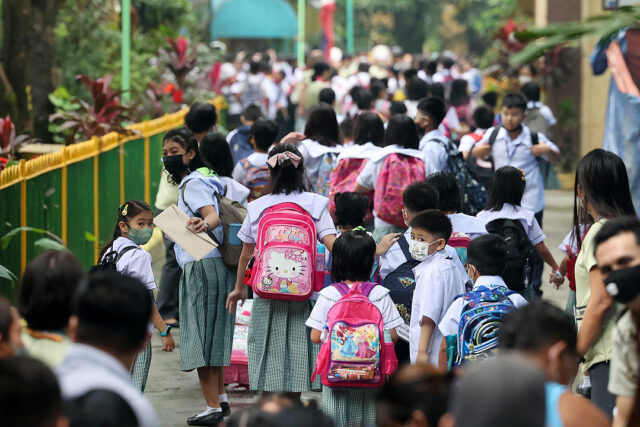
Parents and students are seen crowding the entrance of the Pura V. Kalaw Elementary School in Project 4, Quezon City, Aug. 22. — PHILIPPINE STAR/ MIGUEL DE GUZMAN

THE DISRUPTION of schooling due to the coronavirus disease 2019 (COVID-19) pandemic inflicted lifetime earning losses in developing Asia, most particularly for those in lower income brackets, the Asian Development Bank (ADB) reported.

“The pandemic has further exacerbated the learning crisis for today’s student cohort. Globally, estimates suggest that 70% of 10-year-olds are unable to read and understand a simple text, and this contributes to a loss in potential lifetime earnings by today’s generation of students equivalent to 17% of current gross domestic product (GDP) level,” the ADB said in its Key Indicators for Asia and the Pacific 2022 released on Wednesday.

The multilateral lender estimated lifetime earning losses among developing Asia’s students may range from 3.9% to 8.8% of pre-pandemic earnings.

Future earning losses of poorest Philippine students seen 33% higher than richestBased on ADB data, the Philippines had one of the highest expected losses per capita earning due to learning losses.

In the Philippines, the poorest are expected to lose as much as $590.69 in per capita future earnings, while the richest would lose as much as $443.42 in per capita future earnings.

“The Philippines has to address the challenges and barriers to access health and education services. Otherwise, there will be an impending human capital crisis,” said Rhodora G. Alday, director of the Policy Development and Planning Bureau of the Department of Social Welfare and Development (DSWD).

“Unless there [are] very aggressive efforts to address the problem with urgency, with resource commitments, then any delay would certainly affect labor productivity going forward,” ADB Chief Economist Albert Park added.

The multilateral lender estimated lifetime earning losses among developing Asia’s students may range from 3.9% to 8.8% of pre-pandemic earnings.

“Within each economy, inequality may also further expand due to differences in access to remote learning tools. Under a medium-efficacy scenario of remote learning, estimates show that students from the poorest wealth quintile are expected to have losses in future earnings that are 47% higher than those of the richest students in their economy, while girls may lose about 28% more in future earnings,” it said.

“How it will unfold depends on a number of factors such as effectiveness of remote education and how socioeconomic institutions react to undo the damage to children’s learning and well-being,” said Melissa Pascua, Senior Statistics Officer from the ADB, in the same event.

While growth in the region is expected to reduce extreme poverty to pre-pandemic goals, people with lower pre-pandemic levels of social mobility may find it harder to progress as they experience longer lasting setbacks.

Extreme poverty is defined as those who are living off less than $1.90 a day.

In 2018, 4.7% of the Filipino population were living under the $1.90 daily poverty line, albeit down from 10.7% in 2009, according to the ADB.

Preliminary results from the Philippine Statistics Authority also estimated poverty incidence among individuals rising to 18.1%, from the 16.7% recorded in 2018. In real terms, around 2.3 million Filipinos have been plunged into poverty between 2018 and 2021.

According to the ADB, the Philippines led in losses in annual/lifetime earnings per capita, and ranked 10th out of 14 countries in East Asia in terms of social mobility.

Social mobility prospects, as measured by expected lifetime earnings, are significantly lower than pre-pandemic levels due to the learning losses from the pandemic.

“Economically unequal societies tend to have lower scores for enablers of social mobility,” the ADB said.

Amid the pandemic, the ADB said lower-income households in the Philippines had greater reductions in their consumption compared to those with higher income, with the bottom 10% seeing a decline of 21.1% in their income and expenditure.

“Majority of the Filipinos are in the informal sector. They have no job security [and] no access to unemployment insurance,” Ms. Alday said.

A metric that tries to measure innovation using 80 indicators on political environment, education, infrastructure, and knowledge creation also showed the Philippines among the lower middle-income countries that scored the highest after Vietnam and India.

However, the Philippines and other lower middle-income countries in the region are still behind higher-income economies when it comes to research and development (R&D) expenditure.

Even before the pandemic, R&D as a proportion of gross domestic product stood at just 0.32%, according to the ADB report.

“By 2030, the prevalence of extreme poverty in the region is expected to drop below 1%. At the same time, about 25% of the population is projected to achieve at least middle-class status, defined as having income or consumption of $15 or more a day, adjusted for purchasing power parity,” the ADB said.

“However, this outlook is threatened by differences in social mobility as well as other uncertainties. Developing Asia faces the potential for stagflation, ongoing conflicts involving key global actors, increased food insecurity, and energy price shocks.” — Diego Gabriel C. Robles

Demographic dividend to spur growth — NEDA

Job seekers fill up documents during a job fair in Manila, June 20. — PHILIPPINE STAR/KRIZ JOHN ROSALES

THE COUNTRY must capitalize on its demographic dividend through innovations in human capital and infrastructure development to sustain economic growth, its chief economist said.

“Between 2000 and 2020, the working-age population has grown faster than the total population, leading to increases in its overall share. Thus, a more substantial size of our workforce is supporting economic activity and contributing to growth,” Socioeconomic Planning Secretary Arsenio M. Balisacan said during the 43rd National Conference of Employers by the Employers Confederation of the Philippines on Wednesday.

Recent data from the Philippine Statistics Authority showed the working-age population, covering those 15 to 64 years old, accounts for 63.9% of Filipinos, up from the 63.3% in 2015 and 59.1% in 2000. 

To sustain the economy’s high-growth targets, “the government shall equip and provide our workforce with sufficient tools and infrastructure to raise productivity and enhance innovation capacity,” Mr. Balisacan said, citing the Marcos administration’s eight-point socioeconomic agenda which aims to reinvigorate job creation and reduce poverty.

The government intends to grow the economy by 6.5-7.5% this year and 6.5-8% next year until 2028. At the same time, it also plans to reduce poverty incidence to a single digit by the end of the Marcos administration.

“We must regain losses from the last two years and strengthen human capital even further in light of anticipated future disruptions such as automation and the effects of climate change,” Mr. Balisacan said in reference to the disruptions in learning amid the coronavirus disease 2019 (COVID-19) pandemic.

“The President has directed relevant agencies in the Executive to prioritize efforts that would expand training and skills development and facilitate employment. We are mindful that we must provide opportunities for training of our labor force such that the competencies required by the private sector match what our schools and training institutions teach,” he added.

Under the proposed national budget for 2023, the education sector will get P852.8 billion, an 8.2% increase from this year’s P788.5-billion allocation.

The proposed Department of Education budget of P710.66 billion is the second-highest budget among departments, following the Department of Public Works and Highways (DPWH) at P718.36 billion.

“Binding constraints to investments and job creation — in particular, our need for supporting infrastructure in energy, transportation, logistics, telecommunications, and water — will be addressed over the next six years,” Mr. Balisacan said.

ENERGY
In the same event, the National Economic and Development Authority (NEDA) chief mentioned energy as an important component in ensuring the economy’s growth in the medium and long term, particularly with how it relates to the costs of power and its effects on employment.

“If there are alternative sources of energy that are cheaper, accessible, reliable — it boils down to that. We don’t want a scenario where we adopt a particular source of energy but it comes at the expense of jobs,” Mr. Balisacan said when asked if the Marcos administration is prioritizing alternative sources of energy such as nuclear and renewables.

“The private sector, for example, will lose their competitiveness if their energy source is more expensive than what other countries have for their energy,” he added.

In his first State of the Nation Address, President Ferdinand R. Marcos, Jr. signaled the administration’s intent to build new power plants and pursue technologies in the area of renewable energy to reduce energy costs.

“We are not closed to any sources… The competitiveness of renewables as a source of energy has substantially improved in recent years, so we need to seize the opportunities there,” Mr. Balisacan said.

“Nuclear is one energy source that can be reliable, low cost, and we explore that part of the mix — what I refer to as efficient, affordable, sustainable, and reliable energy sources.” — Diego Gabriel C. Robles