Home Blog Page 5623

Bill seeks to develop handloom weaving industry

PHILSTAR FILE PHOTO

A SENATE bill is proposing to develop the handloom weaving industry and make its products more globally competitive.

Senate Bill 241 or the proposed Philippine Handloom Weaving Industry Development Act of 2022 hopes revive the trade and help weavers tap a broader global market.

Senate President Pro-Tempore Lorna Regina B. Legarda filed the bill to support the artisans “who continuously safeguard our country’s rich heritage.”

We must give our weaving industry a fighting chance,” she added. “Our handwoven fabrics deserve recognition.”

The National Handloom Weaving Department Council will be tasked with generating a roadmap for the industry, an intellectual property framework for textiles, and promoting textile-related Technical Skills and Vocational Education and Training.

It will be composed of representatives from the National Commission on Indigenous People, Technical Education and Skills Development Authority, National Commission for Culture and the Arts, and the Garments and Textile Industry Development Office of the Department of Trade and Industry.

“Handloom weaving is one of the most time-honored cottage industries in the Philippines and a resource for rural employment and income,” Ms. Legarda said. “The industry has a considerable role in rural development as well as a great source of cultural pride and national identity.”

If passed into law, P10 million will be appropriated from the national treasury for initial implementation. — Alyssa Nicole O. Tan

State of calamity extension rests on DoH, says presidential palace

PHILIPPINE STAR/ MICHAEL VARCAS

THE GOVERNMENT is leaving it to health authorities whether the Philippines should remain under a so-called state of calamity, the presidential palace said on Thursday, amid increasing infections spurred by more contagious Omicron coronavirus subvariants.

“It will depend on the recommendation of the Department of Health (DoH),” Press Secretary Trixie Cruz-Angeles told a news briefing. “We will make the announcement when the time comes,” she added.

The country’s state of calamity declaration will lapse on Sept. 12. The emergency use permits for coronavirus vaccines will also expire unless it is extended.

The state of calamity, which has been extended several times already, allows the government to continue its vaccination program, augment pandemic response funds, monitor and control prices of basic goods and provide basic services to affected people.

Emergency procurement, tax exemptions for donors, price controls for coronavirus drugs and benefits to health workers will also cease once the state of calamity is lifted.

President Ferdinand R. Marcos, Jr. last month ordered health authorities study whether there is a need to extend the declaration.

Meanwhile, Mr. Marcos said state decisions on pandemic response should be based on evidence.

“We can resolve… issues by employing cross-sectoral responsive evidence-based systems,” he told an event attended by scientists and health experts, according to a transcript sent by his office. “Evidence-based systems are all that we rely on.”

The president said the country should always be open to new findings, adding that information about COVID-19 has evolved so quickly.

“We cannot measure this pandemic by any other human experience,” he said. “And that is why we have to be very open and understanding and say… it is not something we already know, it is something that we very much do not know.”

“That is the openness that I speak about, especially whenever groundbreaking data or new findings debunk our usual beliefs,” he added. “This has happened. How many times did it happen during the pandemic where everything changed?”

He said a virology institute and local Center for Disease Control and Prevention would boost the country’s pandemic response. “I have presented to both houses of Congress the proposed creation of the Virology Center of the Philippines… so that we can consolidate in a better way all of the disparate research, all the different sources of knowledge,” he said.

The Philippines is also facing threats from monkeypox, for which the World Health Organization (WHO) declared a global emergency last month.

The Department of Health said 10 close contacts of the country’s first monkeypox case, which was confirmed last month, “are still undergoing the required quarantine period.”

The close contacts have not shown symptoms, it said in a Viber group message. “To date, there has been no new case of monkeypox in the country.”

Health officer-in-charge Maria Rosario S. Vergeire earlier said there should be sufficient immunity among Filipinos before the state of calamity is lifted. She also cited the need to increase booster coverage.

DoH has ordered the Food and Drug Administration to determine whether vaccine makers are ready to apply for a certificate of product registration so the drugs can be sold commercially.

The coronavirus has sickened 3.8 million and killed more than 60,000 people in the Philippines, according to the Worldometers website, citing various sources including data from the WHO. About 3.7 million have recovered from the virus.

There were more than 36,000 active cases, 737 or which were serious or critical.

Globally, the coronavirus has sickened almost 593 million people, killing more than 6.4 million. More than 564 million people have recovered.

At least 71.9 million Filipinos have been fully vaccinated against the coronavirus, with about 16.2 million having received their booster shots.

The Philippines added 3,181 coronavirus infections and 25 deaths on Wednesday.

Of the new infections, 1,100 came from Metro Manila, the Health department said.

The Philippines remained at low risk from the coronavirus despite rising infections, Ms. Vergeire said on Tuesday.

The average daily attack rate was 3.42 cases per 100,000 population, with national and all regions showing increased infections.

The use of intensive care units (ICU) in the country has steadily increased since the start of July, with 772 severe and critical admissions or 19.3% of the total, almost as high as the level in March.

ICU use in the Bangsamoro region was at moderate risk, while four other regions — Calabarzon, Western Visayas, Zamboanga Peninsula and Davao — were near the threshold at more than 40%.

Ms. Vergeire earlier reiterated projections that coronavirus infections in the capital region could hit 11,000 by the end of August.

Cases are expected to rise for the rest of the year if booster uptake remained low, people don’t comply with health standards and are allowed to move more freely, and more Omicron subvariants enter the country. — Norman P. Aquino and Kyle Aristophere T. Atienza

QC court stops NTC from blocking Bulatlat website

A QUEZON City trial court on Thursday granted Bulatlat.com’s plea to stop the National Telecommunications Commission (NTC) from blocking its news website.

In a resolution, the court said the order blocking access to the website violated freedom of speech and of the press.

“There is a violation or curtailment of plaintiff’s right to free speech and of the press when its publisher’s and readers’ access to its website was limited,” Associate Justice Dolly Rose R. Bolante-Prado said in the order.

“The court’s resolution is a powerful yet beautiful defense of constitutionally guaranteed press freedom,” Bulatlat tweeted. In June, the regulator ordered local internet service providers to block 26 websites that allegedly support the Communist Party of the Philippines, New People’s Army and the National Democratic Front.   

The order was issued upon the request of former National Security Adviser Hermogenes C. Esperon, Jr.

Bulatlat sued the NTC on July 8 and sought an injunction against the agency.

Meanwhile, the Commission of Human Rights (CHR) said it was consulting civic and grassroot groups on the United Nations’ (U.N.) mechanism to assess the human rights situation in the Philippines.

The U.N. universal periodic review is an important measure to ensure countries use the best practices in upholding human rights, CHR Executive Director Jacqueline Ann C. de Guia told a livestreamed news briefing.

“The purpose of the universal periodic review is actually laudable,” she said. “It aims to replicate and identify the best practices on human rights dimensions in a particular country.“

“We have been in dialogue with our partner civil society organizations in the past two months that gave us very robust discussions,” she added.

Ms. De Guia said the measure also draws attention to human rights issues in the country. The agency would submit a report to the  United Nations Human Rights Council.

Beverly L. Longid, an officer of Indigenous Peoples organization Katribu, told the same briefing indigenous groups still experience discrimination, red-tagging and land-grabbing.

Federation of Free Workers Vice President Julius H. Cainglet said the President Ferdinand R. Marcos, Jr.’s decision for the Philippines not to rejoin the International Criminal Court showed a lack of commitment to accountability.  

“This decision shows that inaction speaks louder than words,” he said.

Also on Thursday, lawyer Dino S. de Leon said the dismissal of bribery charges against his client former Senator Leila M. de Lima reinforces signs of fabricated evidence in her drug trafficking cases.

“The camp of Leila de Lima and Leila de Lima herself were glad that finally this particular case has been junked and has been called for what it truly is,” he told CNN Philippines. “It is a scam, it is a sham, it is inconsistent, it does not have a leg to stand on.”

“We are still hoping, and the reason why Senator Leila de Lima is fighting is that we cling to hope that one day justice will prevail.”

He added that Ms. De Lima, who has been in jail since Feb. 2017 for drug trafficking, was disappointed that it had taken the Ombudsman five years to dismiss the charges based on “sham testimonies.”

The Ombudsman dismissed bribery charges against Ms. De Lima and her former aide Ronnie Dayan as it found no probable cause for their indictment.

Ombudsman investigators filed a complaint against the former lawmaker and her aide accusing them of conspiracy to extort money from self-confessed drug lord Kerwin Espinosa

At least four witnesses have taken back their allegations on the former senator’s involvement in the illegal drug trade.

In a statement on Thursday, the Justice department said the Ombudsman ruling was consistent with a 2017 DoJ resolution that did not consider Mr. Espinosa’s testimony in the absence of corroborating evidence.

The drug trafficking charges are different from the bribery charges, it added.

In 2016, Ms. De Lima led a Senate probe into vigilante-style killings in Davao when former President Rodrigo R. Duterte was mayor and vice mayor of the city.

She was arrested a year later following allegations of her involvement in the illegal drug trade.

Ms. De Lima lost her reelection bid this year.

Political and human rights experts have said the former lawmaker’s detention showed how the Philippine justice system could be easily abused.

Human Rights Watch has said Ms. De Lima suffered five years in detention for a crime that key witnesses now dispute. — John Victor D. Ordoñez

Philippines ready with contingencies over US-China rift on Taiwan

The Arleigh Burke-class guided-missile destroyer USS Kidd and U.S. Coast Guard cutter Munro conduct Taiwan Strait transits August 27, 2021. — U.S. NAVY/HANDOUT VIA REUTERS

THE PHILIPPINES is prepared for disasters including a possible escalation of tensions between the US and China over Taiwan, its Department of Foreign Affairs (DFA) said on Thursday.

“There are always contingency plans in place, not just in China… but anywhere in the world,” Foreign Affairs Assistant Secretary Eduardo José A. de Vega told a news briefing. “They have contingency plans in place for any kind of disaster.”

“They are, in fact, in touch with employers, with local companies and Filipino community leaders to implement the strategic plans in case they are necessary,” he added.

“We hope that diplomacy and dialogue will always prevail in any flashpoint,” he added.

China has extended its military drills within the east and west coasts of Taiwan, despite an initial announcement of staying for only four days. Ballistic missiles have been launched, while attacks were simulated both within the skies and seas surrounding Taiwan.

China’s anger was sparked by House Speaker Nancy Pelosi’s visit to Taiwan. She was the highest-ranking official to visit Taiwan in 25 years. She said her visit is part of a “broader trip” to the Indo-Pacific region that focuses on “mutual security, economic partnership and democratic governance.”

DFA Assistant Secretary Daniel R. Espiritu told the same briefing the Association of Southeast Asian Nations had asked the US and China to hold a dialogue to resolve the issue peacefully.  — Alyssa Nicole O. Tan

Senate probes sought on flagged DepEd laptop contracts, CHED scholarship funds 

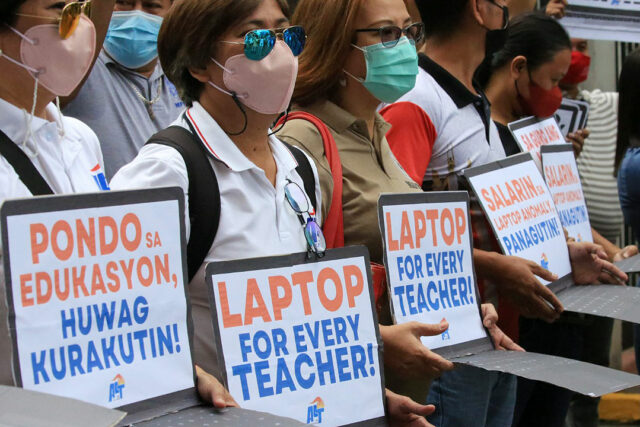
MEMBERS of the Alliance of Concerned Teachers hold a rally on Aug. 11 in front of the Department of Budget and Management office to call for accountability on laptop purchase contracts that were flagged by state auditors. — PHILIPPINE STAR/EDD GUMBAN

RESOLUTIONS have been filed at the Senate calling for separate probes on laptop purchases and scholarship fund disbursement by education agencies that were flagged by state auditors.   

Senate Minority Leader Aquilino Martin “Koko” D. Pimentel III filed Senate Resolution 120 to investigate the alleged overpriced and outdated laptops purchased by the Department of Education (DepEd) through the Department of Budget and Managements Procurement Service (DBM-PS).  

Mr. Pimentel said it is imperative for the DepEd and the DBM-PS to explain the basis for the charge in the unit price (from P35,046.50 to P58,300) and the number of laptop units (from 68,500 to 39,583) to be procured by the DBM-PS.”  

They must also explain the subsequent approval and acceptance of the DepEd of these laptops that were not in accordance with its budget and original specifications, he said.   

The laptops for public school teachers were procured for the implementation of distance learning amid the coronavirus pandemic. Funds were sourced from the Bayanihan to Recover as One Act with a budget of P2.4 billion.  

The Commission on Audit (CoA) said the price of the delivered units were too high for the technical specifications provided.  

The huge difference of P23,253.50 per unit price resulted in significant decrease by 28,917 laptop computers, purportedly for distribution to intended recipient-teachers which could have helped them in performing their tasks in the blended learning set-up, it said.  

The audit report also cited that the laptops were too slow as the processor was outdated.    

CoA also flagged the lack of documentary requirements, including one to support the fund transfer of the P2.4-billion budget to DBM-PS, which remained unliquidated at the end of last year. 

It is within the purview of the Senate Blue Ribbon Committee, and we look forward to the committee calling in these officials of PS-DBM so that these numerous issues are investigated,Senator Ana Theresia RisaN. Hontiveros-Baraquel said in a separate statement on Thursday.  

The characters from Pharmally seem to be reprising their earlier villainous roles in the new anomalies flagged by CoA,she added, referring to the allegedly overpriced medical supplies purchased by PS-DBM for the Health department.   

Meanwhile, Ms. Hontiveros filed a resolution to investigate the Commission on Higher Educations (CHED) scholarship unit over the questionable releaseof P7 billion worth of funds.  

State auditors reported that CHEDs Unified Student Financial Assistance System for Tertiary Education (UniFAST) had P3.4 billion worth of delayed and non-submissions of billings and documents to state and local universities and colleges.   

UniFAST is supposed to be the answer to the gap in education for millions of underprivileged youths. And yet the program is stained with suspicious overpayments and double reimbursements,Ms. Hontiveros said.  

We must be careful with the budget allocation for this, especially at a time when many are struggling to pay tuition,she added. This could be just the tip of the iceberg of dubious practices in CHED-UniFAST.”  

The resolution also cited that UniFAST made payments to universities and colleges without official receipts, released overpayments, gave funds to institutions that were already fully-subsidized, and had duplicate entries of beneficiaries, among other lapses.   

“For a country experiencing an education crisis, I am shocked by the billions we have been careless with,Ms. Hontiveros said. In the midst of these harsh circumstances that have affected the education of a whole generation, our agencies must shine light on these plausibly shady practices.Alyssa Nicole O. Tan 

Makati City to set up solar power systems in schools, gov’t offices 

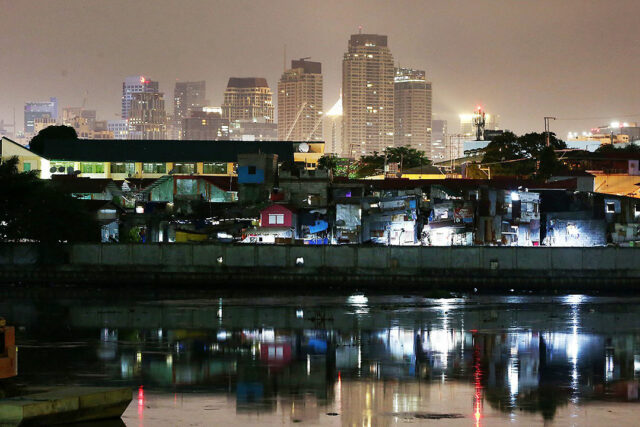
A VIEW of Makati City at night from across the Pasig River in Guadalupe, taken in May, 2020. — PHILIPPINE STAR/ MIGUEL DE GUZMAN

THE MAKATI local government will be installing solar power systems in schools and local government offices as part of its program towards a greener and more sustainable city, its mayor announced on Wednesday.   

“I am proud to announce that the city is procuring solar panels to provide a source of renewable energy in our schools and local government offices. This is part of our city-wide initiatives to reduce our carbon footprint and leave a greener and healthier environment for the next generation of Makatizens,Mayor Abigail Binay-Campos said at an event at the Comembo Elementary School as quoted in a press statement. 

Ms. Binay said the renewable energy source will also help the local government reduce power costs as well as provide an independent system to tap in case the main grid gets affected during disasters.      

The project, to be undertaken in phases, will cover 25 elementary schools, 10 junior high schools, and eight senior high schools. The Comembo Elementary School will be one of the pilot sites, according to the city government. 

The mayor said using green energy in schools will also be a way of creating awareness among students on the environmental impact of fossil fuel use and greenhouse emissions.  

On Friday last week, Ms. Binay formally declared a state of climate emergency in the city and announced initiatives to reduce greenhouse gas emissions in one of the countrys main business districts.   

Among the projects are the establishment of a smart public transport system with assistance from the Korea International Cooperation Agency (KOICA), which will provide $13 million.  

The fund will be used for the design and construction of an electric vehicle bus depot, control tower, electric vehicle buses, and systems for automatic fare collection, fleet management, and mobile passenger information. MSJ 

Metro Manila number coding scheme from 7-10 a.m. back by Aug. 15 

PHILIPPINE STAR/ RUSSEL PALMA

THE NUMBER coding scheme in the capital region, which restricts private vehicles from roads once a week based on the plate number, will again be in effect in from 7-10 a.m. starting Aug. 15, the Metropolitan Manila Development Authority (MMDA) announced.   

In a statement on Thursday, MMDA said the reimplementation of the traffic reduction program in the morning is in line with the expected increase in vehicle volume with the resumption of classes on Aug. 22.  

MMDA said it is expecting traffic volume along the main thoroughfare EDSA to increase to 436,000 daily once schools reopen. This is higher than the current average of 387,000 as well as the pre-pandemic level of 405,000.  

“From August 15 to 17, we will start the dry run and will only remind motorists of the expanded number coding scheme. From August 18 onwards, the MMDA will start apprehending and will issue traffic violation tickets on ground and through our non-contact apprehension policy,” MMDAs acting chairman, Carlo Dimayuga III, said.  

The number coding scheme will also remain in effect from 5-8 p.m. on weekdays.   

Under the scheme, vehicles with license plate ending in 1 and 2 are prohibited on Monday; 3 and 4, Tuesday; 5 and 6, Wednesday; 7 and 8, Thursday; and 9 and 0, Friday during the coding hours.   

The following are exempted: Public utility vehicles, transport network vehicle services, motorcycles, garbage trucks, fuel trucks, marked government vehicles, fire trucks, ambulances, marked media vehicles, and motor vehicles carrying essential and/or perishable goods.  

The MMDA is governed by the Metro Manila Council composed of the 17 mayors in the National Capital Region.  

House bill seeks to rationalize traffic fines, protect motorists 

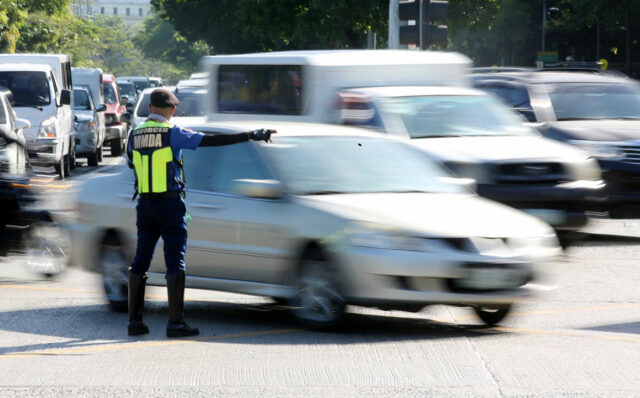
PHILIPPINE STAR/EDD GUMBAN

A BILL that seeks to protect motorists by outlining the limits and parameters of traffic enforcement, including penalty rates, has been filed at the House of Representatives.  

House Bill No. 3423, titled Motorist Protection and Rights Act, aims to amend Republic Act No.4136 or the Land Transportation and Traffic Code, which does not provide for a bill of rights for motorists.   

Albay Rep. Jose Ma. Clemente S. Salceda, author of the proposed measure, said that as private vehicles are being used as a means of livelihood, fairness in traffic enforcement is strongly tied with economic rights and the dignity of labor. 

I dont think its right that we should charge Grab drivers and delivery rides a weeks worth of wages for offenses that are minor,said Mr. Salceda, chair of the House Committee on Ways and Means.  

The bill imposes a cap on fines, which will not exceed the minimum wage rate for the first offence involving minor local traffic violations.   

The point of traffic laws is orderly transport, not punishment. The penalties, especially for local minor traffic violations, can go as high as P3,500 for first offense,he said.   

That is confiscatory, and it sets up room for negotiating with the traffic authorities. The child of confiscatory penalties is (extortion).”   

The bill also guarantees the right to complete, clear, and reasonable definitions of traffic violations.”    

Under the proposed law, every local government must set up a traffic adjudication body to ensure motorists can appeal violations.   

While we have established the no-contact apprehension policy to avoid (extortion), the system does not always have an accessible appeals mechanism,Mr. Salceda said. Matthew Carl L. Montecillo 

Calculated endangerment

MAJOR-GENERAL JAY M. BARGERON USMC US exercise director during the Balikatan 2022 speaks at a briefing in Camp Aguinaldo, Quezon City on March 28. — PHILIPPINE STAR/ WALTER BOLLOZOS

The Marcos II administration has assured visiting US Secretary of State Antony Blinken that it will continue to honor the country’s Mutual Defense Treaty with the United States. It has also affirmed adherence to the “One-China” policy that the Marcos I regime adopted in 1975, and asked both countries for restraint during the current tensions between them over the Taiwan issue.

The tensions generated by the US policy of “containing” China and preventing its rise to superpower status and the latter’s relentless drive for global hegemony have been simmering for decades. But US House of Representatives Speaker Nancy Pelosi’s grossly irresponsible visit to Taiwan last week escalated and made them much more alarming.

The Pelosi visit could have triggered a war between China and the US if China’s fighter jets had prevented her plane from landing or shot it down either deliberately or by accident. It would have been catastrophic for Taiwan, the Philippines, and other countries and would very likely have involved the use of the nuclear, biological, and chemical weapons both countries possess, and threatened all of humanity.

That has not happened — so far. But the visit has intensified the decades-long threat to the Taiwanese of being the first casualty of a US-China confrontation while ushering in an even more dangerous stage in the rivalry between the only superpower on Earth and the rising one.

Like his ally Pelosi, President Joseph Biden has displayed his bias for Taiwan since he assumed office in 2021, and provoked China’s anger over the possibility that he favors its transformation into a separate, independent country. But he nevertheless told the US media that it was “not the right time” for Pelosi and the Congressional delegation she was taking with her to visit the island. The US National Security Agency (NSA) and military sources reportedly briefed her on the possibly catastrophic consequences of her visit and advised her against it. But Pelosi ignored them and during her Asian tour flew to Taipei from Malaysia.

The People’s Republic of China (PRC) launched live-fire military exercises and other measures in response, but did not go as far as to make good on its threat to “burn” those who “play with fire.” While in Manila, Blinken described China’s launch of a missile in the Taiwan Straits as “irresponsible.” But that word more aptly applies to Pelosi’s Taiwan visit, which provoked China into demonstrating how vulnerable that island is to its armed forces.

Both the Chinese Communist Party (CCP) and its long-time foe, the Kuomintang (KMT — Nationalist Party) now based in Taiwan, agree on reunification, the One-China principle, and Taiwan’s being part of China. The former, however, wants reunification under CCP auspices, while the latter regards Taiwan’s as the legitimate government of China and the CCP as in rebellion against it.

The PRC has been in place since 1949, when the CCP’s People’s Liberation Army (PLA) defeated the forces of the Kuomintang after more than two decades of civil war and drove them to Taiwan, where the KMT established the “Republic of China” (ROC) under the Chiang Kai-shek dictatorship. (Taiwan became a democracy only in the 1990s.)

Since then, however, 181 countries including the US and the Philippines have recognized the PRC as the legitimate government of only one China. As per the terms of then Chinese Prime Minister Zhou Enlai and then Philippine President Ferdinand Marcos, Sr.’s joint communique of 1975, the Philippines ended diplomatic relations with Taiwan and created the Manila Economic and Cultural Office (MECO) to limit contacts only to economic and cultural matters.

The United States had recognized the PRC earlier. Then US President Richard Nixon visited China in February 1972, and met with Premier Zhou Enlai and CCP Chairman Mao Zedong. The Zhou/Nixon Shanghai Communique issued during the visit affirmed that there is only one China and Taiwan is part of it, and committed the PRC to peaceful means of reunification.

The Nixon visit to China is generally regarded as the most significant US initiative in foreign affairs in the 20th century because it normalized US-China relations after decades of antagonism and opened China to the world. Every US President except James Carter and Joseph Biden have since visited China.

Despite the near-universal acknowledgement that there is only one China and Taiwan is a part of it, and the above signs of mutual respect, the United States has never been quite at ease with China. Its discomfort with socialist China morphed into outright antagonism when it transitioned to State capitalism after the death of Mao Zedong and became the US’ foremost rival for world domination.

Former President Barack Obama’s “pivot to Asia” was just another name for containing Chinese power and influence and preserving the USA’s “full-spectrum dominance” on land, sea, air, and space. His successor Donald Trump seemed clueless about international affairs and left it to his officials to continue the policy of containment, while current US President Joseph Biden and his administration have been focused on aiding Taiwan should the PRC use military force to reunify it with the mainland.

The Philippines has been having its own problems with its Chinese “friend,” especially over its aggressive incursions into the West Philippine Sea (WPS). But that does not justify this country’s inviting US intervention in resolving the issue, given its likely consequences.

Some Taiwanese groups criticized their government for agreeing to the Pelosi visit. But it seems that it had no choice but to do so in the context of the Biden version of the Obama era’s “pivot to Asia.” What the Philippine government has to keep in mind is that rather than for the benefit of Taiwan, Pelosi’s visit was mostly made out of self-interest. That awareness should guide its response to any US offer of assistance in addressing the country’s problems with China in the WPS.

Pelosi spent her time in Taiwan meeting its officials, and trotting out the usual rhetoric about democracy and the US commitment to it. Rather than benefiting Taiwan, she multiplied the dangers to it, and was not so much driven by any concern for the Taiwanese people who have to face the fall-out from her visit as by her political interests and those of the Democratic Party.

Pelosi and company will lose their seats in the US House of Representatives unless they are re-elected in November’s mid-term elections. Those elections are likely to restore control of the US Congress to the Republican Party unless Biden’s Democrats do something to prevent it.

The Taiwan visit partly fills the bill. In addition to portraying Pelosi and company not only as uncompromising opponents of Chinese belligerency who deserve re-election, the visit and its aftermath are also a distraction from the inflation and US economic recession that are driving Biden’s approval rating and that of Democratic Party candidates to unprecedented lows.

The Pelosi adventure only proves once more that whether under the governance of the Republican Party or the Democrats’ “liberal” rule, the United States will defend and advance not only its economic and strategic interests but also the interests of its own power elite regardless of its consequences to the rest of the world.

Biden’s supposed “advise” to Pelosi against visiting Taiwan was too half-hearted to be taken seriously. He is equally to blame for his failure to prevent it. Far from being merely reckless, the dangers to which he and Pelosi exposed Taiwan and the entire planet were therefore cynically calculated.


Luis V. Teodoro is on Facebook and Twitter (@luisteodoro).

www.luisteodoro.com

Financial system is both institutions and markets

We have no doubt that the off-cycle, huge policy rate adjustment by the Bangko Sentral ng Pilipinas (BSP) last month continues to surprise both market analysts and economists. In a positive way, many of them admit that such a single move re-anchored inflation expectations and minimized the peso exchange rate’s volatility. Yet many incurable growth proponents maintain that such monetary tightening could compromise economic recovery by restricting business activities via the banks’ lending operations.

But four years ago, two senior economists from the BSP’s Department of Economic Research (DER), Carolina P. Austria and Bernadette Marie M. Bondoc (“The Impact of Monetary Policy on Bank Lending Activity in the Philippines,” 2018) had already found very weak to no evidence of monetary policy transmission through the Philippine banks’ lending channel. They used the Kashyap and Stein model that posits the idea “that banks cannot frictionlessly tap uninsured sources of funds to make up for a central bank-induced shortfall in insured deposits.”

This proposition implies that monetary policy affects banks in various ways. Those with adequate liquidity, for instance, could reduce their securities holdings to maintain their level of credit operations. For those with limited liquidity, loans may indeed have to be reduced if the securities level is low.

The Austria-Bondoc research was significant from the perspective of the BSP itself because its own in-house research activities had yielded mixed results on the existence and strength of both interest rate and bank lending channels of monetary policy. One paper done in 2008 found that with the shift to flexible inflation targeting (FIT) in 2002, the expectations channel has assumed greater importance in transmitting monetary policy in the Philippines while the interest rate channel has weakened. Both the credit channel and asset price channel remain closely linked because of the dominance of banks in the financial system.

Other research found that FIT has actually strengthened both the interest rate and bank lending channels although the transmission remains relatively weak considering our shallow financial markets. The BSP was found to have retained the capacity to influence market interest rates through the adjustment of the policy rate. A focused study on the bank lending channel also supported both its existence and magnitude.

But using a greater sample size and covering a longer period compared to previous BSP studies, with a number of robustness checks by varying bank groupings, policy rate used, and removing foreign banks from the sample, Austria and Bondoc, to reiterate, failed to see strong evidence of monetary policy transmission through the bank lending channel.

The BSP’s senior economists’ explanation is robust:

1. Banks rebalance their loan portfolio instead of actually shrinking it. This is consistent with other empirical results showing that monetary policy tightening could have the immediate impact on real estate and consumer loans but commercial and industrial loans do not necessarily have to adjust.

2. Well-capitalized banks, as in the Philippines, could de-link their lending operations from monetary policy shocks like a policy rate adjustment. Banks have become risk-conscious in their credit operations as the quality of loans remained stable. This means that even in credit booms, banks could always choose to lend discriminately. One proof is that despite the economic lockdown, nonperforming loans continued to be relatively low.

3. Financial market liberalization in the Philippines in the 1990s has weakened the ability of bank lending to reflect monetary policy stance. Proliferation in bank loan alternatives, financial market deregulation, and increase in securities trading have all weakened the link between the real economy and the bank lending channel. The weakening of this monetary policy transmission mechanism actually motivated the BSP in establishing the interest rate corridor system.

4. BSP regulations impose hefty penalties for banks mixing up funds in the regular and foreign currency deposits. External liquidity could only affect domestic lending if the BSP purchases those proceeds in the market.

5. The period 2008-2015 could be abnormal because of unorthodox monetary policies in the major economies. Since the upsurge in capital led to an extraordinary rise in monetary growth, the contractionary monetary policy could have been more than swamped by the expansionary impact of those capital flows.

Austria and Bondoc were correct that the main challenge to the monetary authorities is to ensure “that tools, including policy rate, reserve requirements, auction volumes for deposit facilities, and macroprudential measures are used in concert to effectively transmit monetary policy to the economy.” Monetary policymakers can always leverage on various channels of monetary policy, establish good coordination between monetary policy and operations, and employ macroprudential measures to influence bank lending behavior.

Which brings us to another excellent working paper from the BSP that was just released last month entitled “Introducing a multi-dimensional financial development index for the Philippines” by Jean Christine A. Armas and Nerissa D. De Guzman, both senior economists from the BSP’s DER.

What is interesting about this working paper is that it clarifies this nexus between the financial system and economic growth. Economic growth is driven by an efficient saving-investment channel, productive capital, and technological innovation. These growth-positive channels are optimized when the financial system is well developed. But therein lies the rub — we would normally equate financial development only with private sector credit to GDP and, to some extent, stock market capitalization. Or in other words, when we assess the impact of monetary policy tightening, for instance, we only have in mind the bank lending channel of monetary policy. Ergo, high interest rates erode economic growth and therefore, the BSP should go slow in navigating the trade-off between growth and inflation.

Following Armas and De Guzman, we can argue that limiting the assessment to credit and stock market implications of a monetary action would only capture the depth of the financial system. What they offered in their working paper is a multi-dimensional index that measures the level of development in both the system’s institutions and markets in terms of access, depth, efficiency, and stability. The BSP senior economists therefore improved and extended the index originally constructed by the International Monetary Fund (IMF) in 2016.

This enhancement is very useful because of the dramatic evolution of financial systems across the world and in its wake, has also spilled over to those of the emerging markets including the Philippines. While banks continue to dominate the financial system, it is necessary to consider the growing importance of non-banks, particularly private insurance corporations. Future research will have to cover the other financial corporations on which data series began only in the first quarter of 2017.

Elsewhere in their paper, the BSP senior economists also made the point that “large amounts of credit provision do not necessarily correspond to broad access to and efficient delivery of financial services…” We need to go beyond one single dimension of the financial system, or just the financial institutions alone.

Looking at the financial developments in both the financial institutions (FI) and financial markets (FM) in the Philippines in all the four metrics of access, depth, efficiency, and stability and the singular index (Overall FD Index) would show that the Philippine financial system “has progressed and developed quite remarkably.”

As this chart shows, both external developments (for instance, US Federal Reserve quantitative easing in 2010, 2012; US-China trade tension in 2018; COVID-19 pandemic in 2020) and key domestic regulatory and policy reforms (for instance, on financial access and inclusion in 2014 and 2018, monetary policy normalization in 2014) drive the system’s access, depth, efficiency, and stability.

Armas and De Guzman’s paper is very significant because it proves that focusing only on financial institutions, as most of us do today, would ignore the other plank which is the financial markets, as well as key financial dimensions other than depth. On the other hand, Austria and Bondoc alerted us on the need to consider different channels of monetary policy transmission other than the usual bank lending channel in assessing the impact of monetary action, for instance. Otherwise, we might be missing many points.

This is how we transport an elephant in the room.


Diwa C. Guinigundo is the former deputy governor for the Monetary and Economics Sector, the Bangko Sentral ng Pilipinas (BSP). He served the BSP for 41 years. In 2001-2003, he was alternate executive director at the International Monetary Fund in Washington, DC. He is the senior pastor of the Fullness of Christ International Ministries in Mandaluyong.

Nostalgia and chocolates

ENGIN AKYURT-UNSPLASH

In the past, kids played outdoors and climbed trees to get fruits. We made our own kites to fly in open spaces. With only homemade toys and pets, we enjoyed the simple life with classmates and neighborhood playmates. On rainy afternoons, kids splashed in puddles in the driveway and garden.

At night, we gazed at the clear sky and made a wish on the first and brightest star. The secret wish was that time would stand still — that everything would remain the same.

We traced the constellations and waited for shooting stars.

Childhood was a happy, almost perfect time. We were not yet aware of the complications, problems and heartaches of adults.

In a way, we wanted to be children forever — like Peter Pan and the Lost Boys.

Fast forward to the present.

We are in the period of liminality, on the threshold of the vague, uncertain future. We are all struggling to survive the pandemic. We are in limbo after severe personal and financial losses. The grim and shocking reality is a world reeling from the collapse and crumbling of the financial giants. There are natural disasters and wars that have devastated countries and severely affected the rest of the world.

Downsizing, simplicity and frugality are the buzzwords. (There are a few exceptions who are shock-proof.)

We are changing, transforming ourselves through discipline, will power, great effort, resilience, compassion, and sharing with others.

Growing up is a painful process.

To take a leap into the unknown is a challenge. We need to change our attitude and focus on priorities.

“All life itself represents a risk and the more lovingly we live our lives, the more risks we take…. Courage is not the absence of fear. It is the making of action in spite of fear,” wrote M. Scott Peck.

We must remind the adult that the inner child still exists.

We should have hope.

What do people do when they feel distressed, blue, anxious, uncertain?

The aggressive ones take it out on others. There are incidents of road rage, violent confrontations, destructive behavior. These actions come from repressed emotions and frustration. Bullies pick on helpless, vulnerable, gentle people.

The adventurous flee to the mountains or the sea. They trek, climb, swim, fish. Being far away from the source of stress is the key.

The city-bound individual seeks a pacifier that is satisfying. Good food — from comfort food to haute cuisine with fine wine, a cocktail or beer, a cigar.

During the long lockdown and intermittent restrictions, people rushed to the beach, to the provinces for fresh air and a sense of safety in nature. The social ones continued to dance at private parties, and the quiet ones meditated at sunrise and sunset. In between, there were good meals to satisfy cravings.

The fitness buffs worked up a sweat, lifting weights, playing sports and running.

Couch potatoes watched movies, TV or sleep.

Workaholics plunged into their voluminous documents and worked on their computers at all hours.

What could provide instant relief to all?

Something forbidden, infinitely sinful, and fun — in the oral, calorific sense.

Get a temporary reality break. Get a fat fix. Break the diet. Eat comfort food on different levels — wine, chocolate, sweet pastries — anything with sugar, and junk food — salty chips and crackles.

Chocoholics swear that the best antidote for depression is a bite of a delicious bitter-sweet truffle, a decadent chocolate cake with caramel syrup, or a milk chocolate bar. The simple Chocnut was a childhood favorite and still is. Studies show that dark chocolate has more antioxidants. Chocolate has hormones that lift the mood and fight the blues.

Oral satisfaction in a chocolate fix is a tranquilizer par excellence. Stressed people crave a sweet nibble (A healthy raw carrot stick or a celery stalk is good for hunger pangs but it cannot offer the same comfort.)

Nothing appeases the appetite and calms anxiety more than the flavor and taste of premium chocolate. As a quick antidote to sadness, it is both a luxury and a necessity.

The natural tranquilizer contains ingredients like oxytocin, the “feel good” chemical released by the wondrous “high” of falling in love.

Although eating too many chocolates may ruin the figure and raise the sugar level, the instant “high” is worth every gram and centimeter gained. Who wants to be enviably lean and slim but mean and cranky? Deprivation makes people growl.

When the blues cover you in a hazy blanket, indulge!

Forget the calorie counter. Hide the weighing scale and the tape measure — for a while.

Self-denial and guilt (food and alcohol) are outré.

It is a matter of survival. A bite of chocolate is a pleasure with instant relief. It has healing qualities that alleviate or decrease pain, heart ache, and grief. (Forget retail therapy and the accumulation of accessories, jewelry, shoes and other objects that clutter your life.)

There is value in a little decadence… (caramel, vanilla cream, strawberry, champagne, and other rich flavors) after all!

It is also good for the spirit to pray, think, and share blessings with others. This practice lessens the stress and is calorie-free.


Maria Victoria Rufino is an artist, writer and businesswoman. She is president and executive producer of Maverick Productions.

mavrufino@gmail.com

Marcos as the scapegoat

ROGER BUENDIA, PEOPLE POWER — THE PHILIPPINE REVOLUTION OF 1986

It’s been 36 years since EDSA I.

As of this writing, that’s 13,314 days and 16 hours from 9 p.m. of Feb. 25, 1986, the day Ferdinand Marcos the Elder left Malacañang. Make that 319,554 hours of one president and his family living rent free in the heads of so many Filipinos today. Every political leader is gauged whether he’s “Marcosian” or not. We’ve had elections three decades later that essentially forgot about current issues and instead revolved around his legacy. The Supreme Court had to decide how he was to be buried. We have two dueling movies right now essentially about that one single presidency. What’s up with that?

It can’t be his longevity, those 20 years he held power. Gloria Macapagal-Arroyo was president for an impressive nine years and yet barely is the subject of historical study (as of now). Martial Law? It’s implementor, Fidel V. Ramos, died merely weeks ago, and except for a few days of praise and reminisce, the national conversation promptly went back to the bashing or defending a man that’s been dead for 33 years.

And then there’s the hatred. The absolute engulfing hatred, contempt, even shows of disgust, that some are wont to express of a level worthy for Hitler. Of whom FM is oft compared to. But to compare the former Philippine president to a man that ordered the killing of six million Jews borders on the eccentric.

There are the plunder allegations, essentially none of which have been conclusively or categorically proven in court or decided with finality. And if one goes by mere allegations, then many a succeeding president has been equally as bad in that regard.

Human rights violations? Of the 75,730 abuse claims filed in relation to the 1970s martial law, only 14.66% or 11,103 have been recognized as valid by the Human Rights Victims’ Claims Board (HRVCB) to date. Compare that, and more specifically compare the 2,326 deaths recognized by the HRVCB with the more than 12,000 deaths alleged by Human Rights Watch that supposedly occurred during the six years of Duterte’s presidency. Or compare that with the alleged 50,000 murders committed by the CPP-NPA (Communist Party of the Philippines-New People’s Army).

Consider further that of today’s 110 million Philippine population, 75% (or 82.5 million) were born after Martial Law. A further 10% (or 11 million) were merely toddlers or in grade school when Martial Law was imposed. That makes 93.5 million. Which means only the remaining 15% had direct actual experience of Martial Law.

Which begs the question: considering this country went through invasions, a war of independence, a world war, bloody communist and Muslim insurgencies, cataclysmic earthquakes, storm floods, and volcanic eruptions, can the entire country really be this rabidly divided over a single presidency, complete with an overly loud and emotional, sometimes bordering on in-need-of-therapy hatred by a segment of the population whose only knowledge of what happened in the 1970s came from secondhand sources most likely inclined to favor the Aquino family during the total 12 years of their presidencies?

ALL THAT HATRED
It’s this disproportionate amount of vitriol that makes one ponder.

It has all the rationality of the hatred for a parent or lover where the feelings and memories remain but the relationship has gone terribly wrong. Or is it perhaps projection?

An offhand comment by Roger Scruton perhaps leads us to a possible answer: “I was reminded actually of the theory that Rene Girard, the French philosopher and anthropologist produces to explain the scapegoat phenomenon. His view is that, at the heart of every society, there are these huge tensions, caused by the fact that others have what you want essentially and that you’ve been excluded from what you deserve etc. These tensions build up and they’ve been building up in our society as we know…”

Thus, there develops “a need for a victim to persecute when that happens. You single him out and it’s necessary that he should be innocent. If he’s actually guilty of something then you can’t pour all your venom into him. So here is the lamb led to the slaughter and of course we have the great example in Christ whose crucifixion would have meant nothing if he weren’t actually innocent. And the pursuit of the scapegoat for Girard is the way in which a society relieves itself of this burden of mutual resentment growing within it.” (The Spectator, “Full transcript: Douglas Murray in conversation with Roger Scruton,” May 8, 2019)

THE MAN SINGLED OUT
The hatred for that one “singled out” is perhaps the key. How many can honestly say, particularly then and even now, that he would have acted differently from Marcos if he had been placed in a similar situation? History doesn’t give us an optimistic answer.

Joe Studwell, in his book Asian Godfathers: Money and Power in Hong Kong and Southeast Asia, made an analysis on the Philippines that is particularly relevant: “The old political elite, restored by godfather progeny Corazon Aquino after Marcos’ departure in 1986, appears as entrenched as ever. The current president, Gloria Macapagal-Arroyo — herself the daughter of a former president — spends much of her time fending off congressional attempts to impeach her because of the possibly unconstitutional manner in which she ousted her predecessor, Joseph Estrada, 2001, and allegations of vote-rigging in her own election victory in 2004. x x x Faith in the political process is falling, communist insurgency is present in most provinces, and the local elite remains the most selfish and self-serving in the region. The Philippines best known living author, Francisco Sionil Jose, lamented in the Far Eastern Economic Review in December 2004: ‘We are poor because our elites have no sense of nation. They collaborate with whoever rules — the Spaniards, the Japanese, the Americans and, in recent times, Marcos. Our elites imbibed the values of the colonizer.’ The Philippines, in short, has never moved on from the colonial era and the patterns of amoral elite dominance that it created.” (Asian Godfathers, 2007, pp.180-181)

A reading of Sandra Burton’s Impossible Dream shows how those in power were so inextricably linked to each other that our history is seemingly like one long political rigodon. If Burton’s account is accurate: it was a Laurel who acquitted Ferdinand Marcos of murder, a Roxas who liberated him from a US army brig, a Quezon who urged him to be in public life, a Macapagal who awarded him half of his war medals, and a Magsaysay who served as godfather to his wedding. Marcos had Ninoy Aquino as a fraternity brother. And before Aquino married Cory, he was actually dating, guess who? Imelda Romualdez.

Ferdinand Marcos, intelligent, disciplined, athletic, with a beautiful wife and children. Even setting aside the issue of war medals, he was a man that had gone through war. Who topped the Bar Exam while in jail awaiting trial for the murder of his father’s political enemy. An achiever who surrounded himself with other achievers, his cabinet one of “technocrats,” people that worked in multinationals or studied in UP or Harvard.

A CLEANSING OF HANDS
Place all that within this context: a president that — while admittedly wealthy — did not come from the ranks of the supposed “de buena familias” of Philippine society, of which — more to the point — many were accused of being collaborators with either the Spanish, Americans, or the Japanese (and of the latter many would have been charged for treason had not Douglas MacArthur reportedly intervened to stop the prosecutions), and had also mismanaged the country for most of the life of the Third Republic.

So, the “elite,” the same elite that controls media, the academe, business, and politics, many of whom are donors to religious organizations, needed someone to blame. Someone to blame for their own corruption, for their own mismanagement, for their own failings and flaws. A scapegoat was needed.

Scapegoat. As one definition puts it: the one “upon whose head are symbolically placed the sins of the people.”

Or from the Encyclopedia of Social Psychology: “Scapegoat theory refers to the tendency to blame someone else for one’s own problems, a process that often results in feelings of prejudice toward the person or group that one is blaming. Scapegoating serves as an opportunity to explain failure or misdeeds, while maintaining one’s positive self-image. If a person who is poor or doesn’t get a job that he or she applies for can blame an unfair system or the people who did get the job that he or she wanted, the person may be using the others as a scapegoat and may end up hating them as a result.”

DON’T NEED NO EDUCATION
And many of our idealistic youth, rightly frustrated with our country’s continuing and repeating problems, were “conditioned” into believing it. Conditioned, not educated, because the latter presupposes the ability to critically think, which means allowing dissenting thought, and dissenting thought, at least with respect to analyzing the Marcos era, was simply forbidden until recently. And again, many of our youth, either due to kind faith or trust in media or the academe or their church, or some perhaps fearful of being a pariah or of losing popularity or a promotion, went along with it.

LIES, GOSSIP, HISTORY, AND TRUTH
None of this is to absolve anyone of any responsibility for any wrongdoing. But accountability must be had with justice, and justice needs to be rooted in truth. Not the truth of supposed academics or “historical experts” claiming infallibility and exemption from being questioned. But truth of complete, rather than selective, facts and viewed realistically through human experience and logic rather than emotion or jejune idealism. Less than that, history is merely gossip. And history is what we should learn from, not gossip.

A country can’t be built on lies. No life should be built on it. A person will always know when truth is absent no matter how much he tries to deny it. Doubt will gnaw at his being. That’s how fanatics are born and sadly fanatics now litter our national conversation. That is unfortunate. To borrow from George Smiley, fanatics are lost and will come to nothing precisely because he “is always concealing some secret doubt.”

In the end, what is indeed needed for this country is to value the truth and follow it wherever it may lead. Even though it may be truth that blasts our most cherished beliefs and assumptions. Part of that truth is the need to hold people accountable, yes, but also for everyone to assume self-responsibility rather than passing blame.


Jemy Gatdula is a senior fellow of the Philippine Council for Foreign Relations and a Philippine Judicial Academy law lecturer for constitutional philosophy and jurisprudence

www.facebook.com/jigatdula/

Twitter @jemygatdula