Home Blog Page 5580

Investors sell on Globe’s third-quarter income, full-year profit estimate

INVESTORS sold Globe Telecom, Inc.’s stock last week after the release of the listed telecommunication company’s double-digit profit growth in the third quarter, analysts said.

Data from the Philippine Stock Exchange show 220,890 shares worth P491.84 billion were traded from Nov. 14 to 18. Shares in the Ayala company went down by 3.7% to close at P2,214 apiece on Friday. Year to date, the stock has gone down by 33.4%.

Globe released its third-quarter income on Nov. 14 showing a 38.6% increase to P6.82 billion from P4.92 billion in the same quarter a year ago. Year to date, its income reached P26.5 billion, a 47.6% increase from P17.96 billion in the same period in 2021.

Analysts said that Globe’s income report largely moved the stock last week.

In an e-mail, Regina Capital Development Corp. Equity Analyst Anna Corenne M. Agravio said that investors sold the stock after the release of its quarterly financial report.

Papa Securities Equities Strategist Manny P. Cruz said that Globe’s quarterly report is in line with its growth estimate and the consensus estimate for the stock.

In a Viber message, he said third-quarter service revenues declined 2% quarter on quarter and increased 3% year on year, led by weaker mobile and home broadband segments.

He said service revenues experienced weaker prepaid average revenue per user of minus 2% quarter on quarter, with mobile subscriber growth coming in flat.

“Additionally, [Globe’s] home broadband continued its decline as overall subscribers declined 13% [quarter on quarter] with the wireless segment’s 23% decline more than offsetting the 7% gain in fixed broadband subscribers,” he added.

In an emailed analysis to reporters on Nov. 16, financial research firm CreditSights, Inc. said that the telecommunication arm of Ayala Corp. is on track to meet its earnings target this year supported by “sustained subscriber demand and further moderation of fuel prices.”

The financial research firm called Globe “stable” based on its year-to-date financial results.

“This will definitely appeal to investors, as its operations are considered defensive against the volatile markets. Barring one-offs, GLO should be able to sustain its revenues for the remainder of the year since demand for data-related services is expected to remain stable,” Ms. Agravio said, referring to Globe’s stock symbol.

She placed her estimate for the stock’s fourth-quarter income at P5 billion to P6 billion, while its full-year income at P30 billion to P32 billion.

For the week, Ms. Agravio placed her support and resistance levels at P2,200 and P2,350, respectively. — Bernadette Therese M. Gadon


Dashboard

PHOTO FROM SUZUKI PHILIPPINES

Suzuki Philippines (SPH) broke ground on a new location for Suzuki Auto Isabela. The 3S (sales, service, and spare parts) to be managed by trusted partner Elite North Autocars, Inc. is located in Barangay Tanggal in Cordon. The outlet rises on 2,000 square meters, and features a showroom that can display four vehicles, and six working service bay. Said Suzuki General Manager for Automobile Takei Norihide, “Suzuki takes pride in its rapidly expanding dealership network spanning across the country. With the strategic location of our new dealership, we are optimistic of serving more Filipino families with mobility solutions they deserve.” In photo are (from left): Isabela Councilor Florence Zuniega, Councilor Rene Galing, Elite North VP for After-sales Noli Ebora, Elite North VP for Sales and Marketing Ronald Macadangdang, Cordon Isabela Adminstrator Richylou Abaya, Elite North President Dennis San Juan, SPH Director and General Manager for Automobile Norihide Takei, and SPH Sales Manager Jude Racadio. For more information, visit an authorized Suzuki Auto dealership or http://suzuki.com.ph/auto. For daily updates, like the Suzuki Auto Ph’s Facebook page (SuzukiAutoPh), or follow its Twitter account (SuzukiAutoPh) and Instagram (suzukiautoph).

US House Republican farm bill priorities may test Biden agenda

REUTERS

WASHINGTON — President Joseph R. Biden’s pledges to slash emissions from farming and to end American hunger by 2030 may be harder to realize now that Republicans flipped the House of Representatives with a thin majority.

Mr. Biden’s Democrats, who retain control of the Senate, will start negotiating in the coming months with Republican House leaders over a massive farm spending bill passed every five years that funds US public food benefits and farm commodity programs.

The current $428 billion bill expires on Sept. 30, 2023.

“We know the Republicans will be less excited about innovation and will probably want to protect the status quo,” said Vanessa Garci-a Polanco, policy campaigns co-director of the National Young Farmers Coalition, a nonprofit group.

The House and Senate agriculture committees draft the bill, and both parties typically make concessions in negotiations.

With Republicans about to control the House, policy advocates said anti-hunger and environment groups may have to scale back policy proposals they had hoped to get included in the bill such as rewarding farmers for climate-friendly practices and expanding food benefits.

The House agriculture committee will likely be led starting in January by Glenn Thompson of Pennsylvania. A staffer for Mr. Thompson said his main goal is to get the bill passed and he does not yet have clear policy priorities.

In past remarks, he has criticized US Department of Agriculture (USDA) spending on climate programs, and supported restrictions on hunger benefits. The farm bill has a historical reputation of bipartisanship, so some advocates told Reuters they are warily optimistic.

Still, growing polarization in Congress could hinder strong hunger and climate goals. Passage of the 2014 farm bill was held up more than a year as conservative House Republicans tried unsuccessfully to strip the bill of nutrition programs.

About 80% of Republicans on the House Agriculture Committee are members of the conservative Republican Study Committee, whose 2023 budget recommendations similarly proposed dramatic changes such as separating nutrition and farm programs.

Democratic Senator Debbie Stabenow, chairwoman of the Senate Agriculture Committee, said she planned to lead a bipartisan negotiation process and that the bill would ultimately align with Mr. Biden’s priorities.

“Make no mistake: we cannot, and will not, go backwards,” she told Reuters in an email. “The climate crisis is real. Millions of Americans, including millions of children, are food insecure.”

About 75% of farm bill funds go toward anti-hunger programs including the Supplemental Nutrition Assistance Program (SNAP), also called food stamps.

USDA data shows about 41 million people have received SNAP benefits this year.

In previous farm bills, Republicans on the House Agriculture Committee have sought tighter nutrition spending.

The issue could be particularly contentious this time because emergency pandemic-era boosts to SNAP could expire as soon as January, said Ellen Vollinger of the Food Research & Action Center, an anti-hunger group.

“Whenever it does end, most SNAP recipients are going to lose about $82 a person a month,” she said, calling the looming expiration a “hunger cliff.”

Surging food price inflation also has strained household budgets. At an April agriculture committee hearing on the SNAP program, Mr. Thompson expressed support for tightening work requirements for benefit recipients.

But Jim McGovern, a Democrat on the House farm committee, told Reuters any cuts to SNAP or changes to work requirements “will result in a farm bill not getting done, period.”

In September, at the first hunger conference of its kind in half a century, Biden pledged to end hunger by 2030. Many of the strategies he laid out would require Congressional action, but there was little Republican participation in the conference, which Mr. Thompson called a “political stunt.”

Republicans have also protested efforts by US Agriculture Secretary Tom Vilsack to reduce farming’s 10% contribution to US emissions of climate-warming gases.

In September, USDA announced a $3 billion investment for “climate-smart” farm projects like planting cover crops and using sustainable grazing practices.

Every Republican member of the House agriculture committee signed a letter calling the funding “abusive and troublesome.”

Mr. Thompson’s aide said he took issue with spending that money without Congressional input. At an August farm conference in Iowa, Mr. Thompson said if he led the agriculture committee, he would “ensure that the farm bill doesn’t become a climate bill.”

Mr. Vilsack told Reuters in an email that the agency was committed to its climate goals. ‘At the request of farmers, ranchers and producers, we will find ways to increase their production and profits though climate-smart agriculture,” he said.

Hearings discussing the farm bill are underway, but negotiations are behind where they typically would be at this point in the farm bill cycle, in part because of Congressional priorities on other legislation, said Mike Lavender, interim policy director at the National Sustainable Agriculture Coalition, a farm policy group. “It’s going to be a crunch,” he said. — Reuters

Style (11/21/22)


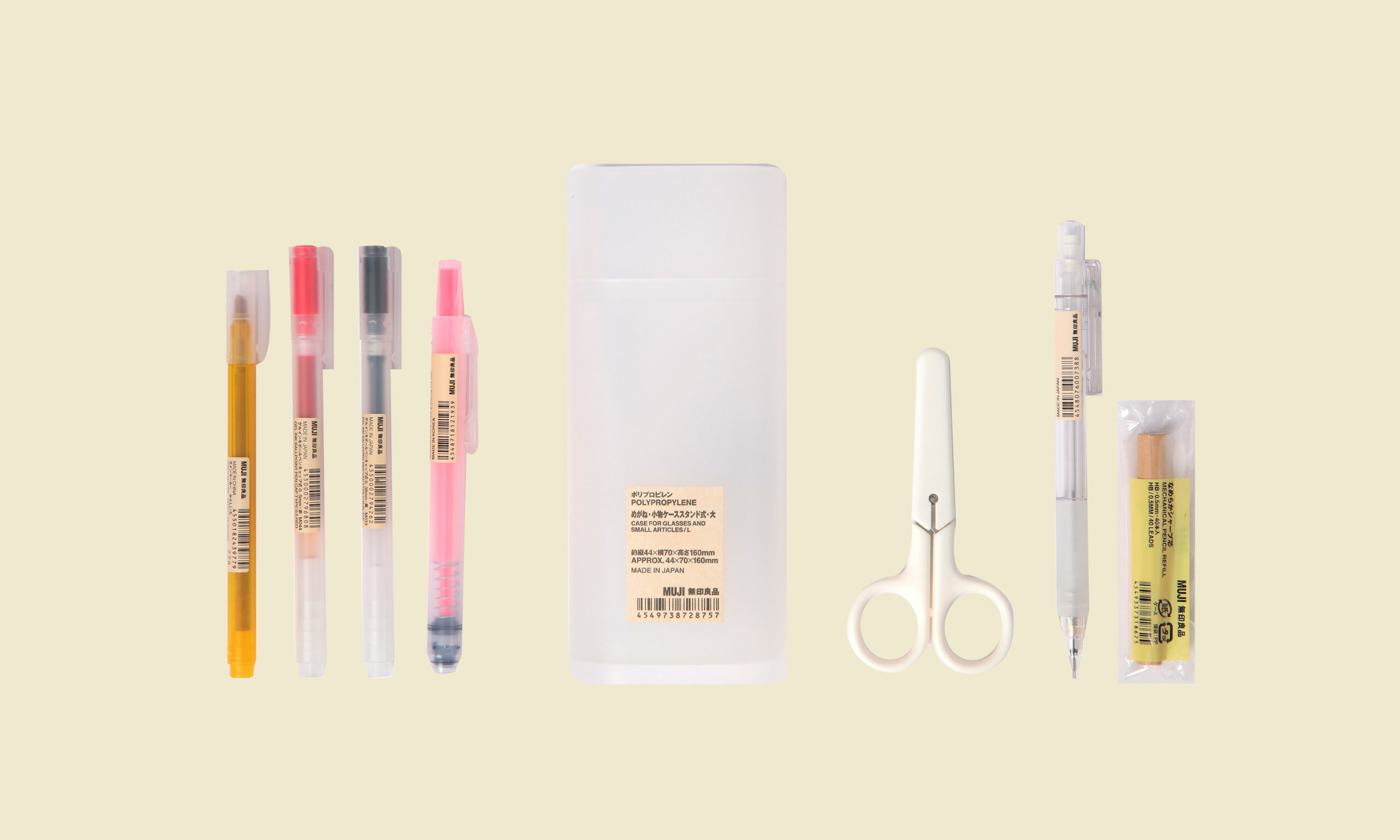
MUJI Christmas bundles available until Dec. 26

AVAILABLE until Dec. 26, MUJI is offering Christmas bundles to celebrate the holiday season. The Christmas bundles are specially put together gift sets that loved ones can use for the new year and daily, from stationery and office items to household products. These Christmas bundles also come in a promotional price that will give customers extra savings. The Christmas bundles start at P500. In MUJI’s holiday collection is the best-selling Jute My Bag which has been a crowd favorite among customers, and this holiday season, it will be offered with a 20% discount when purchased with Christmas Bundles. Meanwhile MUJI Members have activities and promos to make Christmas shopping more enjoyable. (To become a MUJI member, sign-up online or when visiting any of its stores.) Until Dec. 26, MUJI members can get an additional discount on their shopping basket by joining MUJI’s Christmas Bingo. The bingo card is composed of easy activities that customers need to complete to get a P100 discount. The Bingo cards are available in the store. MUJI also has a Christmas raffle for MUJI members running until Dec. 20. Five lucky winners from each MUJI store will win a special gift. MUJI members may join the Christmas raffle and win special prizes worth P1,500. Until Dec. 20, MUJI is holding an Online Art Contest #MyMUJIHoliday. Using MUJI gel ink pens, participants are asked to design or draw their answer to the question “What does Christmas mean to me?” Three winners will receive a P2,000 worth of MUJI stationery gifts and a chance to get featured on MUJI pages. For the full mechanics of all the promos, visit facebook.com/muji.ph or follow @muji_ph on Instagram. In the Philippines, MUJI has stores at Greenbelt 3, Central Square in BGC, Power Plant Mall at Rockwell, Shangri-La Plaza East Wing, and SM Mall of Asia.


Tommy Jeans-Martine Rose capsule collection

TOMMY Hilfiger announced its collaboration with British designer Martine Rose and launched the Fall 2022 Tommy Jeans X Martine Rose capsule collection. The 35-piece gender-inclusive collection is inspired by archival Tommy Hilfiger icons from the 1990s and updated through Martine Rose’s lens. A powerful play of color and graphics on exaggerated proportions are seen throughout the collection, bringing a streetwear vibe with a touch of tongue-in-cheek irony. Key items include the varsity jacket, hoodie, puffer and robe-coat, and are remixed with pop details, over-dye finishes and Martine’s signature patterns. The collection is now available at select Tommy Jeans stores and tommy.com.


Neighborhood x Harley-Davidson limited collection

LEGENDARY motorcycle maker Harley-Davidson and renowned streetwear brand Neighborhood have teamed up for a limited collaboration which launched on Nov. 19. Neighborhood, started in 1994 in Tokyo, Japan, was originally conceived as part of founder Shinsuke Takizawa’s motorcycle enthusiast interests. Neighborhood’s mix of luxury construction standards, and classic utilitarian and subculture aesthetics made the brand a cornerstone of modern streetwear. The Neighborhood x Harley-Davidson collaboration fuses the heritage logos of both brands in motorcycle culture-inspired style with a touch of streetwear ease and comfort. Comprised of sweatshirts, long-sleeve and short-sleeve T-shirts, a lightweight racing jacket and a handful of accessories (hats, mug and sticker pack), each style features both brands’ logos with lightening graphic details and skeletons. The Neighborhood x Harley-Davidson collection is available at neighborhood.jp and h-d.com/neighborhood, as well as at ComplexCon in Long Beach, CA where the brands will have a collaborative space.


A|X Armani Exchange’s fall/winter collection

MODULARITY is the defining characteristic of A|X Armani Exchange: garments with minimal and decisive shapes, easily combinable colors, graphic designs and melting patterns. For its Fall/winter collection, the men’s selections include down jackets, zipped anoraks, shirts, pullovers and trousers in neutral shades of grey and dense blue, with touches of red and shiny textures. Nuanced check motifs flourish on down jackets and oversized shirts alongside iridescent logo prints. The womenswear selection includes blazers, down jackets, trousers, miniskirts, shorts, and tops in natural colors, broken up by metallic accents. Graphic check motifs characterize small padded jackets, trousers, skirts, and dresses with movement created by pleats. Materials include cotton corduroy and satin, flannel, as well as viscose crepe and satin, velvet, chiffon, printed eco-leather, and vintage-effect leather. The collection is completed with a selection dedicated to the world of nightlife and music. Black mixes with denim to capture the nocturnal vibes of a minimal men’s wardrobe, consisting of a leather jacket, bomber jacket, blazer, and pea coat, as well as a shirt, a T-shirt, and five-pocket trousers. For women, these include a fitted dress, a pullover, leggings, high-heeled boots, and a shoulder bag.  In the Philippines, Armani Exchange is exclusively distributed by Stores Specialists, Inc. It has stores at Glorietta, Alabang Town Center, Greenbelt, Power Plant Mall, Shangri-La Plaza and online at Trunc.ph, Rustans.com, and Zalora.


Ortigas Malls ready for holiday shopping

WHIP out your shopping list as Ortigas Malls has shopping options for everyone in Greenhills, Tiendesitas, Estancia, and Industria. It also rewards shoppers with perks and privileges with the Ortigas Community Card, which gives members exclusive discounts. The digital card also allows members to participate in Community Card-exclusive events. Here are some shops to check out. At Greenhills, a mix of tiangge and boutiques is a good way to go through one’s Christmas list. Greenhills has over 2,000 stores offering clothing, shoes, gadgets, jewelry and so much more. Among these are AfterMarket Philippines which specializes in sneakers and all kinds of footwear and casual clothing for the urbanite. Check out their collectible basketball shoes like the Nike Kobe Protro and classic models like the Jordan 1. For the Funko, Twice, Marvel and Star Wars fans on the list, CO Collectible Store is sure to have something. Products range from Panini Stickers, Third Culture, Monster Pulls and Pop.ph, from Frozen to FIFA to Fortnite. The pearl shops at Greenhills have made the mall a destination for jewelry buyers. The Philippines is a rich source of South Sea Pearls and Greenhills has made it convenient for shoppers by putting various sellers from all over the country under one roof. Meanwhile, Tiendesitas puts the spotlight on Philippine products like native food, fashion wear and accessories, furniture, antiques, handicrafts, personal care, and novelty items. You can also find pet products, plants and garden supplies on your one-stop shopping weekend.For pet owners, check out FUR Ever Happy Pet Accessories. For the plantitos and plantitas who want to expand their brood, the Urban Gardening Shop provides services and eco-friendly products. Too, Tiendesitas is the home of the only branch of Decathlon in the northern metro area. Decathlon is the largest sporting goods retailer that carries products for 70 sports. Estancia — Ortigas Malls’ flagship mall for upscale shopping, dining, and entertainment — is a great place to pick gifts and to have a good time without hurry or stress. For example, the multi-brand Retail Lab is the boutique for when you’re not sure what kind of gift to buy but you’re sure you want it made by young designers and independent labels. Originally by the SoFA Design Institute, Retail Lab houses Soak Swimwear, Neon Island, Eighth Mermaid, ANMA Lifestyle, I Love Koi, and Jean & Rosz. Then there is Maristela Fine Jewelry which offers diamond pieces like earrings, necklaces, bracelets and rings. Those who can’t find the time to go shopping, can shop online at Your Daily Store, the online portal of Ortigas Malls tenants that showcases their products. Download the Ortigas Malls app and register for an Ortigas Community Card. Get the latest updates by visiting Ortigas Malls on Facebook, and follow @greenhillsph, @tiendesitasph, @estanciaph on Instagram.

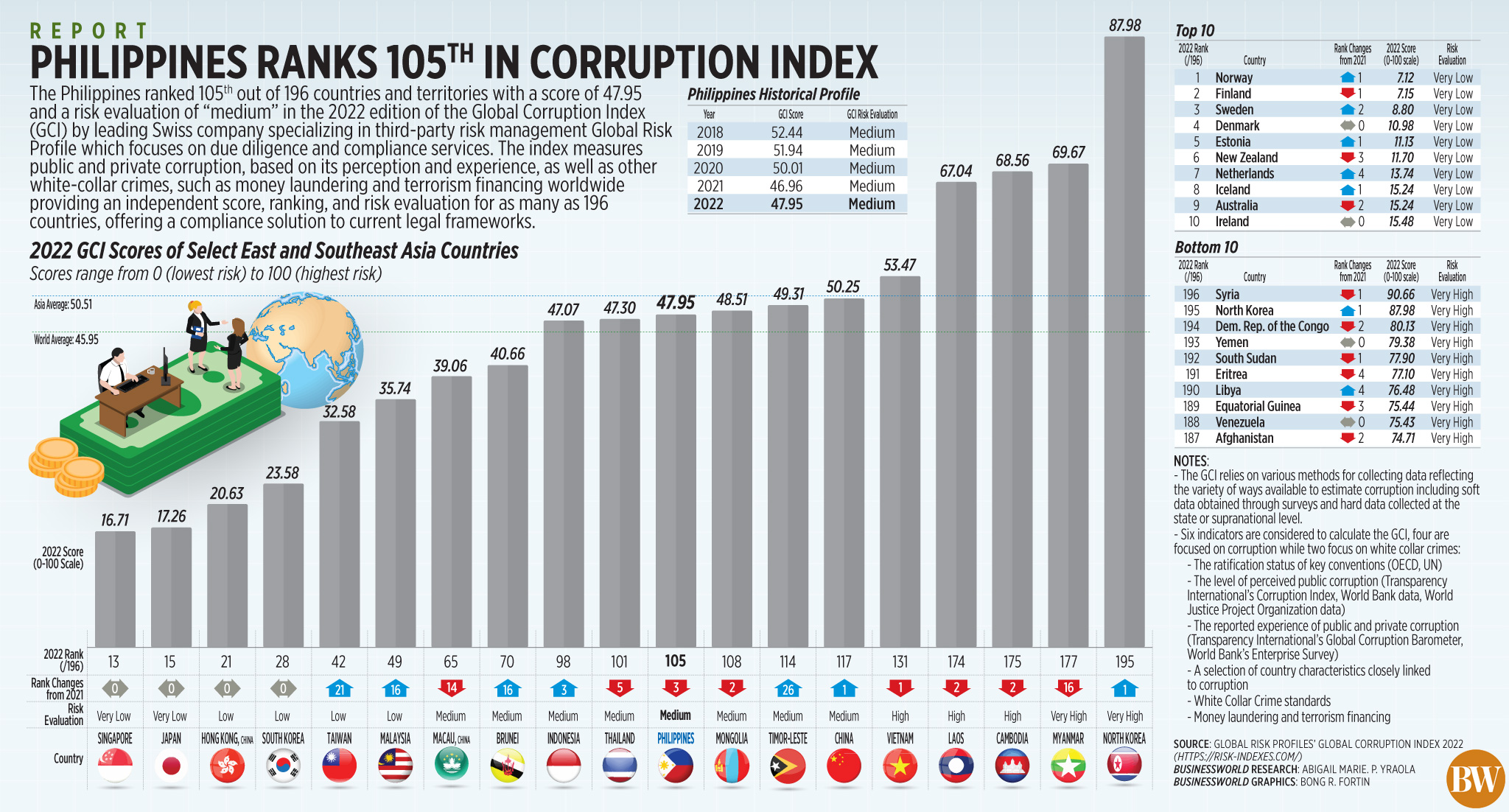
Philippines ranks 105th in corruption index

THE PHILIPPINES slipped three places in a corruption index released by Global Risk Profile (GRP), which noted that financial aid programs during the pandemic created opportunities for corruption and bribery. Read the full story.

Philippines ranks 105<sup>th</sup> in corruption ndex

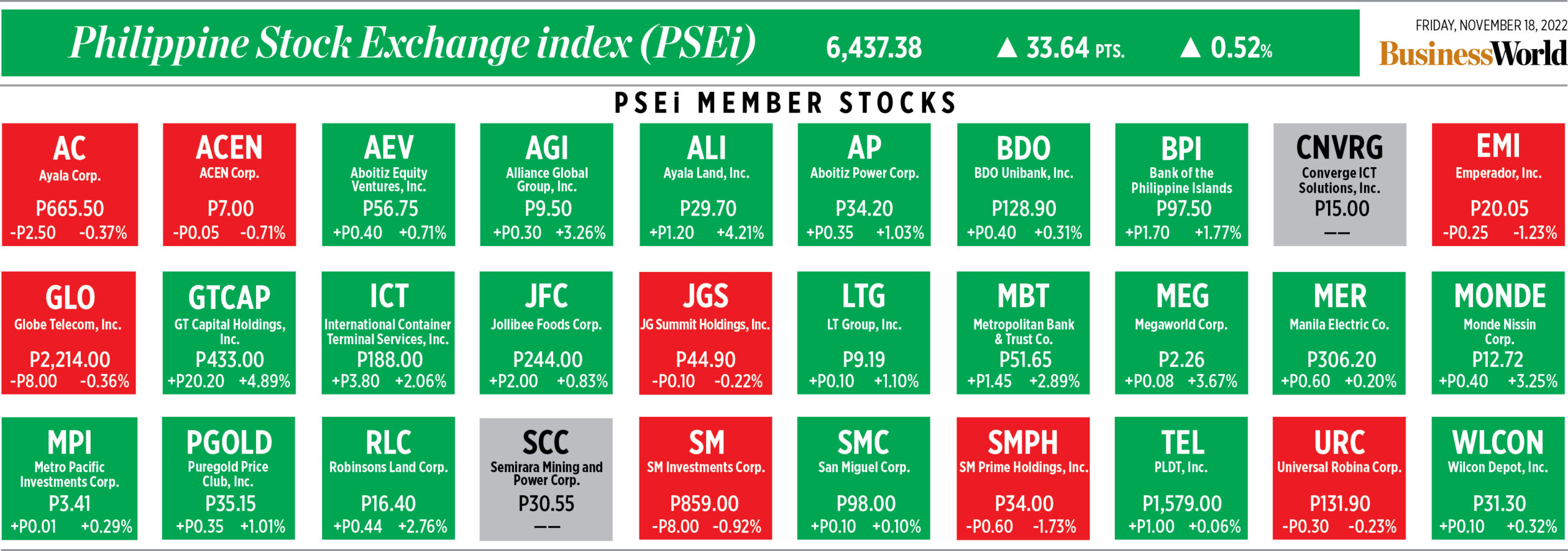
How PSEi member stocks performed — November 18, 2022

Here’s a quick glance at how PSEi stocks fared on Friday, November 18, 2022.


Peso may climb on Fed minutes

BW FILE PHOTO

THE PESO may continue to strengthen against the dollar this week ahead of the release of the minutes of the US Federal Reserve’s November meeting, which could provide hints on its next move.

The local unit closed at P57.26 on Friday, appreciating by 10 centavos from its P57.36 finish on Thursday, Bankers Association of the Philippines data showed.

However, week on week, the local unit was down by three centavos from its P57.23 close on Nov. 11.

The peso opened Friday’s trading session at P57.44 per dollar. Its weakest showing was at P57.45, while its intraday best was at P57.23 against the greenback.

Dollars exchanged decreased to $650.18 million on Friday from $661.88 million on Thursday.

The peso strengthened on Friday after the release of the latest balance of payments (BoP) data, Rizal Commercial Banking Corp. Chief Economist Michael L. Ricafort said in a Viber message.

The country recorded a $711-million BoP surplus last month, the Bangko Sentral ng Pilipinas (BSP) reported on Friday. This was lower than the $1.1-billion surplus seen in the same month last year but was an improvement from the $2.34-billion deficit logged in September. 

This was also the country’s biggest BoP surplus in seven months or since the $754 million in March and was the first time it posted a surfeit since April.

“The dollar/peso exchange rate also eased after the recent decline in global commodity prices, especially as crude oil prices at new 1.5-month lows and also near 10-month lows that could help reduce the country’s import bills/trade deficit, going forward,” Mr. Ricafort said.

Brent crude settled at $87.62 a barrel, falling $2.16 or 2.4%. US West Texas Intermediate (WTI) crude settled at $80.08 a barrel, losing $1.56, or 1.9%. Both posted weekly losses, with Brent down around 9% and WTI roughly 10%.

The peso strengthened as lower-than-expected US consumer price index (CPI) resulted in the dollar’s depreciation, UnionBank of the Philippines, Inc. Chief Economist Ruben Carlo O. Asuncion said in an e-mail.

US CPI rose to 7.7% year on year in October, slower than the 8.2% print in September.

The slower-than-expected inflation print may mean the Fed can begin to scale down its rate hikes as early as its Dec. 13-14 meeting. The Fed has already increased rates by 375 basis points (bps) since March.

For this week, industry players will watch out for the minutes of the Federal Open Market Committee (FOMC) and to look for hints on the US central bank’s next move, Mr. Asuncion said. 

Any hawkish surprise in the FOMC minutes could be mitigated by the BSP’s recent policy tightening, he added.

The BSP last week increased the overnight reverse repurchase rate by 75 bps to 5%, the highest in nearly 14 years. Rates on the overnight deposit and lending facilities were also increased to 4.5% and 5.5%, respectively.

The Monetary Board has so far raised policy rates by 300 bps since May to curb inflation and support the peso.

In an interview with Reuters on Friday, BSP Governor Felipe M. Medalla said the BSP will have to continue raising interest rates if the Fed tightens further next month.

“If the Fed does 50 (bps), we cannot have zero, right? So, the question is whether it’s 25 (bps) or 50 (bps),” Mr. Medalla said, pertaining to both central banks’ policy meetings in December.

For this week, Mr. Ricafort gave a forecast range of P57.10 to P57.50, while Mr. Asuncion expects the local unit to move within a wider range of P56.80 to P57.50 a dollar. — K.B. Ta-asan

Profit taking seen this week amid lack of leads

BW FILE PHOTO

PHILIPPINE SHARES may move sideways this week as investors could pocket profits from the market’s recent rise amid a lack of leads.

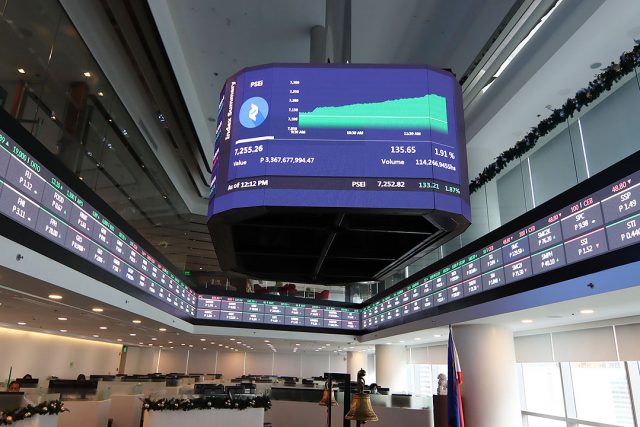
The bellwether Philippine Stock Exchange index (PSEi) gained 33.64 points or 0.52% to end at 6,437.38 on Friday, while the broader all shares index went up by 8.03 points or 0.23% to 3,396.63. 

Week on week, the PSEi rose by 150.61 points or 2.4% from its close of 6,286.77 on Nov. 11.

Philstocks Financial, Inc. Research Analyst Claire T. Alviar said in a Viber message that the PSEi went up on Friday as investors digested the third-quarter financial reports of companies that came out last week and after the policy decision of the Bangko Sentral ng Pilipinas (BSP).

Ms. Alviar added that foreign buying continued to lift the market. On Friday, net foreign buying stood at P652.19 million versus the P1.23 billion in net selling recorded the day prior.

“The market ended in green, maintaining its bullish sentiment after the widely expected 75-basis-point (bp) rate hike from the BSP, which is already priced in,” AP Securities, Inc. Equity Research Analyst Carlos Angelo O. Temporal said in a Viber message on Friday.

“Another factor that we see is the significant drop in oil prices, which is a key driver of inflation at home,” Mr. Temporal said.

The BSP on Thursday delivered an outsized rate hike to rein in rising prices as it sees inflation continuing to overshoot its target until next year.

The Monetary Board increased the overnight reverse repurchase or policy rate by 75 bps to 5%, the highest in nearly 14 years. The rates on the central bank’s overnight deposit and lending facilities were also increased to 4.5% and 5.5%, respectively.

The central bank has now hiked rates by 300 bps since May.

For this week, Mr. Temporal said the market may continue its rally, but profit taking could ensue as investors look for leads.

“We see some continuation in its rally but could be short-lived on potential profit taking as the market awaits further catalysts, prompting investors to take cues from US market sentiment in the meantime,” Mr. Temporal said.

Philstocks Financial, Inc. Senior Research Analyst Japhet Louis O. Tantiangco said the market will look to continue last week’s earnings-driven rally.

“Aside from this, investors are also expected to look for cues with respect to the monetary policy outlook of the Bangko Sentral ng Pilipinas and the Federal Reserve. Cues that would point to a slowdown in their monetary tightening may lift sentiment, while cues that would point to a continuation of their aggressive policy path may lead to otherwise,” he added.

Mr. Tantiangco said the index may retest the 6,400 resistance level this week.

Meanwhile, 2TradeAsia.com put the PSEi’s support at 6,300 and resistance at 6,500-6,600, while AP Securities’ Mr. Temporal placed support and resistance at 6,300 and 6,500, respectively. — Ashley Erika O. Jose

Mindanao WESM targeted for launch in early 2023

PSALM.GOV.PH

THE INDEPENDENT Electricity Market Operator of the Philippines (IEMOP) said it hopes to launch Mindanao’s wholesale electricity spot market (WESM) by the first quarter of next year.

In a virtual briefing, Isidro E. Cacho, Jr., IEMOP’s head of Corporate Strategy and Communications, said the launch could precede the energization of the Mindanao-Visayas Interconnection Project (MVIP).

“We are also working with the DoE (Department of Energy), ERC (Energy Regulatory Commission), PSALM (Power Sector Assets and Liabilities Management Corp.), Mindanao electric cooperatives and stakeholders, hopefully we can launch WESM before MVIP,” Mr. Cacho said in a briefing last week.

Mr. Cacho said WESM Mindanao needs to launch before the MVIP is completed.

“Hopefully we can launch the WESM before the completion of Visayas interconnection,” he said.

The P52-billion MVIP aims to connect the three main grids to ensure the sharing of energy across the network.

The project, which was certified in 2018 as an Energy Project of National Significance, was initially targeted for completion by December 2020. The NGCP then said the project is expected to be completed in 2022 due to delays caused by the pandemic.

“If the MVIP is completed first and we do not have a market yet, the question is, who would pay for the power flowing in the interconnection?” Mr. Cacho said.

According to a joint application of IEMOP and Philippine Electricity Market Corp. (PEMC) to the ERC, approval is being sought for market fees for Calendar Year (CY) 2023.

Market fees are determined under Section 30 of Republic Act No. 9136 or the Electric Power Industry Reform Act of 2001 (EPIRA), authorizing the market operator to recover the cost of administering and operating the wholesale electricity spot market.   

The joint application seeks provisional authority for IEMOP to impose a market fee of P0.0093 per kilowatt hour (kWh) on all power supply registered with the WESM, based on actual generation. It estimated that the proposed market fees for CY 2023 will generate P1.16 billion.

IEMOP is a non-profit operator of WESM.

WESM is the venue for generators to sell excess power not committed to long-term contracts. — Ashley Erika O. Jose

P250-M startup fund expected to be launched next year

AUSTIN DISTEL-UNSPLASH

THE DEPARTMENT of Trade and Industry (DTI) said it hopes to roll out a P250-million startup fund by early next year.

Trade Undersecretary Rafaelita M. Aldaba said the Startup Venture Fund (SVF) had been delayed by the change in administration.

“We’re just finalizing the guidelines and then it will be implemented. We hope that by the beginning of 2023, we will be able to do that. We had a change in administration,” Ms. Aldaba told BusinessWorld on the sidelines of a briefing in Taguig City last week.

“The new sets of leaders are still reviewing the pending projects for implementation. We are just trying to complete that process. Definitely, we are going to implement the project,” she added.

On Nov. 19, the DTI collaborated with the National Development Co. (NDC) and partnership platform for startups QBO Innovation Hub to launch the SVF.

The SVF’s P250-million budget is from the NDC and is targeted at startups in the seed to series B stage.

In a statement, Ms. Aldaba said that the startup ecosystem has grown to over 1,000 active startups.

“Looking back, the Philippine startup ecosystem has grown so much since we first got together in 2015. Back then, only 100 Philippine startups were reported to be active, with $40M in investment and funding. Today, we see individual startups raising $30M in one round alone and growing the ecosystem to more than 1,000 active startups,” Ms. Aldaba said.

Ms. Aldaba proposed that schools and universities review their curriculum to guide students into a technology entrepreneurship track.

She added that investors and industry should collaborate to develop local talent, with the government’s role seen as creating an enabling environment for startups to grow and innovate.

“While the Philippine startup ecosystem has yet to reach its full potential, we Filipinos are not lacking in talent or mindset. What we need are concrete actions to build ecosystems for startups to innovate and disrupt the status quo, building new solutions which will be our anchor in driving our future economy forward,” Ms. Aldaba said. — Revin Mikhael D. Ochave

Israel water industry sees Cebu as potential market for desalination technology

REUTERS

By Alyssa Nicole O. Tan, Reporter

ISRAEL’s water industry considers Cebu as a potential market for desalination technology to address its inadequate water supply, Israel’s economic attache to Manila said.

“Cebu has a shortage of water… and one of the (solutions) for that can be desalinated water… Israel has a lot of experience here. We have five desalination plants… we think that this experience can be very relevant to a place like Cebu,” Economic Attaché and Head of the Manila embassy’s Economic Mission Tomer Heyvi told BusinessWorld on the sidelines of the Israeli Water Technologies Roadshow.

Global water solutions provider Global Environmental Solutions and Aqwise Vice President for Business Development and Sales Harel Rauch said at the same event that the Philippines is viewed as a “very attractive market.”

He said it was “one of the markets where we want to develop operations… We find that it’s really suitable for (Israeli) technologies, and will be one of the countries that will be part of our strategy for the next few years.”

“We’ll start with partnerships with local companies, and after that, based on the operations, we’ll see if we want to open an office or not, but we truly believe it’s a country we should focus on,” he added.

Mr. Heyvi said Israel’s Foreign Trade Administration is planning to bring in a Philippine delegation in July to demonstrate its various water management technologies, with a view towards possibly forming partnerships with Philippine businesses.

“We plan to bring a big delegation from the Philippines to Israel to see with their own eyes desalination plants, treatment plants, and how water is managed in Israel,”

He described the plan to tour the delegation as a major project for next year.

“In Israel, we look at the Philippines as a potential market and a potential partner for collaboration in water,” he added. “I think that this delegation will command the attention of their Israeli counterparts.”

“Every municipality has its own operations in case of a water shortage,” he said, noting that one of the highlights of the tour could be a visit to “the second largest desalination plant in the world.”

He also touted “the efficiency of water management at the municipal level.”

Being invited to participate are Maynilad Water Services, Inc. and Manila Water Co.

“At the end of the day, we want to make sure that you are well-equipped to achieve water efficiency,” Mr. Heyvi said, noting that Israel can offer cost-efficient solutions for detecting water leaks, among others.

Last week Israel brought to the Manila its first water delegation since the beginning of the pandemic. Seven leading Israeli water technology companies met with their Philippine counterparts during their week-long stay.

“We know that some (Philippine water companies) are already using Israeli technologies like control valves, pressure valves, and water meters,” he said.

Collaboration is “already happening, but looking at the future, we brought this delegation from Israel because we think that there are certain areas that we can definitely tap,” he added. “One of them is desalination.”

Mr. Rauch said the Philippines will have to develop its wastewater treatment capabilities.

“You’re not treating all of the wastewater,” he said. “You need to increase your wastewater treatment that enable you to have, let’s say, less expensive desalination. Usually wastewater treatment requires energy, but today with new technology, new processes, you can shift (to an energy-positive stance).”

“I think this is something that may also be relevant here because of increasing energy costs and all of that,” he added. “That may be something we need to see implemented in the Philippines.”

Desalinated sea water is the second-largest source of potable water in Israel, whose five plants source water from the Mediterranean sea, with the capacity to supplying 660 million cubic meters of fresh water per year, Mr. Heyvi said.

Israel also claims global leadership in water reclamation, he added, with 87% of its water treated and reused. Reused water is the main water source for Israeli agriculture, which accounts for 55% of water consumption.

Metro Pacific Investments Corp., which has a majority stake in Maynilad, is one of three Philippine units of Hong Kong-based First Pacific Co. Ltd., the others being Philex Mining Corp. and PLDT, Inc.

Hastings Holdings, Inc., a unit of PLDT Beneficial Trust Fund subsidiary MediaQuest Holdings, Inc., has an interest in BusinessWorld through the Philippine Star Group, which it controls.