Home Blog Page 5542

Philippines improves in RE attractiveness list

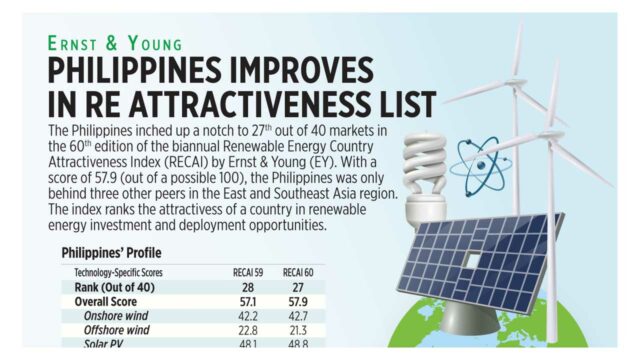
The Philippines inched up a notch to 27th out of 40 markets in the 60th edition of the biannual Renewable Energy Country Attractiveness Index (RECAI) by Ernst & Young (EY). With a score of 57.9 (out of a possible 100), the Philippines was only behind three other peers in the East and Southeast Asia region. The index ranks the attractivess of a country in renewable energy investment and deployment opportunities.

Philippines improves in RE attractiveness list

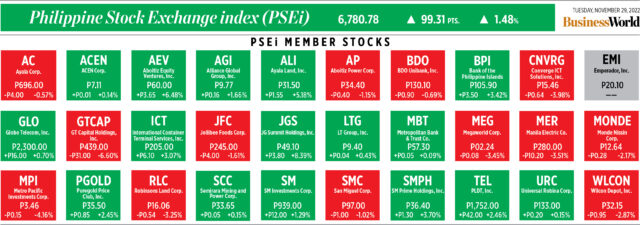
How PSEi member stocks performed — November 29, 2022

Here’s a quick glance at how PSEi stocks fared on Wednesday, November 29, 2022.


Peso strengthens vs dollar on oil, higher remittances

THE PESO strengthened against the dollar on Tuesday amid easing global oil prices and ahead of an expected increase in remittances due to the holidays.

The local unit closed at P56.56 per dollar on Tuesday, up by eight centavos from its P56.64 finish on Monday, data from the Bankers Association of the Philippines showed.

The peso opened Tuesday’s session at P56.70 against the dollar. Its weakest showing was at P56.72, while its intraday best was at P56.50 versus the greenback.

Dollars exchanged rose to $1.03 billion on Tuesday from $806.9 million on the previous trading day.

“The peso appreciated, tracking the decline in global crude oil prices and in anticipation of expected local remittances next month,” a trader said in an e-mail.

Rizal Commercial Banking Corp. Chief Economist Michael L. Ricafort likewise said that the local unit strengthened amid improving oil prices.

“Another important catalyst for the peso is the seasonal surge in OFW (overseas Filipino worker) remittances in preparation for the holidays in December,” Mr. Ricafort said in a Viber message.

Oil prices rebounded on Tuesday after falling to more than 11-month lows in the previous session, Reuters reported.

Brent crude futures advanced $1.81 or 2.2% and traded at $85 a barrel, while US West Texas Intermediate (WTI) crude futures rose $1.37 or 1.8% to $78.61 a barrel.

Brent settled down 0.5% the previous day, having slumped more than 3% to $80.61 earlier in the session to its lowest since Jan. 4. WTI settled up 1.3% on Monday after touching its lowest since December 2021.

“The peso also became stronger after the Treasury bond (T-bond) average auction, which could lower long-term borrowing costs and financing costs,” Mr. Ricafort added.

The government partially awarded the reissued 20-year T-bonds it offered on Tuesday, raising just P22.969 billion versus the P35-billion plan, even as total bids reached P65.514 billion.

For Thursday, the trader said the local currency might weaken ahead of the release of updated third-quarter US gross domestic product data on Nov. 30.

Philippine financial markets will be closed on Nov. 30, Wednesday, to commemorate Bonifacio Day.

Mr. Ricafort gave a forecast range of P56.45 to 56.65 per dollar, while the trader gave a slightly weaker estimate of P56.45 to P56.70. — Luisa Maria Jacinta C. Jocson

Last-minute bargain-hunting lifts PHL shares

PHILIPPINE STOCKS extended their climb on Tuesday on last-minute bargain-hunting and ahead of the rebalancing of the MSCI.

The bellwether Philippine Stock Exchange index (PSEi) gained 99.31 points or 1.48% to end at 6,780.78 on Tuesday, while the broader all shares index rose by 32.81 points or 0.94% to 3,513.98.

Philstocks Financial, Inc. Research Analyst Claire T. Alviar said that the PSEi went up on last-minute bargain-hunting. 

“The effectivity on Dec. 1 of the semi-annual index rebalancing of MSCI also affected the trading session,” Ms. Alviar said.

She said improving investor sentiment also continued to lift the market.

“The market saw an upswing as MSCI rebalancing period comes to a conclusion. Also, China’s reopening bets as health officials try to expedite vaccination efforts have stirred optimism in the Chinese equity market and this reverberated across the Asian region, including the Philippines,” AP Securities, Inc. Equity Research Analyst Carlos Angelo O. Temporal said.

Asian markets climbed on Tuesday after China’s pushed its vaccination efforts amid reopening pressures.

MSCI’s broadest index of Asia-Pacific shares outside Japan posted gains of 1.8%, while Hong Kong’s Hang Seng went up 3.9%.

China will speed up coronavirus disease 2019 (COVID-19) vaccinations for elderly people, health officials said on Tuesday, aiming to overcome a key stumbling block in efforts to ease unpopular “zero-COVID” curbs, Reuters reported.

“The PSEi ended the month strong with the MSCI rebalancing taking effect today. However, the market is trading at overbought conditions and it’s best to lighten up on positions,” Mercantile Securities Corp. Head Trader Jeff Radley C. See said in a Viber message on Tuesday.

Almost all sectoral indices closed higher on Tuesday. Property surged by 103.77 points or 3.57% to 3,007.70; holding firms went up by 107.32 points or 1.67% to 6,497.40; services gained 26.03 points or 1.49% to end at 1,766.97; and financials climbed by 11.24 points or 0.66% to 1,698.66. 

Meanwhile, industrials lost 73.37 points or 0.76% to close at 9,487.17 and mining and oil declined by 41.60 points or 0.4% to 10,223.02.

Value turnover rose to P23.47 billion on Tuesday with 2.23 million shares changing hands from the P8.68 billion with 729.87 million issues traded on Monday. 

Decliners outnumbered advancers, 103 versus 88, while 42 names closed unchanged.

Philstocks Financial’s Ms. Alviar placed the PSEi’s support at 6,600 and resistance at 6,800, while AP Securities’ Mr. Temporal put immediate support and resistance at 6,380 and 6,880, respectively. Mercantile Securities’ Mr. See pegged support at 6,364-6,525 and resistance at 6,877-7,000. — A.E.O. Jose with Reuters

GSIS to provide P125 billion to sovereign wealth fund

The Government Service Insurance System headquarters in Pasay, Philippines. May 28, 2012. — BW FILE PHOTO

THE government financial institutions (GFIs) that will be tapped to provide capital and help manage a P250-billion sovereign wealth fund have disclosed their proposed contributions, with the pension fund for civil servants providing half the required initial funding.

At an online hearing of the House banking committee, which is evaluating the banking-related provisions of House Bill 6398 creating the Maharlika Investment Fund (MIF), the Government Service Insurance System (GSIS) committed P125 billion, the Social Security System P50 billion, the Land Bank of the Philippines P50 billion, and the Development Bank of the Philippines (DBP) P25 billion.

Further annual contributions are expected from the Bangko Sentral ng Pilipinas and the Philippine Amusement and Gaming Corp.

The sovereign wealth fund will also be supported out of the national budget, or the General Appropriations Act.

Sovereign wealth funds are typically supported by proceeds from commodity exports such as oil, as is the practice in energy-rich countries, or other foreign exchange surpluses.

The proposal to effectively fund the MIF with pension money and bank deposits is an unusual feature of the Philippine set-up. MIF supporters have said that the wealth fund will “optimize” the investment strategies of GFIs and direct funding to government priority projects.

At the hearing, the four GFIs said that in supplying the capital to startup the MIF, they will require accommodations in how they are supervised by their regulator.

By law, government-owned and -controlled corporations (GOCCs) must remit 50% of their profits to the Treasury as dividends.

GOCCs answer to the Governance Commission for GOCCs (GCG), which ensures that GOCCs are self-sufficient and not a drain on public funds. The GCG also rules on what measures to take if a GOCC is not capable of remitting dividends.

“If we want a responsive wealth fund, fewer restrictions will be better,” DBP President and Chief Executive Officer Emmanuel G. Herbosa said at the hearing.

Manila Rep. Irwin C. Tieng, the banking committee chairman, approved the creation of a technical working group to refine the bill, and proposed to solicit further comment from finance industry professionals.

The next committee hearing is scheduled for Thursday.

Parts of the bill are also being evaluated by the House committees on appropriations and ways and means. — Beatriz Marie D. Cruz

European Chamber calls for EV tariff exemptions covering all countries of origin

REUTERS

THE European Chamber of Commerce of the Philippines (ECCP) urged the Philippines to eliminate tariffs on imports of all electric vehicles (EVs) regardless of country of origin.

In a statement, the ECCP sought tariff exemptions “for EVs imported from all countries — not only those coming from select economies.”

It is unclear whether the actual tariff reductions will be limited to certain supplier countries, as the proposed executive order (EO) on the tariff exemptions has not yet been released.

The National Economic and Development Authority (NEDA) Board has said only that it endorsed an EO cutting tariffs on EV imports.

In a letter to the Department of Energy (DoE), the ECCP said broad adoption of EVs will help the Philippines reduce its dependence on imported fuel.

“Import duties on all EVs should be lifted to accelerate the Philippines’ shift to EVs, and to spur demand for these vehicles amid high fuel costs,” the ECCP said.

The ECCP also declared its support for an EV tariff exemption on vehicles for household use until 2035.

The ECCP Automotive Committee called for the complete removal of tariffs on EV imports.

“Any types of EVs used for testing, research, marketing, and training must not be subjected to duties coming from any country,” the ECCP said in its letter to DoE.

Last week, the NEDA Board endorsed tariff reductions on EVs, including passenger cars, buses, minibuses, vans, trucks, motorcycles, tricycles, scooters, and bicycles. Tariff rates for EV parts will also be cut to 1% from 5%.

Separately, Trade Secretary Alfredo E. Pascual said during the 2022 Philippine-German Business Forum on Tuesday that the department will help promote EV adoption in the transition away from internal combustion engines.

“The Electric Vehicle Industry Development Act or EVIDA…. can offer targeted incentives to EV model and parts manufacturers in the country,” Mr. Pascual said.

“I opened a potential engagement between our two countries in the sunrise industry of EVs. The German government and the German private sector can tap the Philippines’ significant green metal reserves of nickel and copper,” Mr. Pascual said.

Separately, Mr. Pascual also solicited more partnerships with German companies in the information technology-business process management industry.

He said the initial targets are German firms that are already in the Philippines which are seeking to expand.

“Our government has made significant strides in creating an enabling environment for foreign businesses in support of our country’s recovery and growth,” Mr. Pascual added. — Ashley Erika O. Jose and Revin Mikhael D. Ochave

Marcos to sign EO fast-tracking strategic investment approvals

President Ferdinand Marcos Jr. answers questions from the media after his first Cabinet meeting in Malacañan Palace, July 5, 2022. — PHILIPPINE STAR/KRIZ JOHN ROSALES

PRESIDENT Ferdinand R. Marcos, Jr. is expected to sign an executive order (EO) that will fast-track applications for investments deemed strategic to the economy, the Palace said on Tuesday.

The order will establish a green lane in government agencies and local government units (LGUs) to streamline the issuance of permits and licenses, Acting Press Secretary Cheloy Velicaria-Garafil said in a statement.

The Department of Trade and Industry (DTI) had proposed the EO to ensure the smooth entry of foreign direct investment (FDI) and improve the Philippines’ regional competitiveness.

“That will address immediately what we call the ease of doing business, which is always complained about,” Mr. Marcos was quoted as telling DTI officials at the Cabinet meeting on Tuesday. He urged agencies to “cut down” on delays as much as possible.

The EO formally tasks government agencies and LGUs to act on applications within three business days for simple transactions, and seven business days for complex transactions.

The EO timetable is in line with the provisions of the Ease of Doing Business Act (Republic Act 11032). RA 11032 also allows 20 days for highly technical transactions.

All applications where approval is not given within the specified time are deemed approved, according to the law.

A technical working group led by the DTI’s Board of Investments will oversee the rollout of green lane services.

Ms. Garafil noted that public officers or employees that do not comply with the order’s provisions will face administrative and disciplinary sanction.

In 2020, The Philippines ranked 95th out of 190 countries in the World Bank’s Doing Business Report.

FDI net inflows fell by 12% in the first seven months of 2022, the central bank data said.

Foreign investment pledges declined 22.4% in the third quarter due to rising inflation and the ongoing Russia-Ukraine war, according to the Philippine Statistics Authority.

Approved foreign investment pledges during the first nine months of 2022 rose 15.6% to P68.28 billion. — John Victor D. Ordoñez

Technology investor briefs senators on potential foreign investment deal-breakers in legal system

FREEPIK

AN Israeli tech investor said a country’s legal system is a major consideration in attracting foreign investment, and urged legislators to reform the tax system and investment regulations.

Or Haviv, an Arieli Capital partner and the firm’s head of Global Innovation, said at a forum organized by the Israeli embassy that “the devil is in the details” when it comes to evaluating the legal system of a target company’s home country.

“If I see a legal system that’s going to be problematic for me, I’m not going to go there, that would kill the deal,” he told reporters on the sidelines of the roundtable discussion.

“How do we create a business infrastructure that is attractive to investors, that takes care of their interests, that tells them: be relaxed, if you have problems, these are your rights, this is what you do, this is how we can help you protect your rights, your position in the companies; and that’s how you attract outside forces,” he added.

Mr. Haviv and representatives from the Israeli embassy met with Senators on Monday in connection with the opening of an exhibit showcasing Israel’s innovation projects in the Philippines.

Mr. Haviv did not provide specific details of their “initial discussions” on the proposed reforms, but added that Senators must think more internationally and less so in terms of local issues and concerns.

“Get out of the mindset of local and start thinking global,” he said. “You need to think about how the Philippines can create value for the world, not just for the Philippines, because if you create value for the world, the world will come to you and the Philippines will benefit.”

Arieli Capital invests in emerging technology, deploying capital provided by high-net-worth individuals, family funds, private banks, and financial institutions.

He said the Philippines as an investment destination has a number of things going for it, including fluency in English, its potential as a gateway to other Asian markets, and a desire within the country’s leadership to improve its technological capacity.

“I heard a lot of desire to do things coming from the Philippine Senate. I think it’s great, but I think the question is, follow-up. Is there going to be follow-up?,” Mr. Haviv said. “I believe there will be. I sensed good vibes in the room, from the people.”

“If we get some partnership with the Senate and the people, then it would be a good start,” he added.

Mr. Haviv described the concentration of call centers in the Philippines as emblematic of its “low-tech” niche, which he said can be leveraged when it upgrades its technology.

“You can take this experience in low-tech in call centers and turn it around,” he said, noting that in Israel, military and security experts were turned into cyber and information technology specialists.

“So, if you take people that manage thousands of people in call centers and manage millions of customer support systems, and turn them into high-tech solutions, that can create a lot of demand for big companies like Amazon that are hiring them today as call centers,” he added.

Upgrading technology will also require government involvement, Mr. Haviv said, such as incentives and simplified dealings with companies.

Ambassador Ilan Fluss, who was speaking at the event, said the Israeli delegation will also be meeting with other government agencies to discuss more government-to-government collaboration. — Alyssa Nicole O. Tan

DBM releases P5.2 billion for cash transfer program

PHILIPPINE STAR/EDD GUMBAN

THE Department of Budget and Management (DBM) said on Tuesday that it released P5.2 billion to fund cash transfers for 9.8 million beneficiaries.

“The DBM fully supports the projects and programs that provide social assistance to our fellow Filipinos,” Budget Secretary Amenah F. Pangandaman said in a statement.

The funds cover one month worth of cash transfers administered by the Department of Social Welfare and Development (DSWD).

The program grants P500 per month for 6 months to vulnerable households to mitigate the effects of rising prices.

The DBM earlier released a total of P10.33 billion to the DSWD covering two months of cash transfers for 10 million households.

The program is estimated to cost P9.1 billion overall for the initially identified 9.8 million beneficiaries, plus an additional 2.6 million who will get three months’ worth of payments.

The DBM said the release was charged to unprogrammed appropriations, which may be tapped only if funds are available. — Luisa Maria Jacinta C. Jocson

BSP launches bill payment facility

THE Bangko Sentral ng Pilipinas (BSP) and the Philippine Payments Management, Inc. (PPMI) said they launched on Tuesday a digital payment facility known as Bills Pay PH.

According to the central bank, Bills Pay PH facilitates digital transactions between accounts on the various payment service providers.

“Through our continued collaboration with PPMI, we expect to broaden the reach of the benefits of digitalization for more Filipinos, be it individuals or businesses, through more convenient, affordable, efficient, and responsive digital payment services,” BSP Governor Felipe M. Medalla said in a statement.

The central bank’s goals include the digitization of at least half of retail payments, and to broaden financial inclusion by ensuring that at least 70% of Filipino adults have access to some type of bank account by 2023.

Transactions on Bills Pay PH are executed by scanning or uploading a QR code or by manually inputting payment details.

Bills Pay PH also features zero charges or fees for use of the interoperable facility.

Customers who have accounts with AllBank, Inc., Asia United Corporation, BDO Unibank Inc., China Banking Corp., Philippine National Bank, Queen City Development Bank, Inc., Rizal Commercial Banking Corp., Tayocash Inc., Union Bank of the Philippines, Universal Storefront Services Corp. Money Services, Inc. and Wealth Development Bank Corp. can now make digital payments to almost 500 onboarded billers.

Participating billers that maintain accounts with AllBank, Inc., BDO Unibank, Inc., Bank of the Philippine Islands CIS Bayad Center, Metropolitan Bank and Trust Co., Rizal Commercial Banking Corp., Tayocash, Inc., Union Bank, USSC Money Services, Inc., and Wealth Development Bank Corp. will also be able to receive online payments from a wider set of customers.

The facility also enables payments to Manila Electric Co. (Meralco) and PLDT, Inc., among others. — Luisa Maria Jacinta C. Jocson

Philippines expects coronavirus spike during Christmas holidays

PHILIPPINE STAR/ MIGUEL DE GUZMAN

PHILIPPINE health authorities expect a spike in coronavirus infections during the holidays in the absence of restrictions.

Daily infections could hit 1,114 to 2,294 by the end of December, while active cases could reach 18,000, the Department of Health (DoH) said on Tuesday.

“With increased mobility, social gatherings and eased restrictions, we expect spikes to occur,” Althea R. de Guzman, director of the agency’s Epidemiology bureau, told a forum streamed live on YouTube. “But there should not be any significant increase in our hospitalization rates.”

She said existing vaccines could help minimize hospitalizations even after new variants enter the country.

Edsel Maurice T. Salvaña, a member of DoH’s technical advisory group, told the same forum coronavirus deaths would remain low as long as vaccination and boosting rates are pushed.

He added that using face masks could still prevent outbreaks, decrease cases and protect people from other respiratory illnesses.

“We will have good Christmas holidays if we continue to protect one another,” Mr. Salvaña said.

The Health department said last week it had detected the first 14 cases of the BQ1 Omicron subvariant in the country.

On Monday, Mr. Salvaña told a televised new briefing health authorities had yet to determine if the new variant is a more severe form of the coronavirus. Daily infections would likely stay below 5,000 in December, he added.

The World Health Organization (WHO) first declared Omicron as a variant of concern on Nov. 26 last year.

The Philippines posted 8,004 coronavirus infections for Nov. 14 to Nov. 20, with a daily average of 1,143 cases, DoH said in a bulletin on Monday evening. There were 17 deaths from Nov. 14 to 27, it added.

The agency said 526 or 21.6% of 2,430 intensive care unit (ICU) beds were in use, while 5,169 or 25.2% of 20,508 non-ICU beds were occupied.

It added that 599 were severe and critical coronavirus patients or 9.3% of total admissions staying in hospitals.

The government is set to hold a three-day vaccination campaign on Dec. 5 to 7. To broaden the campaign, it has been coordinating with other organizations such as the Chinese community, malls, fast-food restaurants and private doctors.

DoH said 73.59 million Filipinos have been fully vaccinated against the coronavirus, while 20.72 million people have received booster shots.

The OCTA Research Group on Sunday said daily coronavirus infections in the country could hit as many as 3,000 during the Christmas holidays.

The Philippines might tally 2,000 to 3000 daily coronavirus cases in December, OCTA Research Group fellow Fredegusto P. David said in a Facebook Messenger chat.

OCTA also expects a significant increase in severe and critical cases, though hospital use rate was unlikely to exceed 30%, he added.

Mr. David had said daily cases in the country might rise if there were threats from new subvariants of the coronavirus.

The country seeks to increase its vaccination rate and booster uptake amid the possible entry of more deadly variants and subvariants. 

The WHO earlier said global weekly coronavirus cases dropped by 5% on Nov. 14 to 20 from a week earlier, with more than 2.4 million new cases reported. Weekly deaths fell by 13% to 7,800.

The United States will donate $5 million (P284 million) to boost the Philippines’ vaccination drive, the White House said last week.

The US government said it would also invest $8 million to strengthen its global health security partnership with the Philippines to “help prevent avoidable outbreaks, detect health threats early and respond rapidly and effectively when outbreaks occur.”

“It is important to ramp up vaccination efforts to maintain a high immunity wall to keep the public protected from severe or critical disease and death, even with the emergence of highly transmissible variants,” Ms. De Guzman said. — John Victor D. Ordoñez


Senate bill sets parking rates to protect public

PHILIPPINE STAR/EDD GUMBAN

A SENATOR has filed a bill fixing parking rates in all commercial and business establishments, institutions, and parking facilities in the country.

“While we respect businesses that help our economy grow, we also need to balance and protect the interests of the majority,” Senator Ramon B. Revilla, Jr. said in a statement in Filipino on Tuesday. “It’s only right that we regulate the parking fees that, sometimes, are no longer fair.”

Under Senate Bill 1463, parking rates in malls, supermarkets, restaurants, hotels, hospitals, schools and dedicated parking facilities will amount to P20 for all cars in the first three hours, plus P5 for every succeeding hour. Parking fees for motorcycles is P10 plus P2 for each extra hour.

The flat rate for overnight parking will be P100 for all cars and P50 for motorcycles. For valet service, the flat rate will be P100.

There will be additional parking fees for lost or damaged parking tickets at P100 and parking cards at P200.

The bill also allows customers to pass through and park for at most fifteen minutes for free. Customers who spend at least P500 in an establishment will get free parking for three hours.

“Sometimes, the income of our countrymen is only meager, then it will be reduced even further because of very expensive parking fees in workplaces,” Mr. Revilla said.

“It could also be that instead of being able to add to their budget for groceries, they end up paying expensive parking fees at the market or mall,” he added. “We should really pass this bill so that we can help consumers.”

He said some parking spaces, especially those in the central business districts, charge “exorbitant fees” that reach P400 for eight hours. This already covers a large portion of a worker’s daily wage.

“A bill to regulate the payment of parking spaces like malls, restaurants and other places has been pending in Congress for several years,” Mr. Revilla said. “Honestly, it should have been enacted a long time ago.”

“So now, we will really push for its passage in Congress, especially since it will heavily reduce the expenses of ordinary citizens,” he added. — Alyssa Nicole O. Tan