Home Blog Page 5478

Transformation and inspiration

FACEBOOK.COM/MAGSAYSAYAWARD

The Ramon Magsaysay Award is Asia’s premier prize and highest honor. It recognizes greatness of spirit in selfless service to the peoples of Asia, regardless of race, gender, or religion. It is Asia’s equivalent of the Nobel Prize.

Sen. Ramon Magsaysay, Jr. and Milagros Magsaysay-Valenzuela, son and daughter of the late President Ramon Magsaysay, stated, “For more than six decades, the Ramon Magsaysay Award Foundation (RMAF) has faithfully recognized outstanding individuals and organizations in Asia and celebrates their remarkable, selfless efforts to make a difference in the lives of people and communities. Through the initiative and generosity of the Rockefeller Brothers Fund, RMAF was established in 1957… It engenders hope and optimism through the Magsaysay laureates and their inspiring stories, in a world that is marred by poverty, strife, inequality, and global calamities.

“These are the heroes of today — champions of the poor and marginalized, public service superstars, advocates of truth warriors of peace, protectors of the earth, and guardians of our heritage.”

Among the global icon-laureates are Mother Teresa, India; the Dalai Lama, Tibet; Princess Maha Chakri Sirindhorn, Thailand; Akira Kurosawa, Japan; Muhammad Yunus, Bangladesh; and Mechai Viravaidya, Thailand.

The RMAF will celebrate its 65th year in 2023. President Susan B. Afan explained their ambitious dreams: “To amplify the life-affirming messages and inspiring values of the Magsaysay laureates, to further promote their successful solutions across borders, and to make them true examples of the best of humanity which young people can emulate.”

Chairman Aurelio R. Montinola III remarked: “The Ramon Magsaysay Foundation had remained constant and true to its mission — identifying outstanding leaders who have shown ‘Greatness of Spirit’ to help Asia grow with a humanistic, unselfish and Help-the-Community approach.”

Here are the 2022 laureates and their stories.

Soetheara Chhim, the founder of the Transcultural Psychosocial Organization (TPO)-Cambodia, which alleviates the suffering of the Cambodian people from trauma and mental health problems over the past decades. He recalled the Khmer Rouge regime that brutally murdered the intellectuals in the country — only 40 doctors survived. “We Cambodians were all living in deep trauma and with baskbat, literally meaning broken courage.”

He became a doctor and saw the need for psychosocial healthcare in rural areas. TPO-Cambodia offers mental health service to hundreds of thousands of Cambodians.

“This award comes with a prize money, I am donating all of this to TPO’s initiative, Operation Unchain Project, to treat and unchain more patients… To do the right thing.

“My mother named me ‘Sotheara’ which means gentle, humble, kind, and compassionate. I hope that I have lived up to this name.”

He thanked Dr. Cornelio Banaag, the Father of Child Psychiatry in the Philippines, who was his revered professor in Phnom Penh 26 years ago.

Tadashi Hattori, an eye surgeon who left Japan to take a new challenge in Vietnam.

“I am in no way an elite doctor,” he said.

“There as a shocking prevalence of cataract blindness in the country… The patients would come to the hospital only when…they have lost sight in both eyes.” He recalled a six-year-old boy who did not turn up again because he could not afford surgery. “I have not forgiven myself since then for having let the boy go…”

That was when he decided, “When patients cannot pay, I tell them… ‘No worries. It will be alright. I will pay for you from my own pocket money and so please have the operation.’

“How would you feel of you have to live in darkness for the rest of your life?… It scares me to think of life without light… If there is anything I can do as an ophthalmologist, it is to bring light to people so that they will turn their despair to hope and live a better life that they deserve to live.

“I am just filled with joy with patients when they see light again. I find happiness in working with the doctors I trained and in providing free treatment for people across the region in Asia… I know that regaining vision is not only about being able to see, but about discovering hope in light. Let there be light.”

Bernadette J. Madrid M.D. is a child protection champion. The multi-awarded pediatrician, a graduate of the University of the Philippines and Assumption Convent Iloilo, is the founder of the Child Protection Unit at Philippine General Hospital (CPU-PGH). It started 25 years ago. It has since expanded throughout the country as the Child Protection Network, with more than 115 Women and Children Protection Units and an excellent multi-disciplinary approach.

“Ending violence against children will not happen on its own. We need to fight for it. It needs planning, commitment, resources, persistence, and leadership. With it comes accountability,” Dr. Madrid emphasized.

“There are no quick fixes….

“Violence against children is a crisis! Children are fast becoming an endangered species and with them goes our humanity. We can prevent violence against children, and we know how. We are stewards of this world and particularly of the children. We are stewards of their soul.

“I am so honored that have my work recognized by Asia’s most prestigious award.

“Why me? It is like the violin player receiving recognition on behalf of the whole orchestra… I am just one violin player. The other members of the orchestra (the CPN Foundation Trustees and the teams) are here. I share this award with each one of them.”

Dr. Madrid called the audience to stand up and pledge, “Ako Para sa Bata: I am for every child.” Everyone present did.

She is the 64th recipient of the award in 64 years.

Gary Bencheghib, the handsome “Rock Star” from Indonesia, is only 28 years old. His parents are French nationals, and he grew up in Bali. He represents the RMAF’s “Emergent Leadership.”

“My short life’s journey has pretty much only revolved around plastics… My mother told me ‘if you don’t do your homework, you’ll end up being a garbage man.’

“I receive the Ramon Magsaysay Award as a garbage man.”

He was referring to his amazing work collecting tons of plastic from the rivers of Indonesia.

“It feels like a never-ending battle. We will be knee-deep in a river, cleaning it up and feeling victorious, but the very next day with big rains, the river is filled up with more trash…

“A new study reveals that there is no surface on earth without signs of plastic pollution. Every island in Indonesia and the Philippines under some shell, under some rock has plastic pollution.

“It is a call for collective action. We need to stop this disaster from destroying our plant and our health. We need to focus on scalable solutions and implement them quickly.”

He revealed that after two short years of running Sungai Watch, and due to growing awareness, they have removed some barriers.

“We have cleaned up some of the worst disaster relief areas. When we fully restore these areas, we let nature do its work. We have seen mangroves regrow.…

“Cleaning up plastics is only half the battle. Processing the trash and turning it into valuable products is a whole other game. We are collecting, sorting, processing, treating and recycling the trash that we collect.

“Join me on this lifelong journey against plastic pollution.

“No little boy dreams of becoming a garbage man but here I am a garbage man, doing everything to make sure that we have a plastic free world… We need to let our planet rest and heal.”

Congratulations to the 2022 Ramon Magsaysay Laureates for their noble mission and inspiring achievements.

Best wishes to the Board of Trustees — Aurelio R. Montinola III, Chairman; Dato Timothy Ong, Vice-Chairman; Susan B. Afan, President; Jose L. Cuisia, Jr. Treasurer, Emily A. Abrera, Randolf S. David, Ernesto D. Garilao, Cielito F. Habito, Cecilia L. Lazaro, Ramon R. del Rosario, Jr., Suzanne E. Siskel and Toshinao Urabe.


Maria Victoria Rufino is an artist, writer and businesswoman. She is president and executive producer of Maverick Productions.


mavrufino@gmail.com

The problem of rights inflation

Inflation is such that even rights are affected: when everything asked by anyone is considered a right does that then make “rights,” as a word or concept, of minimal, little, or no value?

What are we to make of a desire? Or a demand? Or even a need? If a man wishes to be called a woman, is that a right that should be respected and made the subject of legislation? Should everyone acquiesce therefore and call that man, no matter how hulking or brutish, as “ma’am”?

What if that man desires instead — or perhaps not merely desires but needs a new heart or kidney, would that be considered a right entitling him to take such away from another?

What makes a right a right rather than a mere want or privilege?

A good starting point is the axiom: we have rights because we have responsibilities.

That is a paraphrase of Cardinal John Henry Newman’s letter to William Gladstone. He was actually talking about “rights of conscience” but it serves our purpose: we have rights because corollary to those right are duties. They go together.

“A” has the right to live peacefully because A also has the simultaneous duty to live to fulfill his humanity, his “human flourishing.” Speech, beliefs, faith, travel, association, and other so-called inherent rights are the same. They are all geared to capacitate A to fulfill that purpose.

“B” on the other hand has the obligation to leave A alone. Which makes another characteristic of a true right: it does not require anything else of B except to allow A to do his thing. A true right will not require B to do, give, or say anything just to fulfill A’s duty and right.

Our constitutional system is founded on those lines, of natural law and natural rights, from a long line of thinkers, from Aristotle to Aquinas, to the Enlightenment, making their way to our 1935 Constitution which, though containing traces of the Malolos Constitution, amongst others, saw the US Constitution (coming off the American Declaration of Independence’s natural law thinking: “We hold these truths to be self-evident, that all men are created equal, that they are endowed by their Creator with certain unalienable Rights, that among these are Life, Liberty and the pursuit of Happiness”) having the most influence.

Thus, Jorge Coquia: “It is understood that the civil and political rights now provided for in the 1973 constitution, as they were in the original constitution, are based on natural law.”

There is also international law, which the Philippines considers part of its legal system (though subservient to the Constitution) and has natural law as basis. Worth pointing out are the contributions of one man to The United Nations Declaration of Universal Human Rights: natural law thinker Jacques Maritain.

However, due to politics that influenced the development of international human rights law, as well as the highly confused woke dogmas regarding intersectionality (unfortunately now being taught in our local law schools), rights have become so inflated as to be absurdly meaningless and incoherent.

Take for example that concept important to rights talk: “marginalized communities.” Set aside for the moment that rights are for all and to be equally applied, what is a marginalized community? The voiceless? The powerless?

But if your community (which only constitutes around 1-5% of the population) dominates the national discussion, makes the country hold a day or even entire month celebrating you, is able to make corporations structure their marketing and business campaigns around you, have Congress legislate in your favor, see the Supreme Court set a month in recognition of your community, have government units hold parades in your honor, make universities adjust their academic policies to accommodate your will, demand churches cower and not teach doctrines that you disagree with would that still qualify as marginalized?

And perhaps because they know their advocacies are unacceptable in many countries, human rights activists picked on the tactic of preaching that international human rights laws are “sui generis.” But sui generis according to whom? Their fellow human rights activists?

Thus, Eric Posner (“The Case Against Human Rights,” The Guardian, Dec. 4, 2014): “The central problem with human rights law is that it is hopelessly ambiguous. The ambiguity, which allows governments to rationalize almost anything they do, is not a result of sloppy draftsmanship but of the deliberate choice to overload the treaties with hundreds of poorly defined obligations.”

Speaking of which, one malignant consequence of rights inflation is government inflation: an increasingly larger bureaucracy needing more and more taxes to feed it just to enforce every new privilege (disguised as “rights”) that come along.

This is why ultimately, we need a clearer, proper, and more accurate view of rights, to ensure that our citizens, particularly students (and definitely law students) do not have their minds confused and poisoned with ridiculous progressive ideologies disguised as “social justice” and “inclusivity.”


Jemy Gatdula is a senior fellow of the Philippine Council for Foreign Relations and a Philippine Judicial Academy law lecturer for constitutional philosophy and jurisprudence

www.facebook.com/jigatdula/

Twitter @jemygatdula

Want to be a gamer? Filipinos need more than P100,000 for basic hardware, report says

Building a gaming PC (personal computer), complete with all components and peripherals necessary for a gamer, costs 1.4 times the average wage in the Philippines, according to a recently released report by Picodi.com, an international e-commerce platform.  

A full gaming PC set in the Philippines is priced at $1,768, or P101,670. This accounts for 1.4 times the average wage of P72,051 net, landing the country in 21st place out of the 50 countries surveyed in terms of PC-price-to-average-wage ratio. 

The cost for a comparable PC set in Argentina is $4,238, the highest price globally, taking about 12.4 average net wages for an Argentinian gamer to afford. Citizens of Pakistan and Indonesia are the runners-up for least favorable ratio, costing $1,685 (or 10.4 average wages) and $1,713 (or 8.7 average wages). 

Meanwhile, the most favorable ratios are enjoyed by gamers in Switzerland, with a PC set costing $1,653, or 0.3 of average wage, followed by the United States ($1,562 or 0.4 of average wage) and Australia ($1,610 or 0.4 of average wage). 

In addition to the one-time expense on gaming hardware, gamers also must spend on the newest games on a regular basis. Assuming an average of one game purchase a month, Filipino gamers will have to spend P29,520 annually. 

Picodi.com used the average prices of popular computer components, gaming peripherals (mouse, keyboard, headset and monitor), and video games based on data from digital gaming store Steam. The report took average wage data from national statistics sites and used Google Finance’s exchange rates from this November. — B. H. Lacsamana


Twitter suspends account tracking Elon Musk’s jet

Twitter Inc. suspended an account tracking its owner Elon Musk’s private jet in real-time, with the billionaire threatening legal action against the account’s operator after saying his son had been mistakenly followed by a “crazy stalker.” 

The suspension comes just a month after Mr. Musk, who bought Twitter for $44 billion in October, said his commitment to free speech extended to not banning the account. 

ElonJet, operated by 20-year-old university student Jack Sweeney, had tracked the movements of Musk’s private jet using data available in the public domain before the suspension. 

Mr. Sweeney’s other accounts were also suspended at the time of reporting. 

Twitter and Mr. Sweeney did not respond to Reuters’ requests for comments. 

Twitter briefly reinstated the “bot,” or automated, account before again suspending it, after saying sharing “live location information” was a violation of its policy. 

Mr. Musk had said in a tweet in November that his commitment to free speech “extends even to not banning the account following my plane, even though that is a direct personal safety risk.” 

On Wednesday, Mr. Musk said: “Any account doxxing real-time location info of anyone will be suspended, as it is a physical safety violation.” 

“Doxxing” is the public release of sensitive information identifying an individual or organization, such as a home address or phone number. 

“Posting locations someone traveled to on a slightly delayed basis isn’t a safety problem, so is ok,” Mr. Musk said. 

The billionaire also tweeted that one of his sons, lil X, had been harassed, and linked it to the tracking accounts. 

“Last night, car carrying lil X in LA was followed by crazy stalker (thinking it was me), who later blocked car from moving & climbed onto hood,” he said. 

“Legal action is being taken against Sweeney & organizations who supported harm to my family.” 

Mr. Sweeney, a student at the University of Central Florida, who also operates similar bot accounts tracking Musk’s jet on Facebook, Instagram, and Telegram, told BuzzFeed the suspension is “a surprise to many people after he publicly said he wouldn’t do it.” 

“It just shows that they can play the rules however they want to, really, for whoever they want,” he said. 

Mr. Sweeney tweeted on Saturday that Ella Irwin, Twitter’s vice president of trust and safety, requested the account be filtered and less visible to users. 

In previous media interviews, Mr. Sweeney said he turned down a $5,000 offer from Mr. Musk in 2021 to shut down the account. 

Separately, Twitter accounts tracking the jets of billionaire tech entrepreneurs Mark Zuckerberg, Jeff Bezos, and Bill Gates were also suspended. — Reuters

British nurses begin first ever strike as pay dispute deepens

Image via Duncan C/Flickr/CC BY-NC 2.0

LONDON — National Health Service (NHS)  nurses in Britain will strike on Thursday in their first ever national walkout, as a bitter dispute with the government over pay ramps up pressure on already-stretched hospitals at one of the busiest times of year. 

An estimated 100,000 nurses will strike at 76 hospitals and health centers on Thursday, canceling thousands of non-urgent operations, such as hip replacements, and tens of thousands of outpatient appointments in Britain’s state-funded NHS. 

Britain is facing a wave of industrial action this winter, with strikes crippling the rail network and postal service, and airports bracing for disruption over Christmas. 

Inflation running at more than 10%, trailed by pay offers of around 4%, is stoking tensions between unions and employers. 

Of all the strikes though, it will be the sight of nurses on picket lines that will be the stand-out image for many Britons this winter. 

“It is deeply regrettable some union members are going ahead with strike action,” health minister Steve Barclay said. 

“I’ve been working across government and with medics outside the public sector to ensure safe staffing levels — but I do remain concerned about the risk that strikes pose to patients.” 

The widely admired nursing profession will shut down parts of the NHS, which since its founding in 1948 has developed national treasure status for being free at the point of use, hitting healthcare provision when it is already stretched in winter and with backlogs at record levels due to COVID delays. 

Barclay said patients should continue to seek urgent medical care and attend appointments unless they have been told not to. 

The industrial action by nurses on Dec. 15 and Dec. 20 is unprecedented in the British nursing union’s 106-year history, but the Royal College of Nursing (RCN) says it has no choice as workers struggle to make ends meet. 

Nurses want a 19% pay rise, arguing they have suffered a decade of real-terms cuts and that low pay means staff shortages and unsafe care for patients. The government has refused to discuss pay. 

The government in Scotland avoided a nursing strike by holding talks on pay, an outcome which the RCN had hoped for in England, Wales and Northern Ireland, but Mr. Barclay is not budging. 

The government has said it cannot afford to pay more than the 4–5% offered to nurses, which was recommended by an independent body, and that further pay increases would mean taking money away from frontline services. 

The RCN has accused the government of “belligerence.” It said as late as Tuesday that the strikes could still be stopped if the government was prepared to negotiate. 

Some treatment areas will be exempt from strike action the RCN has said, including chemotherapy, dialysis and intensive care. 

Polling ahead of the nursing strike showed that a majority of Britons support the action, but once the walk-outs are underway politicians will be closely monitoring public opinion. — Reuters

Fed’s Powell says inflation battle not won, more rate hikes coming

WASHINGTON — The Federal Reserve will deliver more interest rate hikes next year even as the economy slips towards a possible recession, Fed Chair Jerome Powell said on Wednesday, arguing that a higher cost would be paid if the US central bank does not get a firmer grip on inflation. 

Recent signs of slowing inflation have not brought any confidence yet that the fight has been won, Mr. Powell told reporters after the Fed’s policy-setting committee raised its benchmark overnight interest rate by half a percentage point and projected it would continue rising to above 5% in 2023, a level not seen since a steep economic downturn in 2007. 

Those rises in borrowing costs would come despite an economy that Fed officials projected will operate at near stall speed through next year, with an annual growth rate of 0.5% and an unemployment rate nearly a full percentage point higher by the end of 2023, well beyond the increase historically associated with a recession. 

“We don’t talk about this kind of recession, that kind of a recession. We just make these forecasts,” Mr. Powell said in a news conference. “I wish there were a completely painless way to restore price stability. There isn’t, and this is the best we can do.” 

He described the slow rate of economic growth penciled in by Fed officials next year as still “modest.” 

“I don’t think it would qualify as a recession … That’s positive growth,” the Fed chief said, even though “it is not going to feel like a boom.” 

But other aspects of the Fed’s projections, notably a rise in the unemployment rate to 4.6% from the current 3.7%, are consistent with a downturn settling in as the central bank keeps its target policy rate at a “restrictive level” for at least the next two years. 

The rate increase on Wednesday, which was approved unanimously by Fed policymakers and widely expected by financial markets, lifted the targeted policy rate to the 4.25%–4.50% range, with officials expecting it to rise to a level between 5.00% and 5.25% next year. 

If anything, the bias is higher: seven of 19 policymakers projected even higher rates will be needed, and US central bankers are unanimous that the risks are tilted towards higher-than-expected inflation rather than a surprise in the other direction. 

Still, Mr. Powell said, repeating the hard-line on enforcing the Fed’s 2% inflation target that he has developed through the year, “the largest amount of pain, the worst pain, would come from a failure to raise rates high enough and from us allowing inflation to become entrenched.” 

“The new economic projections imply an even higher pain threshold than before” for a Fed willing to tolerate the equivalent of about 1.6 million lost jobs, wrote Aneta Markowska, chief financial economist at Jefferies. “This suggests hawks still outnumber the doves by a significant margin.” 

Even with recent improvements, the Fed’s preferred measure of inflation remains around triple the central bank’s target, and policymakers project it will take at least three years to fall all the way back. 

Only two of 19 Fed officials see the benchmark overnight interest rate staying below 5% next year, a sign of a still broad consensus to lean against inflation. 

The message from the Fed on Wednesday also leaned against market expectations that recent data showing slowing inflation might push the central bank from its hawkish path and move policymakers toward cutting rates before the end of next year. 

“Getting markets to hear that is key to fixing financial conditions” that have loosened in recent months as inflation data has improved, a move counter-productive to the Fed’s inflation-fighting strategy, said Carl Riccadonna, chief US economist at BNP Paribas. 

‘RESTRICTIVE ENOUGH’
The new statement was released after a policy meeting at which officials scaled back from the three-quarters-of-a-percentage-point rate increases delivered at the last four gatherings. 

US stocks closed lower on Wednesday. In the US Treasury market, which plays a key role in the transmission of Fed policy decisions into the real economy, yields were little changed to slightly lower. The dollar dipped against a basket of currencies. 

“Taken together, today’s statement and economic projections tell a simple, but persuasive story: this Fed isn’t prepared to ‘pivot’ in any meaningful way until it sees sustained and conclusive evidence of a reversal in inflationary pressures,” said Karl Schamotta, chief market strategist at Corpay. 

Mr. Powell said the speed of coming rate rises is less critical now than earlier in the year when the central bank was “front-loading” rate hikes to catch up with accelerating prices. 

“It’s not as important how fast we go,” he said, noting the bigger question facing policymakers is finding an “appropriately restrictive” endpoint and determining how long to stay there. 

“Our focus right now is really on moving our policy stance to one that is restrictive enough to ensure a return of inflation to our 2% goal over time, it’s not on rate cuts,” Mr. Powell said. 

“The inflation data received so far in October and November show a welcome reduction in the pace of price increases, but it will take substantially more evidence to give confidence inflation is on a sustained downward path,” Mr. Powell said. — Reuters

Pag-IBIG Fund launches virtual Pag-IBIG mobile app

Pag-IBIG Fund successfully launched the virtual Pag-IBIG mobile app to bring services closer to members. In photo are Pag-IBIG Fund officials (from left) Chief Legal Counsel Atty. Marcial Pimentel, Jr., Trustee Pedrito Angeles, Deputy CEO Benjamin Felix, Jr., Trustee Ma. Lorelei Fajardo, Chief Executive Officer Marilene Acosta, Trustee Mylah Roque, Deputy CEO Alexander Aguilar, Trustee Atty. Cornelio Aldon, Deputy CEO Atty. Robert John Cosico, and Trustee Anthony Cesar Arellano.

Pag-IBIG Fund officially launched the Virtual Pag-IBIG Mobile App to bring its services closer to members as it marked its 42nd anniversary on Dec. 14.

President Ferdinand Marcos Jr. recognized Pag-IBIG Fund’s accomplishments over the years and welcomed the launch of its official mobile app through a recorded message for the agency.

“Through the years, the Pag-IBIG Fund has stayed true to its goal to realize the dreams of millions of Filipinos by providing secure savings programs and dependable and affordable housing loans,” said Marcos. “Today, we also welcome the launching of the Virtual Pag-IBIG Mobile Application. The app will bring Pag-IBIG Fund’s services and benefits closer to every Filipino. In line with the unwavering commitment of this administration to digitize and streamline our services, be assured that this administration is committed to support you as you implement housing and development programs and initiatives,” the president added.

Secretary Jose Rizalino Acuzar of the Department of Human Settlements and Urban Development (DHSUD), who also heads the 11-member Pag-IBIG Fund Board of Trustees, meanwhile, assured members that Pag-IBIG Fund will continue to make use of information technology to improve its processes and services.

“I congratulate the Pag-IBIG Fund for launching the Virtual Pag-IBIG Mobile App. This service innovation will significantly help in providing social benefits to our fellow Filipinos, in line with the call of President Marcos to maximize the use of information technology in the delivery of public service,” Acuzar stated.

Pag-IBIG Fund Chief Executive Officer Marilene Acosta demonstrated the service features and the user-friendly interface of the agency’s mobile app during the launch.

“With the Virtual Pag-IBIG Mobile App, our members can now get their Pag-IBIG Membership ID number, view the status of their Housing or Short-Term Loans, make online payments and create a Virtual Pag-IBIG account by using just their smartphones. Plus, once our members have their own Virtual Pag-IBIG accounts, they can also view their savings and annual dividends, the balance and due dates of their loans, as well as their payment records. And, we shall add even more features to the mobile app over the coming months. With the Virtual Pag-IBIG Mobile App, we are literally bringing our services to the palm of each members’ hand,” Acosta said.

The Virtual Pag-IBIG Mobile Application is available for download via the Apple Store and Google Play. The mobile app has been downloaded by more than 750,000 users since its beta version was made available in August this year.


Spotlight is BusinessWorld’s sponsored section that allows advertisers to amplify their brand and connect with BusinessWorld’s audience by enabling them to publish their stories directly on the BusinessWorld Web site. For more information, send an email to online@bworldonline.com.

Join us on Viber to get more updates from BusinessWorld: https://bit.ly/3hv6bLA.

Bankman-Fried charges showcase US prosecutor’s growing role in crypto enforcement

Bitcoin cryptocurrency representation is pictured on a keyboard in front of binary code in this illustration taken Sept. 24, 2021. — REUTERS

NEW YORK — When he took office as the top federal prosecutor in Manhattan in late 2021, Damian Williams pledged to prioritize “rooting out corruption in our financial markets.” 

Now, with the fraud charges filed earlier this week against Sam Bankman-Fried, the founder of the bankrupt FTX exchange, Mr. Williams has further solidified his office’s growing role in prosecuting financial crimes involving cryptocurrency, according to interviews with a half-dozen former prosecutors. 

“Every US attorney is defined in the public eye by some of the biggest cases that they bring,” said Harry Sandick, a partner at law firm Patterson Belknap and former Manhattan federal prosecutor. “This will forever be connected to the current US attorney.” 

The indictment against Mr. Bankman-Fried — who was charged with using billions in stolen customer funds to buy real estate, pay debts for his hedge fund, Alameda Research, and donate to political campaigns — situates Mr. Williams as a primary adversary for the high-profile entrepreneur whose downfall has captured public attention and led to calls for greater regulation of cryptocurrency platforms. 

Mr. Bankman-Fried, 30, has acknowledged risk management failures at FTX but said he does not believe he has criminal liability. His lawyer said he is evaluating his legal options. On Tuesday, a judge in The Bahamas ordered him detained there while he contests a US extradition request. 

Mr. Williams led the Southern District of New York’s (SDNY) securities and commodities task force before being nominated as the district’s top prosecutor by President Joseph R. Biden, Jr. Mr. Williams, SDNY’s first Black US attorney, earned his law degree from Yale and clerked for former Supreme Court Justice John Paul Stevens as well as current Attorney General Merrick Garland when Mr. Garland was an appellate judge. 

Earlier this year, Mr. Williams brought the first-ever insider trading cases involving digital assets with charges against a former employee of non-fungible token trading platform OpenSea as well as a former product manager at Coinbase Global Inc , an FTX rival. 

Both those defendants have pleaded not guilty. 

SDNY has long been known as one of the most muscular enforcers of financial crimes, and some former prosecutors compared Mr. Williams’ string of crypto-related prosecutions to the focus on insider trading by Preet Bharara, who served as US Attorney from 2009 to 2017 and secured convictions of fund managers such as Raj Rajaratnam. 

Mr. Williams was a prosecutor on several high-profile financial crimes cases during Mr. Bharara’s tenure, including the insider trading conviction of former Goldman Sachs board member Rajat Gupta and the fraud conviction of a former portfolio manager at Visium Asset Management LP. 

“Crypto is the Wild West, but at the end of the day fraud is fraud,” said Mike Ferrara, a former prosecutor and now an attorney with Kaplan Hecker & Fink LLP in New York. “Damian is doing a good job of saying, ‘we’re going to push the envelope in crypto,’ the way Preet was aggressive about insider trading.” 

A spokesman for Mr. Williams’ office declined to comment. 

‘COME SEE US BEFORE WE COME SEE YOU’
Pursuing cryptocurrency-related prosecutions is not without challenges. Defense lawyers may argue that because the sector is relatively new and questions about how it will be regulated are still being worked out, their clients were not clear on how laws crafted for traditional finance applied to them. 

“The government is having trouble keeping up and making clear to participants in the industry what they’re supposed to be doing,” said Elise Maizel, a professor at NYU School of Law and former white-collar defense lawyer. “With these criminal cases, a lot of the time they’re regulating through enforcement.” 

In one setback for prosecutors, three former founders of crypto exchange Bitmex and its first employee — who pleaded guilty to charges brought by Mr. Williams’ predecessor of failing to establish an anti-money laundering program — earlier this year received lighter sentences than prosecutors requested. 

The judge in that case said that while the crime was serious, prosecutors had not brought more weighty charges of money laundering or fraud, and there were no identifiable victims. 

To be sure, Mr. Williams’ office has pursued more traditional financial crimes cases as well, with charges filed this year against the founder of Archegos Capital Management for lying to banks to obtain loans before the firm’s meltdown, and against the former chief investment officer at a unit of Germany’s Allianz SE for inflating fund results. 

Both pleaded not guilty. 

In the wake of Mr. Bankman-Fried’s arrest, Mr. Williams has made clear he would plow on with cryptocurrency enforceme

nt. On Wednesday, he announced wire fraud conspiracy charges against the founders of two separate cryptocurrency mining and trading companies he called Ponzi schemes. 

The five individuals charged in one of the cases have pleaded not guilty, while the three individuals charged in the other have not yet entered pleas. 

On Tuesday, Mr. Williams told reporters more charges in the FTX probe were possible. 

“This investigation is very much ongoing and it is moving very quickly,” Mr. Williams said. “To anyone who participated in wrongdoing at FTX or Alameda Research and who has not yet come forward, I would strongly encourage you to come see us before we come see you.” — Reuters

China’s COVID spike not due to lifting of restrictions — WHO director

PEOPLE wearing face masks are seen at a subway station in Shanghai, China, Jan. 18, 2021. — REUTERS

GENEVA — Coronavirus disease 2019 (COVID-19) infections were exploding in China well before the government’s decision to abandon its strict “zero-COVID” policy, a World Health Organization (WHO) director said on Wednesday, quashing suggestions that the sudden reversal caused a spike in cases.

The comments by the WHO’s emergencies director Mike Ryan came as he warned of the need to ramp up vaccinations in the world’s No. 2 economy. 

Speaking at a briefing with media, he said the virus was spreading “intensively” in the nation long before the lifting of restrictions. 

“There’s a narrative at the moment that China lifted the restrictions and all of a sudden the disease is out of control,” he said. 

“The disease was spreading intensively because I believe the control measures in themselves were not stopping the disease. And I believe China decided strategically that was not the best option anymore.” 

Beijing started pivoting away from its signature “zero-COVID” policy this month after protests against the economically damaging curbs championed by President Xi Jinping. 

The sudden loosening of restrictions has sparked long queues outside fever clinics in a worrying sign that a wave of infections is building, even though official tallies of new cases have trended lower recently as authorities eased back on testing. 

In its most recent COVID report for the week to Nov. 27, the WHO said China had reported increasing hospitalizations for four consecutive weeks. 

“So the challenge that China and other countries still have is: are the people that need to be vaccinated, adequately vaccinated, with the right vaccines and the right number of doses and when was the last time those people had the vaccines,” said Dr. Ryan. 

WESTERN VACCINE 

The elation in China that met the changes in policy allowing people to live with the virus has quickly faded amid mounting concerns about surging infections because the population lacks “herd immunity” and has low vaccination rates among the elderly. 

WHO’s senior epidemiologist Maria Van Kerkhove said the UN agency was providing technical advice to China and Ryan said there were open channels. 

Among the first major announced deals in which a Western drugmaker will supply China with COVID therapies, China Meheco Group Co. Ltd. said on Wednesday it would import and distribute Pfizer’s oral COVID-19 treatment Paxlovid. 

Earlier in the briefing, WHO chief Tedros Adhanom Ghebreyesus said he was “hopeful” that the pandemic, which has killed more than 6.6 million people since it emerged in Wuhan, China, three years ago, will no longer be considered a global emergency some time next year. — Reuters


A smart investment along the flourishing C5-Pasig corridor

Artist's perspective of SYNC's building facade

The C5 road has continuously improved as a main avenue in recent years, especially in Pasig. The city itself has developed into a vibrant area making it a strategic and desirable location for real estate investments. As one of the metro’s newest growth corridors, it is brimming with possibilities for contemporary urban dwellers, including smart investment opportunities like RLC Residences’ SYNC.

This four-tower development is a promising and amazing real estate asset for new and seasoned investors due to the following reasons:

Location

Artist’s perspective of SYNC’s Sky Bridge

An amazing investment starts with the right location that easily connects residents to where they need to be. Given its strategic address along C5 Road, SYNC is an in-demand home that potential renters and even home finders would look for. Having direct access to this major city road easily connects them to key central business districts and important hubs – including Ortigas, Bonifacio Global City, Kapitolyo, and Bridgetowne destination estate.

Aside from these, SYNC is a perfect entry point to major malls like Robinsons Galleria, hospitals like St. Luke’s and The Medical City, and even universities such as UP BGC and Ateneo School of Medicine.

Best-Sized Units with Upgrades

Artist’s perspective of two-bedroom unit with balcony at SYNC N Tower

Zooming in on the details of the property, SYNC is home to multiple flats that are well-spaced for its future residents. Its newly-launched N Tower offers studio, one- and two-bedroom units with balcony options. Having this as your investment means offering a unit for lease for potential renters who are on the lookout for a city home that can provide a place to work, live, and even relax.

Inside these units are multiple home upgrades integrated to help soon-to-be residents live an amazing city life. All homes will have Smart Home features for added safety and security. Main doors will have a Smart Lock accessible by PIN, fingerprint, and manual key; Audio-Video Intercom to screen guests even before they go up the unit; and Smart Lights that can be adjusted with a mobile phone app. A work-from-home provision is also found in each home for those who want a separate space for work or for their hobbies. Lastly, kitchen and toilet and bath upgrades such as cabinets with glass doors, pull-out pantry drawer, and glass shower enclosure are also added for comfort and convenience.

Numerous Amenities

Artist’s perspective of SYNC’s indoor pool

As more people look for a place where they can be at their best, that home should be able to help them live a balanced life. At SYNC, more than 20 indoor and outdoor amenities are found inside – catering to various individual pursuits.

Fitness goals are supported at SYNC, as the development has its own Gym, Yoga Area, and Jog Trail exclusively accessible to residents. Leisure and bonding are also addressed here with indoor and outdoor pools, a Grilling BBQ area, a Private Theater, and a Game Room found inside SYNC. For those who want to just chill and relax and have a good view of the city, the Sky Deck and Sky Bridge are the perfect places to be at.

Having all these will surely make your unit a sought-after home that they would like to live in.

Limited-Time Investment Deal

Sealing the deal, this standout property offers a 5% discount on the newly-launched N-Tower units available for a limited time only. So consider SYNC as your first, or next investment – whether you opt to live here or put this for lease in the future.

Learn more about this condo investment by connecting with an RLC Residences Property Specialist via rlcresidences.com or by following them on Facebook and Instagram.


Spotlight is BusinessWorld’s sponsored section that allows advertisers to amplify their brand and connect with BusinessWorld’s audience by enabling them to publish their stories directly on the BusinessWorld Web site. For more information, send an email to online@bworldonline.com.

Join us on Viber to get more updates from BusinessWorld: https://bit.ly/3hv6bLA.

PHL growth likely 2nd fastest in SE Asia

Shoppers fill the streets of Divisoria, Manila, Dec. 8. — PHILIPPINE STAR/EDD GUMBAN

THE PHILIPPINES is expected to be the second fastest-growing economy in Southeast Asia this year and in 2023, despite global headwinds, according to the Asian Development Bank (ADB).

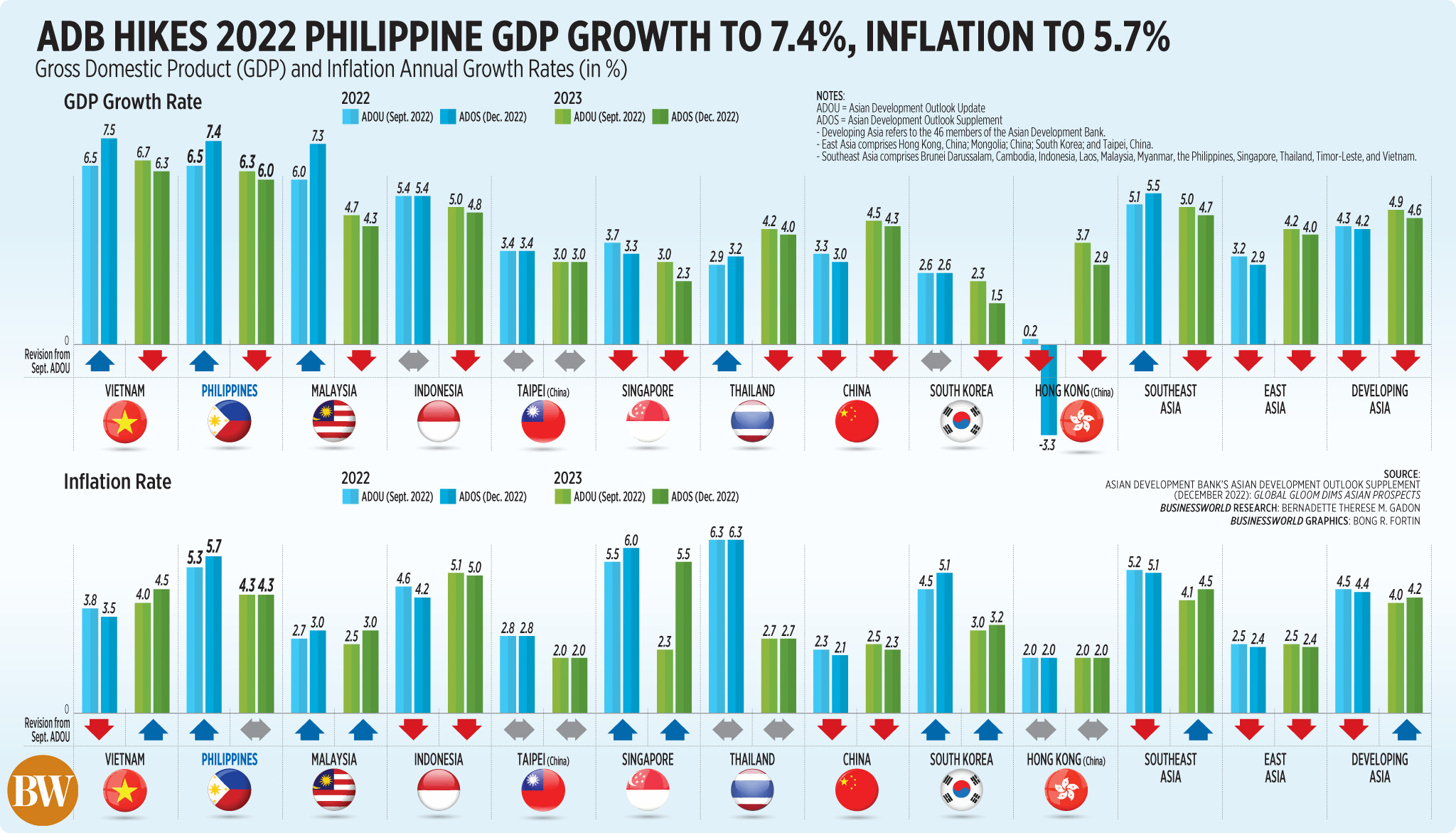
In its Asian Development Outlook (ADO) 2022 Update released on Wednesday, the ADB revised its Philippine gross domestic product (GDP) growth forecast upwards to 7.4% this year, higher than the 6.5% estimate given in September.

The latest GDP forecast for 2022 is within the government’s 6.5-7.5% full-year target.

ADB hikes 2022 Philippine GDP growth to 7.4%, inflation to 5.7%

At 7.4%, the Philippines is expected to be the second fastest-growing economy in Southeast Asia this year after Vietnam (7.5%). This forecast is also above the ADB’s 5.5% growth outlook for the Southeast Asia region, which was raised from 5.1% in September.

“The Philippine economy has shown strong underlying growth momentum and resilience in 2022 and this is expected to continue in 2023, with GDP growth converging towards its longer-term growth rate of about 6%,” ADB Philippines Country Director Kelly Bird said in a statement.

The ADB lowered its GDP forecast for the Philippines to 6% for 2023, from 6.3% previously. This is at the low end of the government’s 6-7% target for next year.

The ADB’s 6% forecast for the Philippines in 2023 is the second-fastest among Southeast Asian economies, following Vietnam’s 6.3%. This is also above the ADB’s 4.7% outlook for Southeast Asia next year, which was downgraded from 5% previously.

“There are downside risks to growth in 2023, including inflation stickiness, further increases in interest rates, and a sharper-than-expected slowdown in GDP growth in advanced countries,” Mr. Bird said.

The multilateral lender said Philippine inflation is expected to average 5.7% this year, up from the September estimate of 5.3%, before slowing to 4.3% in 2023.

At a briefing, Mr. Bird said core inflation is now peaking in advanced economies, but the Philippines may be two quarters behind.

Headline inflation accelerated to 8% in November from 7.7% in October. For the 11-month period, inflation averaged 5.6%, still lower than the central bank’s 5.8% full-year forecast but well above its 2-4% target.

Core inflation, which excludes volatile prices of food and fuel, climbed 6.5% in November from 5.9% in October. In the months to November, core inflation averaged 3.7%.

“So we might expect inflation to peak soon and start to hopefully gradually decline in two to three years. I remember that the central bank recognizes this concern and they have been very proactive in their response,” Mr. Bird said.

The Bangko Sentral ng Pilipinas (BSP) has hiked policy rates by 300 basis points and is widely expected to raise it by 50 bps today (Dec. 15).

DEVELOPING ASIA
Meanwhile, the ADB downgraded slightly its growth forecast for developing Asia this year and 2023, amid global monetary tightening, the prolonged Russia-Ukraine conflict, and slower global expansion.

The ADB trimmed its GDP projection for developing Asia to 4.2%, from its 4.3% projection in September.

For 2023, the multilateral lender cut its growth outlook for developing Asia to 4.6%, from 4.9% previously.

Excluding China, the rest of developing Asia is projected to grow by 5.4% in 2022 and 4.6% in 2023.

“Asia and the Pacific will continue to recover, but worsening global conditions mean that the region’s momentum is losing some steam as we head into the new year,” ADB Chief Economist Albert Park said in a statement.

“Governments will need to work together more closely to overcome the lingering challenges of COVID-19, combat the effects of high food and energy prices — especially on the poor and vulnerable — and ensure a sustainable, inclusive economic recovery.”

Despite the lower forecasts, the ADB said developing Asia will still see better growth and lower inflation than other regions

ADB cut its inflation forecast in developing Asia to 4.4% this year, from 4.5% previously.

However, the bank upgraded its inflation projection for next year to 4.2%, from 4% previously “due to lingering inflationary pressures from energy and food.” — Keisha B. Ta-asan

Vehicle sales post double-digit growth for 9th straight month

Vehicles are stuck in traffic along EDSA, Cubao in Quezon City, Aug. 18. — PHILIPPINE STAR/ MIGUEL DE GUZMAN

THE AUTO INDUSTRY continued its strong recovery, posting double-digit sales growth for the ninth straight month in November.

A joint report by the Chamber of Automotive Manufacturers of the Philippines, Inc. (CAMPI) and Truck Manufacturers Association (TMA) showed vehicle sales jumped by 32.4% to 35,037 units in November, from 26,456 in the same month in 2021. Month on month, vehicle sales grew by 9%.

“The auto sales performance has been improving, recording double-digit growth for nine successive months,” CAMPI President Rommel R. Gutierrez said in a separate statement.

Commercial vehicle sales rose by 43% to 26,106 in November from 18,251 units sold in the same month in 2021. It accounted for 74.51% of the industry’s total sales.

Month on month, commercial vehicle sales went up by 9.4%.

Broken down, sales of light commercial vehicles (LCVs) jumped by 43.9% year on year to 20,211 units, while sales of Asian utility vehicles (AUVs) increased by 52.4% to 4,938 units in November.

Sales of passenger vehicles climbed by 8.8% to 8,931 in November, from 8,205 units sold in the same month last year. Month on month, passenger vehicle sales rose by 7.68%.   

The auto industry is on track to hit its sales target this year.

CAMPI-TMA members posted a 31% increase in sales to 315,337 units in the January-to-November period, from 240,642 units a year ago.

“With the continued growing consumer demand for new motor vehicles, the industry is convinced and confident in exceeding its sales forecast of 336,000 this year,” Mr. Gutierrez said.

Commercial vehicles have driven the industry’s recovery, as it posted 45.3% year-on-year sales growth to 238,054 in the January-to-November period. Sales were led by LCVs, which jumped by 48.5% to 187,101 units sold, while AUV sales rose by 44.3% to 41,812 units.

Passenger car sales were flat, inching up by 0.6% to 77,283 units in the 11-month period.

“The automotive industry underscores the importance of pent-up demand from consumers supported by continued economic recovery, boosting business and consumer confidence. These, alongside the containment of the pandemic, are significant factors towards sustained growth,” Mr. Gutierrez said.

Among car brands, Toyota Motor Philippines Corp. dominated the industry with a 49.75% market share with 156,874 units sold in the January-to-November period.

Other top car manufacturers include Mitsubishi Motors Philippines Corp. with a 14.81% market share or 46,692 units sold, followed by Ford Motor Co. Phils., Inc. with a 6.80% share or 21,450 units sold; Nissan Philippines, Inc. with a 6.14% share or 19,373 units sold; and Suzuki Phils., Inc. with a 5.75% share or 18,118 units sold. — R.M.D.Ochave