Home Blog Page 5439

Hong Kong flags COVID quarantine policy change, wants an orderly opening-up

MAN CHUNG-UNSPLASH

 – Hong Kong leader John Lee said on Tuesday the government aims to make an announcement soon on its controversial COVID-19 hotel quarantine policy for all arrivals, as it wants to keep the city connected with the rest of the world and allow an “orderly opening up“.

Lee said he was conscious Hong Kong needed to retain its competitiveness, adding that authorities were keen to bring back events and activities to the city.

“We know exactly where we should be heading and want to be consistent as we move in that direction. We would like to have an orderly openingup…because we don’t want to have chaos or confusion in the process,” he told reporters.

The changes could be announced this week, local media reported.

Taking its cues from China which is pursuing a zero-COVID policy, Hong Kong is one of the few places in the world to still require travelers from abroad to quarantine upon arrival although the length of quarantine has eased over time. Currently, arrivals must pay for three days in a hotel and follow that with four days of self-monitoring.

Business groups, diplomats and many residents have slammed this rule and the city’s other COVID restrictions, saying they threaten Hong Kong‘s standing as a global financial center.

The rules have fueled an exodus of both expats and local families that was kickstarted by Beijing’s efforts to exert control over the former British colony and limit freedoms. Some 113,000 people have left since mid 2021, according to government figures.

They have also forced airlines to drop dozens of flight routes to and from Hong Kong which used to boast one of the world’s busiest airports, while scores of events have been cancelled or postponed.

In contrast, rival financial hub Singapore is hosting a slew of high-profile conferences this month that has seen business boom for hotels and restaurants. Read full story

As part of its efforts to get business back to a more normal footing, Hong Kong is planning to host a major finance conference and the international Rugby Sevens in November. Bankers have said quarantine-free travel is a precondition for attending the conference.

It is unclear whether other COVID restrictions will also be relaxed. Hong Kong still bans public groups of more than four people and masks are mandatory, even for children as young as 2. – Reuters

New Zealand raises alert level on giant Taupo volcano

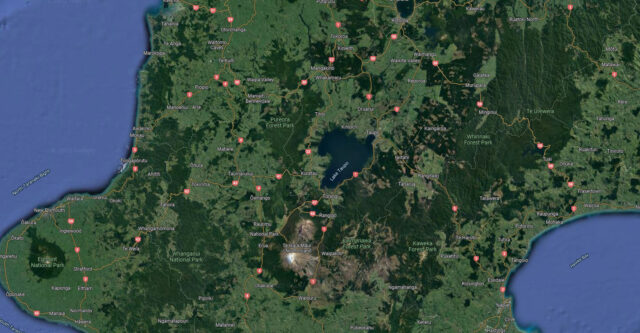
Screenshot from Google Maps

 – New Zealand scientists on Tuesday increased the alert level for the volcano below the country’s biggest lake, which caused the largest eruption on earth in the past 5,000 years when it last exploded about 1,800 years ago.

In a statement, geological agency GeoNet said it had detected almost 700 small earthquakes below Lake Taupo, the caldera created by the giant volcano, and had raised the volcanic alert level to 1 from 0.

The volcanic alert system is based on six escalating levels of unrest, but Geonet notes that eruptions may occur at any level, and levels may not move in sequence as activity can change rapidly.

The Taupo volcano spewed more than 100 cubic kilometers of material into the atmosphere when it last erupted around 200 BCE, devastating a large area of New Zealand‘s central North Island in a period before human habitation. Geonet says the eruption was the largest on the planet in the past 5,000 years.

GeoNet added this was the first time it had raised the Taupo Volcano alert level to 1, but this was not the first time there had been unrest and said the chance of an eruption remains very low.

“The earthquakes and deformation could continue for the coming weeks or months,” it said.

New Zealand straddles the boundary between the Pacific and Australian tectonic plates and experiences significant volcanism and earthquakes.

In 2019, White Island, as known as Whakaari, suddenly erupted, spewing steam and ash, killing 22 people and seriously injuring 25, mostly tourists. – Reuters

August BoP deficit lowest since April

PIXABAY

THE PHILIPPINES’ balance of payments (BoP) position remained in a deficit for a fifth straight month in August, mainly due to the National Government’s foreign debt payments, the central bank said on Monday.

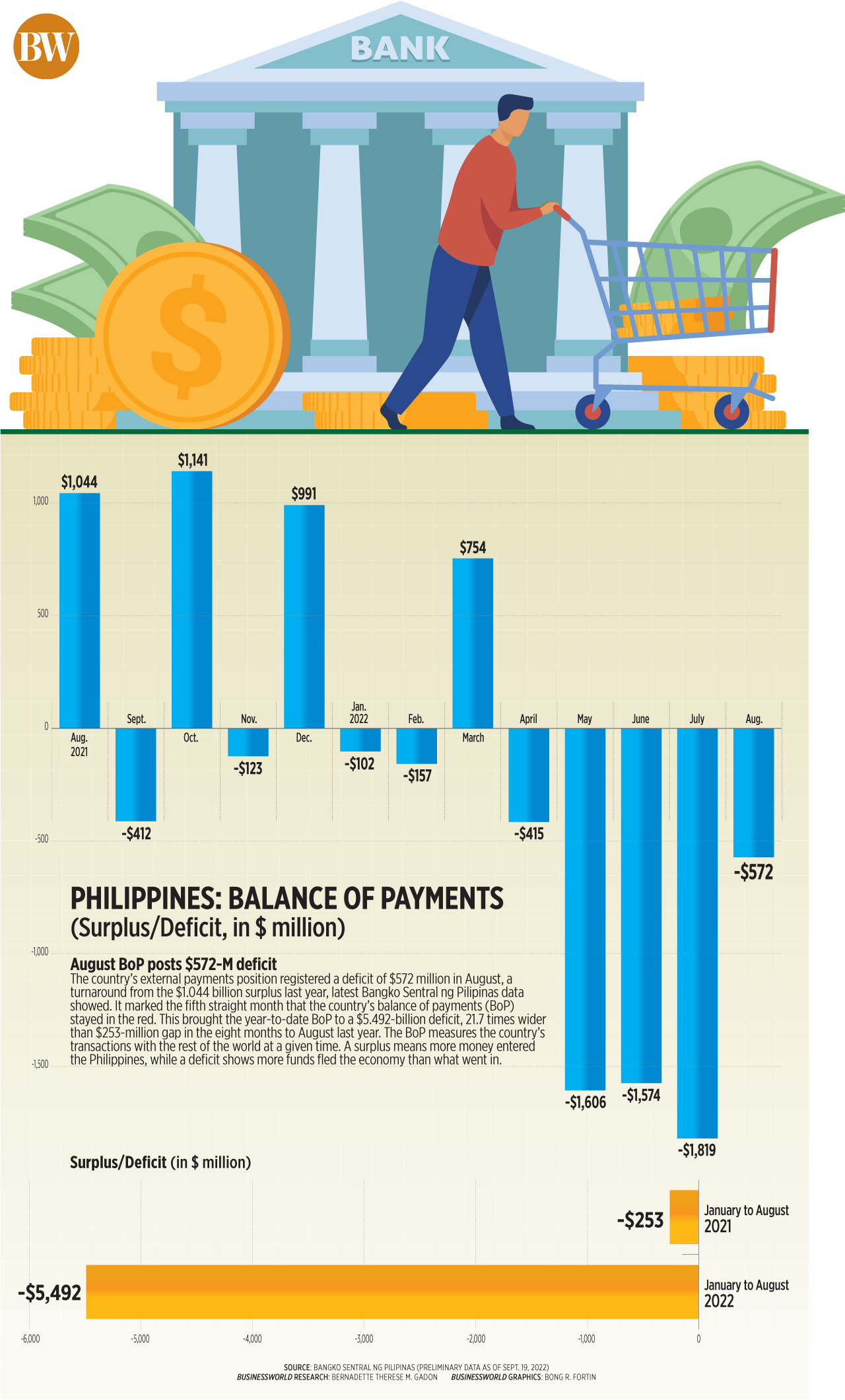
Data released by the Bangko Sentral ng Pilipinas (BSP) on Monday showed the country’s BoP deficit stood at $572 million in August, a turnaround from the $1-billion surplus recorded in the same month last year.

Still, this was the lowest deficit posted in four months or since the $415 million seen in April. The August BoP gap was also lower than the $1.819-billion deficit recorded in July.

Philippines: Balance of paymentsThe BoP measures the country’s transactions with the rest of the world at a given time. A deficit means more funds fled the economy than what went in, while a surplus shows that more money entered the Philippines.

“The BoP deficit in August 2022 reflected outflows arising mainly from the National Government’s foreign currency withdrawals from its deposits with the BSP to settle its foreign currency debt obligations and pay for its various expenditures,” the central bank said in a statement.

For the first eight months of the year, the country’s BoP deficit widened to $5.492 billion from the $253 million seen in the same period in 2021.

The BSP expects the country’s BoP position to end the year at an $8.4-billion deficit equivalent to -2% of gross domestic product amid weaker global demand. In 2021, the Philippines posted a BoP surplus of $1.345 billion.

“Based on preliminary data, this cumulative BoP deficit reflected the widening trade in goods deficit,” the BSP said.

The Philippines’ merchandise trade deficit hit a record $5.843 billion in June amid rising imports, bringing the first-half trade balance to a $29.793-billion gap, ballooning from the $17.953 billion seen in the comparable year-ago period.

The central bank said the eight-month BoP position reflects the final gross international reserves level of $97.4 billion at end-August, decreasing by 2.4% from $99.8 billion as of July.

“The narrower BoP deficit in recent months may have to do with some recovery in the local financial markets, especially the stock and bond markets, from their lows in June 2022, as well as the sharp decline in global oil and other global commodities that could help reduce the country’s trade deficit,” Rizal Commercial Banking Corp. Chief Economist Michael L. Ricafort said in a Viber message.

He said the continued inflow of remittances amid increased spending due to the reopening of schools and the sustained growth in business process outsourcing receipts also supported the country’s BoP position.

“However, from January-August 2022, the significantly wider BoP deficit… may be largely brought about by the significantly wider trade deficits as imports have been bloated by elevated global commodity prices earlier this year, largely attributed to the Russia-Ukraine war as well as the further reopening of the economy towards greater normalcy that also led to some pickup in imports,” Mr. Ricafort said.

He said the continued decline in the prices of oil and other commodities would help narrow the country’s trade in goods deficit. The seasonal increase in remittances during the holidays could also help make up for this gap, Mr. Ricafort added. — Keisha B. Ta-asan

Private firms’ debt-to-GDP ratios ease in Q2 as economy recovers

ALEXES GERARD-UNSPLASH

THE SHARE of the private sector’s outstanding debt in Philippine gross domestic product (GDP) eased in the second quarter, data from the Institute of International Finance (IIF) showed, amid a rebound in business activity and improved economic conditions.

The IIF’s global debt monitor released last week showed the debt-to-GDP ratios of Philippine households, nonfinancial corporations, and the financial sector went down year on year to 14.8%, 31.3%, and 10.5%, respectively, as of the second quarter from 16.4%, 32.4%, and 11.7%.

However, the Philippine government’s debt-to-GDP ratio rose to 58.3% in the second quarter from 55.2% last year, IIF’s report showed.

To compare, government data released last month showed the Philippines’ debt-to-GDP ratio stood at 62.1% in the quarter, lower than 63.5% recorded at end-March but still above the 60% threshold considered manageable by multilateral lenders for developing economies.

“The ratio of household debt, non-corporate, and financial sector debt-to-GDP all fell because of much improved business and economic conditions in the second quarter. The rise in income and revenues enabled many sectors to pay off debts and finance their activities,” University of Asia and the Pacific Senior Economist Cid L. Terosa said in an e-mail.

“Meanwhile, the ratio of government debt to GDP rose because of economic recovery programs and measures that had to be financed with debt. It is a necessary evil to borrow and spend more now to sustain economic resurrection,” Mr. Terosa said.

Rizal Commercial Banking Corp. Chief Economist Michael L. Ricafort attributed the improvement in economic conditions to the further reopening of the economy, which led to higher revenues for both the public and private sector.

“The further reopening towards greater normalcy, compared to some lockdowns a year ago, led to higher incomes and correspondingly reduced the need for these sectors to borrow,” Mr. Ricafort said in a Viber message.

“Many businesses, industries, and individuals experienced reduced sales, livelihood, and employment, while government expenditures ballooned on ayuda (cash aid) and other financial assistance and various coronavirus disease 2019 (COVID-19) programs,” he added.

The Philippine government implemented one of the longest and strictest lockdowns in the world to contain the COVID-19 pandemic in 2020, which caused GDP to contract by 9.6% that year.

Since March, Metro Manila and most provinces have been under the least strict quarantine measures, with the government earlier this month also allowing the voluntary wearing of face masks in outdoor areas where social distancing is possible.

Bank of the Philippine Islands Lead Economist Emilio S. Neri, Jr. said the private sector’s debt ratios declined last quarter on the back of an expanding economy.

“GDP growth played a large role here as we grew 7.8% in the first half, with a much higher denominator lowering the entire equation,” Mr. Neri said. “The economy’s reopening also helped improve employment and incomes, which help households lower their debt. With better business and household incomes, government revenues also improved in the process, causing the equation to fall further.”

Asian Institute of Management economist John Paolo R. Rivera said the job market’s recovery amid the resumption of business operations enabled the private sector to finance their debt despite the weakening of the local currency.

“Their debts are not affected by currency depreciation as it is mostly locally sourced, in my opinion. This is also driven by a growing GDP that is faster than debt growth,” Mr. Rivera said in a Viber message.

“Meanwhile, government debt continues to increase, likely due to currency depreciation and possibly additional debt sourcing. As such, government debt may also have been growing faster than GDP,” he added.

Philippine GDP expanded by 7.4% in the second quarter of 2022, slower than 12.1% a year earlier and 8.2% in the preceding three-month period.

INFLATION WOES
However, Ateneo de Manila University economics professor Leonardo A. Lanzona said in a Viber message that households and private firms are not borrowing as much and limiting their expenses to “maintain their financial viability” as economic conditions remain challenging, especially with inflation reaching multi-year highs.

“Higher inflation and interest rates, after record lows during the height of the pandemic, led to lower borrowings by these sectors,” Mr. Ricafort said.

In contrast, the government has been borrowing more as the country continues to recover from the impact of the coronavirus pandemic.

“The government borrowed a total of about P5 trillion since the pandemic, as the lockdowns led to wider budget deficits with sharp reduction in government tax revenue collections,” Mr. Ricafort said.

Outstanding National Government debt stood at P12.79 trillion at the end of June, reflecting ramped up borrowings to finance its response to the pandemic.

“The government seems to be moving forward with their expenditures beyond their budgetary capacity. Its debt does not seem to benefit the other sectors because otherwise its increased resources should have made easier for the other sectors to have the same debts,” Mr. Lanzona noted.

“The problem stems from this false narrative being propagated by the National Government that the state of the economy is fine, or that the recovery is moving smoothly, and so we can outgrow the debt,” he added. “Growth has been lower than expected, inflation continues to remain high, high rates of underemployment, and increasing poverty. On top of this, virus cases are still surging in certain areas.”

Headline inflation eased to 6.3% in August from a near four-year high of 6.4% in July. This brought the eight-month average to 4.9%, higher than the central bank’s 2-4% target but still below its 5.4% forecast for the year. — Diego Gabriel C. Robles

FIRB decision on WFH to create employment, boost IT-BPM sector

KEVIN KU-UNSPLASH

By Revin Mikhael D. Ochave, Reporter

THE RECENT DECISION of the interagency Fiscal Incentives Review Board (FIRB) to allow work-from-home (WFH) arrangements for information technology and business process management (IT-BPM) firms will help the industry grow and create more jobs, the IT and Business Process Association of the Philippines (IBPAP) said on Monday.

IBPAP President and Chief Executive Officer Jack Madrid said in a statement on Monday that the FIRB’s decision to allow hybrid work arrangements if IT-BPMs transfer their registration will help the industry expand further.

“WFH/hybrid work is a game changer for the Philippines and the sustainability of the IT-BPM industry, and it will be a contributing factor to our ability to create 1.1 million new direct jobs for Filipinos, generate billions more in revenue, and significantly increase our countryside footprint by 2028,” Mr. Madrid said.

“After two years of making a case for what the benefits of WFH/hybrid work are, it is great news that the FIRB will be facilitating a smooth paper transfer of the registration of IT-BPM enterprises from the Philippine Economic Zone Authority (PEZA) to the Board of Investments (BoI),” he added.

Last week, the FIRB announced that registered IT-BPM firms in economic zones can implement 100% WFH arrangements and still avail of fiscal incentives by transferring their registration from the PEZA to the BoI, ending a months-long impasse.

The FIRB said the 70% on-site work and 30% WFH arrangement ratio currently being implemented by IT-BPM firms has been extended until Dec. 31 this year to allow time for the transfer.

Republic Act No. 11534 or the Corporate Recovery and Tax Incentives for Enterprises requires registered business enterprises, including IT-BPM firms, to conduct operations within an ecozone in order to enjoy fiscal incentives.   

Mr. Madrid said during an interview in BusinessWorld Live on One News channel that several IT-BPMs have already signified their intent to transfer their registration to the BoI.

“There are 478 IT-BPM firms that are PEZA-registered that applied for letters of authority. I expect that a good number of those who want to give their employees full flexibility will be applying and expressing their interest to paper transfer to the BoI,” he said.

There are about 2,000 IT-BPM firms registered with PEZA that may transfer to the BoI.

“(The decision to transfer) will depend on the enterprise on what their priorities are. But it does seem that the solution by the DoF (Department of Finance) and FIRB resolves the majority of the issues that we’ve been tackling,” Mr. Madrid added.

He said the decision of the FIRB on work arrangements will also help improve the attrition rate in the IT-BPM industry and attract more Filipinos to work in the sector.

“Given the talent supply and demand mismatch, I think this seamless transfer and allowance of full flexibility will soften the impact of attrition, which is one of our biggest issues as an industry,” Mr. Madrid said.

“I think that it will certainly address the problem of the availability of talent to fill all the jobs for Filipinos in the IT-BPM sector. Will some reduce their workspaces? I expect so, but I believe a good number will also need more space as they receive more work and contracts from our overseas customers,” he said.

Meanwhile, one factor that may affect the decision of IT-BPMs to transfer their registration to the BoI is the one-stop shop service offered by PEZA, Mr. Madrid said.

“Aside from fiscal incentives, which are uniform across all investment promotion agencies, the main attraction of PEZA is and has always been the one-stop shop suite of services that they are able to provide to their locators,” he said.

“It is a big deal because it reduced a lot of the administrative tasks and allows investors to do what they set out to do. This will remain a very prominent feature of remaining with PEZA,” he added.

In 2021, the local IT-BPM industry posted $29.49 billion in revenues, higher by 10.6% from 2020 levels, while total headcount improved 9.1% to 1.44 million, based on IBPAP data.

Foreign asset managers acquire stocks in AbaCore

ABACORE Capital Holdings, Inc. on Monday announced that New-York based brokerage firm and investment bank Auerbach Grayson & Co. placed a block of stock in the listed holding firm with major foreign institutional asset managers.

In a media release, a representative of AbaCore said the investment was made due to several factors such as its “robust expansion plans that will increase the company’s bottom line and boost shareholders’ return on their investments.”

It also noted that AbaCore’s stock has more room for growth due to its price being “undervalued” relative to its book value.

AbaCore did not disclose the amount or details of the transaction. It also did not identify the seller’s identity except to say that the asset managers are based in North America and Europe.

The firm tapped WeCap, Inc., a boutique advisory firm based in Manila, to represent the sellers in the deal.

“We are pleased to work with Auerbach Grayson in this transaction. WeCap is grateful for the opportunity to advise clients in directing their investments towards companies that have successfully demonstrated long-term growth potential,” WeCap Chief Executive Job M. Ambrosio said in the press release.

In quoted David Grayson, chief executive of Auerbach Grayson, as saying: “We have been doing business in the Philippines market for almost 30 years and despite world events, we continue to see interest and opportunity in the Philippines as its economy continues to grow, We are uniquely positioned to work with WeCap as our firm knows the market well and we specialize in dealing in non-US companies.”

Earlier this year, AbaCore said that it was pursuing ventures with business partners across multiple sectors.

The company had signed a coal exploration agreement with Oriental Vision Mining Philippines, Inc. (ORVI). Under the agreement, ORVI will conduct exploration work on three coal blocks from AbaCore in Surigao del Sur.

The company is also developing an energy hub that covers 103 hectares in Batangas. It also sold land to a subsidiary of A. Brown Co., Inc. for the development of a liquefied natural gas facility.

AbaCore has businesses involved in coal and gold mining, financial services, leasing of gaming equipment, and real estate.

The release described Auerbach Grayson as building its global network “by establishing partnerships with local and regional brokers and banks in emerging, frontier and developed markets worldwide, with analysts in every region.”

It also said the firm provides US institutional investors with trade execution and in-depth local equity research from its local partners.

In the first half of the year, AbaCore incurred an attributable net loss of P10.84 million, reversing a net income of P86.82 million in the same period last year.

At the stock exchange on Monday, AbaCore shares declined by 2.16% or P0.05 to close at P2.26 apiece. — Luisa Maria Jacinta C. Jocson

CLI’s Calle 104 brings P13.5-B reservation sales

VISAYAS-MINDANAO property developer Cebu Landmasters, Inc. (CLI) has recorded more than P13.5 billion in reservation sales after selling out an upscale residential project in Cebu City.

“The sales velocity of the project shows that there is a growing demand for upscale residential developments coinciding with the economic recovery and progress of Cebu City,” CLI Chief Executive Officer Jose R. Soberano III said in a press release on Monday.

The P2.4-billion Calle 104, the company’s eighth launch in the region this year, was sold out within three days, the firm said.

“Majority of its buyers are medical professionals, particularly doctors, who choose Calle 104 as their investment of choice,” it added.

Mr. Soberano said “prominent families in Cebu” are the target market for the mixed-use project.

“Its outstanding performance is also attributed to its strategic location, which is very close to major hospitals in Cebu City,” he said.

Calle 104 is a joint venture project of CLI and Borromeo Brothers Estate, Inc. under Cebu BL-Ramos Ventures, Inc. It is located in Cebu City’s Ramos and Ranudo streets.

“Its name refers to the number of an iconic home, the Garcia-Escaño Mansion on Ranudo Street, adjoining another property on perpendicular Ramos Street,” CLI said.

The 5,530-square meter (sq.m.) property has two towers: Ramos Tower has 20 floors while Ranudo Tower has 18 floors.

Aimed at young professionals, Ramos Tower has 325 studio and one-bedroom units, while Ranudo Tower has 192 studios and three-bedroom penthouse units.

Prices of the units range from P3.5 million to P23.7 million. The old Garcia-Escaño landmark was restored to make way for the development.

Among the amenities are swimming pools, function rooms, a jogging path, and a gym.

Calle 104, which is expected to be completed by the fourth quarter of 2026, is projected to bring P3 billion in gross revenues.

Its two towers will be connected by a retail podium, which will have a 5,000-sq.m. gross floor area open to restaurants, clothing, and shops for essentials.

The project will also host a 2,300-sq.m. supermarket in its basements “for the convenience of residents.”

On Monday, shares in CLI lost three centavos or 1.22% to finish at P2.42 apiece. — Justine Irish D. Tabile

Phinma unit Philcement takes out P1-B loan for expansion

A SUBSIDIARY of Phinma Corp. availed of a P1-billion term loan for the expansion of its cement facility to be taken from the proceeds of the parent company’s bond issuance.

Philcement Corp., a 60%-owned unit of Phinma, availed of the loan on Sept. 16 for 1.5 years at the current market rate, the listed firm said in a disclosure to the stock exchange on Monday.

Phinma said that its board of directors approved the loan as part of a plan to support the growth of its strategic business units, which include investment holdings, property development, construction materials, educational services, and business process outsourcing.

The loan proceeds will be used by Philcement to fund the expansion and improvement of its facility in Mariveles, Bataan.

“This is aligned with [Philcement’s] promise to assure Filipino consumers with reliable, high-quality supply of cement products under its legacy brand, Union Cement,” the company said.

On May 6, 2021, Phinma filed with the Securities and Exchange Commission the registration statement of its proposed offering of P2-billion fixed rate bonds due 2024.

It had an oversubscription option of up to P1 billion and had an offer price of 100% of face value, as stated in the company’s information statement.

The company was issued the certificate of permit to offer securities for sale on Aug. 10, 2021. The bonds’ interest rate was set at 3.53%.

Philcement is one of the companies under Phinma’s construction materials group along with Union Galvasteel Corp. and Phinma Solar Corp.

In the first half, the construction material group posted a 13% increase in consolidated revenues to P7.07 billion.

However, the group’s net income declined 19.7% to P443.28 million from P551.89 million last year, which the company attributed to higher costs amid global supply chain issues.

Phinma’s topline jumped by 10.1% to P8.63 billion in the first semester from P7.84 billion in the same period a year ago.

Meanwhile, its attributable net income declined by 7.4% in the first half to P406.83 million from P439.34 million in the same period last year.

On Monday, shares in Phinma closed higher by 25 centavos or 1.22% to P20.75 apiece. — Justine Irish D. Tabile

Petron offers 170-gram LPG refillable cylinders in Cebu

PETRON Corp. has started offering a 170-gram liquefied petroleum gas (LPG) refillable small cylinder in Cebu, the oil company announced on Monday.

“Our new Fiesta Gas 170-gram in refillable cylinders allows the vast majority of Filipino consumers to get their hands on a quality yet affordable LPG product from a brand they can trust,” said Virgilio V. Centeno, vice-president for industrial sales of Petron, in a press release.

Petron said that its small LPG cylinder is in line with the government’s efforts to discourage the use of illegally refilled butane canisters.

Mr. Centeno said Petron is aiming to expand its efforts in the Visayas and Mindanao, which have reported cases of single-use butane canisters illegally refilled with LPG.

“The Department of Energy (DoE) strongly advises against this kind of product which is prone to leaks and can trigger accidental combustion, potentially harming users. Cebu, in particular, has recorded an alarming number of fire incidents resulting from the backyard or illegal refilling of butane canisters,” the listed company said.

Meanwhile, Rino E. Abad, director of the DoE’s Oil Industry Management Bureau, said that the department would also intensify its efforts against illegal refillers to ensure the safety of consumers.

“We appeal to the public to stop using illegally refilled butane canisters and prioritize their safety. As we’ve reiterated in the past, these do not comply with the Department of Trade and Industry or Bureau of Fire Protection standards on safety and quality, making them extremely dangerous,’ Mr. Abad said.

Republic Act No. 11592 or the LPG Industry Regulation Act calls for an LPG cylinder improvement program to ensure the quality of cylinders in circulation and to strengthen consumer protection. The law also regulates the domestic LPG industry to ensure consumer protection against malpractices.

“As with any LPG product, safety should always be the main consideration. Small refillable LPG cylinders warrant stringent safety standards, and the only way this can be guaranteed is if a product is legally refilled and purchased from legitimate sellers,” Mr. Centeno said.

Petron said the Fiesta Gas refillable cylinder is available in Cebu through Petron’s network of LPG dealer stores and service stations.

On Monday, shares in Petron closed unchanged at P2.85 apiece. — Ashley Erika O. Jose

Beyond Rizal: Dapitan hosts major film festival

PHOTO BY MICHELLE ANNE P. SOLIMAN

As the CCP closes for renovation, the independent film fest looks beyond Metro Manila’s borders

BEST known as the place where national hero Jose Rizal spent four productive years in exile, Dapitan has now made a name for itself as a major venue for the Cinemalaya Independent Film Festival.

Having returned to physical screenings in August after two years held online because of the COVID-19 pandemic, Cinemalaya traveled for the first time to Mindanao in September.

Cinemalaya was established in 2005 to help in the production Filipino independent films, discover and support young Filipino filmmakers; and promote Filipino independent films locally and internationally.

Starting out with nine full-length films and six shorts in competition, that first year the festival drew 8,000 people over five days at four screening venues in the Cultural Center of the Philippines (CCP). Through the next 17 years, the festival screened an estimated 2,500 films (both full-length features and shorts), and supported 2,593 filmmakers.

CINEMALAYA IN DAPITAN
With the film festival’s return to cinemas, its events branched outside Manila to Dapitan in Zamboanga del Norte. Cinemalaya 18 Dapitan: Festival of Winners was held from Sept. 9 to 13.

According to Festival Director and former CCP Vice-President and Artistic Director Chris B. Millado, the local government of Dapitan City, led by the office of Mayor Seth Frederick Jalosjos, expressed an interest in bringing the festival to their city.

The local government originally hoped to host this year’s Cinemalaya 18 closing ceremonies in the city, however the schedule did not allow it.

Adamant about pushing through with festivities in Dapitan, the plans for Cinemalaya 18 in Dapitan: Festival of Winners were finalized within “less than two months” from the film festival in Manila, said Mr. Millado, who spoke to BusinessWorld during the festival in Dapitan.

“[They] (The local government) wanted the filmmakers to be present instead of just having the screenings. So, we came up with the idea of Festival of Winners,” Mr. Millado explained.

The Zamboanga del Norte provincial tourism council helped in spreading the news about the film festival in the region.

“They were to reach five communities as far as six hours away from Dapitan and different school campuses. They were able to reach 800 students which they are also busing in to watch the screenings,” he said.

“The objective is to attract film production from outside of Dapitan to shoot here and develop your local young filmmaker’s capacity,” Mr. Millado said of the decision to bring the film festival outside Manila.

READY TO HOST
The Cinemalaya 18 in Dapitan: Festival of Winners opened with a red-carpet gala on Sept. 9 at the Dapitan City Cultural and Sports Center.

The participating films were all winners at the Cinemalaya festival in August: Anna Isabelle Matutina’s 12 Weeks (which won a Special Jury Prize, NETPAC Jury Prize, and Best Actress ); Ma-an L. Asuncion-Dagñalan’s Blue Room (Best Director, Best Supporting Actor, Best Cinematography, Best Production Design); Carlo Obispo’s The Baseball Player (Best Film, Best Actor, Best Screenplay, Best Editing); T.M. Malones’ Kargo (Audience Choice Award); and Short films category winners Gabriela’s Serrano’s Dikit (Best Direction, and Special Jury Prize), and Zig Dulay’s Black Rainbow. (Best Short Film, Best Screenplay, NETPAC Jury Prize); and Arlie Sweet Sumagaysay and Richard Jeroui Salvadico’s Mga Handum Nga Nasulat sa Baras (The Dreams that are Written in the Sand) which won Audience Choice Award.

There were also special screenings of Xeph Suarez’s City of Flowers, Raz Dela Torre’s Kwits; Mark Moneda’s See You George; and Martika Escobar’s Leonor Will Never Die.

The films were screened in Teatro de Dapitan, which is the only theater in the city with 2D and 3D movie projection facilities. Located at the second floor of Thea Mall, ticket prices at the cinema range from P200 to P250 for 2D films, and P300 for 3D films.

“Seven years ago, when we put up the Teatro de Dapitan, that was also a need we saw in the market,” Svetlana Jalosjos De Leon, President of the Dapitan Heritage and Arts Council and the mayor’s sister, told visiting media.

Bakit ang mga northern Mindanaon wala man lang access to a comfortable space to watch films? Nag-invest ang pamilya Jalosjos doon at nagtayo ang Teatro de Dapitan (Why don’t northern Mindanaons have access to a comfortable space to watch films? The Jalosjos family invested in building Teatro de Dapitan),” Ms. De Leon added.

DAPITAN FILM COMMISSION
The Dapitan City government is also working to establish a Dapitan Film Commission which Mayor Jalosjos said “will look at possible services that Dapitan can offer in the local film industry.”

“We will have to craft an ordinance creating the Film Commission of Dapitan city supported by the Film Development Council of the Philippines,” Mr. Jalosjos told visiting media.

The mayor noted that the first requirement in the list to be considered for a film council is to host a film festival in the area.

“With this I hope this inspires other film directors and writers to produce [films] with the help of city government and we can support [them] by hosting a local film festival here,” he added.

TRAVELING FILM FEST?
This was the first attempt to introduce the film festival to a host destination outside of Metro Manila.

“We might do a follow through of this next year, maybe in the same place because they are all set for it,” Mr. Millado said. “This might have bigger version next year.”

As the main building of the Cultural Center of the Philippines is scheduled to close for several years to make way for renovations starting in January 2023, Cinemalaya will still be held in Manila albeit in a new, yet to be determined venue.

“Right now, there are still very general plans,” Mr. Millado said, but assured that “There will still be a Manila version due to its established audience.”

The Manila-based film festival this year reached its target and welcomed “about 25,000 to 27,000” viewers to onsite screenings at the CCP despite the closure of the Little Theater which is currently undergoing renovation.

However, Mr. Millado acknowledged that some films did not perform as well in partner commercial venues. “There were some movies that made okay, pero there were some that na nag-zero tayo sa ibang screening venues. So, it just tells you that there is still so much to be done,” he said.

Online screenings of films from the 18th Cinemalaya will be held on the CCP’s Vimeo account from Oct. 17 to 31. — Michelle Anne P. Soliman


Accenture opens facility for its Japanese clients  

ACCENTURE Philippines has recently opened a new facility for its Japanese clients as part of expanding the company’s services offering amid surging market demand.

In a statement on Monday, the firm said the facility called “Japan Zone” features cloud-first solutions, artificial intelligence and blockchain, intelligent platforms, and systems and operations expertise in finance and accounting, talent and human resources, and customer services.

“The initiative aims to bolster the company’s integrated business services offering and reaffirm its commitment to develop and upskill talent as well as provide diverse, high-value work and career growth opportunities in the country’s Information Technology and Business Process Management (IT-BPM) sector,” Accenture Philippines said.

According to Accenture Philippines, the solutions help enable Japanese clients to optimize costs and maximize their efficiencies to boost growth and expansion.

“Building our capabilities to address specific demands of our Japan client portfolio supports our vision to provide integrated business services and solutions offering from the Philippines. Backed by our strong technology and operations expertise and deep, cross-industry experience,” Accenture Philippines Country Managing Director Lito T. Tayag said.

“Accenture in the Philippines is in a unique position to address complex problems of businesses today. As we bolster the services we provide to our clients in Japan and around the world, we are also able to create diverse roles and rewarding career opportunities for our exceptional pool of talent in the Philippine IT-BPM industry,” he added. — Revin Mikhael D. Ochave

Grand Theft Auto VI leak is a shock to video game studio Rockstar

GLENNCARSTENSPETERS-UNSPLASH

A HACKER published authentic, pre-release footage from development of Grand Theft Auto VI, the most anticipated video game from Take-Two Interactive Software, Inc.

The cache of videos offers an extensive and unauthorized look at the making of one of biggest games in the industry. A leak of this scale is so rare that some people cast doubt on its authenticity, but people familiar with the game’s development said the videos are real. The footage provides an early and unpolished view of plans for Grand Theft Auto VI, though the final version will look much more refined, said the people, who asked not to be identified because the details are private.

The hacker posted dozens of never-before-seen videos from Grand Theft Auto VI on an online message board over the weekend. On the forum, the person suggested they were the same hacker who infiltrated Uber Technologies, Inc. in a high-profile incident last week. The claim is unverified. The hacker indicated in a follow-up message about the upcoming Grand Theft Auto game, “I am looking to negotiate a deal,” and raised the prospect of publishing more internal information about the project.

A spokesperson for Take-Two didn’t respond to a request for comment outside of regular business hours.

The last Grand Theft Auto came out in 2013 and became the most valuable entertainment property, built on the sustained popularity of its companion online game. The upcoming Grand Theft Auto VI has been in development in some form since 2014, Bloomberg has reported. It will feature a playable female protagonist for the first time in the series and will be primarily set in a fictional version of Miami, Bloomberg reported. Take-Two acknowledged the game’s existence for the first time in February, a disclosure that quickly sent its stock surging 7%.

Employees of Rockstar Games, the Take-Two studio that makes Grand Theft Auto, were stunned by the leak, the people familiar with the project said. Many were grappling with the implications of the event and how management would respond to it.

The hotly anticipated Grand Theft Auto VI is estimated to generate $3.5 billion of bookings at launch and an average of $2 billion annually thereafter, according to Bank of America.

The release could offer a much-needed boost to the US gaming company, which forecast weak annual sales in August in a sign that a thin slate of major releases and easing COVID-19 curbs have reined in the industry’s pandemic-era boom.

The gaming industry, considered by some analysts as “recession proof,” has started to see some weakness as inflation-hit consumers rein in spending on entertainment.

In July, the video game maker Roblox Corp. accused a hacker of publishing stolen information in an attempt to extort the business. Neil Druckmann, co-president of Sony Group Corp.’s Naughty Dog who dealt with pre-release information about his game the Last of Us II, posted a message Sunday on Twitter seeking to reassure “my fellow devs out there affected by the latest leak.”

“To my fellow devs out there affected by the latest leak, know that while it feels overwhelming right now, it’ll pass. One day we’ll be playing your game, appreciating your craft, and the leaks will be relegated to a footnote on a Wikipedia page. Keep pushing. Keep making art. (heart emoji) — Neil Druckmann — Bloomberg with a report from Reuters