Home Blog Page 5418

Senate to probe Jan. 1 air control system malfunction 

PHILIPPINE STAR/ MIGUEL DE GUZMAN

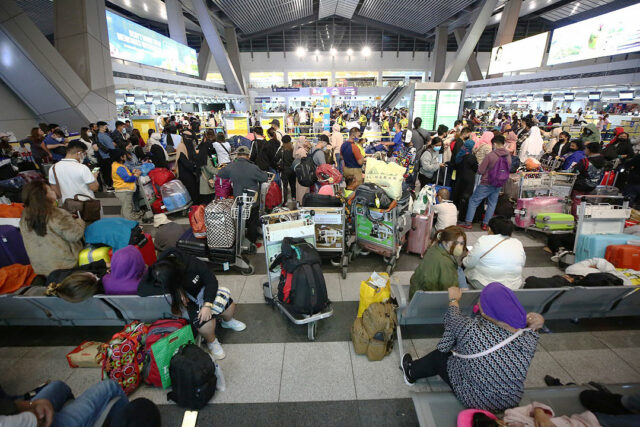
THE SENATE will conduct an inquiry into the Jan. 1 glitch in the countrys air control system that shut the entire Philippine air space, a committee chair of the chamber said, noting that the incident involves national security. 

“Give them (airport authorities) time to restore normal flight operations,” Senator Mary Grace S. Poe-Llamanzares, chairperson of the Senate Public Services Committee, said in a statement on Monday.  

“After which, we will conduct an inquiry and direct them to submit a full report of what caused the supposed glitch and power outage.”  

She noted that lawmakers will question officials from the Civil Aviation Authority of the Philippines (CAAP) on the navigation equipment and determine who is accountable for the reported technical glitch.  

Ms. Poe added the CAAP needs to be transparent and show accountability for the flight disruptions.  

“This is a national security concern,” the senator said. “Thousands of lives depend on the efficiency and competence of CAAP.” 

The CAAP is responsible for implementing policies on safe and efficient air travel and investigating aviation accidents.  

It is an attached agency of the Department of Transportation. 

Senators Sherwin T. Gatchalian, Joseph Victor “JV” G. Ejercito and Jose “Jinggoy” P. Ejercito, Jr. also raised concerns about the hundreds of inbound and outbound flights.  

Mr. Gatchalian urged airport authorities to take accountability for the inconvenience caused to thousands of passengers.  

“The government must do everything in its power to ensure that this doesnt happen again given the impact it would have on affected passengers and the negative impression that it would have on our foreign visitors,” he said in a statement.  

Mr. Ejercito Jr. called the situation a “double black eye” for the country. 

On Sunday, the Manila International Airport Authority said almost 60,000 international and domestic passengers were affected by the delays and cancellations.  

All other airports across the country were also affected.   

Meanwhile, Senator Maria Lourdes “Nancy” S. Binay-Angeles said it was time for the CAAP to upgrade its equipment following the “bothersome and concerning” loss of power. 

“I hope the Department of Budget and Management can assist Transport Secretary Jaime J. Bautista in finding funding to upgrade the CAAP’s equipment this year,” she said in a statement.   

“What happened at the Ninoy Aquino International Airport makes it hard for us to promote traveling to the Philippines when a service attribute has failed.” John Victor D. Ordoñez 

42 arrested for illegal firecrackers; injuries hit 211 

NATIONAL police chief Rodolfo S. Azurin, Jr. (right) and Governor Daniel R. Fernando of Bulacan, a hub of fireworks and firecracker producers, present the types of illegal firecrackers during a media briefing in December. — BULACAN.GOV.PH

FORTY-TWO individuals were arrested for using and selling illegal firecrackers on New Year’s Day, a police official said on Monday.  

Philippine National Police-Public Information Office chief Redrico A. Maranan said charges have been filed against the suspects.   

“Cases have been filed against those arrested for illegal firecrackers and we will remain on full alert until Jan. 6,” he said in a televised briefing.  

The New Year’s Eve celebration was generally peaceful, he said.   

The Bureau of Fire Protection (BFP), meanwhile, reported 10 fire incidents related to firecrackers nationwide, higher than last years tally.   

“We can attribute this increased activity to the excitement of our countrymen to engage in firework activities this year,” BFP Spokesperson Analee Carbajal-Atienza told the same briefing in mixed English and Filipino.  

INJURIES
The Department of Health (DoH) recorded 211 fireworks-related injuries from Dec. 21 to Jan. 2, up 16% from 182 in the same period the previous year, but 30% lower compared to the five-year average of 300 cases.  

The total increased by 74 from Jan. 1s tally of 137, according to the departments monitoring report as of 6 a.m. on Jan. 2.  

Most of the cases were in the capital region Metro Manila with 102, accounting for 48% of the total. The Western Visayas region in central Philippines was second with 12, and Central Luzon with nine.   

Majority of the patients were male at 79%, with median age at 17.   

DoH said 60 of the cases sustained eye injuries while 11 had blast or burn injuries with amputation.  

Half of the patients were actively involvedin the use of firecrackers.  

None of the reported cases involved stray bullets or fireworks ingestion, according to DoH.  

“Again, we hope that our countrymen in the coming years observe safer New Year’s celebrations,” it said in Filipino. John Victor D. Ordoñez  

Marcos’ campaign promise, confidential funds pollute the need for government rightsizing

A CAMPAIGN promise by President Ferdinand R. Marcos, Jr. to fill up vacant positions and regularize contractual workers in government as well as the approval of questioned confidential funds in the 2023 budget taint the administrations plan to rightsize the bureaucracy, according to analysts.  

Czarina Medina-Guce, a governance consultant and development studies lecturer at the Ateneo De Manila University, said streamlining government agencies is a much neededreform in a country.  

Rightsizing, she said in an email interview, is a means of ensuring that taxpayersmoney is spent on programs and services that have an impact and reduce functions and projects that are outdated or underperforming. 

Budget Secretary Amenah F. Pangandaman said in July, the start of the Marcos administration, that her department supports the rightsizing plan to achieve an efficient and agilebureaucracy that will be responsive in a digital era.   

Ms. Pangandaman, in a statement on July 13, said 187 government agencies and government-owned and controlled corporations will have to be evaluated for possible merging, restructuring or abolition.  

There are over 1.86 million permanent government positions as of 2021, of which 1.68 million are filled, according to data from the Department of Budget and Management.  

In addition, there are an estimated 640,000 contractual or job-order workers in government.  

The Budget chief said trimming the workforce by 5%, for example, would mean P14.8 billion in savings in the governments personnel services cost.   

Terry L. Ridon, a public investment analyst and convenor of think tank InfraWatch PH, said the rightsizing plan leaves a bad taste in the mouth considering billions in confidential and intelligence funds allocated in the 2023 budget to the Presidents office as well as the vice-presidents and Department of Education.   

The signed 2023 national budget includes confidential funds worth P2.25 billion for the office of the president (OP), P500 million for the office of the vice-president, and P150 million for the Department of Education, which the vice-president serves as its secretary. The OP was also granted intelligence funds worth P2.31 billion.  

During times of fiscal stresses, government pins much of the blame on a bloated bureaucracy,Mr. Ridon said via Twitter message.  

He said that there is contradiction in pushing to streamline government agencies while retaining billions of pesos in confidential and intelligence funds as well as unspent funds due to limited absorptive capacity among departments and local governments.  

Ms. Medina-Guce said streamlining the civil service must involve the agencies, who themselves must review their structures, functions, and development plans.    

It’s an opportunity to update how human resources are developed in government, she said.   

Mr. Ridon, on the other hand, warned that rightsizing would be political and affect smaller agencies with limited project funding, insufficient personnel, and those with minimal interactions with Malacañang and Congress. 

During his presidential campaign for the May 2022 elections, Mr. Marcos vowed to fill up 180,000 vacancies in government and regularize job order workers in national and local government agencies.  

In his first address to Congress in July, Mr. Marcos listed rightsizing as one of his priority measures.   

The House of Representatives has included the rightsizing bill as one of the 12 priority measures once it resumes on Jan. 23.   

The House committee on government reorganization approved on Nov. 28 a draft substitute bill on the proposed National Government Rightsizing Act.  

Santiago Dasmariñas, Jr., national president of the Confederation for Unity Recognition and Advancement of Government Employees (COURAGE), called the prioritization of government rightsizing a complete reversalof Mr. Marcoscampaign promise.   

Mr. Dasmariñas said the administration should instead prioritize the regularization of contractual workers and the implementation of a P33,000 national minimum wage, both of which already have corresponding House bills filed. Beatriz Marie D. Cruz 

Marcos administration vows to boost streamlining efforts this year with digital systems

BUSINESS.GOV.PH

THE MARCOS administration has committed to boost efforts to improve and streamline government services this year by tapping existing and new digital systems, according to Malacañang.  

“In 2023, the government shall remain steadfast and continue to pursue streamlining initiatives to ensure the delivery of efficient government services to the people and fight corruption by eradicating all forms of red tape,” the Office of the Press Secretary (OPS) said in a statement, citing the administrations yearend report.  

The OPS said the Anti-Red Tape Authority (ARTA) will pursue the National Policy on Regulatory Management System, a common framework for good regulatory practices and compliance strategies.  

The government plans to advance the frameworks components such as the Philippine Business Regulations Information System to provide stakeholders and government agencies access to proposed and existing government regulations and avoid overlapping,the Palace said.   

The Marcos leadership also ordered the Anti-Red Tape Electronic Management Information System to provide a live database and mapping of all government services indicated in the Citizen’s Charter, it added.   

The administration would also strengthen the TradeNet, a one-stop online shop aimed to reduce processing time and harmonize the permitting procedures for imports and exports, according to the OPS.  

In addition, Philippine Good Regulatory Principles will be implemented to promote proportionate, consistent, accountable, and targeted regulations through an effective dialogue between regulators and entities,the OPS said. 

In November, the Palace said President Ferdinand R. Marcos, Jr. will sign an executive order to expedite the permit process for strategic investments. The order would create a green lanefor such investments.  

Under the order, permit or license application that involves “simple transaction” should be processed within three working days. A complex transactionshould be processed within seven working days, while highly technical transactionsshould only take 20 working days to be issued. 

Mr. Marcospredecessor, Rodrigo R. Duterte, signed a 2021 law that allows the President to “expedite” the processing and release of business permits in times of national calamity.  

To optimize the government’s Information and Communications Technology resources, the government will continue to develop and implement interoperable systems that will further implement seamless sharing of data sources, such as the Philippine Identification System and electronic Business Permits and Licensing Service (eBPLS),the OPS said.  

The administration will also address the fragmentation of the justice system through the implementation of the National Justice Information System and Middleware Exchange Platform,it added.  

On budget reforms, the Department of Budget and Management will roll out digital systems that will promote “prudent” fiscal management and improve budget reliability, the OPS said.   

This will be done through the enactment of the Progressive Budgeting for Better and Modernized Governance Bill, developing and implementing the Budget and Treasury Management System, and pursuing the National Government Rightsizing Program.Kyle Aristophere T. Atienza 

The New Year’s guide to living

JAY KUDVA-UNSPLASH

The first order of the day is to look at the New Year as a time to change. January is when it is easiest to start a new habit, a new goal or even a new lifestyle.

But more than just our personal decisions to change a habit, it is also a good time for companies and leaders to start opening up to new ideas and maybe new ways of doing business.

THE GREEN IMPERATIVE
I was at a forum where EU rules were being discussed for exports from our country and the rest of the world. Some exporters see the “greening of the supply chain” as yet another nontariff barrier because certification requirements would increase their expense.

Maybe this time, we should think of going green because it is our duty to do something right, not just to be profitable.

At the forum, there was a manufacturer of shoes made from pineapple fiber, a sustainable product looking for export markets. Why is he into this business? Because it is the right thing to do, he says. What is your green initiative this year?

THE DIVERSITY DIRECTION
More and more companies are looking to include diversity and inclusion in their work plans. The Philippine Business Coalition for Women Empowerment has attracted more member companies. What does it take? If you are a company with forward thinkers in your management, it is about time to get certified as a company that empowers women and includes diversity as one of your goals.

ENABLING HEALTHIER LIVES
If you are in the food business, it is about time to think of serving not just cheap but healthier fare as well to improve consumer health. If we run a company cafeteria, it is time to look for providers who not only sell affordable food to our employees, but healthier food as well. After all, the ones who decide are the management, Human Resources and Finance. You may be surprised that healthier food served in cafeterias may mean fewer sick days.

EFFICIENT TECHNOLOGY
If you have not yet invested in inverter appliances, think again. These energy-efficient appliances, lights and other equipment save the company a lot of money through lower energy consumption while saving the planet. Yes, it may be expensive at the start, but savings as well as a smaller carbon footprint come as a reward for the planet and your bottom line.

BIKE, DON’T DRIVE
Many factories now encourage employees to live near their place of work and avoid long commutes. They give their workers bicycles, motorcycle loans and other provisions so they can avoid long travel times. This also boosts the efficiency of workers who otherwise have to wake up early and get less sleep.

VEGETABLE GARDENS
Companies can designate an area where employees can plant and grow their own vegetables. This  helps employees save on market trips and makes them more conscious about growing their own food. Even the lowly malunggay or moringa tree can give employees a lot of healthy meals at home or in the cafeteria. There are urban gardens, like plant towers, that can be started even in high-rise offices with decks or open rooftops.

Instead of just putting tree-planting activities in the Human Resources calendar, you can start allocating space for company gardens where employees can buy fresh vegetables or harvest what they plant.

WORK OUTSIDE
Make a field day or a day outside a regular occasion for your town hall meetings rather than another gathering inside air-conditioned offices or hotels. Get some sun,  fresh air and let employees work or meet outside the office for a change. Go to a park or a farm, for a change. You may be surprised with better results when your team gets to commune with nature. Take your employees on a hike, go on a picnic or just let them breathe some fresh air regularly.

GREEN REWARDS
The best ideas come from the people who feel the heat of brownouts, high electricity costs and the high price of onions and rice. Listen to ideas from the smallest member or the one who had the simplest education. Green is the new black. Maybe they have ideas that can help your bottom line while you help mother nature. Reward suggestions on how to make your company greener, healthier or safer.

Ready to start turning a new leaf? Start with yourself, then your family and then your company. If everyone just did something different to make the world a better place, we will all be able to take 2023 by the horns and hope for a better, healthier year. But we have to start with ourselves.

What habit can you change this New Year?

This article reflects the personal opinion of the author and does not reflect the official stand of the Management Association of the Philippines or MAP.


Chit U. Juan is a member of MAP’s Diversity and Inclusion Committee and Agribusiness Committee. She is chairwoman of the Philippine Coffee Board and councilor of Slow Food for Southeast Asia.

map@map.org.ph

pujuan29@gmail.com

The World Cup is a pipe dream

RHETT LEWIS-UNSPLASH

“I was overly conservative in giving the stakeholders of Philippine football a very long period to qualify for the World Cup. After witnessing small countries like Croatia and Morocco perform wonders in the last World Cup, overcoming at some stages of the competition such world champions as Germany, Brazil and Spain, my hopes have been raised. Given more support from the Government and the business sector, the Philippine national men’s football team should aspire to qualify for the World Cup, if not in 2026, at least in 2030,” wrote Bernardo Villegas, the eminent economist and Harvard PhD, on this page last Wednesday. He was referring to the dream he expressed in a book he authored in 2016 titled Philippine Football: Its Past, Its Future. On the dedication page of the book, he wrote: “I dedicate this book to all Filipino children who have developed a passion for the beautiful game. You are the hope for the World Cup before the 21st century is over.”

Mr. Villegas is known to all you BusinessWorld readers as the Prophet of Boom. But I think he is overly optimistic about the prospects of Filipino children being in the World Cup if not in 2026, at least by 2030. He has high hopes the Azkals, our men’s national football team, would be in the World Cup by 2026. He cites our women’s national football team having already qualified for the Women’s World Cup next year.

Long before small countries Croatia and Morocco beat big countries Germany, Brazil, and Spain in Qatar, countries much smaller than the Philippines have been beating Western world powers in the World Cup. Fourteen years ago, in June 2006, a year before Mr. Villegas got enamored with football, I wrote here, “Why are we not in the World Cup, many sports fans are asking when Third World countries with population less than seven million like Paraguay, Togo, Croatia, Costa Rica and Trinidad and Tobago (whose population is only one million) can each put together a football team good enough to play against football strongholds like England, France, Brazil, Germany and Argentina. After all, height is not a factor in football.”

That did not inspire Filipino children with passion for football to hone their skills to be able to play in the World Cup in 2010 or the World Cup in 2014. Home grown football players are not motivated to sharpen their skills comparable to those of the Japanese and Koreans, who represented the Asia-Pacific region in Qatar. They know they will not find fame and fortune in Philippine football.

Most of the Azkals he hopes to be in the World Cup in 2026 are not home-grown players. They are Stephen Schrock, Kenshiro Daniel, Gerrit Holtmann, Mike Ott, Manny Ott, Patrick Reichelt, Jovin Bedic, Carli de Murga, Angel Gurado, Amani Aguinaldo, Amin Nazari, Javier Patino, Iain Ramsay, Dylan De Ruycker, Simone Rota, Alvaro Silva, Oskari Kekkonen, Diego Bardanca, Daisuke Sato, Neil Etheridge, Michael Falkessgaard and Quincy Kammeraad. They are children of a Filipino mother or father but who were born or who grew up in countries where football is a very popular sport, if not the most popular.

So are many members of the Philippine women’s football team that will play in the 2023 Women’s World Cup. They are Tahnai Annis, Sarina Bolden, Isabella Flanigan, Quinley Quesada, Katrina Guillou, Carleigh Frilles, Kaya Hawkinson, Jaclyn Sawicki, Sara Eggesvik, Tara Shelton, Jessika Cowart, Sofia Harrison, Chantelle Maniti, Dominique Randle, Reina Bonta, Maya Alcantara, Ryley Bugay, Chandler McDaniel and Olivia McDaniel.

Athletic Filipino boys are driven toward basketball where they can gain glory and money. College dropouts get a guaranteed pay of P200,000 a month in their first year in the Philippine Basketball Association (PBA). The average salary of Filipino football players in the professional leagues — United Football League (2009 to 2016), Philippine Football League (2017 to present) is P336,241 a year, according to the Economic Research Institute.

Mr. Villegas wrote that as a result of having been colonized more recently by the Americans, football is eclipsed in mass popularity by basketball and boxing, driving away many football talents and contributing to the lack of success of football. If that were so, baseball should be the most popular sport in the country as that was the first sport introduced by American soldiers.

Just weeks after the Battle of Manila, a baseball game between a unit of Astor Battery and a squad of the Army was played before Filipinos. Governor-General William Howard Taft, who played catcher for the professional baseball team, the Cincinnati Reds, when he was a student in Cincinnati Law School, promoted baseball to replace cockfighting as Filipinos’ favorite sport. Basketball was introduced by American teachers through the YMCA and the public school system as a women’s sport in 1910. It was played in interscholastic tournaments until 1911.

Basketball and football were the only sports in the program of the National Collegiate Athletic Association when it was founded in 1924. Baseball must have been added in 1928. A La Salle coffee table book has a photo captioned “1928 First La Salle Baseball Team.”

When UP, UST and NU broke away from the NCAA and formed the University Athletic Association of the Philippines (UAAP) in 1938, football, basketball and baseball formed parts of the new association’s athletic program. The government, through the Philippine Amateur Athletic Federation, fully supported the programs. It built the Rizal Memorial Sports Complex in 1934, providing venues of international standards for all sports.

Both the NCAA and UAAP resumed their sport programs after World War II, but the NCAA dropped baseball. While all schools fully supported their basketball and football teams, basketball games drew bigger crowds among students and the public.

Just like basketball in the 1950s and early 1960s when there was the commercial league Manila Industrial and Commercial Athletic Association (MICAA), there were also the semi-professional Manila Football League (MFL) and Manila Bay Baseball League (MBBL).

Just as Yco, San Miguel and Yellow Taxi fielded teams in the MICAA, so did these companies field teams in the football commercial league. The other squads were San Beda AC (the NCAA team reinforced by alumni), William Lines from Cebu, South Star and Cheng Hua, the last two fielded by the Manila Chinese community. The MBBL was composed of the Canlubang Sugar Barons, Ysmael Steel Admirals, UST Gold Sox (alumni plus stars of UAAP team) FEU Tamaraws (alumni plus UAAP players) and teams from the American military bases Clark Field Red Wings, Sangley Point Bluejays and Subic Bay Renegades.

Competition in the MFL and MBBL was fierce, drawing sizable crowds. But like in collegiate sports, basketball drew much bigger crowds than football and baseball. Filipino sports fans just find football slow and boring compared with basketball.

A soccer game takes 90 minutes, sometimes extended to 120 minutes. Much of the time, the ball is kicked back and forth. A skilful attacking move lasts no more than 30 seconds because a defender kicks the ball away from the attacker. That is why goals are rare. Many games end scoreless or tied 1-1. Knockout games ending in a tie are decided by penalty shootouts. Penalty shootouts reduce the game of soccer to a contest between two players — the opposing goalkeepers. All 120 minutes of skilful dribbling and beautiful passing for naught.

Basketball has fast pace of play. All 10 players in the court are constantly moving. All can play offense and defense and all can score at any time. A shot could mean two or three points. That makes an offensive play trickier, getting spectators involved as they guess how the play would evolve. Every time a play results in a score, the fans are gratified. As scores in basketball go as high as 80, fans go home fulfilled.

Most athletes like to play before big crowds. They are motivated to play harder to please the crowd and draw their admiration. Ed Ocampo and Eddie Pacheco, both voted Mr. Football and Mr. Basketball by the Philippine Sportswriters Association in different years, chose to spend their remaining playing years on the basketball court, Ed donning the Yco uniform and Eddie different uniforms until he settled for the Ysmael colors. The three sons of baseball great Filemon Codinera chose basketball over baseball. All three played in the PBA, though Jerry was the only one who achieved stardom and earned a fortune.

I think my good friend Bernie Villegas (he was one year ahead of me in high school and in the Lia-Com (AB-Commerce) program of La Salle but we were fellow members of a number of campus organizations) was right in 2016 when he wrote his book on football. In that book, he expressed his hope that Filipino children would qualify for the World Cup before the 21st Century is over.

Oscar P. Lagman, Jr. is a retired corporate executive, business consultant, management professor and a multi-sport enthusiast. He has taught sports marketing in DLSU’s Graduate School of Business and in the Philippine Olympic Committee’s Sports Management program.


Top 10 trade and investment stories of 2022

Here is this column’s assessment of the important trade and investment stories of the past year, five global and five national.

1. Big recovery in global merchandise trade by nearly $4 trillion in 2021 over 2020

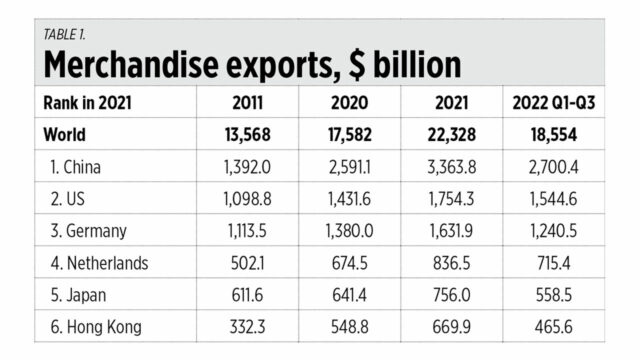
The World Trade Organization (WTO) in November released its flagship annual publication, the World Trade Statistical Review 2022. Global merchandise trade reached $22.3 trillion in 2021, led by China, the US, Germany, the Netherlands and Japan. Economies that experienced big expansion in exports from 2011 to 2021 were China, Hong Kong and Taiwan (2x), and Vietnam (4.8x).

2. Mild expansion in global exports by about $2.4 trillion in 2022

In the online statistics of WTO, the first three quarters of 2022 are available and the trend shows potential global merchandise exports of $24.7 trillion for the full year, or a mild expansion of $2.4 trillion over the previous year. US exports were estimated to have hit $2 trillion for the first time, special credit to its huge LNG exports to Europe. And despite extensive sanctions against Russia, its exports were projected to have reached about $550 billion in 2022 (Table 1).

3. Global foreign direct investment (FDI) inward and outward stocks doubled from 2011 to 2021

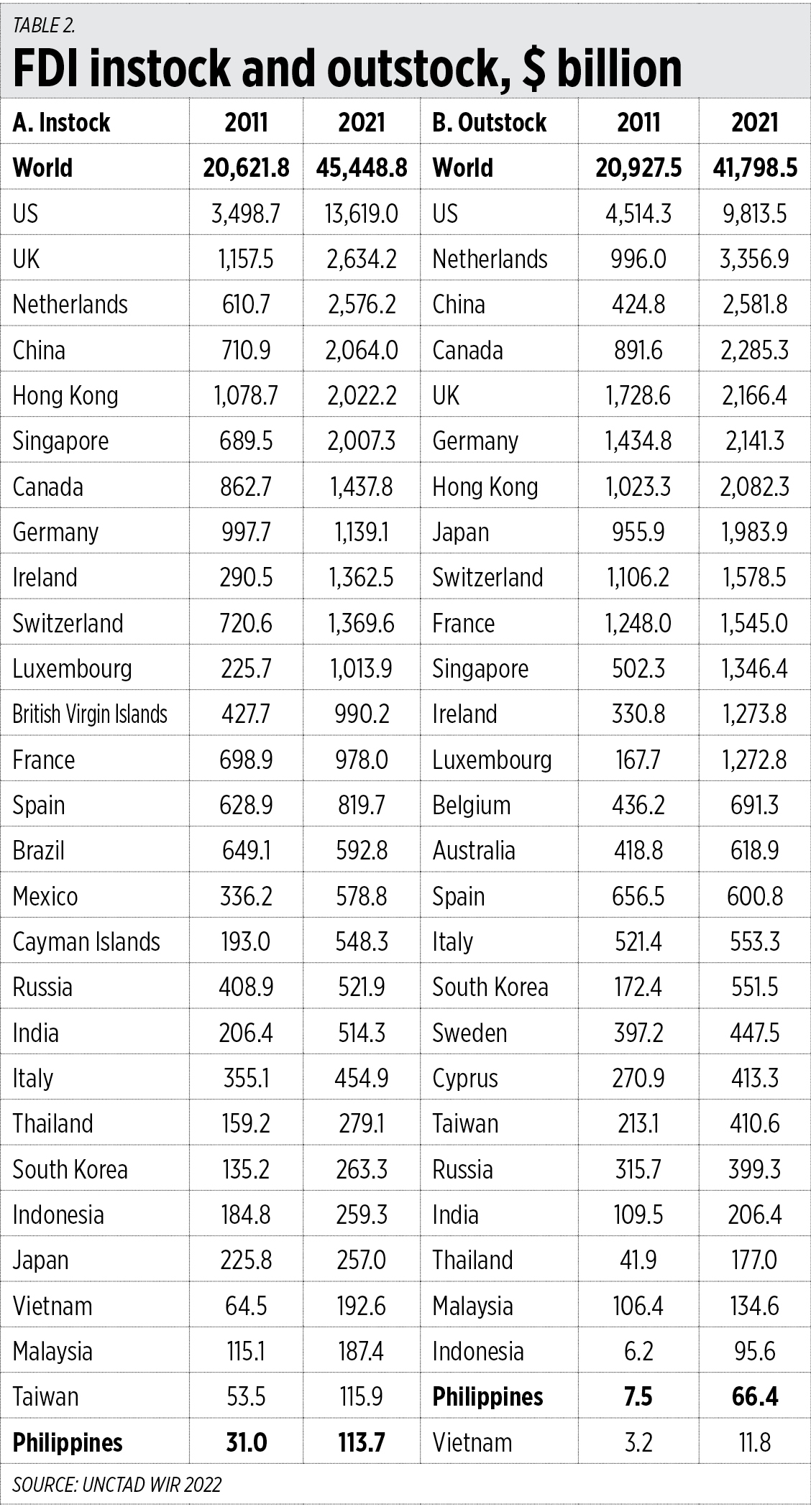
The United Nations Conference on Trade and Development (UNCTAD) in June released the World Investment Report 2022. FDI inward stock — net of inflows minus outflows through time — reached $45.4 trillion in 2021. The US remained the No. 1 destination of FDIs and was the main exporter of FDI measured in outward stocks.

4. China, Japan, South Korea and Taiwan were net exporters of capital, while India and ASEAN countries remained net importers

Japan FDI instock was only $257 billion in 2021 but its outstock was $1.983 trillion. China and Hong Kong had a combined FDI instock of $4.1 trillion in 2021, while their combined FDI outstock was $4.7 trillion (Table 2).

5. Global illicit trade was estimated at more than $2 trillion a year

The number is an UNCTAD estimate. There is a huge diversion in commerce from legal and registered products to illegal ones, leading to lower tax revenues for governments that led them to raise taxes elsewhere. In September, it held the second UNCTAD Illicit Trade Forum in Geneva, in partnership with the Transnational Alliance to Combat Illicit Trade (TRACIT). The goal was to highlight initiatives and cooperation to fight this criminal activity.

6. Philippines remained less attractive in merchandise exports and as an investment destination

The Philippines was ranked the 12th largest population in the world but only 38th in GDP size and 46th in merchandise exports. It was also far below in FDI inward stocks and tourism visitors. Our merchandise exports in 2021 hit only $64 billion, nearly a fourth of Malaysia and Thailand and nearly a fifth of Vietnam. While our geographic isolation (it can be reached only by plane or boat) is a factor, other factors include our overall poor infrastructure and low power generation.

7. High incidence of illicit trade especially in tobacco

See a recent report in BusinessWorld, “Gov’t losing P250B in revenues due to illicit trade” (Dec. 14) quoting Jesus L. Arranza, the chairman of both Fight IT (Illicit Trade) and the Federation of Philippine Industries. He estimates that cigarette smuggling alone deprives the government of P24.7 billion a year in taxes. His estimate is not far from the estimates of Albay Rep. Joey Salceda of P30 billion a year in tax revenue losses, of former Party-list Rep. Koko Nograles of P31 billion a year (P26 billion to P60 billion a year), and this column’s estimate of P36 billion to P49 billon a year (see “Inflation and Illicit trade,” Nov. 7).

8. See-saw in cement liberalization and protectionism

See these reports in BusinessWorld: “Petition to extend safeguard measures for cement rejected” (Nov. 9), “Cement industry says ‘premature’ to let safeguard measures vs imports expire” (Oct. 10), “DTI to impose anti-dumping duties on cement imports from Vietnam for 5 years” (Dec. 22). This column consistently argues for free trade. Consumers and businesses should be free to choose where to buy and get products like cement for their needs. Expensive cement and steel often leads to people cutting costs for their houses, which can be easily damaged by strong earthquakes or storms, which can lead to loss of lives and properties.

9. Higher investor confidence in the Philippines

This was reported in at least four articles in BusinessWorld last month: “Nearly 800 IT-BPM projects endorsed to BoI” (Dec. 19), “PEZA-approved investment pledges surge this year” (Dec. 21), “BoI approves P729-billion investments in 2022” (Dec. 22), “‘Keen’ European interest in shipping after foreign ownership cap removed” (Dec. 26).

10. The worst is over and the best is yet to come

That is the title and assessment of a recent statement from Finance Secretary Benjamin Diokno, also reported as “‘Better years’ ahead for PHL — Diokno” (BusinessWorld, Dec. 29). Among the reasons for his optimism which this column agrees with are: (1) the early approval of the 2023 national budget, faster rollout of important infrastructure projects, (2) adoption of the first-ever Medium-Term Fiscal Framework, FY 2023-2028 and the Philippine Development Plan 2023-2028, which unite executive and legislative fiscal and economic priorities, and (3) legislation for more economic liberalization in the Foreign Investment Act, Retail Trade Liberalization and Public Service Act.

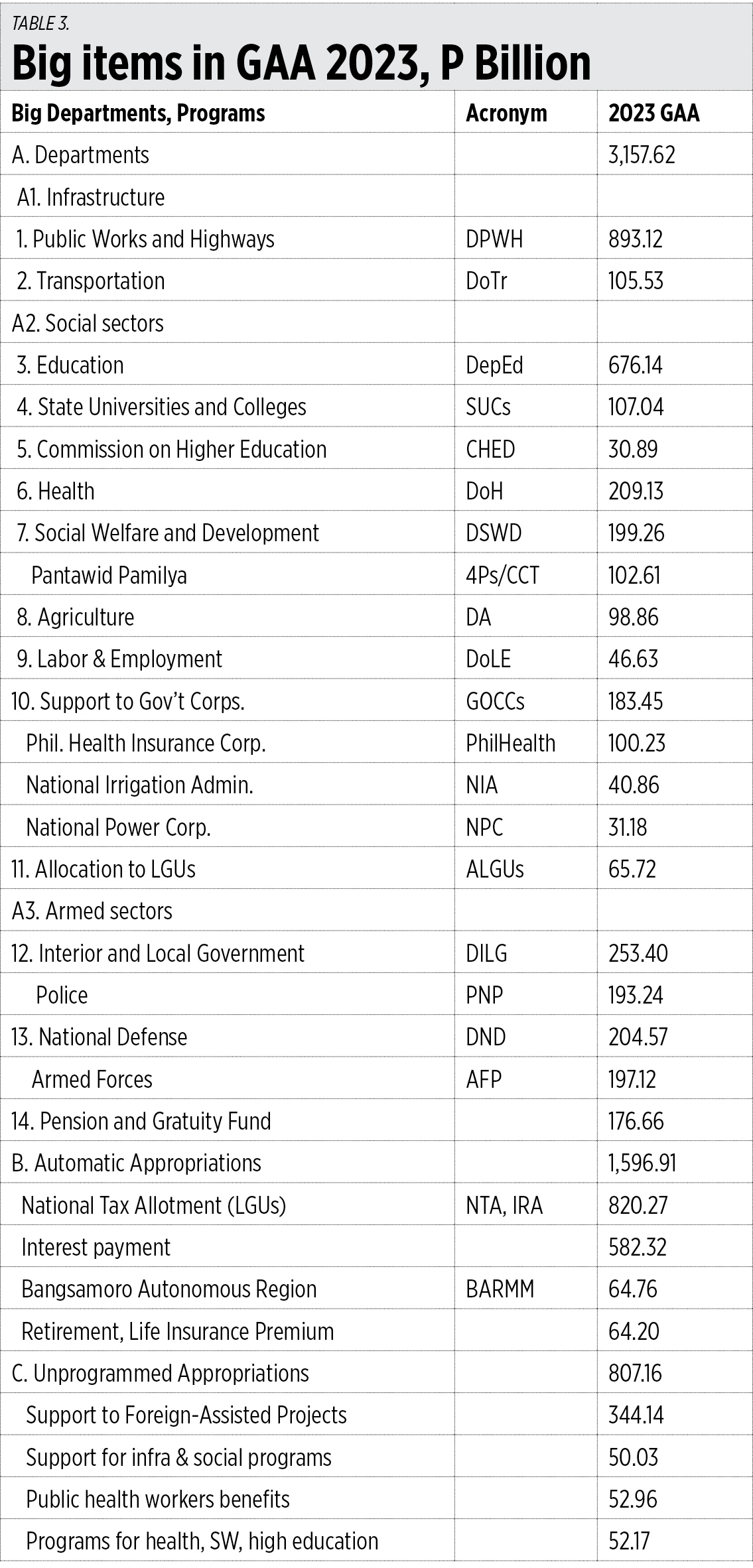
I must add that some changes in budget priorities must be made. In the past and in the recently signed General Appropriations Act of 2023, priorities of the annual budget are not on productivity-enhancing physical infrastructure but on social sector subsidies and freebies, and an ever-rising spending and entitlement by the armed sectors including the luxurious military and uniformed personnel pension: P124.4 billion in 2021, P153.1 billion in 2022 and P176.7 billion in pension and gratuity fund in 2023 (Table 3).

Having free education from elementary to university, free healthcare, free monthly cash, free irrigation, free bus rides in Metro Manila, etc. are formula for people to be more state-dependent and not self-reliant. A bloated police and military with bloated pension funds taken not from their monthly contribution but from taxpayers is additional recipe for endless borrowings, high interest payment, a bad business environment when new taxes must be imposed to pay those huge public debt.


Bienvenido S. Oplas, Jr. is the president of Bienvenido Oplas, Jr. Research Consultancy Services, and Minimal Government Thinkers

minimalgovernment@gmail.com

Bittersweet truth

TETIANA BYKOVETS-UNSPLASH

During our recent trip to Davao, my family stayed at the Malagos Garden Resort. As a chocolate lover myself, I have heard about their chocolates but had yet to try them. Their Koi Café uses chocolates in their beverages and desserts. I like their Cacao tini (a chocolate martini), hot chocolate drink, molten lava cake, tablea cake and ice cream. I can proudly say that our chocolates are at par with those made in Belgium and Switzerland.

The resort also has  the Malagos Chocolate Museum, the first of its kind in the country. I learned a lot about the history of chocolates, the top eight cacao-producing countries, the top 10 consumers and the top 10 manufacturers. It is baffling that the Top 8 cocoa producers — Ivory Coast, Ghana, Indonesia, Nigeria, Ecuador, Cameroon, Brazil, and Papua New Guinea — do not belong to the Top 10 countries with the highest-earning chocolate manufacturers. There is also what they call the Cacao Belt, an area near the equator where cacao plants thrive.

The company started in 2003 when founders Roberto and Charita Puentespina leased farmland in Malagos in the Baguio district of Davao City, where cacao trees were already in the area.

It was only in 2015 when they managed to refine their process of producing quality chocolates.

The company has won several international awards — their recent one was four golds and one bronze at the 2020 World Drinking Chocolate competition in Hannover, Germany, during the virtual Schokoladen Gourmet Festival in October 2020. The company prides itself on having single-origin cacao, which is ethically sourced and adheres to sustainable farming. 

If Filipino consumers patronize our chocolates, we help our farmers uplift their lives. Although Malagos chocolates are expensive, buying them makes us feel good because we are helping our farmers. The altruistic attitude and the good feeling from buying their chocolates will lead to better working conditions and fair payment for farmers while boost our economy. I hope more companies will venture into this endeavor because the Philippines, which is near the Cacao Belt, has the geographical advantage.

Let’s put our country on the world map for producing and manufacturing world-class chocolates.


Alma Maria Jennifer Gutierrez, Ph.D., is a full professor at De La Salle University’s Industrial and Systems Engineering department.

Weightlifting body hoping to send 3 representatives to Paris games

REUTERS

THE PHILIPPINES has set a target of qualifying three or four weightlifters to next year’s Paris Olympics, the sport’s federation said.

Apart from Tokyo Games gold medalist Hidilyn Diaz-Naranjo, the Samahang Weightlifting ng Pilipinas (SWP) is hoping that Elreen Ando, Vanessa Sarno and Kristel Macrohon also earn berths to the games.

Ms. Diaz-Naranjo has a good head start after winning three gold medals in last month’s World Championships in Bogota, Colombia, the first of 10 Olympic qualifying meets sanctioned by the International Weightlifting Federation (IWF).

Ms. Ando, a Tokyo Olympian, Ms. Sarno, an Asian and Southeast Asian champion, and Ms. Macrohon, a SEA Games gold winner, did not medal but earned Olympic qualifying points by competing in the Colombian capital.

“We’re looking at three to four lifters to qualify to Paris. Hidilyn, Ando, Sarno and Macrohon are the lifters to watch,” SWP president Monico Puentevella said.

To make the Paris cut, an aspirant must see action in at least five more IWF-sanctioned tilts and hope they amass enough points in their respective weight classes.

Mr. Puentevella is pleading to the newly appointed Philippine Sports Commission (PSC) officials headed by chairman Richard Bachmann to help support a four-Olympian bid.

The former PSC commissioner from Bacolod was positive of further success after Ms. Diaz-Naranjo’s historic feat in Tokyo.

“Of the 10 or more qualifying events for Paris, we need four more and we hope the new PSC officials will continue this kind of support,” said Mr. Puentevella. “And we promise you, we will deliver again.” — Joey Villar

Nikola Jokic’s triple-double lifts Nuggets over Celtics

NIKOLA JOKIC — RON CHENOY-USA TODAY SPORTS

NIKOLA Jokic had 30 points, 12 rebounds and 12 assists and the Denver Nuggets won their eighth consecutive home game by beating the Boston Celtics 123-111 on Sunday night.

Mr. Jokic made 10 of his 13 field goal attempts and was 8 for 8 from the free throw line. It was his ninth triple-double of the season.

Denver shot 57% from the field (45 for 79) and improved its home record to 14-3. The three home losses came by a total of six points. The Nuggets also ended a six-game losing streak against the Celtics.

Jaylen Brown (30 points) and Jayson Tatum (25) led the Boston offense. The Celtics, who entered the contest with a four-game winning streak, fell to 11-6 on the road.

The Nuggets were 17 of 30 from behind the 3-point arc. The Celtics were 9 of 33.

Denver played without starting guard Jamal Murray (injury management). Bruce Brown replaced Mr. Murray in the starting lineup and finished with 21 points. He made four of his six 3-point attempts.

Mr. Murray is averaging 31.8 minutes and 18.2 points per game this season. Michael Porter Jr. (19), Aaron Gordon (18) and Bones Hyland (17) also scored in double figures for Denver, which led by as many as 18 points in the fourth quarter.

The Nuggets led 37-28 after one quarter and 62-54 at halftime. Denver’s first-half lead peaked at 15 points in the second quarter.

Mr. Jokic led all scorers in the first half with 20 points.

The Celtics were 3 of 14 on 3-point attempts in the first quarter, and 3 of 19 in the half.

Celtics coach Joe Mazzulla returned after missing two games with an eye injury. Guard Malcolm Brogdon and center Blake Griffin, who were unavailable for Thursday’s victory over the Los Angeles Clippers (illness), were available on Sunday.

Mr. Brogdon scored four points with four assists in in 19 minutes, and Mr. Griffin did not play.

It was the second meeting between the teams this season. Boston beat Denver 131-112 on Nov. 11 in Boston.

The game was delayed for nearly 40 minutes to adjust one of the baskets following a Robert Williams dunk midway through the fourth quarter. — Reuters

Ja Morant scores 35 to lead Grizzlies over Kings

JA Morant scored nine of his points in the fourth, as the Grizzlies held the Kings to 21 points. — ALL-PRO REELS/WIKIMEDIA

JA MORANT scored 35 points as the host Memphis Grizzlies pulled away down the stretch for a 118-108 victory over the Sacramento Kings on Sunday night.

The Grizzlies won their third straight by putting together another effective fourth quarter to separate themselves from the Kings.

Mr. Morant scored nine of his points in the fourth, as the Grizzlies held the Kings to 21 points. Mr. Morant made 13 of 23 shots along with eight free throws and also finished with eight rebounds and five assists.

Steven Adams helped Mr. Morant get plenty of shots by matching his career high with 23 rebounds, including a career-best 13 offensive boards. Mr. Adams posted at least 20 rebounds for the second straight game and the center’s big night on the glass helped Memphis outrebound Sacramento 57-47 and score 64 points in the paint.

Reserve Tyus Jones contributed 18 points as the Grizzlies shot 46% and beat the Kings for the eighth time in the past nine meetings. Dillon Brooks added 15 points and Jaren Jackson, Jr. chipped in 14.

De’Aaron Fox scored 19 points but shot 7 of 18 and committed five turnovers as the Kings were unable to win a third straight. Domantas Sabonis posted his 13th straight double-double with 18 points and 14 boards while Malik Monk also contributed 18 points.

The Kings turned a 59-58 halftime deficit into a 79-74 lead when rookie Keegan Murray hit a 3-pointer with 6:58 left in the third. Sacramento then went ice cold as the Grizzlies ripped off a 12-0 run and held a 91-87 lead heading into the final frame.

The Grizzlies began getting separation early in the fourth when Mr. Jones banked in his fifth 3-pointer for a 99-90 lead. The lead reached 105-92 when Mr. Adams used one hand to beat Sabonis for an offensive rebound and converted a putback dunk with 6:49 remaining.

Consecutive hoops by Mr. Morant and a basket by Mr. Brooks opened a 113-99 lead with 4:05 left, but Kevin Huerter’s 3-pointer cut the lead to 113-106 a little over a minute later. After a timeout, Memphis iced the game when Mr. Morant hit consecutive hoops and a free throw. — Reuters

Wizards rout depleted Bucks for fifth consecutive victory

WASHINGTON WIZARDS FORWARD RUI HACHIMURA — MOGAMI KARIYA

RUI Hachimura scored 26 points and Kristaps Porzingis added 22 as the Washington Wizards went on the road and took down the depleted Milwaukee Bucks 118-95 on Sunday night.

Kyle Kuzma also had a big night, finishing with a 10-point, 13-rebound, 11-assist triple-double, the second of his career.

Daniel Gafford and Corey Kispert also finished in double figures, scoring 17 and 12 points respectively for the Wizards, who won their fifth straight game.

The Bucks were without their big three in Giannis Antetokounmpo, Jrue Holiday and Khris Middleton, as well as George Hill.

Mr. Antetokounmpo was ruled out just a few hours before tip with left knee soreness. Bradley Beal also sat out for Washington.

Bobby Portis led the way for Milwaukee in their absence, scoring 19 points and grabbing 10 rebounds. Jevon Carter added 14 points, Grayson Allen scored 13 along with eight assists, and two players who don’t get much playing time took advantage of their opportunities, with rookie MarJon Beauchamp scoring 11 points and AJ Green chipping in 10.

The Wizards quickly built a big lead, up 34-17 after the first quarter, and never looked back, leading by as much as 26.

Washington shot 50% from the field in the first quarter compared with Milwaukee’s 26.1%. The Bucks were particularly outmatched inside early on, as the Wizards held an 18-2 advantage in paint points after one quarter and 36-14 at intermission. Mr. Hachimura scored 16 of his 26 points in the half.

The Wizards, who have won five of their last six games, will remain in Milwaukee for an off day Monday before the two teams match up once again on Tuesday night. The Bucks have lost five of six. — Reuters