Home Blog Page 5408

TDF yields rise as BSP, Fed further hike rates
BW FILE PHOTO

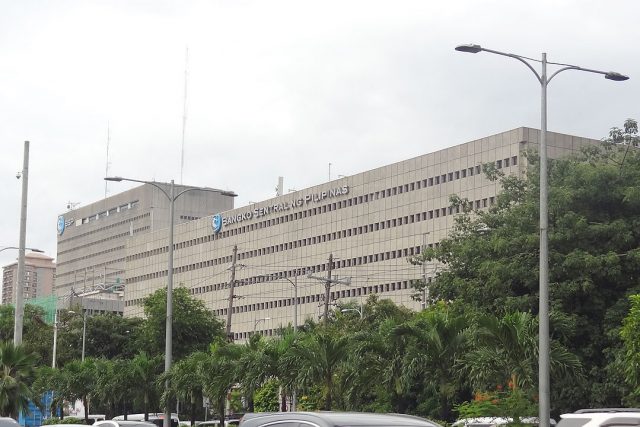
YIELDS on the Bangko Sentral ng Pilipinas’ (BSP) term deposits climbed further on Wednesday following continuous rate hikes locally and in the United States.

Demand for the term deposit facility (TDF) of the central bank totaled P296.495 billion on Wednesday, above the P280-billion offering as well as the P293.004 billion in tenders for a P220-billion offer recorded last week.

Broken down, bids for the seven-day term deposits amounted to P171.205 billion, slightly higher than the P170 billion auctioned off by the BSP. This is below the P224.229 billion in tenders a week earlier, where the BSP offered P140 billion.

Accepted rates ranged from 3.82% to 4.6%, wider than the 3.8088% to 4.22% margin seen in the prior auction. With this, the average rate of the one-week paper rose by 30.17 basis points (bps) to 4.2959% from 3.9942% previously.

Meanwhile, the 14-day papers attracted P125.290 billion in bids against the P110-billion offering. Demand was also up from the P68.775 billion in tenders for the P80-billion offer seen on Sept. 21.

Banks asked for yields from 4.1% to 4.43%, also wider than the 3.84% to 4.25% band recorded a week earlier. This caused the average rate of the two-week term deposit to increase by 17.47 bps to 4.3428% from 4.1681%.

The BSP has not auctioned off 28-day term deposits for more than a year to give way to its weekly offerings of securities with the same tenor.

The TDF and the 28-day bills are used by the BSP to gather excess liquidity in the financial system and to better guide market rates.

Yields on the term deposits were higher following the widely expected policy rate hikes last week, Rizal Commercial Banking Corp. Chief Economist Michael L. Ricafort said in a Viber message

The BSP on Sept. 22 raised benchmark interest rates by 50 bps to rein in persistently high inflation amid a hawkish US Federal Reserve.

The consumer price index climbed to 6.3% year on year in August, exceeding the BSP’s 2-4% target this year for a fifth straight month.

“Average inflation is still projected to breach the upper end of the 2-4% target range at 5.6% in 2022,” the central bank said on Thursday, adding that the forecast for next year had also increased to 4.1%. The forecast for 2024 eased to 3%.

The Monetary Board has raised borrowing costs by a total of 225 bps since May while the Federal Open Market Committee has increased rates by 300 bps since March, including its third 75-bp increase last week.

Yields were also higher as industry players expect further hikes in local policy rates to help support the exchange rate, Mr. Ricafort added.

BSP Governor Felipe M. Medalla earlier signaled the Philippine central bank will resort to more interest rate hikes depending on the Federal Reserve’s action.

“Strong dollar is requiring us to have bigger policy rate increases,” Mr. Medalla said in an interview with Bloomberg TV last week.

“Clearly the Fed’s policies have affected our choices. We don’t want to match the Fed, at the same time we have to respond,” he added.

The peso closed at P58.98 against the greenback on Wednesday, strengthening by one centavo from its P58.99 finish on Tuesday, Bankers Association of the Philippines data showed.

However, the local unit breached the P59-a-dollar level for the first time in intraday trading. It has weakened by 15.64% or P7.98 from its P51-per-dollar close on Dec. 31, 2021. — Keisha B. Ta-asan


TDCX Philippines opens a new site in Iloilo

INFORMATION technology and business process outsourcing (IT-BPO) firm TDCX has recently opened a new site in Pavia, Iloilo as part of its expansion plans in the country.

“We have just expanded our footprint to Iloilo. We officially opened our site last month. We have a team of close to 100 people working in our (site) as of today. The sentiment is well received when we started going into the location,” TDCX Philippines Vice President for Business Strategy Eliza Acuña said during a media briefing in Mandaluyong City on Wednesday.

TDCX’s new Iloilo site is the company’s sixth in the Philippines. It is located at Robinsons Cybergate Iloilo Tower 1, and adds to the firm’s other locations in Metro Manila and Cebu. TDCX Philippines started its Manila office in 2014 and its Cebu office in 2019.

According to Ms. Acuña, the Philippines is a vital member of the IT-BPO firm’s network across the world.

“Our new office in Iloilo will supplement our Manila and Cebu operations and create more job opportunities locally,” she said.

“The Philippines is known for its outsourcing capabilities and is an important node in TDCX’s network. Their highly skilled workforce coupled with a hospitable culture make the country a hotspot for us to hire the talent we need to resolve increasingly complex customer issues,” she added.

On the company’s expansion prospects, Ms. Acuña said that TDCX looks at the demand and the requirements of its customers.

“We typically would go by the demand. We’re seeing the trends in the requirements of our existing clients and even with the new clients that are looking for the type of service that we are able to provide,” Ms. Acuña said.

“As economies around the world recover from the effects of the pandemic and grapple with the current economic uncertainties, we are seeing increased demand for outsourced customer experience services. This is due, in part, to our ability to deliver superior customer experiences and to drive sales quickly, efficiently and cost-effectively for our clients,” she added.

TDCX currently employs over 17,000 employees and has presence in countries such as Singapore, Malaysia, Thailand, Philippines, Mainland China, Hong Kong, South Korea, Japan, India, Romania, Spain and Colombia. The company’s headquarters is in Singapore. — Revin Mikhael D. Ochave

API-first approach expected to boost PHL financial institutions

ADOPTING modern technologies with an application programming interface (API) would benefit both Philippine banks and financial technology (fintech) firms as these will help improve their products and services, API management platform APIwiz said.

APIwiz Co-founder and Chief Executive Officer of Rakshith Rao said in an interview with BusinessWorld that financial institutions in the country and across the region should use API for more innovative digital financial services.

“Ten years ago, every enterprise was looked upon if they had a mobile app or not. So, it was the most important thing in their business portfolio to make and reach to customers having a mobile app,” Mr. Rao said.

“Five years ago, it was every enterprise making sure that they power all of their omnichannel experience through an API. Now, it is getting to a point where everything that an enterprise does is driven through something called an API. They become the underlying backbone for an enterprise survival,” he added 

API relays information from one organization’s technology to another. APIs connect to different areas of a software platform, allowing for more information to be accessed when businesses undergo digital transformation. 

An “API-first” approach can help companies improve their development and strategies to adapt to an evolving digital market, Mr. Rao said.

“So, what we are offering is now a new paradigm shift in improving the productivity of an organization, increasing the reliability, but with all security, compliance and governance in place to make sure that what they are doing does not expose them to risk of threats from external actors and from other partners,” he said. 

Mr. Rao cited how digital bank Tonik reached $100 million in customer deposits in eight months. APIwiz enhanced Tonik’s Open API Platform and helped the lender increase productivity and reduce operational costs. 

“The ability for an organization to take and embed their service in every possible form factor and every other enterprise out there is the force multiplication factor that they will get by leveraging to integrate with APIs,” he said.

However, Mr. Rao said there are challenges to transforming financial institutions and in creating an end-to-end open finance experience where clients can freely access several financial service providers.

“Some of the challenges that we foresee is the ability for enterprises to change their way of doing,” he said. “So we simplified that over the last year to create a more simplified local platform, a local API lifecycle management, because we feel that stuff that needs to be done behind the scenes that does not require human intervention should be done in such a way that you can make releases multiple times a day.”

Mr. Rao said banks and fintech companies should work together to offer more innovative financial services.

“If you look at Southeast Asia and the Philippines, to be more specific, Southeast Asia carries or 8% of the global population… And even within Philippines, if you look at it, the large part of the ecosystem are still unbanked,” he said.

“And the challenge for that is essentially having the ability for them to do transactions at their fingertips,” Mr. Rao added. “If you can actually bring the bank to where people are in their daily lives, essentially, you’re bridging the gap and helping to bring financial transactions to them where they are.” — Keisha B. Ta-asan

Affordability, reliability play key role in smartphone success in the Philippines

AFFORDABILITY and reliability play a major role in achieving success in the Philippines’ mobile smartphone market, a study by e-commerce company iPrice Group said.

“Filipinos’ interests in Apple and Samsung continue to battle neck and neck for the top spot,” iPrice said in its report, citing data from 2019 to 2021.

The study analyzed the popularity of the flagship phones for the top smartphone brands in the country.

iPrice identified Apple, Samsung, Vivo, and Oppo as the top four most popular smartphone brands in the country.

“Apple’s release of the iPhone 11 in 2019, the iPhone 12 in 2020, and the iPhone 13 series gained a lot of attention, [similar to] Samsung’s release of Galaxy S10 in 2019, Galaxy S20 in 2020, and Galaxy S21 in 2021,” the group said.

Meanwhile, Vivo has been receiving “more attention” since 2020 when it released the Vivo X50 series with its “big brother”, the X50 pro.

“The hype is quite high since it’s the first smartphone to have a gimbal stabilizer camera, and it was the only flagship phone brand in our data to have an increase 90 days after its release by 929%,” iPrice said.

“They have found their niche, which is more focused on photography,” the group noted. “This can be one of the main reasons why it’s attracting user interest, especially from the younger generation.”

On Oppo, the group said that interest level among consumers is “somehow close to Vivo.”

“They both use the same strategy in terms of pricing,” the group noted.

According to the International Data Corp. (IDC), smartphone shipments to the Philippines continued to fall in the second quarter of the year due to low demand and supply.

Smartphone shipments fell 3.1% in the second quarter compared with the same period last year, IDC said in a recent analysis report.

“[But] it grew 9.1% quarter-on-quarter, shipping 4.3 million units in the second quarter,” it said.

Consumer spending on smartphones is expected to continue to be under pressure from the rising cost of living and higher prices of essential goods. — Arjay L. Balinbin

McDonald’s hikes prices in Japan on higher input costs, weaker yen

TOKYO — Japan’s McDonald’s fast-food restaurants will raise prices on about 60% of its offerings to customers, fueled by rising input costs and exchange-rate fluctuations, the company said on Monday.

It marks the company’s second set of price increases this year as Japan grapples with inflationary pressures and a slide in the yen to a 24-year-low, making imported ingredients more expensive. The two rounds of hikes this year are the first since 2019.

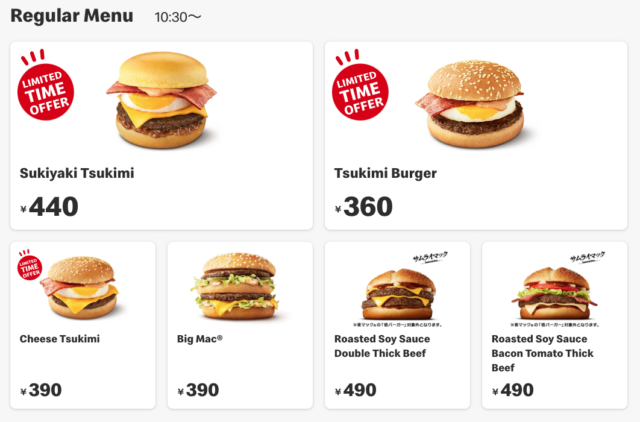
From this Friday, the cost of the signature Big Mac hamburger will increase to ¥410 ($2.85) from ¥390, McDonald’s Holding Company Japan Ltd. said in a statement, reflecting increases of ¥10 to ¥30 on many items.

A Big Mac costs $5.15 in the United States, according to The Economist magazine’s index of prices worldwide. The price difference implied that Japan’s currency was undervalued by 45%, according to the gauge when it was last updated in July.

McDonald’s Japan is raising prices for the second time in 2022 on its cheeseburgers, which will cost ¥180 each from Friday from ¥140 at the beginning of the year.

Rising production costs and the yen’s slide have spurred price increases by 60% of major Japanese restaurants, according to a survey issued this month by Tokyo Shoko Research.

Separately, Mister Donut shops in Japan are to raise prices on most items by about 7.4% from Nov. 25, its parent company, Duskin Co., said. — Reuters

Gov’t rejects all bids in T-bond auction

BW FILE PHOTO

THE GOVERNMENT rejected all bids for reissued 20-year Treasury bonds (T-bonds) it offered on Wednesday as the market demanded higher rates in anticipation of more rate hikes to combat inflationary pressures.

The Bureau of the Treasury  (BTr) did not accept any tenders for the reissued 20-year securities — which have a remaining life of 16 years and four months — it offered on Wednesday even as total bids reached P49.985 billion, higher than the programmed P35 billion.

Rates bid by participants ranged from 7.250% to 8%. Had the offer been fully awarded, the average rate for the bonds on offer would have reached 7.565%, 81.5 basis points (bps) higher than the 6.75% coupon and up 222.4 bps from the 5.341% average fetched for the series when it was first offered on Jan. 22, 2019.

This is also 22.7 bps above the 7.3380% quoted for the 20-year tenor at the secondary market before the auction, based on the PHP Bloomberg Valuation Reference Rates published on the Philippine Dealing System’s website.

Traders said that the market is demanding higher bids amid expectations of more monetary tightening from central banks.

“The bids submitted by the market are too high. That is consistent [with] the view that interest rates may continue to rise in the months ahead,” a trader said.

“Maybe they found the bids too high,” a second trader said, also attributing it to recent and expected policy hikes.

“They don’t want to look aggressive in borrowing as well if they did fully award,” the second trader added. “That will cause sell-off in secondary market or may cause investors to expect higher yields in next month’s auctions.”

Likewise, Rizal Commercial Banking Corp. Chief Economist Michael L. Ricafort said that anticipation of more rate hikes is on expected efforts to help stabilize the weakening peso, as well as elevated inflation.

“Higher bid yields are also due to the aftermath of the storm damage by Super Typhoon Karding in Central and Northern Luzon, especially the provinces that are major producers of rice, corn, vegetables, and other food/agricultural products,” Mr. Ricafort said in a Viber message.

“This could lead to some pick up in overall inflation, and would support more local policy rate hikes to better manage both inflation and inflation expectations,” he added.

The consumer price index climbed to 6.3% year on year in August from the nearly four-year high of 6.4% a month earlier and 4.4% a year ago. It was the fifth straight month that inflation exceeded the Bangko Sentral ng Pilipinas’ (BSP) 2-4% target this year.

In response, the BSP increased its benchmark interest rates by 50 bps to 4.25% last Thursday, hiking borrowing costs by 225 bps since May.

The US Federal Reserve hiked its policy rates by another 75 bps last week while signaling larger increases to come as inflation is still way above its 2% target at 8.3% as of August. The central bank has raised key rates by 300 bps since March, including two other 75-bp moves in June and July.

BSP Governor Felipe M. Medalla said last month that the Fed’s aggressive tightening also poses an additional risk to domestic prices due to its effect on the peso.

The peso closed at an all-time low of P58.99 per dollar on Tuesday, Bankers Association of the Philippines data showed. In the year to date ending Sept. 27, the peso has weakened by 15.66% or P7.99 from its P51-a-dollar close last year.

Wednesday’s T-bond auction was the last one for the month. The government raised just P70 billion via bonds against its P140-billion program for September after rejecting all bids in two auctions. However, it was able to raise P10 billion when it opened its tap facility on Sept. 13.

With Treasury bill (T-bill) awards in September only reaching P18.58 billion against the P60-billion program, the government was only able to raise P88.58 billion out of its P200-billion plan for the month.

For October, the BTr wants to raise P200 billion from the domestic market, or P60 billion via T-bills and P140 billion from T-bonds. It is set to offer longer bond tenors next month, with maturities ranging as high as 13 years.

The government borrows from local and external sources to help fund a budget deficit capped at P1.65 trillion this year, equivalent to 7.6% of gross domestic product. — Diego Gabriel C. Robles

Lalamove, Unioil team up to address impact of fuel prices on delivery drivers

DELIVERY platform Lalamove said it has partnered with Unioil Philippines to help delivery drivers deal with the rising fuel prices.

“More than 200,000 partner drivers of Lalamove can enjoy up to P3/liter off at any Unioil branch,” the company said in an e-mailed statement.

The company said its partner drivers can earn points through Unioil’s loyalty payments mobile application for every P100 of lubricant purchase.

On Monday, oil companies announced that this week would see a reduction in fuel prices.

Phoenix Petroleum Philippines said it would decrease the prices of diesel by P1.25 per liter and gasoline by P1.65 per liter starting Sept. 27.

Caltex said it would decrease fuel prices of Platinum and Silver by P1.65 per liter, diesel by P1.25 per liter, and kerosene by P1.35 per liter.

Lalamove was launched in the Philippines in 2016.

The platform matches drivers with customers and businesses, especially small and medium enterprises, to fulfill same-day deliveries.

Lalamove said it currently operates in over 30 markets across Asia and Latin America. — Arjay L. Balinbin

Intel unveils new chips and software as it chases an industry comeback

INTEL CORP., looking to regain its footing in the chip industry, introduced new personal computer processors and graphics semiconductors, as well as software that makes it easier to use the company’s technology.

Intel’s latest Core desktop processors will provide gamers and other high-performance users with a significant boost, the company said at its Innovate event Tuesday in San Jose, California. A new graphics chip for data centers, meanwhile, is aimed at challenging Nvidia Corp.’s hold on that market. That product, called Ponte Vecchio, has been shipped for use in a new government super computer.

Chief Executive Officer (CEO)Pat Gelsinger is trying to restore Intel to its former dominance, and the Innovate presentation is part of that. The chipmaker had hosted a well-attended product showcase called the Intel Developer Forum until 2017, when then-CEO Brian Krzanich scrapped the event. Now Mr. Gelsinger, in his second year, is bringing the stage show back.

The stakes are high. Intel lost its status as the world’s largest chipmaker in recent years and fell behind rivals in manufacturing prowess. Mr. Gelsinger, a longtime Intel executive who left to run VMware, Inc. for more than a decade, returned to the company in 2021 to orchestrate a turnaround.

During Mr. Gelsinger’s time away, delays in product introductions led customers to look elsewhere for supplies and technological leadership. A company that once had market share of more than 80% has been losing ground, and customers such as Amazon.com, Inc. have increasingly started to design their own chips.

Mr. Gelsinger’s challenge: getting the industry to follow Intel’s lead without first proving that its products are the best again. He also faces a slump in demand for PCs, the biggest end market for Intel’s products. And the stock has fallen 48% in 2022, underperforming its peers during a bleak year for the overall chip industry.

Mr. Gelsinger’s pitch to investors has been that Intel still leads in many areas and the industry needs its innovations. Under his stewardship, the sleeping giant will take back its technical superiority and resume its central role, he has said.

But computing has changed, and Intel is trying to use the San Jose event to show it’s more open to working with partners. The company is letting its offerings work in tandem with those of others, a break from the past.

“Fostering this open ecosystem is at the center of our transformation and the developer community is essential to our success,” Gelsinger said.

One of the company’s new products is the Intel Developer Cloud, a program that gives software makers and other customers early access to new chips — in particular, its forthcoming Xeon server products.

Intel is making the announcements just days after rival Advanced Micro Devices, Inc. debuted its new range of processors, a lineup that experts say is among the industry’s best.

At the event, Mr. Gelsinger acknowledged that Intel— like its peers— is facing slowing demand for its main product. But he reiterated his belief that the company shouldn’t pull back on investments needed for its long-term strategy.

“You cannot be driven by near-term financials,” he said. “You have to be investing for the future.” — Bloomberg

Spanish court formally sends Shakira to trial for tax fraud

A SCREENSHOT from Shakira’s ‘Underneath Your Clothes’ MV — YOUTUBE.COM/SHAKIRA

MADRID — A Spanish court on Tuesday formally ordered Colombian superstar Shakira to stand trial on accusations that she failed to pay €14.5 million ($14.31 million) in income taxes, a court document released on Tuesday showed. The “Hips Don’t Lie” singer, 45, whose full name is Shakira Isabel Mebarak Ripoll, rejected in July a deal to settle the case, which meant she would have to stand trial in a case that could see her sent to prison for eight years.

The Esplugues de Llobregat court on Tuesday confirmed the trial will go ahead on a date still to be announced.

The prosecutor is seeking an eight-year prison term for the singer, who is accused of failing to pay taxes between 2012 and 2014, a period in which she said she was leading a “nomadic life” because of her work.

“The order to send Ms. Shakira to trial is just another step in any proceedings of this kind. The situation has not changed and everything continues as normal. Ms. Shakira’s legal defense will do its job by presenting its written arguments at the appropriate time,” a statement from her lawyers said.

Ms. Shakira vowed last week to fight what she claimed were “false” accusations by Spanish authorities and added that she had already paid what the Spanish tax office said she owed before they filed a lawsuit. — Reuters

BillEase, PayMongo to help retailers through buy-now-pay-later service

CONSUMER finance platform BillEase has partnered with online payments company PayMongo to offer a transparent card-free buy-now-pay-later (BNPL) service that would help businesses expand.

“We’re thrilled to partner with BillEase so thousands of businesses using PayMongo can offer consumer credit at checkout and flexible installment plans,” PayMongo’s Acting Chief Executive Officer Isabel Ridad said in a statement on Wednesday.

“Our payment infrastructure, combined with BillEase’s customizable payment plans and transparent consumer credit offering, is a powerful tool for retailers to reach new customers, and increase average order values,” Ms. Ridad said.

PayMongo now offers BillEase as an installment option for consumers. Through BillEase, retailers can offer three installment options at checkout.

These options are to pay later in 10 or 20 days, pay in four installments for small to medium purchases, and to pay monthly over three to 12 months for large purchases with interest rates between 0% and 3.49%.

Businesses can also offer a 0% annual percentage rate (APR) through PayMongo.

“Over the past three years, BillEase and PayMongo redefined the ecommerce landscape for millions of Filipinos. This strategic partnership underscores our shared values of providing flexible and transparent point-of-sale (POS) financing for retailers and their customers,” BillEase Chief Executive Officer and Co-Founder Georg Steiger said. 

“With PayMongo, BillEase can provide inclusive options for retailers across all sizes and categories, helping them attract new customers and build strong loyalty,” Mr. Steiger said.

BillEase is a credit and finance platform that allows clients to pay for their online and offline purchases through installment plans. It launched its in-store QR payment service this year.

According to the company, businesses offering BNPL services saw an increase in sales conversion between 15-25% with average order values rising more than sales that are not paid through POS financing.

The platform’s revolving credit line also increases the likelihood of re-transaction using the same payment method.

The company earlier said that the volume of transactions on BillEase climbed nearly five times in the first half of the year from the same period in 2021. It has disbursed over 3 million in loans so far.

BillEase is currently accepted as a payment method by over 1,000 brands and small businesses and is offered by seven major payment gateways in the Philippines.

Meanwhile, PayMongo offers a fully online onboarding process with retail websites, allowing businesses to accept digital payments through online banking, e-wallets, and BNPL with BillEase as the newest addition to the channel.

PayMongo is used by over 10,000 retailers in the country. — Keisha B. Ta-asan

MWSS fines Maynilad for recurring water service interruptions

THE METROPOLITAN Waterworks and Sewerage System (MWSS) is penalizing Maynilad Water Services, Inc. for P9.26 million due to prolonged water service interruptions and other issues.

“The MWSS regulatory office penalizes Maynilad for service obligation failure from May to June 2022. The MWSS monitored a prolonged and recurring water service interruptions and water quality issues,” MWSS Chief Regulator Patrick N. Ty said at a virtual briefing on Wednesday.

Mr. Ty said the penalty will be implemented in the form of bill rebates to affected Maynilad customers by November. He clarified that MWSS will still have to study the total number of affected customers.

“This is the second biggest penalty imposed by MWSS to Maynilad. The nature, scope and other details of the rebate will be discussed in October,” he added.

In March, MWSS also imposed a financial penalty on Maynilad in the form of bill rebates due to its failure to meet its service obligations after a prolonged water service interruption in Metro Manila.

Meanwhile, Mr. Ty has also directed Maynilad to ramp up the implementation of its proposed mitigating measures to address the deteriorating raw water quality in Laguna Lake and ensure the continuity of water supply within its service area.

In a statement, Maynilad said that it will abide by the decision of the MWSS to pay a financial penalty for the water interruptions that affected the area of Las Piñas, Muntinlupa, Parañaque, and the cities of Cavite, Bacoor, and Imus and the towns of Noveleta, and Rosario in the province of Cavite.

Maynilad said that the water interruptions were caused by the algal bloom in Laguna Lake which severely affected the water production of its Putatan water treatment plants.

“Our ability to provide uninterrupted water service during the period was severely hampered by the unprecedented extent of the algal bloom that altered the raw water quality in Laguna Lake. Algal bloom is beyond our control, being a product of both natural and industrial causes,” Maynilad said in a statement via Viber.

Maynilad said that the company is investing in treatment technology upgrades for Putatan plants to help improve and maintain water production.

“The ultimate solution would be to protect Laguna Lake from further degradation. We continue to work closely with all Laguna Lake stakeholders to ensure that it is protected, so that the lake’s potential as a long-term supply source for drinking water can be fully realized,” it added.

Metro Pacific Investments Corp., which has a majority stake in Maynilad, is one of three Philippine units of Hong Kong-based First Pacific Co. Ltd., the others being Philex Mining Corp. and PLDT Inc.

Hastings Holdings, Inc., a unit of PLDT Beneficial Trust Fund subsidiary MediaQuest Holdings, Inc., has an interest in BusinessWorld through the Philippine Star Group, which it controls. — Ashley Erika O. Jose

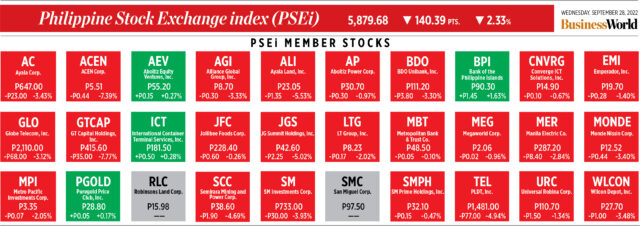
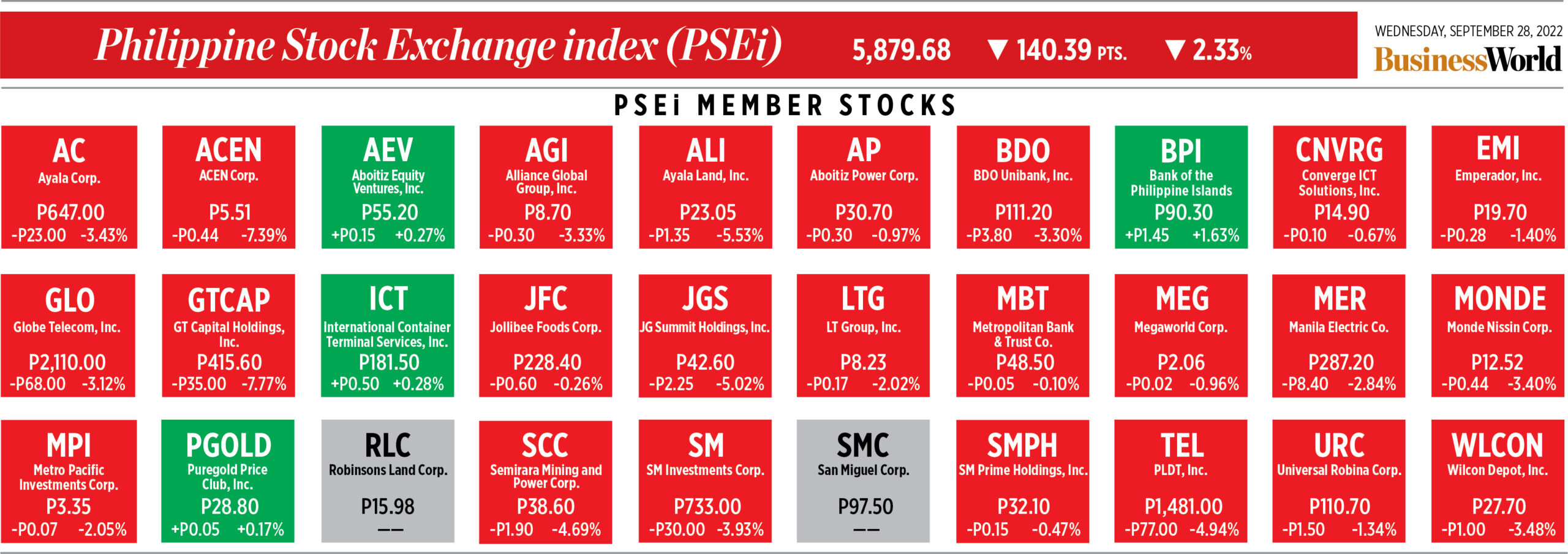
How PSEi member stocks performed — September 28, 2022

Here’s a quick glance at how PSEi stocks fared on Wednesday, September 28, 2022.