Home Blog Page 5403

David Crosby, rock legend and master of harmony, dead at age 81

David Crosby. — Glenn Francis/PacificProDigital.com

David Crosby, one of the most influential rock musicians of the 1960s and ’70s and who was inducted into the Rock & Roll Hall of Fame with two different groups, has died at the age of 81.

Crosby was a founding member of two revered rock bands: the country and folk-influenced Byrds, for whom he cowrote the hit “Eight Miles High,” and Crosby, Stills & Nash, later Crosby, Stills, Nash & Young, who defined the smooth side of the Woodstock generation’s music.

“It is with a deep and profound sadness that I learned that my friend David Crosby has passed,” Graham Nash, his longtime collaborator and sometime sparring partner, said in a statement.

“I know people tend to focus on how volatile our relationship has been at times, but what has always mattered to David and me more than anything was the pure joy of the music we created together … and the deep friendship we shared,” Mr. Nash said.

Crosby’s wife, Jan Dance, announced the death in a statement published by Variety. It did not specify when he died, nor the cause. Crosby’s British-based representatives could not immediately be reached for comment by Reuters.

Musically, Crosby stood out for his intricate vocal harmonies, unorthodox open tunings on guitar and incisive songwriting. His work with both the Byrds and CSN/CSNY blended rock and folk in new ways, and their music became a part of the soundtrack for the hippie era.

“I don’t know what to say other than I’m heartbroken to hear about David Crosby. David was an unbelievable talent — such a great singer and songwriter. And a wonderful person,” Beach Boys leader Brian Wilson said on Twitter.

Personally, Crosby was the embodiment of the credo “sex, drugs and rock ‘n’ roll,” and a 2014 Rolling Stone magazine article tagged him “rock’s unlikeliest survivor.”

In addition to drug addictions that ultimately led to a transplant to replace a liver worn out by decades of excess, his tumultuous life included a serious motorcycle accident, the death of a girlfriend, and battles against hepatitis C and diabetes.

“I’m concerned that the time I’ve got here is so short, and I’m pissed at myself, deeply, for the 10 years — at least — of time that I wasted just getting smashed,” Crosby told the Los Angeles Times in July 2019. “I’m ashamed of that.”

He fell “as low as a human being can go,” Crosby told the Times.

He also managed to alienate many of his famous former bandmates, for which he often expressed remorse in recent years.

His drug habits and often abrasive personality contributed to the demise of CSNY and the members eventually quit speaking to each other. In the 2019 documentary David Crosby: Remember My Name, he made clear he hoped they could work together again, but conceded the others “really dislike me, strongly.”

Crosby fathered six children — two as a sperm donor to rocker Melissa Etheridge’s partner and another who was placed for adoption at birth and did not meet Crosby until he was in his 30s. That son, James Raymond, would eventually become his musical collaborator.

“Thank you @thedavidcrosby I will miss you my friend,” Etheridge said on Twitter alongside a photo of the two of them. Looking back at the turbulent 1960s and his life, Crosby told Time magazine in 2006: “We were right about civil rights; we were right about human rights; we were right about peace being better than war … But I think we didn’t know our butt from a hole in the ground about drugs and that bit us pretty hard.”

Crosby was born on Aug. 14, 1941, in Los Angeles. His father was a cinematographer who won a Golden Globe for High Noon in 1952 and his mother exposed him to the folk group the Weavers and to classical music.

MUSIC AND WOMEN
As a teenager, Crosby found that one of his passions aided him in the pursuit of another. “It (playing music) was absolutely joyous to me,” he wrote. “I always loved it. I always will love it. And I did get laid.”

After a stay in New York’s Greenwich Village music scene, Crosby was back in California in 1963 and helped Roger McGuinn start the Byrds, whose first hit, a cover of Bob Dylan’s “Mr. Tambourine Man,” came in 1965, followed by “Turn! Turn! Turn!”

Crosby was kicked out of the Byrds because the band did not want to play his songs, with the flashpoint being “Triad,” about a menage a trois, and disputes over on-stage political rants.

Crosby and Stephen Stills, whose band with Neil Young, Buffalo Springfield, had fallen apart, then began playing together. Graham Nash of the Hollies, who met Crosby in 1966 and went on to become his closest collaborator and a closer friend, joined them. Their first album, “Crosby, Stills and Nash,” was a big seller in 1969.

Guitarist and singer/songwriter Young fell in with them that year and Crosby, Stills, Nash & Young came to be considered one of the greatest amalgams of talent in rock history.

Their second performance together was the landmark Woodstock music festival in 1969, and their 1970 album, “Deja Vu” contained hits “Teach Your Children,” “Woodstock,” and one of Crosby’s signature songs, “Almost Cut My Hair.”

GIRLFRIEND’S DEATH
As CSNY was taking off, Crosby was in a drug-fueled downward spiral caused by the 1969 death of girlfriend Christine Hinton in a car accident.

“Nothing in my life had prepared me for that,” wrote Crosby, who had added cocaine and heroin to his drug repertoire.

The next decade was a blur of drug arrests, album releases and women. “I was not into being monogamous — I made that plain to everybody concerned. I was a complete and utter pleasure-seeking sybarite,” he wrote in his autobiography.

Crosby had a daughter with a girlfriend but soon left her for Jan Dance, who moved in with him in 1978. That relationship lasted and they had a son, Django, in 1995.

Crosby introduced Dance to heroin and the free-basing method of smoking cocaine. “We went down the tubes together but we did it with our hearts intertwined,” he wrote.

There were several failed attempts at rehab and Crosby developed a reputation as a bloated, hapless addict. In 1985, Nash told Rolling Stone: “I’ve tried everything — extreme anger, extreme compassion. I’ve gotten 20 of his best friends in the same room with him. I’ve tried hanging out with him. I’ve tried not hanging out with him.”

Crosby beat a series of drug charges but lost in Texas after being arrested with a drug pipe and gun at a club in Dallas and went to prison in 1985. The prison system required him to shave his trademark bushy mustache, but he found solace in playing in the prison band during his year of incarceration.

After his release, Crosby told People magazine he had beaten his addictions.

He was also arrested on gun and marijuana charges in New York in 2004.

In 2014 he released “Croz,” his first solo album since 1993, but his tour to promote the record was interrupted in February by heart surgery.

He continued recording and was an active presence on Twitter, in addition to writing an advice column for Rolling Stone.

In March 2021, the Guardian reported that Crosby sold the recorded music and publishing rights to his entire music catalog to Irving Azoff’s Iconic Artists Group for an undisclosed sum. — Reuters


Why learning to surf can be great for your mental health, according to a psychologist

STOCK PHOTO | Image by Pexels from Pixabay

Disclaimer: This asset is provided by The Conversation.

Nothing clears the mind like going for a surf. With the escapism and simplicity of riding waves, it’s no secret that surfing feels good.

Now our preliminary study in children and adolescents adds to growing evidence that surfing really is good for your mental health.

But you don’t have to have a mental illness to get the benefits. Here’s how you can use what we’re learning from our research to boost your own mental health.

Evidence showing the mental health benefits of surfing ranges from improving self-esteem and reducing social isolation to treating depression and other mental disorders.

Such evidence mainly comes from specific surf therapy programs. These combine supportive surfing instruction with one-to-one or group activities that promote psychosocial wellbeing.

At their core, most of these programs provide participants with the challenge of learning to surf in an emotionally safe environment.

Any benefits to mental health are thought to arise through:

  • an increased sense of social connection
  • a sense of accomplishment that people can transfer to other activities
  • respite from the day-to-day stressors due to the all-encompassing focus required when surfing
  • the physiological response when surfing, including the reduction of stress hormones and the release of mood-elevating neurotransmitters
  • exercising in a natural environment, in particular “blue spaces” (on or near water)

Our pilot study aimed to see whether the Ocean Mind surf therapy program improved child and adolescent mental health.

We also wanted to see whether participants accepted surfing as a way to address their mental health concerns.

The study involved 36 young people, 8–18 years old, who were seeking help for a mental health concern, such as anxiety, or a neurodevelopmental disorder (attention deficit hyperactivity disorder or autism spectrum disorder). They were referred by their mental health provider, GP or school counsellor.

Participants were allocated at random to the Ocean Mind surf therapy program or were placed on a waitlist for it. Those allocated to surf therapy continued with their usual care, which included case management from a mental health provider. Those on the waitlist (the control group) also continued with their usual care.

The surf therapy program ran for two hours every weekend for six weeks. Young people were partnered one-to-one with a community mentor who received training in mental health literacy and surf instruction.

Each session included supportive surf instruction and group mental health support, all conducted at the beach. Sessions were run by the program coordinator who was also trained in mental health and surf instruction.

By the end of the six-week program, those receiving surf therapy had reductions in depression, anxiety, hyperactivity and inattention symptoms, as well as fewer emotional and peer problems. This was compared with those in the control group, who had increases in these symptoms.

However, any improvements were not sustained six weeks after the program finished.

Those receiving surf therapy also saw it as a suitable, youth-friendly way to manage symptoms of mental ill-health. This was further supported by the high completion rates (87%), particularly when compared with other methods of mental health treatment. For instance, psychotherapy (talk therapy) has been reported to have a 28–75% drop-out rate for children and adolescents.

These early findings are promising. But given this was a pilot study, more research is needed with larger numbers of participants to confirm these outcomes and see if they generalise to broader populations.

We’d like to identify the best dose of surf therapy in terms of session frequency, duration, and program length.

We also need to understand the factors that maintain these initial positive changes in mental health, so any benefits can be sustained after the program finishes.

The recognition of surfing as a potentially effective and acceptable mental health treatment among young people is also promising. But this finding does not preclude the more conventional clinical treatments, such as talk therapy and medication, which may work better for certain people.

Rather, surf therapy may be seen as an additional form of support alongside these approaches or an alternative for those who do not benefit from more traditional methods.

If you think surfing might be for you, remember:

  • surfing requires complete focus due to the ever-changing conditions of the ocean, making it a great way to step away from day-to-day life and wipe out the effects of stress
  • for some people, surfing may reduce barriers to seeking mental health care
  • surfing may not be for everyone, nor can it guarantee to reduce your symptoms. Even the best surfers can suffer from depression and may require external support
  • don’t worry if you cannot access the ocean or a surfboard. Other nature-based activities, such as hiking and gardening, can also benefit your mental health.

Coins.ph offers sneak peek of the first-ever VR Avatar Studio in the Philippines

Eprom Galang, general manager of Coins.ph

Coins plans to tap into NFTs and metaverse to engage entertainment and gaming communities through its recently launched VR Avatar Studio

Coins.ph (“Coins” or the “Company”), the Philippines’ leading digital wallet provider and crypto exchange platform, recently launched the country’s first-ever Virtual Reality (VR) Avatar Studio. On Jan. 13, 2023, Coins showcased the VR Avatar Studio and demonstrated how brands and users can leverage their Non-Fungible Tokens (NFTs) and transform them into a VR Avatar.

Explore a bold new world with NFTs

NFTs have gained popularity in the past years as they allow people to either create or own digital art that’s one of a kind, with monetary value up to millions. NFTs have gone beyond digital art, with businesses and brands leveraging NFTs in marketing campaigns. These include fashion brands creating digital art of their physical clothing collection, multinational companies creating unique NFTs to help promote their CSR efforts, and lifestyle brands giving exclusive rewards and benefits through NFTs.

In the Philippines, NFTs are being embraced by Filipinos and companies are making the most of it by engaging their customers. Now, brands can bring consumers to a unique universe where their products are showcased.

The Coins VR Avatar Studio is a step forward towards the metaverse

By launching the first-ever VR Avatar Studio in the Philippines, Coins pledged to tap into the metaverse by creating entertaining content and growing VR Avatar influencers to bind crypto, gaming and more communities together.

Brands and users will be able to transform their NFTs into VR Avatars through Coins VR Studio. The NFT VR Avatars can act as an extension of their online and metaverse identity.

“We look forward to helping pioneer the adoption of the metaverse here in the Philippines. We have the opportunity to become a global leader in this new digital environment where physical constraints no longer hold us back. With a young and tech-savvy population, the Philippines is in a prime position to make the most of this new technology, making our lives easier, more efficient and productive,” said Eprom Galang, general manager of Coins.ph.

In the near future, Coins plans to have a set of virtual influencers and hosts that can engage the Coinmunity through interactive content that will educate Filipinos on how to achieve financial freedom through cryptocurrency, NFTs and play-to-earn gaming.

For more information about Coins.ph, visit https://coins.ph and follow us on Facebook, Twitter, and Instagram.


Spotlight is BusinessWorld’s sponsored section that allows advertisers to amplify their brand and connect with BusinessWorld’s audience by enabling them to publish their stories directly on the BusinessWorld Web site. For more information, send an email to online@bworldonline.com.

Join us on Viber to get more updates from BusinessWorld: https://bit.ly/3hv6bLA.

Shortening the last mile to curb shipping delays

STOCK VECTOR | Image by pch.vector on Freepik

Filipino shoppers have complained of orders bought online during the seasonal 12.12 Christmas sale in 2022 that either did not arrive or were tagged missing. E-commerce customers have grown accustomed to snagging deals from brands as diverse as smartphone maker realme and car manufacturer Honda on such sales days. 

Customers want their goods fast – but they also don’t want to pay much for shipping, as pointed out by Constantin Robertz, CEO of Locad, a Philippine-born logistics technology startup. 

“The only way to [address] that…and be reliable and predictable is to shorten the last mile,” Mr. Robertz said. 

“Change the origin-destination combinations, keep inventory closer to the customers, and then fulfill locally,” he added. 

Shipping delays can be distilled down to three factors: location, order fulfillment, and inventory management, he told BusinessWorld in a January 16 event. 

Location, Mr. Robertz said, is the distance between the order’s origin and its destination. If the warehouse is right next door, “there’s only so much that can go wrong… but if the parcel comes cross-border, the number of things that could go wrong along the way are exponentially multiplied.” 

Mr. Robertz also pointed out that the demand surge during sales days like 11.11 and 12.12 goes up tenfold, and that merchants who are into product development and not fulfillment will likely take much longer to push out their orders. 

“Sync your inventory across all sales channels so you don’t end up overselling and… scrambling to get the goods from the manufacturers,” he advised. 

Locad, he said at the January 16 event, leverages a network of last-mile carriers, and then measures in real-time these carriers’ delivery lead times – from the pick-up, to the sorting center, to the destination city. 

When a certain carrier encounters bottlenecks, “we change the allocation to the carriers that can do it faster,” he said. 


Ecommerce in the Philippines 

Shopee reported an increase of over 13 times in items sold in the Philippines during the first two hours of its 12.12 sales in 2021. The Singapore-headquartered company – alongside Lazada, Zalora, and BeautyMNL – are the country’s top ecommerce platforms. 

The Philippines’ digital economy is expected to reach a gross merchandise value of $35 billion by 2025, growing at a 20% compound annual growth rate from the current $20 billion, according to an October 2022 report by Google, Temasek, and Bain & Co. 

The main driver will be the e-commerce sector, the report said. 

The Philippine government has long recognized the role of ecommerce, with its passing into law the Electronic Commerce Act (Republic Act No. 8792) in the year 2000.  COVID-19, however, triggered the e-commerce turning point in the country.  – Patricia B. Mirasol

Google loses bid to block Indian Android antitrust ruling in major setback

REUTERS

 – Google on Thursday lost its fight in India’s Supreme Court to block an antitrust order, in a major setback that will force the US tech giant to change the business model of its popular Android operating system in a key growth market.

The Competition Commission of India (CCI) ruled in October that Google, which is owned by Alphabet Inc., exploited its dominant position in Android and told it to remove restrictions imposed on device makers, including related to pre-installation of apps. It also fined Google $161 million.

Google challenged the order in the Supreme Court, saying it would hurt consumers and its business. It warned growth of the Android ecosystem could stall and it would be forced to alter arrangements with more than 1,100 device manufacturers and thousands of app developers. Google also said “no other jurisdiction has ever asked for such far-reaching changes”.

A three-judge bench at the Supreme Court, which included India’s chief justice, delayed the Jan. 19 implementation of the CCI’s directives by one week, but declined to block them.

“We are not inclined to interfere,” Chief Justice D.Y Chandrachud said.

During the hearing, Chandrachud told Google: “Look at the kind of authority which you wield in terms of dominance.”

About 97% of 600 million smartphones in India run on Android, according to Counterpoint Research estimates. Apple AAPL.O has just a 3% share.

India’s top court asked a lower tribunal, which is already hearing the matter, to decide on Google‘s challenge by March 31.

Google did not respond to a request for comment.

Google licenses its Android system to smartphone makers, but critics say it imposes restrictions such as mandatory pre-installation of its own apps that are anti-competitive. The company argues such agreements help keep Android free.

Faisal Kawoosa, founder of Indian research firm Techarc, said the Supreme Court ruling meant Google may have to consider other business models in India, such as charging an upfront fee to startups to provide access to the Android platform and its Play Store.

“At the end of the day, Google is for profit and has to look at measures that make it sustainable and power growth for its innovations,” he said.

Android has been the subject of various investigations by regulators around the world. South Korea has fined Google for blocking customized versions of it to restrict competition, while the United States Justice Department has accused Google of executing anticompetitive distribution agreements for Android.

In India, the CCI has ordered Google that the licensing of its Play Store “shall not be linked with the requirement of pre-installing” Google search services, the Chrome browser, YouTube or any other Google applications.

It also ordered Google to allow the uninstalling of its apps by Android phone users in India. Currently, apps such as Google Maps and YouTube can not be deleted from Android phones when they come pre-installed.

Google has been concerned about India’s decision as the steps are seen as more sweeping than those imposed in the European Commission’s 2018 ruling, when Google was fined for putting in place what the Commission called unlawful restrictions on Android mobile device makers. Google has challenged the record $4.3 billion fine in that case.

In Europe, Google has made changes including letting Android device users pick their default search engine from a list of providers.

Google also argued in its legal filings, seen by Reuters, that the CCI’s investigation unit “copy-pasted extensively from a European Commission decision, deploying evidence from Europe that was not examined in India”.

N. Venkataraman, a government lawyer representing the CCI, told the top court: “We have not cut, copy and pasted.” – Reuters

Philippines, US in talks on holding ‘2-plus-2 meeting’ -envoy

BW FILE PHOTO

 – The Philippines and the United States are in talks about holding a “2-plus-2 meeting” of top diplomatic and defense officials as early as March, the Philippine ambassador to Washington said on Friday.

In a text message, Jose Manuel Romualdez confirmed a Nikkei report citing sources on the discussions about holding the first such talks in seven years, and said the agenda would include issues such as tension over the South China Sea and Taiwan.

The Philippines is a defense ally of the United States, but under former President Rodrigo Duterte it avoided criticizing Beijing, eyeing Chinese investment.

Since President Ferdinand Marcos Jr took office last year, several top U.S. officials, including Vice President Kamala Harris, have visited the Philippines to shore up ties and discourage aggressive steps by China in the South China Sea and against self-ruled Taiwan.

The Philippines and the United States have a long-standing Mutual Defense Treaty and take part in joint training exercises each year, ranging from live fire and amphibious assaults to humanitarian missions and counter-terrorism drills.

Asked about a 2-plus-2 meeting, a U.S. State Department spokesperson said there was nothing to announce but noted “the long-standing, ironclad alliance between the Philippines and the United States has contributed to peace, stability, and prosperity in the Asia-Pacific region for more than 75 years.” – Reuters

Ushering in the Year of the Water Rabbit

Chinese New Year is known for its festivities and traditions practiced by Chinese communities across the world. From the dragon dance performances, decoration of red lanterns, lighting of fireworks and firecrackers, the serving of “lucky” foods, to visiting one’s family and honoring ancestors, these are among the observances we could look forward to in celebrating the beginning of this new year. But for the days ahead, what could we expect?

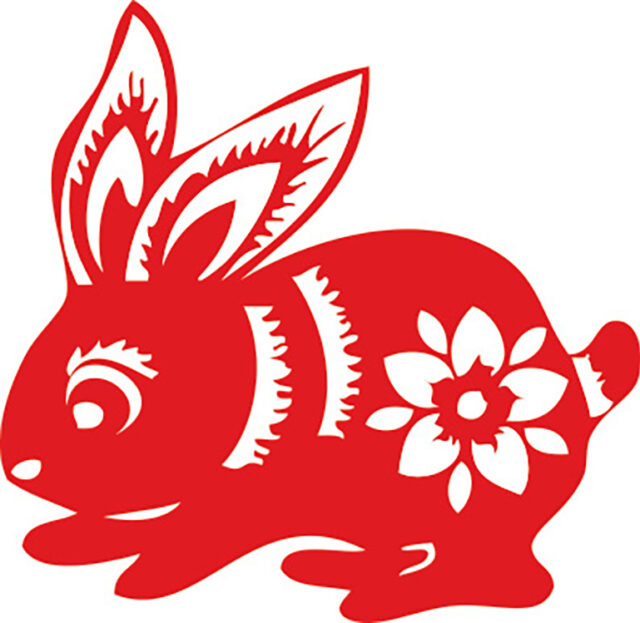
Shengxiao, or the Chinese zodiac, has served as a guide for several people in traversing a new year. Based on the lunar calendar, this ancient belief system has a 12-year cycle, and a particular animal sign represents each year along with one of the five elements. This coming Chinese New Year ushers in the Year of the Water Rabbit.

Gentleness and peacefulness are commonly associated with the Water Rabbit. Rabbits are also seen to be responsible and vigilant. Therefore, after the energetic Year of the Water Tiger in 2022, the coming Year of the Water Rabbit this 2023 is seen as “a harbinger of gentleness and serenity,” according to astrology and feng shui website KarmaWeather. The principal dynamics of this new year are thus “rest, truce, and intellectual challenges.”

Earlier this year on her official Facebook page, Marites Allen, popularly known as the country’s “feng shui queen,” has also unveiled her forecasts for each animal sign as they enter the Year of the Water Rabbit this 2023.

People born under the Rat zodiac sign could be among the “winners” in this year of the Water Rabbit, according to Ms. Allen. Thanks to the Future Prosperity star, Ms. Allen said that this could present the Rat signs with auspicious blessings and good fortune, multipliable up to nine times.

Meanwhile, money and career luck could go on for the Ox this year, but Ms. Allen said they could be disturbed by threats of robbery, losses, or injuries. Despite the difficult times, the Ox people could prosper, having innate confidence, strength, and stability. Still, Ms. Allen also reminded them to steer clear from being stubborn, resentful, and temperamental, which could lead them to downfall and destruction.

Tigers could likewise continue their garnering of good fortune, said Ms. Allen, but she also noted threats of robbery, losses, or injuries. Nonetheless, the universe could help people born under this sign to exhibit some profitable gains this year if they have gotten good karma because of their past actions.

For the Rabbit-born people, given they are held as a harbinger of calmness, peace, and tranquility, there is “a lot to gain.” Still, Ms. Allen reminded Rabbits to be extra careful not to dispel blessings coming in the form of money or promotion at work. For them, the only challenge to confront in their year is the threat to their health and longevity.

Meanwhile, people born under the Year of the Dragon are told to brace for possible negativities carried by hostile energies, which imply heartaches and misunderstandings. Thus, to prevent themselves from being carried away by unusual heartaches, Dragons should possess a lot of patience, tolerance, and restraint. “Avoid at all costs any disagreements and opt for peace and harmonious environment,” Ms. Allen advised.

Snakes could have their peaceful life shaken by the hostility star’s presence this 2023, according to Ms. Allen, who also noted indications of heartaches, misunderstandings, lawsuits, and many quarrelling.

People born under the Horse sign could look forward to wealth luck and good fortune to easily roll to them this year. “This is not the time to take it easy but rather push yourself to the limit and keep on working smart to achieve unlimited funds, profitable partnerships, or promotions,” Ms. Allen said. These would bring the Horse-born people extra income. Additionally, their investments could grow and multiply.

The Sheep, being allies and closest to the Rabbit, is also blessed this year. Add to that the auspicious Victory star that blesses them with “new beginnings and superior blessings.” People born under the Year of the Sheep could expect something new this year, such as achieving new heights and experience as well as abundant new things not familiar to them. It is also a good time for them to venture into unfamiliar territory to expand.

Also blessed by the auspicious Victory Star are the Monkeys, who could have relief this year after last year’s struggles. Still, Ms. Allen warned of the threat of three killings star, which they have to manage. Some issues involving one’s name being compromised, money loss, and health scare could be created by this star.

Meanwhile, Rooster-born people could expect highs and lows this year. “So take it easy, lie low, and best to take a shift, make some necessary changes, or if you can afford it, try to move to a different home, or location, or keep traveling,” Ms. Allen advised. Yet, Roosters could look forward to a busy year with a possibility of cash blessings.

The Dog is the secret friend of the Rabbit. However, with the misfortune star present in their chart this time, Ms. Allen advised people born under the Dog sign to be more attentive on caring for themselves. There is the risk of illness, which could impact one’s income opportunities and working schedules.

Also friends with the Rabbit are the Boars, which meant good news, according to Ms. Allen. As Boars deal with some obstacles, some help from this year’s energies could be there for them. Yet, she also told the Boars to look after their health.

But looking beyond ourselves, what could we expect for the country in the Year of the Water Rabbit?

“It’s a lucky year for the Philippines, born on June 12, 1898, the Year of the Dog, who’s the best friend of the Rabbit,” Ms. Allen was quoted in PhilSTAR Life.

“The stars are aligning and the pandemic is almost over or we’ve gone through the worst of it, though there will always be a pandemic. After the very ferocious Tiger, the attitude of the Rabbit is calm and peaceful, nice and sweet, and it doesn’t like stress. So, we’re hoping for that kind of feeling to pervade this year,” said the feng shui expert. — Chelsey Keith P. Ignacio

Celebrating Chinese New Year’s timeless traditions

Dragon dance, a mainstay in Chinese New Year festivities — PEXELS

It is something of a wonder that billions of people worldwide observe Lunar New Year each year. After all, this is a custom that is centuries- — if not millennia- — old, rooted in mythology and folklore, a custom that still flourishes in the era of space travel and artificial intelligence.

A huge beast named Nian, according to legend, tormented Chinese communities for many years at the end of each year, demolishing homes and slaying helpless peasants. However, since the people have discovered that loud noises and bright lights scare the beast away, a yearly tradition was born.

Nowadays, such traditions persist in the brilliant fireworks and lively annual celebrations. Though being in winter for most of China, the Chinese New Year is popularly known as the Spring Festival in China, marking the end of winter and the beginning of spring. The 15-day New Year festivities kick off with a week-long holiday in China, and much like the Western New Year (Jan. 1), the biggest celebration is on New Year’s Eve.

As 2023 will be the Year of the Rabbit — the fourth zodiac animal in the 12-year periodic sequence of animals which appear in the Chinese calendar — many of the decorations will be related to the rabbit and what it represents.

In the Philippines, the celebrations find their zenith near Binondo. During this time, every street, building, and home is decorated with red, the main color of the festival, while performers hold dragon and lion dances in the crowded streets.

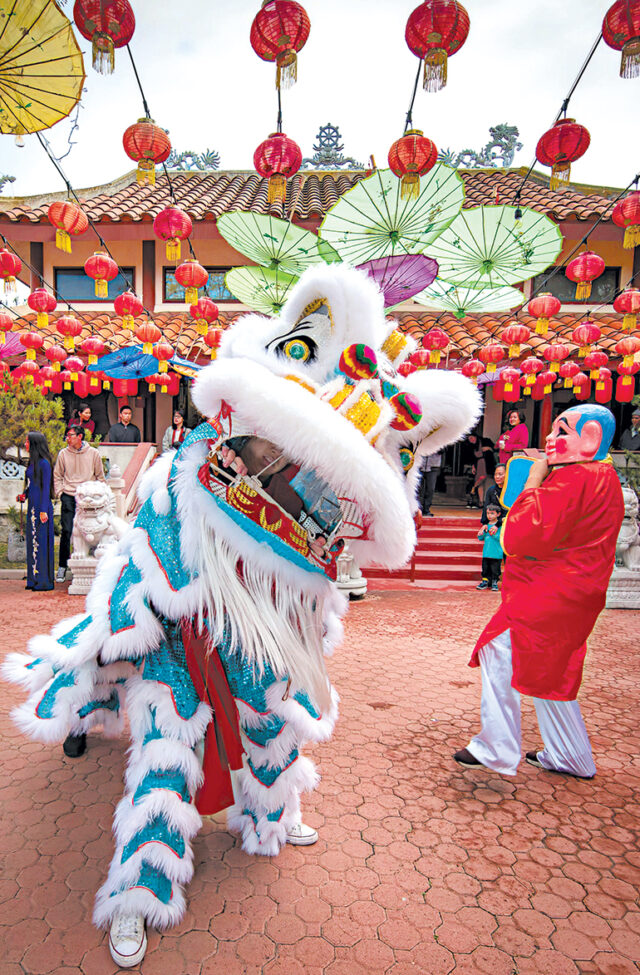
From New Year’s Day on, traditional performances including dragon dances, lion dances, and imperial performances can be seen in many Chinese-populated communities. Such performances have a long history on their own. Chinese dragons are thought to be a representation of Chinese culture and stand for strength, dignity, fertility, knowledge, and good fortune. The dragon was a symbol of imperial authority in numerous legends since it is both an awesome and benevolent being. The motions used in the dragon dance generally represent historical occasions when dragons displayed strength and majesty.

The night before the new year is a special occasion for many Chinese households. Everyone is expected to be at home to participate in the New Year’s Eve “reunion dinner,” which is considered to be the most significant meal of the year, and celebrate the festival with their family. Families often have supper together at a certain relative’s home, but a rising number of families are eating out on New Year’s Eve. Many of them require bookings months in advance owing to the occasion.

Some wealthy families would even invite a professional chef to prepare at their home. On New Year’s Eve, chefs are frequently occupied running from one home to another while preparing meals for many families.

Homemade nian gao — WIKIMEDIA COMMONS

In the Philippines, the most popular dish served during the celebrations is a sticky rice delicacy made from glutinous rice known as tikoy or nian gao.

Afterwards, families typically watch the Spring Festival Gala together, one of the most watched TV shows in China.

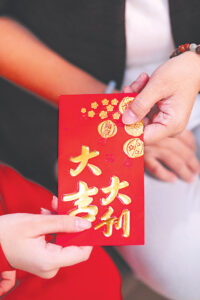
During this time, people also exchange gifts, the most common of which are the customary red envelopes with money inside. Called hong bao in Mandarin, these envelopes are often only given to children or unmarried adults with no job. If you are single, working adult, you are expected to give these to your younger relatives.

Ampao — PEXELS

This tradition lives on in the Philippines, where they are called ampao. The red envelope contains the wishes for good fortune, safety, and well-being for the year. Children are the only ones who traditionally receive red envelopes from their elders.

Of course, at the strike of midnight come the dazzling display of fireworks. Anywhere you are on the globe, fireworks and firecrackers are launched on the first minute of the Chinese New Year. From public displays in major cities to millions of private celebrations in China’s rural areas, setting off firecrackers and fireworks is part of the celebration.

Other celebrations to look forward to

There are other significant days of the 15-day Chinese New Year Festival in addition to New Year’s Eve. For instance, it is thought that the gods of prosperity descend from the heavens on the fifth day of the new year. The event is known as Jie Cai Ceng, or Welcoming the Gods of Wealth and Prosperity, and people make every effort to commemorate it. Businesses participate in the lighting of firecrackers at this time because they believe it will bring them luck and wealth for their enterprise.

The 15th day of the New Year is known as Yuan Xiao Jie or the Festival of Lanterns, and it marks the end of the Chinese New Year celebrations. All types of lanterns are lit throughout the streets and often poems and riddles are often written for entertainment.

Paper lanterns on wheels that are shaped like a rabbit or the year’s zodiac animal can also be seen during the festivities. An old Chinese fable about a goddess named Chang’E who leaped to the moon is symbolized by the rabbit lantern. The goddess brought a rabbit with her because she didn’t want to travel alone. It is stated that on this day you can see the goddess Chang’E and her rabbit on the moon if your heart is pure enough.

Each and every element of the Lunar New Year is imbued with traditional folklore such as this, owing to the centuries of history the tradition brings with it. As time goes on, more of these traditions will evolve and change, and only time will tell what such spectacles they will bring in the future. — Bjorn Biel M. Beltran

All you need to know about feng shui for the Year of the Water Rabbit

Photo from PEXELS

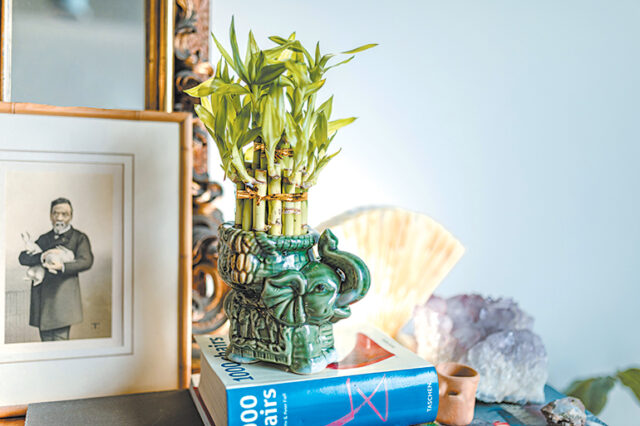
Due to the country’s substantial Chinese and Filipino-Chinese population, feng shui is as part of Filipino culture as Christianity or English proficiency. It is something of a historical holdover from times even before the rule of the Spaniards.

Feng shui is a traditional practice that tries to understand the energy forces of the environment. As an ancient art that literally translates to “the way of wind and water,” it is one of the ways the early Chinese civilization attempted to make sense of the universe’s chaos.

It centers on the Taoist view that everything contains chi — a life force regulated by the diametrically opposed yet complementary energies of yin and yang — as the foundation for the practice. According to Taoist theory, people can increase the flow of chi in their life and keep bad chi at bay by balancing yin and yang within themselves and their surroundings.

Feng shui is thus the art of arranging spaces, furniture, and things in a space to create harmony and balance between yin and yang.

Little is known about the beginnings of feng shui, but popular historical consensus is that the ancient Chinese may have used feng shui principles to construct their cities and dwellings over 4,000 years ago. The placement of ancient Chinese grave sites — areas where conveying good chi was crucial — provides some of the earliest examples of feng shui.

People all throughout the world utilize feng shui principles to adorn their homes, carrying on the tradition with the overall goal of creating and maintaining this delicate balance between yin and yang energies, and assisting the flow of chi throughout the home or office.

Assisting the flow of wind and water

In feng shui, the goal is to create sheng chi, or an atmosphere that is conducive to good fortune. ‘Sheng,’ which means upward flowing energy, is thought to produce a sense of health and well-being, the same positive energy that one might have while communing with nature by taking a walk through a forest, by a waterfall, on a mountainside, or by the ocean.

Getting rid of clutter inside and outside of your home or business is one of the numerous strategies to acquire sheng chi and recreate that feeling of well-being. This is due to the fact that an untidy and unorganized environment exudes si chi, a sluggish and stagnant energy. Si chi is a decomposing type of energy that gradually consumes its surroundings.

To lessen their degrading power, one should keep things like dust, garbage, waste, clutter, cobwebs, stagnant water, and other kinds of dirt away from one’s house and place of business.

Sha chi, on the other hand, is known as the “death energy” because of the way it stifles positive energy and stunts any progress. It may take the form of organic land formations, artificial structures, things, or locations like dead end streets, cemeteries, or bridges.

According to feng shui, direct energy flows that are narrow and quick carry a lot of sha chi, which carries positive energy out and swaps it out for bad energy.

A building or establishment located directly at the end of a straight street is constantly exposed to a cluster of bad energy. Similar to how lightning gets attracted to high points, sha chi is directly drawn to clusters like that. Sha chi can also be seen in sharp, angular corners, such as those found in towering buildings, steep cliffs, mountain summits, and acute roof angles.

This is why feng shui advises making walkways round rather than at straight angles and access roads to homes and buildings slightly twisting. As a result, negative energy is changed into positive energy.

The Year of the Water Rabbit

2023, the Year of the Water Rabbit begins on January 22nd (Chinese New Year) and ends on February 9th (Chinese New Year’s Eve) in 2024. In Chinese tradition, the sign of the rabbit represents longevity, harmony, and prosperity, and as such this year is expected to be filled with hopeful optimism that will serve as a welcome break after the past two tumultuous years.

Rabbits are portrayed in Chinese astrology as being delicate, calm, elegant, alert, quick, skillful, kind, patient, extremely responsible, and faithful to those around them. The Water Rabbit in particular is renowned for being kind, cordial, and easily adaptable to various situations.

In general, the lucky colors that will integrate the wood, fire, water, metal, and earth components of feng shui are azure blue, apple green, pearl white, fiery red, and royal yellow. Any feng shui-inspired trends in art, fashion, and interior design may be dominated by the wood and water aspects, specifically the lucky colors of green and blue.

Blue and green are also particularly noteworthy as they also represent popular depictions of planet Earth. Environmental stewardship has gained widespread popularity as a way to promote eco-friendly living, sustainable fashion and prospering on this world, and good fortune could specifically fall on those who integrate such values into their lives this year. — Bjorn Biel M. Beltran

Understanding the Chinese calendar and zodiac

Chinese Zodiac carvings on the ceiling of the gate to Kushida Shrine in Fukuoka, Japan — Jakub Hałun | WIKIMEDIA COMMONS

So far, Chinese cultural influence has been evident worldwide by the constant celebration of Chinese tradi­tions and practices. This can be seen not just in the regular festivities of the Lunar New Year, but also in the systems that are often mentioned alongside the occasion, namely the lunar calendar and the Chinese zodiac.

Unlike the Gregorian Calendar, the Chinese calendar, also known as the lunar calendar, features 12 or 13 lunar months each year. The lunar calendar is used to decide the dates on which traditional Chinese holidays will be celebrated and also serves as guide for Chinese zodiac astrology.

The first day of the month starts when the moon aligns with the earth and the sun, and the middle of the month occurs when the full moon appears. The lunar year consists of 12 or 13 months, with 354 or 355 days in a year for those 12 months. Thus, a leap month occurs in two to three lunar years in order to make up for the other 10 days on the Gregorian calendar.

As aforementioned, the lunar calendar is slightly different from other calendars, and creating leap months where a 13th month is added to the calendar. 2020 marked the last leap month on the lunar calendar, thus, the next leap month will happen in 2023, which will also be the second lunar month.

“As a lunar month is on average 0.92 days shorter than a ‘solar month,’ the lunar calendar is just under a day per month slower than the solar calendar. To prevent the lunar calendar from becoming more than half a month of sync with the solar calendar, an extra leap month is added to the lunar calendar every 32 or 33 months,” China-oriented travel platform Chinese Highlights explained on its website.

The months from the lunar calendar vary throughout the years. For instance, a short month in Chinese has only 29 days, whereas a big month consists of 30 days.

Each lunar month, Chinese Highlights added, was given a name in accordance with what people do or which trees or flowers blossom in the said month. The first month is called the start month; the second month the apricot month; the third month a peach month; the fourth month the locus tree month; the fifth month the sweet sedge month, in which the Dragon Boat Festival is said in the fifth day of the month; the sixth month the lotus month, as lotus flowers start to blossom; the seventh month the skill month; the eighth month the osmanthus month; the ninth month the chrysanthemum month; the tenth month the yang month, when the Taoist yang force is believed to be strong; the eleventh month the winter month, coinciding with the winter solstice; and, finally, the twelfth month the preserved month, when meats are preserved for the Spring Festival.

At present, the Gregorian calendar is commonly used by Chinese communities. Nonetheless, they still pay attention to lunar dates for celebrating important traditional Chinese festivals, including the Spring Festival, Dragon Boat Festival, and Mid-Autumn Festivals, unlike before when the lunar calendar is being utilized for daily discourse and special occasions.

Chinese zodiac signs have also become an essential facet that many until now have still sought for a deeper understanding of their personality and their fortune in the future as represented by zodiac animals.

A zodiac animal, each with its own traits, represents each year in the 12-year cycle. The Chinese zodiac consists of 12 animals, namely, the rat, ox, tiger, rabbit, dragon, snake, horse, sheep, monkey, rooster, dog, and pig.

“Chinese people believe that a person’s horoscope, personality and love compatibility are closely associated with his/her Chinese zodiac sign, determined by his/her birth year,” Chinese Highlights explained.

For instance, the zodiac signs are associated with the following personalities: rats are seen as quick-witted, oxen are diligent, tigers are brave, rabbits are quiet, dragons are confident, snakes are enigmatic, horses are animated, goats are calm, monkeys are sharp, roosters are observant, dogs are prudent, and pigs are compassionate.

While astronomical and Chinese zodiacs both include 12 signs with an associated personality and fortune, both systems used time of birth as their basis for determining and assigning the signs. However, the Chinese zodiac is based on archetypal animals from folks and legends which is significant to Chinese culture; whereas astronomical signs are based on the distance between constellations and the earth, deriving from Greek mythology and astrological philosophy. In addition, the Chinese zodiac is determined by the year, while astrological signs are determined by the month.

In a TED talk titled “The Chinese zodiac, explained” in 2016, Taiwanese technologist and entrepreneur ShaoLan Hsueh highlighted the influence of the Chinese zodiac, which reached “as much as a quarter of the world population.”

According to Ms. Hsueh, the theoretical framework that Chinese ancestors created years ago has become a part of popular culture up to present times. The popularity of the Chinese zodiac through time has influenced people’s decisions, including personality, marriage, birth, or even career.

“As China plays such an important role in the global economy and geopolitics, the decisions made on the zodiac and other Chinese traditions end up impacting everyone around the world,” Ms. Hsueh explained. — Angela Kiara S. Brillantes

A feast for fortune

Photos from Unsplash

As the most important Chinese holiday approaches, many people are looking forward to celebrating new luck and prosperity anew. Also commonly known as the Lunar New Year or Spring Festival, the Chinese New Year is frequently associated with traditional dishes that bring luck and fortune to the year.

Until this day, customs and traditions are still practiced among the Chinese community worldwide, which include decorating, offering sacrifices to ancestors, family reunion dinners, exchanging gifts, and watching fireworks and festival dances during the Chinese New Year.

Undoubtedly, as the Chinese community celebrates the new year, their traditional dishes are the most anticipated part of the festive season.

Traditional dishes during the Chinese New Year are associated with a good fortune, with each evoking symbolic meanings of health, wealth and prosperity. As travel company and China-oriented online platform China Highlights stated, popular dishes during the festive season are dumplings, spring rolls, rice cakes and fish.

Dumplings

Typically, dumplings resemble Chinese silver ingot consisting of chopped vegetables, minced pork, shrimp, fish, chicken, or beef wrapped in thin elastic dough which can be cooked by boiling, steaming, frying, or baking but steamed dumplings are most commonly used during this festive season. Because of their rich and sweet taste and ingot-looking shape, Chinese dumplings symbolize wealth, meaning it brings a prosperous life.

Spring rolls

A Cantonese dim sum dish spring rolls are a golden-yellow cylindrical-shaped rolls filled with pork, vegetables, or something sweet in tiny dough wrappers. Similar to dumplings, the golden rolls are meant to symbolize golden bars, which bring wealth and prosperity during the year.

Vegetable dishes

Vegetable dishes are a must-have during the festive season. Vegetable dishes with long and leafy greens, including lettuce, cabbage, or broccoli are most commonly eaten during Chinese New Year. Aside from the nutrients one can get from such viands, these vegetable dishes bring wealth and longevity to life.

Noodles

Another popular dish is long noodles, which are made up of Chinese egg noodles or Asian wheat flour noodles that are cooked and longer than regular noodles and served uncut. Long noodles consist of broth and various vegetables included on the plate which can be cooked by boiling or frying. Just like its name, long noodles bring longevity and happiness into the eater’s life.

Chicken

Chicken dishes for Chinese New Year often serve a whole chicken, including the head and its feet. The chicken is often braised or roasted with seasonings like ginger and soy. Chicken is considered lucky as it provides protein for the body, and a whole chicken is traditionally presented to serve as a blessing, protection and wholeness to families feasting in the celebrations.

Shrimp

Shrimp-based dishes are crispy and flavorful. They usually have a salty and sweet mild flavor, which is often tender, and they can be paired with vegetables and rice. These dishes have become a common part in the Chinese New Year menu as shrimp stands as a symbol of happiness and good fortune since shrimp in Cantonese is similar to the sound of laughter.

Fish

One of the most familiar traditional dishes for the Chinese New Year are steamed fish which comes in different varieties, including crucian carp, Chinese mud carp, and catfish. Like chicken, steamed fish dishes provide good nutrients and proteins in the body, best served as a whole as a symbol of good fortune and prosperity for the brand-new year.

Rice cakes

Another lucky dish consumed during the festival season is nian gao, a glutinous rice cake. These rice cakes come in different flavors. In Northern Chinese cuisine, the rice cake is mainly yellow and white in color and sweet in taste, and made with either glutinous rice or yellow rice; while in Eastern or Shanghainese Chinese cuisine, it is white in color and made with non-glutinous rice. In Cantonese cuisine, nian gao is made with brown sugar, which brings out its dark yellow color, and it is also stretchy and sticky; while in Fujian or Hokkien cuisine, it consists of sugar, peanuts, fruits and seeds. Glutinous rice cakes are said to symbolize higher income, either in academics or career.

Sweet rice balls

Sweet rice balls are said to be the season’s signature delicacy. Sweet rice balls are round-shaped glutinous rice balls that consist of sticky rice flour and sugar with fillings like peanut butter or sesame paste. The round-shaped delicacy symbolizes wholeness and togetherness within the family.

Fruits

The Chinese New Year celebrations are not complete without fruits, specifically those of the citrus kind, such as oranges, which have a sweet-tart and bitter flavor; tangerines, known for their sweet and strong flavor as well as small, thick, rough, and sweet flesh; and pomelo, whose flavors range from sweet to sour. Due to their round shapes and golden color, citrus fruits are said to bring luck and fortune, as well as fullness and rich in wealth.

With the distinct and unique flavors and characteristics of Chinese cuisine, a festive and auspicious feast are indeed a part of celebrating Chinese New Year as it once again kick-start hopes and anticipations of more luck and fortune for all. — Angela Kiara S. Brillantes

Philippines to stem ‘recessionary forces’

PCO.GOV.PH

PRESIDENT Ferdinand R. Marcos, Jr. on Wednesday said the Philippines would resist global recessionary headwinds, but warned that increasing tensions in the South China Sea were harming trade.

In a speech at the World Economic Forum’s (WEF) annual meeting in Davos, Switzerland, the president said he was bullish about the country’s economic prospects.

“My belief is that as long as the unemployment rate stays low, we will be able to resist recessionary forces,” he said at the conference, which has been dominated by talk of an impending global recession brought on by rising food and energy prices.

Mr. Marcos said the upskilling of the country’s labor force was powering economic growth, including remittances from migrant Filipino workers.

But increasing tensions in the South China Sea were affecting trade on all of the exchanges in the region, he said. “The future of the region has to be decided by the region, not outside powers.”

Mr. Marcos earlier said he expects the domestic economy to grow by about 7% this year, citing strong fundamentals, prudent fiscal management and reforms in key sectors that would cushion against risks from a potential global recession.

The government, which will announce its 2022 economic performance on Jan. 26, expects economic growth last year to have topped its 6.5% to 7.5% goal.

“Our strong macroeconomic fundamentals, fiscal discipline, structural reforms and liberalization of key sectors instituted over the years have enabled us to withstand the negative shocks caused by the pandemic and succeeding economic downturns, and map a route toward a strong recovery,” Mr. Marcos said, based on a statement from the presidential palace.

Pent-up domestic demand after the removal of pandemic restrictions propped up economic growth last year and will continue supporting consumer spending this year, Bangko Sentral ng Pilipinas Governor Felipe M. Medalla said on Jan. 10.

“Our actual projection is 6.5% [for 2023] but there are signs that we might be able to surpass that,” Mr. Marcos said in Davos, where he also presented a still unapproved sovereign wealth fund bill to potential investors.

He said they were mainly introducing the idea. “We want people to be aware that this is in the pipeline. This is something that we can look forward to, and that we will be able to utilize for the continuing development in the Philippines.”

The Philippines is grappling with soaring prices of onions, widely used in many local dishes, and prompting the government to approve emergency imports.

Mr. Marcos said prices had started to come down thanks to the imports, but in the long term there was no getting around the need to increase production.

Asked about criticism that poor planning by the government, such as delayed decisions on imports, was to blame, he said the government had great difficulty in determining how much they had. He also blamed smuggling.

“We have a better handle on it now and I think we can see it in terms of our scheduling of our buying,” he said. “But the long-term solution is productivity.”

Mr. Marcos also said he was confident about economic growth given the country has a young and English-speaking workforce. “We have the youngest workforce in Asia,” he said, based on a transcript from the palace.

“You might be surprised to know that the average age of a Filipino worker is 23-and-a-half years old,” he said. “That is a huge demographic dividend.” He also said Filipino workers are well-trained and sophisticated.

“That is where my confidence comes from and that is the confidence that I hope to exude sufficiently, to bring that confidence also to all of you and all of our potential partners in the world,” he said.

WANING GROWTH
Meanwhile, the Philippine economy is expected to grow by  5% this year as “favorable elements” that pushed expansion last year are expected to wane, ANZ Research said.

“We forecast growth of the Philippine economy to slow to 5% in 2023, as most of the favorable elements of 2022 falter,” it said. “The surge in export demand late last year will not be sustained amid a broadening of global growth risks.”

The firm kept its economic output growth forecast steady from its December estimate. This is also below the government’s 6% to 7% target this year.

But it raised its 2022 forecast to 7.5% from 7.2%, citing robust exports and demand during the holiday season. This matches the higher end of the government’s 6.5% to 7.5% target last year. ANZ Research said the Philippine economy likely expanded by 6.7% in the past quarter.

“The improvement in the labor market, strong remittance flows in real terms and solid demand for household credit lifted private consumption growth,” it said. “The drag from the net external demand side decreased as export growth offset import growth in late 2022.”

ANZ Research’s 2023 forecast for the Philippines is better than its outlook for Indonesia (4.7%), Malaysia (3.9%), Thailand (3.6%), Hong Kong (2.5%), Taiwan (2.5%) and Singapore (1.9%).

ANZ also sees Philippine inflation easing to 4.3% this year from 5.8% last year, still above the central bank’s 2-4% target.

The Philippine central bank raised key policy rates by 350 basis points in 2022, bringing the overnight reverse repurchase rate to a 14-year high of 5.5% from an all-time low of 2% to tame inflation.

Inflation averaged 5.8% last year. The central bank expects it to ease to an average of 4.5% this, year and to 2.8% in 2024.

ANZ Research expects the Philippine economy to expand by 5.3% in 2024. — Keisha B. Ta-asan and Kyle Aristophere T. Atienza with Reuters

ADVERTISEMENT
ADVERTISEMENT