Home Blog Page 5334

Consumer brands set to miss plastic sustainability targets

PHILSTAR

SINGAPORE — Some of the world’s biggest consumer goods companies, including PepsiCo, Mars and Nestlé, are almost certain to miss a target to make plastic packaging more sustainable by 2025, according to a new report published on Wednesday.

The study by the Ellen MacArthur Foundation and the United Nations (UN) Environment Program also revealed that some companies -— including Coca-Cola and Pepsi — are using more virgin plastic despite a pledge to reduce its use.

The report comes as UN members are due to meet in Uruguay this month to start negotiations on the first ever global plastics treaty, which is aimed at reining in soaring waste pollution choking marine life and contaminating food.

Some UN members are pushing for a pact that includes legally binding targets to increase recycled content in packaging and use less petroleum-derived virgin plastic, rules that would have financial implications for the consumer goods and petrochemical industries.

Pepsi, Coca-Cola, Nestlé and Mars did not immediately respond to requests for comment.

Dozens of major brands have in recent years set targets to increase plastic recycling and reduce the use of single-use packaging in partnership with the Ellen MacArthur Foundation, as part of efforts to burnish their green credentials.

The headline pledge was that 100% of plastic packaging would be reusable, recyclable or compostable by 2025, but this goal will “almost certainly be missed by most organizations,” the environmental group’s report said.

Greenpeace said the report is evidence that voluntary corporate targets have failed and called on the UN to forge a treaty that forces governments and companies to use less single-use plastic packaging.

“This underlines the need for governments to ensure that the global plastic treaty… delivers major reductions in plastic production and use,” said Graham Forbes, Greenpeace’s USA Global Plastics Project Leader.

“Anything less than this is a disservice to our communities and our climate.” — Reuters

Hong Kong’s Lee touts ‘China advantage’ to rebuild city’s image as financial hub

MAN CHUNG-UNSPLASH

HONG KONG — Hong Kong leader John Lee on Wednesday pitched the city’s connection with China in an address to some of the world’s top financial executives, as he strives to rebuild the Chinese territory’s COVID-hit image as a major financial hub. 

Chief Executive Lee told the Hong Kong Monetary Authority’s Global Financial Leaders’ Investment Summit that the city would continue working towards lifting coronavirus disease 2019 (COVID-19) restrictions. 

The conference is the biggest corporate event in Hong Kong, since it shut its borders in 2020 and put in place rolling restrictions to combat the pandemic. Those measures have badly hit the economy and have resulted in an exodus of talent. 

Some of the world’s biggest banking bosses, including Goldman Sachs’ David Solomon and Morgan Stanley’s James Gorman, are in Hong Kong for the first time in almost three years for the summit. 

For foreign financial firms operating in China and Hong Kong, the summit comes as they navigate tensions between the United States and China. A depleting pool of talent in Hong Kong, often described as “Asia’s world city” is also creating a major challenge. 

“Hong Kong remains the only place in the world where the global advantage and the China advantage come together in a single city,” Mr. Lee told roughly 250 summit participants, mostly local financial executives. 

“This unique convergence makes Hong Kong the irreplaceable connection between the mainland and the rest of the world.” 

Eddie Yue, chief executive of the city’s de-facto central bank Hong Kong Monetary Authority (HKMA), said the reopening of Hong Kong brings exciting growth opportunities to talents and financial institutions around the world. 

Besides stringent COVID restrictions, Hong Kong’s outlook as a premier financial center has also been clouded by anti-government protests in 2019 and the imposition of a sweeping national security law a year later. 

Mr. Lee said that Hong Kong was working to attract top talent to offset a major brain drain seen in the past three years due to the pandemic rules. 

“As have many other major cities worldwide, Hong Kong has been through ups and downs over the years but our resilience remains remarkably unmatched,” he told the summit.  

FINANCIAL CENTER
Global financial institutions have for long betted on Hong Kong as a gateway to China, to tap into the world’s second-largest economy and its trillions of dollars’ worth of financial markets. 

Foreign banks including Goldman, Morgan Stanley, HSBC and Standard Chartered also have significant onshore presence in China.

Hong Kong was a “very, very important” financial center for China, China Securities Regulatory Commission (CSRC) Vice Chairman Fang Xinghai told the summit. 

Authorities, he said, were keen for more international companies to list in Hong Kong to grow the city’s capital market activities. 

Hong Kong’s new share listings are worth $10.77 billion so far in 2022, the lowest level since 2017, compared with $37.7 billion at the same time last year, according to Refinitiv figures. 

Global investors are grappling with several challenges this year, with the Russia-Ukraine war, rising inflation, soaring energy prices and tightening interest rates all hammering risk appetite. 

Goldman Sach’s Mr. Solomon told the summit it could take up to six quarters for the world to “rebalance” after a period of uncertainty. 

“There’s still a significant amount of uncertainty as we get into 2023,” he said. “My expectation is that equilibrium will come more into balance in the coming quarters.” 

Michael Chae, Blackstone’s chief financial officer, said that the geopolitical situation playing out between major economies was a growing risk facing the world. 

“What keeps me up is the possibility of rising tensions around the world that could lead to serious threats to instability,” he said. 

Morgan Stanley’s Mr. Gorman said that the biggest risk the world currently faced was the high level of inflation. 

Meanwhile, UBS Group Chairman Colm Kelleher said that the bank keenly awaited the next step in China’s management of the pandemic which is considered the strictest in the world. 

As part of its zero-COVID strategy, China has continued to impose lockdowns, even for a small number of positive cases, even as the rest of the world has shifted towards easing nearly all restrictions. 

“We are waiting for zero COVID and the opening up of China to see what will happen,” he said. — Reuters

South Korea PM urges police to explain response to Halloween crush emergency calls

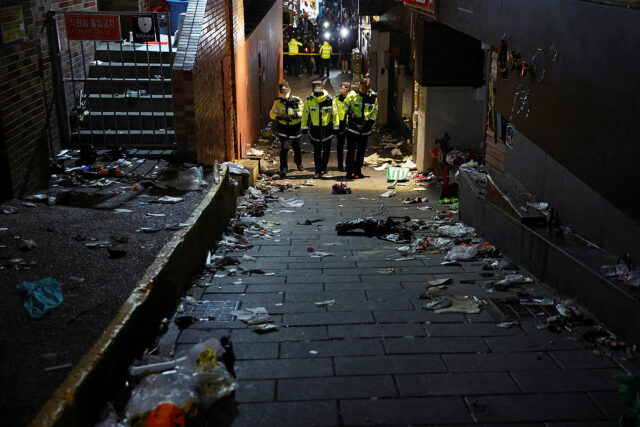
POLICE OFFICERS walk at the scene where many people died and were injured in a stampede during a Halloween festival in Seoul, South Korea, Oct. 30, 2022. — REUTERS

SEOUL — South Korea’s Prime Minister Han Duck-soo said on Wednesday police must explain how they responded after receiving multiple emergency calls in the hours before a Halloween party crush killed more than 150 people in Seoul. 

The disaster on Saturday night killed 156 and injured 172, leaving 33 in serious condition. At least 26 citizens from 14 countries were among the dead. 

“The police must conduct thorough inspections and provide a clear and transparent explanation to the public,” Mr. Han said at the televised beginning of a task force meeting on the disaster. 

Tens of thousands of young revelers had crowded into narrow streets and alleyways of the popular Itaewon district for the first Halloween festivities in three years virtually free of coronavirus disease 2019 (COVID-19) restrictions. 

Transcripts of emergency calls released by the police on Tuesday showed the first warning of a possible deadly crush roughly four hours before the disaster, with the caller requesting police dispatched to an alley where partygoers were already packed wall-to-wall. 

Police received 10 other similar calls, with the callers pleading with growing urgency and desperation. The final call was placed just minutes before people in the narrow and sloping alley began to fall over each other. 

The transcripts appear to confirm the accounts of witnesses, who told Reuters they saw some police directing traffic on the main road but few or no officers in the crowded pedestrian alleyways and side streets. 

Roughly 100,000 people were estimated to be in Itaewon on Saturday, an area known for its hills and narrow alleys. There were 137 police officers there at the time, the authorities have said. 

Police went to the scene for four out of the 11 calls, a police official told reporters. It was not immediately clear why they did not deploy officers on the other calls or what safety measures they took after arriving. 

“When someone dials 112, it is when the situation is very urgent and the help of police or action is desperately needed,” Mr. Han said, referring to South Korea’s emergency police hotline. 

The release of the transcripts fueled further criticism of missteps by the police that may have been a key factor leading up to the crush that has become the deadliest accident since a 2014 ferry sinking that killed 304 people, mainly high school students who drowned amid botched rescue operations. 

Opposition members of parliament called for the immediate dismissal of the national police chief and the interior minister. 

National Police Commissioner General Yoon Hee-keun on Tuesday acknowledged crowd control at the scene was “inadequate” and promised a thorough internal investigation. — Reuters

Blue whales found to swallow 10 million microplastic pieces daily

WASHINGTON — As Earth’s largest animals, blue whales are mighty big eaters, gulping tons of food each day. They also now are ingesting huge amounts of plastic, according to scientists, due to the alarming volume of tiny particles of pollution choking the oceans. 

Researchers on Tuesday presented an estimate of the amount of microplastics ingested by three species of baleen whales — blue, fin and humpback — off the US Pacific coast, detailing an issue posing uncertain health concerns for these marine mammals. 

As baleen whales, these species are filter-feeders. They strain food — shrimp-like crustaceans called krill and other small prey — from the seawater using baleen plates in the mouth made of keratin, the substance found in people’s fingernails. 

Blue whales, according to the study, may swallow roughly 10 million microplastic pieces daily, or up to about 95 pounds (43.5 kg) of plastic. For fin whales, whose main prey also is krill, the estimated daily tally is about 6 million microplastic pieces, or up to 57 pounds of plastic. 

Some humpback whales specialize in krill and some favor eating small schooling fish. Krill-favoring humpbacks, according to the study, may ingest about 4 million microplastic pieces (up to 38 pounds of plastic) daily, while those favoring fish may take in a much smaller amount, roughly 200,000 pieces (up to a couple of pounds of plastic). 

“In the moderately polluted waters off the US West Coast, baleen whales may still be ingesting millions of microplastics and microfibers per day,” said Stanford University marine biologist Matthew Savoca, a co-author of the study published in the journal Nature Communications

“Also we find that the vast majority — 99% — are via their prey that have previously ingested plastic and not from the water they filter,” Mr. Savoca added. 

The study illustrated how baleen whales may be at an elevated risk for microplastics ingestion as a result of their mode of feeding, the quantity of their food intake, and their habitat overlapping with polluted areas such as the California Current that flows south along North America’s western coast. 

Blue whales can reach a maximum of about 100 feet (30 meters) long, fin whales about 80 feet (24 meters) and humpback whales about 50 feet (15 meters). 

The researchers estimated the daily microplastic ingestion by examining the foraging behavior of 126 blue whales, 65 humpback whales and 29 fin whales using measurements from electronic tag devices suction-cupped to the animal’s back, with a camera, microphone, GPS locator and an instrument that tracks movement. They then factored in the concentrations of microplastics in the California Current. 

As a study published last year based on the same whales off the U.S. West Coast showed, blue whales eat about 10–20 tons of krill daily, while fin whales eat 6–12 tons of krill and humpback whales eat 5-10 tons of krill or 2–3 tons of fish. 

The new study found that the whales primarily feed at depths of 165–820 feet (50–250 meters), coinciding with the highest measured microplastic concentrations in the open-ocean ecosystem. 

Microplastics are particles of plastic debris — less than 5 mm (0.2 inch) long — arising from the disposal and breakdown of various consumer products and industrial waste, with their concentrations in the oceans mounting in recent decades. The potential health effects on the whales from ingesting it is not well understood. 

“While this was not the focus of our study, other research has shown that if plastics are small enough they can cross the gut wall and get into internal organs, though the long-term effects are still unclear. Plastics can also release chemicals that are endocrine disruptors,” said marine biologist Shirel Kahane-Rapport of California State University, Fullerton, lead author of the study. — Reuters

Pfizer boosts 2022 COVID vaccine forecast, looks to pivot with deals, new drugs

PHILIPPINE STAR/ MICHAEL VARCAS

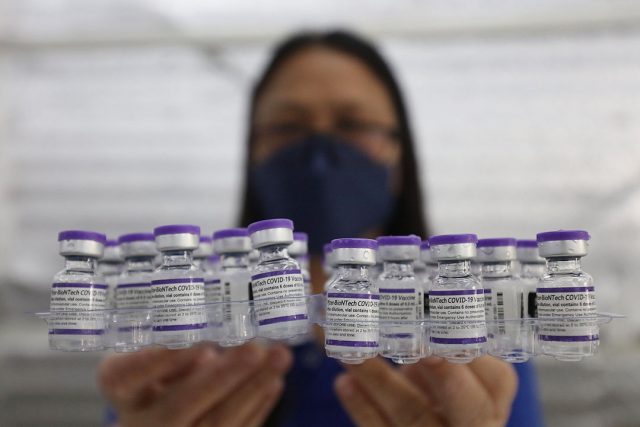
Pfizer Inc. on Tuesday raised its forecast for 2022 sales of its coronavirus disease 2019 (COVID-19) vaccine by $2 billion to $34 billion, and said new deals and drugs in development should help replace future declining vaccine sales and lost revenue from patent expirations. 

The US drugmaker’s shares rose 2.7% to $47.84 as its third-quarter profit beat estimates, mainly due to higher-than-expected sales of the vaccine it shares with German partner BioNTech. 

The upbeat earnings also sent shares of rival COVID-19 vaccine makers higher. Novavax Inc. and Moderna Inc. were up roughly 2% each. 

Sales of the Pfizer/BioNTech COVID vaccine are down from pandemic highs as many countries have neared the end of their primary vaccination campaigns. There are also concerns about soft demand for newly updated booster shots. 

In response, Pfizer hopes to roughly quadruple the price of the vaccine in the United States once the government stops buying doses and sales shift to the private market. 

Chief Executive Albert Bourla said in an interview that the company is trying to showcase what a “post-COVID crisis” Pfizer will look like. 

COVID-19 treatments and vaccines will be multibillion-dollar franchises, he said, “but that will be stable, not with ups and downs. And the growth will be driven by the pipeline and the business development.” 

Pfizer is expected to face the loss of patent protections for some key drugs between 2025 and 2030. The company has turned to deals such as its recent $5.4 billion acquisition of Global Blood Therapeutics Inc. and its $11.6 billion purchase of Biohaven to beef up its pipeline of future products. 

Mr. Bourla said the company’s internal pipeline should help replace lost growth from COVID sales and patent expirations, pointing to 19 products the company hopes to launch over the next 18 months that he said could deliver some $20 billion in annual revenue. These include treatments for ulcerative colitis and migraines, as well as its vaccine for respiratory syncytial virus (RSV). 

The company said its experimental RSV vaccine was found to be effective in a late-stage study in preventing severe infections in infants when given to expectant mothers. 

BMO Capital Markets analyst Evan Seigerman said some investors will point to the massive COVID vaccine beat as unsustainable, however, “we’re not yet throwing in the towel given an emerging pipeline and significant balance sheet flexibility.” 

Third-quarter sales of the COVID vaccine came in at $4.40 billion, blowing past estimates of $2.60 billion. 

However, $7.51 billion in sales of Paxlovid, the company’s COVID-19 antiviral treatment, fell short of estimates of $7.66 billion. 

Pfizer reported adjusted earnings of $1.78 per share in the third quarter, beating analysts’ estimates by 39 cents. — Reuters

Ahead of COP27, researchers call for climate compensation fund

MOTORISTS drive through a flooded portion of Taft Avenue in Manila following a heavy downpour midnight of Aug. 9. — PHILIPPINE STAR/ MIGUEL DE GUZMAN

BRUSSELS — Channeling climate compensation payments through existing funds will not work for vulnerable communities, a team of international researchers said on Tuesday, arguing that a new fund be created. 

“Loss and damage,” the contentious issue of how vulnerable nations affected by climate change could be compensated by rich countries, is set to dominate talks at next week’s United Nations (UN) climate summit in Egypt. 

Representatives of the nearly 200 countries attending COP27 will be weighing whether to create some form of compensation fund — a central demand by developing countries worldwide. 

In a report on Tuesday, researchers at the Stockholm Environment Institute backed the case for a new fund. 

While numerous funds exist to help countries cut CO2 emissions and prepare for floods, rising seas, and other climate impacts, they cannot readily help countries recover from losses and damages already being incurred from climate-fueled natural disasters, the researchers argue. That is because of chronic funding delays or because recipient communities have limited involvement in decision-making, they said. 

“There are significant gaps in existing climate finance mechanisms that make it important to create a dedicated loss and damage mechanism,” said Ines Bakhtaoui, a lead author of the report. 

For example, most climate finance takes the form of loans, rather than the small grants the researchers said would support vulnerable communities without burdening them with debt. The report suggested forming a UN fund with simplified rules for easier access to cash for those hit hardest, while temporarily channeling compensation through existing funds while the new scheme is launched. 

“Climate finance is currently largely inaccessible for recipient countries and communities due to stringent proposal and accreditation requirements and long lag times in delivery,” the report said. 

The researchers said that, in principle, those responsible for causing climate change should be on the hook for paying compensation — but acknowledged that the idea was politically contentious. 

The United States and 27-country European Union have opposed such a fund over concerns about their liabilities. — Reuters

ISOG honors outstanding Filipino Cyberleaders at the first I Am Secure Cybersecurity Excellence Awards 2022

Information Security Officers Group (ISOG) gave recognition to 20 outstanding Filipino cybersecurity experts at the first ISOG I Am Secure Cybersecurity Excellence Awards held on Oct. 27, 2022 at the Shangri-La at the Fort.

ISOG launched the I Am Secure Cybersecurity Excellence Awards to recognize exceptional Filipino cyberleaders who showed exceptional leadership and contributions in their respective roles as Chief Information Security Officer (CISO) or Senior Head of Security; Chief Risk Officer (CRO) or Risk Manager; Chief Information Officer (CIO), Chief Technology Officer (CTO) or Technology Head; and Data Privacy Officer (DPO).

For the CISO/Senior Head of Security category, the awardees are Jose Paolo Rufo, CISO and DPO of UnionBank of the Philippines (Banking and Finance); Jan Martin Encina, Associate Director/Head of Information Security Governance and Ops of MAYA (Fintech).Russell Hernandez, CISO of Insular HealthCare (Insurance); Ross Sherwin De Claro, Senior Manager II of Philippine Amusement and Gaming Corporation (Government and Public Sector); Charmaine Rose Valmonte, CISO of Aboitiz Equity Ventures, Inc. (Utilities); and Mario Demarillas, CISO of Exceture Inc. (Management and Services).

For the CRO/Risk Manager category, the winners are Ana Marie Acuña, Operational Risk Management Head of BDO Unibank, Inc. (Banking and Finance); Bayan Magallon, AVP and Senior Manager – Risk Management and Compliance Division of Cocolife (Insurance); and Kamille Ann Salva, Head of Business Analytics Continuity and Actuarial Risk Department of Public Safety Savings and Loan Association, Inc. (Other Financial Institutions).

For the CIO/CTO/Technology Head category, the awardees are Henry Rhoel Aguda, Senior Executive Vice President, Chief Technology and Operations Officer and Chief Transformation Officer of UnionBank of the Philippines (Commercial Bank); Alfred Punzalan, Information Technology (IT) Head of Northpoint Development Bank (Other Local Banks); Lloyd Alferez Sioson, Vice President for IT Department of Philippine Guarantee Corporation (Other Financial Institutions); Ken Sarmiento, OIC-ICT Branch Director of Department of Migrant Workers (Government and Public Sector); Reuben Thomas Nagtalon Jr., Consultant for Digital Transformation & Re-engineering of Chinese General Hospital and Medical Center (Healthcare); and Ricson Singson Que, Cybersecurity Program Coordinator/IS Consultant of De La Salle-College of Saint Benilde.

For the DPO category, the awardees are Jonathan John Paz, DPO & Enterprise IS Officer of Bank of the Philippine Islands (Banking and Finance); Jonathan Pineda, VP, CISO & DPO of Government Service Insurance System (Government and Public Sector); Jan Edward Cruz, Data Privacy & IT Manager of Chroma Hospitality Inc. (Management and Services); Michael Oliver C. Ignacio, Information Security and Data Privacy Vice President of Inspiro Relia, Inc. (Business Process Outsourcing); and Roselle Basa, DPO/Compliance Officer for Data Privacy of University of the East (Academe).

“In our mission to safeguard people and institutions in cyberspace, we find encouragement in the dedication and untiring efforts of our colleagues and partners in the field of cybersecurity. Through this ceremony, ISOG hopes that our awardees’ commitment and competence inspire a culture of excellence among cybersecurity professionals in the Philippines,” ISOG President and Land Bank Chief Information Technology Officer Archie Tolentino said.

All nominees were screened by ISOG core and its alliance and partner representatives from Department of Information and Communications Technology (DICT), ISACA Manila Chapter, IT Interaction Philippines (ITIP), and ROOTCON.

“The success of this first ISOG Cybersecurity Awards affirms that the Information Security Officers Group is in the right direction towards strengthening information security in the Philippines. Since the organization was founded in 2014, we’ve continuously equipped and empowered as many information security professionals through our awareness and education programs, as well as avenues for community and fellowship,” said ISOG Vice President and I Am Secure Cybersecurity Excellence Awards Chairman.

Organized by XMS, the ISOG I Am Secure Cybersecurity Excellence Awards is one of ISOG’s initiatives to strengthen information security in the Philippines. Titanium event sponsors are Microsoft, Huawei, Trends, Cycognito, DarkTrace, Crowdstrike with ITSDI, Trend Micro with Netsec and VST ECS. Platinum event sponsors are VMWAre; Checkmarx; Palo Alto with Westcon, Extrahop; Fortinet, Trellix with VST ECS, Mandiant with MDI Novare, and VST ECS; and Rubrik with Exclusive Networks. Gold event sponsors are BlueVoyant, Efficient IP, Gigamon, F5 with Westcon; and Silverfort and IPV Network. Exhibitors were G Core Labs; Arcon, Cybereason, Cyfirma with NextGen Group, KnowBe4, Yubico and Sophos with WSI.

Media partners for this event are the Philippine Daily Inquirer, BusinessWorld, DIGI.PH, Backend News, and the New Hue.

For more details about ISOG, visit ISOG’s official website at www.isog-org.ph and socials at LinkedIn: ISOG (Information Security Officers Group), Facebook: ISOGPH, YouTube Channel: ISOG SUMMIT.


Spotlight is BusinessWorld’s sponsored section that allows advertisers to amplify their brand and connect with BusinessWorld’s audience by enabling them to publish their stories directly on the BusinessWorld Web site. For more information, send an email to online@bworldonline.com.

Join us on Viber to get more updates from BusinessWorld: https://bit.ly/3hv6bLA.

Dennis Uy’s Udenna weighs sale of Conti’s, Wendy’s restaurants businesses

CONTIS.PH/STORES

SINGAPORE/MANILA – Udenna Corp, controlled by a close associate of former Philippine president Rodrigo Duterte, is exploring the sale of its Conti’s Bakeshop and Restaurant and Wendy’s fast-food chain businesses in the country, five sources told Reuters.

The Philippine petroleum-to-education conglomerate is in talks with at least one financial adviser on potentially selling both businesses together, three of the sources with direct knowledge of the matter said.

The deal could fetch as much as $200 million for the two assets combined, two of the sources added.

The sources declined to be identified as they were not authorized to speak to the media. Udenna owns Wendy’s and Conti’s through its food subsidiary Eight-8-Ate Holdings, according to its website.

“We are always exploring opportunities available that would be beneficial for the group,” a Udenna spokesperson told Reuters on Wednesday.

The Philippines’ economy grew 7.4% in the second quarter from a year ago, the second fastest in Southeast Asia for the period trailing only Vietnam, following the easing of lengthy COVID-19 restrictions.

Tycoon Dennis Uy, a close associate and the top campaign donor of Duterte, founded Udenna in 2002.

It bought a 70% stake in Conti’s in 2018 for an undisclosed sum, according to its website.
A year later, it acquired all of Wendy’s restaurants in the Philippines, becoming the master franchisee of the fast-food chain in the country. It did not provide financial details on the purchase.

Conti’s owns 70 stores in the Philippines. Its founding owners hold a minority stake in the company.

Wendy’s has 52 stores in the Philippines, mainly in the capital.

Uy’s rapid, debt-fueled business expansion started when Duterte took office in 2016, but revenues declined significantly during the pandemic. The company has long insisted it received no preferential treatment under Duterte.

Amid deep losses, Uy had to resort to selling his assets, including a stake in the Philippines’ major gas field in the South China Sea. — Reuters

Investa Summit to be held online on Nov. 25-27

The Investa Summit is here, this time to help you weather the storm in the markets. Top financial and business experts from all around the world are gathered to share investment principles, strategies, and tactics with digital audiences at the Investa Summit.

This year, the theme is matched with how the markets have been faring over the year. As the global economy has been rocky, the audience will be provided the most value by setting the theme to finding opportunities within a crisis. Despite the gloomy investor sentiment throughout the year, opportunities will always be there. The Investa Summit serves as a way for traders and investors to learn how to prepare themselves to catch those opportunities.

Organized by Investagrams, the Investa Summit this year will be held online on Nov. 25 to 27. This year’s Investa Summit brings to you a star-studded lineup of speakers featuring:

Jack Schwager, author of Market Wizards

Jared Tendler, best-selling author and Mental Game coach

Tom Basso, Market Wizard

Mark Yusko, CEO & CIO of Morgan Creek, managing partner of Morgan Creek Digital

Akio Kashiwagi, founder of MoneyGrowersPH

Lawrence Lee, president and CEO of CTS Global

Edmund Lee, president and CEO of Caylum Trading Institute

Javi Medina, managing director and CIO of BIM, founder of Open Journal

Emmanuel Onuoha, founder of Openwaver

George Asibal, founder of ZFT

More speakers will soon be announced as Investagrams wants to bring the most value it can to its audience.

“Based on the performance of stocks and even cryptocurrencies over the year, it was obvious for us that the traders and investors of today need knowledge and wisdom that will help them get past hurdles in the markets,” said Joanne Marquez, Investagrams’ marketing head and project head for the Investa Summit.

Joanne also shared that bear markets are always where skilled traders truly shine. Spotting key opportunities during bear markets takes a lot of skill and discipline, which are honed through studying real-life experiences. Thus, she hopes that the wisdom to be shared by the speakers will allow the attendees to learn a thing or two and hopefully help them through the bear market we’re facing.

Investagrams, the leading social-financial platform and mobile app in the Philippines, is in charge of organizing the Investa Summit. The platform offers virtual stock market trading, analytical tools, market education, and a social network to empower traders and investors of all levels in order to help you keep on top of the global markets. The Investa Summit is another step in the company’s goal of increasing the number of Filipinos who invest in the Philippines to 10 million.

Continuing Investagrams’ mission to equip millions of Filipinos with strong financial education, the Investa Summit gives you all these quality lessons and insights.

Now only one question remains: Are you willing to learn how to spot opportunities in a crisis, and improve your trading system to flourish through bear markets?

Tickets for the virtual summit start at only P999. For more information, you can head over to https://www.investagrams.com/InvestaSummit/ to view all the details.


Spotlight is BusinessWorld’s sponsored section that allows advertisers to amplify their brand and connect with BusinessWorld’s audience by enabling them to publish their stories directly on the BusinessWorld Web site. For more information, send an email to online@bworldonline.com.

Join us on Viber to get more updates from BusinessWorld: https://bit.ly/3hv6bLA.

Aggressive rate hikes may be needed

Jeepneys wait for passengers at the EDSA-Aurora Boulevard intersection in Quezon City, June 9. The minimum jeepney fare increased to P12 starting October, which likely fueled inflation. — PHILIPPINE STAR/ MIGUEL DE GUZMAN

MORE AGGRESSIVE monetary tightening by the central bank may be needed if inflation continues to accelerate, economists said.

“To avoid de-anchoring inflationary expectations, more aggressive monetary tightening may be necessary to further slow exchange rate pass through to domestic prices,” Bank of the Philippine Islands (BPI) Lead Economist Emilio S. Neri, Jr. said in a Viber message.

The Bangko Sentral ng Pilipinas (BSP) on Monday projected inflation to settle within the 7.1-7.9% range in October, well above the 2-4% target band.

A BusinessWorld poll of 14 analysts conducted last week yielded a median estimate of 7.2% for annual inflation in October. The statistics agency will release last month’s inflation data on Nov. 4.     

“There must be flexibility not just to match but to hike more than the US Federal Reserve to avoid inflation from staying elevated for a longer period. Persistent inflation can erode future growth prospects, after all,” Mr. Neri said.

Calixto V. Chikiamco, member of the board of Institute for Development and Econometric Analysis, told BusinessWorld Live on One News that the BSP will raise rates later this month to tame inflation and match the Fed’s tightening.

“The government said it will match the Fed point by point so that’s probably what we can expect…We will only see deceleration when the Fed stops increasing interest rates,” he said.   

The US Federal Reserve is widely expected to raise rates by three quarters of a percentage point at its policy meeting this week, bringing the target overnight lending rate to a 3.75%-4% range.

BSP Governor Felipe M. Medalla last week said the Monetary Board may raise benchmark interest rates by 75 basis points (bps) at its Nov. 17 meeting if the Fed delivers a hike of the same magnitude. The BSP has raised rates by 225 bps this year to tame inflation.

“What will happen is we’ll see a slowdown in the economy… We’re still very positive, with the 5-6% (gross domestic product) but probably in the lower range with interest rate hikes, as this will hit the interest rate sensitive sectors like car, houses, etc.,” Mr. Chikiamco said.   

The economy expanded by 7.8% in the first half, still within the government’s 6.5-7.5% full-year target. Third-quarter GDP data is set to be released on Nov. 10. 

NOT YET THE PEAK?
If the upper end of the BSP’s October inflation forecast is realized, this would be the fastest pace in over 14 years or since the 9.1% print in November 2008.   

However, the BSP said inflation is projected to “gradually decelerate” in the next months, as “cost-push shocks to inflation due to weather disturbances and transport fare adjustments dissipate.”

“My concern is we haven’t seen the peak yet cause we’re heading into the Christmas season,” Mr. Chikiamco said, adding that there is stronger demand for goods during the holidays.   

“Winter is coming; therefore, oil prices globally may see a spike again and of course this is the lean season for the fish catch, therefore this may also contribute to further inflation,” he added.

Mr. Neri said inflation may slow in the succeeding months, but remain above the BSP’s 2-4% target band.

“Inflation may slow a bit but remain well above target until well into 2024 if structural reforms to improve the supply side are not addressed and if demand factors causing currency weakness are not tempered,” he added.

Asian Institute of Management economist John Paolo R. Rivera said in a Viber message that inflation may continue to rise ahead of the holiday season.

“But inflation can be expected to slow down after the holidays or early 2023 due to reduced demand and impact of monetary tightening by BSP,” he added.   

At its Sept. 22 policy meeting, the central bank raised its average inflation forecast for this year to 5.6% from 5.4% previously, exceeding the 2-4% target.

For 2023, the BSP expects inflation to average 4.1% before easing to 3% in 2024. — Keisha B. Ta-asan

PHL companies expect growth in cashless payments to continue

By Arjay L. Balinbin, Senior Reporter

PAYMENT SOLUTION PROVIDERS said enterprises in the Philippines are increasingly accepting cashless payments, and this trend is expected to continue.

“More enterprises are now accepting cashless payments. For example, the number of our registered merchant touchpoints in end-September 2022 tripled year on year, and many of these are micro, small and medium enterprises (MSMEs),” Maya Group President and Maya Bank Co-Founder Shailesh Baidwan told BusinessWorld in an e-mail interview last week.

During the pandemic, Maya rolled out a digital transformation solution for enterprises, allowing them to accept digital payments as they earn additional income from other digital services such as remittance, cash-in and out, bills payment, and load transactions.

“At the height of the pandemic, going cashless was out of necessity. Today, more Filipinos are opting to use digital payments,” Mr. Baidwan said.

According to the Visa Consumer Payments Attitude Study 2022, nearly four of every five Filipino consumers (78%) plan to use digital payments more often, with three in four (79%) believing it is safer.

“This growing demand for digital payments continues — there’s no turning back from this rising tide,” Mr. Baidwan said, adding that everyday transactions such as airtime load, bill payment, money transfers and shopping are driving growth.

He noted that more digital banking services, such as savings and credit, are driving digital payment transactions.

“We’re seeing this in our Maya app — customers who have saving accounts, for example, are very active in using their wallets for everyday payments because the experience is conveniently seamless and intuitive,” Mr. Baidwan added.

GrabPay, also a payment solution provider in the Philippines, said it continued to see growth in cashless transactions despite the full reopening of the economy.

This is “driven by both online and offline merchants,” GrabPay said in a statement to BusinessWorld last week.

“We are seeing more retailers accepting payments via e-wallets. This is most particularly evident on offline merchants with the implementation of PH QR,” it added, referring to the national quick response (QR) code standard, which the Bangko Sentral ng Pilipinas and the Philippine Payments Management, Inc. launched in 2019.

GCash President and Chief Executive Officer Martha M. Sazon said the company saw higher user engagement “now that things have started to normalize.”

This is “further proof that GCash has become embedded in the everyday lives of Filipinos,” she said in an e-mailed statement.

GCash had 66 million users as of the second quarter of the year, while Maya, which rebranded from PayMaya in April, had 50 million registered users across its consumer platforms.

Mr. Baidwan said Maya has powered “over 700,000 registered merchant touchpoints with QR payments.”

According to GCash, it expanded its cash-in and cash-out outlets to 339,000 in the first half of the year.

“It just goes to show that the Filipinos’ shift to a more digital lifestyle is not limited to those during lockdowns. We continue to see the adoption increasing, and even the everyday use and use case diversity are growing. I think the adoption is here to stay and we’re not seeing it plateauing in the near future,” Ms. Sazon said.

According to London-based data analytics and consulting company GlobalData Plc, food and drink accounted for the largest share of the total e-commerce transaction value last year due to the popularity of online grocery sales and on-demand food delivery services amid the public health crisis. 

“This has somehow softened during the onset of the easing of lockdown restrictions, but it is picking up back again especially during the holidays,” GrabPay said.

Maya’s Mr. Baidwan said people are now enjoying more mobility amid the “early post-pandemic period. The return to normalcy translates to an upward trend for digital transactions in the travel, entertainment, food, and retail sectors, he added.

“The share of offline payment transactions for food and groceries posted double-digit year-on-year growths, even as consumers continued to order and shop online. Entertainment and travel-related transactions posted the highest growth in terms of volume, based on data from 2022. Travel-related transactions in May this year grew 10X year on year, while entertainment grew by 9X for the same period,” Mr. Baidwan said.


Shell completes exit from Malampaya

BW FILE PHOTO

SHELL PETROLEUM N.V. (Shell Petroleum) on Tuesday completed the sale of its stake in the operator of the Malampaya gas field to a unit of Razon-led Prime Infrastructure Capital, Inc. (Prime Infra). 

In a statement, the company said its 100% shareholding in Shell Philippines Exploration B.V. (SPEX) has been transferred to Malampaya Energy XE Pte. Ltd. (MEXP), subsidiary of Prime Infra, effective on Nov. 1.

SPEX will continue to operate the Malampaya gas field, where it still has a 45% operating interest.

Shell said SPEX staff will continue to be employed under the new ownership.

The other members of the Service Contract (SC) 38 consortium are a subsidiary of Dennis Uy’s Udenna Corp., and PNOC Exploration Corp., which own a 45% and 10% interest, respectively. The Malampaya concession is set to expire by 2024.

“Since operations began in 2002, the Malampaya gas field has supplied an important part of the Philippines’ energy demand through the dedicated work of our partners and staff, past and present. This sale supports our strategy to create a resilient and competitive upstream portfolio,” Shell’s Upstream Director Zoe Yujnovich said in a statement.

SPEX received its license to operate in the Philippines in 1990, and developed SC 38 offshore northwest of Palawan.

The Malampaya gas field, which began commercial operations in 2002, supplies up to 20% of Luzon’s total electricity requirements, according to the Department of Energy (DoE). However, it is expected to be depleted by 2027.

Shell said the deal has no impact on its other businesses in the Philippines. 

“Shell will continue to pursue opportunities in the Philippines where it can leverage its global expertise,” the company said.

Regina Capital Development Corp. Head of Sales Luis A. Limlingan said in a Viber message that investors will now be looking at Shell’s future prospects in the Philippines as it remains one of the market leaders in the energy sector.

Investors will also keep an eye on Prime Infra’s planned P28-billion initial public offering (IPO), which was postponed to the first quarter of 2023 due to unfavorable market conditions.

“Even without considering this deal, the Prime Infra is one of the most anticipated IPOs. It is just unfortunate that the global market weakness has postponed the listing,” Mr. Limlingan said.

The Philippines also has to prepare as Malampaya, the country’s only domestic commercial source of natural gas, runs out in the next few years.

“The country needs to prepare the possible reduction of natural gas flow from the facility estimated in the coming years, since natural gas has been one of the major sources of energy/electricity for the country,” Rizal Commercial Banking Corp. Chief Economist Michael L. Ricafort said. — A.E.O.Jose