Home Blog Page 5281

SIM registration drives users of mobile number portability, says TCI

TELECOMMUNICATIONS Connectivity, Inc. (TCI) saw a 28% year-on-year increase in the number of consumers who kept their phone numbers when they switched to another network provider in January.

“We can only attribute this spike in MNP (mobile number portability) to the intention of mobile users to keep their number, even as they make the move to the subscription or network they wish to permanently register under their name under the SIM (subscriber identity module) Registration Law,” TCI General Manager Melanie Arsua-Manuel said in a press release.

“This is how the convenience of MNP and the protection provided by SIM registration, complement and reinforce each other,” she added.

MNP is a global telco practice that enables mobile phone subscribers to keep their number even when they switch networks or change their subscription from postpaid to prepaid and vice versa without charge.

The increase started in December when the SIM registration process began, during which TCI saw 26% more porting activity.

Republic Act No. 11934 or the SIM Registration Act regulates the use of SIM cards by mandating all end-users to register these under their name. The government expects registration as curbing the proliferation of mobile phone-aided criminal activities.

As of Feb. 12, the Department of Information and Technology reported that 32.06 million SIM registrations have been completed. The latest count is 18.97% of around 167.98 million total subscribers nationwide.

The deadline for SIM registration is on April 26, 2023. Subscribers who will not meet the deadline risk deactivation of their SIMs.

“We believe that SIM registration will help ensure a more stable and secure information and communications technology environment for Filipinos and provide online safety from scammers, threat and fraudulent elements,” said Ms. Arsua-Manuel.

She added that SIM registration will also help subscribers in choosing the subscription and network provider that will best serve their needs.

TCI was formed as a joint venture among DITO Telecommunity Corp., Globe Telecom, Inc. and Smart Communications, Inc. in 2021 to facilitate mobile number portability. — Justine Irish D. Tabile

LANDBANK sets P35-B profit goal

BW FILE PHOTO

LAND BANK of the Philippines (LANDBANK) is targeting a net income of P35 billion this year, higher than the P30.1-billion profit it recorded in 2022, amid partnerships and increased digitalization to provide better banking services, especially to the agriculture sector.   

“As the biggest lender to the agriculture sector, LANDBANK targets to increase the number of small farmers and fishers it has cumulatively assisted to 3.6 million in 2023, among other key players in the agribusiness value chain,” the lender said in a statement on Tuesday.

“The state-run bank is also determined to increase its net income by at least 16% to P35 billion, by optimizing resources, maximizing yields from earning assets, generating return from non-earning assets, and expanding trust banking and bancassurance business,” it added.

The bank posted a 38.2% year-on-year increase in its net profit in 2022 and surpassed its target of P25.71 billion amid improved interest income from loans and investments and gains from fees, commissions, and foreign exchange.

This translated to a return on equity of 14.37% and return on assets of 1.05%.

During the inauguration of the LANDBANK Leadership and Development Center in Manila on Tuesday, LANDBANK President and Chief Executive Officer Cecilia C. Borromeo said they plan to sustain their various lending programs to the agriculture sector and expand their digital banking services.

“We’re looking to support not only the small farmers but all the players of the agribusiness value chain, even the large agribusiness corporations, with very good business models and have proven themselves to be very profitable. We will continue to support them as well,” she told reporters at the sidelines of the event.

Ms. Borromeo said the bank was able to end 2022 with more than P261 billion in loans to the agriculture sector. She added that the bank’s agriculture loan portfolio continues to expand faster than the sector itself.

LANDBANK mainly provides credit to the agriculture and fisheries sector, micro, small and medium businesses, countryside financial institutions, local government units (LGUs), and government institutions.

Republic Act 10000 or the Agri-Agra Reform Credit Act of 2009 mandates banks to set aside 15% of their loanable funds to the agriculture sector and 10% for agrarian reform-related projects.

“Also, we want to expand our digital banking services because we believe that is a very good way of including many Filipinos into the mainstream banking. We use our digital banking channels to deliver social amelioration programs or assistance not only by the national government, but also the programs that the various local governments are embarking under,” Ms. Borromeo said.

“We already have all the LGUs in our ecosystem. All of them have deposit accounts with us, so that is a good start. So, slowly but surely, we will encourage them to join our digital banking portals as well.”

LANDBANK is looking to onboard more LGUs as merchants in eGov Pay and the Link.BizPortal, among its other digital channels. This includes growing the number of government and private merchants in its Link.BizPortal to over 1,600 merchants by end-2023.

The state-run lender is also targeting to grow its digital transactions by 60% in terms of both volume and value, driven by the expansion of its retail customer base. 

“LANDBANK is also set to establish touchpoints in all 1,634 LGUs nationwide, further solidifying its position as the biggest development partner for local and countryside development,” the bank said.

The bank on Tuesday also launched a new scholarship program for students to support dependents of agrarian reform beneficiaries, small farmers and fisherfolk, allotting P128 million to cover the educational expenses of 360 scholars from 2023 to 2028. The scholarship will support 60 new scholars annually and provide each with P100,000 per year.

“Our primary purpose is really to help the families of the farmers and fishers. Also, to encourage the younger generation to pursue the agriculture field. As you know, the Filipino farmers are aging, so we need younger Filipinos to join that very important sector,” Ms. Borromeo said. — Keisha B. Ta-asan

Ballet Manila dances again with classics for its 25th season

THE MAIN role of Kitri in Don Quixote will be played by Katherine Barkman.

AFTER a fire destroyed it in 2019, followed by the coronavirus pandemic which kept its doors shut for a further two years, the Aliw Theater in Pasay City is finally reopening. Its inaugural performance is also Ballet Manila’s return to the stage with the first of three productions of its 25th performance season, Of Hope and Homecoming.

“Once again Aliw Theater is open, and live performances are back, and there is a rebirth and a renewal of the ability to perform to a live audience,” Ballet Manila CEO and artistic director Lisa Macuja-Elizalde said during a press conference on Feb. 8 at the Aliw Theater.

Due to the uncertainty of mounting a full season, Ms. Macuja-Elizalde waited for the other ballet companies to finish their shows last year before opening a full season for Ballet Manila.

She described it as a “radical” move to open the season in February instead August as the company used to do.

ROMEO AND JULIET
Just as radical is the 25th season’s opening production, British choreographer Martin Lawrence’s reimagining of Romeo and Juliet in a modern Filipino setting with a mix of musical genres.

The ballet is set in a quaint Philippine town with dancers dressed in hip costumes, performing to a mash-up of the original Prokofiev score along with popular OPM songs, and tracks from the musical West Side Story.

“I really wanted it to be a mixture,” Mr. Lawrence said of combining contemporary music and with the original classical score.

“Prokofiev is so heavy all the way through [that] I needed to give it some variety,” he said.

There will be performances on Feb. 18 at 8 p.m. and Feb. 19 at 5 p.m.

DON QUIXOTE
The season will continue with the classical ballet, Don Quixote.

“My ballet teacher in Russia said that company dancers get strong with putting up classical ballet,” Ms. Macuja-Elizalde said. “So, I really wanted there to be a full-length classical. And the easiest classical performance to put on if you don’t have that many dancers is Don Quixote.” Ballet Manila currently has 30 dancers.

The main role of Kitri will be played by Katherine Barkman. Mentored by Macuja-Elizalde from 2015 to 2018, Ms. Barkman was a principal dancer at Ballet Manila before moving back to the US in 2018. She is currently at the San Francisco Ballet.

Ms. Barkman will be in town to dance alongside Esteban Hernandez, a principal danseur at San Francisco Ballet, who will play Basilio.

“Coming back to the full-length Kitri, I had a lot more time dancing excerpts of Kitri over the last few years,” Ms. Barkman, who began dancing the role at 19, said at the press conference via Zoom. “To return to the full-length, the biggest difference that I hope will be evident is a more authentic and natural approach to the character,” she said.

Don Quixote goes onstage on May 27 at 8 p.m. and May 28 at 5 p.m.

IBONG ADARNA
Finally, the performance season will close with an original Filipino work, Ibong Adarna by Gerardo Francisco.

Mr. Francisco’s choreography for the ballet has received multiple accolades including Gawad Buhay awards for Outstanding Male Lead for Modern Dance, Outstanding Modern Dance Production, and Outstanding Choreography for Modern Dance.

Mr. Francisco noted that this version will be shorter, and an LED screen will be maximized for visual effects.

Ibong Adarna goes on stage Aug. 19 at 8 p.m. and Aug. 20 at 5 p.m.

“This is an auspicious beginning. It may be a simple beginning but it’s a beginning, nonetheless. And from here, we are just starting and we are going to soar,” Ms. Macuja-Elizalde said.

All performances will be staged at Aliw Theater, Pasay City. For tickets, visit www.ticketworld.com.ph or call 8891-9999. To know more about Ballet Manila and its shows, visit www.balletmanila.com.ph. — Michelle Anne P. Soliman

Toyota: New light commercial vehicle inspired by Tamaraw

PHILSTAR FILE PHOTO

CAR manufacturer Toyota Motor Philippines Corp. (TMP) said that its former Asian utility vehicle Tamaraw would serve as the inspiration for a new light commercial vehicle (LCV) in a bid to support local businesses.

TMP Vice-President Rommel R. Gutierrez told reporters at a media event in Taguig City late Monday that the Tamaraw model would inspire a new model called Toyota Mobility LCV.

“Basically, this (LCV) model is for the micro, small, and medium enterprises (MSMEs). It would be inspired by the Tamaraw model. It’s just a concept because the Tamaraw was considered a workhorse,” he said.

His statement comes after news reports claiming that the Tamaraw would be revived in the Philippines as part of the discussions held during the recent five-day official visit of President Ferdinand R. Marcos, Jr. to Japan.

“The LCV takes inspiration from the heritage of the iconic Tamaraw, the first Asian utility vehicle (AUV) introduced in the 1970s,” Mr. Gutierrez said.

“As it has been Toyota’s mission to produce ever-better cars, TMP will showcase advancements from Tamaraw and further build on the reliability and flexibility it established for the Filipino customers,” he added.

Mr. Gutierrez said that the LCV is still in its prototype phase, adding that TMP will invest P4.4 billion for the vehicle’s production and parts localization.

“This Toyota Mobility LCV model aims to demonstrate the development of the Innovative International Multi-purpose Vehicle (IMV) and Toyota’s future commitment to the Asian market including the Philippines, the third-largest market in the ASEAN region. It is designed to adapt to the usage patterns and lifestyles of Asian customers,” Mr. Gutierrez said.

The Toyota Mobility LCV will be the third completely knocked down (CKD) model introduced by TMP into the country, after the Vios and the Innova. CKD units are vehicles brought into the country for local assembly. 

“There will be no impact on Vios and Innova production,” Mr. Gutierrez said.

“For the details on the production, sales volumes, and prices, TMP can only announce them at the start of local production,” he added.

Meanwhile, Mr. Gutierrez said the planned local production of the Toyota Mobility LCV model aims to meet the surging demand in the segment and to provide a “more suitable and affordable option for Filipino entrepreneurs.”

He added that the localization of the planned model would help the company respond to the specialized needs of Philippine customers.

“The introduction of a third CKD model will help sustain automotive manufacturing in the Philippines, especially with the cessation of local production by other original equipment manufacturers,” Mr. Gutierrez said.

“TMP remains committed to the local automotive manufacturing industry in the Philippines despite the difficulties brought by the pandemic and the general economic slowdown. The introduction of a third CKD model will help sustain TMP’s production operations,” he added,

TMP led local car manufacturers in terms of sales for 2022, accounting for 174,106 units sold or 49.38% of total sales, based on figures from the Chamber of Automotive Manufacturers of the Philippines, Inc. and Truck Manufacturers Association. — Revin Mikhael D. Ochave

Life insurers eyeing fixed-income market for infrastructure financing

MEMBERS of the Philippine Life Insurance Association, Inc. (PLIA) are looking to tap the fixed-income securities market to participate in infrastructure financing, the group’s president said.

PLIA President Rico T. Bautista, who is the president and chief executive officer of Etiqa Life and General Assurance Philippines, Inc., said in a speech on Tuesday that the group plans to “explore securitization as a pathway to industry participation in infrastructure financing and creating diversity in the fixed-income securities market.”

“Securitization is seen to provide a new source of financing for the significant and growing demand of the infrastructure marketplace,” he added.

He said the PLIA hopes to provide high-quality fixed-income securities that can support the long-term investment objectives of insurance fund managers.

“It is a positive development that securitization has recently been recommended to be part of the blueprint of the Capital Market Development Council, of which PLIA is a member,” Mr. Bautista added.

Aside from this, life insurance companies are also looking to tap digital platforms to improve their operations, he said, as PLIA is aiming to partner with the Insurance Commission (IC) in using artificial intelligence for the online qualifying exams for insurance agents.

An application programming interface (API) for the industry’s medical information database (MID) will also be developed, Mr. Bautista added.

He said the API will provide a secure linkage of the MID with a member company’s internal underwriting applications and would end having to download a decrypted copy of the database on a daily basis.

An industry workshop on technology-enabled growth and transformation opportunities in the insurance industry and the life insurance market will also be sponsored by PLIA, Mr. Bautista said.

The workshop will cover the different stages of digital transformation maturity and highlight strategic trends needed in being digital-ready, he added.

“Participants will go through each stage of the design thinking framework to come up with innovative ideas on how to reimagine the digital insurance customer value proposition,” he said.

“It is hoped that this workshop will provide guidance to our members in developing their digitization strategy,” Mr. Bautista added.

He said PLIA is proposing to add a subject on financial literacy in high school curricula in the country.

Aside from working with the Department of Education, PLIA is also looking at supporting legislative means to implement this.

The life insurance industry posted total premiums of P229.34 billion as of September 2022, slipping from the P230.613 billion a year prior, data from the IC showed.

This caused the sector’s net income to drop by 12.67% year on year to P26.095 billion in the same period. — A.M.C. Sy

German ballet choreographer smears critic with dog excrement, newspapers say

NIHAL DEMIRCI ERENAY/UNSPLASH

BERLIN — Arts critics are used to trashing sub-par performances with negative reviews, but they are rarely on the receiving end of an all-too-literal smear campaign.

This weekend though, the chief choreographer of Hanover State Opera smeared the face of a dance critic with dog excrement after she gave a negative review of his latest show, German newspapers wrote.

Wiebke Hüster, a dance critic for the German newspaper Frankfurter Allgemeine Zeitung (FAZ), was attending the premiere on Saturday of the ballet Glaube – Liebe – Hoffnung (Faith – Love – Hope) at the Hanover State Opera.

During the interval, Marco Goecke, one of the production’s choreographers, confronted Ms. Hüster in the theater’s crowded foyer and smeared her face with dog excrement, newspapers said.

Mr. Goecke, who is Hanover State Ballet’s chief choreographer and director, threatened to ban Ms. Hüster from the theater before removing a bag filled with the feces and wiping its contents in Ms. Hüster’s face, FAZ reported on Sunday.

The exchange followed Ms. Hüster’s negative review of Mr. Goecke’s new show In the Dutch Mountains, which was published in the FAZ on Saturday.

Ms. Hüster wrote that watching the show, which recently opened at Nederlands Dans Theater in The Hague, was like being “alternately driven mad and killed by boredom.”

Hanover State Opera apologized for the episode and said on Monday that Mr. Goecke was being suspended with immediate effect and barred from attending the theater.

“This is not only about the future of Marco Goecke, but also about the future of the over 30-strong ballet ensemble,” the theater said in a statement. “The theater management has a duty of care towards every member of the ensemble.”

FAZ said that a police investigation had been launched.

“This humiliating incident is not only an act of bodily harm but also an attempt to intimidate our free, critical view of art,” the newspaper said. — Reuters

PhilHealth members still pay out of pocket in spite of universal healthcare

FILIPINO “charity patients” fall in line to get served at the Philippine General Hospital in Manila. — BW FILE PHOTO

By Patricia B. Mirasol, Reporter

MEMBERS of state-owned Philippine Health Insurance Corp. (PhilHealth) still pay out of pocket for medical services despite a law on universal healthcare, according to state think tank Philippine Institute for Development Studies (PIDS).

The elderly, women, rural and poor Filipinos are more likely to spend more, with the national health insurance program coverage limited to 40% of total hospital costs, PIDS said in a December 2022 study.

“Despite modest improvements in health outcomes, inequities continue to exist due to unresolved challenges in access to healthcare,” PIDS senior research fellow Valerie Gilbert T. Ulep, supervising research specialist Jhanna Uy and research consultants Clarisa Joy A. Flaminiano, Vicente Alberto R. Puyat and Victor Andrew A. Antonio said.

“This includes the physical constraints due to lack of health facilities, along with the financial risks of catastrophic health expenses especially for vulnerable populations,” they added.

PIDS computed the “support value” — the percentage of hospital care costs shouldered by PhilHealth — using PhilHealth data from 2018 to 2021, along with data sets from the Department of Health, Philippine Statistics Authority and Washington-based Institute for Health Metrics and Evaluation.

While 55.83% was found to be the average support value, the rate varied based on membership type, socioeconomic status, patient accommodation, disease classification, hospital ownership and level, and location.

Elderly members got the lowest support value in both public and private hospitals. Poor indirect contributors had a lower average support value than direct contributors such as like employees.

Women faced higher financial risk due to lower incomes and higher hospital admission rates across all age brackets, the think tank said.

This was for “avoidable conditions” such as nutritional deficiencies that could have been addressed through outpatient and preventive care, it added.

The study found that Filipinos in rural areas were likely to spend more because of the uneven distribution of primary care facilities and accredited hospitals that “do not cover the cost of all services.”

Less than a half (43%) of Level 1 hospitals, which offer minimum health services, were government owned.

Out-of-pocket costs are an important indicator of an effective healthcare system, PIDS said in a November 2016 report.

In 2012, about 1.5 million Filipinos spent more than 40% of their earnings on healthcare. Drugs were the major source of out-of-pocket costs.

PIDS recommended a shift in PhilHealth’s service purchasing and revenue generation to guarantee funds for all covered diseases.

It also said the government should increase the support value of the elderly and invest in health literacy.

“Effective financial protection in a health system should reduce out-of-pocket patient costs that are not covered by insurance, as much as possible,” it said in a separate statement.

The state think tank examined the performance of PhilHealth in terms of population coverage (how many people are covered), service coverage (how many people access care) and financial risk protection (how many people are exposed to out-of-pocket payments).

Bayad, Omega BCI partner to boost online bills payment

FREEPIK

BILLS payment firm Bayad has signed a partnership with Omega Business Consulting, Inc. (Omega BCI) to boost its bill payment facility.

“Under the partnership, Bayad will continue to boost the bills payment capability of Omega BCI through its web-based application, Paymybills,” Bayad said in a statement on Tuesday.

To date, the platform has over 91 billers covering payments for electric and water utility, cable and internet, government contributions, loan payments, school tuition fees, online shopping, and insurance, among others.

“Paymybills was borne out of the need to help overseas Filipino workers (OFWs) conveniently pay for their families’ bills back home, and at the same time help them settle for government contributions, enabling them to save and invest for their future,” Omega BCI President and Chief Executive Emmanuel Masangkay said.

“We strive to go beyond just providing payment services by empowering families to strengthen their relationships as we drive for borderless financial inclusion,” Bayad President Lawrence Y. Ferrer added.

Omega BCI is a financial management service provider that offers accounting, auditing, data processing, and integrated software services to its local and international clients in the retail, banking, and fintech space. — Luisa Maria Jacinta C. Jocson

BPI’s wealth management arm changes business name

THE ASSET MANAGEMENT arm of listed Bank of the Philippine Islands (BPI) has changed its business name to BPI Wealth — A Trust Corporation.

BPI Wealth, formerly known as BPI Asset Management and Trust Corp., said in a statement on Tuesday that it aims to connect with various client segments and promote the company’s expertise as a leader in the asset and wealth management space.

“At BPI Wealth, we will continue to be your trusted partner in navigating volatile financial markets, in guiding investment decisions, in constructing portfolios, and in creating a legacy for future generations. We will continue to offer the best-in-class asset and wealth management solutions to enable you to live your best life,” BPI Wealth President and Chief Executive Officer Maria Theresa D. Marcial said.

“We recognize that our clients want a name they can trust to address their complex financial needs. They want a name they can trust to help grow their hard-earned money. They want a name they can trust so they worry less about their investments, so they can do more, explore more, and live more. That is our brand promise,” she added.

The company said its new name is anchored on its strength in investment process, risk management framework, investment professionals and wealth advisors, and a wide range of innovative investment solutions.

It also represents its renewed commitment to deliver a “superior” customer experience for its individual, corporate, and institutional clients, BPI Wealth said.

Its listed parent BPI booked a net income of P39.6 billion in 2022, 66% higher from the previous year, driven by strong loan growth, higher net interest margins and lower provisions.

BPI’s shares fell by P1.70 or 1.6% to end at P104.30 apiece on Tuesday. — AMCS

The CCP in 2023

The CCP Little Theater under renovation. —PHOTO BY KIKO CABUENA

AS the main building of the Cultural Center of the Philippines (CCP) shuts down for the first of a multi-year renovation, the CCP’s programs will be traveling to a variety of performances spaces.

The CCP’s program lineup this year aims to be more accessible and diverse, with live performances, productions, exhibits, as well as training and education programs.

“We hope that through our increased geographical presence and more outreach activities, the public will know that we are relentless in offering arts and cultural experiences for people from all walks of life,” CCP president Margarita “Margie” Moran-Floirendo said in a statement. “While we are temporarily closing our home, our commitment to fulfill our duties will even be intensified.”

CHALLENGES
The program announced during the press conference was not complete as more performances and programs by resident companies will be announced as schedules are firmed up.

CCP Vice-President and Artistic Director Dennis Marasigan said that the chosen titles will depend on how the final venue will measure to their requirements.

“Because of the transfer of the CCP, we are really behind in terms of the fulfillment of the contracts. Because also of the changes of schedule with the transfer of venues we are finalizing those things,” Mr. Marasigan said in a press conference on Feb. 2 at the CCP Black Box Theater.

“One of the problems we are encountering because of the changes in the CCP is that we also lack rehearsal venues. There are certain companies that are having second thoughts about their own seasons,” he added.

THE PROGRAM
The Philippine Philharmonic Orchestra (PPO) will present the sixth and seventh concerts of its 38th season on Feb. 24 and March 17 at the Metropolitan Theater in Manila.

Tanghalang Pilipino’s Ang Pag-uusig, the Filipino adaptation of Arthur Miller’s The Crucible, will open on Feb. 17 and run until March 12. The play won six Philstage Gawad Buhay Awards (including Outstanding Translation and Outstanding Play) after its first run in April 2018. The Crucible used the setting of the Salem witch trials in the 1690s to comment on the United States government’s persecution in the 1950s of people accused of being communist. Ang Pag-uusig in turn, uses The Crucible to comment on the Philippine situation.

There will also be a three-day festival called Performatura slated on March 31 to April 2 at the CCP’s new black box theater, the Tanghalang Ignacio Gimenez. Performatura is the country’s biggest performance literature festival celebrating the written word, performance, and the rich history of Philippine literature.

On March 28 to April 1, Ballet Philippines will hold a week-long dance celebration featuring characters of Carlo Calma’s Diyosa. To be performed at the Samsung Performing Arts Theater at Circuit Makati, this story is set in a dreamy mythical world depicting Filipino culture and heritage, fusing fashion, art, music, and architecture.

The CCP will also conduct workshops and training programs for young musicians in different regions to upgrade their skills and prepare them for professional careers with the National Music Competitions for Young Artists (NAMCYA).

WEBSITE MAINTENANCE
Meanwhile, the CCP’s official website is undergoing maintenance and will soon be active within the year.

“Our website, once its fully up, will really have a good connection to the archives,” Mr. Marasigan said. “We have not digitized all the collections… we are making sure that the library is going to be up [and running] again as soon as possible.

The digitized collections are accessible at https://collections.culturalcenter.gov.ph/ while the CCP time capsule, which includes text and photos of events and programs, is accessible at https://timecapsule.culturalcenter.gov.ph/.

THE RENOVATIONS HAVE BEGUN
After the National Artist Leondro Locsin-designed main building of the CCP was the named an important cultural property in 2019, it closed this January for the first year of a major three-year renovation.

The redevelopment of the building, which opened in 1969, will retain its architectural design and focus on structural improvements including upgrading its fire, drainage, electrical and environmental protection systems and other changes needed to conform to modern building codes. The project will include climate change adaptation measures to improve energy and water efficiency. The improved facilities will be gender-responsive and inclusive for persons with disabilities and senior citizens.

An initial budget of P900 million was allocated for the rehabilitation of the CCP Main Building, which came from an earlier proposed budget for an Artist Center.

The second phase will cover the repair of facilities such as the hydraulic lift, freight elevator, LED lights, rigging system, and acoustics. But given the scale and ambitions for the project, more funds may be needed.

The allotted P900 million will only cover the structural renovations such as plumbing, electrical, and drainage. Additional money will be needed for interior renovations and architectural design.

“We are approximating that it will cost an additional amount of about P200 million, but that is a very conservative amount,” CCP trustee Junie del Mundo said. “X-rays are being taken of the structure [for structural defects] because… we do not want to damage the integrity of the building,” he said.

“We are going to go back to congress for additional appropriation and [will] also tap sponsors to help us with the renovations,” he added.

For more inquiries and information on this year’s programs, visit the CCP website at www.culturalcenter.gov.ph or like and subscribe to their Facebook Page, Twitter or Instagram accounts. — Michelle Anne P. Soliman


Early detection of cancer

Breast and cervical cancer are the most common cancers affecting Filipino women. They are highly amenable to early detection and cure, but women continue to die prematurely from these diseases.

Delaying screening and early detection programs is a substantial social and economic burden on individuals, families and the whole society. Effective screening programs drastically improve survival rates for women affected by breast or cervical cancer.

Cancer registration is necessary for cancer control, because knowledge of the country’s particular cancer situation and patterns is needed to make informed decisions on the targeted interventions to reduce incidence and death. High-quality population-based cancer registries at the national level are the ideal standard for cancer registration.

The National Integrated Cancer Control Act (NICCA) mandates the establishment of a national population-based cancer registry that covers all forms of cancer among adults and children and serve as a guide for the NICCA Council in policy development. This registry will collect data on all new cases of cancer by geographical region to provide a framework for assessing and controlling the impact of cancer on the community. Cancer registries will form part of the Electronic Medical Record requirement of the Department of Health (DoH), and must comply with the Data Privacy Act.

NICCA contains a comprehensive set of provisions that aims to enhance cancer screening, treatment and survivorship, especially for underprivileged and poor Filipinos. As the country observes National Cancer Awareness Month, the development of a national registry can help ensure the law’s full and effective implementation.

Like in the Philippines, breast and cervical cancer impose a heavy disease burden in many countries in the Americas, where cancer is the second leading cause of death. Each year, 400,000 women in the Americas are diagnosed with breast and cervical cancer, and 92,000 die from breast cancer and 36,000 from cervical cancer, according to the International Federation of Pharmaceutical Manufacturers & Associations (IFPMA).

The IFPMA earlier formed a three-year partnership with the Pan American Health Organization (PAHO) Foundation to increase awareness of breast and cervical cancer and improve screening and earlier detection services. Initiatives under this partnership eventually helped build a cancer registry that saved lives.

There was great progress in three main areas in the first year of the partnership. The partnership produced a number of educational materials for the public on breast and cervical cancer prevention, detection and treatment to raise disease awareness and encourage women to go for screening and early detection services.

A pilot project with the Ministry of Health in Chile was implemented to strengthen national cervical cancer screening programs, as well as a series of policy workshops with government officials and health experts. Finally, a cancer registry training was held in 11 countries, in collaboration with the International Agency for Research on Cancer.

Health information, education and communication activities were developed to raise public awareness and to support an informed, empowered community of women.  A toolkit with educational messages on HPV, HPV vaccination, cervical cancer screening and treatment was also created and disseminated throughout the region. Spanish language guidelines for program managers and health professionals on how to design and deliver programs for comprehensive cervical cancer prevention and control were shared with the Ministries of Health in Latin America. English language guidelines have also been disseminated.

The partnership also offered healthcare provider training to strengthen the national cervical cancer screening program, focusing on HPV test-based strategies to improve screening coverage and pre-cancer treatment rates. The program likewise disseminated evidence on breast cancer screening and early detection, and trained providers at the primary healthcare level on the early signs and symptoms of breast cancer.

Training for primary health providers on visual inspection using acetic acid took place as well as a pilot screening program using HPV DNA testing for cervical cancer.

All these best practices can help inspire activities in the Philippines as both the national and local governments work on the implementation of the cancer law in communities. These efforts will be more successful if conducted in partnership with patients, the medical community and private sector.


Teodoro B. Padilla is the executive director of Pharmaceutical and Healthcare Association of the Philippines, which represents the biopharmaceutical medicine and vaccine industry in the country. Its members are in the forefront of research and development efforts for COVID-19 and other diseases that affect Filipinos.

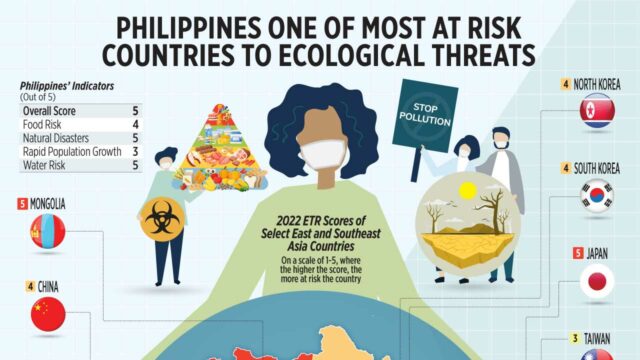
Philippines one of most at risk countries to ecological threats

The Philippines scored 5 (out of 5) in the third edition of the Ecological Threat Report (ETR) by the Institute of Economics and Peace. This meant that the country is at “extremely high” risk of natural disasters, food and water insecurity, and rapid population growth.

Philippines one of most at risk countries to ecological threats