Home Blog Page 5280

Mexican genetically modified corn spat could affect US sugar trade

REUTERS

NEW YORK —  Mexico’s proposed ban on genetically modified (GM) corn imports could impact other areas of trade with the United States, including the large sugar and corn syrup exchange, according to an independent report released on Thursday.

Mexico’s government of Andres Manuel Lopez Obrador approved a ban of all GM corn from 2025, a regulation that would block most US corn exports to Mexico. The US is the world’s largest corn exporter and is against the ban.

Mexico claims GM corn can hurt its ecosystem by killing some species, an allegation some scientists question. The country also wants to boost local, non-GM corn production.

The report, from trader and supply chain services provider Czarnikow, said the restriction would also block shipments of US high fructose corn syrup, a sweetener used in the food and beverage industry.

“This could lead to severe repercussions. The US could potentially ban the 1.35 million tons of imported Mexican sugar (70% raw sugar, 30% white),” analyst Adrian Torrebiarte said in the report.

According to the US Department of Agriculture, Mexico accounts for nearly half of all the sugar the US imports annually that is projected at 3.46 million short tons (ST) in 2022/23.

“A ban by the US on Mexican sugar could lead to severe complications. The US could give more TRQ allocations to Brazil, the Dominican Republic, or Central American countries,” according to the report.

The TRQs, or tariff rate quotas, are the share of imports that follow World Trade Organization import rules for reduced tariffs. That quota is currently at 1.61 million ST. The TRQs plus the Mexican imports make up 90% of all sugar the US buys every year.

Those low-tariff quotas only cover raw sugar, so Mr. Torrebiarte says the US would still have to replace around 400,000 tons of white sugar, also known as refined sugar, currently imported from Mexico, in case the GM corn ban goes ahead and derails bilateral trade. Reuters

Yields on government debt rise as Jan. inflation hits fresh 14-year high

YIELDS on government securities (GS) increased last week as headline inflation accelerated to a fresh 14-year high in January, which could prompt the Bangko Sentral ng Pilipinas (BSP) to increase benchmark rates again at its upcoming meeting.

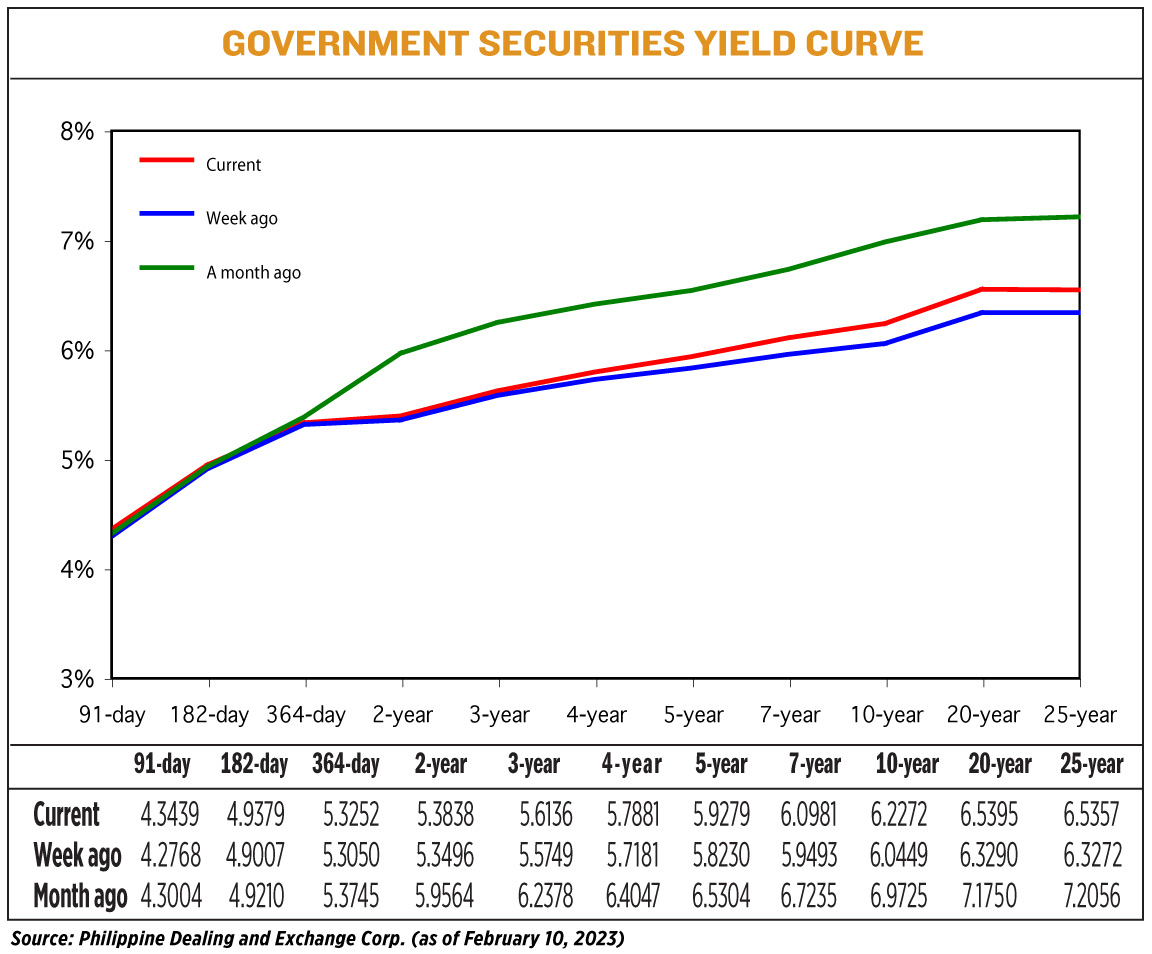
Bond yields, which move opposite to prices, went up by 10.2 basis points (bps) on average week on week, based on PHP Bloomberg Valuation Service Reference Rates as of Feb. 10, published on the Philippine Dealing System’s website.

Rates at the short end of the curve went up, with the 91-, 182- and 364-day T-bills rising by 6.71 bps, 3.72 bps, and 2.02 bps to fetch 4.3439%, 4.9379%, and 5.3252%, respectively.

Similarly, the belly of the curve, also increased, with the rates of the two-, three-, four-, five-, and seven-year T-bonds gaining 3.42 bps (to 5.3838%), 3.87 bps (5.6136%), 7 bps (5.7881%), 10.49 bps (5.9279%) and 14.88 bps (6.0981%), respectively.

The long end of the curve rose, with yields on the 10-, 20-, and 25-year debt papers increasing by 18.23 bps (to 6.2272%), 21.05 bps (6.5395%), and 20.85 bps (6.5357%).

Total GS volume traded reached P14.118 billion on Friday from P9.068 billion seen on Feb. 3.

Noel S. Reyes, Security Bank Corp. chief investment officer for Trust and Asset Management Group, said US jobs numbers and high Philippine inflation in January were the main drivers for bond yields last week.

“Longer bias for hawkishness needs to be undertaken by both the Fed and BSP (Bangko Sentral ng Pilipinas) as a result,” he said in an e-mail.

Similarly, the bond trader said inflation data drove yield movements last week.

The trader said the latest retail Treasury bond (RTB) sale and the Fed’s comments of a higher peak rate this year also affected rates.

“[It] indicated strong demand, therefore, influenced the secondary market. Yields are somewhat anchored to the RTB demand despite the bad news (inflation),” the bond trader said in an e-mail.

The Bureau of the Treasury last week raised an initial P162.180 billion from the rate-setting auction for the 5.5-year RTBs.

The RTBs fetched a coupon rate of 6.125%. The papers were awarded at rates ranging from 5.375% to 6.24%, bringing the average to 6.022%.

Meanwhile, Philippine headline inflation soared to a 14-year high of 8.7% in January, above the 7.5% to 8.3% forecast of the central bank for the month. It also marked the 10th straight month inflation was above the BSP’s 2-4% target.

Inflation last month was higher than 8.1% in December and 3% a year earlier.

Abroad, Fed Chair Jerome H. Powell last week said borrowing costs may reach a higher peak than traders and policy makers anticipate, Bloomberg reported.

“We think we are going to need to do further rate increases… The labor market is extraordinarily strong,” he said.

Data released earlier showed employers added 517,000 new workers in January while unemployment fell to 3.4%, the lowest rate since 1969.

For this week, Mr. Reyes sees remittances and the central bank’s policy action influencing this week’s trading as well as US inflation and retail sales data.

“So far, from the looks of it, the sell-off [last] week seemed to be welcomed by the market which I think should be the same case as well for any sell-off [this] week,” he said.

He added that with the latest inflation data, the market is expecting a 50-bp increase from the BSP at their policy meeting this week, as anything lower could push back further the timeline of achieving a lower inflation trend.

The Monetary Board is set to review its policy settings on Feb. 16, Thursday. It hiked key policy rates by a total of 350 bps last year to control surging inflation. — Abigail Marie P. Yraola

Hugh Hudson, director of Chariots of Fire, 86

LONDON — British film director Hugh Hudson, best known for making the Oscar-winning Chariots of Fire, died on Friday aged 86, his family said.

Mr. Hudson died in a London hospital after a short illness and was survived by his wife Maryam, his son Thomas, and his first wife Sue, the family statement said.

Mr. Hudson made television commercials in the late 1960s and 1970s before moving on to documentaries — including a biography of Argentine motor racing champion Juan Manuel Fangio — and feature films.

Chariots Of Fire, the story of British athletes competing at the 1924 Olympics, swept the Oscars in 1981, winning the best picture and three other Academy Awards.

Mr. Hudson’s other films included the acclaimed Greystoke: The Legend of Tarzan, Lord of the Apes in 1984. Not all his works were a success: Revolution — an ambitious portrayal of the American War of Independence — was a 1985 box-office flop. — Reuters

Nickel Asia’s stock price soars amid rising global nickel prices

By Lourdes O. Pilar, Researcher

NICKEL Asia Corp. was one of the most active stocks last week after investors took positions as global demand for nickel elevated the metal’s prices in the world market.

A total of P618.83 million worth of 84.53 million shares were traded from Feb. 6-10, data from the Philippine Stock Exchange showed. This made Nickel Asia the 18th most active stock last week.

The mining company’s shares closed at P7.42 apiece on Friday, up 9.4% week on week from its P6.78 finish on Feb. 2. For the year, the stock has gained 27.1%.

Cristina S. Ulang, research head at First Metro Investment Corp., said in an e-mail that elevated global prices made Nickel Asia one of the most active stocks last week.

“Price per ton of nickel globally has almost tripled since the pandemic and add to that China’s reopening which will further boost demand. That is against a predicted global supply deficit,” she said.

Ms. Ulang said the manufacturing of electric vehicles will also keep nickel, which is used in clean technology, in demand globally.

In a Reuters report, Indonesia, with the largest reserves of nickel, has signed more than a dozen deals worth more than $15 billion for battery and electric vehicle production in the country with manufacturers including Hyundai Motor, LG Group and Foxconn and next might be Tesla, Inc.

Indonesia produced 1.4 million tons of nickel in the third quarter of last year, according to the International Nickel Study Group. That’s far ahead of the second-biggest producer, the Philippines, which mined 290,000 tons in the same period.

During the third quarter of 2022, Nickel Asia said it sold a total of 12.44 million wet metric tons (WMT) of nickel ore at an average price of $29.46 per WMT. In the same quarter in 2021, the company exported more at 14.44 million WMT but priced lower at $28.05 per WMT.

The drop in sales volume was caused by unfavorable weather that adversely affected the group’s mining operations. However, the company’s nickel ore sales were realized at P54.22 per dollar, up 10% from P49.17 a dollar in the previous year.

Nickel Asia reported an attributable net income of P3.07 billion in the third quarter of 2022, lower by 10.9% from P3.45 billion in the same period in 2021. Still, its nine-month bottom line rose to P6.90 billion, up 11.8% from the P6.17-billion net profit attributable to equity holders of the parent.

As of Feb. 8, nickel spot prices closed at $27,390 per MT, according to London Metal Exchange.

In a previous report, Nickel Asia said it was looking for opportunities in the electric vehicle industry as the government is pushing for the manufacture of electronic vehicle batteries.

Meanwhile, Diversified Securities, Inc. Equity Trader Aniceto K. Pangan pointed to the company’s disclosure about a penalty incurred regarding its nickel ore shipment.

“This means that the demand for the commodity is so tight that they hardly could follow the government documents permit to serve their buyers,” said Mr. Pangan.

Last week, Nickel Asia disclosed to the Philippine Stock Exchange that its subsidiary, Rio Tuba Nickel Mining Corp., paid a penalty of P100,000 to the Bureau of Customs for loading nickel ore to a bulk carrier without the authority to do so from the agency.

However, Ms. Ulang noted that the disclosure had no bearing on Nickel Asia’s share prices.

“It is the company’s strong fundamentals that’s keeping investors inspired,” she said.

“Stock might be range-bound this week and test P7.00 ahead of the Bangko Sentral ng Pilipinas interest rate hiking event. But overall, the momentum would be upward to P7.50,” said Ms. Ulang.

She placed Nickel Asia’s support and resistance at P6.30 and P7.50, respectively.

“Expected revenue should reach around P7 billion in the fourth quarter of last year. Full-year should be flat as compared to last year at P28 billion,” Mr. Pangan said.

“As the current price is a new high, it should be on consolidation with support at P7.15 per share while resistance at P7.60 per share,” he added.

The Philippines has 34 operating nickel mines and exports most of its nickel ore to China and some to Japan. But it has only two nickel processing plants, which are both partly owned by Nickel Asia. The country is one of the biggest suppliers of the prized metal ore to China, overtaking Indonesia’s status.

Nickel Asia is partly owned by Japan’s Sumitomo Metal Mining Co. Ltd.

A V-Day gift guide

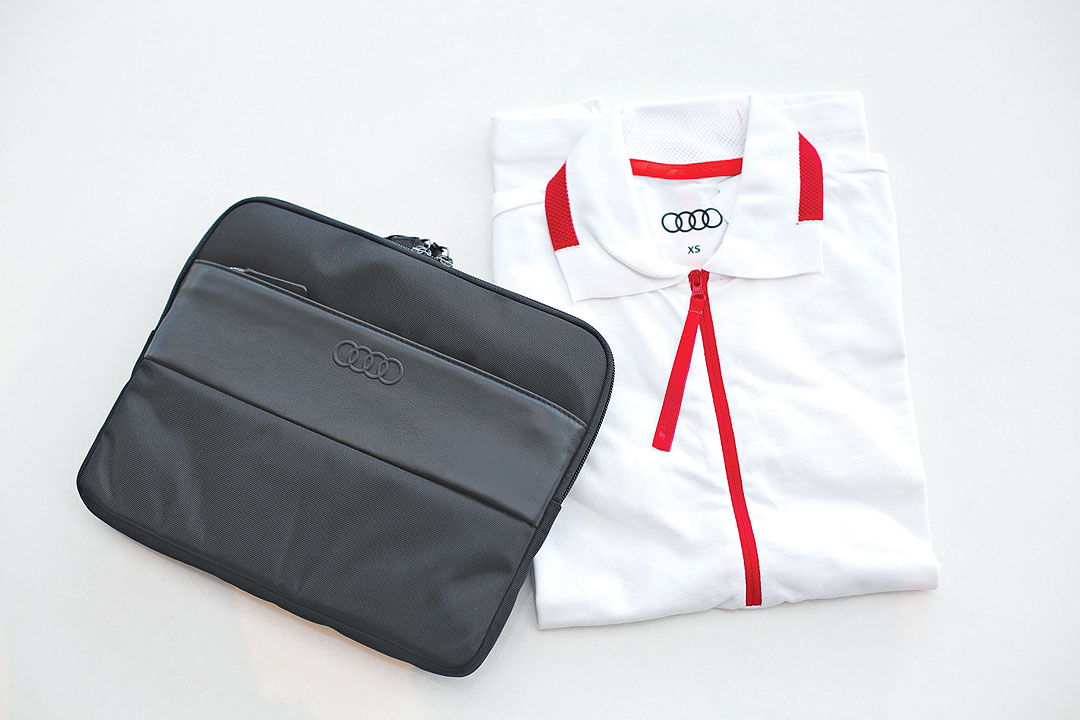
Audi Black Tablet Sleeve, P4,200; Audi Women’s Polo Shirt, P5,400

WITH VALENTINE’S DAY just a breath away, “Velocity” has compiled some gift suggestions from a handful of your favorite brands. Give your nearest dealership a call or a visit and you might just find a matching gift for your, well, love match.


• AUDI

Audi Black Tablet Sleeve, P4,200; Audi Women’s Polo Shirt, P5,400

• BENTLEY

Bentley Motorsport Teddy Bear, P4,200; Bentley Green Heritage Teddy Bear, P4,000

• PORSCHE

Porsche Silver Thermoflask, P4,700; Porsche 917 Pink Pig Thermal Insulated Bottle, P5,950

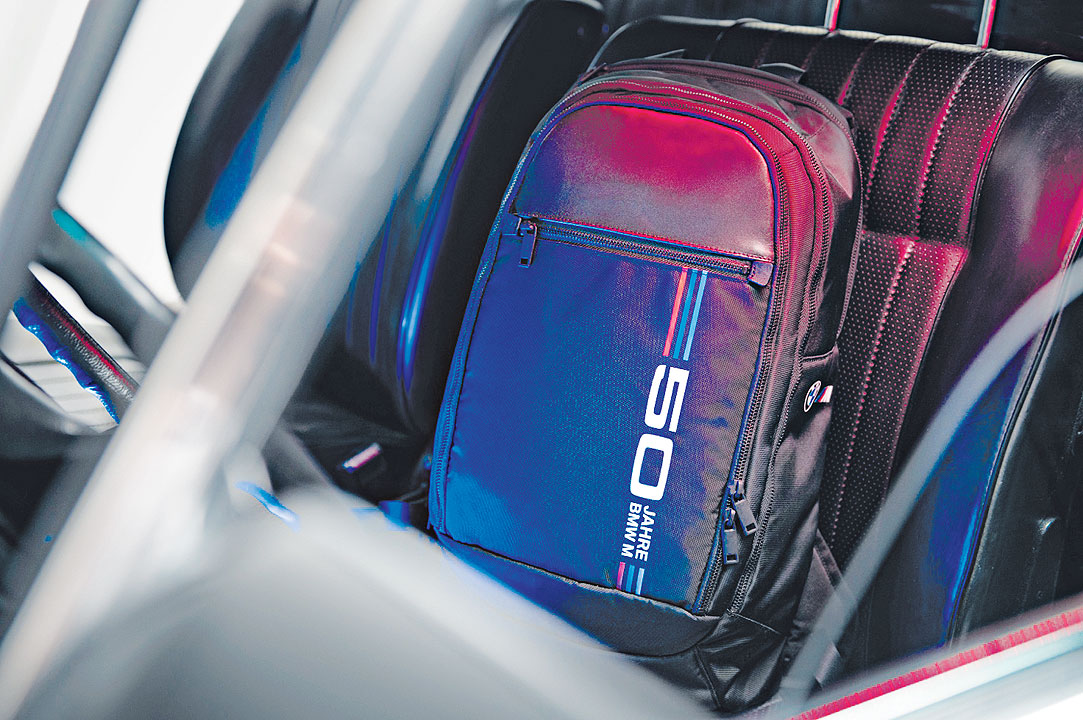
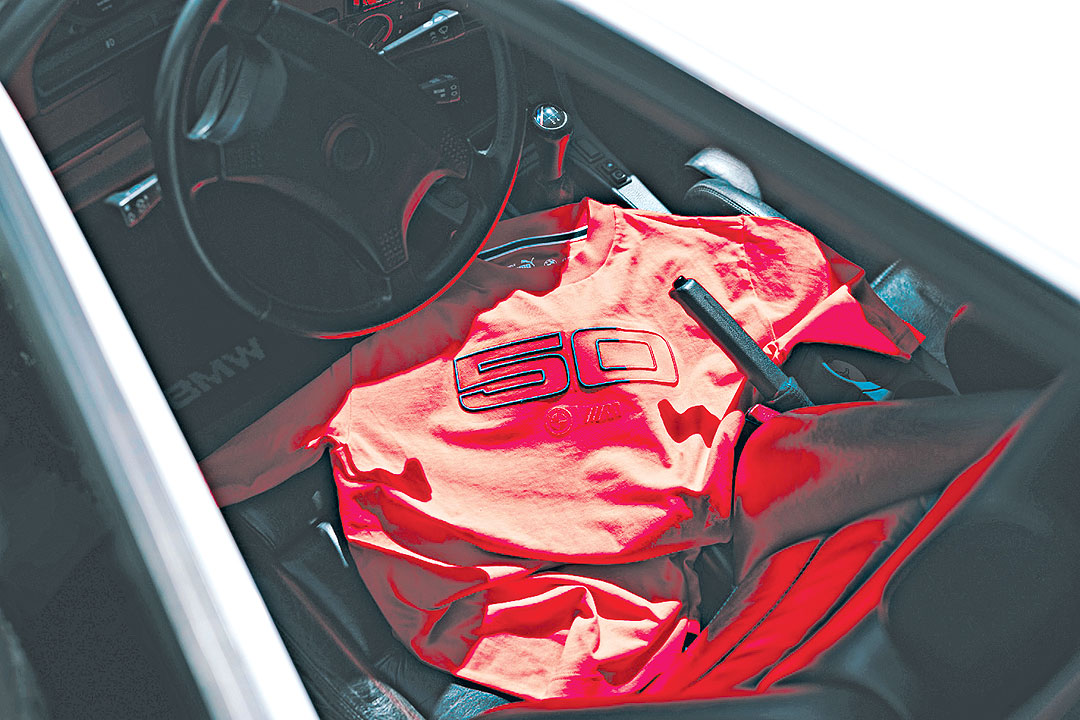
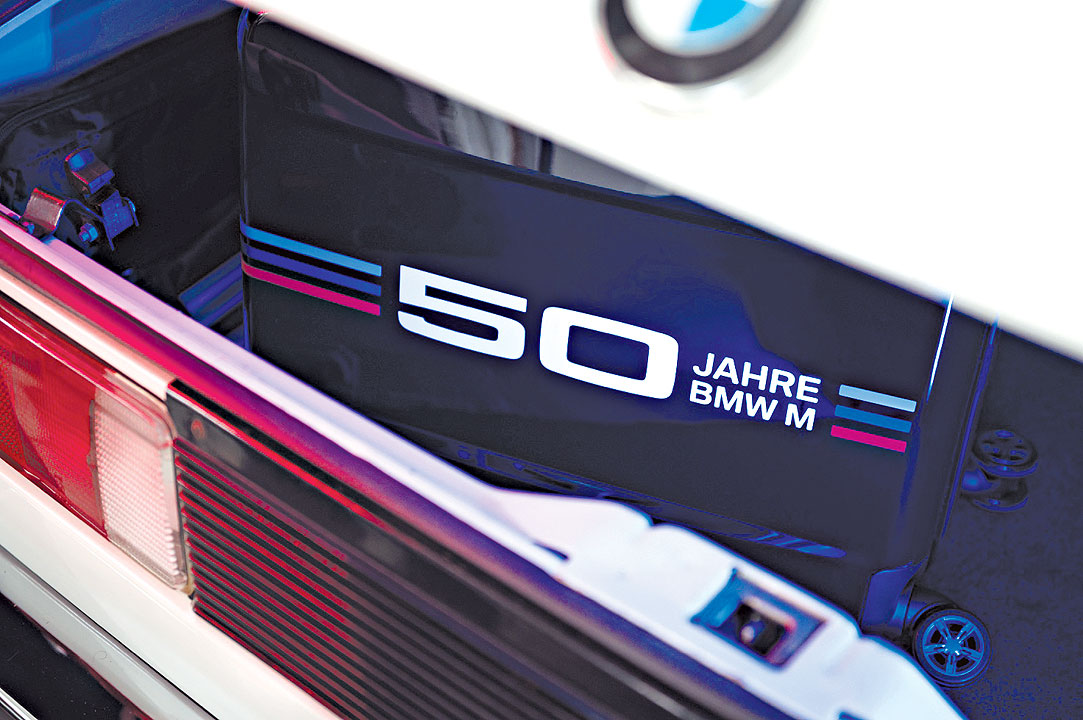
• BMW


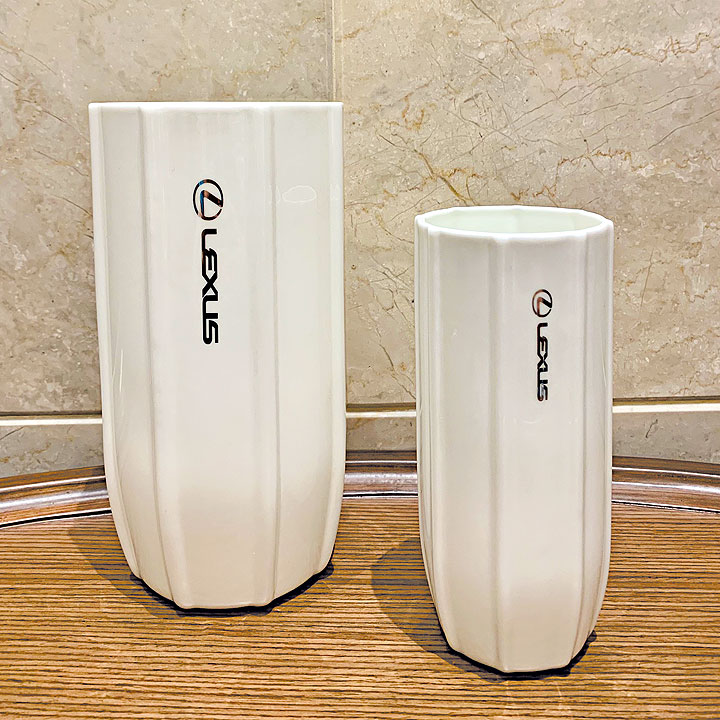
• LEXUS


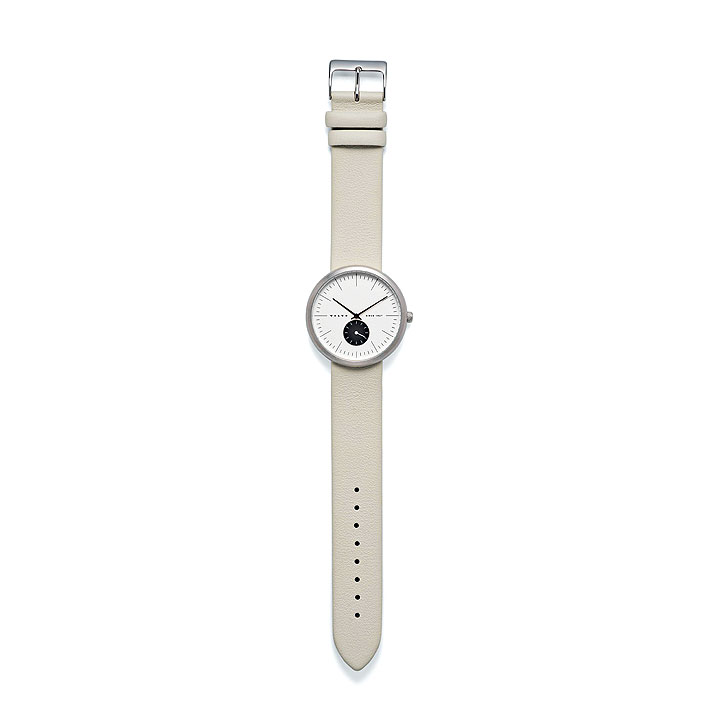
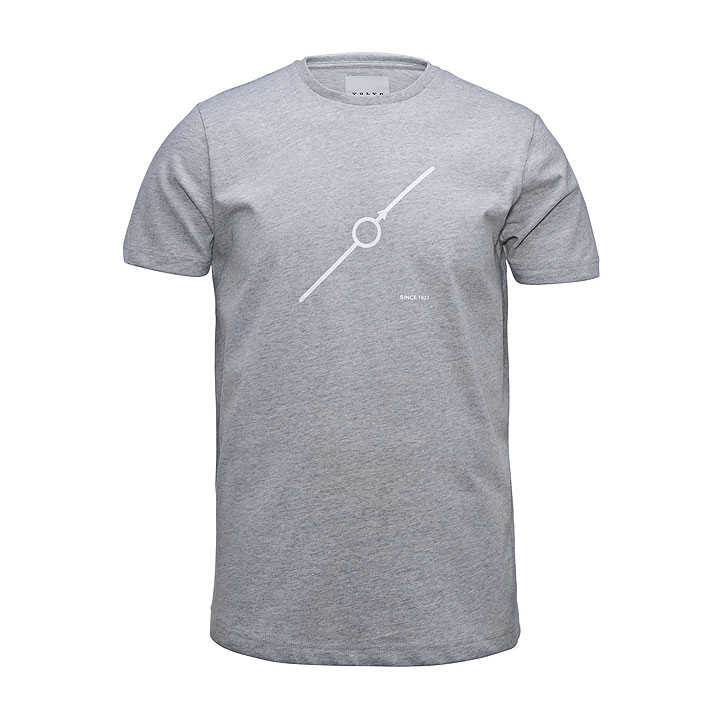
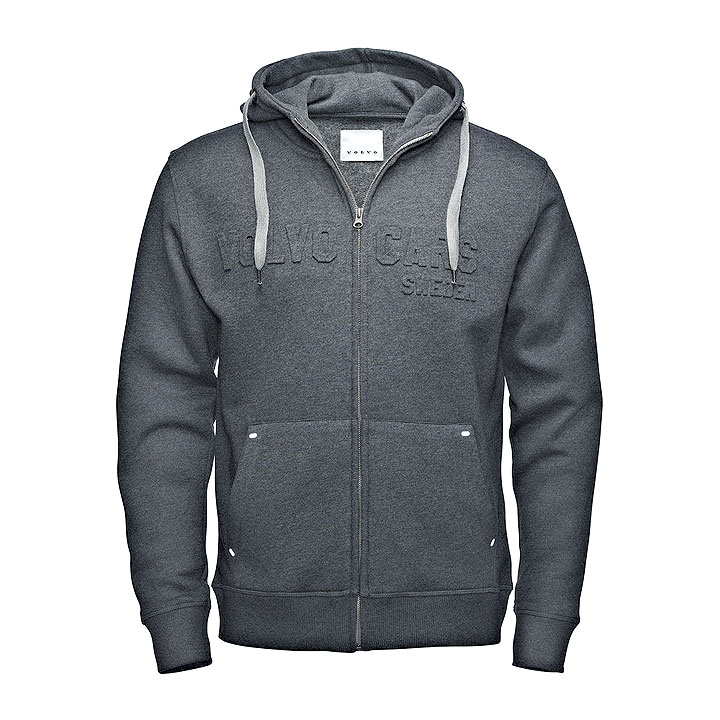
• VOLVO


• MINI


• LAMBORGHINI

Lamborghini Crest Mugs (P2,500 each)


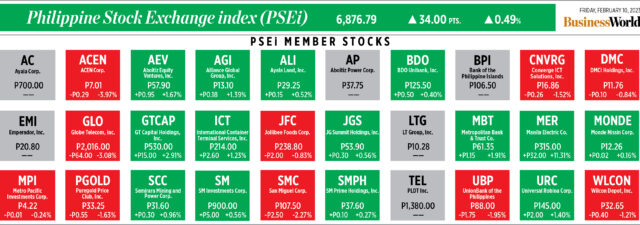
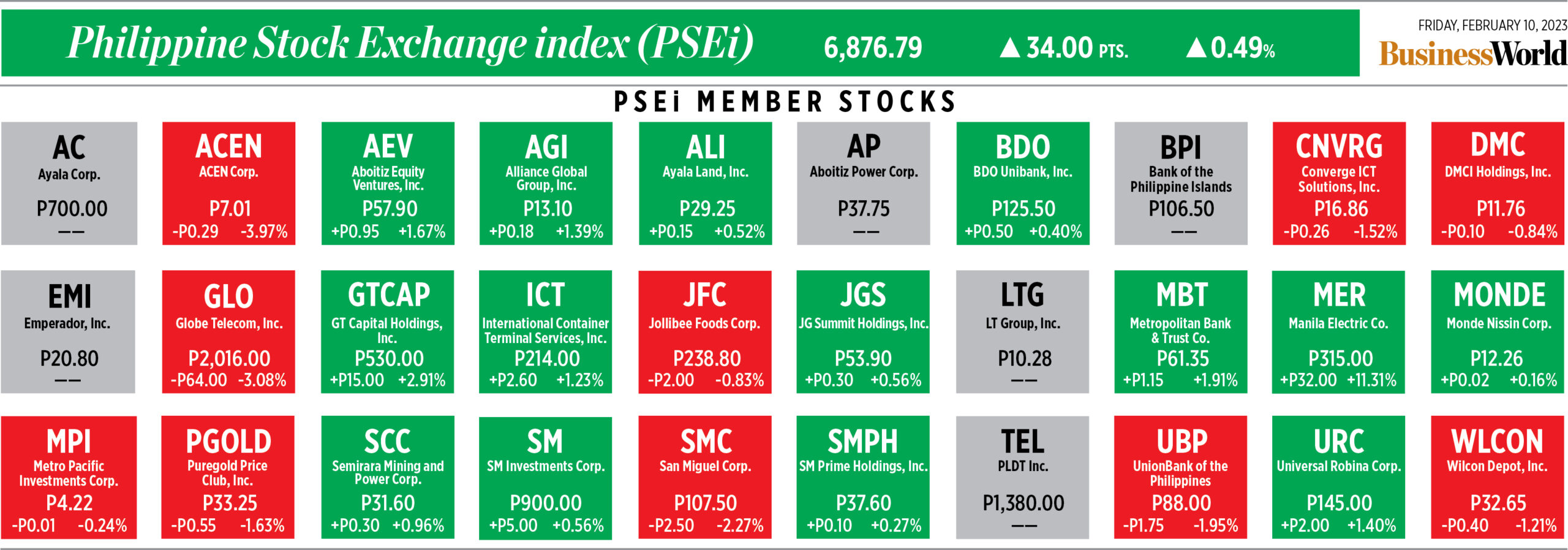
How PSEi member stocks performed — February 10, 2023

Here’s a quick glance at how PSEi stocks fared on Friday, February 10, 2023.


Peso may drop vs dollar ahead of BSP policy review

BW FILE PHOTO

THE PESO may weaken against the dollar this week as the market expects a big rate hike from the Bangko Sentral ng Pilipinas (BSP) after headline inflation surged in January.

The local unit closed at P54.42 per dollar on Friday, strengthening by three centavos from its P54.45 finish on Thursday, data from the Bankers Association of the Philippines’ website showed.

Week on week, however, the peso dropped by 74 centavos from its P53.68 finish on Feb. 3.

The peso opened Friday’s session at P54.65 per dollar. Its weakest showing was at P54.70, while its intraday best was at P54.40 against the greenback.

Dollars exchanged went down to $1.248 billion on Friday from $1.375 billion on Thursday.

The peso strengthened on Friday “after a gauge of the US dollar versus major global currencies again corrected slightly lower from near one-month highs recently,” Rizal Commercial Banking Corp. Chief Economist Michael L. Ricafort said in a Viber message.

The dollar index was up 0.4% at 103.55 on Friday as investors await the US consumer price index (CPI) report to be released on Feb. 14.

For this week, Mr. Ricafort said peso-dollar trading could be driven by sentiment ahead of the BSP’s policy meeting on Feb. 16, Thursday.

He said he expects a 25-basis-point (bp) increase in borrowing costs at the meeting to match the US Federal Reserve’s move.

Meanwhile, UnionBank of the Philippines, Inc. Chief Economist Ruben Carlo O. Asuncion said in a report that the “disappointing” January inflation report has fueled bets that the BSP will hike rates by as much as 50 bps on Thursday.

“A BSP more hawkish than the (US Federal Reserve) in their first policy meetings this year, could spill over into a firmer peso later in the week,” he said.

“The peso will also benefit from flows attracted by the latest retail Treasury bond (RTB) issuance whose settlement starts on Feb. 22,” Mr. Asuncion added.

Headline inflation accelerated to a new 14-year high of 8.7% in January as food prices continued to surge, causing renewed rate hike worries.

This was faster than the 8.1% print in December 2022 and 3% in the same month last year. It also marked the 10th consecutive month that inflation was above the BSP’s 2-4% target for the year.

The BSP’s policy-setting Monetary Board last year raised interest rates by 350 bps, bringing its key rate to a 14-year high of 5.5%.

Meanwhile, the government last week raised an initial P162.18 billion from the rate-setting auction for its offer of 5.5-year RTBs.

Tenders hit P196.109 billion, or more than six times the P30 billion on the auction block. The RTBs were awarded at a coupon rate of 6.125%.

Mr. Ricafort expects the peso to trade between P54.20 and P54.70 per dollar this week, while Mr. Asuncion sees the local unit moving from P54.10 to P55. — A.M.C. Sy

Stocks may move sideways ahead of BSP meet

BW FILE PHOTO

PHILIPPINE STOCKS may move sideways this week on cautious trading as investors await the Bangko Sentral ng Pilipinas’ (BSP) policy decision on Thursday and the release of more firms’ financial reports.

The benchmark Philippine Stock Exchange index (PSEi) went up by 34 points or 0.49% to close at 6,876.79 on Friday, while the broader all shares index added 9.67 points or 0.26% to end at 3,653.17

Week on week, however, the PSEi went down by 150.59 points or 2.14% from 7,027.38 on Feb. 3.

“Bears took the reins amid the higher-than-expected inflation print for the month of January,” online brokerage 2TradeAsia.com said in a market note.

Headline inflation accelerated to a new 14-year high of 8.7% in January, faster than the 8.1% print in December 2022 and 3% in the same month last year.

This was also higher than the 7.5% to 8.3% forecast range given by the central bank for the month, and marked the 10th consecutive month that inflation was above the BSP’s 2-4% target for the year.

For this week, Philstocks Financial, Inc. Senior Research Analyst Japhet Louis O. Tantiangco expects investors to trade cautiously ahead of the central bank’s policy meeting on Feb. 16.

“The possibility of a 50-basis-point (bp) rate hike is expected to be priced in, following the Philippines’ strong January inflation data. This in turn could weigh on the local bourse,” Mr. Tantiangco said.

The central bank could raise benchmark rates by 50 bps at its meeting on Thursday to rein in elevated inflation, analysts said.

A BusinessWorld poll last week showed 17 out of 18 analysts see the Monetary Board hiking borrowing costs at its first meeting of the year. Nine see a 50-bp hike, while eight expect a 25-bp increase.

BSP Governor Felipe M. Medalla earlier said the central bank could hike borrowing costs by 25 or 50 bps at their policy meeting on Feb. 16 as they need to anchor inflation expectations.

“Investors may also look towards our upcoming OFW (overseas Filipino workers) remittances data for clues on the local economy,” Mr. Tantiangco added.

Remittances data are expected to be released by the central bank on Feb. 15, Wednesday.

“Over a few weeks of grappling with macro drivers, particularly following inflation and interest rate movements, markets are looking to find direction from earnings reports for fourth quarter,” 2TradeAsia.com said.

Listed companies are expected to continue releasing their 2022 financial reports in the coming weeks.

Mr. Tantiangco placed the PSEi’s support at 6,800 and immediate resistance at its 20-day exponential moving average, while 2TradeAsia.com put support at 6,700 and resistance at 7,000. — Justine Irish D. Tabile

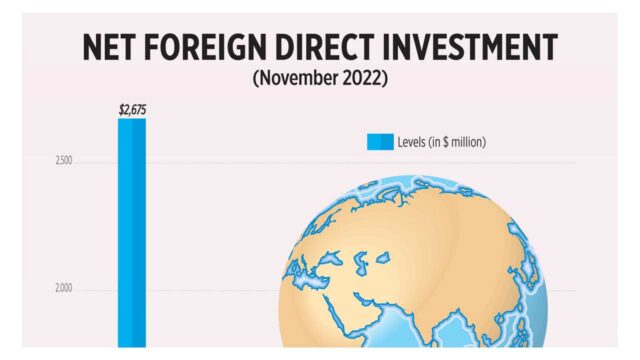
Net Foreign Direct Investment (November 2022)

FOREIGN DIRECT investments (FDI) in the Philippines plummeted 43.6% in November to $793 million and 13.4% to $8.43 billion in the 11-month period, suggesting a weaker global economic outlook. Read the full story.

Net Foreign Direct Investment (November 2022)

Money ‘mule’ incidents in 2021 spike as digital banking surges

MONEY “mules” generated 732,392 suspicious-transaction reports (STRs) in 2021, up 1,277.09%, the Anti-Money Laundering Council (AMLC) reported.

The AMLC said the STRs spiked with the accelerated adoption of digital banking and electronic wallets.

Suspected money “mule” offenses in 2021 were up 50.50% from a year earlier.

“The sharp increase in the number of submitted STRs in 2021 can be attributed to the emergence and accelerated adoption of digital banking and electronic wallets, which did not only provide alternative payment methods but also made financial transactions easier and safer in the midst and in the wake of the COVID-19 (coronavirus disease 2019) pandemic,” the AMLC said.

“This is consistent with the reported volume of PESONet and InstaPay transactions, which posted 164% and 223% growth, respectively, in the first half of 2021,” it added.

PESONet and InstaPay are automated clearing houses launched in December 2015 under the central bank’s National Retail Payment System.

PESONet caters to high-value transactions and may be considered an electronic alternative to the paper-based check system.

On the other hand, InstaPay is a real-time, low-value electronic fund transfer facility for transactions up to P50,000 and is most useful for remittances and e-commerce.

“The annual values of STRs related to money mules likewise spiked in 2021, reaching P505.99 billion or 99.18% of the total value of the captured STRs,” the AMLC said.  

It added that the sudden increase in the value of STRs in 2021 was due to an attempted bank account opening with an initial deposit of $10 billion.

According to the report, most of the STRs were triggered by suspicious circumstances defined by Republic Act (RA) 9160, accounting for 99.77% of the total volume of STRs.

About 45.89% of the STRs were deemed suspicious because there was no underlying legal or trade obligation, purpose, or economic justification.

Suspected money mules utilize three main modes of withdrawing funds: electronic cash cards, automated teller machines, and over the counter transactions.

“Using the available addresses of the reporting branches as proxy for the location of the cash-out facilities used by suspected money mules, it was observed that 54.91% of the withdrawal transactions were performed in Metro Manila. This was followed by Cavite (38.08%), Negros Occidental (2.80%), Laguna (2.10%), Pampanga (1.64%), and Tarlac (0.47%),” according to the report.

“Within Metro Manila, the withdrawal transactions by suspected money mules were done in Makati City (76.60% of total transactions in Metro Manila), Parañaque City (17.45%), City of Manila (2.98%), Quezon City (2.55%), and Pasay City (0.43%).”

“Given the seemingly rampancy of money mules in the country, the report highlights the need to raise awareness among the covered persons so that they may prevent money mules from taking advantage of the existing financial infrastructure,” the AMLC said.

“Likewise, the study finds value in educating the general public about the suspicious activities and notable typologies of money mules, so they may protect themselves from being victimized. Thus, the dissemination of this report to law enforcement agencies, supervising authorities, other government agencies, covered persons with Public-Private Partnership Agreement with the AMLC, other financial intelligence units, and the general public is recommended.”

According to the AMLC, a money mule is someone who, either intentionally or unintentionally, uses his or her bank account to transfer money on behalf of someone else, usually a cybercriminal.

Cybercriminals use these bank accounts for crimes such as money laundering or for transferring stolen money, which are prohibited under Republic Act 9160 or the Anti-Money Laundering Act of 2001. — Keisha B. Ta-asan

Mindanao-Visayas grid link starts testing phase in March

BW FILE PHOTO

THE Independent Electricity Market Operator of the Philippines (IEMOP) said the project linking the power grids of the Visayas and Mindanao is expected to be completed by March.

“During the ceremonial launch of WESM (Wholesale Electricity Spot Market) Mindanao, it was announced that MVIP (Mindanao-Visayas Interconnection Project) will be commissioned by the end of March,” Isidro E. Cacho, Jr., IEMOP’s head of Corporate Strategy and Communications, said in a briefing.

The P52-billion MVIP will connect the Mindanao and Visayas power grids, to ensure the sharing of energy across the network and create a market for surplus power.

Robinson P. Descanzo, IEMOP’s chief operating officer, said that according to the National Grid Corp. of the Philippines the start of testing for the MVIP will begin in March.

“Gradually, while the unit testing is being conducted, the cable will be energized. It will start with a certain megawatt (MW) amount for import and export of power through that interconnection until it reaches the maximum capacity of the cable which is 240-MW,” Mr. Descanzo said.

Mr. Descanzo said that by the second quarter the import and export of power through interconnection may hit 80 MW to 100 MW.

“These are just estimates but again the build-up of export and import of power from Mindanao to the Visayas and vice versa will  be gradual,” he said.

In January, the Department of Energy announced the start of the commercial operations of WESM Mindanao, which is expected to help lower the power costs in the region.

Meanwhile, IEMOP said that electricity spot market prices may continue to increase for the rest of February due to an expected lower supply margin.

“For the rest of February, covering the remaining days of the Malampaya shutdown, we are projecting that we will have an average market price of P7.55 per kWh, with the lower overall supply margin equivalent to 3,882 megawatts as compared to January’s 4,979 MW,” Christian Karla A. Rica, IEMOP knowledge management specialist, said in a virtual briefing last week.

The Malampaya gas field is currently shut down for maintenance until Feb. 18.

Malampaya-supplied plants account for up to 27% of the Luzon power grid’s electricity requirements. During its shutdown, the five power plants with a combined capacity of 3,453 MW will need to run on alternative fuel.

As of Feb. 8, electricity spot market prices rose P1.67 to P7.43 per kilowatt-hour (kWh) from their January levels.

Ms. Rica said that in early February, supply levels declined to 13,601 MW from 14,232 MW while demand continued to increase to 9,785 MW from 9,253 MW. — Ashley Erika O. Jose

Sugar industry calls for broad participation in import program

BUREAU OF CUSTOMS FACEBOOK PAGE

THE sugar industry has called on the government to admit all interested parties, including sugar producers, industrial users, and accredited traders to the proposed program to import sugar. 

In a letter to the Sugar Regulatory Administration (SRA) on Feb. 6, Confederation of Sugar Producers Association, Inc. (Confed) President Aurelio Gerardo J. Valderrama, Jr. asked the government to operate the import program in an “open, transparent, and equitable manner.”

“We also urged SRA to adopt import guidelines which are transparent and allow the participation not only of industrial users but also of sugar producers and other interested accredited sugar traders,” Mr. Valderrama told BusinessWorld in an e-mail on Friday.

According to Mr. Valderrama, the SRA has yet to respond.

Sugar federations and associations initially sent letters last month with a similar position and proposed a 50:50 split between industrial users and sugar producers.

Confed reiterated its recommendation to cut the amount of proposed imports to 350,000 metric tons (MT) from 450,000 MT, of which 300,000 MT will consist of refined sugar and 50,000 MT raw sugar.

These should arrive no earlier than July in order not to distort mill gate prices, the sugar group said.

“In our Jan. 27 letter, we leave it to SRA’s prudent judgment, based on actual market requirements, what volume of the 350,000 MT will be refined sugar and what volume will be raw sugar,” he said.

Confed further recommends that all applications be submitted and opened after five days upon the effectivity of the appropriate Sugar Order, to ensure transparency.

National Federation of Sugarcane Planters and Panay Federation of Sugarcane Farmers also sent a joint letter to the SRA with similar recommendations.

“Producers should be granted import rights, so that we can also benefit from the program and somehow make up for the high cost of production in the past years,” according to the letter.

Citing an SRA report and the pre-final crop estimate as of Dec. 11, 2022, Mr. Valderrama said that the remaining sugarcane to be harvested after Jan. 22 is around 9.42 million MT, with an estimated yield of 846,168 MT.

According to the SRA, the reserved stocks of imported sugar will begin to be released as required by the market.

“We are waiting for SRA’s final production figures so that we can also check for ourselves what the actual shortage is,” he said.

“The actual shortage should serve as the sole basis for determining the volume of the imports (initially classified as “C” or reserve sugar) which should be converted into “B” sugar and released to the domestic market,” he added. — Sheldeen Joy Talavera