Home Blog Page 5262

GSIS posts 15% increase in gross nonlife insurance premiums in 2022
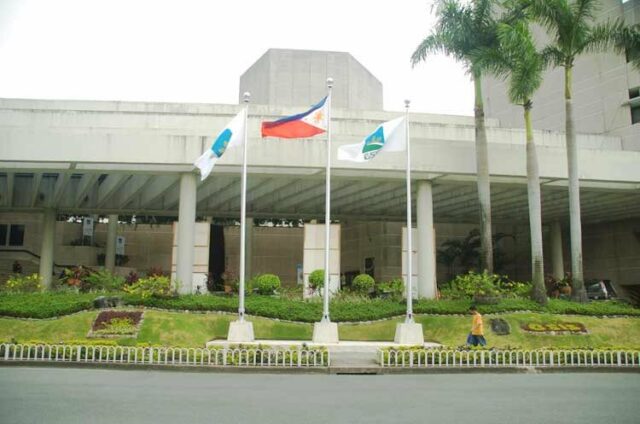
The Government Service Insurance System headquarters in Pasay, Philippines. May 28, 2012. — BW FILE PHOTO

GOVERNMENT Service Insurance System (GSIS) saw a 15% increase in gross premiums written in its nonlife insurance business last year, it said in a statement on Sunday.

Its gross nonlife premiums written were at P6.8 billion in 2022, which GSIS said was a record. This was up from P5.9 billion in 2021.

The state-run pension fund also recorded a 33% increase in its net premiums written to P4 billion.

“With a net worth of P41 billion in 2022, GSIS is now the biggest nonlife insurer in the country,” it said.

“I commend the men and women of GSIS who made this achievement possible. During my oath taking as head of GSIS in July 2022, one of the marching orders that President Marcos gave me was to provide insurance cover to all government properties. And we have been making headways in complying with the president’s directive,” GSIS President Jose Arnulfo “Wick” A. Veloso was quoted as saying in the statement.

GSIS is the pension fund for government employees.

Under Republic Act 656 or the Property Insurance Law, GSIS is mandated to insure all properties, assets, and interests of the government.

It offers coverage for fire, engineering, marine hull, marine cargo, aviation, bonds, motor car, personal accident, contractors’ all risks, as well as comprehensive general liability insurance.

GSIS’ general insurance teams embarked on a nationwide campaign to market its nonlife insurance products to local governments, holding caravans and capacity-building initiatives for its property officers, the pension fund said.

As a result, GSIS generated the bulk of big-ticket accounts in the second half of 2022, worth of premiums above P5 million.

These included the Philippine Statistics Authority; Philippine Reclamation Authority/CAVITEX Infrastructure Corp.; Hann Philippines, Inc.; Eastern Visayas Regional Medical Center-Tacloban; Vicente Sotto Memorial Medical Center-Cebu; Quirino Memorial Medical Center; Philippine Atmospheric Geophysical and Astronomical Services; Philippine Coast Guard Marine Hull Fleet, Philippine Ports Authority-Globalport Terminals, Inc.; and additional assets of the Quezon City government. — A.M.C. Sy
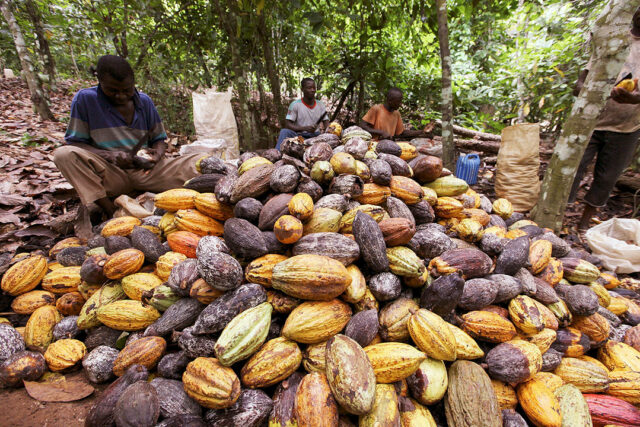
Ivory Coast gives cocoa farmers electronic cards to track beans

REUTERS

ABIDJAN — Ivory Coast’s cocoa regulator started distributing electronic cards to cocoa farmers to help track beans from plantations to their export ports and ensure the growers are paid a guaranteed price for their produce.

The countrywide exercise is part of a response to plans by the European Union to ban imports of commodities and products linked to deforestation and rights abuses by 2024.

Ivory Coast, the world’s top cocoa producer, has been criticized over the years for using thousands of child laborers in farms, and destroying large areas of forests and national parks to expand production.

Authorities have said they are tackling the issue of child labor and acknowledged that farming is encroaching on forests. In 2019, the Coffee and Cocoa Council (CCC) commissioned a study to establish the number of cocoa farmers and where they operate. It registered 995,000 farmers and found that 15% of plantations were in protected forest areas.

The new card system, which will start operating at the start of the next cocoa season on Oct.1, will enable the CCC to reject beans grown illegally and trace them from plantations to the ports of Abidjan and San Pedro.

“The European Union voted a new law that will be implemented soon, and this pushes us to develop a traceability and certification system,” CCC head Yves Brahima Kone told hundreds of cocoa farmers collecting their cards in the northern city of Agboville.

The cards are also integrated with an electronic payment and wallet system that will allow farmers to get the guaranteed farmgate price of 900 CFA francs ($1.52) per kg of beans, which many buyers do not respect.

“It is the first time I have a bank card that I can use to withdraw cash. I have never had a bank account and I am happy because now I can sell my cocoa for the guaranteed price,” said Jean Dominique Boua, who farms outside Agboville.

The CCC has already given out 100,000 cards since a pilot project in April last year. It aims to distribute around 50,000 cards per month until the end of the current season. — Reuters

UnionBank shares rise on earnings report, PSEi reentry

BW FILE PHOTO

SHARES in Union Bank of the Philippines (UnionBank) rose last week when the Aboitiz-led bank reported its full-year earnings and ahead of its return to the Philippine Stock Exchange index (PSEi) after 14 years.

Data from the PSE showed UnionBank ranked second in value turnover with P4.08 billion worth of 42.31 million shares changing hands from Jan. 30 to Feb. 3.

The Aboitiz-led bank shares finished at P96 apiece on Friday, inching up by 2.7% from its P93.50 close last Jan. 27. For the year, the stock has risen by 11.5%.

Rastine Mackie D. Mercado, research director at China Bank Securities Corp., said UnionBank’s price movement was mainly driven by its impending inclusion in the main index.

“While many anticipated [UnionBank]’s inclusion, the formal announcement was made after the market close last [Jan. 27], hence funds/investors had to work to rebalance their portfolios by [last] week,” Mr. Mercado said in an e-mail.

He added that the bank’s fourth-quarter performance was stronger on an annual basis although its “bottomline performance was relatively flat despite the strong growth in revenues (as driven by its acquisition of Citi’s consumer business effective August 2022).”

In a press release last week, UnionBank said its net income reached P12.7 billion last year, or nearly flat from the P12.578-billion net profit in 2021. Its revenues rose by 16% to P52.2 billion from P45.1 billion in the same period in 2021.

Revenues mainly came from net interest income and fee-based income, which compensated for the absence of trading gains, the bank said.

The listed bank’s acquisition of the consumer banking business of Citigroup, Inc. in the Philippines was completed in August last year. It was valued at P55 billion.

The takeover covers Citi’s local credit card, unsecured lending, deposit, and investment businesses, as well as Citicorp Financial Services and Insurance Brokerage Philippines, Inc.

Meanwhile, the PSE said in a statement last week that DMCI Holdings, Inc. and UnionBank will be replacing Megaworld Corp. and Robinsons Land Corp. in the PSEi beginning Feb. 6.

The move comes after the bourse operator’s index review for 2022. To be included in PSEi means a listed company must be among the top in terms of liquidity and market capitalization.

Companies considered for inclusion also need a free float level of at least 20% of their outstanding shares. Relevant financial criteria as well as eligibility for early inclusion are also considered by the PSE in the index review, PSE said.

“We think market reception to the earnings news was lukewarm as investors monitor the ongoing impact of the Citi consumer business acquisition to financial performance,” Mr. Mercado said.

“Revenues saw strong growth, but operating expenses grew at a steeper pace [which is] likely in relation to the acquisition, so how that dynamic change is something that investors will monitor moving forward,” he added.

Traders and investors should consider UnionBank given its improving visibility on the acquisition’s impact on its financials, Mr. Mercado said.

“Investors will likely monitor continued growth in net interest income, net interest margins, and nonperforming loans, considering the higher proportion of consumer loans to its total book, and impact of the Bangko Sentral ng Pilipinas’ cumulative rate hikes.”

Mr. Mercado pegged support and resistance levels at P91.80 and P100.00, respectively. — Abigail Marie P. Yraola

Peugeot raffles off 24 Hours of Le Mans VIP access

Peugeot 9X8 — PHOTO FROM PEUGEOT

PEUGEOT PHILIPPINES customers have a chance to win a trip to the 24 Hours of Le Mans race happening in France from June 10 to 11. All expenses of two lucky winners and their companions will be footed by Peugeot, with the winners receiving VIP access to the race, round-trip airfare, and hotel accommodations.

Customers are entitled to join the raffle upon purchase of a brand-new Peugeot vehicle at any authorized dealership nationwide. The current vehicle lineup includes the 2008 SUV, 3008 SUV, 5008 SUV, and the Traveller Premium van.

The 24 Hours of Le Mans (now on its 91st year) is an automobile endurance event that is scheduled to take place at the Circuit Bugatti du Mans in Le Mans, France. Peugeot will enter its 9X8 Hypercar in the newly created Le Mans Hypercar (LMH) class in the World Endurance Championship.

Said Peugeot Philippines Brand Head Maricar Parco, “We’re excited to offer our customers the once-in-a-lifetime experience to witness the sheer power and performance of the Peugeot 9X8 Hypercar and get exclusive VIP access during the 24 Hours Le Mans race in France — the birthplace of Peugeot.”

For more than 10 years, Peugeot has been perfecting its hybrid-electric technology in competition and on the road. The 9X8 will succeed the 905 and 908, victorious at the 24 Hours of Le Mans in 1992 and 1993, respectively, and in 2009.

Customers can visit any of the 13 Peugeot dealerships located in Metro Manila (Alabang, Balintawak, Makati, Manila Bay, Pasig, and Quezon Avenue), North Luzon (Bulacan and Pampanga), South Luzon (Sta. Rosa and Batangas), Visayas (Cebu and Negros), and Mindanao (Davao).

For more information, visit https://www.peugeot.ph/buy/buy-online/24h-lemans.html. Promo period is until March 30, 2023 only.

Beyond beep beep: Video game music goes to next level at Grammys

GRAMMY.COM/ JATHAN CAMPBELL

LOS ANGELES — Whether it is the catchy chime of a chip tune, the melodies of the metaverse or the latest trending Super Mario Bros remix — video game music is seemingly boundless.

Now the growing popularity of the video game industry and years of advocacy from game composers will be reflected in the 2023 Grammy Awards as the Recording Academy announced its inaugural “Best Score Soundtrack for Video Games and Other Interactive Media” category.

Five nominees will compete at Sunday’s Grammys, out of the 70 original scores submitted for the category’s maiden year. The nominees are composers Austin Wintory for Aliens: Fireteam Elite, Stephanie Economou for Assassin’s Creed Valhalla: Dawn of Ragnarok, Bear McCreary for Call of Duty: Vanguard, Richard Jacques for Marvel’s Guardians of the Galaxy and Christopher Tin for Old World.

The success of video game music coincides with the overall growth of the global games market, which in 2022 generated total revenues of $184.4 billion and is expected to reach $211.2-billion revenue by 2025, according to data analytics firm Newzoo.

The video game industry also flourished during the COVID-19 pandemic as people increasingly turned to digital entertainment during lockdowns. “It was only a matter of time before the Grammys recognized that there were a lot of soundtracks being produced for video games and they’re all very good,” Mr. Tin told Reuters.

Tin’s “Baba Yetu” theme for the game Civilization IV won the “Best Instrumental Arrangement” Grammy in 2011, making him the first video game nominee and winner, while Wintory’s soundtrack for the game Journey was nominated in the “Best Score Soundtrack for Visual Media” in 2012.

“Video games have been making waves with new revenue streams for some time,” Uziel Colon, who helped develop the new category, told the Grammys. “In the future, video games and music will merge — it’s already happening.”

However, video game music has not always hit all the right notes to be specifically recognized at the Grammys.

“Video game music has been eligible for the Grammys since 1999, and only one score had ever been nominated before, which was 10 years ago. There are people who I think were dissatisfied with that,” Mr. Wintory told Reuters.

Wintory said video games were not being nominated at all when the category they fell under was “Best Score Soundtrack for Film, Television, and Other Media” because being labeled “Other Media” was “marginalizing” them as a sort of miscellaneous category.

But game music is breaking ground through technological innovation and new avenues for consumers to experience it.

This includes live immersive video game concerts, video game scores across platforms like YouTube, Twitch, TikTok, and Fortnite, remixes and collaborations, augmented and virtual reality and even eye-tracking technology.

Economou told Reuters that having Grammys recognition provides validation that video game music is shaping “the musical landscape of society.”

Mr. McCreary, who has composed music for popular shows like Battlestar Galactica, The Walking Dead, and The Lord of the Rings: The Rings of Power believes composing for games, movies and TV shows is not so different.

“For me, story and theme are universal,” he told Reuters.

Yet, he said video games have unique challenges for composers because they are interactive experiences versus only being witnessed by the audience.

The music must “work in a unique technical capacity, beyond simply supporting narrative,” he added.

Collaborating with game developers and audio teams informs his ability to write music that can be smoothly integrated into a video game.

“It’s a close collaboration unlike anything else in the entertainment industry,” Mr. McCreary said. — Reuters

Roxaco Land Corporation launches new projects 

Roxaco Land Corporation (“RLC”), a subsidiary of Roxas and Company, Inc. (“RCI”) ushered 2023 with an aggressive expansion program in its real estate and hospitality units.

RLC will launch land development projects in the Tagaytay to Nasugbu corridor, buoyed by strong demand and accelerating property prices. The town of Nasugbu, Batangas has been identified by large infrastructure groups as a prime destination and access point into Western Batangas from Metro Manila, attracting locators and home buyers. The planned extension of the CTBEX toll road and the emergence of the CBEX alternative route will substantially reduce travel time from Metro Manila to Nasugbu to just over an hour. RLC resumed land development and construction of sold units in its low cost and mid-market open lot and housing projects in Nasugbu. These were stalled during the pandemic but are back on track.

In Tagaytay, plans are being finalized to launch the Anya Villa Project, a low density offer that targets the higher end segment of the property market. The success of the RLC-owned Anya Resort Tagaytay gave rise to a strong brand for boutique residential resort developments that can be replicated throughout the country’s many prime tourist destinations.

RLC is leveraging on the recovery of local travel and tourism, boosting occupancy levels in all of its budget hotels located in Metro Manila. Guests are returning and pushing bookings to near pre-pandemic levels. RLC is implementing phased renovations of its hotels as well as targeted marketing programs to strengthen its customer proposition.


Spotlight is BusinessWorld’s sponsored section that allows advertisers to amplify their brand and connect with BusinessWorld’s audience by enabling them to publish their stories directly on the BusinessWorld website. For more information, send an email to online@bworldonline.com.

Join us on Viber at https://bit.ly/3hv6bLA to get more updates and subscribe to BusinessWorld’s titles and get exclusive content through www.bworld-x.com.

Yields on government debt slip on Fed, RTB offering

YIELDS on government securities (GS) slipped last week after US Federal Reserve’s rate hike and the announcement of the Bureau of the Treasury’s retail Treasury bond (RTB) offering.

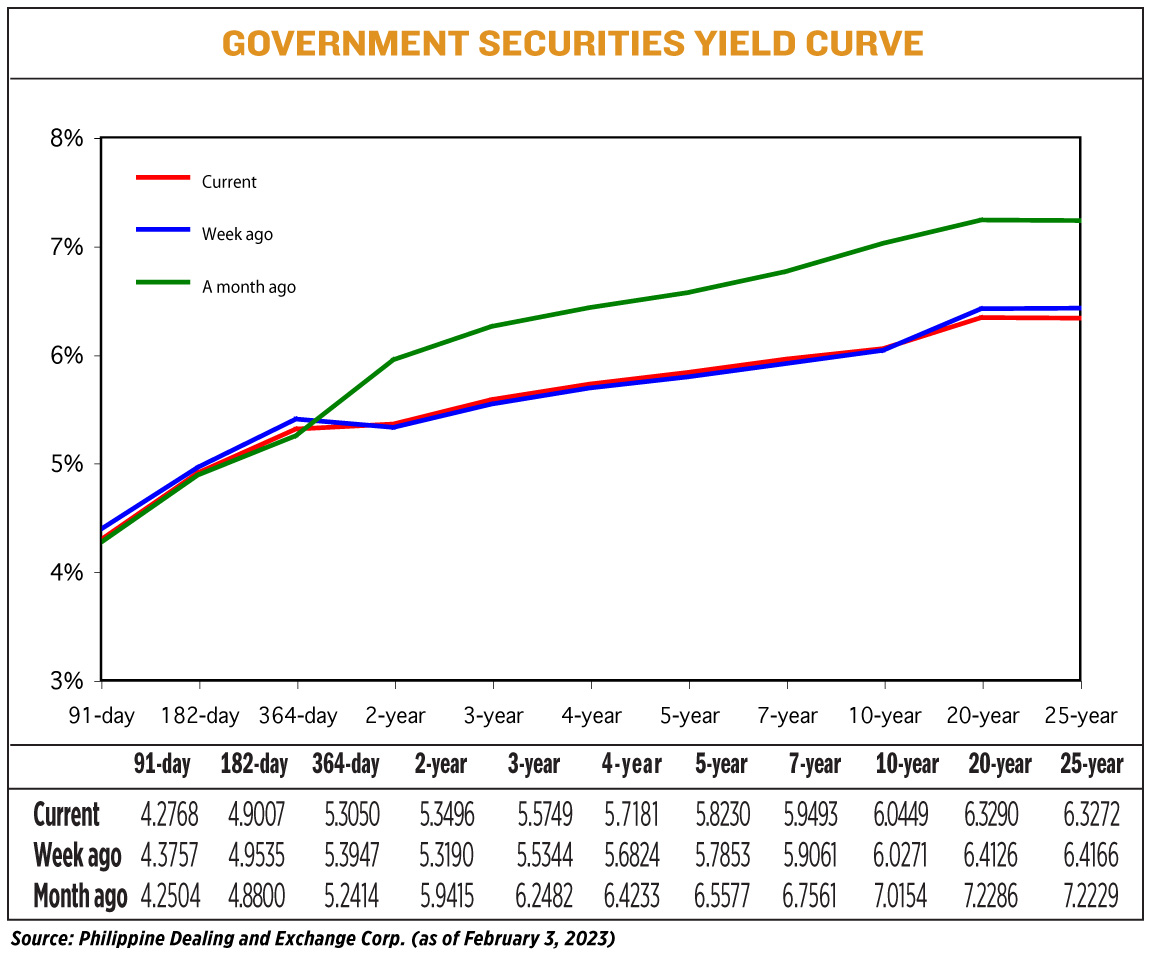
GS yields at the secondary market went down by 1.90 basis points (bps) on average week on week, based on the PHP Bloomberg Valuation (BVAL) Service Reference Rates as of Feb. 3 published on the Philippine Dealing System’s website.

Rates of the short-dated Treasury bills (T-bills) fell last week. Yields on the 91-, 182-, and 364-day T-bills dropped 9.89 bps (to 4.2768%), 5.28 bps (4.9007%), and 8.97 bps (5.305%), respectively.

However, yields on the belly of the curve rose, with the two-, three- four- five, and seven-year bonds gaining 3.06 bps (5.3496%), 4.05 bps (5.5749%), 3.57 bps (5.7181%), 3.77 bps (5.823%), and 4.32 bps (5.9493%), respectively.

Meanwhile, papers at the long end saw mixed results as the rate of the 10-year paper rose 1.78 bps to 6.0449%, while that of the 20- and 25-year debt fell 8.36 bps (6.329%) and 8.94 bps (6.3272%), respectively.

Total GS volume traded reached P9.068 billion on Friday, 6.3% higher than the P8.531 billion on Jan. 27.

ATRAM Trust Corp. Head of Fixed Income Jose Miguel B. Liboro said overall market sentiment was driven by the Fed’s policy rate hike last week, which was anticipated by traders.

“Softer economic data out of the US over the last few weeks had already caused market estimates to shift towards a consensus of the 25-bp rate hike from the Fed. The in-line event and more dovish tone caused a continuation of the recent rally in both global bonds and equities,” Mr. Liboro said in an e-mail.

The US central bank last week raised its federal funds rate by 25 bps to a 4.5% to 4.75% range, bringing total hikes since March 2022 to 450 bps.

The move was a step down from the 50-bp hike it delivered in December 2022, which came after four consecutive 75-bp increases as the Fed sought to bring down inflation.

Investors took a dovish cue from remarks by Fed Chair Jerome H. Powell after the meeting as he acknowledged that inflation was starting to ease, although he also said it is still unclear how high rates still need to go.

The Fed statement also indicated that future increases would be in 25-bp increments.

Meanwhile, a bond trader said in a Viber message that market activity last week was relatively quiet compared with the previous one.

“[This] resulted in firmer bids for the GS market, although bonds have been rallying for weeks even before the [Fed] meeting,” the trader said.

The bond trader added that the RTB offering announced by the Treasury last week also affected trading.

The Treasury announced on Friday that it will offer 5.5-year fixed-rate RTBs and is looking to raise at least P30 billion, with the rate-setting auction to be held on Feb. 7.

The offer period is scheduled to end on Feb. 17, unless adjusted by the government. The offering also includes a swap option for some bonds maturing this year.

For this week, Mr. Liboro said even if the January headline inflation print, which will be released on Tuesday, comes in above 8%, investors are “looking forward and largely expect a consistent decline in headline inflation towards yearend,” which will continue to fuel the bond-buying momentum seen recently.

“Buying momentum will remain strong, with investors hoping to participate in a 5-year RTB, which is likely to price at 6% or just below it,” Mr. Liboro added.

The bond trader said yields could be “steady with an upward bias” as inflation likely remained elevated last month. — Ana Olivia A. Tirona

Western US states struggle to allocate dwindling water

REUTERS

SEATTLE — The Colorado River, which provides drinking water to 40 million people in seven US states, is drying up, straining a water distribution pact amid the worst drought in 12 centuries, exacerbated by climate change.

California split from the six states of Arizona, Colorado, Nevada, New Mexico, Utah and Wyoming on Tuesday in the face of a US government deadline to negotiate their own supply cuts or face possible mandatory cutbacks by the federal government.

“What happened today was a step forward,” said Kevin Moran, a water policy specialist at the Environmental Defense Fund. “Six of the seven basin states are playing catch-up to reduce water use from the Colorado River, which is absolutely critically needed after 20 years of drought and the impacts of climate change,” Mr. Moran told Reuters.

When the states struck their agreement 100 years ago, it envisaged the river could provide 20 million acre-feet of water a year. An acre-foot (1,233 cubic meters) of water is generally considered enough to supply two urban households per year.

But over the last two decades, the actual flow has dwindled to 12.5 million acre-feet on average, leaving state water managers with more rights on paper than existing supply.

California receives the largest allotment, 80% of which is consumed by its $50-billion agricultural industry. Many experts see its decision to sit out the agreement as fueling the chances that the water fight will end up in the nation’s highest courts.

“We have a situation where some of the water rights holders in California are saying, ‘We’re not willing to give up more water, and we think we have legal rights and we’re willing to go to court if we have to’,” said David Hayes, a lecturer at Stanford University Law School.

“And there’s not enough time to litigate these issues,” added Mr. Hayes, a former top climate aide to President Joe Biden. He saw a need for drastic conservation efforts to protect reservoirs from overuse and drought worsened by climate change, a situation that if left unchecked could threaten supply from the Hoover Dam to the city of Las Vegas or California.

Although California was deluged for weeks from late in December by seven atmospheric rivers that dumped up to 30 inches (76 cm) of rain over some areas, little of that reached the Colorado River basin.

Despite predictions for more such atmospheric rivers, of growing size and frequency, California cannot solve its long-term crisis without major investments to capture more storm water, restore flood plains and recycle wastewater.

A report in the journal Nature last year found 2000-2021 to be the driest 22-year period for southwestern North America in at least 1,200 years.

“Something will have to give,” said Sharon Megdal, director of the University of Arizona’s Water Resources Research Center, as temperatures rise, mountain snows melt faster in spring, and the state lacks capacity to store the runoff.

A letter signed by the six states showed they all recognized the need for a change in operating procedures for the Colorado River and deliveries from it, she added.

“I think people would like to believe that we can somehow figure out a way to keep these economic activities, keep our kind of economies and livelihoods, going,” Ms. Megdal said. “But it’s going to be a drier future.” — Reuters

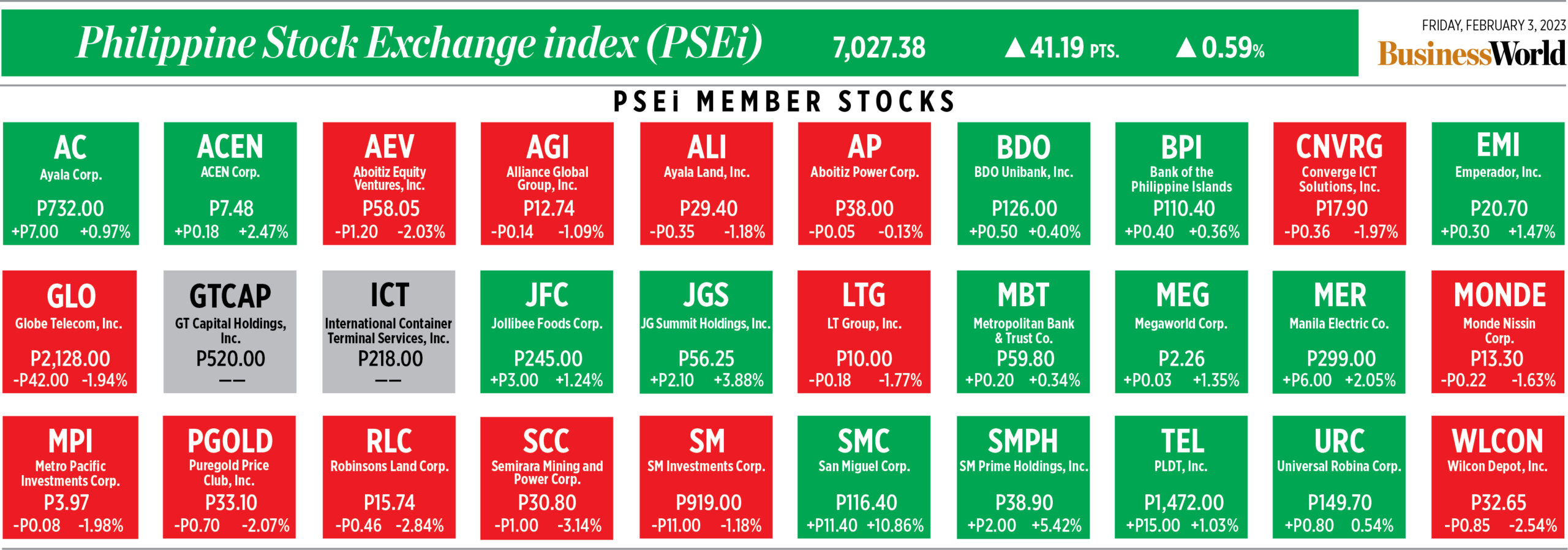
How PSEi member stocks performed — February 3, 2023

Here’s a quick glance at how PSEi stocks fared on Friday, February 3, 2023.


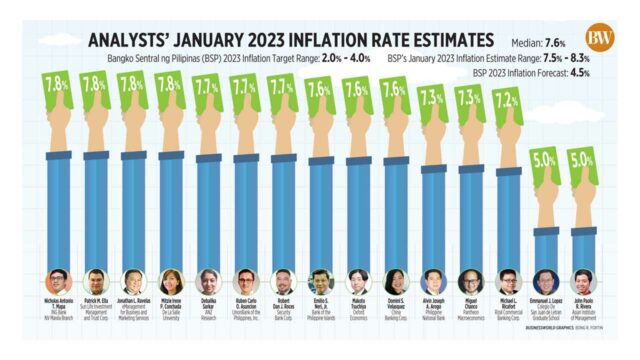
Analysts’ January 2023 inflation rate estimates

HEADLINE INFLATION likely cooled in January as weaker demand, the peso’s appreciation against the US dollar, and slower growth in food prices offset the rise in utility rates and pump prices. Read the full story.

Analysts’ January 2023 inflation rate estimates

PSEi to move sideways ahead of inflation report

BW FILE PHOTO

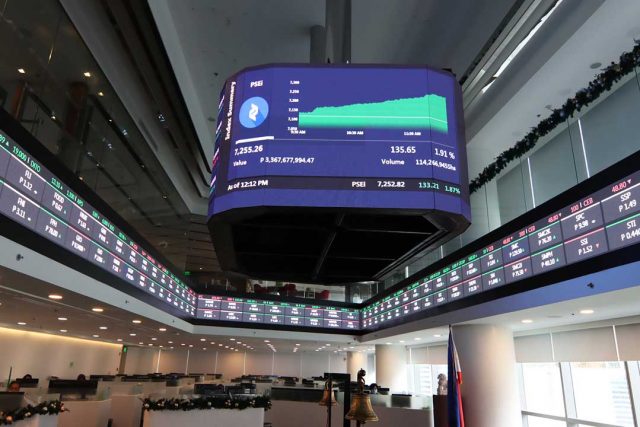
THE MAIN INDEX will continue to test the 7,000 level ahead of the release of January inflation data this week, which could set the tone for the Bangko Sentral ng Pilipinas’ (BSP) policy move this month.

The benchmark Philippine Stock Exchange index (PSEi) went up by 41.19 points or 0.59% to close at 7,027.38 on Friday, while the broader all shares index added 21.68 points or 0.58% to end at 3,705.46.

Week on week, however, the PSEi went down by 24.78 points or 0.35% from 7,052.16 on Jan. 20.

“With the lack of a strong catalyst and the lingering economic concerns, the local market is having a hard time getting past its 7,000-7,100-resistance range,” Philstocks Financial, Inc. Senior Research Analyst Japhet Louis O. Tantiangco said in a Viber message.

“The local bourse stationed within the 7,000 level, as bulls managed to recoup early week losses following a more comfortable US Federal Reserve rate hike. After falling by 311 points, the PSEi managed to slightly recover by 24 points to close at 7,027,” online brokerage 2TradeAsia.com said in a market note.

The US central bank last week raised its federal funds rate by 25 basis points (bps) to a 4.5% to 4.75% range, bringing total hikes since March 2022 to 450 bps.

For this week, Mr. Tantiangco and 2TradeAsia.com expect trading at the stock market to be driven by the January consumer price index (CPI) data, which will be released by the Philippine Statistics Authority on Feb. 7, Tuesday.

“The country’s CPI data may have a big impact on [this] week’s trading as inflation remains a key risk to the local economy’s growth outlook,” Mr. Tantiangco said.

“An inflation rate near the upper end of the BSP’s 7.5%-8.3% projection may pull the local bourse down, while a print biased to the lower end of the forecast may spur optimism,” he added.

2TradeAsia.com said the report will “be crucial in reading the tea leaves for BSP’s next rate move but will also reveal inflation drivers that may persist until the beginning of summer 2023 and may therefore push expectations of consumer confidence recovery later in the year.”

The online brokerage also expects the release of more fourth quarter financial reports to affect sentiment.

A poll of 15 economists conducted by BusinessWorld last week yielded a median estimate of 7.6% for January headline inflation, close to the lower end of the 7.5% to 8.3% forecast given by the BSP.

If realized, this will be slower than the 14-year high of 8.1% in December 2022 but faster than the 3% print seen in January 2022 and the central bank’s 2-4% target.

The BSP raised benchmark interest rates by 350 bps in 2022, bringing its key rate to 5.5%. It will hold its first policy meeting for the year on Feb. 16.

Mr. Tantiangco placed the PSEi’s support at its 10-day exponential moving average and resistance at 7,000 to 7,100, while 2TradeAsia.com put support at 6,800 to 6,900 and resistance at 7,200. — Justine Irish D. Tabile

Peso may climb further vs dollar on dovish Fed, retail bond offer

BW FILE PHOTO

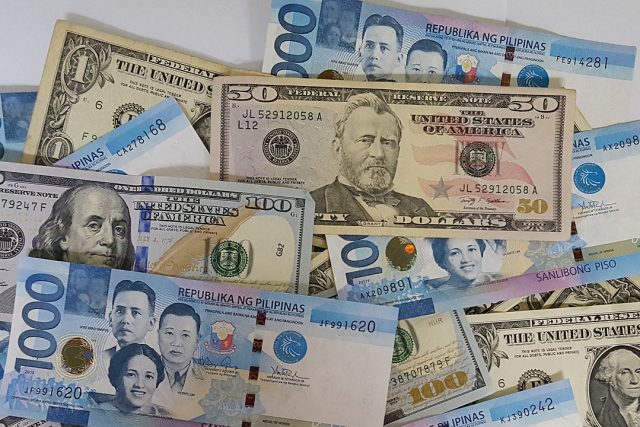
THE PESO may strengthen this week after the US Federal Reserve delivered a smaller rate hike and with the government set to begin its retail Treasury bond (RTB) offer.

The local unit closed at P53.68 a dollar on Friday, strengthening by 16.50 centavos from its P53.845 finish on Thursday, data from the Bankers Association of the Philippines’ website showed.

Week on week, the peso also climbed by 79 centavos from its P54.47 finish on Jan. 27.

The peso opened Friday’s session at P53.93 per dollar, which was also its weakest showing of the day. Its intraday best was at P53.63 against the greenback.

Dollars exchanged went down to $1.165 billion on Friday from $1.62 billion on Thursday.

The peso rose on Friday amid lower global crude oil prices, Rizal Commercial Banking Corp. Chief Economist Michael L. Ricafort said in a Viber message.

Brent crude futures settled at $82.17 a barrel on Friday, shedding 67 cents or 0.8%, Reuters reported. West Texas Intermediate crude settled at $75.88 a barrel, down 53 cents or 0.7%.

“The peso also strengthened after the announcement of the upcoming retail Treasury bond offering on Feb. 7 that could attract some of the excess liquidity/investments from the financial system,” Mr. Ricafort added.

The Treasury announced on Friday that it is looking to raise at least P30 billion from its offer of 5.5-year retail bonds, with the rate-setting auction scheduled on Feb. 7.

The minimum investment amount for the papers is at P5,000.

The offering also includes a swap option for some bonds maturing this year.

The offer period will run until Feb. 17, with the issue date set on Feb. 22.

The government last offered peso retail bonds in September 2022, raising P162.72 billion.

Meanwhile, a trader noted that the peso was an outlier in Asia against the dollar, which could have been due to “remittance flows over the weekend and overall improved risk sentiment.”

Most Asian currencies fell against a firmer dollar on Friday as investors awaited the key US nonfarm payrolls report for further clues about the US Federal Reserve’s policy path after dovish signals from global central banks.

The dollar index was up 0.1% at 101.85, as of 0615 GMT on Friday, away from Wednesday’s nine-month low of 100.80.

For this week, UnionBank of the Philippines, Inc. Chief Economist Ruben Carlo O. Asuncion said in a report that the peso could appreciate further as the dollar’s weakness may continue in the coming days.

“Broad dollar weakness will persist on improved risk appetite backed by the market implications of the latest Federal Open Market Committee (FOMC) meeting outcome alongside the Fed Chair [Jerome H.] Powell’s acknowledgment of the inception of US disinflation,” Mr. Asuncion said.

“Rumors circulating of an RTB offer size of P400 billion with some foreign participation may support additional dollar selling momentum in the next few weeks,” he added.

The FOMC hiked borrowing costs by 25 basis points (bps) at its Jan. 31 to Feb. 1 meeting, bringing the fed funds rate to a 4.5% to 4.75% range, the highest since 2007.

The US central bank has now hiked rates by 450 bps since March 2022.

In remarks after the meeting, Mr. Powell acknowledged that inflation was starting to ease, although he also said it is still unclear how high borrowing costs still need to go to bring the average rate of price increases back within its target.

The Fed statement after the meeting also indicated that future rate increases would be in 25-bp increments.

Meanwhile, the trader said peso-dollar trading could take its cue from US labor data released on Friday.

The US Labor department reported that nonfarm payrolls increased by 517,000 jobs in January, Reuters reported.

US unemployment growth also hit a 53-and-a-half-year low of 3.4%, slower than December’s 3.5%.

However, average hourly earnings only increased by 0.3% last month, compared with 0.4% in December.

This lowered the year-on-year increase in wages to 4.4%, the smallest rise since August 2021, from 4.8% in December.

The trader expects the peso to trade between P52.50 and P54.50 against the dollar this week, while Mr. Ricafort gave a forecast range of P53.40 to P53.80. Mr. Asuncion sees the peso moving from P53.50 to P54.10. — A.M.C. Sy with Reuters