Home Blog Page 520

UK man pleads guilty in New York to $99-million wine fraud

STOCK PHOTO | Image by Wavebreakmedia_micro from Freepik

NEW YORK — A British man pleaded guilty on Tuesday in New York to involvement in a nearly $100-million fraud whose victims invested in loans meant for fictitious wealthy wine collectors whose wine also did not exist.

James Wellesley, 59, pleaded guilty to wire fraud conspiracy before US District Judge Pamela Chen in Brooklyn, court records show.

Mr. Wellesley, also known as Andrew Fuller, had pleaded not guilty to three charges including conspiracy in July. He remains jailed at Brooklyn’s Metropolitan Detention Center, after unsuccessfully fighting extradition from Britain.

A lawyer for Mr. Wellesley did not immediately respond to a request for comment.

According to his plea agreement, Mr. Wellesley could face 10 to 12-1/2 years in prison under recommended federal guidelines.

He also agreed to forfeit $1 million plus funds in more than two dozen bank accounts.

Co-defendant Stephen Burton, 61, who is also British, pleaded guilty in July to wire fraud conspiracy and money laundering conspiracy, and accepted a $26-million forfeiture order. He is also jailed in Brooklyn.

Prosecutors said Mr. Wellesley and Mr. Burton, posing as executives at London- and Hong Kong-registered Bordeaux Cellars, raised $99.4 million by promising loan investors they would receive regular interest payments from “high net worth” wine collectors.

The defendants allegedly claimed the loans were backed by an inventory of more than 25,000 bottles of wine, including from Domaine de la Romanee-Conti in Burgundy and Chateau Lafleur in Bordeaux.

Prosecutors said Bordeaux Cellars controlled far fewer bottles, and as few as 217, while the defendants used loan proceeds for personal expenses and to pay interest to some investors.

The scheme ran from June 2017 to February 2019, and collapsed when interest payments stopped, prosecutors said.

Mr. Burton’s sentencing is scheduled for Jan. 6, 2026, and Mr. Wellesley’s sentencing is on Feb. 3, court records show. — Reuters

First Gen to supply renewable energy to Mets Cold Storage

EDC HANDOUT

LOPEZ-LED First Gen Corp. has signed an agreement with Mets Cold Storage Services, Inc. (Mets) to supply renewable energy (RE) to the latter’s cold storage facility in Cagayan de Oro City.

In a media release on Wednesday, First Gen said the supply agreement covers up to 2,050 kilowatts to support the ongoing expansion of the facility, which currently has over 7,100 metric tons of cold storage capacity.

The geothermal power will be sourced from the Mt. Apo Geothermal Power Plant in Cotabato, owned and operated by Energy Development Corp., a subsidiary of First Gen.

“We are pleased to partner with First Gen to reduce the energy intensity of our cold storage operations. This move will reduce not just our energy cost but our carbon footprint as well, while providing stable power supply,” said Donna Robles, chief operating officer of Mets.

Established in 2010, Mets operates cold storage facilities in Cavite, Bulacan, Cebu, and Cagayan de Oro with over 100,000 pallet positions. The company offers various cold storage solutions, including air-conditioned storage, blast freezing, and toll processing.

“Cold storage is critical for ensuring safety and sanitation across the supply chain for food and even medicines. We are committed to partnering with Mets to ensure they can power their cold storage operations sustainably with a steady supply of RE,” said Arlene Sy-Soriano, assistant vice-president and head of sales and engagement at First Gen.

First Gen has a total geothermal capacity of 1,200 megawatts (MW). Its RE portfolio also includes hydro, wind, and solar projects with a combined installed capacity of over 400 MW.

In partnership with Prime Infrastructure Capital, Inc., First Gen also operates four gas-fired power plants with a total capacity of 2,017 MW. — Sheldeen Joy Talavera

The two years of fighting since Oct. 7 have transformed the Middle East

PALESTINIANS gather to receive food cooked by a charity kitchen in Khan Younis, Gaza Strip, in the midst of the Gaza-Israel conflict, on Dec. 1, 2024. — REUTERS/MAJDI FATHI/NURPHOTO

The morning of Oct. 7, 2023, set in process a series of events which have profoundly changed the Middle East.

At the beginning of that month, the region looked very different to today. Saudi Arabia appeared ready to normalize with Israel, having recently set aside longstanding differences with Iran.

With the normalization of relations between the region’s two preeminent military powers would come the possibility of curbing Iran’s influence. This, in turn, could bring peace to Yemen and Lebanon.

But thanks to the events of that day, this vision is in tatters. As the sun rose, Hamas fighters launched a brutal terror attack in southern Israel, killing 1,195 people and taking a further 251 hostages. The attack opened up a wound at the heart of the Israeli psyche, evoking memories of the Holocaust and of repeated terror attacks across the 2000s.

In the past two years, the destructive reverberations have been felt across the entire Middle East as Israeli forces have sought to assert unilateral and hegemonic dominance. Beyond Gaza, Israel has engaged in military strikes across the region, causing thousands of deaths and widespread destruction and sowing the seeds of division.

GET OUR NEWSLETTER
In Lebanon, Israeli strikes on Beirut and across the south led to more than 3,100 deaths — including senior Hezbollah leaders such as Hassan Nasrallah. The Israel Defense Forces (IDF) launched a military campaign in southern Lebanon in October 2024, pushing Hezbollah fighters north of the Litani river. Though a ceasefire was reached on Nov. 26, Israel’s bombardment of Lebanon continues, with the Israeli government citing Hezbollah’s refusal to disarm.

With Hamas and Hezbollah on the ropes, Netanyahu’s attention turned to Iran. Given Israel’s longstanding view of the Islamic Republic as an imminent threat to Israel’s security, this is hardly surprising.

The so-called shadow war that had taken place between the two states across the previous decade erupted. The outbreak of open conflict between the two states on June 13, 2025 — since dubbed the 12-day war — had a devastating impact on the Iranian regime.

Netanyahu had called for the Iranian people to overthrow the Islamic Republic. But while many Iranians are unhappy with the regime, Israel’s strikes appeared to have the opposite effect as people rallied around the flag.

Hostilities culminated in bombing raids launched by the US on Iran’s nuclear installations. While the success of these raids has been open to question, the raids allowed the US president, Donald Trump, to claim a US victory.

He demanded an end to hostilities between Israel and Iran and Iran’s retaliation to the US strikes was confined to a carefully orchestrated attack on a US base in Qatar, which was telegraphed in advance and was more performative than escalatory.

Israel has also conducted regular strikes against the Iran-backed Houthi rebels in Yemen, which had targeted Israeli (and other countries’) shipping in the Red Sea. And since the fall of the Assad regime, the Israeli military has occupied large tracts of southern Syria, seizing the demilitarized buffer zone around the contested Golan Heights in violation of a 1974 treaty between the two countries.

More recently, Israel struck targets in Doha, Qatar, in an effort to assassinate senior Hamas leaders which ultimately failed. The strike prompted a united front from the Gulf monarchies who called for a real discussion about ending the war. With US officials furious at the Israeli strike on a major non-Nato ally, diplomats sensed an opportunity for a breakthrough.

PEACE PLAN
Donald Trump’s 20-point plan to enact a ceasefire has the potential to be an impressive feat of diplomacy, bringing together a wide range of disparate actors with a real chance of ending the fighting — despite its multiple flaws. But as a feat of peace building, it rings hollow.

The plan does not indicate how a Palestinian state will emerge. It does suggest that the Palestinian Authority will, in the right circumstances, play a role in the governance of Gaza — but this is something that Netanyahu has repeatedly rejected.

Instead, the Gaza International Transition Authority will resemble a mandate of the sort imposed by the League of Nations over a century ago. And even if Trump’s plan brings about a ceasefire and the release of the Israeli hostages, the contours of regional order have been dramatically affected.

Without a Palestinian state there can be no Saudi normalization with Israel. This is a point that Saudi crown prince, Mohammad bin Salman, has made abundantly clear.

Popular anger across the region will remain. The failure to secure a viable Palestinian state after the Abraham accords provoked anger and resentment among some. That feeling is now growing with the death and destruction meted out to people in Gaza.

If a ceasefire doesn’t emerge, the destruction of Gaza will continue at a pace which will continue to have a catastrophic impact across the Middle East. Israel will remain diplomatically isolated while its citizens will continue to live in fear of Houthi and Hezbollah rockets or attacks from what remains of Hamas, as well as having to deal with the memory of Oct. 7 for years to come.

All the while, Palestinians continue to die on a daily basis and there are still Israeli hostages (and in some cases bodies) waiting to be brought home. Gaza is devastated and rebuilding the enclave will take decades. And the so-called international rules-based order may never recover.

THE CONVERSATION VIA REUTERS CONNECT

Simon Mabon is a professor of International Relations at Lancaster University. He receives funding from Carnegie Corp. of New York and The Henry Luce Foundation.

Singapore vs Philippines in startup funding: lessons for fintech growth

AUSTIN DISTEL-UNSPLASH

By Joey Brillantes

THE FIRST HALF of 2025 laid bare the stark divergence in startup funding fortunes between Singapore and the Philippines, especially in the fintech sector. Singapore captured a dominating 92% share of Southeast Asia’s startup funding, attracting approximately $1.04 billion in financial technology (fintech) investments alone, while the Philippines garnered a fraction of that despite its growing digital economy. What lessons can the Philippines draw from Singapore’s success, and what concrete measures must it take to bridge this widening investment gap?

WHAT SINGAPORE IS DOING RIGHT
Singapore’s fintech ascendancy is no accident. It is the result of a mature, sophisticated ecosystem that blends strong government support, deep capital markets, world-class infrastructure, and regulatory foresight. The country’s focus on cultivating late-stage startups with solid fundamentals appeals to cautious investors seeking capital-efficient, scalable businesses. Areas like payments, cryptocurrency, and artificial intelligence (AI)/machine learning (ML) fintech verticals have attracted the bulk of this investment, supported by consistent regulatory clarity and institutional initiatives.

Furthermore, Singapore’s strategic push to become a regional hub for enterprise infrastructure startups has bolstered its ability to attract substantial capital inflows. The Monetary Authority of Singapore’s proactive regulatory sandboxes and digital banking licenses have nurtured innovation while ensuring investor confidence and consumer protection. The presence of numerous venture capital funds and global investors accelerates deal flow and follow-on funding.

WHAT THE PHILIPPINES IS MISSING
The Philippines, despite its rapid digitalization and vibrant startup culture, still lags due to a less mature investment ecosystem and regulatory uncertainties. While fintech remains the most active sector domestically, attracting significant deal flow, the funding quantum remains relatively small and fragmented. Challenges include limited late-stage funding options, less accessible venture capital, and regulatory frameworks that are evolving but still perceived as less predictable compared to Singapore.

Infrastructure gaps and lower institutional support for scaling startups also limit the Philippines’ ability to cultivate fintech firms that can compete regionally. The country’s fintech landscape is largely dominated by payments-focused startups, but it lacks sizable investments in emerging verticals like AI/ML or crypto that are gaining investor attention elsewhere.

Here are some steps the Philippines can take to level up:

1. Enhance regulatory clarity and innovation-friendly policies — The Bangko Sentral ng Pilipinas and other regulators must continue to develop clear, consistent fintech regulations, including improving sandbox initiatives that balance innovation with risk management. Simplifying licensing and compliance for fintech startups will reduce barriers to growth.

2. Expand late-stage funding channels — The Philippines should cultivate deeper pools of venture capital and private equity specifically oriented toward late-stage fintech investments to support startups in scaling confidently. Encouraging institutional investors and global funds to participate via incentives or matching schemes can increase deal size and valuation.

3. Strengthen startup infrastructure and ecosystem support — Building world-class innovation hubs, accelerator programs, and talent pipelines focused on fintech domains like AI, regulatory tech, and blockchain is key. The government and private sector partnerships can fund capacity building and encourage corporate-fintech collaboration.

4. Promote strategic partnerships and regional integration — Filipino fintechs should be encouraged to form cross-border alliances within ASEAN and beyond, tapping into larger markets and investor networks. ASEAN fintech collaboration frameworks supported by government agencies can facilitate such scaling efforts.

5. Focus on high-impact verticals — Beyond payments, Filipino fintech startups should diversify into emerging areas like digital lending, wealth tech, and cybersecurity solutions, aligning with global investor interests in AI-enabled financial services and sustainable fintech.

Singapore’s triumph in dominating Southeast Asia fintech funding in the first half of 2025 sends a clear message: strategic ecosystem building, investor confidence through transparency, and targeted innovation make all the difference. The Philippines, with its large population and increasing digital adoption, holds immense potential.

By addressing regulatory bottlenecks, expanding capital access, and intentionally investing in scalable fintech innovation, the country can elevate its position and attract the meaningful investments key to driving inclusive financial digital transformation.


Joey Brillantes is the founder and managing partner of public relations and digital marketing agency Integral Public Relations, Inc. The individuals, brands, nations, companies, organizations, agencies, and institutions mentioned in this commentary have no business relationship with his agency, nor are they competitors of its clients.

BSP to pause rate cut cycle this week as it seeks clearer economic picture

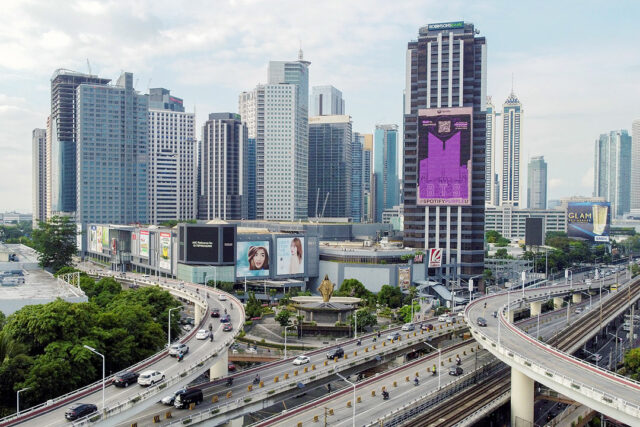
AN AERIAL VIEW shows the Ortigas business district in Pasig City, June 10, 2022. — REUTERS

THE BANGKO SENTRAL ng Pilipinas (BSP) could pause its easing cycle anew at this week’s meeting even as September inflation was below market expectations as it will likely want to see more data to assess the overall economic picture, analysts said.

However, risks to the country’s growth outlook due to the fragile global environment could lead to a cut at the Monetary Board’s December meeting.

“We think September inflation sets the stage for a quarter-point rate cut in 4Q 2025 to 4.75%,” Aris D. Dacanay, HSBC economist for Association of Southeast Asian Nations, said in an e-mailed note. “We think this cut will happen in December this year, and not the upcoming meeting on Thursday.”

“Though, admittedly, the downside surprise in inflation increases the risk that the BSP frontloads its rate cut, we still think the central bank would like to see more data on growth and rice prices before deciding to continue its easing cycle,” he said, adding that further policy easing is also possible next year, depending on the inflation picture.

Philippine headline inflation accelerated to 1.7% in September from 1.5% in August, the government reported on Tuesday.

This was the fastest clip since 1.8% in March but was below the median estimate of 1.9% in a BusinessWorld poll and within the central bank’s 1.5-2.3% forecast. It also marked the seventh straight month that inflation was below the BSP’s 2-4% annual target.

For the first nine months, inflation averaged at 1.7%, matching the central bank’s full-year forecast.

The BSP has cut rates by a total of 75 basis points (bps) so far this year, delivering three straight 25-bp reductions after a surprise pause in February due to uncertainties over the impact of the Trump administration’s trade policies on the economy.

It has now lowered benchmark borrowing costs by a total of 150 bps since kicking off this rate cut round in August 2024, with the policy rate now at 5%.

BSP Governor Eli M. Remolona, Jr. earlier said the current key rate is now at a “sweet spot” for both inflation and output, but one more reduction is possible within the year to support the economy if needed, which would likely mark the end of the rate cut cycle.

Citi Research likewise expects the central bank to pause on Thursday as it seeks clarity on the economic outlook.

“With regard to policy rates, our view is that growth concerns could eventually resurface, leading to a cut before the end of the year. However, as economic data is so far mixed, BSP will probably pause in the October meeting,” it said in a note.

It expects inflation to rise further and be within the 2-4% target band next year as rice deflation wears off.

Bank of the Philippine Islands Lead Economist Emilio S. Neri, Jr. said the BSP may take a more cautious stance as inflation is expected to quicken further in the near term.

“With inflation likely to pick up in the coming months, the pace of monetary easing may slow down. A more conservative approach is justified as cutting rates aggressively could leave the economy vulnerable to inflation shocks that might force a sharp policy reversal later on,” he said in a note.

He added that the BSP could still deliver one more cut this year, which would likely depend on the third-quarter gross domestic product data that will be released next month. He also sees space for further easing next year.

“The BSP may cut its rates further in 2026 if growth loses momentum, most likely in the first half before inflationary pressures build in the latter part of the year,” Mr. Neri said.

Deutsche Bank Research also said that the weakening economic outlook gives the central bank room for a 25-bp cut in December.

“Despite October’s policy pause, we believe BSP still has room for further easing as downside risks have not faded; we forecast a 25-bp rate cut in its December meeting,” it said in a report.

“Real interest rates are still elevated and the economy is at ‘slightly negative output gap over the near term,’ while government disbursements could slow amid its ongoing fiscal consolidation, and more recently, a corruption probe,” it added, quoting the BSP’s assessment of the economy in its August Monetary Policy report.

Meanwhile, Pantheon Macroeconomics trimmed its inflation estimate for this year to 1.7% from 1.8% and to 2.4% from 3% previously for 2026.

“Crucially, food prices are heading into next year with little to no real momentum,” it said in a report. “Retail rice prices have yet to show any upside, in spite of the temporary suspension of imports that began last month, suggesting ample supply domestically.” — Katherine K. Chan


France trims wine output estimate after summer heatwave

STOCK PHOTO | Image by Ededchechine from Freepik

PARIS — France’s farm ministry lowered its projection for this year’s wine output on Tuesday to 36 million hectoliters, down from the 37.4 million forecast last month and 1% below last year’s harvest, citing a heatwave in August.

The revised forecast, based on the latest harvest results, was 16% below the five-year average.

“The grape harvest, now almost complete, confirms the adverse effects of the August heatwave on production potential in most regions,” the ministry said.

The hot and dry weather reduced production potential, accelerating grape ripening while limiting their growth, which late September rains failed to offset, the ministry said.

France is the world’s second-largest wine producer after Italy and the first exporter by value. Its wine output has been hit by adverse weather in the last two years while surplus management policies have prompted winemakers to uproot a portion of their vineyards.

Champagne production is expected to rise 14% year on year to 2.1 million hectoliters, though it remains 10% below the five-year average. Producers said the harvest showed good quality.

In contrast, Charentes, a key area for Cognac production, is expected to see output fall 2% compared to last year, putting it 23% below average.

Bordeaux and Languedoc-Roussillon, both major wine regions, are forecast to see output declines of 2% and 9% respectively from last year, remaining well below their five-year averages.

Burgundy was better off, but neighboring Beaujolais saw vineyard yields fall to their lowest level in at least 35 years due to bad weather and fungal disease.

The Loire Valley, meanwhile, is expected to increase production by 15% to 2.4 million hectoliters, narrowing the gap with its five-year average.

Conversely, output in Alsace is set to fall 9% year on year, 17% below its average.

A hectoliter is the equivalent of 100 liters, or 133 standard wine bottles. — Reuters

SM Hotels eyes composting 80% of food waste by 2040

A BUFFET SPREAD at Taal Vista Hotel reminds diners to ‘Take only what you can eat,’ part of SMHCC’s Plate for the Planet initiative that reduces food waste and promotes sustainable dining practices. — SM HOTELS AND CONVENTION CORP.

SM HOTELS and Conventions Corp. (SMHCC), the hospitality arm of property developer SM Prime Holdings, Inc., aims to compost 80% of its food waste by 2040 as part of its push for sustainable dining across its properties.

“[The] strategy also includes expanding partnerships with local producers and MSMEs (micro, small, and medium enterprises) to promote inclusive sourcing and integrating more local produce into menus,” it said in a statement on Wednesday.

The goal aligns with the company’s “Plate for the Planet” initiative, which incorporates circular economy principles into daily hotel operations.

The program tracks food use from sourcing to serving through green procurement, support for MSMEs and local farmers, showcasing heritage and regional cuisine, encouraging responsible consumption, reducing plastic use, and managing food waste efficiently.

Since the initiative’s launch in 2019, SMHCC has diverted 323 tons of food waste — equivalent to the amount of waste produced by more than 500 Filipino households in a year, the company said.

The program was first implemented at Pico Sands Hotel in Batangas and Taal Vista Hotel in Cavite.

It now operates across 10 hotel properties and three convention centers.

SMHCC sites participating in the program include Taal Vista Hotel, Pico de Loro Beach and Country Club, Pico Sands Hotel, Radisson Blu Cebu, Conrad Manila, Park Inn by Radisson branches in North EDSA, Clark, Davao, Iloilo, and Bacolod, as well as Lanson Place Mall of Asia, SMX Convention Center Manila, SMX Aura, and Megatrade Hall.

The company said SMHCC kitchens practice accurate forecasting, mindful production, and cooking techniques to reduce waste and maintain food freshness.

It added that food waste is converted into soil-enriching material used to grow vegetables, herbs, and fruits.

In the second quarter, SM Prime’s net income rose by 10% to P12.8 billion. Hotels and convention centers accounted for 3% of total income, contributing P635 million, up 20% from P527 million, driven by strong room bookings and higher demand from the meetings, incentives, conferences, and exhibitions (MICE) market.

SM Prime shares closed flat at P22.80 apiece on Wednesday. — Beatriz Marie D. Cruz

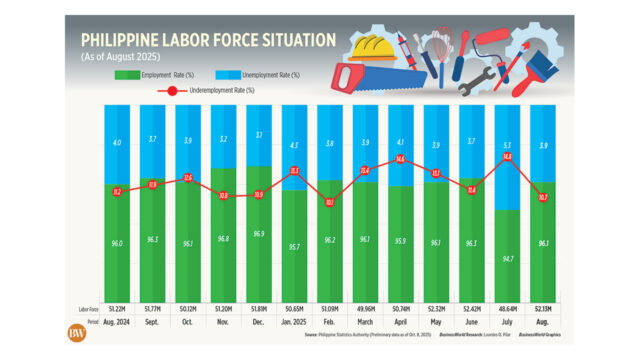
Philippine Labor Force Situation

THE PHILIPPINES’ unemployment rate dropped to 3.9% in August, driven by renewed hiring in the agriculture and construction sectors, the Philippine Statistics Authority (PSA) reported on Wednesday. Read the full story.

Philippine Labor Force Situation

Background music

FREEPIK

By Tony Samson

WHATEVER happened to background music in public places? Does one even notice it in the malls or restaurants? (Is piped-in music still there?) When waiting for the order to be served, can you notice French songs being played in this Chinese restaurant? Of course, when the sound is too loud, elderly customers ask for it to be turned down — I can’t hear myself think.

Dentists’ waiting rooms and elevators used to feature piped-in music of soothing instrumental renditions of popular tunes. The familiar melodies were intended to lull passengers through an elevator ride or distract patients from the muffled drilling sound of root canal work inside the dentist’s clinic while waiting for their turn. (Is that melody from “Camelot”?)

Movies feature background music to set the mood of a scene. Horror movies employ the crashing organ sound, or the squeaky violin when the sleeping child-sized doll suddenly opens its eyes. Of course, movie musicals present the songs front and center.

Does life also provide background music for the highs and lows of getting through the day?

Neither happy moments nor personal crises merit any musical accompaniment. Can you hear jaunty rock music in the background when you find out a newly subscribed IPO just took a dive on its second day of trading? What about a drumroll when an acquaintance from the past pops up at a mall — Are you still working?

Is a karaoke revelry considered part of life’s musical interludes? Maybe less popular now than they used to be, karaoke parties still pop up as bonding moments. One can rub elbows (or other bodily parts) with a seatmate while belting a song. A loud rendition of that favorite karaoke piece “My Way” can accompany a milestone in life. (But then again, too few to mention.)

Music keeps us company through the day. It’s not just those using phones and wireless ear plugs as permanent bodily attachments that enjoy melodies through streaming. (Are you texting me?)

Certain establishments have common sounds. The spas may have conspired together on the background cubicle sound in their premises that should be as liberally spread as oil on one’s back.

Is there a streaming app employed by massage parlors? (We also do foot massage.) The featured sounds have a slow beat, featuring a single instrument, maybe a nose flute or a two-stringed harpsichord. Mixed in with the tuneless melodies are forest sounds of raindrops hitting large leaves, cicadas crying for understanding, a breeze passing through bamboo poles, and the mating sounds of humpbacked whales in heat. It’s supposed to be enjoyed with both eyes closed. (Go a little lower please.)

Tuneless audio or “white noise” is unobtrusive. Intimate dining places can employ such background sounds to allow conversation to flow freely. The quiet clatter of plates and eating utensils have also been adopted by dining places that feature “degustation” meals — don’t ask for the menu. Small servings of whatever is on hand are serially offered, usually with wine. (These are fisheyes marinated in olive oil.)

Also known as ambient music, this hybrid of jazz, electronic, acoustic, new age, and percussion is not intended to be hummed. It is interchangeable and invites many levels of listening. This may be used by big spaces like theater lobbies featuring a fireside chat to take place in 15 minutes.

Offices that once featured piped-in music to increase productivity in assembling computer chips seem to now avoid any kind of melodic interruption. If the executives want to accompany their keystrokes in the computer, they must stream their own tunes that do not intrude on other cubicles. That’s what the headphones are for. It is not unusual to see heads keeping time to some unheard beat.

Sleep doctors (as differentiated from sleepy ones) may suggest that those suffering from sleep apnea or insomnia avail themselves of white noise machines to lull them to a “Rapid Eye Movement” (REM) type of deep slumber. Such murmuring sounds may include the quiet snoring of a spouse beside the insomniac. Dreams will occur even though one forgets them upon waking.

Perhaps the background music of life should be natural sounds like wind across the trees, as well as human conversation. At night, it’s the hum of the air-conditioning, the buzz of a mosquito, and the alarm clock ringing. Or just a short gasp…followed by silence


Tony Samson is chairman and CEO of TOUCH xda

ar.samson@yahoo.com

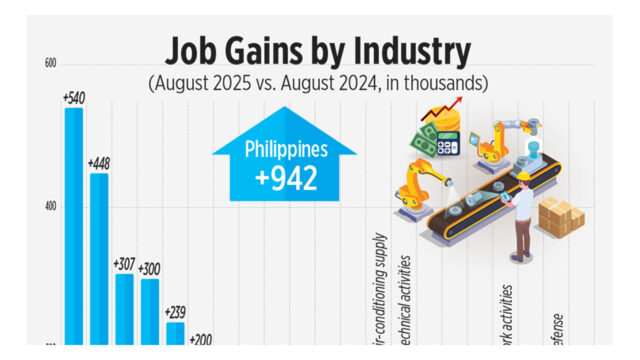
Job Gains by Industry

THE PHILIPPINES’ unemployment rate dropped to 3.9% in August, driven by renewed hiring in the agriculture and construction sectors, the Philippine Statistics Authority (PSA) reported on Wednesday. Read the full story.

251009Gainers_Industry

251009Gainers_Industry

Peso returns to P57-a-dollar level as market awaits BSP’s policy decision

BW FILE PHOTO

THE PESO climbed back to the P57-per-dollar level on Wednesday as the market looked ahead to the Bangko Sentral ng Pilipinas’ (BSP) policy meeting.

The local unit closed at P57.95 versus the greenback, jumping by 15 centavos from its P58.10 finish on Tuesday, Bankers Association of the Philippines data showed.

The peso opened Wednesday’s session weaker at P58.205 versus the dollar. Its intraday best was at P57.93, while its worst showing was at P58.23 against the greenback.

Dollars exchanged jumped to $2.03 billion on Wednesday from $1.34 billion on Tuesday.

“The pair closed lower on lower-than-expected local unemployment data and bets that the BSP will hold its monetary policy tomorrow, further strengthening the peso,” a trader said in a phone interview.

The Philippines’ unemployment rate dropped to 3.9% in August from 5.3% in July, the Philippine Statistics Authority reported on Wednesday.

The number of jobless Filipinos fell to 2.03 million from 2.59 million in July and 2.07 million a year earlier.

Year to date, the unemployment rate in the Philippines was at 4.1%,

Meanwhile, 10 of the 16 analysts in a BusinessWorld poll expect the central bank to pause at its policy meeting on Thursday (Oct. 9), while the remaining six said a fourth consecutive 25-basis-point (bp) reduction could be made to support growth.

The BSP has lowered benchmark borrowing costs by a cumulative 150 bps since it began its easing cycle in August 2024, bringing the policy rate to 5%. Analysts widely expect another 25-bp cut before yearend following hints from the BSP chief but remain divided over the timing.

The peso was also supported by markets’ anticipation of the seasonal increase in remittances as the holidays draw near, Rizal Commercial Banking Corp. Chief Economist Michael L. Ricafort said in a Viber message.

For Thursday, both Mr. Ricafort and the trader see the peso moving between P57.80 and P58.10 per dollar. — A.M.C. Sy

Dining In/Out (10/09/25)


Hilton celebrates Oktoberfest

OKTOBERFEST 2025 is in full swing, and Newport World Resorts is transforming the Hilton Manila into a Bavarian haven from Oct. 8 to 11. The fest promises four nights of overflowing Weihenstephan beer, live performances by Austria’s AnTon Showband, and a grand Bavarian buffet prepared by the culinary team of Newport World Resorts. Begin the night with a plate full of Bavarian flavors — pretzels, sausages, schnitzel, pork knuckle, and Spaetzle. Beer from Weihenstephan, the world’s oldest brewery, carries a fuller body and stronger kick than most local brews. Tickets are available at P5,500 net for one chosen date between Oct. 8 and 11 through newportworldresorts.com/oktoberfest-2025.


Finestra, Yakumi hold 4-hands dinner at Solaire North

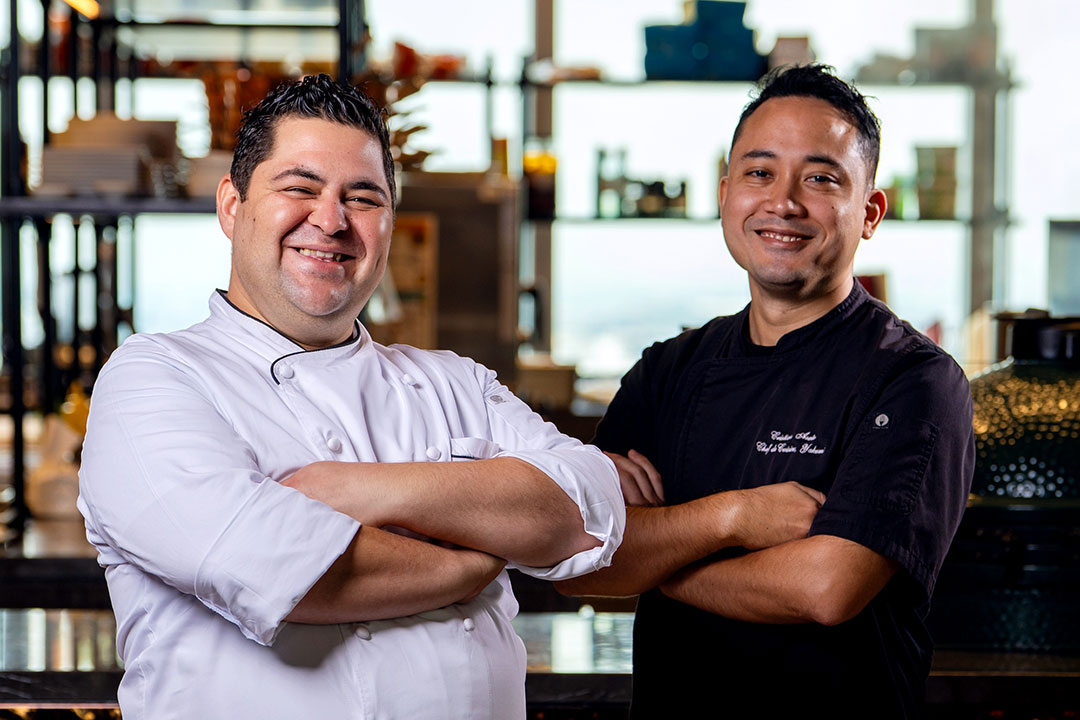
TWO of Solaire Resort North’s dining destinations, Finestra and Yakumi, join forces for the first time in a one-night-only, four-hands dinner titled “The Code of Umami,”which will take place on Oct. 17 at Finestra. Joel Manchia of Finestra and Cristian Asato of Yakumi will present a six-course tasting menu that brings together the soul of Italy and the precision of Japanese craftsmanship. This is priced at P4,988++ per person with an optional P1,888++ pairing of wine and sake. For bookings and inquiries, visit sn.solaireresort.com or sn.solaireresort.com/dining/finestra, call 8888-8888, or e-mail snrestaurantevents@solaireresort.com.


Chowking plays the moon fest Dice Game

CHOWKING has launched the Luck ‘N Roll Dice Game just in time for the Mid-Autumn Festival. Customers can join in two ways: in-store until Oct 12, for every purchase worth P499, diners get one roll of the dice (two rolls for P999). Depending on the results, customers can win Chowking vouchers, free treats, or special prizes on the spot. On Grab, until Oct. 21, every roll on the Grab app gives users a chance to win exclusive rewards and prizes instantly. Customers can also use these exclusive codes on the Chowking App or WebApp to for P100 off an order with a minimum spend of P499: KIMPAU100, DARREN100, KAI100, BGYO100.


Early bird offer for Manila Hotel Christmas Hampers

THE Manila Hotel has unveiled its Christmas Hampers and has an Early Bird offer of up to 30% off on the hampers until Nov. 15. The Deluxe Hamper is available at P3,104 net from the regular P3,880 net. Inside are Food for the Gods, fruitcake, Christmas cookies, dark chocolate Postcard, Christmas chocolate balls, and a bottle of red wine. The Premium Hamper is offered at P5,516 net from the regular P7,880 net. This set features a Regular Prestige Card, The Manila Hotel façade tote bag, The Manila Hotel tumbler, fruitcake, Christmas cookies, chocolate Santa, Christmas tree mediants, The Manila Hotel coffee drip, and a bottle of red wine. These will be available for pick-up from Nov. 20 to Jan. 5. For orders and inquiries, call 8527-0011, e-mail restaurantrsvn@themanilahotel.com, or visit www.manila-hotel.com.ph.


McDonald’s has new Sea Salt Caramel Iced Coffee

MCDONALD’S is back with another McCafé Iced Coffee flavor: McCafé Sea Salt Caramel Iced Coffee. Launched last month, it’s the latest addition to McDonald’s Philippines’ coffee lineup. McCafé’s Sea Salt Caramel Iced Coffee is available at McDonald’s stores nationwide for dine in, take out, drive-through, or ordering via McDelivery and other food delivery apps.