Home Blog Page 5148

PHL, Japan to hold air force exchanges to enhance defense cooperation

JAPAN and Philippine air force officers during a bilateral training on humanitarian assistance and disaster relief held at Clark Air Base in Pampanga in June 2022. — JAPANESE EMBASSY PHOTO

THE PHILIPPINE and Japan air forces are set to hold unit-to-unit exchanges from November 27 to December 11 to enhance bilateral defense cooperation, according to a statement released by the Japanese Embassy on Tuesday.  

Deployed units from both parties will undergo exchange programs aimed at promoting mutual understanding and defense cooperation and exchanges,it said.  

The Philippine Air Force and Japan Air Self-Defense Force will conduct the activities at the Clark Air Base in Pampanga, located north of the capital Manila.   

The embassy said Japan will deploy two F-15 fighter aircraft and send 60 personnel from their air defense command.   

The two countries air forces also held bilateral exercises on humanitarian assistance and disaster relief in July 2021 and June 2022. The program sought to improve their ability to deliver relief goods to victims in severe emergencies. Alyssa Nicole O. Tan

PHL to hold special COVID vaccination drive for kids as fully vaccinated Filipinos reach 73M

PHILIPPINE STAR/ MICHAEL VARCAS

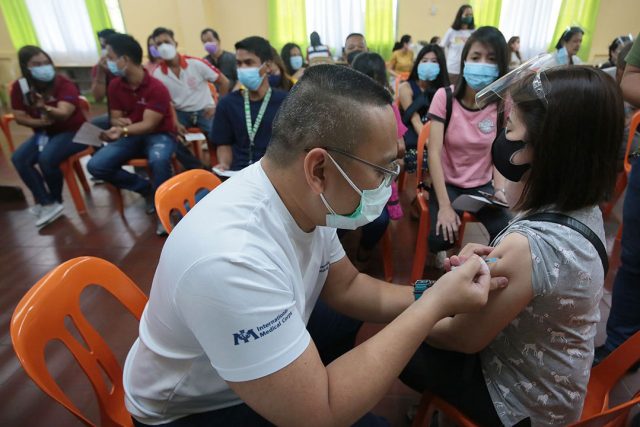
MORE than 73 million Filipinos are now fully vaccinated against coronavirus disease 2019 (COVID-19), the Department of Health (DoH) said on Thursday.

Of the total number of fully vaccinated people, 6.9 million were seniors and more than 10 million were adolescents, Health officer-in-charge Maria Rosario S. Vergeire told a news briefing on Tuesday.  

More than 5.3 million children have also been fully vaccinated, she added.  

Ms. Vergeire said nearly 20.9 million people have received their first booster dose and more than 3.5 million have received their second booster dose.  

In January this year, officials of the previous administration said the government was expecting to have 90 million fully vaccinated individuals by end-June.   

The Health Official, meanwhile, said a three-day COVID-19 vaccination drive will again be held this December to increase the vaccination rate among Filipino children.  

The drive would prioritize kids aged five to 11 and those who have yet to receive their first booster shot, she added.  

The country has wasted more than 31 million doses of COVID-19 vaccines, amounting to P15.6 billion, Ms. Vergeire said on Monday.  

Almost 70% of the wasted vaccines were procured by the private sector and local governments, she said. Short life spans and temperature excursions were among the causes of vaccine wastage, she noted.  

The country posted 8,004 coronavirus infections in the past week, with a daily average of 1,143 cases, the DoH said in a bulletin on Monday. Kyle Aristophere T. Atienza

San Miguel sets up livelihood center, cooperative for Bulacan residents affected by airport project 

THE SMAI Livelihood Center in Bulakan, Bulacan. — SMC PHOTO HANDOUT

SAN MIGUEL Corp. (SMC) on Tuesday said it has launched a livelihood center and a consumer cooperative for nearly 500 Bulakan town residents affected by its P735-billion New Manila International Airport (NMIA) project.

Through the San Miguel Aerocity, Inc. (SMAI) Livelihood Center, Bulakan citizens who used to reside at the NMIA project site can avail of training support and immediately apply the skills theyve learned, to earn a stable income for their families at the livelihood center located in Barangay San Nicolas, Bulakan,the company said in an e-mailed statement.  

The livelihood center project is a partnership among SMAI, the Bulacan provincial office of the Technical Education Skills and Development Authority, the Department of Trade and Industry, and the Gintong Aral Foundation.   

The cooperative and livelihood projects aim to empower residents through training and knowledge transfer on the inner workings of a cooperative to harness the strength of collective membership and ensure a stronger enterprise with better profitability,SMC said.  

The Department of Transportation (DoTr) recently said that land development work for the airport project is now more than 40% complete.  

The San Miguel group is expected to complete the construction of the airport by 2027. The new airport, which is expected to start operations in 2027, will be owned by the government under a build-operate-transfer program. The first phase of the airport will have a capacity of 35 million passengers annually. It is seen to generate more than one million jobs.  

Our continuing efforts to engage residents and local officials in Bulakan has allowed us to fine-tune our existing livelihood restoration programs, as well as come up with new initiatives that will adapt to their needs,SMC President and Chief Executive Officer Ramon S. Ang said.   

With these, we can better ensure that the economic growth that the NMIA will bring in the coming years, will be inclusive and will be felt by Bulacan residents and the rest of the country,he added. Arjay L. Balinbin

Senate leader discusses tourism, business prospects with Vietnam

OFFICE OF SENATOR MIGUEL ZUBIRI

THE PHILIPPINE Senate president met with the Vietnamese ambassador in Manila where they discussed further cooperation on tourism and business, ahead of a visit on Wednesday by Vietnams National Assembly president.   

Senate President Juan Miguel F. Zubiri noted the need to expand exchanges between our parliaments, and boost tourism and business opportunities.”  

He said Vietnamese Ambassador Hoang Huy Chung showed interest in strengthening tourist exchanges with the Philippines now that restrictions caused by the pandemic have been loosened across the globe.  

Filipino teachers, he added, are highly valued in Vietnam for their fluent English, which many Vietnamese seek to learn.  

The ambassador also noted the agricultural partnership between the Philippines and Vietnam which will benefit trade, research, development, and technology. Alyssa Nicole O. Tan

Edtech to remain valuable amid return to face-to-face classes

UNSPLASH

Cloud-based educational platforms that gained traction over the pandemic will remain relevant regardless of whether schools require face-to-face, remote, or hybrid setups, according to Instructure, the edtech firm behind the Canvas learning management system (LMS). 

“Institutions driving great adoption within their Canvas systems are using it both inside and outside of the classroom,” said Christopher Bradman, Instructure’s general manager and vice president for sales for Asia Pacific, at a recent media briefing. 

“We’ve been very cognizant of our clients across all sectors — K-12, vocational schools, and universities,” he added. 

Canvas counts among its clients the top three universities in the Philippines (Ateneo de Manila University, University of the Philippines, and De La Salle University) as well as individuals in the labor force securing certification to become more employable.  

Instructure, founded in 2008 and present in the Philippines since 2017, serves over 7,000 customers in higher education, K-12, and corporate markets. Aside from being able to handle different teaching and learning functionalities, Canvas LMS has mobile apps for parents, educators, and students available in 33 languages globally, including Tagalog. It also allows institutions to integrate third-party applications such as the anti-plagiarism academic integrity tool Turnitin.   

MICROCREDENTIALS
Sidharth Oberoi, Instructure’s vice president for international strategy, said that microcredentials and skill-based certifications are on the rise due to individuals looking to find suitable jobs as the world recovers from the pandemic.  

“It’s driven by the demand inside the economy. We see people seek technical training like plumbing and electrical engineering. We also see bootcamps for coding, machine learning, and even artificial intelligence,” he said at the briefing.  

“[Institutions and organizations] are hiring more on the competencies and skills learned over time. Academia is no longer a linear journey. The hybrid experience is neither fully on campus nor remote,” he added. — Brontë H. Lacsamana

Hope for coconut farmers

STOCKSNAP-PIXABAY

(Part 1)

Coconut farmers are among the poorest of the poor in the Philippines. Whereas, the national poverty line at the moment is on the average at about 17%, there are provinces among the 69 growing coconuts (out of 82 provinces in the entire archipelago) that have poverty incidence as high as 50% to 60%, especially in the island of Mindanao.

It is small comfort to learn that coconut production has been recently growing at 2% on the average if most of the revenues go to middlemen and the large processing plants. It is neither worth celebrating to learn that the Philippines is the largest exporter of coconut products in the world (although Indonesia is the largest producer but consumes most of what it produces) if the farmers who grow coconuts continue to wallow in poverty.

The present administration can contribute most to sustainable and inclusive growth by significantly increasing the productivity of the coconut sector and at the same time making sure that the 3.5 million coconut farmers get a larger share of the increase in productivity.

The coconut industry can do much to contribute to food security because it has a total production area of 3.62 million hectares with 347 million fruit-bearing trees and a total production of 14.7 million (nut terms) in 2018. Furthermore, many other higher-value crops such as vegetables, fruits, coffee and cacao, among others, can be intercropped between coconut trees in those 3.62 million hectares.

It is not comforting to hear official government excuses for the underdevelopment of the industry. In the website of the Philippine Council for Agriculture, Aquatic and Natural Resources Research and Development of the Department of Science and Technology (DoST-PCAARRD) one can read the usual lamentations. The following problems facing the coconut industry are cited: “In the past, the coconut industry has experienced various challenges ranging from low production to natural calamities and pest infestations. Certain studies pointed to low productivity being caused by old and senile coconut trees. On the other hand, historical disasters, specifically typhoon Pablo and Yolanda in 2012 and 2013 also instigated massive damages on coconut farms and other key players with the coconut supply chain. The industry further faced numerous infestations from coconut scale insects (CSI), locally known as cocolisap, which were first observed in 2010 … Although replanting is the immediate solution for the abovementioned problems, it will still take several years for them to reach the optimum maturity for production.”

So what else is new? These are the usual problems faced by any of the products of the agricultural or fishery sector, i.e., natural calamities, diseases, and lack of funding and technology support. It is up to us human beings to use our creativity, ingenuity and enterprising spirit to solve these problems!

That is why it was very refreshing to hear a foreign executive,  Christian Moeller, describe how thousands of coconut farmers (including members of an indigenous tribe) had been liberated from poverty within a short period of six years through a business enterprise model that combined the four strategic solutions to the problem of the entire agricultural sector: consolidation, diversification, digitalization and industrialization as outlined in the transition report of former Secretary of Agriculture William Dar to President Marcos Jr.

Mr. Moeller was one of the speakers in the inaugural event of the newly established Palawan Business Club, an initiative of members of the business community and civil society of the province of Palawan to replicate the experience of the Makati Business Club of getting people in business to promote the common good of Philippine society instead of just focusing on their legitimate vested interests (similar to what the Iloilo Business Club did more than 30 years ago).

Mr. Moeller is the typical social entrepreneur who addresses social problems (in the case of Lionheart Farms which he founded in 2015, the twin problems of eradicating poverty and protecting the environment) by establishing a viable business enterprise. A social enterprise is different from a charitable or philanthropic organization that may address the same social problems but is entirely dependent for financing on donations or dole outs.

To cut a long story short, let me quote from the website of Lionheart Farms: “Our fascination is our vision, which has become the story of Lionheart. The sap harvested from coconut flower is full of energy and nutrients. This raw material is the foundation of our products — from traditional coconut sugar to delicious syrup or nectar and savory coconut amino seasoning or vinegar.”

Christian, who is partly Danish and partly Norwegian, saw the potential of increasing the productivity of the coconut farms in the province of Rizal in the southern region of Palawan which is known for having some of the best soils for coconut in the whole country. At the same time, he saw the plight of the coconut farmers in that part of Palawan where there are the indigenous natives of the province. In 2016, obtaining funding from some of his major partners, Lionheart Farms planted their first coconut palms in Rizal, Palawan at the foot of Mount Mantalingahan facing the West Philippine Sea.

The vision to integrate all elements from the soil to the finished product has been realized in a sustainable way. Building from the ground up gave the enterprise the opportunity to align their operations with the United Nations Sustainable Development Goals. Recently, the UN Sustainable Assessment for Food and Agriculture recognized Lionheart Farms with a score of 4.79 out of 5, with an accuracy 2.95 out of 3.0. This October, Asia CEO Forum gave the top sustainability award among more than 20 nominees to Lionheart Farms.

The model followed by Lionheart Farms comes closest to the nucleus estate model made popular by the Malaysians in the production of palm oil. Small farms are consolidated into bigger units to attain economies of scale in farming and in the other stages producing the high-value products such as coconut milk, premium coconut oil, fresh coconut water, organic shredded coconut, coconut sugar, coco jam, Virgin Coconut Oil, and desiccated coconut.

In the case of Lionheart Farms, the initial products were coconut flower sugar, coconut nectar/syrup and coconut aminos which are mostly exported and are among those high-value products from coconut that should replace the traditional copra and coconut oil that have resulted in very limited revenues for the coconut farmers.

The small farms are leased to the nucleus corporation (Lionheart Farms) by small farmers, usually beneficiaries of agrarian reform. The farmers receive a rental for their farms and are further benefited by members of their families being hired as workers in the various stages of farming and processing of the raw materials to the finished products.

As one of the couples participating as both leaseholders and workers commented: “We benefit most from the company because upon our computation, the rent we get from our land leased to Lionheart is higher than the buying price of copra. They also gave job opportunities … I am happy because my wife is now 55 years old and yet, the company never hesitated to hire her. It is her first time to be employed with mandated benefits. We couldn’t be happier. Now, we learn organic farming practices and see the benefit of coconut palms. We learn so much from Lionheart and have much better stability in life.”

The skills being learned in situ by the farmers and members of their families can also go a long way in the diversification strategy. Coconut farms are among the best for diversification of crops because they are most amenable to intercropping.

Organic farming practices can be applied to such crops as cacao, coffee, vegetables and fast-growing fruits such as papaya. In fact, in the conference organized by the Palawan Club, I suggested that the management of Lionheart Farms should partner with such agribusiness enterprises as Harbest and East West Seeds that provide both technical training and the seeds for the planting of a large variety of vegetables, fruits and flowers that can increase even more the incomes of the farmers and the indigenous people in Rizal Province.

In the future, some NGOs are actually planning to put up a training center for master gardeners who can come from the unemployed and underemployed people in Southern Palawan. Palawan has the potential of not only becoming self-sufficient in many of these high-value products but can provide for the increased demand for high-value food products that will result from the boom in tourism expected in the coming years (Palawan has been for hailed in the international press as the Best Island Resort in the world).

(To be continued.)


Bernardo M. Villegas has a Ph.D. in Economics from Harvard, is professor emeritus at the University of Asia and the Pacific, and a visiting professor at the IESE Business School in Barcelona, Spain. He was a member of the 1986 Constitutional Commission.

bernardo.villegas@uap.asia

Day 1 of the Pilipinas Conference: Commitments from our government

PHILIPPINE STAR/ MICHAEL VARCAS

Day 1 of the Pilipinas Conference turned out to be everything we had expected and more. Our esteemed guests from the public sector, private sector, civil society, as well as the diplomatic community, enthusiastically shared their time and their precious insights to deepen our discussions on how we can more effectively respond to the challenges of the times.

This is our seventh Pilipinas Conference, and I have reason to believe we will look forward to many more.

For this year, the continuing challenges posed by the pandemic are compounded by the issues posed by the Filipino people’s perception of their current state, their expectations of their leaders, as well as by the various geopolitical, traditional and non-traditional threats that we are facing.

We are grateful that representatives from the government gave us an assurance that they have a fairly accurate picture of what the country needs at present and, more importantly, what is supposed to be done to respond to these needs and to propel our nation forward.

For instance, Secretary Amenah Pangandaman of the Department of Budget and Management (DBM) said that digital transformation is at the core of the reform agenda of her agency. It is her agency’s goal to achieve efficiency across the government and enhance the digital economy, and this is best done through investing in digitalization and innovation.

She also said that they are making a conscious effort at energizing citizen participation in governance, specifically through the Open Budget Survey. The DBM is in the process of crafting the sixth National Action Plan under the Philippine Open Government Partnership initiative, amplifying the collaboration between the non-government sector and government agencies in the design, implementation, and monitoring of government programs.

Environment Secretary Ma. Antonia Yulo-Loyzaga said that the main takeaway from the 27th Conference of Parties in Egypt, with regard to climate change, is that the world remains way off its commitment to cut emissions. She acknowledged the role of the private sector as a critical actor in bridging the cost of energy transition and the just transition toward net zero. She pointed out that it is incumbent for society to prevent and mitigate factors that contribute to people’s vulnerability — directly related to exposure, driven by development trajectory, and characterized by decades of unregulated urbanization, inequities in social services and social protection, and the disregard for ways by which our ecosystems actually support our communities.

“Lessons learned from past disasters need to be made part of our survival DNA,” she said. She added that we need to invest in education training and capacity building to create support systems for risk governance based on the best available science. For its part, the private sector should adopt climate and disaster resilience into their core business value cycles. Many companies, she said, have already chosen to be agents of environmental conversation and champions of community progress and empowerment.

Meanwhile, Transportation Secretary Jaime Bautista said that the maritime industry is a crucial component in the country’s socioeconomic rebound from the pandemic. Specifically, the Philippine Coast Guard is taking the lead at promoting maritime safety.

“The Philippines aims to be a major maritime nation that values the safety and protection of marine life and marine environment,” he said. “We look at opportunities to forge collaborations with maritime-related agencies of other countries to benchmark our efforts at raising our maritime industry to global standards.”

Closing the first day of the conference was Philippine Ambassador to the United States Jose Manuel “Babe” Romualdez.

“The evolving nature and emergence of security threats present a significant opportunity for both the Philippines and the United States to explore new areas of cooperation,” he said in a recorded statement, adding that diplomatic relations between the two countries have been further strengthened by the Visiting Forces Agreement and the Enhanced Defense Cooperation Agreement.

Ambassador Romualdez said that the defense and security aspects will continue to remain key pillars in the bilateral relations of the two countries, and that alliance between them is vital in maintaining peace and stability in the Indo-Pacific region.

After all, based on surveys, one of the most recent ones being commissioned by Stratbase this year, a large majority of Filipinos consider the United States as their most trusted country. Ambassador Romualdez said the alliance between the Philippines and the US will remain solid and stable, “underpinned by deep people-to-people ties forged by our shared experiences of the past decades.”

***

For many years now, the Stratbase Group has been doing just this: bringing people together, providing the platform for interaction, provoking thought, sparking conversations, and translating all these into actionable policy recommendations, which we hope helps make a difference in people’s lives.

There is no single sector that can and should drive the nation’s affairs. There are no formulaic solutions or quick fixes. We acknowledge the complexity of what we are up against, the diversity yet interwovenness of our interests, but also the singularity of our aspirations — a better, more secure life for Filipinos. A guarantee that people will not only survive, but flourish.

I am thankful for our friends — key thinkers, policy shapers, decision makers — who continue to share their valuable insights during these conferences. I look forward to the conversations that we will have, and which we will hopefully sustain.


Victor Andres “Dindo” C. Manhit is the president of the Stratbase ADR Institute.

Contracting arrangements in the Philippines: Where are we now?

SCOTT GRAHAM-UNSPLASH

To recall, under the administration of former President Rodrigo Duterte, the Department of Labor and Employment (DoLE) issued Department Order No. 174, series of 2017 (“DoLE DO 174-17”).

DO 174-17 showcased former President Duterte’s thrust towards the stricter implementation of laws on contracting arrangements. While there have been cases on contracting arrangements prior to 2017, from this year onwards, the country saw an uptake in routine and complaint inspections.

As may be well-known, our regulations focus on two arrangements: (1) permissible contracting and (2) labor-only contracting.

A permissible contracting arrangement complies with the requirements of Section 8 of DO 174-17: (a) engaging in a distinct and independent business and undertaking to perform the job on its own responsibility, manner, and method; (b) possessing substantial capital or investment in the form of tools, equipment, machinery and supervision; (c) being free from the control of the principal, except as to the end result of the work; and (d) having the Service Agreement comply with the rights/benefits of the contractor’s employees.

Meanwhile, Section 5 of DO 174-17 states that there is labor-only contracting when the contractor: (a) (i) does not have substantial capital or investments in the form of tools, equipment, and machineries and (ii) the contractor’s employees perform activities which are directly related to the main business of the principal; or (b) the contractor does not exercise the right to control the performance of work of the employee.

All these led to much interpretation by the Supreme Court in determining whether there exists a permissible contracting arrangement.

Accordingly, one of the most often raised issues is this: Can a contractor’s employee perform work which is directly related to the principal’s main business? In the case of Aliviado, et al. v. Proctor and Gamble, et al. (G.R. No. 160506, 9 March 2010), the Supreme Court ruled in the affirmative and recognized that management has the “prerogative to farm out any of its activities, regardless of whether such activity is peripheral or core in nature.”

Further, DO 174-17 implies that a finding of labor-only contracting requires two (2) elements: first, the contractor has no substantial capital or investments in the form of tools, trades, or machineries; and second, the contractor’s employees perform work which is directly related to the principal’s main business. Thus, the existence of just one element is not sufficient for a finding of a labor-only contracting arrangement. However, establishments are reminded that this is still subject to the other prohibitions under DO 174-17 which include, among others, the prohibited activity of outsourcing functions which are performed by regular employees.

Relevantly, there has also been much issue regarding the requirement of substantial capitalization or investments via tools and machineries. Particularly, must these two requirements be present?

In Neri v. NLRC, et al. (G.R. Nos. 97008-09, 23 July 1993), the Supreme Court equivocally stated that: “the law does not require both substantial capital and investment in the form of tools, equipment, machineries, etc. This is clear from the use of the conjunction ‘or.’ If the intention was to require the contractor to prove that he has both capital and the requisite investment, then the conjunction ‘and’ should have been used.

Thus, in San Miguel Foods v. Rivera, et al. (G.R. No. 220103, 31 January 2018), the Supreme Court reiterated the case of Neri and ruled that a contractor need not possess both substantial capital and investments in tools and trades.

Despite these, in Servflex, Inc. v. Urera, et al. (G.R. No. 246369, 29 March 2022), the Supreme Court seems to have required the contractor to possess both substantial capital and investments when it found that “in the context of labor-only contracting, substantial capital or investment rests not only on the capitalization indicated in the financial documents but on the pieces of equipment and machinery, and work premises a person or entity actually and directly used in the performance of the work.” As a caveat, however, the Supreme Court made such findings in the context of such case, where there existed other elements of a labor-only contracting arrangement.

Most importantly, the issue of control is primordial in determining whether a contracting arrangement is permissible. Significantly, a principal is only prohibited from exercising control over the means and methods of how the contractor’s employees perform the work. In Nestlé v. Puedan, et al. (G.R. No. 220617, 30 January 2017), the Supreme Court found that mere rules of conduct and guidelines set out by the “principal,” but which did not control how the “contractor” performed its business, do not warrant a finding of a labor-only contracting arrangement. Notably, while the Supreme Court ultimately found that the relationship in this case was not between a contractor and a principal, the discussion on “control” can still be instructive.

In any event, these discussions only give a glimpse of the issues pervading contracting arrangements in the Philippines. However, considering that the country is now under the new administration of President Ferdinand R. Marcos, Jr., it is likely that we will soon see his administration’s approach in regulating such contracting arrangements.

This article is for informational and educational purposes only. It is not offered and does not constitute legal advice or legal opinion.


Karenina Isabel A. Lampa is a senior associate of the Labor and Employment Department (LED) of the Angara Abello Concepcion Regala & Cruz Law Offices or ACCRALAW.

(632) 8830-8000

kalampa@accralaw.com

Looking for the World Cup winner? Don’t follow the money

AHMED bin Ali Stadium, Al Rayyan, Qatar, general view inside the stadium ahead of the World Cup. — REUTERS

ENGLAND is going to take the World Cup — besting Brazil in a tight final after narrowly defeating Portugal.

Unless markets fail.

It’s hard not to reach that conclusion after contemplating England’s imposing $1.3 billion-plus roster. It’s the richest in the competition, roughly 80 times as valuable as the home team, Qatar, at the very bottom of the pile. If England’s scoring abilities are proportional to the money its players are worth, it should dispose of Iran in the opener by 21-to-1.

But even if there’s a team out there willing to spend $166 million for the French wunderkind Kylian Mbappé — his value according to football website transfermarkt, it is probably unreasonable to expect him to score 1,600 as many goals as Australia’s Garang Kuol, even though he is worth only around $104,000.

The chasm that has yawned between the Brobdingnagian valuations of elite players and the price tag of mere mortals plying their trade outside the limelight of the European leagues is not driven by surging footballing abilities. This is just another story of technology driving inequality in our increasingly winner-takes-all world.

Brazil’s Pelé, arguably still the greatest football player of all time, made his World Cup debut in Sweden in 1958 when he was only seventeen. In 1960, his team, Santos, reportedly paid him $150,000 a year — about $1.5 million in today’s money. These days that would amount to middling pay. Paris Saint-Germain pays Mbappé $110 million a year. Even aging superstars Lionel Messi and Cristiano Ronaldo, who are on their way out, make $100 million or more, including sponsorships. They are not 67 times as good as the Brazilian master.

This is not just about football. In 1981 the University of Chicago economist Sherwin Rosen published an article entitled “The Economics of Superstars.” Rosen argued that technological progress would allow the most sought after talent in any given occupation to serve a bigger market and reap a greater share of its revenues. It would also reduce the spoils available to the less gifted in the business.

Pelé just had a small revenue base because not that many people could watch him play. In 1958 there were about 350,000 TV sets in Brazil. The first television satellite, Telstar I, wasn’t launched until July 1962, too late for Pelé’s World Cup debut. FIFA boss Gianni Infantino predicts that 5 billion people will watch the games in Qatar. That is 66% more than the entire world population in 1960.

This pattern shows up in other sports. In 1990, the most expensive payroll in Major League Baseball — at $24 million — belonged to the Kansas City Royals. This year the New York Mets top the list at $287 million. Inequality has widened considerably. While the Royals were paying about three times as much as the White Sox, the cheapest team in the league back in the day, the Mets’ payroll is almost six times that of the Oakland A’s at the bottom.

The music industry exhibits a similar dynamic: The technological progress that replaced vinyl records and the local radio station with iTunes and Spotify has supersized the reach of the top acts, propelling the globalization of the industry and driving a larger share of the money into the pockets of the very top global bands.

BTS wouldn’t have happened 20 years ago. Or, rather, it would be some locally popular Korean boy band. Last year they performed at the United Nations.

In “Rockonomics: The Economics of Popular Music” the economists Alan Krueger and Marie Connolly observe that in 1982 the top 1% of artists took in 26% of concert revenue. By 2003, their share had risen to 56%. That was, by the way, a much larger share of the pie than the 16% of national income taken that year by the one-percenters at the top of the US distribution.

And of course, some of the same stuff is going on in the business world. Economists Xavier Gabaix at Harvard, Augustin Landier at HEC Paris and Julien Savagnat of Bocconi University in Milan estimated that the fast rise in pay of corporate chief executive officers has mostly reflected the growing size of corporations.

Hiring the “best” top executive might only marginally increase the stock value of a company. But when the market cap is $2.4 trillion, tiny gains can add up to real money. As Gabaix and Landier wrote in an earlier paper, “Substantial firm size leads to the economics of superstars, translating small differences in ability to very large deviations in pay.”

Fortunately for all the football fans out there, whether sipping their Coke in the alcohol deserts of Qatar’s stands or watching comfortably at home while sipping their lager, markets can fail and send us astray.

There are all sorts of frictions in the market for soccer players, like long-term contracts with humongous buyout penalties that require teams to evaluate a player’s talent not over a year or two but over the arc of a career.

Ronaldo’s and Messi’s price tags seem weighted by nostalgia. Maybe Mbappé isn’t worth quite $166 million, if measured in pure soccersmanship. Perhaps his life story, growing up in the banlieue, has some specific value to Parisian fans.

At some $78 million, Argentina forward Lautaro Martinez is perhaps worth 2.5 times as much as his compatriot Paulo Dybala. But so far this year he has only scored eight goals for Internazionale Milano against Dybala’s seven for Roma.

So maybe Harry Kane gets hurt, or Harry Maguire does Harry Maguire or…. Maybe the World Cup does not “come home” this time either. It won’t be England’s first disappointment. After all, the most expensive team in world football is England’s own Manchester City. How many times has it won Europe’s Champions League? Zero.

BLOOMBERG OPINION

Outlook for airlines darkens as post-pandemic honeymoon ends

A PLANE is seen shortly after take-off at sunset, from Heathrow Airport, London, Britain, Dec. 11, 2020. — REUTERS

LONDON — The outlook for airlines has darkened as the post-pandemic boom in travel wears off and recession looms, with carriers focused on Britain particularly exposed, industry executives warned on Monday.

The chief executive of transatlantic-focused Virgin Atlantic said 2023 would be “tough,” while Heathrow Airport’s boss said airlines were increasingly worried about the demand outlook, and the head of global industry body IATA warned about the impact of the downturn on Britain.

Most European airlines posted soaring profits this northern hemisphere summer as people took advantage of the first travel season without coronavirus disease 2019 (COVID-19) restrictions for three years.

But with inflation soaring and mortgage rates rising, disposable income is set to plunge, and analysts have asked how long the boom can last.

Shai Weiss, the chief executive of Virgin Atlantic, said he was bracing for next year after the company beat its forecasts for 2022.

“It’s going to be a tough 2023. We need, of course, the price of energy to come down and people’s lives to be a bit better with inflation tamed,” Mr. Weiss told an industry conference.

Heathrow CEO John Holland-Kaye said that the aviation industry’s focus was shifting from the recovery from COVID-19 to worrying about the global economy.

“Airlines are concerned about the nature of demand,” he told reporters on the sidelines of the conference.

For Willie Walsh, director general of IATA, the outlook for aviation is optimistic on a global basis, but there would be a slowdown in Europe, and even more so in Britain.

“I think the UK is different,” he told Reuters.

But he said compared to what had happened during the pandemic when governments banned travel and airlines grounded most of their fleets, carriers should not be “overly concerned”.

“I see these as business-as-usual challenges,” he said. “Airlines will take measures to try and stimulate demand through pricing.”

‘REVENGE TRAVEL’
For 2022, Virgin’s Mr. Weiss said the airline would post higher revenue than in 2019, the year before the pandemic, despite it flying 20% less capacity. He said “Revenge travel,” the idea that after years of lockdowns people were determined to holiday, helped lift Virgin’s performance.

Virgin’s competitor IAG, which owns British Airways, also reported a strong summer, beating profit forecasts in October.

Britain is already in recession, but Virgin had not yet seen a drop in bookings although Mr. Weiss said he was planning for a downturn.

“I’m very cautious for 2023. I don’t want to give any other sentiments other than cautious,” he said.

Mr. Weiss used his speech at the conference to take aim at Heathrow, Virgin’s main hub airport which wants to hike passenger charges as it seeks to expand. He said Virgin’s support for a third runway at Heathrow depended on fair pricing and it being open to competition.

Heathrow and its airline customers are waiting for Britain’s aviation regulator to confirm what the airport can charge per passenger in the coming years, and Mr. Holland-Kaye said Mr. Weiss’ comments reflected their disagreement over fees.

“This is about how the value is shared between the airline and the airport,” he said.

Virgin Atlantic — owned by billionaire Richard Branson’s Virgin Group with a 51% stake and US airline Delta which has a 49% stake — reports annual results early 2023. — Reuters

China’s great reopening may come too late for many businesses

A WOMAN walks across the street during morning rush hour in Chaoyang District, Beijing, China Nov. 21, 2022. — REUTERS

SHANGHAI — The culinary tourism business of Brian Bergey and his wife Ruixi Hu has persevered in China through three years of harsh COVID-19 restrictions.

But just as excitement is mounting in global financial markets that the world’s second-largest economy may finally come out of isolation next year, the two are packing their bags.

“I remain fairly pessimistic about the quote-unquote reopening of China,” said Bergey. Their Lost Plate company, which has been hosting food tours in several Chinese cities since 2015, will instead veer to Southeast Asia.

China, the last among major countries not treating COVID as endemic, this month unveiled 20 new steps that eased its stringent anti-COVID policies.

That catapulted Chinese stocks, bonds and the yuan currency higher, and a broad range of assets from Asia to Europe and Latin America rallied.

If China reconnects with the world next year, the investor thesis went, its economy will recover from its sharpest slowdown in decades, and with it, the prospects of a global recession in 2023 might fade as well.

But that exuberance contrasts with the bleak economic reality inside China.

Many businesses, especially customer-facing ones, fear they may not survive until next year: China is still battling some of its biggest outbreaks so far, while shell-shocked consumers — whose lives were upended by the government’s harsh anti-COVID measures — are holding on to their cash.

“The biggest thing will be to see in February and March who was actually able to survive the winter,” said Shanghai-based American entrepreneur Camden Hauge, who owns a cafe, a bar, several matcha kiosks and an events company in the city.

Shanghai’s 25 million people, traumatized by two months of captivity in their own homes early this year, often without access to basic necessities, will continue to avoid crowded venues for a long time regardless of the rules, she expects.

“People are not going to flick a switch and go back to the way life was before,” Ms. Hauge said.

SHELL-SHOCKED CONSUMERS
China’s economy is expected to grow around 3% this year, missing its target of about 5.5%.

A slate of economic data for October came in below already weak expectations: Exports fell. Inflation slowed. New bank lending tumbled. The downturn in the property market deepened. Retail sales fell for the first time since Shanghai’s April-May lockdown.

With COVID outbreaks getting worse, it is unlikely that China’s economy can shift into a higher gear in the near term.

JPMorgan estimated earlier this month that cities with more than 10 new COVID cases accounted for 780 million people and 62.2% of gross domestic product — roughly triple the levels seen at the end of September.

Vaccination and booster rates remain relatively low across China, especially among vulnerable populations such as the elderly, leaving authorities wary about easing up before the populace is better prepared.

As a result, the new COVID rules have not been implemented uniformly. Local authorities in some Chinese cities eased restrictions, while others tightened.

In several cities, officials came out to reassure residents the tweaks did not mean letting their guard down.

Faced with mixed messages, some nervous households have been taking matters into their own hands. Posts on social media showed many parents, fearing their children might get COVID, are using pretexts such as toothaches or ear infections to pull them from school.

Those families will not be going out for dinner or shopping excursions any time soon, economists warn.

“The new measures to ‘optimize’ COVID containment seem to be creating chaos on the ground as local governments attempt to interpret the policies,” analysts at Gavekal Dragonomics said.

“[This] presents economic uncertainty that seems likely to further dampen consumption and property sales in the near term.”

At its core, the problem reflects authorities’ failure to prioritize the interests of consumers, who are often the punching bag in China’s investment-driven economy.

Take China’s traffic data: in the third quarter, freight turnover by road, rail and water were roughly the same as in the third quarter in 2019, pre-COVID, according to a Fitch Ratings analysis.

By comparison, passenger turnover on the same modes of transportation was only half or even one-third the levels of three years ago, indicating that people’s lives suffered far more disruption than industrial logistics.

That bodes ill for customer-facing businesses.

Yao Lu’s Shanghai-based bar, Union Trading Company, was a stalwart on international “best bar” lists until this year, when it has only operated for 50 days between COVID shutdowns.

“What this year has taught us is that whatever plan you have for the future doesn’t really matter,” Yao said. “We’re just trying to live day by day.” — Reuters

Pentagon chief raises concern about Beijing’s ‘dangerous’ behavior with Chinese counterpart

DEFENSE.GOV

PHNOM PENH — US Defense Secretary Lloyd Austin on Tuesday emphasized the need to improve crisis communications during a meeting with his Chinese counterpart while raising concern about “increasingly dangerous” behavior by Chinese military aircraft.

The roughly 90-minute meeting in Cambodia, described as “productive and professional” by a US official, was the pair’s first since a visit to Taiwan by US House Speaker Nancy Pelosi in August enraged China, which regards the island as its territory.

In his second face-to-face meeting with Chinese Defense Minister General Wei Fenghe this year, Mr. Austin discussed the importance of “substantive dialogue on reducing strategic risk and enhancing operational safety,” Pentagon spokesman Brigadier General Pat Ryder said in a statement after the meeting.

“He (Austin) raised concerns about the increasingly dangerous behavior demonstrated by PLA (China’s People’s Liberation Army) aircraft in the Indo-Pacific region that increases the risk of an accident,” Mr. Ryder said.

In June, a Chinese fighter aircraft dangerously intercepted an Australian military surveillance plane in the South China Sea region in May, Australia’s defense department said.

Australia has said that the Chinese jet flew very close in front of the RAAF aircraft and released a “bundle of chaff” containing small pieces of aluminum that were ingested into the Australian aircraft’s engine. Tuesday’s meeting of the defense ministers took place on the sidelines of an ASEAN gathering in Siem Reap, Cambodia.

After Ms. Pelosi’s visit, China announced it was halting dialogue with the United States in a number of areas, including between theater-level military commanders.

A senior US defence official, speaking on condition of anonymity, said Mr. Austin and Mr. Wei had a “lengthy” discussion about Taiwan and also talked about restarting in the coming months some of the mechanisms that had been canceled after Ms. Pelosi’s visit.

“There’s an expectation that there will be some restart of some of the mechanisms that have been frozen for the last six months,” the official said.

Tuesday’s talks come after a three-hour meeting between US President Joseph R.  Biden and Chinese President Xi Jinping last week on the sidelines of the G20 summit in Indonesia, aimed at preventing strained ties from spilling into a new Cold War.

Despite tensions between the United States and China, US military officials have long sought to maintain open lines of communication with their Chinese counterparts to mitigate the risk of potential flare-ups or deal with any accidents.

After Mr. Austin and Mr. Wei’s first meeting this year in Singapore in June, the Pentagon chief said his talks with his Chinese counterpart were an important step in efforts to develop those means of communication.

Relations between China and the United States have been tense, with friction between the world’s two largest economies over everything from Taiwan and China’s human rights record to its military activity in the South China Sea.

Ms. Pelosi’s Taiwan trip infuriated China, which saw it as a US attempt to interfere in its internal affairs. China subsequently launched military drills near the island.

The United States has no formal diplomatic relations with Taiwan but is bound by law to provide the island with the means to defend itself. — Reuters