Home Blog Page 507

Pope Leo criticizes high, Musk-style corporate pay packages

Pope Leo XIV leads the Angelus prayer on his 70th birthday, from the window of the Apostolic Palace at the Vatican, Sept. 14, 2025. REUTERS/Vincenzo Livieri

VATICAN CITY – Pope Leo criticized corporate pay packages that offer executives much higher salaries than their employees in excerpts from his first media interview released on Sunday, citing Tesla’s recent $1 trillion compensation plan for CEO Elon Musk.

Leo, originally from Chicago, also spoke about the United Nations, his decades working as a missionary in Peru, how he has been adapting to the role of pope, and his hopes for peace in the bloody, three-year conflict between Ukraine and Russia.

He has shown a more reserved style than his predecessor Pope Francis, who often gave interviews, and prefers to speak from prepared texts. Sunday’s excerpts were released on the Catholic news site Crux.

“CEOs that 60 years ago might have been making four to six times more than what the workers are receiving … 600 times more (now),” Leo said in the interview, conducted at the end of July for a coming biography.

“Yesterday (there was) the news that Elon Musk is going to be the first trillionaire in the world,” he said. “What does that mean and what’s that about? If that is the only thing that has value anymore, then we’re in big trouble.”

Leo, elected the first US pope by the world’s cardinals in May to replace Francis, criticized the UN as no longer being able to foster effective multilateral diplomacy.

“The United Nations should be the place where many … issues are dealt with,” said Leo. “Unfortunately, it seems to be generally recognized that the United Nations, at least at this moment in time, has lost its ability to bring people together on multilateral issues.”

On becoming pope, Leo said he felt more prepared at first to lead the world’s 1.4 billion Catholics on spiritual matters but less prepared to play a major role on the global diplomatic stage.

“The totally new aspect to this job is being thrown onto the level of world leader,” said the pope. “I’m learning a lot and feeling very challenged, but not overwhelmed. On that one I had to jump in on the deep end of the pool very quickly.” — Reuters

PHL external debt jumps to $149B

The Philippines’ outstanding external debt hit $148.87 billion as of end-June. A teller counts US dollar banknotes at a money changer in Jakarta, Indonesia, April 9. — REUTERS/WILLY KURNIAWAN

THE PHILIPPINES’ outstanding external debt jumped to a record $148.87 billion as of end-June amid the weakening of the US dollar, the Bangko Sentral ng Pilipinas (BSP) said.

Central bank data showed the country’s external debt rose by 14.4% from $130.318 billion in the same period last year.

“The increase in external debt was driven primarily by borrowings, which included bond issuances by the National Government amounting to $5.83 billion and external financing tapped by local banks amounting to $3.44 billion,” the BSP said in a statement.

Quarter on quarter, external debt inched up by 1.5% from the $146.74 billion logged at the end of the first quarter.

“The increase in external debt for Q2 (second quarter) 2025 was primarily due to valuation effects from the depreciation of the US dollar,” the BSP said.

External debt accounts for all borrowings by residents from nonresidents.

The BSP said the external debt level remained “sustainable,” equivalent to 31.2% of gross domestic product. This was better than the 31.5% in the previous quarter but higher than the 28.9% a year ago.

The central bank said the weaker greenback increased the US dollar equivalent of borrowings denominated in other currencies by $1.49 billion.

In the April-to-June period, the peso recorded a strong performance against the dollar as it traded between the P55 and P56 level, averaging P56.581 as of end-June.

“The net acquisition of Philippine debt securities amounting to $660.96 million also contributed to the increase (in external debt), while net repayments amounting to $315.67 million partially tempered the increase in the country’s external debt,” the BSP said.

Most of the country’s public sector obligations, amounting to $88.371 billion, were from the National Government while the rest came from the BSP ($3.919 billion) and government banks ($1.81 billion).

Japan remained the Philippines top creditor with loans amounting to $15.599 billion, followed by the United Kingdom with $6.358 billion and Singapore with $4.837 billion.

The borrowing mix was composed mainly of US dollar-denominated debt, followed by debt in Philippine peso and debt in Japanese yen.

As of the second quarter, the country’s short-term external debt based on remaining maturity concept (STRM) was at $28.63 billion. STRM debt is composed of loans with original maturities of one year or less plus amortization on medium and long-term accounts falling due within the next 12 months.

“This level remains well-covered by the country’s gross international reserves (GIR) of $106 billion, providing 3.7 times cover for short-term obligations,” the BSP said.

“The country’s GIR-to-STRM debt ratio remains at par with emerging economy peers.”

Meanwhile, the BSP said resident borrowers’ lower principal and interest payments brought the debt service ratio down to 8.7% during the period from 9.8% a year ago. This ratio measures a country’s capacity to meet its obligations based on its foreign exchange earnings.

“This resulted from lower principal and interest payments by resident borrowers as of the second quarter of 2025,” it said.

BSP data showed the public sector’s external debt went up by 88.2% to $94.801 billion at end-June from $50.36 billion the previous year.

Private sector obligations, on the other hand, declined by 32.3% year on year to $54.072 billion from $79.83 billion a year ago. — Katherine K. Chan

PHL big banks post slower growth in assets, loans in 2nd quarter

Peoples walk past automated teller machines in Makati City, June 23, 2016. — REUTERS

By Abigail Marie P. Yraola, Deputy Research Head

THE GROWTH in combined assets and loans of the country’s biggest lenders eased as of end-June, dragged by weaker economic output in the second quarter despite cheaper borrowing costs and slower inflation.

The latest edition of BusinessWorld’s quarterly banking report showed that the aggregate assets of 44 universal and commercial banks grew by 9.05% year on year to P27.37 trillion in the second quarter from P25.09 trillion a year earlier.

This pace was slower than the 9.51% logged in the first three months of the year and the 10.7% growth in the second quarter of 2024.

Top 10 Biggest Banks by Total Assets

Asset growth during the period was the weakest in five quarters or since the 8.69% expansion recorded in the first quarter of 2024.

Meanwhile, the aggregate loans of the country’s biggest lenders went up by 12.38% year on year to P14.4 trillion in the April-to-June period.

This expansion was slower than the 13.46% recorded in the first quarter and the 14.01% growth in the second quarter of last year.

Lending growth was also the weakest in the five quarters or since the 12.32% observed in the first three months last year.

This modest growth in both assets and loans mirrored economic developments such as slowing economic growth and benign inflation.

In the second quarter, the country’s gross domestic product (GDP) expanded by an annual 5.5%, slower than the 6.5% growth in the same period last year but slightly faster than the 5.4% expansion in the January-to-March period.

This brought GDP growth to 5.4% in the first semester, slowing from 6.2% a year earlier.

Meanwhile, inflation in June picked up to 1.4%, a tad faster than the 1.3% in May. Still, this was slower than the 3.7% in June last year.

For the first half, inflation averaged 1.8%, decelerating from the 3.6% average in the first six months of 2024.

At its June meeting, the Bangko Sentral ng Pilipinas (BSP) delivered a 25-basis-point rate cut to bring its key rate to 5.25% — the lowest level in two and a half years.

Data also showed the share of bad loans to the total loan portfolio, also known as the nonperforming loan ratio, jumped to 3.39% in the second quarter. This was higher than the 3.25% a year earlier and 3.24% in the first quarter.

Loans are considered nonperforming if any principal and/or interest are left unpaid for over 90 days from the contractual due date or accrued interests for more than 90 days have been capitalized, refinanced, or delayed by agreement.    

Meanwhile, the banks’ median return on equity (RoE), which is an indicator of profitability, dipped to 7.69% in the second quarter from 8.93% in the second quarter of 2024. The RoE measures the amount that shareholders make on every peso they invest in a company.

Additionally, the largest banks’ median capital adequacy ratio — which reflects the lender’s ability to absorb losses from risk-weighted assets — stood at 19.18% during the period.

This was higher than the 18.8% recorded in the same period last year but lower than the 19.71% a quarter earlier.   

The ratio remained well above the regulatory minimum of 10% set by the BSP as well as the international minimum standard of 8% under the Basel III framework.

The leverage ratio, which gauges the institution’s ability to absorb shocks by measuring the bank’s capital relative to total exposure, stood at a median of 11.39% as of end-June. The current figure exceeded the central bank’s 5% guideline as well as the international standard of 3%.

Meanwhile, the net interest margin (NIM) of these big banks hit 4.23%, higher than the 3.19% a year earlier.

NIMs are an indicator of banks’ investing efficiency by dividing annualized net interest income by average earning assets.

During the period, the return on assets, which measures the profit generated per peso of an asset, rose to 1.62% from 1.42% in the second quarter of 2024.

In the April-to-June period, BDO Unibank, Inc. (BDO) remained the largest bank in terms of total assets with P5.05 trillion, followed by Metropolitan Bank & Trust Co. (Metrobank) with P3.51 trillion and Bank of the Philippine Islands (BPI) with P3.5 trillion.

In lending, the Sy-led bank also led the industry with P3.41 trillion worth of loans issued, followed by Bank of the Philippine Islands (BPI) with P2.36 trillion and Metrobank with P1.85 trillion.

In terms of deposits, BDO led with P4.03 trillion in deposits, followed by Land Bank of the Philippines (LANDBANK) with P3.06 trillion and BPI with P2.61 trillion.

Among banks with at least P100 billion assets, Security Bank Corp. posted the fastest year-on-year asset growth with 25.6%, followed by Bank of Commerce (17.8%), and The Hongkong & Shanghai Banking Corp. Ltd. (16.6%).   

On the other hand, Asia United Bank was the most aggressive lender with a year-on-year growth of 35.57%, followed by China Banking Corp., with 18.04% and Philippine Trust Co., with 16.31%.

BusinessWorld Research has been tracking the financial performance of the country’s large banks quarterly since the late 1980s using banks’ published statements.

Business groups say independent body can help restore investor confidence in PHL

Ongoing flood-control works continue in Binondo, Manila. — PHILIPPINE STAR/RYAN BALDEMOR

THE PHILIPPINES’ largest business groups on Sunday expressed confidence the newly created Independent Commission on Infrastructure (ICI) could help restore investor confidence in the country’s public works program.

The Philippine Chamber of Commerce and Industry (PCCI) said the commission, tasked with probing anomalies in projects such as flood-control systems, is well positioned to drive systemic reforms that will improve governance and efficiency in big-ticket projects.

“The ICI, as currently composed and empowered, is a strong signal of the President’s political will to address infrastructure anomalies, especially in flood control,” the group said in a statement.

The ICI will be composed of former Public Works and Highways Secretary Rogelio L. Singson and former Chair of the Procurement Policy Board-Technical Support Office, Rossana A. Fajardo. Ms. Fajardo is now the country managing partner at SGV and Co.

Baguio City Mayor Benjamin B. Magalong will also be an adviser.

Mr. Marcos is expected to name the chairman this week.

“This strategically balanced team combines operational, institutional, and investigative strengths that can translate findings into actionable reforms,” the PCCI said.

This comes as the government intensifies efforts to crack down on corruption that led to incomplete and nonexistent flood mitigation projects worth billions of pesos.

“With its strong legal foundation and credible composition, the ICI can become a cornerstone institution for safeguarding public funds and ensuring that infrastructure projects deliver real value to the Filipino people,” the group said.

The PCCI said sustained funding, independence from political influence, and seamless interagency cooperation will determine whether the ICI can close procurement loopholes and reduce corruption risks that have historically delayed infrastructure pipelines.

The Federation of Philippine Industries (FPI) also welcomed the commission’s creation, saying it aligns with its long-standing push for a clean, rules-based market anchored on strict Philippine National Standards compliance.

“The ICI’s work will clean up a decade of flood control anomalies, restore trust in public works, and cut the corruption premium that drives up costs,” FPI Chairperson Elizabeth H. Lee said in a statement on Sunday.

“That means cheaper financing, stronger investor confidence, and a manufacturing sector that wins on standards, integrity, and quality — now and for years to come.”

By dismantling entrenched networks inflating costs and distorting competition, Ms. Lee said the ICI could allow compliant firms to access more affordable financing for capital-intensive upgrades, while attracting higher-quality bidders more likely to source inputs from local manufacturers.

The ICI has the power to issue subpoenas, request financial records and recommend preventive suspensions.

It may also endorse evidence for prosecution and collaborate with technical experts in support of its investigations.

BIR SUPPORT
Meanwhile, the Bureau of Internal Revenue (BIR) has offered its services to the newly formed ICI.

“The entire BIR is ready to help the ICI if necessary, and the BIR will use all its powers granted by law to go after those who seek to use public funds for personal gain or greed,” BIR Commissioner Romeo “Jun” D. Lumagui, Jr. said in a statement.

“As a government agency that collects taxes to fund projects for the Filipino people, we aim for every Filipino to live well through the proper use of taxes,” Mr. Lumagui said.

The BIR earlier said the tax fraud investigation in the first batch of individuals linked to flood control anomalies, such as Cezarah Rowena “Sarah” Discaya and Pacifico “Curlee” F. Discaya II are almost concluded.

The BIR on Sept. 2 served contractors with Letters of Authority, which authorizes a tax audit on those who may have underpaid or evaded taxes.

The BIR warned that it will not issue an updated tax clearance, a document that guarantees that every contractor has no outstanding tax liabilities and has duly filed and paid all applicable taxes.

Unable to present this clearance will result in the suspension of contract settlements and the imposition of a tax lien over the contract amount in favor of the government.

Finance Secretary Ralph G. Recto earlier said corruption related to flood control projects may have cost the Philippines between P42.3 billion and P118.5 billion in average economic losses since 2023. — Chloe Mari A. Hufana and Aubrey Rose A. Inosante

Higher terminal fees take effect at Manila’s main airport

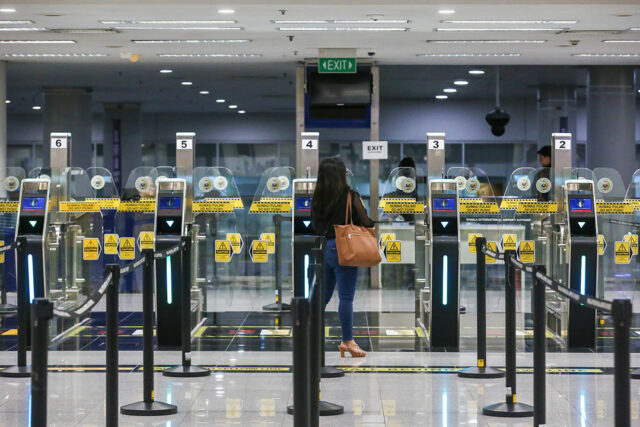
A WOMAN uses the electronic gate at the Ninoy Aquino International Airport Terminal 3. — PHILIPPINE STAR/NOEL B. PABALATE

THE OPERATOR of the Ninoy Aquino International Airport (NAIA) began charging higher terminal fees on Sunday, a year after it took over the country’s main gateway.

In a statement, the New NAIA Infrastructure Corp. (NNIC) said the terminal fees were adjusted for the first time in 20 years to sustain the airport’s operations and upgrades.

“Even with the adjustment — set by government with the Asian Development Bank as adviser — NAIA’s rates will only match other local airports and remain among the lowest in Asia,” the company said.

The passenger service charge (PSC), also known as terminal fee, nearly doubled to P950 from P550 for international departures. The terminal fee for domestic departures was raised to P390 from P200.

Since NNIC took over the operations last year, the company said it has already remitted P48.3 billion to the government, including a P30-billion upfront payment, with 82% of revenues going directly to the state.

NAIA received 51.7 million passengers since Sept. 13, 2024, a 6% increase year on year, and handled 283,771 flights.

“Operational changes such as reconfiguring aircraft parking stands, expanding taxiway movements, and removing abandoned aircraft freed up valuable space for smoother airside operations,” the company said.

NNIC also said it is preparing to introduce a facial recognition system that will allow travelers to “check in, drop bags, clear security and board flights using just their face.”

“Operating an airport the size and scale of NAIA will always be demanding. But what this first year has shown is that with teamwork, discipline, and the dedication of our people, real change is possible… Together with government and our partners, we will sustain these gains and finally deliver a truly world-class NAIA,” NNIC President Ramon S. Ang said.

Last year, the NNIC, formerly the SMC SAP & Co. Consortium, inked a P170.6-billion contract to operate, maintain, and upgrade the country’s primary gateway for 25 years. — Sheldeen Joy Talavera

MGI plans up to P8.9-B geothermal expansion in Batangas

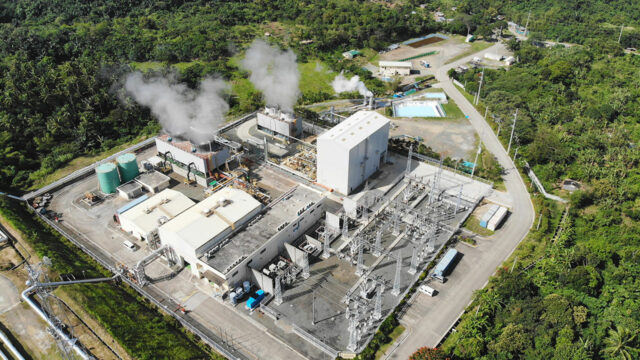
PETROENERGY.COM.PH

RENEWABLE ENERGY developer Maibarara Geothermal, Inc. (MGI) is proposing an up to P8.9-billion expansion of its geothermal facility in Batangas to supply additional power to the Luzon grid.

The expansion is expected to generate 25 to 40 megawatts (MW) of capacity, which will raise MGI’s total output to 80 MW once completed, the company said in a filing with the Department of Environment and Natural Resources (DENR).

The company said the project would help meet growing demand while supporting the country’s energy transition.

“Viewed on a broader scale, the project will contribute additional generation capacity to the Luzon grid, addressing the country’s persistent power shortages and supplying power to new infrastructure to be built by the government or the private sector in the future, leading to additional jobs,” it said.

MGI is a joint venture of PetroGreen Energy Corp. (65%), ACEN Corp. (25%), and PNOC Renewable Corp. (10%). It currently operates the 20-MW Maibarara-1 and 12-MW Maibarara-2 plants in Sto. Tomas, Batangas.

The proposed expansion covers the drilling of new production and reinjection wells, development of discharge facilities, and installation of a power plant and switchyard.

The facility will use geothermal steam from the new wells, which will be converted into electricity through the steamfield system.

Construction is targeted to begin in the fourth quarter of 2027, with commissioning scheduled between 2029 and 2031. Full operations are expected in the third quarter of 2031.

MGI said the expansion will also contribute to reducing greenhouse gas emissions, as geothermal plants emit only a fraction of the sulfur dioxide, nitrogen oxide, and carbon dioxide generated by coal-fired facilities of similar capacity.

The Philippines has a total installed geothermal capacity of 1,952 MW, making it the world’s third-largest geothermal producer.

As of July, the Department of Energy had awarded 31 geothermal service contracts with a combined potential capacity of 1,077.22 MW. — Sheldeen Joy Talavera

The Fronx awakens

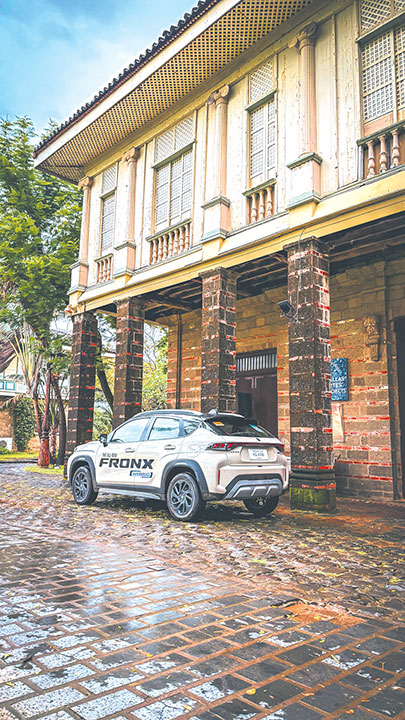
PHOTO BY MANNY N. DE LOS REYES

Impressive first impressions of Suzuki’s new subcompact

HARD TO BELIEVE that it’s been eight years since the last time Suzuki brought in a subcompact crossover to our shores. That was in 2017 and that vehicle was the Vitara — a model that sold very well for the Japanese small car specialist. And now it’s been three years since Suzuki stopped bringing that model in — a significant span of absence that Suzuki is now keen to correct.

That corrective measure is called the Fronx. I got to drive it over a couple of days from Suzuki Caloocan all the way to Las Casas Filipinas de Acuzar in Bataan (and back) and I can say that the Fronx is well poised to take over where the Vitara left off.

First of all, it’s got the looks. The Vitara wasn’t exactly a head-turner, yet it sold quite a number in its day. The Fronx, on the other hand, has much more eye-catching styling.

The highly sculpted front end has the now-de-rigueur big black grille bracketed on both sides by slim DRLs. The triple-lens headlights are mounted low on the bumper in their own distinctive pentagonal-shaped housing. The side view is equally dynamic, with taut lines and large fender openings that are flattened at the top. The roofline tapers downward toward the rear, continuing with the sharply raked tailgate, leaving a very sporty side silhouette you can see in the Honda HR-V and Porsche Macan.

The rear view, often the least flattering for most vehicles, continues the youthful and sporty vibe. It looks highly stylized, with lots of detailing on all surfaces, from the backlight to the tailgate to the bumper. The sharply angled backlight gives it a couple-like profile, while the full-width slim-line LED taillamps (that look good at night), roof spoiler, and prominent under-bumper diffuser in matte silver add sporty and upscale elements to the overall design.

Altogether, the Indonesia-made Fronx pulls off a style that should elicit a lot of positive reactions on the road.

Thankfully, the interior does not disappoint. It looks great, has excellent build quality, offers good space, and boasts a decent array of comfort and convenience features. You won’t find a sunroof or power seats, but there’s not much else to complain about. There’s good head and legroom up front and in the back seat. The gauges are easy to read. You’ll feel soft-touch materials on all touch points. The flagship SGX variant boasts a very upscale black-and-burgundy color theme with high-gloss silver accents.

There are audio and cruise-control buttons on the steering wheel. The floating infotainment touchscreen isn’t competing to be the largest in its class but is faultless in its intuitiveness. There is a wireless charging pad on the forward part of the center console (for the SGX variant), USB charging ports for the front and back, and there are A/C vents for the rear passengers as well. Plus points are earned for fitting analog buttons and switches for controls (i.e. side mirrors and A/C) that too many new cars now are requiring you to fiddle with on the touchscreen. The old-school handbrake lever is a nice analog touch that will never get old.

Powering the Suzuki Fronx is a 1.5-liter four-cylinder gasoline engine — the same 1.5-liter mill paired to Suzuki’s Smart Hybrid system (a mild hybrid system) that makes use of an Integrated Starter Generator and a lithium-ion battery. Three transmission options are available: a five-speed manual or a four-speed automatic for the GL variant, and a six-speed automatic (with paddle shifters) for the mid-range GLX and top-of-the-line SGX hybrid versions.

On the road, the Fronx proves to be a willing and eager companion. The naturally aspirated engine doesn’t deliver overwhelming power, but it’s peppy enough — and the transmission responsive enough — to feel energetic in city driving. Overtaking on the expressway needs only a deeper press on the throttle, although the paddle shifters proved especially useful during our spirited run up the mountain roads around Mt. Samat (to keep the engine in its torque sweet spot).

Riding comfort is top-notch for this small vehicle — even over bumps and potholes — while handling proved nimble through the winding roads of Bataan. Steering feel is excellent while the brake pedal proved wonderfully easy to modulate. The stiffness of the chassis and the NVH (noise, vibration, harshness) suppression measures — evident in the low noise levels inside the cabin — likewise is very impressive.

Best of all, Suzuki’s vaunted fuel economy is at the fore of the Fronx performance. We left Suzuki Caloocan with a full tank and arrived at the Caltex in Pilar Diwa, Bataan (a distance of about 160 kilometers) and needed just 9.3 liters to fill it up again — for a fuel consumption of 17 kpl with my spirited (read: heavy-footed) driving. An official Automobile Association Philippines (AAP) fuel economy run netted a highway figure of 27.98 kpl.

The Fronx SGX range-topper has its share of advanced driver assist system (ADAS) features in its Suzuki Safety Support, as well as adaptive cruise control, head-up display, 360-degree camera, six air bags (dual front, side, and curtain) and more.

The Fronx comes in four colors: Magma Gray Metallic, Snow White Pearl (available also in two-tone with a Cool Black Pearl Metallic roof), Savannah Ivory Metallic and Ice Grayish Blue Pearl Metallic (both in two-tone with Cool Black Pearl Metallic roof).

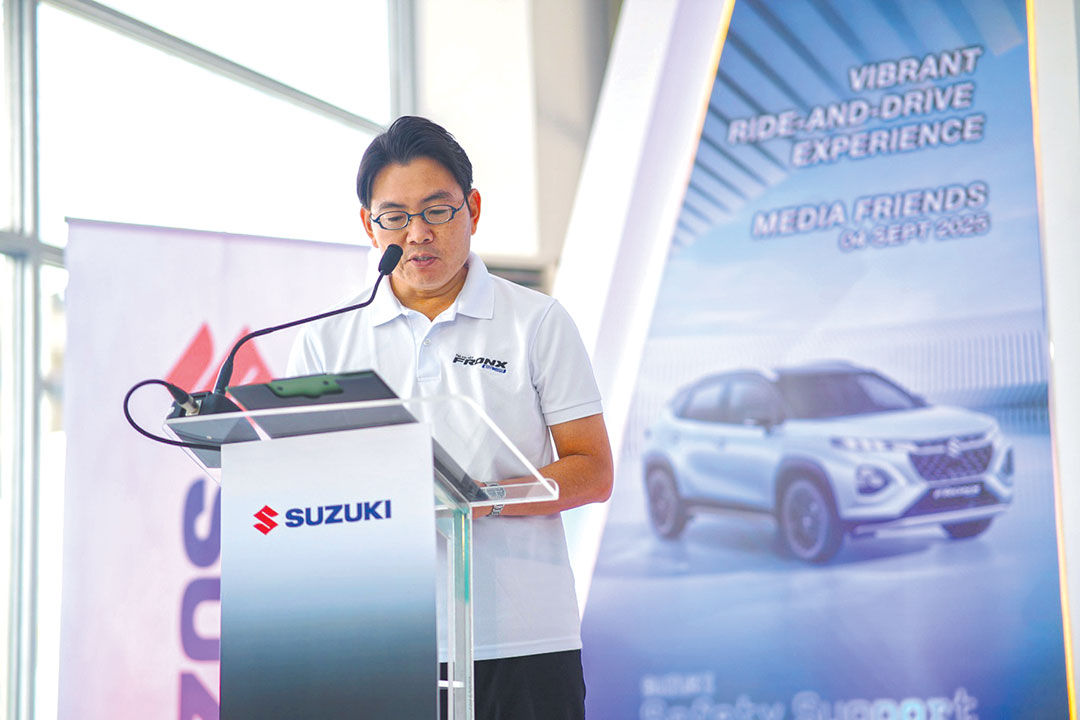
At the formal launch of the Suzuki Fronx last Friday, Suzuki Philippines, Inc. (SPH) revealed the pricing of the model range: Fronx GL AT (P1.059 million), Fronx GLX AT Hybrid (P1.219 million), Fronx GLX AT Hybrid Two Tone (P1.229 million), and Fronx SGX AT Hybrid Two Tone (P1.299 million).

With top-notch styling, excellent build quality, a spacious interior, solid fuel economy, and polished driving performance, the Suzuki Fronx should very soon be a familiar sight on Philippine roads.

SM Prime shares rise after $350-million dollar bond issuance

SM City J Mall in Mandaue City — BW FILE PHOTO

SM PRIME HOLDINGS, INC. (SMPH) saw its shares rise week on week after completing a $350-million dollar-denominated bond issuance to fund mall redevelopment and expansion.

The Sy-led property developer was the ninth most actively traded stock last week, with 28.46 million shares worth P674.42 million changing hands from Sept. 8 to 12, data from the Philippine Stock Exchange (PSE) showed.

SMPH closed at P23.90 per share, up 3.9% from P23 on Sept. 5, outperforming the property sector’s 1.7% growth and the PSE index’s (PSEi) 0.6% decline.

Year to date, the stock has fallen 5%, lagging behind the property sector’s 5.3% gain but outperforming the PSEi’s 6.4% drop.

Franco Fernandez, equity research analyst at Dragonfi Securities, Inc., attributed the recent rise to “a combination of bargain hunting and selective investor positioning.”

Jervin De Celis, equity trader at The First Resources Management and Securities Corp., said investors have shifted into resilient stocks since the PSEi peaked at 6,547.57 in July.

“SMPH’s outperformance of the broader property sector underscores investor sentiment after the company’s successful dollar bond issuance and strong financial results,” he said.

In a disclosure on Wednesday last week, SMPH said it had secured $350 million from the bond issuance to finance expansion plans.

Demand was three times oversubscribed, with offers reaching over $990 million.

The bonds, carrying a 4.75% coupon and maturing in five years, are the second drawdown under SMPH’s existing $3-billion multi-issuer European Medium-Term Note program and will be listed on the Singapore Exchange.

SMPH plans to use proceeds to fund 16 major redevelopments and 12 new lifestyle malls scheduled between 2026 and 2030.

Mr. Fernandez said the move “reinforced the investment case for SMPH as an undervalued play on retail growth, with macro tailwinds from easing inflation and lower interest rates further underpinning sentiment.”

Aniceto K. Pangan, trader at Diversified Securities, Inc., noted that ongoing central bank rate cuts are expected to support mall performance and property sales.

Inflation quickened to 1.5% in August from 3.3% a year earlier, while the Bangko Sentral ng Pilipinas lowered its key rate by 25 basis points to a three-year low of 5% in August.

Since starting its easing cycle in August, the central bank has reduced interest rates by a total of 150 basis points.

SM Supermalls President Steven Tan told reporters earlier that the company plans to open a new mall in Xiamen City, Fujian province, in October, and another in Fujian in 2027.

Mr. Pangan said the openings “will further sustain growth in the company going forward.”

SMPH’s attributable net income rose 10.3% year on year to P12.8 billion in the second quarter, bringing first-half attributable profit to P24.46 billion, up 10.8%.

Mr. De Celis expects third-quarter net profit of about P13.5 billion, representing 5.5% year-on-year growth, while both he and Mr. Pangan project full-year earnings of around P50 billion.

For this week’s trading, analysts placed immediate support levels between P22.45 and P23.70, with resistance at P24 to P26, citing the stock’s recent performance and underlying business developments. — Heather Caitlin P. Mañago

Treasury bills, bonds may fetch lower rates before Fed meeting

BW FILE PHOTO

RATES of the Treasury bills (T-bills) and Treasury bonds (T-bonds) on offer this week could decline as weak US data boosted expectations of further monetary easing by the US Federal Reserve.

The Bureau of the Treasury (BTr) will auction off P25 billion in T-bills on Monday, or P8.5 billion each in 91-day and 182-day securities and P8 billion in 364-day papers.

On Tuesday, the government will offer P25 billion in reissued 10-year T-bonds with a remaining life of nine years and seven months.

T-bill and T-bond yields could go down to mirror the week-on-week declines seen at the secondary market on growing Fed cut bets, Rizal Commercial Banking Corp. Chief Economist Michael L. Ricafort said in a Viber message.

“Most softer US jobs and other economic data recently increased the urgency of a 25-basis-point (bp) Fed rate cut as early as the next rate-setting meeting on Sept. 17 and as the markets priced in three 25-bp rate cuts for the rest of 2025 after mostly weaker US jobs and other economic data recently,” Mr. Ricafort said.

At the secondary market on Friday, yields on the 91-, 182-, and 364- day T-bills went down by 8.73 bps, 9.92 bps, and 11.68 bps to end at 5.0896%, 5.2143%, and 5.3531%, respectively, based on PHP Bloomberg Valuation Service Reference Rates data as of Sept. 12 published on the Philippine Dealing System’s website.

For its part, the 10-year bond went down by 3.12 bps week on week to yield 5.9702%.

US consumer prices increased by the most in seven months in August amid higher costs for housing and food, but a surge in first-time applications for jobless benefits kept the Federal Reserve on track to cut interest rates next Wednesday, Reuters reported.

The larger-than-expected rise in the consumer price index (CPI) reported by the Labor department on Thursday resulted in the biggest year-on-year increase in inflation since January. Higher inflation and softening labor market conditions fanned fears of stagflation, and pose a dilemma for the US central bank, beyond Wednesday’s anticipated rate decision.

The CPI rose 0.4% last month, the biggest gain since January, after increasing 0.2% in July, the Labor department’s Bureau of Labor Statistics said.

In the 12 months through August, the CPI advanced 2.9%, the largest increase since January, after climbing 2.7% in July.

Economists polled by Reuters had forecast consumer prices would rise 0.3% in August and increase 2.9% on a year-over-year basis.

Financial markets have fully priced in a quarter-percentage-point reduction in rates next Wednesday, with the Fed expected to deliver two similar-sized additional cuts this year.

The US central bank, which tracks the personal consumption expenditures (PCE) price indexes for its 2% inflation target, paused its easing cycle in January because of uncertainty over the inflationary impact of import duties.

Economists estimated that core PCE inflation increased 0.2% in August after rising 0.3% for two straight months, which would translate to an annual increase of 3.1%. That would be an acceleration from a 2.9% increase in July.

The labor market’s struggles were underscored by a separate report from the Labor department showing initial claims for state unemployment benefits jumped 27,000 to a seasonally adjusted 263,000 for the week ended Sept. 6, the highest level since October 2021.

Still, labor market conditions have weakened. The number of people receiving benefits after an initial week of aid was unchanged at 1.939 million during the week ending August 30, the claims report showed.

The government said last week that nonfarm payrolls could have been overstated by 911,000 jobs in the 12 months through March. That followed the release last Friday of the monthly employment report, which showed job growth almost stalled in August and the economy shed jobs in June for the first time in four and a half years amid tariff uncertainty.

Meanwhile, a trader said in an e-mail that the reissued 10-year bonds could fetch an average rate ranging from 5.95% to 5.975% amid decent demand.

“Ultimately, this will be the catalyst for government securities as it should reveal the market’s true appetite for risk. The offering is just P25 billion combined with expectations of a light borrowing calendar for the fourth quarter, yet the local bond market is jittery,” the trader said.

Last week, the BTr raised P25 billion as planned from the T-bills it auctioned off as the offering was more than six times oversubscribed, with total bids reaching P156.428 billion.

The Treasury borrowed P8.5 billion as planned via the 91-day T-bills as total tenders for the tenor reached P37.225 billion. The three-month paper was quoted at an average rate of 5.046%, down by 8.1 bps week on week. Yields accepted ranged from 5% to 5.104%.

The government likewise raised P8.5 billion as programmed from the 182-day securities as tenders amounted to P63.072 billion. The average rate of the six-month T-bill was at 5.222%, falling by 10.1 bps from the previous week, with accepted rates spanning from 5.185% to 5.248%.

Lastly, the Treasury sold the planned P8 billion in 364-day debt as demand for the tenor totaled P56.131 billion. The average rate of the one-year T-bill dropped by 12.7 bps to 5.376%. Tenders awarded carried rates from 5.373% to 5.383%.

Meanwhile, the reissued 10-year T-bonds to be offered on Tuesday were last auctioned off on Aug. 19, where the government raised P25 billion as planned at an average rate of 5.997%, well below the 6.375% coupon rate.

The BTr is looking to raise P220 billion from the domestic market this month, or P100 billion via T-bills and P120 billion through T-bonds.

The government borrows from local and foreign sources to help fund its budget deficit, which is capped at P1.56 trillion or 5.5% of gross domestic product this year. — Aaron Michael C. Sy with Reuters

Curtains set to close on Honda Civic Type R

PHOTO BY KAP MACEDA AGUILA

THE CURRENT-GENERATION Honda Civic Type R (or FL5) will cease to be sold in the country after the Honda Cars Philippines, Inc. (HCPI) inventory with a “few units left” runs out. In a release, the company said, “As HCPI moves forward with upcoming models and innovations, the (FL5) will soon conclude its official run in the Philippines. This presents a unique opportunity for those who have always dreamed of owning their own unit of the halo model.”

From the “legendary” EK9 to the FL5, each iteration of the Civic Type R is said to have pushed boundaries and set new benchmarks for what a front-wheel-drive performance car can achieve. When the Honda Civic Type R FK8 was previewed at the 2017 Manila International Auto Show (MIAS), an initial 100 units were made available for the Philippine market — “all of which were spoken for within 48 hours upon the announcement of availability.”

A refresh in 2021 saw the model get the Honda Sensing suite of advanced driver assistance system features, improved brakes, and new colors. Finally, the sixth generation (FL5) was launched in January 2023. “HCPI is looking forward to whatever iteration (the Civic Type R may have) in the future,” continued the statement.

Maintained HCPI President Rie Miyake, “We are extremely grateful for how well our customers have received the Civic Type R and shown their appreciation for this model over the past eight years. We are confident that this model’s legacy will inspire us as our model range continues to evolve, especially our current and upcoming models that will always give our customers the familiar, fun-to-drive spirit of Honda.”

For more information, check out any HCPI dealership at https://www.hondaphil.com/dealer-finder and learn more about the Civic Type R through https://www.hondaphil.com/model/civic-typer.

A portrait of a Filipino as a consumer: Spending wiser, saving smarter

STOCK PHOTO | Image by Macrovector_official from Freepik

By Abigail Marie P. Yraola, Deputy Research Head

FILIPINO CONSUMERS are walking a financial tightrope — tightening belts, gripping wallets, and bracing for every shift in the economic winds.

In the second quarter, Filipino consumers are seen to be optimistic about their earnings but remain cautious. Consumers are adjusting their attitudes towards budgets and savings, despite the increase in their pay checks to brace for economic shocks.

This consumer behavior is reflected in a quarterly survey from TransUnion. In its Q2 2025 Consumer Pulse Study, it assessed the everchanging consumer attitudes based on the dynamics of income, debt, and identity theft.

“The report underscores a dual reality: optimism about future income coexists with persistent financial stress and caution,” Ruben Carlo O. Asuncion, chief economist at Union Bank of the Philippines, Inc., said in a Viber message.

He added that the report implies that consumer confidence is fragile and highly sensitive to economic headwinds such as inflation and job security.

For the banking industry, the future isn’t just about expanding credit access — it’s about earning trust through transparency, personalization, and education.

Mr. Asuncion said that banks that integrate financial wellness tools, alternative credit scoring, and proactive fraud protection will not only meet immediate needs but also position themselves as long-term partners in resilience.

“The winners will be those who shift from being lenders to becoming financial enablers,” he said.

Development Bank of the Philippines (DBP) President and Chief Executive Officer (CEO) Michael O. De Jesus said that banks have the responsibility to improve financial literacy among the population.

But to do this, a better understanding of individual attitudes toward savings is needed.

SAVING SMARTER
Mr. De Jesus pointed out that saving is essentially setting aside the money we earn due to different reasons, and mostly these reasons for savings are valid enough but the challenge is not in “piling up cash” but how we manage it.

“Saving may be a ‘good idea,’ but it is never going to make one seriously wealthy unless you can save a massive proportion of your income and your income is massive as well,” he said in an e-mail.

While saving is a commendable act, investing, on the other hand, can generate wealth, provided there is money to begin with.

“Saving can be a virtue, but you have to move beyond keeping your money in savings and start investing to reap the full benefit,” he advised.

He added that as financial institutions, providing consumers the knowledge (financial literacy), planning tools (wealth and asset management) and savings and investment products to achiever their life goals are necessary.

INCOME AND SPENDING
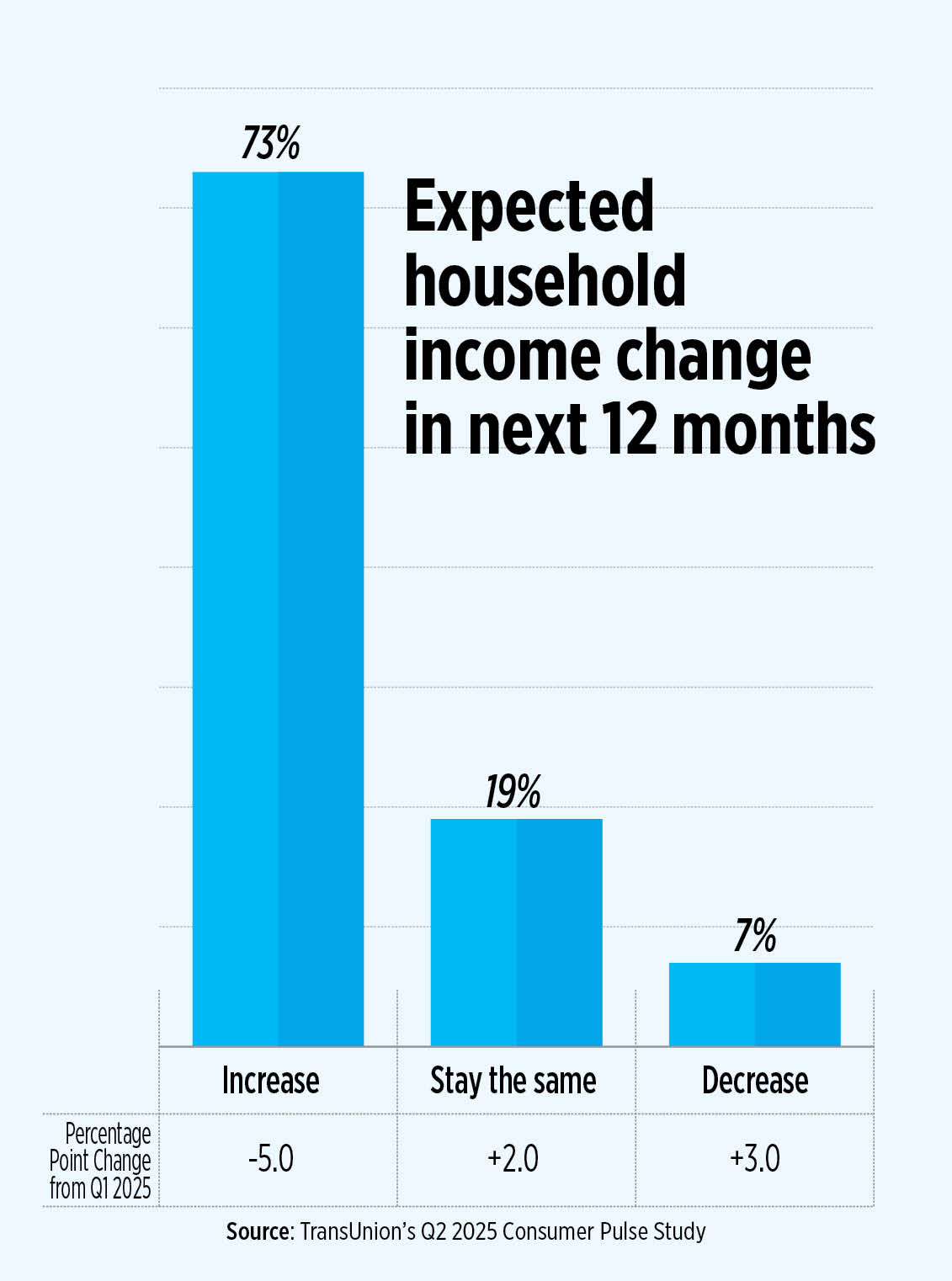
According to the TransUnion report, consumer financial health stayed mostly stable as 41% of consumers suggested a rise in their income for the past three months, while 73% of Filipino consumers expect a rise in come next year, an optimistic outlook on their financial futures.

Still, financial stress is evident with 44% of consumers expecting difficulties in paying bills.

This financial worry mirrors that consumers are cautious in spending and adjusting their savings, driven by concerns in inflation and job securities.

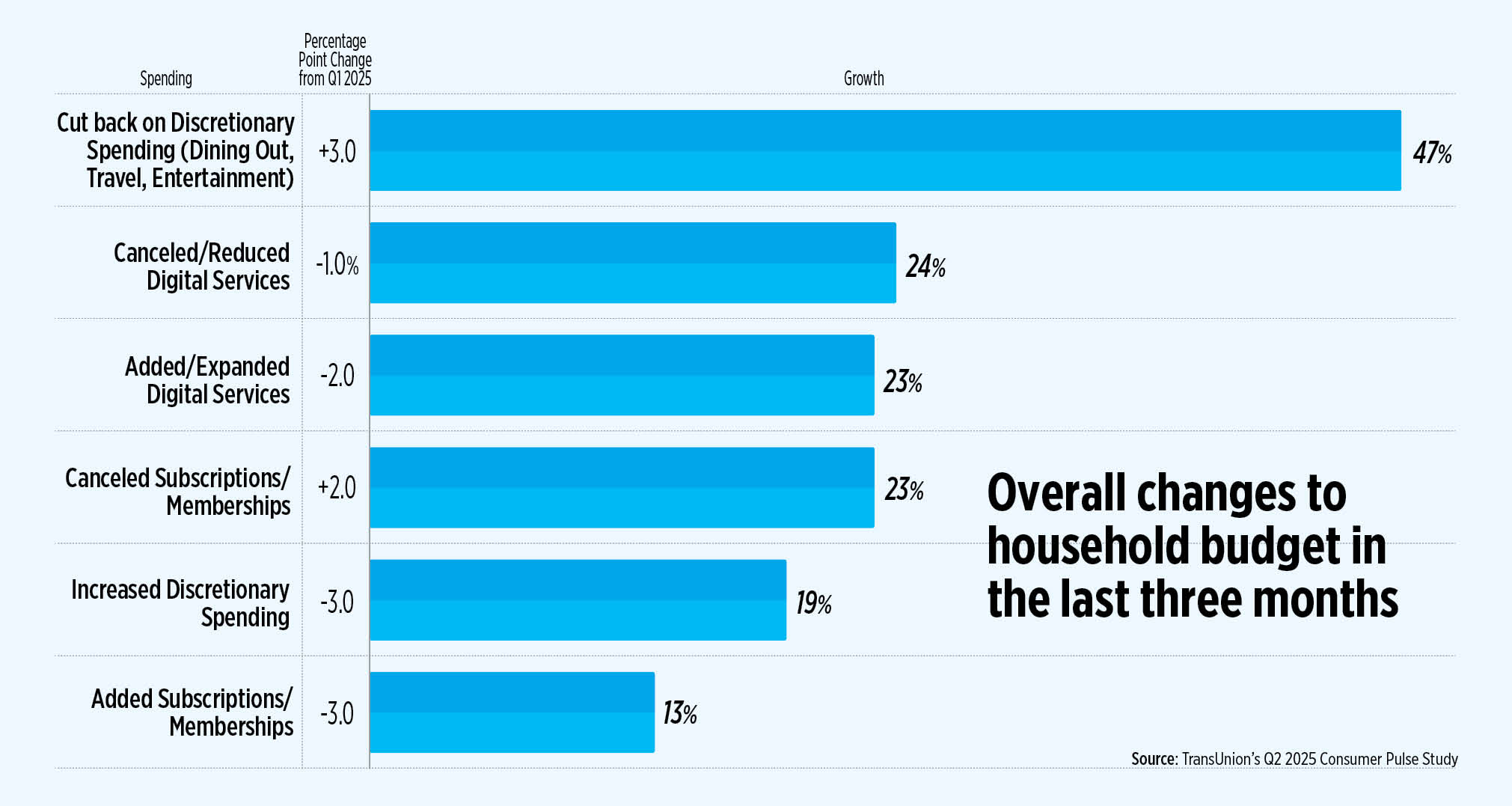
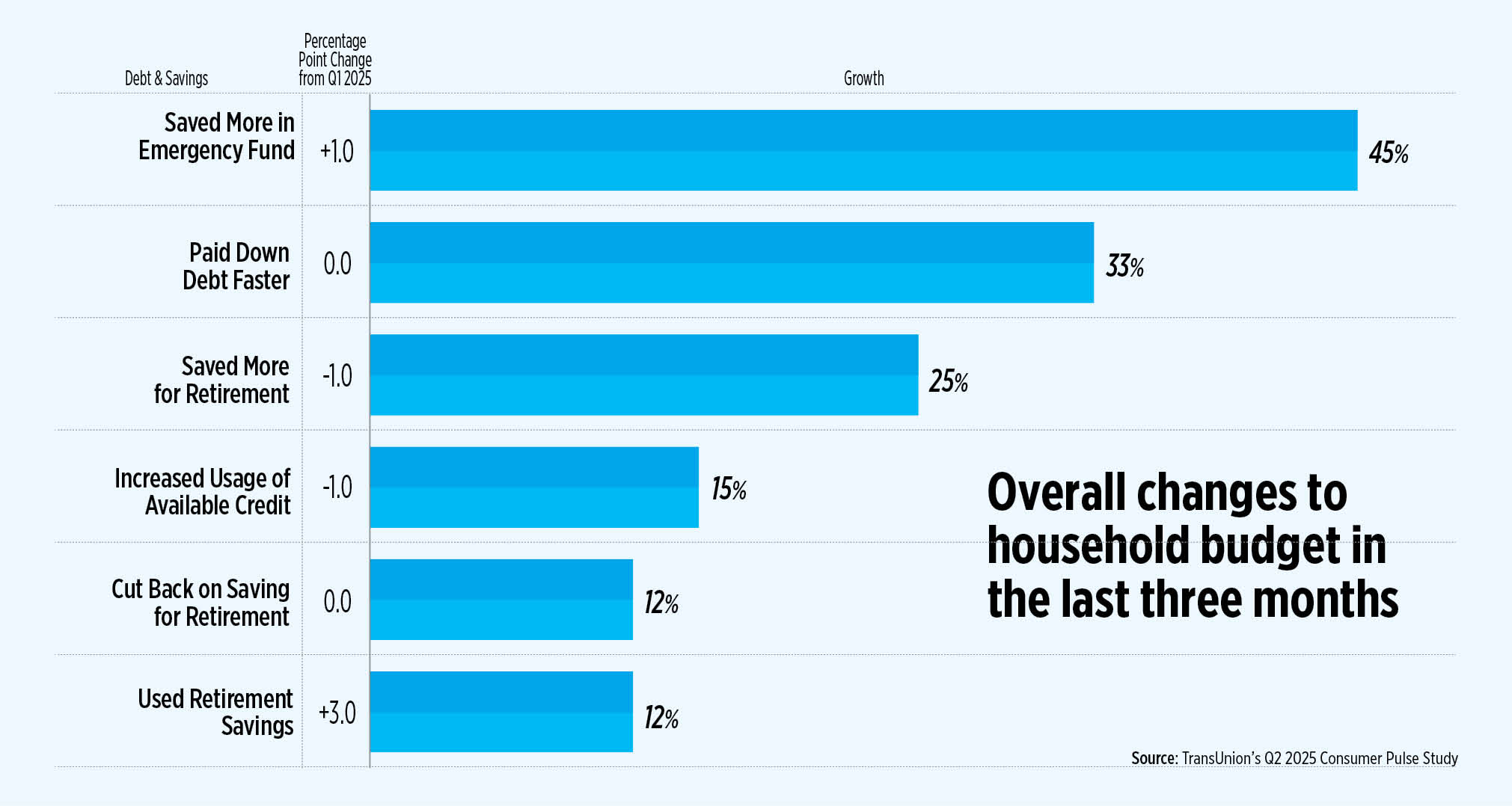
Still, the report highlighted that there was a 45% increase in emergency savings and a 47% cutback in discretionary spending in the past three months.

Moreover, some were upbeat in managing their finances by increasing savings and paying off debt faster.

“Spending patterns reflected a balancing act between optimism and constraint,” the report noted.

“This often leads to a ‘bunker’ mentality as consumers scrimp on spending and buttress their savings for the expected ‘rainy days’ ahead,” he noted.

He cautioned that if this “behavior” cascades among consumers, it could lead to a recession. In turn, businesses may respond to reduce demand by cutting back on productions on their services and goods.

“The shift in savings behavior means many households adopt a more conservative mindset, prioritizing liquidity and financial safety versus ‘wants’ spending — which benefits the consumer, the financial institutions, and the economy in the long run,” Maybank Philippines said in an e-mail.

This provides peace of mind for consumers amid uncertainty and prevents them from falling into debt in emergencies. While they continue to spend, consumers will seek value to justify what they spend.

“Consumers may become more receptive to financial literacy campaigns and products framed around security, preparedness and long-term goals,” Maybank said.

This indicates an increased demand for savings accounts, time deposits and low-risk investment products as the appetite for personal loans and credit card spending tempers.

“Higher savings means better ability to lend out these funds to businesses,” it said, which in turn will boost long-term growth and help strengthen the economy.

For Nicholas Antonio T. Mapa, chief economist at Metropolitan Bank & Trust Co., this behavioral shift aligns with conventional economic thought as households shift their budgets to prioritize essential while cutting back on discretionary spending during challenging periods.

“The growth in personal loans have helped support domestic consumption throughout the period of elevated inflation, delivering robust household expenditure,” Mr. Mapa said in an e-mail.

He added that as inflation slows, this should at least help restore some purchasing power to help households restore savings or pay down loan balances.

SAVINGS AND CREDIT BEHAVIOR
As highlighted by the report, rising prices, job security and interest rates were the sources of caution of consumers and financial institutions are taking countermeasure in addressing these financial woes.

For Rizal Commercial Banking Corp. Credit Cards President and CEO Arniel Vincent B. Ong, financial institutions can ensure their borrowers added value for using their credit cards on everyday essentials to help address rising prices and cost of living pressures

“Lenders can help address the concern on job security (and its resulting income uncertainty) by offering flexible payment programs for customers,” Mr. Ong said in an e-mail.

For Mr. Mapa, the central bank’s lowering borrowing costs provide relief to households and firms.

“Lower interest rates will help firms hire more workers or invest to bolster operations, resulting in increased efficiencies and or job creation,” Mr. Mapa explained.

Latest government data showed inflation picked up 1.5% in August from 0.9% in July. This was the fastest reading since the 1.8% recorded in March.

A year earlier inflation rate was higher at 3.3%.

Meanwhile, in late August, the Monetary Board slashed the target reverse repurchase rate by 25 basis points (bps) to 5% from 5.25%, for a third straight meeting.

Since it began its easing cycle in August last year, the BSP has reduced borrowing costs by a total of 150 bps. In its last two meeting this year, it delivered two 25-bp cuts each in April then in June.

On the other hand, government data also showed that the Philippine economy expanded by an annual 5.5% in the April-to-June period, slower than the 6.5% growth in the same period last year.

However, this was a tad faster than the 5.4% in the first three months.

In the first semester, GDP growth averaged 5.4%, significantly slower than the 6.2% a year earlier.

The latest gross domestic product print (GDP) missed  the lower end of the government’s 5.5% to 6.5% growth target this year.

Results of the study also showed that 58% of Filipinos see access to credit as a “major enabler” of their financial goals. But even so, 57% had dropped their application or refinancing proposal due to fears of rejection resulting from income or work status and the high cost of new credit.

“To meet strong demand for credit while addressing fears of rejection and high costs, banks need to adopt a more inclusive and transparent lending approach,” UnionBank’s Mr. Asuncion said.

This, he added, includes leveraging alternative data such as utility or rental payment history, for credit scoring to assist those with limited credit files.

He noted that ultimately, banks must position credit as an enabler of financial stability, not just consumption.

For RCBC’s Mr. Ong, an effective way for banks to adapt their lending approach is by utilizing nontraditional sources of data.

“Banks have relied on a combination of traditional employment documents proof and data from credit bureaus — which means that first-time borrowers or those working in the gig economy have no access to credit,” he said.

In this day and age where data is king, there are numerous other data points available that can help predict a borrower’s creditworthiness, Mr. Ong said.

“Financial institutions must make a strategic decision to leverage this alternative data in order to expand the population of credit-worthy individuals.”

MANAGING FINANCIAL STRESS
It is worth noting enough that banks should invest in financial literacy or education to aid consumers in making informed decisions to adjust their spending and saving patterns amid inflationary pressures, and economic uncertainty.

For the Bangko Sentral ng Pilipinas (BSP), it said that it has been a pioneer in promoting financial literacy in the country when it established the BSP Consumer Education Committee.

This established a structured financial education program to empower Filipinos in making informed financial decisions.

Efforts include BSP e-Learning Academy, collaborative programs, innovative programs for marginalized sectors, training and capacity building, financial learning sessions, digital platforms, and educated materials.

For RCBC’s Mr. Ong, banks can play a crucial role in enhancing consumers’ financial literacy and health through various strategies such as educational resources, user-friendly tools and apps, transparent information and promoting savings.

“Private financial institutions as well as BSP roll out programs to help grow financial learning and literacy to equip households and firms with the understanding and knowhow to navigate the challenging economic landscape with the help of financial market tools,” Mr. Mapa said.

For Mr. Asuncion, banks in the country and the BSP are investing heavily in financial literacy to help consumers make informed decisions amid inflation and uncertainty.

Initiatives [may] aim to build resilience, promote responsible borrowing, and empower Filipinos to navigate inflationary pressures and economic uncertainty, said Mr. Asuncion.

The central bank strongly urges banks to go beyond providing basic access to financial services and improve in strengthening their clients’ financial health.

“Banks are well-positioned to champion financial literacy because of their direct interaction with consumers and their central role in financial transactions,” the BSP said in an e-mail.

It added that by embedding financial literacy into their products, promoting responsible lending, scaling education through partnerships, and tracking client outcomes, banks can help convert financial inclusion into financial resilience and well-being.

Banks, businesses, and the government should work to shore up confidence in the overall economy, Mr. De Jesus said.

“[This can be done] by loosening credit, such as through interest rate reductions initiated by the BSP, making it easier for borrowing and lending, encouraging business investments that boost the business climate, and ensuring that the ventures we fund will have maximum impact on employment and incomes.”


First Gen, Unilever Philippines renew RE partnership

UNILEVER.COM

FIRST GEN COrp. will supply 10 megawatts (MW) of renewable energy (RE) to seven Unilever Philippines facilities as part of a renewed partnership supporting the consumer goods maker’s operational and sustainability goals.

The agreement covers Unilever’s production and distribution sites in Metro Manila, Cavite, Laguna, and Batangas, First Gen said in a statement over the weekend.

The sites manufacture a range of products, including ice cream, sauces and seasonings, beauty and personal care items, and home care goods.

First Gen will source the power from the geothermal plants of its subsidiary Energy Development Corp. (EDC) in Bicol, Tongonan in Leyte, and Palinpinon in Negros Oriental.

“Since 2017, First Gen has been our partner in helping us reduce the carbon footprint of our manufacturing operations with a steady supply of RE,” said Rondell Torres, Unilever sustainability lead.

“We are committed to continually use RE for our factories and facilities to achieve our operational and sustainability ambitions.”

Carlo L. Vega, First Gen chief customer engagement officer, said the company remains committed to supporting Unilever’s efficiency and sustainability goals.

“First Gen and Unilever share similar concerns over climate change and are doing our part to mitigate risks by choosing to decarbonize,” he said.

First Gen has a total generating capacity of 3,668 MW from geothermal, wind, hydropower, solar, and natural gas plants.

Since 1976, EDC has led the development of geothermal energy in the Philippines, operating facilities across Bicol, Leyte, Negros Island, and Mindanao. — Sheldeen Joy Talavera