Home Blog Page 4970

Mobile testing labs to join ASF containment effort this year
REUTERS

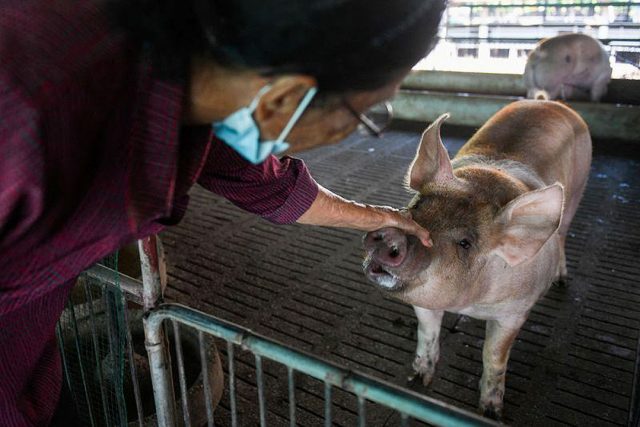
BIOASSETS Corp., an animal health diagnostics company, said it is building up to six mobile biocontainment laboratories in 2023 to address a gap in the market for such services in the hog industry, which is currently dealing with an outbreak of African Swine Fever (ASF).

The company said the mobile labs can help local government units (LGUs) surveil diseases and respond to outbreaks upon detection.

The mobile laboratory project is supported by the Department of Science and Technology’s Science for Change Program, which hopes to harness innovation in science and technology.

The lab is the first of its kind in the Philippines and can serve between 5 and 10 farms per day for diagnostic testing. It is also equipped with a biocontainment facility for handling infectious diseases.

“The mobile labs will allow LGUs to protect the livelihood of many livestock producers, be they small or large scale,” according to Homer D. Pantua, president and co-founder of BioAssets.

“Protecting their livelihoods translates to supporting food security,” he said in an e-mail.

The company is also developing a platform that can perform polymerase chain reaction (PCR) testing in 15-20 minutes, with “comparable accuracy” to the standard, real-time PCR.

“We are in talks with several LGUs who have expressed interest in the platform,” Mr. Pantua told BusinessWorld, adding that each of these labs costs about P27 million, including starter kits. “They appreciate the potential contribution of the (lab) in addressing disease outbreaks in livestock and in protecting the livelihood of their constituents.”

While the initial plan is to serve hog and poultry breeders in Bukidnon, the company hopes to eventually supply its mobile labs to all 82 provincial veterinary offices.

In a March interview, a former Agriculture department consultant on ASF said farmers need better access to confirmatory tests for the disease.

“A lot of LGUs have very limited access to the confirmatory tests,” Fermin M. Diaz said.

The scarcity of testing facilities prolongs the time to confirm a diagnosis, he added. “Tantsiyahan na lang (They end up having to guess).”

The Bureau of Animal Industry reported the presence of ASF in more than three-fourths of the country’s provinces as of April 3.

The ASF genome was published by the BioAssets team in November 2022. This information, according to Mr. Pantua, will guide diagnostics design as well as vaccine development.

The first ASF outbreak was recorded in the Philippines in July 2019. — Patricia B. Mirasol

Filipino Fund, Inc. to conduct annual stockholders’ meeting on May 9 via remote communication


Spotlight is BusinessWorld’s sponsored section that allows advertisers to amplify their brand and connect with BusinessWorld’s audience by enabling them to publish their stories directly on the BusinessWorld Web site. For more information, send an email to online@bworldonline.com.

Join us on Viber at https://bit.ly/3hv6bLA to get more updates and subscribe to BusinessWorld’s titles and get exclusive content through www.bworld-x.com.

How beauty filters like TikTok’s ‘bold glamor’ affect tweens using social media

MYRIAMMIRA-FREEPIK

TIKTOK’s new “bold glamor” filter “enhances” physical features in a way that makes it difficult to distinguish whether someone is using a filter or not, despite its airbrushing qualities.

Unlike its predecessors, this filter allows movement through an AI feature with the filter remaining fixed on when, for example, a hand crosses the face, with fewer glitches.

Users could be left comparing their unfiltered appearance with their “perfect” filtered self. They may start to develop unrealistic goals of perceived physical perfection that affect their self-esteem.

Although the terms of service for most social media platforms require users to be at least 13, a significant number of “tweens” (children between the ages of nine and 12) now have a social media profile.

Online safety lessons in schools tend to concentrate on physical risk and predatory behavior rather than emotional risks that children may encounter, as these may not be as apparent or experienced by adults.

The damaging effect of “filters” (digital image effects that alter a person’s appearance) is less commonly taught.

In my research, I presented eight focus groups with activities to generate discussions with children of 10 and 11 years of age who were in their final year of primary school. One of the activities was related to the use of filters.

Participants were given a set of photographs of people using filters on the social media site Snapchat and were asked questions such as: “How are these different from how they look in real life?” and “why do people use these filters?”

The results demonstrated a clear and distinct gender divide. The boys said they used filters for fun and entertainment, favoring dog ears and exaggerated tongues to “make people laugh.” The girls used filters to create an idealized image that conformed to beauty ideals and for validation in the form of likes and comments.

One girl, Samantha, said: “[filters] make you look perfect and flawless.” Another explained: “I like putting filters on because it doesn’t show my birthmark at all. It takes the blemishes off my face.”

Similarly, tween Mia explained: “when you put a filter on, it makes your skin tone better and it covers up any spots or like any bruises and stuff that you feel insecure about in yourself.”

My findings suggest that girls are internalizing and aspiring to the beauty ideals that they are consuming via social media. There is a pressure to adopt a polished, physical appearance through filters, which may have emotional repercussions.

I also used collaging as an activity for exploring individual experiences. One child, Sophie, chose to show a binary depiction of herself as two halves.

On the social media side, she used lots of different animal prints in triangles to show that you can be lots of different things and there are lots of different parts of yourself.

She explained that the patterns she had chosen looked unnatural, unlike the more realistic filters online.

Because (like other females in the study) she felt that there is an expectation for girls to look a certain way, Sophie also wrote “no one is perfect” on her collage.

For the girls in my research, there was a sense that self-expression was strongly linked to appearance, with a pressure to adhere to certain perceived physical ideals.

In her collage, Karen discussed at length how social media can be an augmented reality and can emphasize feelings of self-consciousness linked to physical appearance.

The characters drawn on her collage show a “real-life” self that had no filter, which “makes her sad” and a “filter self” which used make up and filters to enhance her appearance and made her happy.

She also emphasized the feelings of negative self-esteem that viewing filtered images could have by saying: “People try and make themselves look beautiful and at the end it may really disappoint them.”

Similar research from 2020 also concluded that girls tend to replicate “female” cues popularized through social media patterns, such as exaggerated lips and flawless skin.

Although my research specifically focused on Snapchat, other social media platforms such as TikTok and Instagram also encourage enhancing appearance through filters.

Beauty filters reinforce the message that wearing makeup, looking a certain way and conforming to beauty ideals, is the desired physical state for women. Isabel had a strong message for girls in her collage: “be your own person and stop comparing yourself to others.”

The widespread use of filters is certainly not facilitating this message and it is important that the emotional repercussions of using these appearance altering tools — as well as continually seeing them in social media feeds — is addressed.

Open discussions could help educate girls to learn that these unattainable physical aspirations do not represent reality. — The Conversation via Reuters Connect


Claire Pescott is a Senior Lecturer in Education, University of South Wales

Century Pacific Food’s shares decline due to inflation woes

CENTURY PACIFIC Food, Inc.’s stocks continued to decline last week as investor confidence soured amid elevated inflation, analysts said.

Data from the Philippine Stock Exchange (PSE) showed a total of 17.75 million shares worth P435.68 million were traded from April 11 to 14.

Century Pacific Food shares closed at P24.15 apiece on Friday, down by 1.4% from the P24.50 closing price last April 5. For the year, the stock has fallen by 17.4%.

The company released its full-year earnings in 2022 on April 4, with its net income going up by 6% to P5 billion from P4.22 billion in 2021.

Century Pacific Food also reported that its consolidated revenues reached P62.2 billion.

Analysts attributed the company’s positive revenues to the performance of its Branded business sector, which grew by 16% on the back to consumers choosing alternative products due to elevated inflation.

Globalinks Securities and Stocks, Inc. Head of Electronic Trading Mark Crismon V. Santarina noted in a Viber message that the company’s Original Equipment Manufacturer (OEM) also grew by 4%.

He said that while the market’s volume “remained thin,” he said that there was significant foreign buying activity for Century Pacific Food last week.

RCBC Securities, Inc. Equity Research Analyst Brenda A. Gannaban said in an e-mail note that she believes Century Pacific Food can weather both good and challenging market conditions because they “offer value and premium products overall/essential food items.”

“Although revenues grew 14% [year on year], it translated to a modest net income growth of 6% due to margin erosion on higher raw materials cost, and increased innovation and A&P (advertising and promotional) spend,” she added.

Despite the increase in its earnings last year, the price of Century Pacific Food’s stock has gone down, and analysts said the stock was affected by challenging economic conditions and high inflation.

“The decline in CNPF’s stock price from its last year’s closing price of P29.25 could be attributed to several factors. One of the main reasons could be the overall market conditions, including a bearish sentiment or economic uncertainty, leading investors to sell off their CNPF holdings,” Globalinks Securities and Stocks’ Mr. Santarina said, referring to Century Pacific Food’s ticker symbol CNPF.

RCBC Securities’ Ms. Gannaban said most stocks traded downwards due to a bearish market, and Century Pacific Food still has trading investors because of its “high growth prospects from internally-generated innovations and other acquisitions, and high brand equity.”

Philippine headline inflation eased to 7.6% from 8.6% in February, still above the Bangko Sentral ng Pilipinas’ (BSP) target of 2-4% and 6% forecast for the year. In 2022, headline inflation averaged at 5.8%, beyond the BSP’s 2-4% goal.

Ms. Gannaban expects Century Pacific Food’s net income to post a high single-digit growth.

She said with the company’s high input costs last year seen to keep its income “depressed” in the first quarter, she expects recovery from the second quarter onwards.

Meanwhile, Mr. Santarina expects Century Pacific Food to have posted a net income of P1.2 billion in the first quarter, with his full-year forecast at P5.61 billion.

“To achieve its targets, CNPF should focus on its core business and work towards establishing its market dominance,” he said.

Inflation will continue to put pressure on Century Pacific Food’s earnings this year as higher borrowing costs and weaker consumer demand will affect the food, beverage, and tobacco industry, both analysts said.

“I believe investors would expect better cost controls or margin recuperation moving forward. There probably are some expectations for the recovery of the OEM Export segment, the impact of recent acquisitions like the integration of Ligo in its operations, and the growth trajectory of the promising emerging and new products like milk and pet food,” Ms. Gannaban said.

She placed the stock’s support and resistance levels at P24.20 and P24.80, respectively.

For his part, Mr. Santarina put Century Pacific Food’s support and resistance levels at P22.85 and 25.85, respectively.

“CNPF’s recent acquisition of Ligo and expansion of its coconut OEM facility last year are positive developments for the company, indicating a commitment to growth and strengthening its core businesses. As a result, the company may be well-positioned to maintain its momentum this year,” he added. — B.T.M. Gadon

Bright idea: Vespa Primavera Color Vibe series

Autohub Group President and CEO Willy Tee Ten with Autohub Group VP for PR, Marketing, and Fleet Owee Cruz aboard the special-series Vespa Primavera Color Vibe — PHOTO FROM AUTOHUB GROUP

VESPA PHILIPPINES recently introduced a new series called the Vespa Primavera Color Vibe. The new line is said to be a “tribute to the colorful and carefree Vespa universe.”

The two-wheeler features a special two-tone livery. The body, available in Orange Tramonto or Blue Audace, are matched with side graphics and a footboard in blue and orange. An original contrasting color “stain,” outlined in black, runs diagonally across the entire body through the dedicated graphics on the sides of the front shield and side panels. The decorations of the typical steering cover on the front shield are also matched with graphics, as well as the exclusive wheel rims, made only for this version in a special glossy metallic finish.

The image is completed by a sporty black trim for the headlamp and taillight frames, the profile that runs along the front shield, the crest on the front mudguard, the front suspension spring and guard, the passenger grab handle, and the silencer cover. The saddle is colored black with anthracite stitching.

The Vespa Primavera Color Vibe is available with a 150cc engine, with the displacement indicated in orange and blue on the side panels. Accredited Vespa Philippines dealerships will start selling the model in June, which retails for P235,000.

Cold chain industry says more storage to raise viability of farm businesses

REUTERS

MORE cold storage facilities will help make farming businesses more economically viable, by preserving bumper crops for processing or sale beyond the harvest season, a cold chain industry official said.

“Technically speaking, most food commodities improve their economic viability through cold chain intervention,” according to Anthony S. Dizon, president of the Cold Chain Association of the Philippines.

In an e-mail, Mr. Dizon added: “The primary factors are protection of food safety, extension of useful product life, and minimization of food waste.”

Cold storage facilities preserve fruits and vegetables as well as seafood and meat products until they are ready for market. They reduce post-harvest losses for the farmers, who gain the ability to meet demand even when supply dips over the course of the year.

Asked about possible partnership between the private sector and the government to build more cold storage facilities, Mr. Dizon said that “the possibilities are always there but realistic implementation will depend on the terms of reference.”

According to the Public-Private Partnership (PPP) Center, projects eligible for PPP implementation include the building of storage and processing facilities, with PPPs governed by the Build-Operate-Transfer Law.

“These can be wholly or partly financed, constructed, and operated by private sector partners,” it said.

Mr. Dizon said that the private sector can provide technical assistance in the design, as well as on the construction of the facilities and selection of equipment.

“Viability of investment in cold chain infrastructure is always anchored on the supposition that all components of the supply chain will be functioning in synchrony, from production to distribution and consumption,” he said.

Department of Agriculture (DA) Deputy Spokesman Rex C. Estoperez said on the sidelines of a briefing that the DA is open to partnerships with the private sector.

“We can save on budget resources via partnerships. We can redirect our resources to those priority areas that the President wants to allocate funds to,” he said.

Mr. Dizon added that building cold storage facilities will require “the availability of support infrastructure such as ports, roads and electric power supply.” — Sheldeen Joy Talavera

Philippines remains at ‘high’ risk for humanitarian crises and disasters

The Philippines ranked 30th out of 191 countries with a risk score of 5.4 (out of 10) and a “high” risk class in the INFORM Risk Index Mid2023 edition by the European Commission’s Disaster Risk Management Knowledge Center. The country was tied with Colombia and Madagascar, overall.

Philippines remains at ‘high’ risk for humanitarian crises and disasters

CAMPI/TMA Q1 vehicle sales 2020-2023

CAMPI/TMA vehicle sales 2020-2023

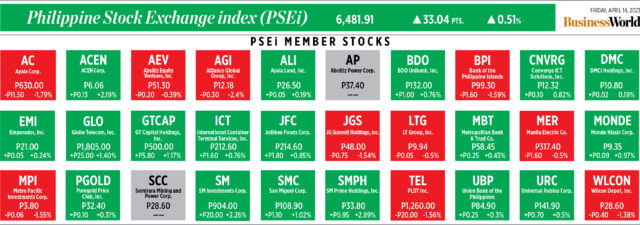
How PSEi member stocks performed — April 14, 2023

Here’s a quick glance at how PSEi stocks fared on Friday, April 14, 2023.


Peso may weaken as investors eye central bank moves

BW FILE PHOTO

THE PESO could depreciate this week on expectations of another rate hike by the US Federal Reserve despite slower consumer inflation in March and a pause in the Bangko Sentral ng Pilipinas’ (BSP) tightening cycle.

The local currency closed at P55.21 versus the greenback on Friday, climbing by five centavos from Thursday’s P55.26 finish, Bankers Association of the Philippines data showed.

However, week on week, the peso fell by 81 centavos from its P54.40 finish on April 5.

The peso opened Friday’s session at P55.22 per dollar. Its worst showing was at P55.27, while its intraday best was at P55.06 versus the greenback.

Dollars traded increased to $1.39 billion on Friday from the $1.198 billion recorded on Thursday.

The peso appreciated on Friday as mixed US data bolstered expectations of further Fed rate hikes, Rizal Commercial Banking Corp. Chief Economist Michael L. Ricafort said in a Viber message.

A slew of mixed economic data including retail sales, industrial production and consumer sentiment cemented expectations that the Fed will hike rates another 25 basis points (bps) at next month’s policy meeting, Reuters reported.

Those expectations were underscored by Atlanta Fed President Raphael Bostic, who said another 25-bp hike could allow the Fed to end its tightening cycle, even as Chicago Fed President Austan Goolsbee called for the central bank to be prudent.

The Fed raised borrowing costs by 25 bps at its March 21-22 meeting, bringing its target interest rate to a range between 4.75% and 5%.

Since March 2022, it has hiked rates by a total of 475 bps.

The US central bank’s next meeting is on May 2-3.

In a report on Thursday, the US Labor department said its producer price index (PPI) for final demand dropped 0.5% in March, the most since April 2020, after being unchanged in February.

In the 12 months through March, the PPI increased 2.7%. That was the smallest year-on-year rise since January 2021 and followed a 4.9% advance in February.

On Wednesday, the US Labor department reported that the US consumer price index (CPI) climbed 0.1% last month after advancing 0.4% in February.

In the 12 months through March, the CPI increased 5%, the smallest year-on-year gain since May 2021. The CPI rose 6% on a year-on-year basis in February.

Meanwhile, retail sales fell more than expected in March as consumers cut back on purchases of motor vehicles and other big-ticket items, signs that the economy was slowing at the end of the first quarter because of higher interest rates.

On the other hand, initial claims for state unemployment benefits rose 11,000 to a seasonally adjusted 239,000 for the week ended April 8.

For this week, the peso could weaken anew amid bets of another rate hike by the Fed and a pause by the BSP, Union Bank of the Philippines, Inc. Chief Economist Ruben Carlo O. Asuncion said in a report.

“The latest strong US labor data that upheld Fed rate hike expectations despite softer US March CPI, onshore trading adjustments after the long Lenten holidays, and risk of a premature BSP rate pause could sustain a trading range above P55 according to our traders,” Mr. Asuncion said.

The central bank may consider pausing its monetary tightening next month if April inflation does not accelerate, BSP Governor Felipe M. Medalla said last week.

He said a pause in interest rate increases was possible “if the April CPI is not higher than the March CPI” or if there is “zero or negative month-on-month inflation.”

The BSP last month hiked benchmark interest rates by 25 bps to help bring down elevated inflation.

This brought the yield on its overnight reverse repurchase facility or its key rate to 6.25%.

Since May 2022, the central bank raised borrowing costs by a total of 425 bps.

The Monetary Board’s next meeting is on May 18.

Philippine headline inflation slowed for a second consecutive month in March to 7.6% from 8.6% in February.

For the first quarter, inflation averaged 8.3%, well above the BSP’s 6% forecast and 2-4% target for the year.

Mr. Asuncion expects the peso to trade between P55 and P55.50 against the dollar, while Mr. Ricafort sees it moving from P54.90 to P55.40. — A.M.C. Sy with Reuters

PSEi may move sideways amid lack of leads

By Adrian H. Halili

PHILIPPINE stocks are expected to move sideways this week as investors await leads amid worries of a possible recession in the United States and more rate increases by the US Federal Reserve.

The benchmark Philippine Stock Exchange index (PSEi) gained 0.51% or 33.04 points to close at 6,481.91 on Friday, “as investors cheered more signs of cooling inflation in the US,” Philstocks Financial, Inc. Research Analyst Claire T. Alviar said in a Viber message.

The broader all-share index went up by 0.41% or 14.25 points to 3,480.77. Week on week, the PSEi shed 0.1% or 6.6 points.

US inflation picked up to 5% in March — slowest in almost two years — from 6% a month earlier, according to the Bureau of Labor Statistics.

Stocks would probably move sideways this week in the absence of fresh leads, Jovis L. Vistan, vice-president at AB Capital Securities, Inc., said in a Viber message at the weekend.

“The market will continue to move on the same narrative of high inflation, interest rates, and US recession concerns,” he said. “This will keep buyers at bay.”

Stocks would likely trade narrowly “as market participants continue to take cues from developments in the US,” Toby Allan C. Arce, head of sales trading at Globalinks Securities and Stocks, Inc. said in a Viber message.

Concerns of a possible recession resurfaced after minutes from the US Fed’s March policy meeting showed that several members of the Federal Open Market Committee were worried about the failure of two regional banks.

They said a “mild recession” might be possible, with a recovery in 2024-2025.

Mr. Arce said Fed officials had cited the need for further rate increases to curb inflation.

“The hawkish remarks are likely to push investors to increase their bets on further Fed monetary policy tightening ahead, just as data showed signs the US economy is slowing but not fast enough to stop the Federal Reserve from raising interest rates again in May,” he added.

The Fed raised key interest rates by a quarter of a percentage point last month to 4.75%-5%. It has raised rates by 475 basis points since March 2022.

The next Fed meeting is on May 2-3.

Overseas remittance data due on Monday could “show some residual uptick given the favorable exchange rate, but these are likely to be offset by the higher costs of living in both the host and recipient countries,” Mr. Arce said.

He placed the PSEi’s support at as high as 6,394 and resistance at as high as 6,645. Mr. Vistan put support at 6,439 and resistance at 6,640 points.