Home Blog Page 4880

The tenuous grand alliance breaks up

WIRESTOCVK-FREEPIK

The demotion of Senior Deputy Speaker Gloria Macapagal Arroyo to Deputy Speaker last Wednesday drew both formal statements and casual comments from the parties involved. Many are contradictory, some cryptic, and others incongruous. Here are my musings on those statements and on the implications of the originally trivial matter of the unceremonious demotion from a ceremonial position turned into an event of national import.

The initial reaction of the person at the center of the maelstrom, Ms. Macapagal Arroyo, was, “It’s the prerogative of the House.” Subsequently, she issued this lengthy statement: “When I learned that there were reports that I was suspected of plotting a ‘coup’ against Speaker Romualdez, I decided I must speak out to clarify my political position. Indeed, some of my actions may have been misconstrued, such as my recent trip with a delegation of Congressmen to Korea for some official meetings.

“To be clear, my political objectives are three: First, to represent the 2nd district of Pampanga. Second, to support the legislative agenda of Speaker Romualdez and President Marcos. Third, to use whatever experience I have as a former President to help out when I am called upon to do so.

“Outside of my role as Congresswoman, my public interest going forward is to help reduce tensions between the United States and China, given that I was strongly allied to both countries when I was President. This time, I am a mere Congresswoman, so issues of national importance no longer depend on my role in Congress. Thus, I have no compelling reasons to change my mind about foregoing my ambitions for the Speakership.”

If she thought that she was suspected of plotting a coup because of her actions, I think she should have explained those actions, particularly that recent trip with a delegation of congressmen to Korea. Apparently, House Speaker Ferdinand Martin Romualdez was not in on that official meeting of congressmen in Korea, otherwise it would not have caused suspicion of a sinister scheme. But Ms. Macapagal Arroyo did not say what it was all about to allay negative impressions.

She also said that now that she is a mere congresswoman, issues of national importance no longer depend on her role in Congress. If so, why did she join President Ferdinand “Bongbong” Marcos, Jr. on all his foreign trips, including that one to Davos?

Reacting to the demotion of Ms. Macapagal Arroyo to Deputy Speaker, President Marcos Jr. said, “I really see it as just a run of the mill [thing] that they do in the House. I think we should also be careful to not read too much into it.” The President himself reacting to a “run-of-the-mill” thing done in the House and cautioning people from reading too much into it just gave the matter some significance.

The day after Ms. Macapagal Arroyo was demoted to Deputy Speaker, Vice-President Sara Duterte resigned from the Lakas-Christian Muslim Democrats (Lakas-CMD) party, which helped her get elected to her present position. She declared: “I am here today because of the trust of the Filipino people in me to lead and serve them and the country, and this cannot be poisoned by political toxicity or undermined by toxic political powerplay.

“I am grateful to all the party members for the support that also once demonstrated that unity is possible to advance our shared dreams for our fellow Filipinos and our beloved country. Nothing is more important to me than being able to serve our fellow Filipinos and the Philippines with President Ferdinand Marcos, Jr. leading the way.”

If she was sickened by the toxic powerplay within Lakas-CMD, she should have disciplined, if not expelled, those who engaged in combative politics. After all, she was chairperson of the party. But I surmise she resigned because she sensed the inevitability of the breakup of the alliance between Gloria Macapagal Arroyo and the first cousins Martin Romualdez and Bongbong Marcos. She must have decided “I am outta here!” She will probably go on her own from here on.

On VP Duterte resigning from Lakas-CMD, President Marcos Jr. had this to say: “You know that VP Inday Sara is very plain spoken. She really means what she says. She has too much work to do that she cannot… allow herself to be distracted. That is the way I see it.” I take that as an endorsement of VP Duterte leaving Ms. Macapagal Arroyo’s party. He is like saying, “That’s right, Inday Sara, don’t get involved in the Lakas-CMD intramurals, don’t take sides. You are better off leaving the tumultuous party.”

House Majority Leader Mannix Dalipe said that the move to replace Ms. Macapagal Arroyo as Senior Deputy Speaker with Rep. Aurelio Gonzales, Jr. was meant to “unburden” her from “the heavy load required from the position.” But the position was only ceremonial, there was nothing to unburden.

It is said the position was specially created for her. That is probably true. She is known to want to be “first among equals.” That is what her former classmates in Assumption College say. Her father, Diosdado Macapagal, was the Vice-President and subsequently the President of the Philippines when the young Gloria was a student in Assumption.

Anyway, even if the position of Senior Deputy Speaker were only ceremonial, the imperious Gloria Macapagal Arroyo would still want it. Her removal from it and the unceremonious way she was yanked out of it would have serious repercussions on the people responsible for the caper. Hell has no fury like Gloria Macapagal Arroyo crossed.

Those who testified that there was bribery in the deal involving the National Broadband Network (NBN) and China’s telecommunication giant ZTE suffered serious consequences. They were businessman Joey de Venecia, son of then Speaker Jose de Venecia; Jun Lozada, technical consultant of Romulo Neri, National Economic and Development Authority Director-General; and Neri himself. They accused President Macapagal Arroyo’s husband Mike and Commission on Elections Chairman Benjamin Abalos of being intermediaries in bribery.

As no wrongdoing could be pinned against businessman Joey for which he could be punished, President Macapagal Arroyo took it out on his father. Jose de Venecia was ousted as Speaker by the then-president’s minions in the House of Representatives, never mind if Jose de Venecia was the one who accommodated the party-less Gloria Macapagal Arroyo as his vice-presidential running mate in the 1998 general elections.

Jun Lozada was abducted by agents of the state when he arrived at the airport from Hong Kong where he was sent to keep him away from the Senate committee investigating the aborted NBE-ZTE deal. Had he not been rescued by the La Salle Brothers, he would probably be considered “missing” or “disappeared.” In 2009, the year after the NBN-ZTE scandal, the Ombudsman filed graft and corruption charges against Lozada for selling 6.599 hectares of public land to his brother Orlando when Jun was president of Philippine Forest Corp., a government entity. He and Orlando were found guilty and sentenced to six to 10 years in jail.

Jun and Orlando Lozada are in jail while former Congressman Prospero Pichay, convicted of three cases of graft valued at P780 million and sentenced to 18 years, is not.

Romulo Neri went into hiding during the Senate hearing on the NBN-ZTE deal. He was subsequently charged with grave misconduct in the handling of the NBN-ZTE scandal. He was eventually convicted and is perpetually barred from holding public office.

When there is a power struggle at the highest levels of Philippine officialdom, four Cabinet members would become the subjects of loyalty checks because of the sensitive positions they hold. They are the Executive Secretary, the secretaries of the departments of Interior and Local Government (DILG), Defense, and Justice.

The Executive Secretary is the President’s Man-Friday and also the eyes and ears of the President. He knows all the secrets in the presidential palace. He must be extremely loyal to the President. The DILG secretary is the liaison between the president and the governors and mayors. Under him is the Philippine National Police. The Defense secretary is the commander of the Armed Forces of the Philippines, including the Presidential Security Guards. The Justice Secretary is the chief prosecutor of the country. Under him is the National Bureau of Investigation.

Executive Secretary Lucas Bersamin had no previous ties with Presidents Marcos, senior or junior. He was appointed a judge by President Cory Aquino, associate justice of the Supreme Court by President Macapagal Arroyo, and named Chief Justice by President Rodrigo Duterte.

DILG Secretary Ben Hur Abalos was the general campaign manager of the Bongbong Marcos-Sara Duterte presidential ticket in the 2022 general elections. He is the son of Benjamin Abalos, an anti-Marcos activist during Martial Law. Ben Abalos, Sr., as mentioned above, was Commission on Elections chairman during President Macapagal Arroyo’s incumbency and alleged to have been her bagman in the anomalous NBN-ZTE deal.

When Defense Secretary Carlito Galvez was an Army lieutenant, he joined the Reform the Armed Forces Movement (RAM), a loose organization of military officers, mostly alumni of the Philippine Military Academy, who clamored for reforms in the much-politicized military establishment during the reign of President Ferdinand Marcos, Sr. He was on the side of the rebels during the EDSA uprising. He was named Chief-of-Staff of the Armed Forces by President Duterte.

When Justice Secretary Crispin Remulla was in the House of Representatives, he was always on the side of the sitting president. During President Duterte’s presidency, he was a staunch ally. It should be noted though that his father, Johnny Remulla, political warlord of Cavite, was close to President Marcos, Sr.

We will know in the days ahead as the power struggle intensifies if there is collateral damage among the four Cabinet members.


Oscar P. Lagman, Jr. has been a keen observer of Philippine politics since the 1950s.
The Laffer Curve of Philippine tobacco taxation

One important concept in Public Finance Economics is the Laffer Curve. It shows a bell-shape relationship between tax rates and revenues: as tax rates increase, revenues also increase initially then plateau at some point and start to decline after. The concept was developed by US economist Arthur Laffer.

Consider income tax. At 20% to 30% tax, people would tolerate it. But as income tax rises to 40% and higher as their income rises, some people would reduce work to an income level where the tax rate is only 30% or lower and instead enjoy more rest. Other people would misdeclare their real income, like getting a second or third job and not declaring it because their tax rate would then jump to 50% or higher. This undeclared, unreported income is considered among “underground economy” activities and tax collection on this is zero. And the government’s overall revenues start to decline.

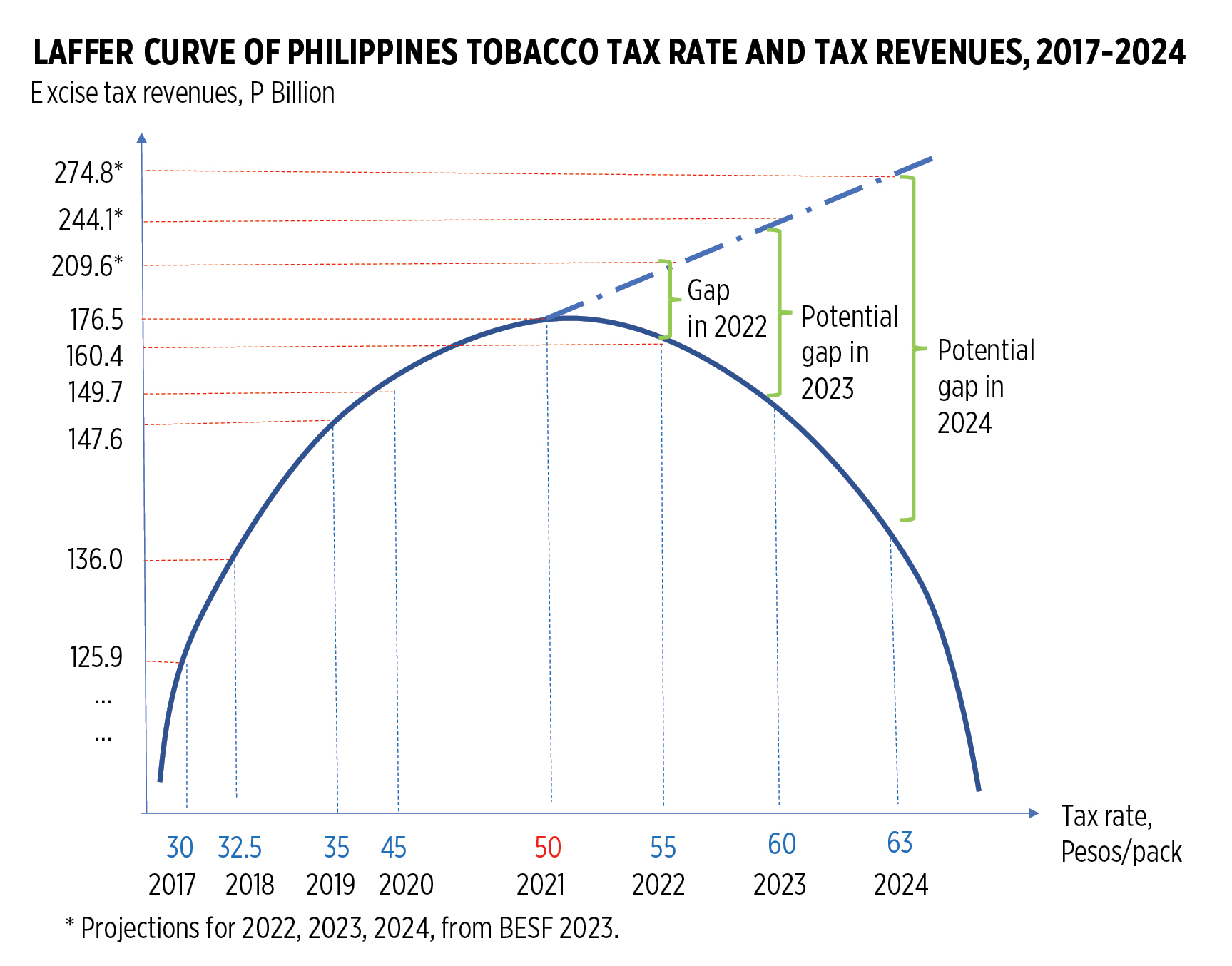
This column has discussed the Philippines’ excise tax revenues from “sin” or “public bad” products — alcohol, mining, petroleum, sugar-sweetened beverages, tobacco — before (“Taxpayers’ burden from uniformed pensions,” May 1). Tobacco tax revenues were the highest in the following years: P126 billion in 2017, P136 billion in 2018, P148 billion in 2019, P150 billion in 2020, P176 billion in 2021, and P160 billion in 2022. Tobacco tax revenues experienced a decline for the first time in 2022, coinciding with the big tax rate imposed — P55/pack — and as more people shifted to smuggled or illicit tobacco products which are very cheap.

This column has also previously discussed estimates of tax losses from cigarette smuggling alone: Congressman Joey Salceda, the Chairman of the House Committee on Ways and Means, put it at P30 billion/year; former party-list congressman Jericho Nograles, said it was P31 billion/year; Jesus Aranza, Chairman of the Federation of Philippine Industries (FPI), said it was P25 billion/year; and Bureau of Internal Revenue (BIR) Commissioner Romeo Lumagui, Jr., put it at a whopping P100 billion/year. See Table 2 in the column “Addressing high inflation and tax leakage” of March 13.

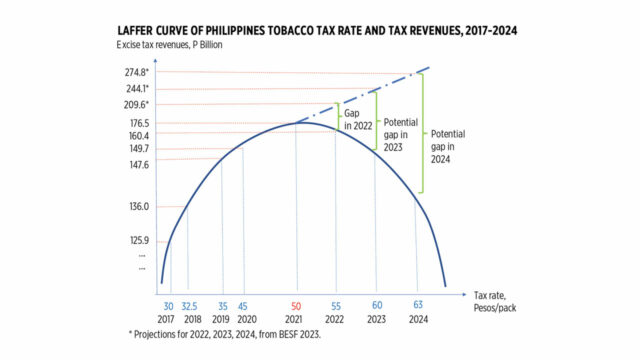
I constructed this illustration of a Laffer Curve using data on actual tobacco tax collections from 2017-2022, then projected collections for 2022-2024, and the tax rates per pack. So a tax rate of P30/pack in 2017 yielded P126 billion in revenues; P50/pack in 2021 yielded P176 billion revenues; P55/pack in 2022 yielded P160 billion, versus the projection of P210 billion in the Budget of Expenditures and Sources of Financing (BESF) 2023.

This represents P50 billion (P210 billion minus P160 billion) in unrealized revenues, which is midway and consistent with the various estimates of P30 billion to P100 billion in yearly tax losses from tobacco smuggling and illicit trade.

If this trend continues, the potential revenue gap in 2023 could be as high as P90 billion, and even larger in 2024 (see Figure 1).

So, from a Laffer Curve analysis, the optimal tax rate — where tax revenue is largest — is P50/pack. The P55/pack imposed last year yielded a decline in revenues. Government is worse off while smugglers, criminals, and their protectors in government are better off.

Assume tax losses of P50 billion from smuggling in 2023 and beyond. If this can be cut to just half via better law enforcement by national and local governments, the P25 billion in additional revenues can do any of these, and more:

1. If used to subsidize electricity prices, this will lead electricity that is cheaper by P0.23/kwh (P25 billion/110 billion kwh), for all on-grid consumers nationwide.

2. If used to retire some public debt, this will lead to savings of P26.5 billion/year (P25 billion principal plus P1.5 billion in interest at the current 6% a year Treasury-bills and Treasury-bond rates).

3. Such savings can fund a Targeted Cash Transfer (TCT) program covering 7.60 million households. For 2022, the Department of Budget and Management released P27.1 billion for the TCT program — P19.43 billion last year and a follow up of P7.68 billion last week.

Last week, on May 18, The Economist Impact organized a big conference, “Global Anti-Illicit Trade Summit, South-East Asia,” at the Shangri-La The Fort at BGC in Taguig City. The keynote speech was given by BIR Commissioner Romeo Lumagui, Jr. Among the things he said was, “the damage that illicit trade can wreak on an economy… most immediate impact is the loss of tax revenues that are urgently needed to fund development efforts.” He also pointed out the “unfair competition between the players in these illegal activities and legitimate business enterprise… money generated from illicit trade is used to fund organized crime, resulting in heightened security risks both locally and internationally.”

Then he discussed four measures that the government can take to control smuggling and illicit trade, especially of tobacco products. These are: a.) improved border controls, b.) enhancement of intelligence networks and interagency coordination between the country’s key law enforcement agencies, c.) have a comprehensive legal framework on trade of products in “brick-and-mortar” stores and e-commerce platforms, and, d.) strict enforcement of applicable laws and regulations against illicit trade and new anti-illicit trade legislation.

I think these measures are practical and workable. In addition, the Commissioner and Congress may also consider two other policies that I propose.

One, freeze the tobacco excise tax to between P50 to P55/pack. Reduce the price gap between legitimate tobacco — the cheapest pack now costs P120 (P60 of which is excise tax alone) vs the prevailing smuggled tobacco price of only P40/pack. A lower price differential between the legal and illegal products can lead to reduced consumption of the latter.

Two, partially peg the annual budget of law enforcement agencies like the Philippine National Police, Philippine Coast Guard, and National Bureau of Investigation on revenue collections from excise tax, especially tobacco products. If excise tax collections (with the oil excise tax removed) flat line or decline, these agencies’ budgets will be affected for the worse. This way, there is an incentive among the agencies to strictly enforce laws against illicit trade and products.

FEWER BIRTHS
Also last week, the Philippine Statistics Authority (PSA) released an update on monthly vital statistics for 2023. To save space, I computed the monthly data to January-November averages, as the December 2023 data is still incomplete.

There has been an alarming, consistent decline in the number of births in the Philippines starting during the 2020 lockdown, then the mass vaccinations starting 2021. There were nearly 30,000 fewer births a month in 2022 than in 2019. This is not good (see Figure 2).

The lockdowns of 2020-2021 plus the mass vaccinations of 2021-2022 — or political tyranny plus medical tyranny — coincided with, if not triggered, the reduction of births in the Philippines.

The proposed Senate Bill 1869 creating a new bureaucracy —the Center for Disease Control (CDC) — is a dangerous bill. Among the coercion explicitly provided for in the bill is “Promote treatment, vaccination, or immunization against a contagious disease, compelling the isolation or quarantine of persons who are unable or unwilling, for reasons of health, religion, or conscience, to undergo immunization or treatment” (Section 13, #5).

Mandatory vaccination or mandatory isolation is equivalent to mandatory discrimination. The vax-vax-vax narrative and business has contempt for the natural immunity developed by people and only believes in “vax immunity.” It only believes in virus mutation but not human mutation in response to new viruses and bacteria. It is a dishonest narrative and now senators want to institutionalize the dishonesty via legislation. SB 1869 is political and medical tyranny. It should not be passed.


Bienvenido S. Oplas, Jr. is the president of Bienvenido S. Oplas, Jr. Research Consultancy Services, and Minimal Government Thinkers.

minimalgovernment@gmail.com

What innovation means for the Philippines

PIKISUPERSTAR-FREEPIK

THE ADMINISTRATION argues that the future of the nation is “innovation,” as this is the catalyst to sustaining growth. On paper, this certainly looks like a very defensible strategy. The Philippine Development Plan (PDP) 2023-2028’s Chapter 8: Advance Research and Development, Technology, and Innovation, lays out strategies, programs, and legislative priorities to be pursued to promote innovation among industries, and identifies metrics to measure the country’s progress in harnessing research and development, technology, and innovation.

In this article, I clarify where the idea that innovation matters comes from, and discuss what type of innovation the Philippines needs in order to sustain growth.

Innovation refers to the creation of a new idea, method, device, product, service, or process; or to the introduction or use of such novelties in economic and social spheres. Innovation matters to an economist because it leads to productivity gains. These can be passed on to workers in the form of higher wages, and to consumers in the form of lower prices and products of higher quality. The term “innovation” is used in the literature to mean both original inventions and the creative use of existing products or processes. Economists argue that the former is what advanced economies do — that is, invent. This is so because their governments and companies have developed national innovation systems and invest in research and development (R&D). This is what allows them to make high cost, complex (unique) products and systems such as airplanes, robotics equipment, satellite systems, intelligent buildings, submarines, dams, luxurious yachts and cruise liners, or nuclear power plants. These are not just products but entire “systems” that require knowledge and coordination that most developing countries do not have. Historical experience tells us that this type of innovation is passed on to workers in the form of higher wages.

A country’s potential (maximum) growth is given by the sum of the growth rates of the labor force and labor productivity. Both are low in advanced economies, with the consequence that growth is low. In many of them, labor force growth is zero or even negative. Labor productivity growth is also relatively low because they are on the technological frontier, which means that firms are already highly mechanized and have high organizational capabilities (these refer to how to organize the flow of work in both a manufacturing shop floor and in an office). Therefore, the level of labor productivity is high in developed countries but, at the same time, the growth rate is low. If they want to grow, they need to create new products, invent. Innovation and R&D became buzzwords in the 1980s and 1990s in the literature that was created to explain growth in the developed countries, and not in the developing nations. Yet, many scholars started trying to explain growth in developing countries by appealing to the innovation paradigm.

Aren’t developed countries inventing new products? Yes, but many economists believe that today’s technologies are not as revolutionary as those of the late 19th and early 20th centuries, the Second Industrial Revolution (electricity, the internal combustion engine, running water, indoor toilets, communications, entertainment, chemicals, petroleum). The introduction and spread of these technologies lasted until the 1970s, and delivered very high growth rates and huge increases in humanity’s living standards. The technologies of the Third Industrial Revolution (computers, mobile phones, the web) did not do the same, with the consequence that growth since the 1970s in the developed nations declined significantly. We do not know yet whether the technologies of the Fourth Industrial Revolution (Artificial Intelligence, nanomaterials, blockchain, neuro technologies, synthetic biology) will do the same as those of the Second.

The situation in developing countries is different. They do not create new products. At best, they do process innovation (small changes in products created by developed countries). These types of innovations most often are not transferred to workers in the form of higher wages but instead lead to lower prices. In these countries, potential growth can be high, as labor force growth is still positive (certainly it is in the Philippines), and labor productivity growth is significant because developing countries are adopting the technologies created in the advanced economies. This type of progress is called behind-the-frontier catch up. This is what the East Asian countries did during the period of high growth in the 1970s and 1980s. South Korea is the best example. China’s labor force growth has already reached developed-nation rates — zero and even negative. Hence, output growth is about labor productivity. China is still adopting technologies from the advanced nations and, at the same time, developing its own (innovating and inventing) and competing with the advanced economies in the most advanced sectors. No other developing nation can do this.

The Philippines is clearly far from the technological frontier. Moreover, it does not have the capabilities to invent and compete through research at the frontier, certainly not in the areas of the Fourth Industrial Revolution. The optimal strategy is to accelerate the behind-the-frontier catch up by adopting technologies from the advanced nations. This is about learning, adopting, and improving fast what others have done. It is also about improving firms’ organizational capabilities — low in many Filipino companies. This is productivity-enhancing and a form of innovation that does not require huge investments in capital. This is where the government should help small- and medium-size Filipino companies. There is nothing wrong with this — quite the opposite. This is what the successful East Asian countries did. Filipino innovation that translates into productivity will hardly come from pure research and development.

The above considerations do not imply that a relatively poor nation cannot innovate at the frontier in some sectors. Besides China, take the case of Vietnam. It has developed its own electric automobile, the VinFast. What is impressive is that it has done it in less than a decade. It is already making inroads in Europe and in the United States, some of the world’s most sophisticated markets. Vietnam is clearly determined to nurture its new national champions with a package of proactive trade and industrial policies. This requires a very clear and well-focused industrial policy that targets a few products, led by the government and a group of companies willing to invest, develop a competitive product, and sell it to the whole world, not just in the domestic market. Vietnam will certainly move forward. It is already slightly ahead of the Philippines in GDP per capita, and it will continue opening the gap in the coming decades.

I close this article with a reference to education. What type of workers needed to undertake behind-the-frontier catch up? Surely education matters for innovation and growth. Yet, one can hardly argue that for the Philippines as a whole, the key constraint on growth is education. There might be specific sectors that lack good professionals but this is not true at the aggregate level of the nation. This is a country where helpers, guards, and drivers, have college degrees. Claiming that education is the binding constraint is barking up the wrong tree. When today’s advanced economies reached high income status in the 20th century, it was not because half of their labor forces had PhDs.

What is true is that today’s technological world has magnified the returns to those with strong math and science skills and who can use them in fields such as finance, software development, or genetics. This is increasing inequality in both developed and developing countries. In the Philippines, and given that it is not a leading nation in the development of advanced technologies, this group represents a very small percentage of the labor force. What the Philippines needs is a well-trained labor force: workers who can perform in an office and in an assembly line, who can read and write, understand a manual, and who can be easily redeployed to perform news tasks. I am talking about plumbers, electricians, carpenters, bricklayers, mechanics, workers who can build a road properly, mid-level technicians, and workers with skills to make quality products (shoes, furniture) that meet international standards and can compete in world markets. The skills of these workers do not require college degrees, and much less graduate degrees. And while it is important to think about the skills that will be needed for tomorrow’s jobs, the nation needs jobs for the workers it has today. If the education paradigm were true, it would imply that the Philippines would have to wait for a new whole generation of “well-educated” workers; and also, that today’s Filipino workers cannot do what Korean or Singaporean workers did in the 1970s, what Chinese workers did in the 1990s and 2000s, and what Vietnamese workers seem to be doing today.

I reiterate that certainly innovation matters for the future of the nation, but we must be clear about what type of innovation makes sense and is feasible in the Philippines. This will be the result of fast assimilation and adaptation of advanced technologies, not of research and development (except in well targeted areas), and improvement of firms’ organizational capabilities to increase productivity.


Jesus Felipe is a distinguished professor of Economics and the director of the Angelo King Institute, De La Salle University.

David Carlos rules FIBA 3×3 Manila Masters Dunk contest 

FILIPINO high-flyer David Carlos soared to another title, leaving over fancied counterparts to rule the Chooks-to-Go FIBA 3×3 World Tour Manila Masters 2023 Dunk Contest over the weekend at the Glorietta Activity Center in Makati.

Mr. Carlos, 34, scored 55 points on two roaring dunks in the final round for his another crown in the 3×3 dunk circuit that capped the country’s magnificent hosting of another FIBA 3×3 World Tour leg.

He bested Australia’s Brodie Stephens and compatriot Daniel Marcelo for a $4,000 grand prize after jumping over four people for 28 points in his first attempt and completing a “tetris” slam over two individuals piled up on top of each other for 27 points in the second dunk.

“Against the time, with two missed attempts, I didn’t lose hope. This is for the fans. I thank my Chooks-to-Go family for their unwavering support,” said Mr. Carlos, who beat the buzzer in his third try.

Mr. Carlos’ win made up for the early exit of Manila Chooks in the pool play with a 0-2 slate following losses against Utsunomiya BREX EXE, 22-18, and eventual champion Ub Huishan NE of Serbia, 21-9.

Ub, the world No. 1 3×3 team, bested China’s Futian, 21-17, for its second straight Manila Masters championship and $40,000 grand prize.

Strahinja “Doctor Strange” Stojacic fired six points and was named the Manila Masters MVP. Marko Brankovic and Dejan “The Maestro” Majstorovic, added nine and six points, respectively.

“We really played well and we deserved the championship. Every team wants to beat us because we are the number one team in the world, so we have to stay focused,” Mr. Stojacic said.

Futian settled for a bridesmaid finish and a $30,000 prize while its fellow Chinese team Beijing took home $22,000.

Up next for the Philippines in 3×3 pro circuit hosting is the Cebu Masters in September. — John Bryan Ulanday

Road Warriors win first ‘coach challenge’ in PBA game

NLEX may have lost its opening assignment in Sunday’s PBA On Tour but the Road Warriors have the distinction of winning the first “Coach’s Challenge” in a PBA game.

Coach Frankie Lim made use of the option late in the NLEX-Blackwater game last Sunday, contesting a foul called on Sean Anthony in a rebound play against Josh Torralba.

Upon review, Mr. Lim’s challenge was declared successful, the foul on Mr. Anthony was nullified and slapped on Mr. Torralba instead.  Mr. Anthony went to the stripe as a result, his two charities inching NLEX closer, 81-85, with 3:22 left.

The Bossing, though, went on to take the W, 93-88.

The “Coach’s Challenge” is among the proposed rules for the coming Season 48 that the PBA is testing in the pre-season tournament running until July.

Under this new rule, which is subject to final approval before the season starts, a head coach like Mr. Lim is allowed to challenge a call once per half during a game, provided the team has full timeouts remaining.

The head mentor mat dispute calls on act of shooting/sideline, common foul/charging/blocking or traveling, flopping, eight-second violation, backcourt violation, timeout/held ball/out-of-bounds, remaining shot-clock.

A successful challenge will give the squad possession and won’t be charged with a timeout. If unsuccessful, though, the team will lose a full timeout.

PBA coaches are expected to take advantage of this option, which is already implemented in the NBA.

“Once you see something wrong, you can challenge yung mga wrong calls,” said Mr. Lim. — Olmin Leyba

Filipino ace Pagunsan readies for Mizuno Open

JUVIC Pagunsan is highly-motivated to reclaim his lost crown in this week’s Gateway to the Open Mizuno Open and bring his dream British Open debut to fruition this time.

Mr. Pagunsan ruled the prestigious Japan Tour event in 2021 and earned a ticket to The Open Championship that year.

But the Pinoy ace decided to skip the oldest golf tournament in the world held July 15 to 18 in England due to travel and quarantine restrictions at the time and instead gave priority to his stint in the July 29 to Aug. 1 golf tourney of the Tokyo Olympics.

“I vividly remember my first victory and I aim to approach next week’s tournament with that same mindset,” Mr. Pagunsan said ahead of the Mizuno Open, which is slated for May 25 to 28 at the JFE Setonaikai Golf Club in Okayama.

Bouncing back is also a driving force for Mr. Pagunsan, who bombed in his title defense in 2022. He missed the cut after opening with 71 and 76.

Going to the 2023 edition, the 45-year-old Mr. Pagunsan is on a high after reigning supreme in the Golf Partner Pro-Am Tournament last Sunday. It was  his second triumph in the Japan Tour.

“I am extremely happy right now. Winning for the second time in Japan has always been a dream of mine and I am thrilled to have accomplished it,” he said.

Mr. Pagunsan fended off the final-round challenge of Japanese Taihei Sato to win by two in front of his loved ones.

“This victory is even more special because my family is here to witness my performance. They returned to Japan last week after the travel restrictions were lifted,” said the pride of Bacolod, who carded a winning 23-under 257 and banked ¥12 million (around P4.85 million). — Olmin Leyba

Manchester City celebrate Premier League title with 1-0 win over Chelsea

MANCHESTER, England — Manchester City celebrated their Premier League title success on Sunday, beating Chelsea 1-0 with an early goal by Julian Alvarez in the team’s home finale at a sun-drenched Etihad Stadium.

Treble-chasing Man City, who wrapped up the title when second-placed Arsenal were beaten at Nottingham Forest on Saturday, have won 12 successive games in the top flight.

Forward Jack Grealish was asked if Man City, who were eight points behind Arsenal in late March, have felt invincible over the past few weeks.

“Yeah, we have. It’s mad because I spoke to some of the lads and said imagine if someone had said that to win the league we would need to win 12 games in a row,” Mr. Grealish told Sky Sports, with celebrations still going strong on the pitch behind him.

City have 88 points from 36 matches, seven more than Arsenal who have just one match remaining. Frank Lampard’s struggling Chelsea side are languishing in 12th spot with 43 points.

SCORING RECORD
Mr. Alvarez scored in the 12th minute for a largely second-string City side, slipping the ball under goalkeeper Kepa Arrizabalaga from a pass by Kyle Walker. He also had another goal chalked off for a handball in the build-up.

Mr. Alvarez’s winner meant City had scored 100 goals at The Etihad this season, equalling the record – which they set in 2018-19 — for most home goals scored in all competitions in a single season by an English top-flight club.

With nothing on the line on Sunday and two huge games on the horizon — the FA Cup and Champions League finals — City manager Pep Guardiola left his big guns, including Mr. Haaland, on the bench for most of the game.

The Spaniard, who claimed his 10th major trophy at City, made nine changes to the side that throttled Real Madrid in their Champions League semi-final, second leg on Wednesday.

Despite wholesales changes to the team, City still dominated against Chelsea, proving they are a well-oiled machine no matter which parts their mastermind manager has to work with.

City were crowned champions for the third season in a row and fifth in six years a day earlier than expected when Arsenal’s 1-0 defeat at Forest doused any remaining hope the Londoners had of catching them.

FESTIVE MOOD
The mood on Sunday was festive. Chelsea sportingly gave the City players, who had watched the Arsenal game together the previous evening, a guard of honour before kickoff while thousands of fans rushed onto the field after the final whistle.

Rather than spending a few minutes to soak up the atmosphere, the players were quickly shepherded down the tunnel by security.

Despite announcements to leave the pitch immediately, nobody was in a hurry and the mass of sky blue fans lit flares and pulled at the goalposts. One supporter hoisted a banner that read “The Treble is On.”

Mr. Guardiola led the players out for the trophy celebration, high-fiving each member of the team staff on the way. Mr. Haaland received the loudest cheer while his smiling dad Alfie, who once played for City himself, filmed with his mobile phone.

Mr. Haaland had been a late substitute and did not extend his record of 36 goals in a single Premier League season.

“I don’t know what to say, I didn’t plan to say anything,” Norway striker Mr. Haaland said. “I feel a special connection with the fans… 36 goals, Premier League trophy, debut season, two finals left, not a bad start.”

Raheem Sterling nearly equalized in the second half but defender John Stones made a spectacular sliding stop after the ex-City forward beat keeper Stefan Ortega.

Mr. Stones wrapped a friendly arm around fellow England international Sterling after his near-miss, while City fans saluted their former player with a standing ovation when he was substituted. — Reuters

CEU guns for outright semis slot vs UPHSD

Team Standings
Marinero-San Beda 4-1
EcoOil-La Salle 3-1
CEU 2-1
Perpetual 2-2
Wangs Striker – Letran 1-2
PSP 2-3
AMA 0-4

Games Tuesday
(Filoil EcoOil Centre)
2 p.m. — AMA vs Wangs-Basketball @27 Striker-Letran
4 p.m. — Perpetual vs CEU

SURGING Centro Escolar University (CEU) eyes to shore up its drive for an outright semifinal slot while Wangs Basketball @27 Striker-Letran aims to get a good run going against separate counterparts in the 2023 PBA D-League Aspirants’ Cup today at the Filoil EcoOil Centre in San Juan.

The CEU Scorpions (2-1), on a two-game streak, clash against University of Perpetual Help System Dalta or UPHSD (2-2) at 4 p.m. for a chance to tie idle and reigning champion EcoOil-De La Salle University at the second spot.

At 2 p.m., San Juan de Letran University (1-2) seeks its second straight triumph to boost its playoff hopes while sporting a chance to boot out winless AMA Online (0-4) from contention.

The CEU Scorpions, who bowed to EcoOil-De La Salle in the opener, drubbed AMA Online and Letran for now a solo third place. But against the Altas, they brace for a gritty challenge.

Coach Rensy Bajar, for his part, only asks for steady progress from his charges in a transition period after his appointment as the new helm of the three-time NCAA champion Letran in lieu of Bonnie Tan.

Reeling on different slumps, Perpetual and AMA Online are out to wage an all-out resistance to give their rivals a run for their own money. — John Bryan Ulanday

Medvedev outclasses Rune to capture Rome title

ROME — Daniil Medvedev claimed the first claycourt title of his career ahead of the French Open as the Russian world number three beat Denmark’s Holger Rune 7-5 7-5 in a gripping Italian Open final that began after a rain delay on Sunday.

Medvedev drew first blood in the first Rome final since 2004 not to feature 22-times Grand Slam champions Rafa Nadal or Novak Djokovic, breaking in the 12th game where he met a feeble drop shot from Rune with a powerful drive to wrap up the first set.

Rune, at 20 the youngest finalist at the Foro Italico since Spaniard Nadal 17 years ago, broke to love in the first game of the second set and pounced again for a 4-3 lead after Medvedev hit back to level the scores.

But the aggressive world number seven appeared to run out of steam late in a physically demanding spell to hand the advantage back to Medvedev, who produced a tight hold thanks to two huge serves before closing out the victory in style.

Medvedev’s fifth title of the season leaves him as one of the top contenders for Roland Garros which begins on May 28. — Reuters

Koepka wins PGA Championship as magic Block shines at Oak Hill

ROCHESTER, New York — Brooks Koepka claimed a PGA Championship hat-trick and a landmark major win for LIV Golf on Sunday but the day also belonged to Michael Block, a 46-year-old club professional, who capped a golfing fairytale with a hole-in-one.

Koepka, saying he had learned his lessons from last month’s Masters when he led by two going into the final round before a collapse opened the door for Jon Rahm to grab the Green Jacket, began the day with a one-shot advantage and would not let go.

In a cool, clinical display, Koepka returned a three-under 67 for a winning total of nine-under 271 and a two-shot victory over world number two Scottie Scheffler and Norway’s Viktor Hovland.

“I just learned I knew what I did in Augusta,” Koepka told reporters. “I spent the whole night thinking about it.

“I knew what I did and I knew I was never going to come out and think that way again.

“Didn’t do that.”

The win gives Koepka a fifth major and third PGA Championship to go with back-to-back wins in 2018 and 2019.

With 33-year-old Koepka clinging to a one-shot lead, the turning point came at the par four 16th where the big-hitting American had a birdie and Hovland a double-bogey after trouble in a fairway bunker, opening up a four-shot cushion.

Scheffler began the day four shots back but by the back nine had put himself back in the thick of the chase.

In the end a terrible third round had put him in too big a hole that even the joint best round of the day, a five-under 65, could not dig him out of.

Hovland, bidding to become the first Norwegian man to win a golf major, closed with a 68 to grab a share of second.

“It sucks right now, but it is really cool to see that things are going the right direction,” said Hovland, who has now contended in the last three majors with a tie for second at the British Open and tie for seventh at the Masters. “If I just keep taking care of my business and just keep working on what I’ve been doing, I think we’re going to get one of these soon.”

Australian Cam Davis (65), Kurt Kitayama (65) and Bryson DeChambeau (70) finished six shots back in a tie for fourth.

The win will be remembered as a landmark moment for LIV Golf, with Koepka’s major victory being the first by a member of the controversial Saudi-bankrolled circuit, providing badly needed validation.

Critics of LIV Golf have branded the big-money venture as uncompetitive and little more than a sportwashing enterprise by a country eager to polish its human rights record.

Koepka’s win will not end the human rights questions but will give LIV Golf a bit of the credibility and respect it is demanding.

“I definitely think it helps LIV, but I’m more interested in my own self right now, to be honest with you,” said Koepka, who had seen his career stalled much of the last two years by knee injuries and surgery. “I think I was the first guy to win two LIV events.

“To win a major is always a big deal no matter where you’re playing.

“Yeah, it’s a huge thing for LIV, but at the same time I’m out here competing as an individual at the PGA Championship.”

FAN FAVOURITE
For all the magic produced by golf’s biggest names at Oak Hill none could match what Block, an unknown club professional, conjured up.

Already a fan favorite before the final round teed off, Block, one of 20 teaching professionals in the field, added to a Rocky-like Hollywood script when his tee shot at the par-three 15th soared into the air and slammed straight into the cup without even rattling the flagstick.

The moment left Block, who was playing with four-time major winner Rory McIlroy, in disbelief.

“No, no, no way. Rory did it go in?” Block said on the tee as spectators erupted in wild scenes around the green.

Block, who has “Why Not” written on his golf balls, became the every man blue-collar hero and gallery darling at Oak Hill by carrying the hopes and dreams of every duffer who has picked up a club.

His legion of fans have not seen the last of the charismatic club pro who finished with a one-over 71 which was good enough for a tie for 15th and automatic entry into next year’s PGA Championship. — Reuters

Gabe Vincent, Heat thrash Celtics for 3-0 series lead

GABE Vincent scored 29 points to help the host Miami Heat move within one win of their second NBA Finals appearance in four seasons, courtesy of a 128-102 victory over the Boston Celtics on Sunday.

Vincent made 11 of 14 shots from the floor — including six of nine from 3-point range — and Duncan Robinson and Caleb Martin scored 22 and 18 points off the bench, respectively.

Jimmy Butler collected 16 points, eight rebounds and six assists for eighth-seeded Miami, which shot a blistering 56.8 percent from the field (46 of 81) and 54.3 percent from 3-point range (19 of 35). The Heat improved to 6-0 at home in the playoffs ahead of Game 4 of the best-of-seven series on Tuesday in Miami.

Bam Adebayo scored 13 points and Max Strus added 10 as the Heat seized control of the contest by outscoring the second-seeded Celtics by a 32-17 margin in the third quarter.

Boston’s Jayson Tatum recorded 14 points and 10 rebounds and Jaylen Brown scored 12 points, although the pair combined to make just 12 of 35 shots from the floor and 1 of 14 from 3-point range.

The Celtics have their backs against the wall. No team in NBA history has overcome a 3-0 deficit to win a series.

Boston whittled a 22-point deficit down to 12 at 61-49 after Marcus Smart converted a three-point play to start the third quarter. Miami answered with a 28-9 run to seize control of the game, highlighted by a pair of 3-pointers by Vincent.

The Heat carried a 93-63 lead into the fourth quarter before both teams opted to rest their stars. Vincent sandwiched 3-pointers around a three-point play and Robinson converted from beyond the arc to extend Miami’s advantage to 112-83 with 4:43 to play.

Miami claimed a 61-46 lead at halftime after shooting a sizzling 57.5 percent from the floor (23 of 40) and 45 percent from 3-point range (9 of 20). Martin sank a trio of 3-pointers to highlight his 11-point performance, while Robinson and Vincent each made a pair from beyond the arc to finish with 10 points apiece.

Miami’s Kevin Love scored five quick points to start the game before exiting after five minutes with an ankle injury. He did not return. — Reuters

Ronaldo, Messi lead Saudi Arabia’s makeover

CRISTIANO RONALDO holds his Ballon d’Or (Golden Ball) trophy after winning the FIFA World Player of the Year 2016 award, Jan. 1, 2017. — REUTERS

SAUDI ARABIA’s tab for using icons of western popular culture to enhance its stature and sway on the global stage could soon rise by another nine figures.

The kingdom is reportedly willing to pay Argentinian maestro Lionel Messi $400 million-a-year for the twilight of his career. While a huge sum, even by football’s bloated standards, it’s just the latest in a string of moves by the petrostate’s rulers, who are plowing billions into sports, art and music.

Saudi Arabia hopes the spending, powered by excess revenue from its role as the world’s biggest crude exporter, will excite its burgeoning younger generation and supercharge its tourism industry. Critics say the efforts are aimed at varnishing an international image battered by a brutal war in Yemen and murder of Saudi dissident Jamal Khashoggi in 2018.

Overseeing this so-called soft power play is Crown Prince Mohammed bin Salman, who’s simultaneously spending billions to build Saudi Arabia’s military capabilities, with what is now the world’s fifth-largest arms budget, and pursuing a more opportunistic diplomatic track that’s repeatedly put Riyadh at odds with Washington.

“It’s a complete reorientation of the kingdom,” says Kristin Smith Diwan, senior resident scholar at the Arab Gulf States Institute in Washington. “They want to convince people this is a welcoming place, not a threatening one.”

SPORTING BETS
The magnitude of its spending has made Saudi Arabia impossible to ignore for the world’s political and business elite. The kingdom’s economy was one of the fastest growing in the Group of 20 last year, boosted by the highest oil prices in about a decade, and it now boasts the world’s seventh-largest sovereign wealth fund, deploying billions both at home and abroad.

Sports assets have been high on the shopping list.

In late 2022, Portuguese football superstar Cristiano Ronaldo signed a contract with Al-Nassr FC worth a reported $200 million a year. Little more than a year prior, Saudi Arabia’s Public Investment Fund led a consortium that acquired English Premier League football club Newcastle United FC for more than £300 million ($373 million). Saudi Arabia is considering a joint bid to host the 2030 FIFA World Cup, having witnessed the recent success of the tournament in neighboring Qatar.

The PIF has also reportedly earmarked billions of dollars to finance its LIV Golf tour, which has attracted stars including Phil Mickelson and Dustin Johnson, and last year considered a $20-billion attempt to add Formula 1 motor racing to its growing portfolio of sports investments. Elsewhere, venues in and around Jeddah and Riyadh have hosted mega-money boxing bouts featuring everyone from heavyweight champions Anthony Joshua and Oleksandr Usyk to up-and-coming fighters Jake Paul and Tommy Fury.

“Sport is essential to what Saudi is doing as it moves toward a world where it is less dependent on oil revenues,” according to Simon Chadwick, professor of sport and geopolitical economy at Skema Business School in Paris.

Saudi Arabia wants tourism to account for 10% of its gross domestic product in 2030, by which time it hopes to be attracting 100 million visitors a year. In 2022, the kingdom hosted about 16 million visitors, including tourists, business travelers, those coming to see relatives residing in the country and overseas Muslims on the Hajj pilgrimage to Mecca, a Saudi Tourism Authority representative said at a press briefing in Dubai this month.

To reach its target, Saudi Arabia has been looking beyond just professional sports. From an Andy Warhol exhibition, art biennale and electronic music concerts in the desert, to celebrity chef restaurants in Riyadh and partnerships with top culinary schools, it’s spending heavily to create an entertainment and leisure industry from scratch.

High-end hotels Aman Resorts and Banyan Tree have already been drawn to Al-Ula, an ancient oasis city in Saudi Arabia’s northwest that’s being transformed into a luxury travel destination on a budget of $35 billion. US pop stars Alicia Keys, Mariah Carey and John Legend have all recently performed there.

Phillip Jones, chief tourism officer of the country’s Royal Commission for Al-Ula, said that, while some artists still refuse to visit the kingdom, the smart money is in Saudi Arabia looking for opportunities to invest. “They recognize that this country is about to explode in terms of financial capacity growth,” he said.

And it’s not just the private sector. In recent years, the UK and France have signed cultural cooperation agreements with Saudi Arabia.

‘FALSE IMPRESSION’
The sudden influx of sporting and cultural events is popular in the country, which until only recently enforced rules forbidding men and women from mixing together in public. But not everyone is buying the hype. Campaigners say Saudi Arabia is deflecting attention from a poor domestic record on free speech and other human rights.

“I’m glad these changes are happening, but it gives a false impression of our country,” Lina Al-Hathloul, Brussels-based head of monitoring and advocacy at human rights group ALQST, said of MBS’s soft power blueprint. She said once this strategy of using culture, sports and the arts to rehabilitate the Crown Prince’s reputation and woo Western investors and visitors yields dividends, “violations we point out will no longer be effective.”

Lina Al-Hathloul’s sister, Loujain Al-Hathloul, a prominent women’s rights activist in Saudi Arabia, was arrested in 2018 and later jailed on charges of inciting regime change and seeking to serve foreign agendas. She was released in 2021.

Al-Ula’s metamorphosis is just one project feeding into MBS’s ambitious Vision 2030 plan to overhaul Saudi Arabia’s economy — something not universally welcomed within its borders. Members of the Howeitat tribe have been arrested for resisting forced evictions linked to the giant Neom megacity project and risk the death penalty, the Office of the United Nations High Commissioner for Human Rights said in a statement on May 3.

A representative for Neom declined to comment. The Saudi government’s Center for International Communications didn’t respond to requests for comment.

Earlier this month, Fahd Hamidaddin, CEO of the Saudi Tourism Authority, led a large contingent taking part in the annual Arabian Travel Market exhibition in Dubai. He said it was only the third time Saudi Arabia had participated in the trade show that launched 30 years ago.

Addressing reporters at a luxury hotel during the event, Hamidaddin sat in front of a large screen flicking images of a smiling Mr. Messi in his capacity as a Saudi tourism ambassador. The footballer and his family were shown weaving baskets, petting Arabian thoroughbreds and playing in amusement parks during a visit to the kingdom.

“To those that are skeptics, if you want to put effort in talking and saying things about Saudi, I would encourage you to see it before you make that effort,” Mr. Hamidaddin said at the event. — Bloomberg

ADVERTISEMENT
ADVERTISEMENT