Home Blog Page 4867

Tires are for roads

ROBERT LAURSOO-UNSPLASH

Used tires, millions of them, usually end up in landfills. People can recycle only so much of them, turning them into planters or trash bins or other things. At some point, in the 1970s-1980s, many used tires ended up in oceans as artificial reefs for aquatic life. But with so many vehicles on the road, electric or otherwise, the world is swamped with used tires.

Fort Lauderdale in Florida used around 700,000 old tires in the 1970s to build an artificial reef to boost fish growth. But they used metal clips to hold the tires together, the Sun Sentinel reported. And those clips were eventually corroded by salt water. Thus, the artificial reef later came loose and floating tires damaged existing coral reefs. Fixing the mess required a massive cleanup.

The Philippines had a similar campaign in the 1980s and 1990s using old tires as artificial reefs. I am uncertain as to whatever became of the effort, and if we had to deal with issues similar to what occurred in Florida. But research now tells us that tires in oceans are a bad idea. Old tires in water eventually degrade into microparticles that pollute the seas.

So, what to do with old tires? Fort Lauderdale eventually opted to burn them for electricity. A 2019 story in National Geographic quoted Reto Gieré, an environmental scientist at the University of Pennsylvania, as saying that if tires were “burned in facilities specifically designed for the task, it can be done fairly cleanly and is a decent way to recapture energy.” But improper burning results in the release of pollutants into the air.

In 1991, a US Federal law required the addition of rubber in the construction of roads that were federally funded. But, with limited technology at the time to mix rubber into asphalt or concrete, the law was repealed four years after. Since then, many states started mixing tire crumbs with asphalt for road construction. The crumbs were produced from grinding old tires.

Today, California state law requires the use of old tire rubber in 35% of paving projects. Chemical & Engineering News (c&en) reported that California also requires that the binder used in surface pavement contain 18-20% rubber by weight. In 2018, the state used an estimated 35,000 metric tons of crumb rubber in its asphalt-paving works.

“Incorporating tire rubber into pavement has benefits beyond just recycling: it increases resistance to rutting, cracking, and aging,” c&en reported. “But the process for making asphalt roads is energy intensive… Researchers have been working to hone the technology for incorporating rubber into pavement to decrease energy use and harmful emissions while increasing durability and life span.”

“They’ve also been experimenting with adjusting processing temperatures, recycling used pavement, and mixing in other types of waste materials, including recycled cooking oil, plastic, and even cigarette butts. Of these salvaged ingredients, however, tires are a proven option,” c&en added.

In my column last week, I wrote about how, as far back as eight years ago, South Korea and the Netherlands have both incorporated solar panels in road construction. In particular, both countries have built solar bicycle lanes where dedicated roads for cyclists are lined with solar panels. In the case of Korea, the panels were used as sunshade. But in the Netherlands, the panels were used as bike paths.

The use of old tires in road construction is nothing new either. The US has been experimenting with it since the 1990s. As a modernizing country, we are also dealing with a tire waste problem. Used tires mostly end up in landfills, when they can instead be used to build more roads. Perhaps we should consider instituting a policy on this.

There should be more emphasis on how to make use of waste in road construction. Plastic waste is now being used for roads in India and other countries. Even locally, San Miguel Corp. has looked into using plastic waste in building roads. In Melbourne, Australia, there have been initiatives to pave highways with crushed glass.

“Developing truly sustainable pavements requires not just incorporating recycled ingredients but also considering their entire life cycle. Ideally, roads would be composed of durable waste materials that allow them to be recycled, forming a zero-waste construction stream,” c&en reported.

Saudi Aramco is also moving to turn old tires into asphalt rubber or AR, noting that “using recycled tires in asphalt pavement has significant environmental benefits, in addition to improved safety and reduced maintenance costs. AR minimizes scrap tires, thereby reducing tire stockpiles that are breeding grounds for a variety of pests, such as mosquitoes and other insects. Tire stockpiles are a prime component of illegal dumping and a source of air pollution when burned.”

In a story in aramcolife.com, the company said it produced a new AR mixture using an “innovative modified dry mix method” with crumb rubber being added directly into the hot mix asphalt, rather than pre-blending them. The AR pavement also used rubber content that was 20% of total asphalt weight, as opposed to the standard 10%.

“AR is a special type of asphaltic paving material in which more than 15% of the binder content is crumb rubber from recycled waste tires. From a pavement engineering point of view, AR offers mechanical properties that are superior to conventional asphalts. As an example, AR has better resistance to permanent deformation… those annoying depressions or grooves worn into the road by heavy haul trucks. AR has greater resistance to oxidation, meaning less cracking of roads. AR pavements also help to reduce roadway noise produced by traveling vehicles, they have a darker tone of black, and a shinier appearance,” aramcolife.com noted.

It’s about time that the Philippines also look into making use of old tires as road-building material. As Highways Today noted, policymakers should be looking into “rubber modified asphalt as a proven circular solution for scrap tires.”

Citing a report by the US Tire Manufacturers Association, in partnership with the University of Missouri and The Ray, a non-profit proving ground for sustainable transportation technologies, it said that “rubber modified asphalt is a resilient pavement solution to rebuild America’s roadways and a promising sustainable and circular end-of-life market for scrap tires.”

“Developing sustainable end-use markets for the 260 million scrap tires generated annually in the US is a top industry priority. Rubber modified asphalt, which incorporates ground tire rubber made from scrap tires into asphalt, provides demonstrated economic, performance and environmental benefits,” Highways Today reported.

“Compared to traditional asphalt, rubber modified asphalt provides cost savings over the life of the asphalt, extends pavement life, and reduces noise, CO2 emissions and tire and road wear particles. Rubber modified asphalt also leads to lower rolling resistance, which helps improve fuel economy,” it added.

With newer research now showing options in dealing with used tires, perhaps our lawmakers should start looking into institutionalizing and incentivizing the manufacture and use of asphalt rubber.


Marvin Tort is a former managing editor of BusinessWorld, and a former chairman of the Philippine Press Council

matort@yahoo.com

Umbrellas that don’t open as rains come

ILYA MONDRYK AR0-UNSPLASH

As expected, a number of business groups and organized employers have opposed any kind of across-the-board legislated wage hike. The statement of the business groups projected images of widespread begging and business closures. One headline read, “Wage hike plan to send 42 million begging for ayuda,” referring to the billions in direct dole outs given by the Rodrigo Duterte administration during the pandemic.

Reports stated that “the business groups asked the Senate to scrap a bill that grants workers an across-the-board P150 wage hike, warning the move could lead to price increases, job losses and eventual shutdown of small enterprises.”

The group showed its concern for what are called MSMEs by adding that “98% of businesses in the county are micro-, small- and medium-sized enterprises, most of which would have to absorb additional costs anew just a year after suffering from the financial impact of the pandemic.” The group warned that “if the proposal for increased wages is approved, these employers may have to further increase the prices of their products, reduce the number of their workers, or simply close down.”

How’s that for a doomsday scenario that could effectively kill the middle class and eventually the democracy that depends on a vibrant middle class.

We failed to see any alternatives or counter proposals by the trade groups which presumably account for 2% of businesses in the country and are therefore not MSMEs. If there was a counter alternative, we did not get a hold of it as we started doing this piece.

Be that as it may, such concern for the 98% is indeed laudable and encouraging. Certainly far better than policies of traditional banking and financial services towards MSMEs who have to deal with high interest rates and who have to additionally grudgingly cope with collection problems created by the 2% and the hard collateral requirements of banks. All these parties use the pandemic for unilateral policy changes and for delays in settling payables to MSMEs which, because they are MSMEs, have small margins and are vulnerable to national emergencies. But, again, thanks to trade groups for being concerned with the plight of small business if there’s a wage hike proposal.

In contrast, the Foundation for Economic Freedom (FEF) opposes the Senate bill on different grounds: that the proposed bill(s) do not take into consideration the varying local and industry conditions. A noted economist, Romeo Bernardo, says that beyond the respected FEF’s stand, he believes that the wage boards should be empowered to act speedily in adjusting wages.

Based on its statement objecting to the legislated wake hike, big business groups have decided to champion the cause of MSMEs and some 42 million Filipinos, pointing out the dire impact on and disastrous consequences of the P150 increase. The present daily minimum wage rate for the non-agriculture sector is P570 and if the P150 increase is approved, the new total is P720 which translates to about P18,720 for a 26-day work month.

Before we go any further, it may be worthwhile to define what is meant by MSMEs. The Philippine Statistics Authority (PSA) employs two criteria in operationally defining MSMEs, namely employment and asset size. The PSA classifies an enterprise as micro if it has less than 10 employees, small if it has 10-99 employees, medium with 100-199 employees, and large if it has 200 or more employees.

The strategic focus of the business groups on MSMEs as the principal victims of any substantial wage increase brings entrepreneurship and entrepreneurs to center stage. Entrepreneurs are responsible for setting up businesses and advocacies. They marshal the funds to finance a business opportunity, use their creativity, employ the basic tools of business, put in the long hours, and assume all the risks and alleviate these risks by being smart in business risk management. All businesses were created by entrepreneurs on that business’ birthday. Some become big and become members of business groups that have now taken the cudgels for MSMEs. Many have fallen by the wayside as they suffer from poor cash flow created by collection problems, which was a common occurrence during and after the pandemic.

Banks of all types and categories were of little or no help, demanding hard collateral from enterprises which did not have such assets. This is one area where big business can use its muscle — to convince banks (some of which are members of these business groups) to modify their lending policies if they really want to be some kind of a second to these MSMEs in the business ring. They could play that important role and go beyond subcontracting MSMEs with very slim margins or accrediting MSMEs as suppliers only to delay payments by anywhere from six months to one year.

What is the state of entrepreneurship in the Philippines, in Asia, in the world? What are the drivers of entrepreneurship? What challenges and obstacles do entrepreneurs face?

A search of the most recent publicly available data on entrepreneurs and entrepreneurship led us to an article, “Entrepreneurship: an emerging Career Path for Filipinos.” Although the article, put together by gemwconsortium.ns-client.xyz, was dated 2014, it does offer some insights on MSMEs which is the concern of our big business groups. The data presented are however validated by many MSMEs’ actual experience here and now in 2023.

The paper states that 6.2% of the adult population of the Philippines are established business owners and 18.4% are engaged in early-stage entrepreneurship (TEA). The country’s TEA rate is far higher than the average for Asia and Oceania (13%).

On the other hand, the country’s business discontinuance rate (12.6%) far exceeds the ASEAN average (4.8%). Poor profitability and a lack of access to capital are the major reasons for the business closure, a statement which applies to MSMEs in a post pandemic era: banks tightened up credit, in some cases changing amortization schedules and imposing more stringent collateral requirements to otherwise good accounts. It is ironic that the bank themselves helped create the successful performance of these same accounts only to abandon them when the MSMEs badly and urgently needed support. Most of these MSMEs were reeling from delayed payments of accounts payable of big businesses, with the delays in payment serving as some kind of free working capital for big business at the expense of the MSMEs which they are now so worried about.

More than half (52%) of Filipino entrepreneurs are in the 18-44 age group. Eighty-three percent of entrepreneurs are involved in retail trade, hotels, and restaurants, while only 3% are involved in the transformative sector — manufacturing, construction, and transportation. Four percent are in agriculture, forestry, fishing. Notably there are more women (56%) in entrepreneurship at the early stage as well as in established business (55%).

With respect to the state of Philippine entrepreneurship relative to the rest of Asia, Dr. Federico HH Frederick states in his article, “Top Ten countries for Asia-Pacific Entrepreneurs,” that “In these challenging times, entrepreneurs can take advantage of opportunities in the Asia-Pacific region… Just consider the potential in the top Asian countries with combined populations of 2.5 billion. Add to that another 1.7 billion in South Asia, a whopping East Asia and Pacific GDP of $22 trillion.” Frederick identifies indicators of entrepreneurship and ranks countries on the presence or extent of development of such indicators in 13 Asian countries and territories. Among these indicators are: people can identify opportunities; people have skills to start a business; and capital is available from investors.

What about the global situation? Writer Usha Gwale says, “As the home of Silicon Valley and global success stories from Google to Apple, the United States tops the global ranking of the best country to be an entrepreneur.”

As more discussions are triggered by the proposed legislated across-the-board wage hike and alternatives are offered by informed thinking groups, other corollary issues may emerge, and every sector will be asked how they can contribute to alleviating the problem. And these issues usually revolve around debt and equity capital availability. And whether you like it or not, the role of banks and financial institutions in helping MSMEs come into play.

A seasoned businessman who heads a conglomerate and whom we presume would have no problem with banks and financial institutions said, “Banks provide us with umbrellas but when strong and continuous rains come, the umbrellas cannot and do not open to protect us from the rain.”


Philip Ella Juico’s areas of interest include the protection and promotion of democracy, free markets, sustainable development, social responsibility and sports as a tool for social development. He obtained his doctorate in business at De La Salle University. Dr. Juico served as secretary of Agrarian Reform during the Corazon C. Aquino administration.

Philippines ratings upgrade, energy policies to sustain growth

Last Monday, there was good news — the Fitch upgrade of its outlook on the Philippines from “negative” to “stable.” The Philippines’ rating remains at “BBB” which is considered “investment grade” and above the “speculative grade” of “BB” to “D.” A rating of BBB means the risk of loan default is low and is a vote of confidence that the country’s ability to pay its financial obligations is high.

Finance Secretary Benjamin Diokno commented: “The improved outlook for the Philippines to ‘stable’ is a testament to the country’s robust macroeconomic fundamentals, as evidenced by the economy’s strong growth performance in 2022 at 7.6% and 6.4% in the first quarter of 2023.”

Budget Secretary Amenah Pangandaman said: “Fitch’s improved outlook is a welcome development leading to the attainment of our fiscal consolidation goals and the achievement of more fiscal space for the government’s priority agenda and projects.”

So far, so good.

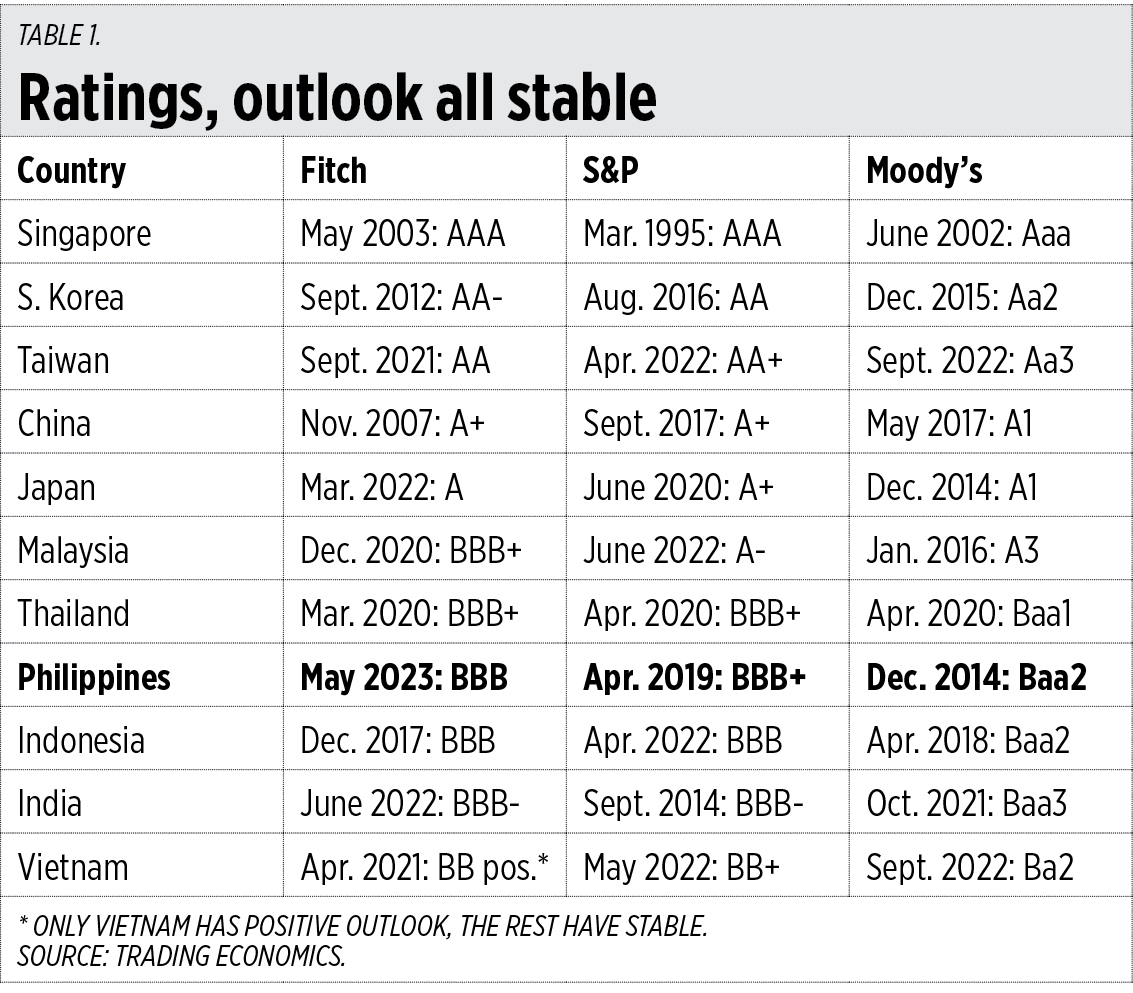
Table 1 shows the comparative ratings of selected Asian economies from the top ratings agencies in the world. The Philippines is at par with Indonesia in Fitch ratings but higher than it in S&P ratings. It is also higher than India and Vietnam.

Congratulations, Philippine entrepreneurs, investors, consumers, and the government economic team.

ENERGY ISSUES
The National Grid Corp. of the Philippines (NGCP) has recently been on the hot seat in the eyes of the public, government regulators, and legislature. See these recent reports in BusinessWorld: “NGCP warns RE intermittency could pose grid integration issues” (May 14), “Gov’t may retake control of NGCP” (May 14), “NGCP confident of hurdling proposed audit of operations” (May 18), “DoE expects NGCP audit to start this year” (May 21), “Senate probe sought on delays in NGCP projects” (May 21).

The trigger was the series of yellow and red alerts and rotating blackouts in the Luzon-Visayas grids, the latest being on May 8. The NGCP’s PR guys tried to spin the event as due to failing power plants when the reality was its transmission line in Zambales tripped, affected a big power plant there which took many hours to restore. Its spin was caught by the public and the legislature, especially the Senate.

In other developments, see also these recent reports about solar and wind energy in BusinessWorld: “Six floating solar contracts issued for construction on Laguna de Bay” (May 10), “Higher auction floor price sought for floating solar” (May 11), “ETM seen helping PHL accelerate transition to clean energy” (May 16), “DoE issues rules to expedite offshore wind energy projects” (May 19).

Since solar hates shade — from clouds, rain, trees — it is an intermittent and problematic energy source. Solar developers cut and murder all trees nearby because of the trees’ shade that can reduce solar output. Or large agricultural land is converted, so we see many rice fields, sugar fields, cornfields, etc. that have been converted to solar farms. Solar is the most anti-trees, anti-green energy technology.

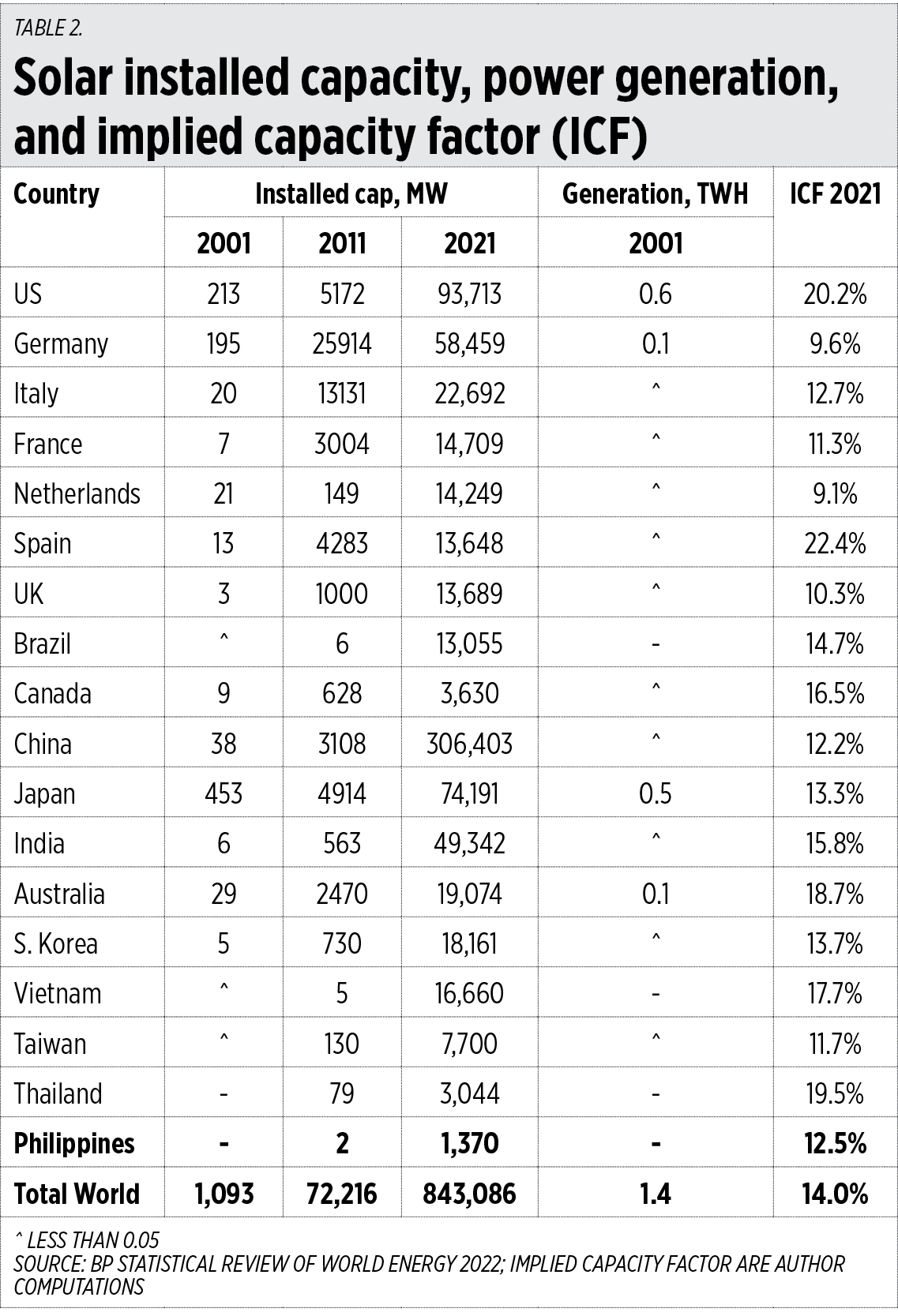
I checked data on solar capacity and generation by country and computed the implied capacity factor or percentage of installed capacity that actually generates electricity. After many decades of subsidies and favoritism given to solar (and wind), the capacity factor remains low. In 2021, there was a maximum of 22% (Spain) and as low as 9% (Netherlands), with an average of 14% worldwide. Meaning that on average, solar produces 28% at daytime, zero at night, for an average of 14% worldwide. The Philippines has only 12.5% or below the world average (See Table 2). This could be due to the frequent cloudy, rainy days in the country that year.

We have to sustain growth. We have to further improve our investment environment and attractiveness. We have to create more jobs and businesses, reduce people’s dependence on government for welfare and subsidies. In the process, we have to reduce the need for more borrowing and taxes.

Our energy policies should not compete with more agriculture production, more forest protection. There are moves now to develop solar farms in lakes and dams. This should be fine but the impact on the marine environment as sunlight is prevented from reaching below the water’s surface does not seem to have been studied well.

Wind capacity factors and related issues will be discussed in future columns.


Bienvenido S. Oplas, Jr. is the president of Bienvenido S. Oplas, Jr. Research Consultancy Services, and Minimal Government Thinkers

minimalgovernment@gmail.com

Canceled meetings

ROBIN JONATHAN DEUTSCH-UNSPLASH

MEETINGS, especially those prescribed by company by-laws or regulatory agencies, are set up in advance, checking the availability of attendees and the agenda to be taken up. VIPs with their busy schedules involving some financial crisis, visits from investors, appearances in congressional hearings, basketball playoff games, and local travel plans need to be consulted to set dates and times of availability. Such meetings with their meticulously coordinated schedules are hardly canceled, even with a few absences, as long as there is a quorum and a presiding officer.

However, not all meetings take place as scheduled.

Lunches for just “catching up” are easy enough to cancel — I must go swimming for my sciatica. Even when a long-planned get-together of old classmates has been set, cancellation is contemplated by the host when only the hangers-on have confirmed attendance.

A meeting is canceled at the last minute when the chair fails to show up and is not picking up his mobile calls. Secretaries who deal with such eventualities neither give any excuses nor offer any alibis for the absence — he’s simply not here, folks. The boss is unavailable, and the meeting must be rescheduled — you can finish up your longanisa and garlic rice.

Some meetings are randomly arranged. Maybe, someone mis-sends a text message about lunch for somebody else and an unintended party accepts, “You want to have lunch with me?” The sending party covers his blunder — so, when are you free next month? A few days before the meeting is to take place, one in the mismatched pair sends a message, “Can we reschedule again next month? I need to join a pilgrimage to the Holy Land.” This postponed get-together then falls outside the to-do list and then eventually forgotten. Neither party may find the need to resurrect the corpse of a wrong send.

Petitioners who arrange meetings with those who dispense favors invite the likelihood of having a supposedly firm commitment suddenly canceled. (Please check with my secretary.) Requests for an appeal fall on the deaf ears of an assistant who doesn’t even sound sympathetic. (Yes, Sir, I know you already got a ’60s rock band to provide the entertainment for your birthday, but the boss got invited to join an international delegation to promote the resettlement of orphans of war.)

When a meeting is called by a more powerful person summoning someone lower in the food chain, the event cannot just be canceled by the invitee. However, the higher-up can abruptly find such a meeting unnecessary — I’ll just send you an e-mail on the subject. There’s no need to meet. You can go ahead and get your open-heart surgery as scheduled.

When bumping into someone unexpectedly, the small talk is replete with old memories followed by vague promises of getting together sometime soon. This ambiguous commitment is a meeting that is unlikely to even take place. No specific date is set — See you sometime soon?

Canceled meetings are like gifts of time, but only for those with busy schedules. There is suddenly a chunk of two hours freed up in the calendar that can be put to good use by arranging yet another meeting with another person who may, however, not be available at such short notice.

Frequently canceling meetings is a bad habit. It is very discourteous and does not value the time of other people. It’s even worse than always being late for appointments. The routine occurrence of last-minute changes of plans then attaches to someone justly perceived as a “canceller.” If meetings with this person seldom materialize, setting any date with him is considered wasteful. (Call me when you’re free and if I’m also available, we can cancel together.)

The farther away a meeting has been scheduled, the greater the likelihood of its being canceled, unless it’s a wedding. Conversely, the more hurriedly an appointment is set up, the more likely it will take place. So, a meeting set for the next day is likely to go ahead.

Certain meetings are seldom canceled, maybe even moved earlier with glee. (Can we make it noontime rather than 3 p.m.?) These entail mutually exhilarating prospects. The meeting doesn’t appear on the appointment calendar. And neither is there a photo taken by the waiter — closer together please.


Tony Samson is chairman and CEO of TOUCH xda

ar.samson@yahoo.com

Pag-IBIG members save record-high P27.51B in Jan.-April 2023, up 10%; MP2 Savings reaches P13.89B, up 14%

Pag-IBIG Fund members saved P27.51 billion during the first four months of 2023, growing 10% year-on-year and setting a new record for the highest amount saved by members for any January-to-April period.

“We are happy that Filipino workers are saving more with Pag-IBIG Fund. Their trust and confidence in our savings programs continue to grow as proven by our record-high members’ savings collections for January to April. This is good news because the increase in the savings collected shall allow us to finance the increasing demand for our home loans, in line with our objectives under the Pambansang Pabahay para sa Pilipino Housing or 4PH Program of President Ferdinand Marcos, Jr.,” said Secretary Jose Rizalino L. Acuzar, who leads the Department of Human Settlements and Urban Development (DHSUD) and the 11-member Pag-IBIG Fund Board of Trustees.

Pag-IBIG Fund Chief Executive Officer Marilene C. Acosta, meanwhile, said that the increase in savings was not confined to the mandated Pag-IBIG Regular Savings of its members. Ms. Acosta also attributed the record-high collections to the continued popularity of the agency’s Modified Pag-IBIG 2 (MP2) Savings Program. The amount voluntary saved by members under its MP2 Savings in the first four months have already reached P13.89 billion, which is 14% higher than the P12.14 billion saved by members during the same period last year, and is also a new record-high.

The MP2 Savings is Pag-IBIG Fund’s voluntary savings program that yields higher dividends compared to the agency’s Regular Savings program. The program has a five-year maturity period and a minimum savings requirement of only P500. The MP2 Savings is also open to retirees and pensioners who are former Pag-IBIG Fund members. For 2022, the savings program earned an annual return rate of 7.03%, the highest since the pandemic.

“Our MP2 Savings Program continues to grow at a strong pace. We thank our members for their continued support and enduring trust in our MP2, as well as in our Regular Savings program. We are even more grateful that the biggest growth areas in our savings collections come from our voluntary MP2 Savings Program and from members who save more than their mandated monthly savings. The new record-high in total members’ savings we collected from January to April of this year show the deeper appreciation of our members on the benefits of saving with Pag-IBIG Fund,” Ms. Acosta added.


Spotlight is BusinessWorld’s sponsored section that allows advertisers to amplify their brand and connect with BusinessWorld’s audience by enabling them to publish their stories directly on the BusinessWorld Web site. For more information, send an email to online@bworldonline.com.

Join us on Viber at https://bit.ly/3hv6bLA to get more updates and subscribe to BusinessWorld’s titles and get exclusive content through www.bworld-x.com.

Cathay Pacific fires three staff after passenger alleges discrimination

MDS AYON

 – Cathay Pacific Airways Ltd 0293.HK said it fired three flight attendants after a passenger accused them of bias against non-English speakers, prompting criticism on Chinese state media and Hong Kong’s leader to vow it wouldn’t happen again.

Cathay said the experience of passengers travelling on its CX987 flight from the southwestern Chinese city of Chengdu to Hong Kong on Sunday caused “widespread concern” and said it sincerely apologized.

The airline fired three flight attendants involved after an internal investigation, CEO Ronald Lam said.

“I would like to reiterate that Cathay Pacific takes a ‘zero tolerance’ approach to serious violations of company rules and ethics by individual employees and will not tolerate them,” Lam said.

He added that he would lead a cross-departmental working group to conduct a comprehensive review of service processes, staff training and related systems to enhance its service quality.

“Most importantly, we must ensure that all Cathay Pacific staff respect passengers from different backgrounds and cultures and provide professional and consistent service in all areas served,” Lam said.

A passenger on the flight from Chengdu wrote in an online post that flight attendants complained amongst themselves about passengers in English and Cantonese. They said the flight attendants made fun of others for asking for a carpet instead of a blanket in English.

“If you cannot say blanket in English, you cannot have it. … Carpet is on the floor. Feel free if you want to lie on it,” a flight attendant said, according to a recording that was circulated widely online. Reuters could not verify the authenticity of the clip, which triggered criticism on social media.

Hong Kong’s flagship carrier has been trying to rebuild itself as it emerges from the COVID-19 pandemic. It was badly hit by COVID-related flight cancellations, border closings and strict quarantine measures for crew, resulting in drastic headcount reductions since 2020.

Hong Kong’s chief executive, John Lee, said on Wednesday that the discrimination incident was serious and could not be repeated.

“The words and deeds of the flight attendants hurt the feelings of compatriots in Hong Kong and the mainland and destroyed Hong Kong’s traditional culture and values of respect and courtesy,” he said, according to a post on his Facebook.

Cathay’s Flight Attendants Union did not immediately respond to a request for comment.

China’s state-owned People’s Daily in an online commentary said it was shocked by the incident against Mandarin-speaking passengers and criticized Cathay‘s corporate culture for “worshipping foreigners and respecting Hong Kong people” but looking down on Mainlanders.

Cathay Pacific can’t just apologize every time, but should rectify heavily, establish rules and regulations, and stop the unhealthy trend from the root,” it said.

The newspaper went on to say that the level of Mandarin in Hong Kong is improving by “leaps and bounds.”

“In Hong Kong the reverse trend of worshipping English and looking down on Mandarin is bound to disappear.” the newspaper said. – Reuters

Hollywood needs to depict safer gun use in film and TV – study

STOCK PHOTO | Image by Carlos Andrés Ruiz Palacio from Pixabay

 – Hollywood should portray safer use of guns in television and film at a time of rampant gun violence in the United States, USC Annenberg’s Norman Lear Center for Hollywood, Health and Society said in a report released on Tuesday.

“Trigger Warning: Gun Guidelines for the Media” encompasses more than 20 years of gun data and trends revolving around the statistic that firearms are the leading cause of death in children and teens in the United States.

“If television can embrace depicting gun safety, we will see people in America become more comfortable with securing their guns safely at home,” Norman Lear Center program director Kate Folb told Reuters.

Folb, who has spent years studying the correlation between entertainment and society, says that simply showing safe gun storage onscreen can have a lasting impact.

The guidelines break down the problematic influence of guns in America through myth debunking, intimate partner violence, mass shootings and children’s programming, and offers suggestions for improving the representation without sacrificing storylines.

The report was developed with support from the Brady Campaign to Prevent Gun Violence, which after the mass shooting of children and teachers in Uvalde, Texas, a year ago, wrote an open letter committing to gun safety onscreen. More than 300 directors, producers and writers signed that letter.

Folb said the Norman Lear Center would hold presentations and meetings on gun portrayal with Hollywood and will have a presence at entertainment festivals.

The Norman Lear Center studies the social, economic and cultural impact of entertainment and has consulted on several television projects, including “Grey’s Anatomy,” “This is Us,” and “Euphoria.”

Award-winning producer and writer Norman Lear celebrated the guidelines and the mission.

“I couldn’t be prouder that the Center which bears my name is releasing this report about gun safety and the entertainment industry,” Lear said. “How guns are portrayed on screen should reflect the public health crisis we are in, and help portray responsible gun ownership.” – Reuters

US signs agreement to continue Micronesia assistance under strategic pact

 – The United States said it signed agreements with Micronesia on Tuesday concluding negotiations to extend economic assistance to the island state under a strategic pact key to US efforts to push back against China in the Pacific.

The State Department said additional negotiations were underway with Micronesia (FSM) to continue federal programs and services currently provided under a Federal Programs and Services Agreement.

Three agreements related to Micronesia‘s Compact of Free Association (COFA) with the United States were signed by the charge d’affaires of the US Embassy in Pohnpei and Micronesian negotiator Leo Falcam Jr.

This marked “the successful conclusion of negotiations with FSM regarding the extension of Compact– related economic assistance” and was “a major milestone” in relations, the State Department said in a statement.

Washington first reached COFA accords with three Pacific island states – FSM, Palau and the Marshall Islands – in the 1980s under which it retains responsibility for their defense and provides economic assistance while gaining exclusive access to huge strategic swathes of the Pacific in return.

Under memorandums of understanding reached on renewing the pacts, the US will commit a total of $7.1 billion over 20 years to the three nations, subject to US Congressional approval.

The US statement called the relationship with FSM “special and historic” and said continuation of COFA-related assistance at “significant” levels reflected this and would support development and help tackle challenges such as climate change.

Renewing the COFAs has become a key part of US efforts to push back against China’s bid to expand its influence in the Pacific. Chinese diplomats have been courting the region and China’s construction and mining companies have expanded their business in many Pacific island nations.

On Monday the US signed a renewed COFA with Palau and chief COFA negotiator Joseph Yun told Reuters on Saturday he hoped to finalize a deal with the Marshall Islands in the coming weeks.

The Marshall Islands’ COFA is due to expire this year. – Reuters

US, South Korea issue fresh North Korea sanctions on ‘illicit’ IT workforce

WASHINGTON – The United States and South Korea on Tuesday announced new North Korea sanctions related to thousands of IT workers, many operating in China and Russia, whose labors allegedly help fund weapons of mass destruction and missile programs, they said.

One individual, Kim Sang Man, and the North Korea-based Chinyong Information Technology Cooperation Company were sanctioned jointly by the United States and South Korea in relation to their IT worker activities, U.S. Treasury Department said.

South Korea’s foreign ministry separately announced new sanctions on seven individuals and three entities, including Kim and the IT company, Chinyong.

North Korea oversees thousands of IT workers around the world, primarily located in China and Russia, Treasury said. These workers “generate revenue that contributes to its unlawful WMD and ballistic missile programs.”

The workers hide their identities, locations, and nationalities and use forged documentation to apply for jobs, it said. They have secretly worked in a variety of positions and industries, including the fields of “business, health and fitness, social networking, sports, entertainment, and lifestyle,” the Treasury Department said.

In the past, the U.S. State Department has warned that hiring North Korean IT workers could also lead to incidents of intellectual property theft.

Three other groups – the 110th Research Center, Pyongyang University of Automation and Technical Reconnaissance Bureau – had been previously sanctioned by South Korea for engaging in cyber operations and illicit revenue generation that support North Korea’s weapons of mass destruction programs, Treasury said.

“Today’s action continues to highlight (North Korea’s) extensive illicit cyber and IT worker operations, which finance the regime’s unlawful weapons of mass destruction and ballistic missile programs,” Brian Nelson, Under Secretary of the Treasury for Terrorism and Financial Intelligence, said in a statement.

South Korea’s foreign ministry said the latest announcement demonstrates joint efforts with the U.S. to block North Korea’s malicious revenue generation through illicit cyber activities.

In its announcement, the Treasury Department noted that the Technical Reconnaissance Bureau currently leads North Korea’s offensive cyber efforts and oversees staff affiliated with the infamous Lazarus hacking group.

Lazarus has been accused of carrying out some of the largest virtual currency heist to date. In March 2022, for example, they allegedly stole about $620 million in virtual currency from a blockchain project linked to the online game Axie Infinity. – Reuters

Choice Hotels looking to buy Wyndham Hotels & Resorts -source

Choice Hotels International is seeking to buy Wyndham Hotels & Resorts in a deal that would create a US budget hotel giant, a person familiar with the matter told Reuters on Tuesday.

The talks between the companies are at an early stage and it is not clear whether Wyndham is interested in pursuing a tie-up with Choice, the source said, requesting anonymity as these discussions are confidential.

If Wyndham decides not to proceed with a deal, Choice Hotels could choose to go hostile and take an offer directly to Wyndham’s shareholders, the source said.

News of the potential deal comes at a time when high inflation and recession risks could sap consumer spending on travel and drive up demand for affordable hotels such as Choice and Wyndham.

The news was first reported by the Wall Street Journal on Tuesday, after which shares of Wyndham Hotels closed 5.1% higher, while Choice Hotels ended about 4.6% lower.

“We don’t comment on rumors. We are focused on business as usual, driving value for our franchisees, team members, guests and stakeholders,” Wyndham said in an emailed statement.

Wyndham had a market value of $5.9 billion as of Monday’s close, while Choice has a market capitalization of $5.8 billion. Wyndham, whose brands include Days Inn and Travelodge, operates and franchises a hotel portfolio of 24 brands that are primarily located in secondary and tertiary cities, according to its annual filing.

Wyndham was formed in 2018. Wyndham Worldwide spun off its $11 billion hotel business to create two separate publicly-traded hospitality companies. Wyndham Worldwide is now known as Travel + Leisure and focuses on timeshare resorts.

Choice Hotels, which operates brands like Econo Lodge, Quality Inn and Clarion, franchises more than 7,000 hotels and caters to customers in the mid-scale to upscale range.

The company did not immediately respond to a request for comment. – Reuters

Netflix expands password sharing crackdown around the world

REUTERS

Netflix Inc on Tuesday expanded its crackdown on password sharing to the United States and more than 100 other countries, alerting users that their accounts cannot be shared for free outside of their households.

The streaming video pioneer has been looking for new ways to make money as it faces signs of market saturation, with efforts including limits on password borrowing and a new ad-supported option.

Netflix on Tuesday said it was sending emails about account sharing to customers in 103 countries and territories, including the United States, Britain, France, Germany, Australia, Singapore, Mexico and Brazil.

The emails state that a Netflix account should only be used in one household. Paying customers can add a member outside of their homes for an additional fee. In the United States, the fee is $8 per month.

Members can also transfer a person’s profile so the user can keep their viewing history and recommendations.

Netflix last year said it was going to limit account sharing and was testing various approaches in some markets.

The company had estimated that more than 100 million households had supplied their log-in credentials to friends and family outside their homes. As of the end of March, Netflix’s paying customers totaled 232.5 million globally.

Under the new policies, people within the same household can continue sharing a Netflix account and can use it on various devices when traveling, the company said. — Reuters

‘Mild’ economic slowdown seen in Q2

A worker carries a sack of rice in Tondo, Manila. — PHILIPPINE STAR/EDD GUMBAN

PHILIPPINE ECONOMIC growth may slow to below 6% in the second quarter, as elevated inflation continues to dampen consumer spending, First Metro Investment Corp. (FMIC) and the University of Asia and the Pacific (UA&P) said in a joint report.

“We expect only a mild slowdown in Q2 by around 0.5 percentage points or slightly below 6% year on year, as the elevated inflation rate eats in consumers’ purchasing power,” they said in the May issue of The Market Call.

The Philippine economy grew by 6.4% in the first quarter, slower than the revised 7.1% growth in the previous quarter, and the 8% expansion in the first quarter of 2022. This was also the slowest growth rate in eight quarters or since the 3.8% contraction in the first quarter of 2021.

Economic managers are still confident of meeting the 6-7% gross domestic product (GDP) growth target for 2023.

“The downward trend will likely bottom in the second quarter as inflation eases and more employment and the income tax cut boost consumption spending,” FMIC and UA&P said.

However, they expect the economy to recover in the second half thanks to “muscular growth” in key services sub-sectors such as transport and storage, and accommodations and food services as tourism recovers.

The construction sub-sector is also expected to contribute to economic growth, thanks to flagship infrastructure projects such as the Metro Manila Subway, North-South Commuter Rail, and the South Expressway Extension.

“These large contributors to employment and slower inflation should combine to power more robust consumer spending, heretofore hindered by elevated inflation,” they added.

FMIC and UA&P now expect inflation to ease to an average of 6.3% in the second quarter, from 6.6% previously. Inflation is seen to further decelerate to an average of 5.1% in the third quarter, and 3.3% in the fourth quarter.

“The supply response to higher food prices earlier in the year appears to gain traction, while crude oil prices remain weak due to the global economic slowdown,” they said.

Headline inflation slowed to 6.6% in April, from 7.6% in March. For the first four months of the year, inflation averaged 7.9%, higher than 3.7% seen a year ago.

The BSP sees inflation settling within the 2-4% target band by September, and averaging 5.5% this year. It projects inflation to ease to 2.8% in 2024.

As inflation continues to slow, FMIC and UA&P said the BSP may be done with its tightening cycle.

“BSP has kept policy rates unchanged at 6.25% in its May 18 meeting, and we think it will have ended its policy rate hiking cycle, unless a major spike in inflation occurs or the exchange rate again rises too fast,” it said.

To tame inflation, BSP raised borrowing costs by 425 basis points (bps) since May last year, bringing the benchmark rate to 6.25%.

FMIC and UA&P also noted the peso may further depreciate against the dollar due to the country’s large trade deficits.

“The peso will likely remain under pressure due to elevated trade deficits and higher policy rates in the US by another 25 basis points in June,” they said.

‘READY TO USE ALL TOOLS’
At the same time, the Bangko Sentral ng Pilipinas (BSP) stands ready to use its tools to manage elevated inflation and maintain price stability, its governor said.

BSP Governor Felipe M. Medalla said on Monday that the central bank’s aggressive monetary tightening has not negatively affected the stability of the financial system.

“With the Philippine banking sector being liquid and well-capitalized, the central bank stands ready to use all the tools at its disposal to preserve price stability,” he said in a statement after Fitch Ratings affirmed the Philippines’ investment-grade credit rating.

Fitch maintained the Philippines’ long-term foreign currency issuer default rating at “BBB,” but upgraded its outlook to stable from negative.

A “BBB” rating indicates low default risk and adequate capacity to pay, although some unfavorable economic conditions could impede said capacity.

A stable outlook indicates that the country’s rating is likely to be maintained rather than lowered or upgraded in the medium and long terms or over the next 18-24 months.

Fitch downgraded the Philippines’ outlook to negative in July 2021 amid the pandemic.

In a statement released on Monday, Fitch cited the credibility of the BSP’s inflation-targeting framework and flexible exchange rate regime.

“Last year’s interventions to mitigate peso volatility have been reversed. Monetary financing to the government during the pandemic was more limited and was reversed more quickly than in some peers. The government’s response to the commodity price shock has been measured, for example in resisting calls to introduce fuel subsidies,” the credit rater said.

In an e-mail, ING Bank N.V. Manila Senior Economist Nicholas Antonio T. Mapa said Fitch’s decision to upgrade the outlook to stable was due to the country’s strong economic performance following the pandemic.

Fitch expects the Philippine economy to grow by above 6% in the medium term, which is “considerably stronger” than the “BBB” median of 3%.

“Better credit ratings help the Philippines finance expenditures at a lower cost as borrowers will be more reassured of getting paid back on time. A lower credit rating could translate to higher borrowing costs,” Mr. Mapa said.

However, he noted that it is crucial for the Philippines to maintain its current growth momentum.

“Robust growth delivers fresh revenues which in turn improves fiscal balances while faster growth helps dilute the above threshold debt-to-GDP ratio,” he said.

At the end of March, the National Government’s debt as a share of GDP stood at 61%. This is still above the 60% threshold considered manageable by multilateral lenders for developing economies.

The government aims to trim the debt-to-GDP ratio to less than 60% by 2025 and to 51.5% by 2028.

Mr. Mapa added that a large deterioration in the country’s external balances could weigh on the outlook moving forward, while sustaining growth and improving governance standards could support a ratings upgrade.

The country has maintained the same investment-grade credit rating from Fitch since December 2017. — K. B. Ta-asan