Home Blog Page 4762

Loan growth slows in April amid BSP tightening

BW FILE PHOTO

LENDING GROWTH slowed in April due to a high base and as the central bank’s rate hikes made their way through the financial system, and even as liquidity expanded faster that month.

Outstanding loans by big banks grew by 9.7% to P10.86 trillion in April, slower than the 10.2% expansion in March and the 10.1% seen in April 2022, preliminary data from the Bangko Sentral ng Pilipinas (BSP) showed.

Meanwhile, big banks’ loans net of reverse repurchase (RRP) placements with the BSP inched up by 0.6% from a month earlier.

“The sustained expansion in bank lending activity suggests that domestic liquidity remains sufficient to support economic activity,” BSP Governor Felipe M. Medalla said in a statement.

Oxford Economics Japan Assistant Economist Makoto Tsuchiya said in an e-mail that the slowdown in credit growth was likely due to a high base.

“The slowdown in credit growth can be partly attributed to base effects, as you can see that the annual growth was picking up throughout last year given gradual economic reopening. But we estimate that the sequential growth has stalled since late last year, as the initial demand from economic reopening faded,” he said.

Meanwhile, ING Bank N.V. Manila Senior Economist Nicholas Antonio T. Mapa said the aggressive policy tightening by the BSP since May last year has affected bank lending growth.

“Loans to productive sectors show slower pace of expansion again, which points to slower capital formation which should cap productive capacity down the line,” Mr. Mapa said.

The BSP raised the benchmark interest rate by 425 basis points from May 2022  to March 2023 to tame inflation, with the key rate now at 6.25%.

The Monetary Board last month paused its tightening campaign after hiking for nine straight meetings on expectations that inflation would continue to ease.

BSP data showed outstanding loans to residents, net of RRPs, eased by 9.6% to P10.55 trillion in April from 10.2% in March and 10% a year ago.

Credit for production activities declined by 8.3% to P9.47 trillion in April from 9% in March and 10.3% in the same month in 2022.

Year on year, more loans were extended for electricity, gas, steam, and air-conditioning supply (12.4%), wholesale and retail trade, and repair of motor vehicles and motorcycles (10.3%), manufacturing (9.3%), information and communication (19%), and real estate activities (4.5%).

Meanwhile, Mr. Mapa said consumer credit is still showing faster gains despite higher borrowing costs.

“This could mean that households are resorting to consumer credit at higher rates to finance basic goods and services. The increase in rates may have also translated to higher consumer loans receivable as households find it more difficult to service debt on time given constraints on higher costs,” he said.

Consumer loans to residents increased by 22.3% to P1.08 trillion in April, a tad faster than 21.8% in March. This was attributed to year-on-year rise in credit card loans (29.9%), motor vehicle loans (1.9%) and salary-based general purpose consumption loans (56.2%). 

Meanwhile, outstanding loans to nonresidents excluding RRPs expanded by 12.2% to P319.31 billion in April, slower than the revised 13.1% growth in the previous month.

Oxford Economics’ Mr. Tsuchiya said loan growth is expected to slow further this year amid lower demand from households and businesses.

“Given slowing global economy and lower demand for Philippines goods exports, businesses will likely remain cautious in expanding their production capacity,” he said.

Mr. Tsuchiya cited a BSP survey that showed bank officers said demand for loans remained unchanged for the last three quarters.

“Households will feel less pressure to borrow as initial pent-up demand fades, inflation edges down, and interest rate remains high. That said, higher unemployment rate could keep borrowing high, as consumers borrow out of necessity,” he said

M3 GROWTH
Despite slower credit growth, domestic liquidity rose by 6.6% annually to P16.3 trillion in April, the BSP said in a separate statement, faster than the revised 6.2% expansion in March. Month on month, it rose by about 0.5% from March.

Money supply, or M3, is considered as the broadest measure of liquidity in an economy.

In April, domestic claims rose by 11.9%, slightly slower than the 12.4% in March.

Net borrowings of the central government expanded by 20.1% in April, declining from the revised 21.1% rise in the prior month.

Net claims on the private sector grew by 9.7% in April, unchanged from March, due to the sustained expansion in bank lending to nonfinancial private firms and households

Meanwhile, net foreign assets (NFA) declined by 0.2% in April, improving from the revised 3.9% contraction in March.

“The NFA of banks declined mainly on account of higher bills payable. Meanwhile, the BSP’s NFA position expanded by 2.5% in April after contracting in the previous month,” Mr. Medalla said.

“Looking ahead, the BSP will continue to ensure that domestic liquidity conditions remain consistent with the prevailing stance of monetary policy, in line with the BSP’s price and financial stability objectives,” he added. — Keisha B. Ta-asan

AEV board clears P17.5-B bond issuance

ABOITIZ Equity Ventures, Inc.’s (AEV) board of directors on Wednesday approved the company’s issuance of up to P17.45 billion for its second tranche of fixed-rate retail bonds, inclusive of an oversubscription option.

It said, subject to market conditions, the bonds are expected to be offered to the public in the third quarter of this year and will be listed with the Philippine Dealing & Exchange Corp.

In a regulatory filing, the company said the bonds would come from its P30-billion shelf-registration program, which was approved by the Securities Exchange Commission in 2022.

Last year, the company issued the first tranche of its fixed-rate retail bonds together with the final tranche of its 2019 bonds amounting to about P20 billion.

Its board delegated the company’s management to appoint an issue manager, bookrunner, underwriter, and trustee of the issuance. Its management will also approve the final interest rate, offer price, tenors, and other terms and conditions of the second tranche bonds.

The company has yet to disclose the use of proceeds from the issuance.

During the first quarter, AEV reported an attributable net income of P4.01 billion, up 1.8% from P3.98 billion in the same period last year.

AEV’s core businesses, conducted through its subsidiaries and affiliates, are grouped into five main categories: power generation, distribution and retail electricity supply; financial services; food manufacturing; real estate; and infrastructure.

On Wednesday its shares declined by 0.91% or 50 centavos to P54.50 apiece. — A. H. Halili

Mighty dollar can fight off the digital upstarts

JASON LEUNG-UNSPLASH

PROPONENTS of de-dollarization might resent America’s exorbitant privilege all they want. But what can they do about it?

Analysts usually trace the US currency’s hegemony to its outsized use in international commerce. Even a decade after China eclipsed the US as the world’s largest goods-trading nation, that dominance doesn’t appear to be fading. The much-awaited petroyuan has so far been just a myth, even though some dollar-starved importers like Pakistan are keen to pay for Russian crude in the Chinese currency.

An even bigger moat may be the greenback’s role in fundraising. It will take the People’s Republic a long time to match the depth, liquidity, and openness of the dollar-denominated capital market in which firms and banks borrow and hedge their risks. A proposed common currency for the so-called BRICS grouping of Brazil, Russia, India, China, and South Africa may flounder for the same reason.

That still leaves the de-dollarization camp with a low-hanging fruit, one they can pluck with digital technologies.

When it comes to carrying value across illiquid currency corridors, the dollar is a sturdy mule. That’s a big part of the reason it ends up on one side of the trade in nearly 90% of foreign-exchange trades. Dealers often find it more efficient to use the dollar as the go-between. Funds are first converted into the US currency, and then reconverted into whatever the payee’s bank will accept: euros, yen, Swiss francs, or something else. This preferred vehicle-currency status accounts for 40% of the dollar’s $6.6 trillion-per-day turnover.

This is what keeps Brazil’s President Luiz Inacio Lula da Silva awake at night. Bypassing the need for dollars as a middleman is also the vision outlined by Southeast Asian nations’ finance ministers and central bank governors in Bali last year. They want payments transacted in Thailand using an Indonesian app to be directly exchanged between rupiah and baht.

Five central banks in the region — Indonesia, Malaysia, the Philippines, Singapore, and Thailand — are seeking to achieve this by syncing their domestic, smartphone-based, instant-payment systems under a protocol known as Nexus. This will solve some of the existing issues related to slow transfers. The hefty fees charged by banks for cross-border transactions will also fall, or at least become more transparent to customers.

However, the problem of foreign-exchange conversion will remain. That’s because the Singapore dollar is the only Southeast Asian currency eligible for settlement by CLS Group Holdings AG. Jointly owned by many of the world’s largest banks, CLS lines up payments so that neither party in a trade is left holding a claim after it has discharged its obligations.

Settlement risk compels banks to set aside capital to cover it. That has a charge. Therefore, for an illiquid bilateral payments corridor in Southeast Asia, both the Singapore dollar and the US dollar — or at least one of them — will still end up as vehicles because they help cut costs. Nexus won’t change this. No matter how hard the BRICS push their rival IOU, the greenback isn’t going away.

One way to edit it out will be to use blockchain technology to eliminate settlement risks. If all countries put their central bank digital currencies, or CBDCs, on a common platform, it would be easy to ensure “atomicity:” Transfers across borders will either succeed in their entirety, or fail altogether. Money won’t get stuck somewhere in the long chain of banks between the sender and the recipient. In payment journeys where the dollar is just a vehicle — and not the origin or the destination — it can be ditched. Tokenization will provide safety to intermediaries.

A multicurrency CBDC network could eliminate a big chunk of the $120 billion-a-year in transaction costs. However, the enormous coordination and trust it will require to first create such a global public good, and then agree on its ownership and governance, makes the idea a non-starter. Especially when the same blockchain technology can be more feasibly employed to preserve the dollar’s exceptionalism.

In a recent experiment with the Singapore central bank, the New York Federal Reserve showed that it could keep the dollar in play even in the blockchain world. A vehicle currency managed to deliver up to 47 payments in one second in an illiquid corridor of two other national units. Distributed ledgers that didn’t share a common technology were able to participate without requiring a central party. What’s more, the Fed didn’t need a retail digital dollar to do this. A wholesale token, available only to banks, was enough.

Experiments like the awkwardly named Project Cedar Phase II x Ubin+ show one thing: The Fed may be taking its time to decide whether to issue a retail CBDC, but it’s not wasting the interlude. The e-CNY, now available via popular WeChat Pay and Alipay wallets to 1 billion retail users, is gaining acceptance at stores within China. Sooner or later, the online yuan will go global.

Should the BRICS nations get serious about a single currency for trade, they may, too, offer a digital version. But why would any of these alternatives get a second look from intermediaries if a wholesale token of the US currency is available to carry the weight of payments across illiquid corridors? The dollar is a mule with very strong legs.

BLOOMBERG OPINION

VistaMalls, Inc. announces schedule of annual stockholders’ meeting on June 26

NOTICE OF ANNUAL MEETING OF STOCKHOLDERS

Notice is hereby given that the annual meeting of stockholders of VISTAMALLS, INC. (the “Company” or “STR”) for the year 2023 will be held online on June 26, 2023, Monday at 10:00 a.m. with the proceedings livestreamed and voting conducted in absentia through the Company’s secure voting online facility which may be accessed through the following URL address: https://vote.vistamalls.com.ph/VSRV/Login.

The following shall be the agenda of the meeting:

  1. Call to order
  2. Certification of service of notice and presence of quorum
  3. Approval of the minutes of the last Annual Meeting of Stockholders held on June 27, 2022
  4. Presentation of the President’s Report, Management Report and Audited Financial Statements for the year 2022
  5. Ratification of all acts and resolutions of the Board of Directors and Management from the date of the last annual stockholders’ meeting until the date of this meeting.
  6. Election of the members of the Board of Directors, including the Independent Directors, for the year 2023
  7. Appointment of External Auditors
  8. Adjournment

Minutes of the 2022 Annual Meeting of Stockholders is available at the website of the Company (https://documents.starmalls.com.ph/minutes-of-meetings.php).

Electronic copies of the Information Statement and Management Report with respect to the 2023 Annual Meeting of Stockholders of the Company, as well as the 2022 Annual Report (SEC Form 17-A) and Quarterly Report for period ended 31 March 2023 (SEC Form 17-Q) of the Company, are available on the Company’s website (https://documents.starmalls.com.ph/sec-annual-reports.php) and PSE Edge (https://edge.pse.com.ph/companyDisclosures/form.do?cmpy_id=147).

The Board of Directors has fixed the close of 16 May 2023 as the record date for the determination of stockholders entitled to notice of, and to vote at, said Annual Stockholders’ Meeting.

In light of the current circumstances, and to ensure the safety and welfare of the Company’s stockholders, the Company will dispense with the physical attendance of stockholders at the meeting and will allow attendance only by remote communication and voting only in absentia or by appointing the Chairman of the meeting as their proxy.

Stockholders who intend to participate in the meeting via remote communication and to exercise their vote in absentia must notify the Corporate Secretary by registering in advance at https://vote.vistamalls.com.ph/VSRV/Login on or before June 16, 2023. All information submitted will be subject to verification and validation by the Corporate Secretary.

Stockholders who intend to appoint the Chairman of the Meeting as their proxy should submit duly accomplished proxy forms on or before June 16, 2023 at the Office of the Corporate Secretary at UGF Worldwide Corporate Center, Shaw Boulevard, Mandaluyong City and/or by email to ir@vistamalls.com.ph.

The procedures for participating in the meeting through remote communication and for casting of votes in absentia are set forth in the Information Statement.


MA. NALEN S.J. ROSERO
Corporate Secretary


Spotlight is BusinessWorld’s sponsored section that allows advertisers to amplify their brand and connect with BusinessWorld’s audience by enabling them to publish their stories directly on the BusinessWorld Web site. For more information, send an email to online@bworldonline.com.

Join us on Viber at https://bit.ly/3hv6bLA to get more updates and subscribe to BusinessWorld’s titles and get exclusive content through www.bworld-x.com.

Google announces AI-powered digital marketing tools for firms

REUTERS

GOOGLE has introduced new assistive tools enhanced by generative artificial intelligence (AI) to improve the efficiency of digital marketing for businesses.

“Small businesses, agencies, and major brands are seeing the opportunity, the potential, of AI to be additive to their own skills as a creative partner,” Dan Taylor, vice-president for global ads at Google, said in a roundtable on Friday.

To cater to this demand, Google Ads has introduced AI-boosted solutions to their existing products amid rapidly changing landscape for marketers, Mr. Taylor said.

Ad spending in the Philippine digital advertising market is projected to reach $1.608 billion in 2023, according to Statista.

“Our goal is to help advertisers perform better,” said Brian Burdick, senior director for search ad automation at Google.

The new products include AI- and large language model-powered improvements to Automatically Created Assets (ACA), conversational experience in campaign constructions, and Google Product Studio.

With these, Google said advertisers can produce text assets and professional-grade creative images by simply entering landing pages from their website and uploading existing product or service images.

AI will then generate relevant and effective keywords, headlines, descriptions, images, and other assets for ad campaigns that advertisers can review and edit before deploying.

Advertisers can also chat with Google AI using natural, conversational language for suggestions and better performance.

A text-to-image AI model in Google Product Studio can also be used to help create new lifestyle product images from basic product photos. This will allow advertisers to prompt the tool with a brief description of their desired background and image elements.

“We’re trying to make it as user-friendly as possible,” said Jeff Harrell, senior director for shopping at Google, on AI-generated image assets using Google Product Studio.

“There is no special knowledge needed of AI versus being able to be descriptive about what you’re looking for,” he added.

Text-based AI-generated assets with ACA are currently in global open beta testing stage for English, with plans to include more languages this year, the company said.

Conversational experience in Google Ads will start a closed beta testing in the United States soon, it added.

Google Product Studio will be available in the US later this year via Merchant Center Next or the Google and YouTube Channel App on Shopify.

“We are absolutely looking to expand over the course of the year,” Mr. Harrell said on growing access to different regions and languages.

Amid the current issues surrounding AI, Google said it is carefully integrating the use of the technology in its products.

“Even if a creative is generated [by AI] in a way that isn’t quite right for the use case, we have really high quality policies in place to make sure that we catch those ads before they’re served,” Mr. Taylor said.

“As these AI tools develop new ways to deliver creatives at scale, we’re also developing policies and monitoring of those creatives to make sure that they deliver a great experience for the consumer,” he added. — Miguel Hanz L. Antivola

D.M. Wenceslao & Associates, Inc. to conduct annual stockholders’ meeting via remote communication on June 23


Spotlight is BusinessWorld’s sponsored section that allows advertisers to amplify their brand and connect with BusinessWorld’s audience by enabling them to publish their stories directly on the BusinessWorld Web site. For more information, send an email to online@bworldonline.com.

Join us on Viber at https://bit.ly/3hv6bLA to get more updates and subscribe to BusinessWorld’s titles and get exclusive content through www.bworld-x.com.

Emmentaler loses fight for EU trademark

EMMENTALER AOP SWITZERLAND

BRUSSELS — Emmentaler cheese cannot be trademarked in the European Union (EU) as the German public sees it as a type of cheese rather than by its geographical origin, Europe’s second-top court said on Wednesday.

The yellow Swiss cheese recognizable by its large holes is the second most-produced and exported hard cheese in Switzerland.

Emmentaler Switzerland, which has registered the word “Emmentaler” with the World Intellectual Property Organization (WIPO), took its fight to the General Court after the European Union Intellectual Property Office (EUIPO), turned down its application to register the WIPO recognition.

The Luxembourg-based Court backed the EU patent office.

“Since the mark applied for is descriptive of a type of cheese for the relevant German public and is not perceived as an indication of the geographical origin of that cheese, the General Court concludes that it does not enjoy protection as a collective mark,” the Court said.

Emmentaler Switzerland can appeal on points of law to the Court of Justice of the European Union. —  Reuters

Beneficial Life Insurance Company, Inc. issues Notice of 2023 Annual Stockholders’ Meeting

NOTICE OF ANNUAL STOCKHOLDERS’ MEETING

NOTICE IS HEREBY GIVEN that the Annual Stockholders’ Meeting (“ASM”) of BENEFICIAL LIFE INSURANCE COMPANY, INC. (the “Company”) will be held through remote communication via https://www.benlife.com.ph/benlife-2023-ASM/ on June 28, 2023, Wednesday, at 3:00 o’ clock in the afternoon with the following:

A G E N D A

  1. Call to Order
  2. Certification of Notice of Meeting and Quorum
  3. Approval of the Minutes of the Previous ASM Held on 30 June 2022
  4. Presentation of Annual Report and Approval of the Audited Financial Statements ( “AFS”)
  5. Ratification and Confirmation of all Acts and Resolutions of the Board of Directors and its Committees, Officers and Management Since the 2022 ASM
  6. Election of Members of the Board (including the Independent Directors)
  7. Election of External Auditor
  8. Consideration of Such Other Matters as May Properly Come Before the Meeting
  9. Adjournment

Only stockholders of record at the close of business hours on June 01, 2023 are entitled to notice of, and to vote at, this ASM.

In view of current circumstances and pursuant to and in accordance with the Company’s Amended By-Laws, the Board of Directors, during its Regular Meeting held on April 13, 2023, resolved that the Annual Stockholders’ Meeting be held in a fully virtual format, thus, stockholders may only attend the ASM by remote communication, by voting in absentia, or by appointing a proxy.

Stockholders intending to participate in the meeting by remote communication must register at https://form.jotform.com/benlifemis.com.ph/2023-ASM-registration on or before 27 June 2023. Stockholders may vote by remote communication, or in absentia subject to validation procedures. The procedures for participation in the meeting through remote communication and for casting of votes in absentia are explained in the Information Statement.

Stockholders who intend to vote by proxy shall submit the duly accomplished proxy to the Office of the Corporate Secretary, 7th/F Beneficial Life Building, 166 Salcedo Street, Legaspi Village, Makati City or via email to corpsec@benlife.com.ph not later than 5:00 P.M. of June 21, 2023. Validation of proxies shall be held on June 23, 2023 at 2:00 p.m. WE ARE NOT SOLICITING PROXIES.

For your convenience and in accordance with the Notice of the Securities and Exchange Commission dated 13 March 2023 regarding the Alternative Mode for Distribution and Providing Copies of the Notice of Meeting, Information Statement, and Other Documents in connection with the Holding of Annual Stockholders’ Meeting for 2023, a copy of the Definitive Information Statement, Management Report, SEC Form 17A, Audited Financial Statements and other pertinent documents will be available at the Company’s website at https://www.benlife.com.ph/disclosures/

All email communications should be sent to corpsec@benlife.com.ph on or before the designated deadlines.

Given this 18th day of May 2023.

By order of the Board of Directors:

(Sgd.) MA. SIGRID PINLAC
Corporate Secretary


Spotlight is BusinessWorld’s sponsored section that allows advertisers to amplify their brand and connect with BusinessWorld’s audience by enabling them to publish their stories directly on the BusinessWorld Web site. For more information, send an email to online@bworldonline.com.

Join us on Viber at https://bit.ly/3hv6bLA to get more updates and subscribe to BusinessWorld’s titles and get exclusive content through www.bworld-x.com.

Yields on term deposits inch lower

YIELDS on the Bangko Sentral ng Pilipinas’ (BSP) term deposits edged lower on Wednesday amid progress in the US debt limit deal and as market players await May Philippine inflation data.

Demand for the BSP’s term deposit facility (TDF) amounted to P221.806 billion on Wednesday, higher than the P220 billion on the auction block and the P199.795 billion in tenders seen a week earlier for a P190-billion offer.

Broken down, the seven-day term deposits fetched bids amounting to P123.506 billion, surpassing the P120 billion auctioned off by the BSP and the P103.975 billion in tenders logged the previous week for a P110-billion offer.

Accepted rates for the tenor ranged from 6.3% to 6.64%, unchanged from the band logged a week ago. This caused the average rate of the one-week deposits to slip by 0.63 basis point (bp) to 6.5863% from 6.5926% previously.

Meanwhile, demand for the two-week deposits amounted to P98.30 billion, lower than the P100-billion offer but slightly above the P95.82 billion seen last week for P80 billion up for auction.

Banks asked for yields from 6.25% to 6.651%, a tad higher than the 6.2% to 6.6344% range seen last week. This caused the average rate of the paper to dip by 0.83 bp to 6.5852% from the 6.5935% quoted on May 24.

The BSP has not auctioned off 28-day term deposits for more than two years to give way to its weekly offerings of securities with the same tenor.

The term deposits and the 28-day bills are used by the central bank to mop up excess liquidity in the financial system and to better guide market rates.

The lower TDF yields seen on Wednesday followed the declining trend in rates of US Treasuries, Rizal Commercial Banking Corp. Chief Economist Michael L. Ricafort said in a Viber message.

Yields on 10-year US Treasury notes dropped by 10 bps to 3.72% on Tuesday, while thirty-year yields fell 8 bps to 3.9%, Reuters reported. 

US markets reacted to a weekend deal to suspend the $31.4-trillion debt ceiling until 2025 while keeping some costs flat.

However, the deal is unlikely to pass easily through Congress, and the risk that the US may run out of money to pay its debts in early June remains.

Mr. Ricafort said the lower TDF yields also came ahead of the release of May Philippine inflation data on June 6.

Easing inflation “could fundamentally support the easing trend in Treasury bill and Treasury bond auction yields,” especially if inflation slows further later in 2023 and in early 2024, he said.

In a statement on Wednesday, the BSP said headline inflation may have settled within the 5.8% to 6.6% range in May amid lower pump prices.

If realized, inflation would exceed the BSP’s 2-4% target for the 14th consecutive month.

Still, the lower end of the forecast or 5.8% would be the slowest pace recorded in a year or since the 5.4% recorded in May 2022. The higher end would match the 6.6% headline print recorded in April.

The BSP sees inflation averaging at 5.5% this year. For the first four months, the consumer price index averaged 7.9%.

The central bank last month paused its aggressive tightening cycle after hiking for nine straight meetings amid expectations of easing inflation, with the key rate at 6.25%.

The Monetary Board raised benchmark interest rates by 425 bps from May 2022 to March 2023.

The next BSP policy meeting will be held on June 22. — Keisha B. Ta-asan with Reuters

US firm Regent to bring seagliders to the Philippines

US-BASED Regent Craft, Inc. is set to its bring electric seagliders to the Philippines through a partnership with Lopez-led INAEC Aviation Corp.

“Seagliders are a game changer for the Philippines,” INAEC President Benjamin R. Lopez said in a statement. “They will open up new opportunities to reach currently inaccessible islands and allow visitors to experience more of the natural beauty our country has to offer.”

Regent’s seagliders are said to combine the high speed of an airplane with the low operating cost of a boat. They are all-electric, zero-emission vessels that will operate exclusively over water. The company is based in North Kingstown, a town in Rhode Island.

“We’re excited to work with Regent to introduce innovative technologies like seagliders that are safe and affordable while being consistent with the Lopez Group’s strategic direction to provide environment-friendly and sustainable modes of transport for travelers,” Mr. Lopez said.

The companies did not disclose the date of the launch of the commercial service but said that they will be engaging with various stakeholders to identify infrastructure and operating requirements ahead of the launch.

Regent said it had also received approval in principle for its Viceroy seaglider from Bureau Veritas, a company that provides testing, inspection, and certification services to maritime manufacturers and operators.

It said the nod “marks an important milestone in the classification and eventual certification of the vessel.”

Billy Thalheimer, co-founder and chief executive officer of Regent, said the archipelagic geography of the Philippines is a perfect match for seagliders.

“Island nations like the Philippines are a perfect match for seagliders, where communities are connected by shared coastal waterways and can benefit from more affordable and convenient mobility between them,” Mr. Thalheimer said in the statement.

“We’re thrilled to have such strong alignment with INAEC in our shared mission to deliver safe, sustainable, and memorable passenger experiences for all travelers,” he added.

To date, Regent said it had built an order book of over 500 seagliders worth $8 billion from airline and ferry operators around the world. In five years, the company is expecting its Viceroy seagliders to enter service.

INAEC, a member of the Lopez group of companies, offers aviation services such as air transportation, on-demand charters, aircraft management and maintenance, and aviation training. — Justine Irish D. Tabile

NGCP, low power generation, and the Maharlika Fund

Last week, the National Grid Corp. of the Philippines (NGCP) was a hot item. See for instance these reports in BusinessWorld, “Senate probe sought on delays in NGCP projects” (May 21), “DoE, ERC seek enhanced powers in EPIRA amendments” (May 23), “Senators slam NGCP over poor network, keeping high gains” (May 24), “NGCP says it invested P300 billion in grid since 2009” (May 25).

THE SENATE ENERGY COMMITTEE HEARING
The Senate Committee on Energy, chaired by Rafael Tulfo, conducted a public hearing on May 24. Among the resource persons, Prof. Rowaldo del Mundo of the UP College of Engineering said that “Out of 219 committed projects under the DoE (Department of Energy)-approved transmission development plan (TDP), 79 were not implemented and 49% of completed and on-going projects are delayed… Project delays are up to nine years.” Horrible NGCP.

Energy Regulatory Commission (ERC) Chairperson Monalisa Dimalanta was also a resource speaker, and she said that the NGCP has 72 delayed projects: 33 in Luzon, 19 in the Visayas, and 14 in Mindanao. And six of these 72 delayed projects are “Energy Projects of National Significance,” like the Mindanao Visayas interconnection and the Panay-Negros interconnection projects. Again, horrible NGCP.

The economic team of the Marcos Jr. administration has been going around major cities in Asia, Europe, and the US trying to attract more investors to come into the country as many economic liberalization measures have been institutionalized and legislated as new laws, like the amendment to Public Service Act, the Retail Liberalization Act, etc. But investors see and read about the frequent yellow-red alerts in the country, and the high-power rates due to the limited power supply relative to fast-rising demand, so many of them are not coming. We can call this NGCP- (or power undersupply-) instigated business uncertainty.

NGCP-INSTIGATED BUSINESS UNCERTAINTY
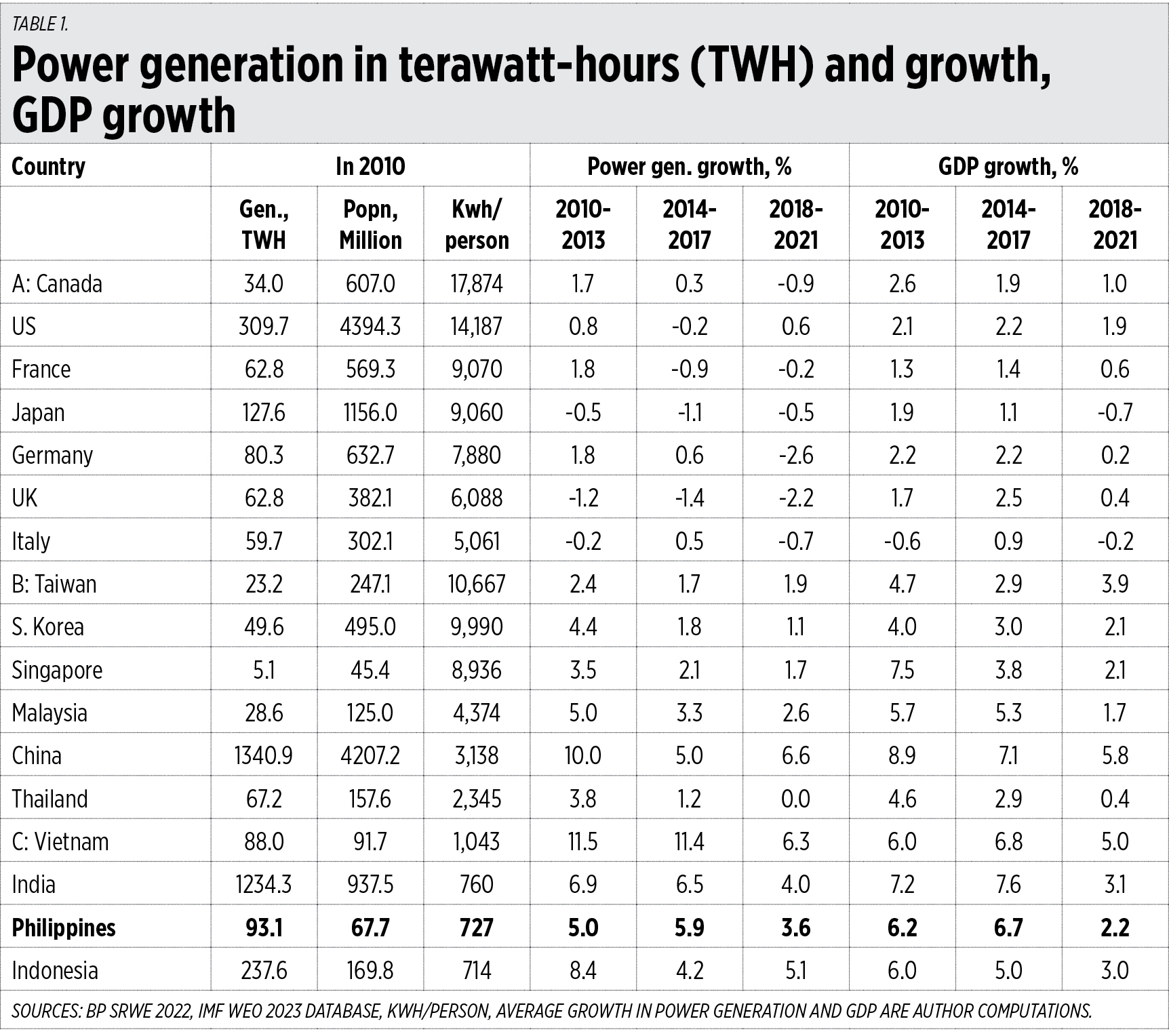
I wanted to possibly measure this uncertainty, so I constructed this table. My sources of basic data are: Power generation from the BP Statistical Review of World Energy (BP SRWE) 2022, and Population and GDP growth from the IMF World Economic Outlook (IMF WEO) 2023 database. I computed the kilowatt hour (kWh) per capita, the annual growth rate of power generation, then I averaged the generation and GDP growth rates.

I group the countries into three: Group A are the G-7 member-countries; group B are high generation Asian economies with 2,300 kWh/person and higher as of 2010; and group C are low generation Asian countries with 1,000 kWh/person and lower. The later are India, Indonesia, Philippines, and Vietnam.

I chose the year 2010 because that was the first year of operation of the NGCP and hence, the improvement in the grid stability and security, or the lack of it, would have been felt. The results are somehow revealing.

One, of the four countries in Group C, the Philippines had the slowest growth in power generation from 2010 to 2021. Some big new power plants would have started generating additional power, but with many delayed or unconstructed transmission and interconnection lines, or with the existing ones frequently conking out, this adversely affected overall generation.

Two, in average GDP growth, Vietnam and India had faster rates than the Philippines and Indonesia. I still have to quantify how many trillions of pesos of unrealized expansion in GDP were caused partly, or largely, by NGCP inefficiency. I will do so in future columns.

Three, looking at all the countries covered, those with fast growth in power generation also have fast GDP growth: China, India, Indonesia, the Philippines, and Vietnam. And countries with slow growth or a contraction in power generation also have low, anemic GDP growth: these were all the G7 countries (see Table 1).

Japan, the UK, and Italy, in particular, are slowly toying with deindustrialization and degrowth economics as they slowly unload their reliable coal, gas, and nuclear power plants, and embrace more intermittent wind and solar.

So, among the important energy policies that the Philippines and other developing countries should note are: One, power generation, especially from reliable conventional plants, should keep expanding and they should avoid adding more intermittent sources to the grid. Two, the transmission and interconnection system, especially for an archipelago like the Philippines, should keep expanding and modernizing.

Three, the electricity distribution system to end-users like households should also keep expanding and modernizing.

And, four, the government power price control like the secondary price cap (SPC) at the Wholesale Electricity Spot Market (WESM) should be scrapped or raised to a higher level. No new peaking plants and ancillary plants are being constructed because companies will not operate at a loss. The most expensive electricity is not P7/kWh or more (vs. the SPC of P6.25/kWh since around 2014). The most expensive electricity is no electricity, resulting in blackouts, and people forced to use candles, gensets, or manual fans.

MAHARLIKA INVESTMENT FUND PASSED BY THE SENATE
On the early morning of May 31, the Senate voted 19-1-1 to pass the Maharlika Investment Fund (MIF). That was almost unanimous voting by the Senate. All the economic team members, including the Bangko Sentral ng Pilipinas (BSP) Governor, are supporting it.

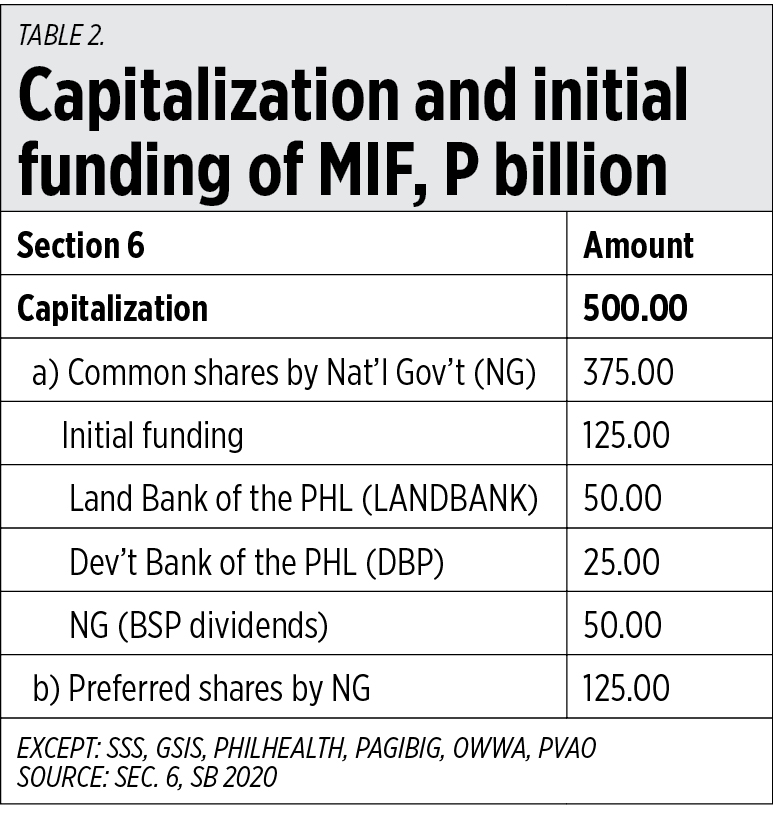
There seems to be no hard copy yet of the approved Senate version as of my deadline, but based on the May 30 version of the bill, Table 2 shows the proposed funding of the MIF.

These plus dividends from the Philippine Amusement and Gaming Corp. (PAGCOR) and other government gaming operators. Plus private funds.

I am wondering why Malampaya royalties are not included in the funding? This is big: P24.52 billion in 2018, P26.57 billion in 2019, P19.08 billion in 2020, P19.79 billion in 2021, P25.90 billion in 2022. Or an average of P23.17 billion a year over the last five years.

I am hoping that the bicameral conference committee will consider using Malampaya royalties for MIF funding.

Once established, I wish to see the MIF getting majority control of the only remaining private monopoly nationwide — the NGCP. Plus do more oil-gas-coal exploration and development.


Bienvenido S. Oplas, Jr. is the president of Bienvenido S. Oplas, Jr. Research Consultancy Services, and Minimal Government Thinkers

minimalgovernment@gmail.com

nChain eyes to promote Bataan province as blockchain hub in Asia

TRUSTPAIR.COM

GLOBAL blockchain company nChain is working with Bataan to digitize their local government processes and become a blockchain hub in Asia, the company’s Chairman and Co-Founder Stefan Matthews said.

This is in line with the memorandum of understanding (MoU) signed by Mr. Matthews and Bataan Governor Jose Enriquez “Joet” S. Garcia III to implement a blockchain framework for their provincial government services.

“Part of this is facilitating workshops and trainings to the leaders of Bataan in understanding the various use cases of blockchain,” Mr. Matthews said in his keynote presentation in the BusinessWorld Economic Forum last week.

The special economic zone status of the Freeport Area of Bataan makes the province an attractive location for companies to harness the potential of blockchain, he noted.

The Authority of the Freeport Area of Bataan (AFAB) has formulated the Offshore Blockchain and Financial Technology Solutions Policy to promote and regulate the activities.

“With AFAB at the forefront of cultivating a thriving blockchain culture within the Freeport Area of Bataan, the Philippines is poised to harness the full potential of this transformative technology,” Blockchain Association of the Philippines founding president Donald Lim said.

“This emphasis on an enabling environment and ease of doing business is crucial in fostering innovation and entrepreneurship, key drivers of blockchain technology adoption,” he added.

Mr. Matthews said blockchain can transform the country’s systems of auditing and tracking, micropayments, agriculture, disaster management, central bank digital currency, and automation.

Blockchain can also boost the use of emerging technologies in the country such as artificial intelligence, the Internet of Things, and the Internet Protocol version 6, he said.

nChain is looking to help improve processes in government agencies, universities, and enterprises through digital transformation by building a nation of blockchain professionals, Mr. Matthews said.

The company has also signed an MoU with the Ateneo de Manila University to help promote blockchain research and education.

“Our mission [is to] power the peer-to-peer economy today and in the future,” Mr. Matthews said.

“Through technology, we can make a more transparent and impactful society,” he added. — M.H.L. Antivola