Home Blog Page 4749

Gov’t sale of NLEX stake seen as good policy move

THE government’s plan to sell its stake in NLEX Corp. will help raise revenues and allow it to better exercise oversight, analysts said.

The Finance department earlier announced its plan to dispose of P2.5 billion worth of assets this year. Included in the government’s disposition plan is its 3.46% stake in NLEX Corp., which it plans to unload by the third quarter.

Data from the Privatization Management Office showed that the disposition is still subject to third-party valuation. The plan is expected to be endorsed to the Privatization Council within the month.

Finance Secretary Benjamin E. Diokno said the disposition was driven by the need to raise more revenues for priority projects and clear any “stagnant assets.”

Transportation expert Rene S. Santiago said in a Viber message that the disposition is a “good policy move” as this would help the government avoid conflict of interest.

“The government will still be able to exercise oversight over NLEX operations through its regulatory agency, the Toll Regulatory Board, to ensure reasonable rates to tollway users,” Terry L. Ridon, convenor of infrastructure think tank InfraWatch PH, said in an e-mail.

The disposition will also help raise government revenues.

“With the government’s limited fiscal space, disposing its shareholdings in various corporations will allow it to raise significant amounts of cash to fund its programs and projects. It should, however, ensure that it gets the best price in the disposing of its shares,” Mr. Ridon said.

“Proceeds would help increase government revenues, though one-time, and contribute to improving the fiscal position,” Rizal Commercial Banking Corp. Chief Economist Michael L. Ricafort said in a Viber message.

Mr. Ridon also noted that the company may also consider buying back its shares through a share buyback program.

“It will allow the tollway operator to further consolidate its control over its operations,” he said.

Analysts also noted that the government’s stake is minimal and will not impact the firm.

“The government’s stake is relatively small, way below controlling stake. [It could] be sold at an attractive price or valuation, at least fair,” Mr. Ricafort said.

Mr. Santiago said that “the equity is too small to even merit a board seat.”

“It should have no real impact on its project timelines to complete the NLEX Connector Road, and its other important initiatives within its tollway network,” Mr. Ridon added.

The second segment of the NLEX Connector Road is set to be completed by the end of June, NLEX Corp. earlier said.

NLEX Corp. is part of Metro Pacific Tollways Corp., the tollway unit of Metro Pacific Investments Corp. (MPIC).

MPIC is one of three key Philippine units of Hong Kong-based First Pacific Co. Ltd., the others being Philex Mining Corp. and PLDT Inc.

Hastings Holdings, Inc., a unit of PLDT Beneficial Trust Fund subsidiary MediaQuest Holdings, Inc., has a majority stake in BusinessWorld through the Philippine Star Group, which it controls. — Luisa Maria Jacinta C. Jocson


Cine Europa returns to physical screenings on its 26th year

VICTOR POLSTER in the Belgian film Girl (2018)

CINE Europa is back for its 26th edition, this time with physical film screenings in Metro Manila, Cebu, Iloilo, Bacolod, and Davao from June 16 to July 16.

The longest-running European film festival in the country brings 28 multi-awarded films to cinemas and outdoor venues, presented by the European Union (EU) Delegation to the Philippines and the EU member states’ embassies, together with Goethe Institut Manila.

“This year’s edition is a special one because we are finally returning to fully on-site screenings,” said Ana Isabel Sanchez-Ruiz, Deputy Head of the EU Delegation at the press briefing at Shangri-La Plaza on June 8.

In 2020 and 2021, Cine Europa was held online, which according to Ms. Sanchez-Ruiz, was a challenge and not as successful as previous years, given the pandemic. She said that in 2022, hybrid screenings resulted in a rise of festival attendees.

“The main issue online is the intellectual property rights for the movies. It’s not easy to find filmmakers who agree to that format. That’s why we switched. But we’ll consider the hybrid option every year,” Ms. Sanchez-Ruiz said.

For the 2023 edition of the film festival, Cine Europa will screen 28 multi-awarded films from different EU Member States for free. Though there is no particular theme, the organizers and embassy members chose films from various genres to present the best of what European cinema has to offer. The festival will open on June 16 with a documentary from Sweden titled Historja – Stitches for Sapmi, directed by Thomas Jackson, about the Sami female artist Britta Marakatt-Labba, whose art showcases Sami culture and how reindeer husbandry is affected by the climate crisis.

The other films being shown this year include Murina (Croatia and Slovenia), a coming-of-age film about a teenager, her father, and an old friend with a life-changing deal. My Love Affair with Marriage (Latvia and Luxembourg) is an animated feature film for adults about young Zelma and her quest for a perfect love and lasting marriage. Poland’s Sweat follows Sylwia Zając, a celebrity fitness motivator who is looking for true intimacy. Rien à Foutre (Zero F*cks Given), from Belgium, is about Cassandra, a flight attendant floating through life until forced to confront situations she is running from. Another Belgian film, Girl, follows 15-year-old Lara, who dreams of becoming a ballerina.

Irish film Ensilumi (Any Day Now) follows an Iranian family living in a refugee center and their process of filing for asylum. Another Irish movie, Róise & Frank, is a warm-hearted and witty tale about widowed Róise who believes that a stray dog embodies the spirit of her late husband Frank.

Danish film Miss Viborg is about two women from different generations who share an unlikely friendship. This film was awarded Best Nordic/Dutch Film Award at the Santa Barbara International Film Festival. German documentary The Cleaners follows the work of content moderators in Manila and their harrowing day-to-day lives. Szelíd (Gentle), from Hungary, is a fictional documentary about a female bodybuilder whose dream is to win Miss Olympia. Spanish film Ramona is a comedy about the immortal feud between sense and sensibility. Io Sto Bene (Luxembourg, Germany, Belgium, and Italy) shows parallel destinies of an old man and a young woman and a future full of peace for them both. Greek comedy Dodo is about the supposedly extinct dodo bird making a reappearance that spirals a family’s boundaries out of their control.

Moi dumky tykhi (My thoughts are silent) is a Ukrainian film that explores the eternal problem of parents and children and showcases a mother and son relationship where the son wants to move to a different country. Lyuksemburh, Lyuksemburh (Luxembourg, Luxembourg) is a Ukrainian comedy about two children in search of their father in Luxembourg. Marocco/Mikado (Romania and Czech Republic) is a drama depicting a father-daughter relationship faced with chaos and irreversible outcomes.

OSS 117: From Africa with Love is a French espionage film about OSS 117, France’s finest secret agent, who heads to Africa for what could be the trickiest mission ever. Os Demónios Do Meu Avô (Portugal, Spain, and France) is an animated film about Rosa and her journey back to her native village on the border between Spain and Portugal. Srdce na dlani, a comedy from the Czech Republic is about characters falling in love and navigating love’s complications and obstacles. Imad’s Barndom (Imad’s Childhood), co-produced by Sweden and Latvia, is a documentary about a family released from ISIS captivity and placed in a displaced persons’ camp in Kurdistan. Bulgarian film Golata istina za grupa Zhuguli (The Naked Truth about Zhugui), is about a fictional band that broke up 30 years ago, setting up for a 50th anniversary concert.

Bėgikė (Runner), a co-production from Lithuania and the Czech Republic, centers on Marija and her frantic search for her boyfriend. Mitra, from the Netherlands, is a revenge and friendship story about Haleh and the woman who betrayed her and caused the death of her daughter in Iran 37 years ago. Estonian film Kratt is about a magical creature who will do whatever its master says, with the quest to buy a soul from the devil. Smagen af sult (A Taste of Hunger) from Denmark follows a family, their gourmet restaurant, and their quest for a Michelin Star. Italy’s Olmo is a short film about 80-year-old Olmo, his 8-year-old grandson Giulio, and their search for an old tree. Le Variabili Dipendenti, another short from Italy, follows two characters, Pietro and Tommaso, who are curious and are getting to know each other.

Screenings will be held onsite in select venues in Metro Manila, Cebu, Iloilo, Bacolod, and Davao.

The schedule for each venue is as follows:

June 16 to 18: Shangri-la Plaza
June 21 to 23: Film Development Council of the Philippines, Kalaw, Manila
June 24- 25: Cultural Center of the Philippines — Open grounds
June 30 to July 2: Rizal Open Park Auditorium — Luneta Park
July 5 to 7: SM Cinema Cebu
July 8 to 9, and July 12-16: Film Development Council Iloilo
July 14-16: Film Development Council Negros (Bacolod)
July 14-16: Film Development Council Davao

The screening schedules for all films and venues can be found on Cine Europa’s social media pages (@cineeuropaph on Facebook and Instagram). — Brontë H. Lacsamana

ICTSI’s Melbourne expansion to operate by 2024

PHILIPPINE-LISTED International Container Terminal Services, Inc. (ICTSI) is set to start operating the first phase of the expanded portion of its port in Melbourne, Australia by 2024.

The project worth 235 million Australian dollars will allow Victoria International Container Terminal (VICT) to accommodate larger ships or two 336-meter vessels simultaneously, the company said in a press release on Monday.

“Once the [whole] project is complete, our operations will expand from five quay cranes to eight, adding three new-generation cranes, 10 new automatic stacking cranes (ASC), and 50% increased yard capacity,” said VICT Chief Executive Officer Bruno Porchietto.

Mr. Porchietto said the expansion will also allow the port to handle neo-Panamax vessels, which have a capacity of up to 14,000 twenty-foot equivalent units (TEUs).

“[It will provide] shipping lines with the opportunity to leverage economies of scale and thereby reduce supply chain costs — something that isn’t available at the Port of Melbourne’s Swanson dock terminals,” he said.

The expansion project at the VICT has two phases, with the first phase on track for completion in 2023 and the second phase scheduled for completion in line with market demand.

The first phase of the project will increase VICT’s capacity by 25% to 1.25 million TEUs. It will include two new quay cranes and six new ASCs, while the second phase involves the third quay crane and four ASCs.

ICTSI won the concession for the Melbourne-based terminal in 2014 to which it has invested more than 700 million Australian dollars for operations.

Under a separate proposal, ICTSI publicly shared a 500-million Australian dollar expansion of Webb Dock, which it believes will provide the lowest cost, most efficient and environmentally sustainable solution at the Port of Melbourne.

“ICTSI believes the proposal would be a key facilitator for the continued growth of the Victorian economy,” the company said.

To assess the merits of its proposal, it has engaged multiple firms such as Jacobs Engineering, which undertook a detailed technical assessment that includes estimated construction costs, and Boston Consulting Group, which made market and economic assessments. — Justine Irish D. Tabile

Green jobs and job titles

CONVERTKIT-UNSPLASH

Did you notice the new names for courses in college these days? There are applied management courses, management engineering, communication management, multimedia management and many more names that did not exist about 20 years ago. And there are new job titles, careers and green jobs that we’ve never heard of before. What are green jobs?

We now have virtual assistants, not just executive assistants. We have digital creators, not just writers or artists. Multimedia and content creators have become all-in-one advertising agencies. Everyday, there seems to be a new development in the career field and managers should be a step ahead in managing human resources. Adding to this need to learn new things is the need to study how to entice people to join the workforce and make them stay.

I remember about 40 years ago, my friends and I did a job evaluation project for our manufacturing company. We set up job titles, career paths and salary levels so it would be easy for HR officers to promote someone, evaluate each person in the organization periodically and lay out a clear career path so people will stay and give us as managers good grades for employee retention. Is that still possible now?

I just gave an online lecture to more than 120 Africans and a few Middle Eastern startup owners, and they actively participated, wanting to start businesses of their own. This is why many employees now choose to work from home so they can also do a side hustle and try to be entrepreneurs. In addition to knowing new job titles and thinking of how to keep employees happy, we also must face the fact that many employees now want to try being entrepreneurs.

The pandemic gave a taste of entrepreneurship possibilities to many displaced workers — they sold stuff online, went into Facebook Live selling and even made TikTok their venue for selling anything. Many of our former staff members chose to go home to the provinces than pay rent in boarding houses and start their own small business.

This is why coffee shops also became the fashion. Anybody can order equipment from Alibaba, Lazada and Shopee. They can start their own coffee kiosk whether they are in Misamis or La Carlota City. Ordering online became the norm, and small businesspeople accessed equipment and supplies by ordering online. Anyone can be an entrepreneur. If it succeeds, maybe they can scale up. If they fail, they get up, brush their knees and put away their equipment and start looking for a regular job. I was ordering artisan bread from a neighbor, who I learned had closed his business when things normalized and returned to his 9-to-5 job.

This is what managers now have to contend with. Today’s youth are more carefree and do not want a set career path. They are more fluid in their decision-making and do not see anything wrong with resigning from a job to be able to take a trip somewhere because they found a “piso fare” — one-peso fares occasionally offered by airlines. Some resign when they are reprimanded by a superior. Some just stop reporting for work because it has become difficult to commute.

I have a nephew who finished a technology course and has worked only for foreign companies since he graduated — all from the comforts of his home. He has had three jobs, all with US companies and they have never ever met physically.

He is the typical Gen Z employee, who works from home but has a stable job with an overseas company. His written and spoken English has also improved because of his daily interaction with his employers. He is the new OFW — he works abroad but is physically home. Jobs, like his, may be the solution to the social cost of parents working abroad.

But for our physical offices, what does the future hold? In manufacturing companies, we still need workers because robots are expensive for our economy. In offices, many already work with a hybrid setup — two days in the office, three days from home. HR departments must double up on thinking of new ways to hire, retain and promote people along a career path.

Meanwhile, managers must face the new jobs the digital economy has created. Even a small company like ours has had to hire virtual staff for the past three years now. Our marketing department can discuss over Zoom, Messenger and hardly ever meet physically. Large companies may downsize and realize they can save on office space as well as utilities and employee benefits. We really need to take another look at hiring and keeping people, especially in air-conditioned offices in the central business district because rents have not come down despite these developments. Trim your need for physical offices because the internet has opened a lot of possibilities for managers to be able to manage remotely.

The future may be in hiring for a specific task or skill, and not the usual employee development along a career path. Employers must open their minds to new ways to keep millennials and Gen Z people in the workforce. They were born in a different scenario, and with the added complication of COVID closing offices for almost three years, anything is possible for this generation. They can work from home, become virtual assistants, tech assistants and be entrepreneurs on the side.

These may be the new green jobs we often aspire to include in our plantilla. They are green because they may use less energy to commute, saving lots of resources such as gasoline and human energy. They are green because we can save money and time and may be more sustainable in the long run. Imagine your office with nobody except one assistant.

Maybe it is time to convert our job titles and positions to green jobs.

This article reflects the opinion of the author and does not reflect the stand of the Management Association of the Philippines or MAP.


Chit U. Juan is a member of MAP’s Diversity and Inclusion Committee and Agribusiness Committee. She is chairwoman of the Philippine Coffee Board and councilor of Slow Food for Southeast Asia.

map@map.org.ph

pujuan29@gmail.com

AirAsia plans to create local businesses, jobs

ISABEL LEE-UNSPLASH

THE holding firm behind AirAsia Philippines is looking at bringing its logistics, engineering, and ride-hailing businesses to the Philippines to create more jobs for Filipinos, its top official said.

Capital A Berhad Chief Executive Officer Anthony Francis Fernandes said in a statement on Monday that the company will be putting more investments in the Philippines.

“We have a great logistics business coming — Teleport Philippines, which we think will be great for e-commerce providers in the Philippines to sell their goods all over,” Mr. Fernandes said.

“We want to build an engineering company here, on top of Lufthansa Technik’s. We would like to bring Asia Digital Engineering (ADE) which is really a fantastic engineering company,” he added.

ADE is the engineering arm of Capital A, which provides heavy maintenance, repair, and overhaul services for the group’s commercial aircraft.

Capital A is also planning some major changes across its Philippine operations as part of its post-pandemic recovery strategy such as increasing its fleet to sustain route expansion both domestically and internationally.

“Leisure, migration workforce, and small and medium enterprises travel currently comprise pent-up demand for air travel,” Mr. Fernandes said, adding that 80% of AirAsia’s traffic in Southeast Asia consists of shorter trips and low-cost travel.

“With this, we’d like to further connect the Philippines to other ASEAN destinations,” he said. 

The company will be making recruitment a priority in the next few months. It anticipates hiring an additional 1,000 employees to support AirAsia Philippines’ expansion in the next three years on top of the expected 6,000 jobs that will be created by the introduction of Capital A’s ride-hailing business in the Philippines.

“My priorities were to survive, to bring back people, and recruit more people. Our biggest asset actually is people. People are smart here, people are hard-working, and they have a wonderful personality. So for us, we will grow all four lines of Capital A in the Philippines,” Mr. Fernandes said. — Justine Irish DP. Tabile

Kimberly Akimbo, Tom Stoppards’ Leopoldstadt among winners on writerless Tony night

J. HARRISON GHEE accepts the award for the Best Performance by an Actor in a Leading Role in a Musical for Some Like It Hot at the 76th Annual Tony Awards in New York City, US, June 11. — REUTERS

KIMBERLY AKIMBO, about a teenager who ages in reverse, and Tom Stoppards’ autobiographical Leopoldstadt were among the winners Sunday as the Tony Awards went on despite the Writers Guild of America strike.

The three-hour telecast on CBS was hosted by Tony- and Academy Award-winner Ariana DeBose. Held for the first time at the United Palace in Washington Heights in northern Manhattan, it leaned heavily on musical performances from the nominated shows, and other numbers including a dance performance in tribute to the recipients of the 2023 Lifetime Achievement awards, Joel Grey and John Kander.

Patrick Marber, who won Best Director of a play for Leopoldstadt, was among several winners who used their acceptance speeches to express support for the strike.

Mr. Marber added the evening was going well without writers because “actors are great improvisers and yeah, it’s fun. I wouldn’t like it to become a trend, but I’m not surprised.”

Kimberly Akimbo won best musical, beating out splashier, higher-budget productions such as New York, New York and Some Like It Hot. Victoria Clark picked up her second Tony Award for her role as the title character in Kimberly Akimbo. Ms. Clark won a Tony in 2005 for The Light in the Piazza.

Best play Leopoldstadt, which also won the 2020 Olivier Award in London for best new play, follows the experiences of a Jewish Viennese family over 50 years.

Sean Hayes won Best Lead Actor in a Play for his role as Oscar Levant in Goodnight, Oscar. J. Harrison Ghee and Alex Newell made Tony Awards history as the first two openly nonbinary actors to win. Mr. Ghee won Best Actor in a Leading Role in a musical for Some Like It Hot, and Newell won for Best Actor in a Featured Role in a Musical for the portrayal of brassy Lulu in Shucked.

“When I saw the script,” Mr. Ghee said, “I saw an opportunity to be an inspiration, to be that representation, to be someone who could be a part of people’s lives where they could see themselves and grow and learn and live and expand, and it’s not something I take lightly. It’s something that I cherish and it’s a dream come true, truly.”

Jodie Comer won Best Actress in a Play for her role as brilliant barrister Tessa in the one-woman tour-de-force Prima Facie. Michael Arden won for Best Direction of a Musical for the revival of Parade. Topdog/Underdog won the Tony for Best Revival of a Play.

During a pre-show hosted by actors Julianne Hough and Skyler Astin and streamed on the free platform Pluto TV, Tonys were awarded mostly in technical categories. The pre-show included the award for Best Regional Theater, which went to the Pasadena Playhouse, and the Isabelle Stevenson Award, which went to director and choreographer Jerry Mitchell. — Reuters

How Apple’s Vision Pro could save its VR competitors

APPLE, INC.’s Vision Pro headset is an overpriced laggard with no proven market and a decade of history to show why it should fail. Which is precisely the reason its entry into the virtual reality (VR) sector could ignite a boom among rivals fighting to improve their own devices using cheaper components and new technologies.

It’s rare that Apple is first to market on anything. We know it wasn’t the premier laptop maker, was late to the MP3 business, and certainly didn’t invent the smartphone. Yet in each case, the Cupertino-based company brought out what it envisioned to be the best version of a device, one that focused heavily on user experience and needs.

A key feature of its new-product strategy is to not get trapped by technological barriers, and instead plow ahead confident in the belief they can be overcome. And if not, Apple leaders have rarely been shy to pull a product or re-engineer to ensure the user experience remains the top priority.

One famous example is Steve Jobs’s dissatisfaction with the iPhone screen mere months before launch. It was originally to be made of plastic, but a few weeks with a demo device in his pocket jangling with a set of keys revealed how easy it was to scratch. He got to work rebuilding the device around a glass panel instead.

When the company suddenly switched materials its suppliers were crucial to solving the problem. Apple doesn’t assemble its own products, but it does work very closely with vendors to create new chemicals, develop innovative technologies and engineer production processes. This approach means Apple has historically blazed a path forward in hardware and materials that allowed the rest of the sector to ride its coattails. It’s common for suppliers to quietly tout their famous client as proof of technical prowess.

Two other case studies show just how influential the US company is in clearing the way for rivals to enjoy easy access to world-changing technology.

Apple’s Powerbook G4, released 20 years ago, introduced a metal shell to the laptop market when most competitors were still using plastic. But these new materials required a whole new approach to manufacturing. So Apple worked closely with its Taiwanese supplier to develop a laser welding technique for assembling these cases. The result was a groundbreaking approach that, while initially challenging, taught the industry a new way to envision and build laptops. Within a few years, others followed, including brands such as Google, Dell, HP and Huawei.

Not long after, the iPhone appeared on Apple’s radar. From the outset, Jobs knew that he needed to do away with a keyboard — like that sported by the BlackBerry — and go with a touch interface. At the time, one of the most common techniques was to lay two thin plastic sheets close to each other, but not touching. A finger press pushed one against the other, completing a circuit and identifying the location of the touch. It was slow, unresponsive and flimsy.

But Taipei-based startup TPK Holding Co. had a better approach. It used a single layer that sensed changes in electrical current caused by a finger press. This new technology was far better than anything else available, but had not yet been perfected and as a result manufacturing capacity was still lacking.

Rivals, including HTC Corp., Nokia Oyj and Research in Motion Ltd. soon got wind of this superior solution and started using it in their own devices. Within five years, TPK’s sales to non-Apple clients had climbed 10-fold and surpassed that to the iPhone maker. 

We can expect a similar story to play out with Vision Pro, which might best be called a mixed-reality device because it combines real and virtual worlds. HTC, Meta Platforms, Inc. and Microsoft Corp. are among the companies that, until now, believed they had the best VR products. But Apple has put them back in their places. Some of this is because of the ecosystem that allows the new headset to play nicely with iPhones, iPads, AirPods and Macs.

But a major reason the Vision Pro is widely regarded as the best, after just a few days of its highly controlled demonstration to the world, is because Apple clearly spent a lot of time and money perfecting the underlying technology. This includes the “singular piece of three-dimensionally formed laminated glass” which acts as the lens, alongside a suite of advanced sensors, as well as the miniature high-quality micro‑OLED screens.

Apple has been working hard to develop its own displays for at least eight years and says it filed more than 5,000 patents related to the Vision Pro alone. This means that a lot of the technologies deployed in the device will be exclusive. But not all of them — many may not even be owned by the company.

Equally important for both Apple and its rivals is the $3,499 price tag that prohibits it from becoming a mass-market device, but gives a lot of room for cost shrinkage. Over time, components will get cheaper and production volume will escalate as vendors become more efficient at manufacturing. As happened for metal laptop cases and touch screens, the benefits will be shared across the entire supply chain.

With Apple giving rivals a template for how a mixed-reality headset should work, and by providing vendors a guide for making the parts required, the entire industry will get the kind of boost not seen since Steve Jobs unveiled the iPhone.

BLOOMBERG OPINION

Metro Pacific farm unit to focus on dairy brand

METRO Pacific Investments Corp.’s (MPIC) agriculture arm Metro Pacific Agro Ventures, Inc. (MPAV) will focus more on its dairy business as it saw a big demand for its ice cream brand, a company official said.

“Primarily, we have been focused on Carmen’s Best. We were surprised that the ice cream business is growing more than 50% year on year, so we want to push more,” MPAV President and Chief Executive Officer Jovy I. Hernandez told reporters on the sidelines of the company’s annual stockholders’ meeting last week.

He added that the company is partnering with other dairy farmers to alleviate the scarcity of milk.

“We are also very adamant in pushing for the new dairy facility,” he said. “We are still pursuing the Metro Pacific dairy farms, which will eventually have at least 1,000 cows.”

He said the facility would increase production by five times.

“And we also continue to work with the local farmers, so when we consolidate that mas marami nang supply ng milk (there would be more milk supply),” he added.

The company announced earlier this year that it aims to build a dairy facility in Laguna which will produce about six million liters of milk per year. The facility is expected to begin operation by late 2025 or early 2026. It is via a P2-billion partnership with Israel-based firm LR Group.

“We are still planning a few new things within the year, which we will announce soon, particularly on the ice cream side,” Mr. Hernandez said.

MPIC has a partnership with the Carmen’s Best group, which consists of Carmen’s Best Dairy Products, Inc., Carmen’s Best International Dairy Co., Inc., Real Fresh Dairy Farms, Inc., and The Laguna Creamery, Inc.

Meanwhile, Mr. Hernandez said the company’s almost P1-billion investment in a greenhouse had met construction delays.

“But we are working double time now to hasten the construction,” he said.

The greenhouse is expected to produce about 1,600 metric tons of vegetables a year.

MPIC through MPAV has been investing in various agricultural ventures with the recent purchase of an almost 34.76% stake in Axelum Resources Corp. for P5.32 billion.

“While we are still a minority in Axelum, we are closely working with [its] management to try to not only improve the business but develop the local market for coconut products, and we are primarily interested in looking at the coconut supply also,” Mr. Hernandez said.

MPIC is one of three key Philippine units of First Pacific, the others being Philex Mining Corp. and PLDT Inc.

Hastings Holdings, Inc., a unit of PLDT Beneficial Trust Fund subsidiary MediaQuest Holdings, Inc., has a majority stake in BusinessWorld through the Philippine Star Group, which it controls. — Adrian H. Halili

Fête de la Musique dives into ocean conservation efforts

THE world-renowned free music event that started in France and is now celebrated across the globe is returning to the Philippines — this time to raise funds for ocean conservation through music.

Fête de la Musique PH, the music festival’s Philippine edition organized by Alliance Française de Manille, will have a series of live celebrations from June 16 to 24 in Metro Manila, Caloocan, Tagaytay, Laguna, Zambales, Pampanga, Baguio, Baler, Albay, Cebu, El Nido, and Siargao. Fête de la Musique began as a music festival in Paris on June 21 (Fête’s official date) in 1982 and has since spread across the world. Fête 2023 in the Philippines will kick off on June 16 with a music export conference by SONIK Philippines at The Astbury in Makati. It aims to empower local acts to grow music and fanbases in foreign markets.
This year’s festival is titled “Mersea,” which merges the French words mer (sea) and merci (thank you). Its goal is to show gratitude for 29 years of Franco-Filipino cultural relations and contribute to furthering ocean conservation efforts.

“In spite of all our differences, music — just like the oceans — connects us humans with each other,” said Xavier Leroux, executive director of Alliançe Française de Manille, in a statement.
Under a partnership with the United Nations Development Programme (UNDP) Philippines and the Department of Environment and Natural Resources (DENR), coastal cleanup and tree-planting activities around the country will be promoted, including in Metro Manila, Siargao, and Cebu.

The scheduled events include SONIK Sessions on June 16, and performances on the Makati pocket stages on June 17. During the festival’s official date on June 21, French act Remi Panossian Trio will perform at Long Bar in the Raffles hotel in Makati, while the party goes on at its stages in Cebu and Siargao. Mr. Panossian will also perform the next day at Alliance Française de Manille. On June 23, Fête de la Musique’s main stage will open at Greenbelt 3. Finally, the festival’s last day on June 24 will see performances in its stages in Albay, Baler, Baguio, Caloocan, El Nido, Laguna, Pampanga, Tagaytay, and Zambales.

For more information, visit www.facebook.com/FetePH/. — BHL

Financing growth, fiscal discipline and Maharlika fund

(Second of four-parts)

Last week, the Development Budget Coordination Committee (DBCC) or economic team kept the Philippine growth targets of 6-7% this year and 6.5-8% for 2024-2028, having considered the risks of El Niño, global trade tensions and value chain disruptions, among other factors.

Among their assumptions are inflation of 5-6% in 2023 and 2-4% in 2024-2028; peso-dollar rates of P54-P57 this year and P53-P57 in 2024-2028; Dubai crude at $70-$90 per barrel in 2023-2024 and $60-$80 in 2025-2028.

I think these growth targets are achievable and should be maintained. I can think of at least three reasons.

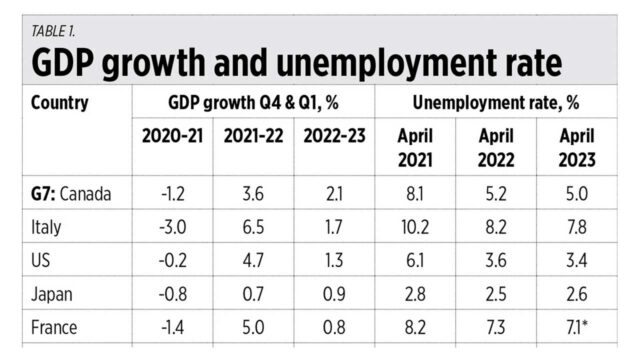
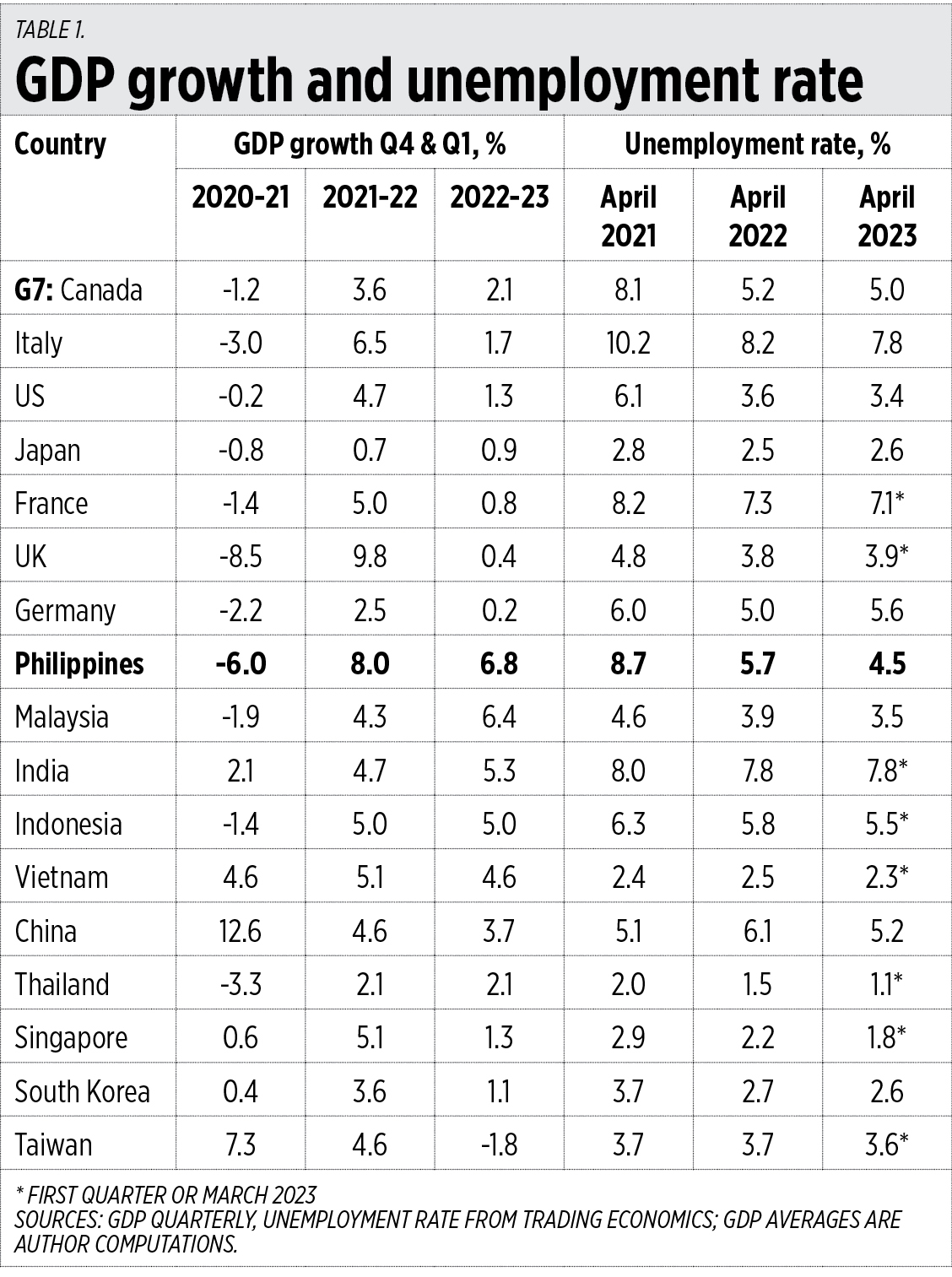
One, the Philippine growth momentum is way above the pace of neighboring Asian economies, and triple or quadruple those in G7 countries. Out of 72 economies that reported first quarter growth, the Philippines was the fifth-fastest growing and among the medium-to-large economies worldwide, the Philippines has the fastest growth.

Two, the average growth for the fourth quarter of 2022 and the first quarter this year was 6.8%, the fastest among the countries listed below, and it was a fast growth over a high base and high growth of 8% a year earlier.

Three, job creation remains fast as shown by the unemployment rate of 4.5% in April, which is almost one-half of 8.7% registered in April 2021 (Table 1).

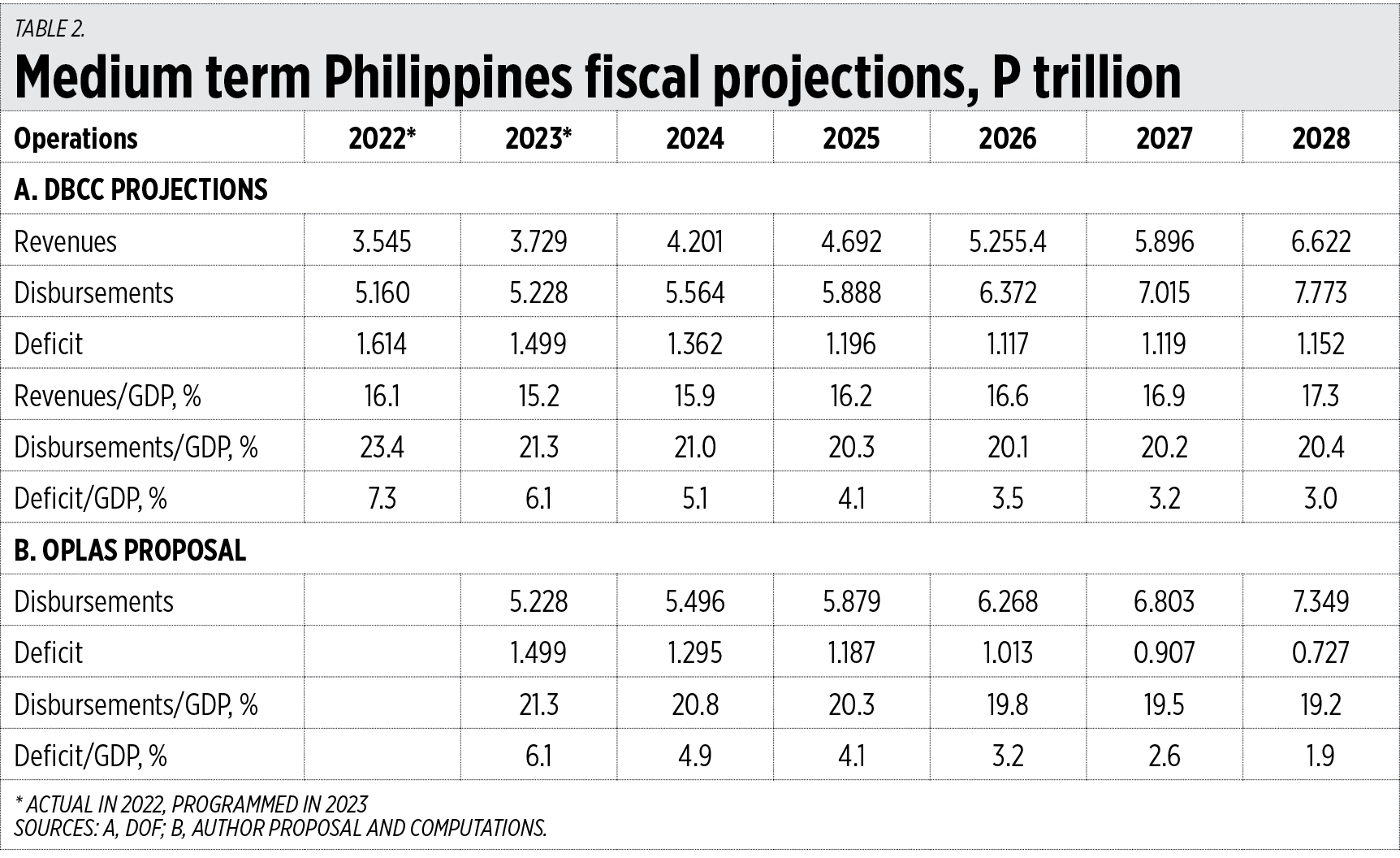
The DBCC also showed its medium-term fiscal scenario from 2023 to 2028. The revenue-to-GDP ratio will rise from 15.2% in 2023 to 17.3% in 2028, and the budget deficit-to-GDP ratio will decline from 6.1% in 2023 to 3% in 2028.

These are good targets by the DBCC, but we should aim for a drastic reduction in the annual budget deficit. This can be done via fiscal discipline — controlling spending and borrowings during noncrisis years, retiring public debt and saving on interest payments. When crisis years occur again, we will have wider fiscal leeway to engage in higher deficit spending and higher borrowings at lower interest.

Here, I propose that the disbursement-to-GDP ratio should decline from 21.3% this year to 20.3% in 2025 and 19.2% in 2028. Assuming that the revenue-to-GDP ratio will stay at DBCC targets, then the deficit-to-GDP ratio should significantly decline from 6% in 2023 to only 1.9% in 2028 (Table 2).

Where can spending cuts be made? One in some subsidies and welfare programs. There are many subsidies and freebies that started many decades ago, including in healthcare and medicines, education from elementary to university, irrigation and agriculture credit, condoms and pills, monthly cash transfers, etc. Recently, food stamps were unveiled. New subsidies imply that some or many existing subsidies are hardly working. To finance new subsidies, some old subsidies must shrink or be stopped and rechanneled to new welfare programs.

Two, in National Government subsidies where there is high or rising subsidy programs by local government units (LGUs). LGUs now have more resources as a result of the Mandanas ruling, in which their share in national tax revenues have significantly increased.

Three, in big infrastructure projects via the Maharlika Investment Fund. Once the fund is established, many big projects that otherwise would be funded by taxes and public borrowings can be taken by the fund.   

These include inter-island bridges (Panay-Guimaras-Negros bridge, new Samar-Leyte bridge, Cavite-Corregidor-Bataan bridge, etc.); small modular reactors for off-grid islands and provinces to stop endless subsidies to National Power Corp. gensets. We can also revive the Bataan Nuclear Power Plant, which has potential generation (assuming a capacity factor of 85%) of 4.62 million megawatt-hours yearly, much larger than solar and wind’s combined generation of 2.71 million MWh in 2021, and reduce electricity prices. The plant was killed in 1986 due to politics. Even business conglomerates would be hesitant to revive this plant because of heavy politics in the energy and environment sectors.

The Philippines has big metallic mining potentials especially for gold, copper and nickel. The Maharlika fund should go there and generate more jobs, more forex revenues and pay more mining taxes. The single-biggest foreign direct investment for the Philippines would have been the $5.9-billion Tampakan gold-copper project by Sagittarius Mines in South Cotabato. The provincial government simply disallowed open-pit mining and the project failed to take off.

Potential projects like these may have failed to register in the minds of the authors of “Maharlika Investment Fund: Still Beyond Repair,” a 27-page paper written by faculty members of my alma mater, the UP School of Economics. Among the reasons they oppose the fund are the inability to articulate implications of the fund’s dual-bottom line objective, funding the MIF poses huge risks to strained public coffers and is vulnerable to moral hazard, and the unlikely ability to crowd in investments and eke out large returns.

Several government agencies are ironically the hurdles and disruptors of important infrastructure and energy projects. If the Maharlika fund is involved in reviving the Bataan plant and in big mining projects, local governments and national bureaucracies can’t easily delay or stop the operation of these big projects knowing there is National Government involvement. Thus, these objections are addressed. The second objection is also addressed as big private capital comes in.

If the fund is questioned or opposed, my question is why Malampaya royalties, which averaged P23 billion a year from 2018 to 2022, were not included in the funding.

The Philippines should endlessly push for fast economic growth. Financing and sustaining it via rechanneled public resources from nonworking subsidy programs, plus government resources outside taxes and borrowings like the Maharlika fund, are noteworthy initiatives.


Bienvenido S. Oplas, Jr. is the president of Bienvenido S. Oplas, Jr. Research Consultancy Services, and Minimal Government Thinkers

minimalgovernment@gmail.com

Locad to build more warehouses in Manila, VisMin

ELEVATE-UNSPLASH

By Justine Irish D. Tabile, Reporter

LOGISTICS COMPANY Locad is looking to expand its warehouse footprint in the Philippines to further ramp up its capacity and provide cheaper services in the Visayas-Mindanao (VisMin) region.

“So, in the Philippines, we currently have eight [warehouses] and we’re looking at a couple of additional warehouses, both in Metro Manila to further ramp up our capacity, and potentially in one or two provincial cities,” Locad Chief Executive and Co-Founder Constantin Robertz told reporters on the sidelines of the Philippine Global E-commerce Summit.

“We are looking at cities, especially in VisMin where we have a lot of demand and where currently the lead times and the cost of shipping are proportionally high because they’re further away from existing warehouses,” he added.

Mr. Robertz said it is unfair that people in Metro Manila get their shipments faster and cheaper, while people in the provinces have to wait longer and pay higher for their items.

“Why would I pay three times for shipping and why wait four times as long? That’s not a good experience. And for a brand or a merchant, it’s too hard to open all these warehouses all over the country yourself,” he said. “The only ones who manage that are the biggest global FMCG (fast-moving consumer goods) brands.”

“So, we want to expand that network and make it open for anyone, so merchants can just leverage on our warehousing network — place their stock in any of our warehouses and pay only for the items that are in the warehouse at no fixed cost,” he added.

Locad currently has 20 warehouses in its portfolio distributed across the Philippines, Southeast Asia, and Australia.

“What we’ve ultimately done and what we are doing with the funds we raised is to continuously expand the platform on the technology side and also add new warehouses in the region,” Mr. Robertz said, referring to the $11 million the company raised early this year.

“We expect to double our footprint of warehouses in the next year and make that available to more and more brands and provide that scalable backend infrastructure for commerce that is available plug and play for any brand-new merchant,” he added.

The Philippines is still the biggest market of Locad, followed by Australia and Singapore. Meanwhile, it expects growth in Thailand, Indonesia, and Malaysia.

“The Philippines is still what we consider our home market, because it’s where we have the biggest team and when we first launched, and it continues to be our biggest market to date, followed by Australia and Singapore,” said Mr. Robertz.

“We’re seeing good growth in our newest markets, which is Thailand, Indonesia and Malaysia. But of course, they’re still slower because they just opened more recently,” he added.

Despite growth in other countries, Mr. Robertz said the Philippines will continue be one of Locad’s top markets.

“We are seeing good growth here, with Philippine e-commerce growing about 15% this year to $16 billion to $17 billion. So, we definitely still see a lot more growth potential here, and we have the deepest market penetration — the strongest presence — in the Philippines,” he said.

“But of course, as other markets like Indonesia and Australia are getting more mature, given the size of these markets… But the Philippines is our largest market to date and will definitely remain one of our most important markets over time,”  Mr. Robertz added.

T-bill, bond rates could rise with expected Fed tightening pause 

BW FILE PHOTO

TREASURY BILL and bond rates on auction this week could rise as traders look to the US Federal Reserve’s next monetary policy move, which could be matched locally.

The Bureau of the Treasury (BTr) will auction off P15 billion in T-bills on Tuesday, or P5 billion each in 91-, 182- and 364-day debt.

On Wednesday, it will offer P25 billion in reissued 20-year T-bonds with a remaining life of 14 years and eight months.

Rates of the government securities might track the rise seen at the secondary market as investors expect the Fed to pause its monetary tightening cycle this week, which could be matched by the Bangko Sentral ng Pilipinas (BSP), Michael L. Ricafort, chief economist at Rizal Commercial Banking Corp., said in a Viber message.

The 91-and 364-day T-bills went up by 9.74 basis points (bps), and 1.68 bps week on week at the secondary market to end at 5.8631% and 5.9482%, respectively, on Friday, based on the PHP Bloomberg Valuation (BVAL) Reference Rates published on the Philippine Dealing System’s website. The 182-day T-bills fell by 6.21 bps to 5.9009%.

“The upcoming 15-year Treasury bond auction yields could be similar to the comparable 15-year PHP BVAL yield at 5.96% as of June 9,” Mr. Ricafort said.

Meanwhile, the 20-year T-bonds rose by 6.92 bps week on week to end at 5.9437%.

“As a result, the markets are now anticipating a possible pause on Fed rates on June 14, and also a pause on local policy rates on June 22,” he added.

The US central bank raised borrowing costs by 25 bps last month, bringing the Fed fund rate to 5-5.25%. It has increased borrowing costs by 500 bps since March 2022.

The Federal Open Market Committee will review policy on June 13-14.

The Bangko Sentral ng Pilipinas (BSP) paused its aggressive monetary tightening last month and signaled it would put the key rate on hold at its next two to three meetings.

The BSP raised policy rates by 425 bps from May 2022 to March 2023. The Monetary Board will review policy on June 22.

Mr. Ricafort also attributed the higher rates to volatile global crude oil prices after Saudi Arabia pledged to cut its oil output by a million barrels per day starting July.

Oil prices declined on Monday ahead of the US Federal Reserve meeting as investors tried to gauge the central bank’s appetite for further rate hikes, while concerns about China’s fuel demand growth and rising Russian crude supply weighed on the market, Reuters reported.

Brent crude futures fell by 1.3% or 97 cents to $73.82 a barrel by 4:37 a.m. GMT. US West Texas Intermediate (WTI) crude was at $69.24 a barrel, also down by 1.3%.

The Treasury bureau raised P15 billion from T-bills it auctioned off on Monday, with total bids hitting P27.653 billion — almost twice the amount on offer.

The Treasury borrowed P5 billion as planned via the 91-day T-bills, with tenders reaching P6.589 billion. The average rate of the three-month debt went up by 4.4 bps to 5.827%, with accepted rates ranging from 5.67% to 5.9%.

The government fully awarded P5 billion in 182-day securities as bids for the tenor reached P11.07 billion. The six-month T-bill was quoted at an average rate of 5.891%, up by 1.2 bps from the previous week, with accepted rates from 5.74% to 5.95%.

The bureau raised the programmed P5 billion from the 364-day debt as demand hit P9.994 billion. The average rate of the one-year T-bill rose by 3.2 bps to 5.98%. Accepted yields were 5.81% to 6%.

Reissued 20-year T-bonds to be auctioned off on Wednesday were last offered on July 31, 2018, when the government rejected all bids.

The Treasury seeks to raise P185 billion from the domestic market this month, or P60 billion via T-bills and P125 billion via T-bonds.

The government borrows from local and foreign sources to help fund its budget deficit, which is capped at 6.1% of economic output this year. — Aaron Michael C. Sy