Home Blog Page 4666

Proposed ‘junk food’ tax draws mixed reaction

A worker arranges juice packs in a grocery in Quezon City, July 8, 2020. — REUTERS

By Revin Mikhael D. Ochave, Reporter

THE GOVERNMENT’S proposal to tax “junk food,” as well as raise taxes on sweetened beverages, has drawn mixed reactions from business groups and economists.

At the same time, the House Ways and Means committee is “still studying the best form of a junk food tax, or whether to do it at all,” according to its chairman and Albay Rep. Jose Ma. Clemente S. Salceda.

“We will also look at inflationary impact — because there will definitely be price implications on taxes on food,” he said in a statement.

Finance Secretary Benjamin E. Diokno on Wednesday estimated that the proposed new taxes could generate an additional P76-billion revenues in the first year of implementation.

Under the program, there will be a P10 tax per 100 grams or P10 tax per 100 milliliters on pre-packaged foods that lack nutritional value and go beyond the Department of Health’s specified thresholds for fat, salt, and sugar content. These products include confectioneries, snacks, desserts, and frozen confectioneries.   

It is also aiming to raise the sweetened beverage tax to P12 per liter for any kind of sweetener used from P6 per liter currently.

The country’s high obesity rates show there is a cause for the government-led efforts to cut consumption of salt and sweetened beverages, Mr. Salceda said.

Around 27 million Filipinos are overweight and obese, according to a survey conducted by the Department of Science and Technology’s Food and Nutrition Research Institute. Obesity among Filipino adults nearly doubled from 20.2% in 1998 to 36.6% in 2019.

“But we are also looking at research, and as for salt, it appears that the highest proportion of excess salt in diets come from added salt in food and sauces — so not necessarily ready-to-eat junk food. In that sense, taxation might not be the best measure,” Mr. Salceda said.

He said the House panel will give priority to tax measures “that are clearly progressive and hit the rich first,” such as taxes on motor vehicles and luxury goods.

Ebb Hinchliffe, American Chamber of Commerce of the Philippines, Inc. executive director, told BusinessWorld in a Viber message that it may not be a good time to increase taxes as the economy is still recovering from the pandemic.

“I would like to see solid data that show a P10 tax would result in 21% decrease (in junk food consumption). To my knowledge, it didn’t help in other countries and was only one more source of revenue for the government. Consumers slowed down for a month but went back shortly no matter what the price. Same for the sweetened beverage tax,” Mr. Hinchliffe added.

Chris Nelson, British Chamber of Commerce Philippines executive director, said the proposal should be studied further especially its impact on inflation.

“We need to look at the details. We also would need to see what the basis is behind the calculation of the P76 billion in additional government revenue. This requires a very careful study,” Mr. Nelson said in a mobile phone message.

Foundation for Economic Freedom (FEF) President Calixto V. Chikiamco said the proposal could be a “double-edged sword” for the country.   

“First, it’s regressive, hitting poor consumers more who spend more of their budget on food and drinks. Second, it could slow down consumption spending and lower gross domestic product (GDP) growth,” Mr. Chikiamco said via mobile phone.

“Sometimes, junk food is the only food that the poor can afford to consume. For example, instant noodles are affordable for students. Will they tax that? Healthy fresh food costs more. I’m not saying it’s a bad idea but the officials have to look at the problem in an all-around way,” he added.   

However, Mr. Chikiamco said that it could still be a good proposal if the revenue will be used to address malnutrition in the country.   

“If the revenue they raise is spent toward solving the malnutrition problem of children, then it’s okay. But if it’s lost through graft and corruption and spent on the wrong projects, yes, it may be considered anti-poor,” Mr. Chikiamco said.   

For Philippine Amalgamated Supermarkets Association President Steven T. Cua, the “junk food tax” could be seen as “anti-consumer.”

“Snack foods and sweetened beverages are not a nutrition necessity, but it provides some momentary relief from hunger and stress from one’s daily grind. It satiates the palates of those who cannot afford more substantive food like shawarmas, doughnuts, and burgers, which are not any more nutritious,” Mr. Cua said in a Viber message.

“If the DoF (Department of Finance) will check out consumer trends worldwide, it is moving towards growth in snacking. This volume should bring about an increase in collection of taxes. But of course, the DoF wants immediate tax collection upon production and not sales,” he added.

Mr. Cua said the proposal would also “not sit well” with junk food and sweetened beverage manufacturers in a consumer-led economy such as the Philippines.   

Meanwhile, Philippine Chamber of Commerce and Industry (PCCI) President George T. Barcelon expressed support for the Finance department’s proposal, saying this would help reduce consumption of junk food and sweetened beverages.

He told reporters on Wednesday evening the measure could also help address obesity among Filipinos.

Rizal Commercial Banking Corp. Chief Economist Michael L. Ricafort said additional revenues from these new taxes could help pay the National Government’s debt which hit P13.91 trillion at the end of April.

“New and higher taxes during better economic times make sense since there is an urgency to pay large debts incurred since the pandemic, though some of the debt are long-term in nature,” Mr. Ricafort said in a Viber message. — with inputs from Beatriz Marie D. Cruz
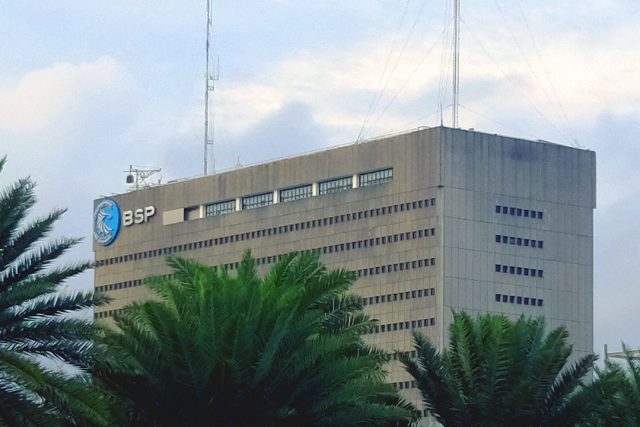

Bankers support BSP’s post-LIBOR initiatives

BW FILE PHOTO

THE Philippines needs to enhance its benchmarks and form a credible yield curve based on actively traded securities to further develop its capital markets.

This as the Bangko Sentral ng Pilipinas (BSP) created a new overnight rate (ON) as reference rate amid the phaseout of the London Interbank Offered Rate (LIBOR) on June 30.

In a statement, the Bankers Association of the Philippines (BAP) has expressed support for the BSP’s latets initiative.

“We will continue to work actively with the regulators to ascertain that any foreseeable benchmark implementation undergoes system-wide testing, accreditation, and general acceptance by all market stakeholders,” it added.

BSP Senior Assistant Governor Office of Systemic Risk Management Johnny Noe E. Ravalo said the overnight rate is vital for decision makers.

“Whether you’re a regulator or ordinary investor, it’s important that the basis for prices you’re looking at is correct,” he told reporters in an ambush interview.

“The calculated overnight rate will represent a reference rate which can be used by the market to price its money, at the same time it will be used in reference to our reading of the policy rate,” he added.

In the Philippines, the LIBOR is still used for some fixed-income securities available in the market, as well as for interest rate and cross-currency swaps.

The Philippine Interbank Reference Rate, which is used for interest rate swaps, cross-currency swaps and some peso corporate loans, is also computed using dollar LIBOR.

Meanwhile, the BAP said that compared with other markets in the region, the Philippines still strives to have a “deeper and more vibrant securities market.”

The country has 5-year, 7-year and 10-year securities actively traded in the market — with the 12-year, 15-year, and 20-year bonds receiving strong interests from market participants and investors.

“These securities provide the banking industry sufficient support for pricing bank products such as loans, mortgages, investments, and marking-to-market of banks’ own portfolios,” the BAP said.

It also noted that the Philippine Bloomberg Valuation Service (BVAL) benchmarks that are currently being administered by the BAP are still credible and addresses scenarios of limited market activity.

“BVAL, as a benchmark, is accepted by Philippine financial and capital market participants.  Market confidence in the use of BVAL is a result of rigorous back-testing and its ability to perform straight through processing — a critical element to deliver efficient and convenient services to bank customers,” it added.

The BVAL reference rates are solely calculated by Bloomberg Finance Singapore L.P. and its affiliates, under an agreement with the BAP.

Rizal Banking Corp. Chief Economist Michael L. Ricafort said the overnight rate should complement the Philippine BVAL tenors, as it lacks an overnight interest rate.

“This would increase the transparency and efficiency in the markets in terms of the real borrowing costs in the economy (not distorted nor manipulated), thereby increasing predictability with better/improved benchmarks, by curing the defects of LIBOR, which will be phased out this month,” Mr. Ricafort said.

He said that the LIBOR was manipulated by some market players before by managing borrowing costs favorable to their interest and detrimental to other parties in the market.

“The ideal is to have market rates that are fair for both borrowers and investors, as properly determined by market forces, and not manipulated/not distorted by any party,” Mr. Ricafort said.

“As the BSP fulfills its mandate of price stability and inflation-targeting and the National Government fulfills its mandate of getting the lowest borrowing costs possible, these reforms are important to further develop the country’s capital markets, especially long-term funding and investments,” he added.

Earlier in 2020, the central bank issued BSP Memorandum No. M-2020-083, which required financial institutions to report their LIBOR-related exposures.

The central bank wanted proper identification of exposures to ensure that the cessation of LIBOR does not disrupt banks’ operations. — Keisha B. Ta-asan

Local workers to be hit by Grab’s 1,000 layoff

PHILIPPINE employees of Singapore-based Grab Holdings Ltd. will be affected by the mass layoff which the ride-hailing company announced on Wednesday.

“[We] can confirm that the Philippines is affected too — but again, we won’t be providing any numbers or breakdowns,” Grab Philippines said in a statement.

According to the local transport network company, it has already sent out notices to employees it will be laying off.

“It is a very difficult period also for us because we are letting go of our employees. The focus right now is to make sure that we look after those who are staying and those who are also leaving,” said Grab Philippines, or MyTaxi.PH, Inc.

Anthony Tan, Grab’s group chief executive officer, announced in a statement on Tuesday night that the company will be laying off 1,000 employees.

Multinational technology company Grab operates in Singapore, Malaysia, Cambodia, Indonesia, Myanmar, Philippines, Thailand, and Vietnam.

“I want to be clear that we are not doing this as a shortcut to profitability. Over the past couple of years, we’ve been consistent in managing costs tightly in all areas of our operations and on improving platform efficiency,” said Mr. Tan, who is Grab’s co-founder.

He said the reorganization of the group is meant to help the company adapt to the changing landscape of digital services.

“The primary goal of this exercise is to strategically reorganize ourselves, so that we can move faster, work smarter, and rebalance our resources across our portfolio in line with our longer-term strategies,” he said.

Amid the announcements of a mass layoff, digital advocacy group Digital Pinoys sought assistance from the Department of Information and Communications Technology (DICT) and the Department of Labor and Employment (DoLE).

“[The DICT and DoLE] should check if there are Filipinos affected by the massive layoff of Grab employees and ensure that their rights and welfare under Philippine Laws are followed,” said Ronald Gustilo, national campaigner of Digital Pinoys, in a statement on Thursday.

“Tech companies should respect Philippine labor laws. If they are to terminate any Filipino employee, regardless of the nature of employment, it should still comply with our labor code. Our agencies should ensure that these laws are implemented,” he added.

Sought for comment, Grab said in a statement: “Of course, we will follow. That is the goal. Our commitment is that we will follow the policies and laws for each specific market and that also includes the Philippines.”

In his letter to Grab employees, Mr. Tan enumerated the support that the company will provide, which includes severance pay, goodwill payment of an ex gratia amount, encashment of unused annual leave and GrabFlex credits, extended medical insurance coverage, maternity and paternity leave encashment, and completion bonus.

In 2020, the company announced a mass layoff that affected 360 employees. — Justine Irish D. Tabile

SEC steps up efforts to adopt digital technology

THE SECURITIES and Exchange Commission (SEC) on Thursday launched digital technology initiatives in line with its program for the capital market and the administration’s move towards e-governance.

“We will launch a wave of digital initiatives… consisting of the e-SEARCH, eSECURE, eRAMP, SEC API Marketplace, and SEC CheckApp 2.0,” SEC Chairman Emilio B. Aquino said during the commission’s 85th anniversary celebration.

He added the commission has now been acknowledged as a “digital leader and an ease of doing business champion” through its efforts in leveraging digital technologies.

Through its Electronic SEC Universal Registration Environment (eSECURE) clients can access SEC online services in a single platform. The platform electronically authenticates the identity of clients, preventing unauthorized access to confidential company information.

“It works against the perpetration of investment scams and money laundering activities, as well as improves financial integrity and readily exacts accountability,” the SEC said.

The commission’s Electronic SEC Education, Analysis, and Research Computing Hub (e-SEARCH) platform will allow the public to purchase and download SEC documents online.

“Investment evaluation and vetting of contracting parties can be commenced in just a couple of minutes,” the regulator said.

Its SEC API Marketplace hastens the availing of financial services and addresses consumer protection concerns by allowing the direct sending and ingestion of data without the need for encoding.

Additionally, its Electronic Registry Application for Market Participants (eRAMP) service will allow investors and capital market institutions to process applications for registration, payment of annual fees, and other notification requirements.

The platform also acts as an online registry of all capital market participants and institutions that are registered with the SEC.

The commission also launched the updated version of its mobile application SEC CheckApp 2.0 where users can confirm the validity of investment opportunities, check the availability of a company name, and provide a 24/7 customer care online assistant.

Meanwhile, the commission launched its Securing and Expanding Capital for Farms and Agribusiness Related Modernization Schemes or SEC Farms program, which can help farm-based companies to fund their agricultural projects by selling securities through simplified registration. The companies may raise up to P500 million per project under the program.

“It is envisioned to help overseas Filipino workers (OFWs), who are notoriously targeted by scammers into investing their hard-earned money into fraudulent investment schemes, to avail of sound and legitimate investments available in the market,” the commission earlier said.

‘PROMOTE EASE OF DOING BUSINESS’
Meanwhile, President Ferdinand R. Marcos, Jr. on Thursday urged the SEC to help the government in making the Philippines an investment hub by promoting ease of doing business and expanding its digitalization efforts.

“I call on the good people that make up the SEC: Let us use all the successes to further promote ease of doing business and to actively contribute to our overall goal of bringing a comfortable life to our people,” he said in a speech for the SEC anniversary.

Mr. Marcos also asked the SEC to expand the digitalization of its services and “further invigorate its advocacy for sustainable finance and good corporate governance.”

“I know that I can count on each of you to help promote our country as an investment destination — one that is safe, that is orderly, and proactive,” he said, “and one that can uphold the rights and welfare of our investors and consumers to their mutual benefits.”

Mr. Marcos said the government will boost its monitoring of digital transactions amid the threats posed by artificial intelligence (AI), which he said is now being used in investment scams.

“We have to continue strengthening our capabilities when it comes to this. This is not a problem that is exclusive to the Philippines alone and that is some of the danger that people are starting to use AI, people are starting to use all the new very powerful tools that are available to be used on the social media or on the internet in general,” he told reporters when asked how the government will address investment scams.

Mr. Marcos admitted that authorities struggle with finding scammers who are not in identifiable offices or establishments while they operate.

“These are people sitting in somebody’s basement with a computer, which they can just shut down, sell away, buy a new one, and keep going. So, that’s the trouble that we are finding now,” he said.

“If the public is aware and knows and is able to spot because of the way that these scams are presented, then that is the best defense that we have,” Mr. Marcos said. — Adrian H. Halili and Kyle Aristophere Atienza

Philex Mining ‘almost done’ raising funds for Silangan project in Surigao del Norte

PHILEX Mining Corp. is close to raising the needed funding for its Silangan copper-gold project in Surigao del Norte, which it aims to start commercial operations by 2025, its top official said on Thursday.

“We are now almost done securing the whole funding of the project which includes financing from the Philex SRO (stock rights offering), project financing debt syndication of Silangan, and from additional cash infusion from [Philex] cash reserves,” Philex Mining Chief Executive Officer Eulalio B. Austin said during the listed mining company’s virtual annual stockholders meeting.

“Everybody is excited with the start of the Silangan project,” he said.

Mr. Austin said the company is in the final stage of negotiation for the debt syndication component of the funding plan, which is expected to be completed “in due time.”

“In the meantime, we are proceeding with the major development works of the project on the ground that includes the completion of the box cut portal and commencement of tunneling works,” he said.

In 2021, the company announced its plan for the project, placing its development cost at $224 million for an estimated 571 tons worth of mineral resources.

The Silangan project will initially process 2,000 tons of ore in a day until this reaches 12,000 tons or four million tons annually upon its completion.

Meanwhile, Mr. Austin said the operations of Philex Mining’s underground mine in Padcal, Benguet may still go beyond 2027 after it identified mineable reserves.

“Its extension to 2027 is the sixth time and there’s always a possibility of another extension given that there are remaining mineral resources at Pagcal, Sto. Tomas that can still be declared as reserves, subject to the further studies and reassessment of the existing mine facilities,” he said.

The underground Padcal mine is located in Tuba, Benguet province. Its operation started in 1958 and was scheduled to cease operation by the end of 2024 after several extensions.

Earlier this year, the company signed a nonbinding term sheet with Macawiwili Gold Mining and Development Co., Inc. in a bid to acquire the latter’s gold mine in Itogon, Benguet.

Mr. Austin said Philex Mining would “relentlessly pursue” its engagement with Macawiwili. He also cited the same for the exploration of the company’s nickel property in Zambales.

In 2022, the company posted an attributable income of P1.8 billion, down 27% from P2.43 billion in 2021. Its core net income reached P1.73 billion, down 32% from P2.53 billion in 2021, which it attributed to lower revenues and higher operating costs.

Gross revenues dropped 4% last year to P10.09 billion from P10.49 billion previously brought about by the decline in metal output and prices of gold and copper.

“While global uncertainty will continue to persist in 2023 and the years to come, we have more reasons to be optimistic that the best years have yet to come for Philex Mining,” said Mr. Austin.

Philex Mining is one of three Philippine units of Hong Kong-based First Pacific Co. Ltd., the others being Metro Pacific Investments Corp. and PLDT Inc.

Hastings Holdings, Inc., a unit of PLDT Beneficial Trust Fund subsidiary MediaQuest Holdings, Inc., has interest in BusinessWorld through the Philippine Star Group, which it controls.

Shares in Philex Mining closed Thursday at P2.62 apiece, down by four centavos or 1.5%. — Sheldeen Joy Talavera

Manila Water targets local and international expansion 

MANILA Water Co. Inc., is planning to expand its business in the Philippines and overseas, a company official said on Thursday.

The east zone water concessionaire eyes a deliberate approach for expansion both domestically and abroad, Roberto R. Locsin, chief administrative officer of Manila Water, told reporters in a media gathering.

Manila Water serves Metro Manila’s east zone network, which is made up of Marikina, Pasig, Makati, Taguig, Pateros, Mandaluyong, San Juan, portions of Quezon City and Manila, and several towns of nearby Rizal province.

For its expansion in the Philippines, the company plans to reach “highly dense populations,” Mr. Locsin said.

“We’re optimistic but in the Philippines, we’d like to focus on highly dense populations. I’ll give you an example: Davao City. One of the fastest-growing cities in Davao is Panabo. We want to be present [there],” he said.

He said the company is in talks with local government units in line with its target expansion.

“The idea is to talk with water districts that are large enough where we can make the investment work,” he said.

Manila Water pursues local expansion initiatives through its subsidiary Manila Water Philippine Ventures, Inc.

For its overseas expansion, the company wants to have a presence in locations where International Container Terminal Services, Inc. (ICTSI) operates, Mr. Locsin said.

“Right now, we have a more robust view [of] our international expansion. In the past, I alluded to our company ICTSI and where they were present. So that kind of gives you an indication of where our interest lies,” he said.

For the company’s international expansion strategy, Manila Water is looking at concession-based businesses, build-operate-own and build-operate-transfer schemes, and public-private partnerships for bulk water supply, Mr. Locsin said.

“We have a very strong capability in the industry through our estate water business in the Philippines. Replicating that and consolidating that really gives us an opportunity to talk to a lot of people,” he said.

ICTSI and Manila Water are both chaired by Enrique K. Razon, Jr. Established in 1987, ICTSI operates 33 terminals in 20 countries across six continents. — Ashley Erika O. Jose

CIMB targets 500,000 virtual card users

CIMB.COM

CIMB BANK Philippines, Inc. (CIMB Bank PH) is aiming to have half-a-million sign-ups for its virtual debit card products by yearend.

If realized, this would be double the current 250,000 virtual card users of the online commercial bank.

The growth will be driven by the continued increase in online transactions amid the reopening of the economy following the coronavirus pandemic, CIMB Bank PH Chief Marketing Officer D’Artagnan Aguilar said at a press meeting on Thursday.

“One good thing that the pandemic brought to us was the fact that people got comfortable with anything online, including online transactions because we were forced to do it during the lockdown,” he said.

Mr. Aguilar said he does not expect online transactions to drop even amid the lifting of pandemic-driven mobility restrictions.

He added that the bank’s virtual cards are more secure than using a physical card, addressing safety concerns of customers about online transactions.

“We want to take advantage of this trend of online transactions happening right now. The fear of security will always be there given that people transact now more and more online,” Mr. Aguilar said.

The bank launched the CIMB Virtual Debit Card last month as it seeks to help boost digital payments.

“We are aligned with the BSP (Bangko Sentral ng Pilipinas) in strengthening our customer preference for digital payments by offering faster, more secured, and more affordable payment options,” CIMB Bank PH Chief Executive Officer Vijay Manoharan said in a statement.

This is the bank’s second virtual card after the one for REVI Credit customers.

The CIMB Virtual Debit Card lets Fast Plus, GSave, or UpSave account holders transact online using their savings accounts, the lender said. It can be activated through the bank’s mobile app and has the option to set transaction limits.

The virtual debit card can be used for online transactions only but has no minimum maintaining balance, Mr. Aguilar said. — AMCS

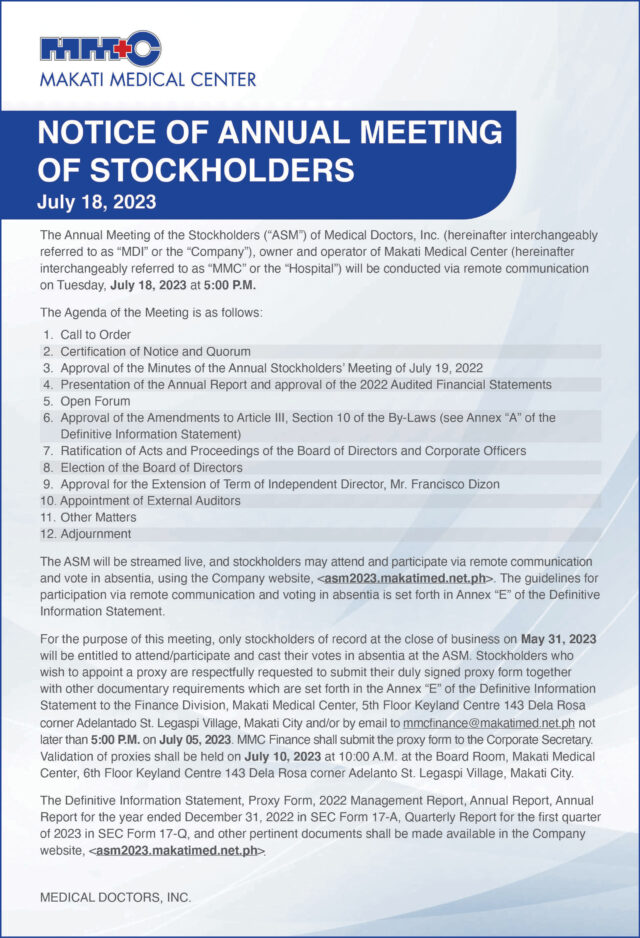
Medical Doctors, Inc. to hold 2023 Annual Meeting of Stockholders via remote communication on July 18


Spotlight is BusinessWorld’s sponsored section that allows advertisers to amplify their brand and connect with BusinessWorld’s audience by enabling them to publish their stories directly on the BusinessWorld website. For more information, send an email to online@bworldonline.com.

Join us on Viber at https://bit.ly/3hv6bLA to get more updates and subscribe to BusinessWorld’s titles and get exclusive content through www.bworld-x.com.

YCO targets Batangas data center to start by 3rd quarter 2024

LOCAL digital infrastructure firm YCO Cloud Centers expects to complete its Batangas data center by the latter part of 2024, its top official said.

“We are looking towards the third quarter of 2024 to be able to start delivering real capacity to the market,” YCO Chief Executive Officer Nikolas de Ynchausti told BusinessWorld during its launch event.

Mr. Ynchausti added that the company will focus on hyperscalers, wholesale enterprises and potentially, telecommunication companies to use its facilities.

“We try to stay neutral,” he said, adding that what the Philippines needs are players who “want to contribute infrastructure to help develop the [country], and that’s how we want to position ourselves.”

Additionally, the company plans to expand its data center network outside of serving Metro Manila.

“We have been working with a lot of government officials, entrepreneurs, [and] businesspeople who see that [data centers] are the next step for the country. We have been looking at locations based on that,” he said.

He said the company is planning another location for a data center but did not provide the exact site.

“We are not just looking at the National Capital Region, we’re looking at all other areas of the Philippines where there is demand and need. We will go there,” Mr. Ynchausti said.

He added that the company is looking at potential locations throughout the country, with possible areas such as Iloilo, Cebu, and Ilocos Norte.

The company started construction of its data center in March at the Light Industry and Science Park IV of the Science Park of the Philippines, Inc. in Malvar, Batangas.

The data center is expected to contain four halls spanning 1,400 square meters each designed to provide locators with 3 megawatts (MW) of critical load for a total of 12 MW.

It is designed to meet the market’s demand for co-location, build-to-suit, enterprise, hyperscale, powered shell, and private data hall suites.

YCO is a digital infrastructure company formed to take advantage of the growing demand for data centers and digital infrastructure in the Philippines. It is an affiliate of JJYnchausti Ventures, Inc. — Adrian H. Halili

Powell: Half point of additional hikes a ‘good guess’ of policy outcome

WASHINGTON — Further US Federal Reserve rate increases are “a pretty good guess” of where the central bank is heading if the economy continues in its current direction, Fed Chair Jerome H. Powell said in remarks on Wednesday to lawmakers on Capitol Hill.

In response to a question late in a three-hour hearing before the House Financial Services Committee, Mr. Powell said he would not characterize the Fed’s decision last week to hold interest rates steady as a “pause,” and noted the fact that a majority of policy makers see two more quarter-point rate increases as likely by the end of the year.

“We didn’t use the word pause and I wouldn’t use it here today,” Mr. Powell said. The outlook for two more rate hikes by the end of the year, included in the Summary of Economic Projections released by the Fed last week, “is a pretty good guess of what will happen if the economy performs about as expected,” Mr. Powell said.

Right now that is characterized by modest growth but a still strong labor market and only stodgy progress on inflation.

As Mr. Powell spoke, comments from other Fed officials showed the contours of the debate emerging at the central bank over whether further rate increases will, in fact, be needed.

Chicago Fed President Austan Goolsbee said at a Wall Street Journal forum that he felt the central bank was in a “wait-and-see” mode as further data come in.

“If you don’t see progress, that is an answer, if you do see progress, that is also an answer,” he said.

Atlanta Fed President Raphael Bostic, meanwhile, became the first policy maker to suggest the Fed would need to wait at least past its July meeting to decide on further rate increases, because acting too fast at this point could “needlessly drain” strength from the economy when inflation may continue heading down with monetary policy where it is.

“If we simply press on with additional rate hikes, we could needlessly drain too much momentum from the economy,” Bostic said.

BANKING REGULATIONS IN FOCUS
The comments by Mr. Powell were his most explicit on the monetary policy outlook during a hearing dominated by questions from Republican lawmakers concerned that a string of bank failures in the spring would prompt the Fed to push back too hard on the financial sector with tougher capital and other rules.

“There are a number of proposals in the works. They have not been finalized,” Mr. Powell told lawmakers who questioned why the Fed might consider forcing banks to raise more capital while at the same time saying that the financial system was stable, and that the failure of institutions like Silicon Valley Bank was largely the result of poor management.

Any change of capital rules or other regulations “would need to be shown to be justified,” Mr. Powell said.

Mr. Powell said any changes “will take time,” and should not impact the industry in the near term. The proposals “are still to some extent in motion… It will take quite a while to decide what to do” and years after that to implement, he said.

Nominees to three Fed board positions faced similar queries in a separate hearing in the Senate.

On monetary policy, Mr. Powell kept the focus on the central bank’s fight to lower inflation and said the process “has a long way to go.”

“Inflation has moderated somewhat since the middle of last year,” Mr. Powell told the House panel. “Nonetheless, inflation pressures continue to run high, and the process of getting inflation back down to 2% has a long way to go.”

Though Fed officials held off on raising interest rates at their meeting last week, Mr. Powell called that an exercise in prudence, allowing time to gather more information before deciding on further rate increases that most Fed policy makers feel will be necessary by the end of the year.

Mr. Powell and the nominees for three Fed Board seats testified over several hours on Wednesday, laying out a set of views that could broadly shape the economic conditions facing the country during what may be an era-defining political rematch next year between incumbent Democrat Joseph R. Biden, Jr. and Republican former President Donald J. Trump.

Despite the consensus on lowering inflation, the Fed is at a point where opinions about the need for and timing of additional interest rate increases may start to diverge. As it was for past presidential incumbents, how that debate gets resolved could make the difference between a benign election-year economy and a corrosive one.

For Mr. Biden, the success or failure of Fed policy could mean a “soft landing” of continued economic growth, lower inflation and only modestly higher unemployment, or it could force him to campaign against a backdrop of increasing joblessness, stubbornly higher prices, and punishing interest rates for anyone trying to buy a home or car or finance a business.

The Fed at its meeting last week held its benchmark interest rate steady at level between 5% and 5.25%, but officials projected rates will have to increase another half percentage point by year’s end because inflation has been falling so slowly and remains more than double the Fed’s 2% target. — Reuters

And just like that: Carrie Bradshaw is back for spinoff season two

NEW YORK — Carrie Bradshaw is back navigating love in New York City once again in season two of And Just Like That, where an old flame comes back into her life.

The popular sequel to the hit show Sex and The City returns to screens this week, as Carrie, with the support of her pals — old and new — embraces single life after being widowed in season one.

“I feel excited about this season,” Sarah Jessica Parker, who plays Bradshaw, said in an interview. “We spent a season in grief, which was appropriate for such a consequential loss.

“So it’s very nice to see and was certainly fun to play a sort of re-emergence, a resurfacing of Carrie, especially as she pursues being single in this particular city that has been familiar to her, but is not any longer the same city, nor is she the same.”

Sex and the City, which ran from 1998 to 2004, followed the friendship and romances of writer Carrie and her friends Miranda, Charlotte, and Samantha. And Just Like That only features the first three, all now in their 50s, as well as new characters: Che, Seema, and Nya.

“It just felt like a very buoyant season,” Ms. Parker said.

“The tone felt familiar to the original show, as we were all sort of the characters on paths of discovery and that provides for whimsy, absurdity, amusement, joy, disappointment, surprise.”

Director, writer and producer Michael Patrick King said the goal of the second season of And Just Like That was “to make the new characters someone you knew better.”

“One of our goals was to not just look at the cover of the book but open it and see who these people are,” he said.

In this season, Carrie meets up with former fiance Aidan, and there is a surprise appearance by original cast member Kim Cattrall, who played Samantha. In the first season of And Just Like That, Carrie is only seen messaging with now London-based Samantha by phone.

“She appears in text in this season as well and … just the idea of adding the face to the text felt nice,” Ms. Parker said.

“It’s quick, but it’s very sweet.” — Reuters

Toyota launches the Zenix

PHILSTAR FILE PHOTO

TOYOTA Motor Philippines Corp. (TMP) has launched the all-new Zenix hybrid electric vehicle (HEV) to bolster its offerings for the multipurpose vehicle (MPV) segment.

The Japanese car brand said in a statement on Thursday that the seven-seater Zenix comes in two variants: the 2.0 Q hybrid CVT priced at P1.953 million, and the 2.0 V gasoline CVT priced at P1.67 million. The vehicle is now available in all 72 Toyota dealerships across the country.

The Zenix is the latest addition to TMP’s hybrid vehicle lineup, which consists of the Corolla Altis, Corolla Cross, Camry, and RAV4.

“Our customers have been waiting for a hybrid option that is perfect for more sustainable rides for the whole family, and so we are very proud to welcome this newest model in our MPV category,” TMP First Vice-President for Vehicle Sales Operations Danny Cruz said. 

The HEV variant comes in 18-inch alloy wheels while the gasoline variant has 17-inch alloy wheels. Both variants have a push-start ignition system and smart entry for easier access.

Inside, the features of the Zenix include a dashboard with a 7-inch Thin Film Transistor Multi-Info Display and a 10.1-inch Display Audio with wireless Apple Carplay and Android Auto.

The new model also comes with an electronic parking brake, while the HEV variant also has captain seats with a power ottoman, power recline, side table, and ambient lighting.

The Zenix also comes with the latest Toyota Safety Sense, which has safety features such as a pre-collision system, lane departure alert, and dynamic radar cruise control. It also has active safety features such as an anti-lock brake system and vehicle stability control.

“Positioned to bring the electrified mobility experience to modern Filipino families, the all-new Zenix is a versatile vehicle with a self-charging hybrid system, combining the comfort, spaciousness, and reliability of a Toyota family carrier with the benefits of an advanced energy-efficient ride, with a quiet drive and lesser emissions,” TMP said.

The available colors of the Zenix HEV variant include Platinum White Pearl Mica, Blackish Brown Mica, and Dark Steel Mica, while the gasoline variant comes in Platinum White Pearl Mica, Silver Metallic, Gray Metallic, and Attitude Black Mica. — Revin Mikhael D. Ochave