Home Blog Page 4515

Palawan municipality of Bataraza gears up for ecotourism

PALAWAN municipality of Bataraza

THE MUNICIPALITY of Bataraza in Palawan, an island southwest of the Philippines, is studying the feasibility of offering mangrove forest tours to the public. The municipality has 16 of the 50 known mangrove species worldwide.

Mas maganda ang aming mangrove ecosystem sa Bataraza compared sa Puerto Princesa Underground River… ang gaganda, ang tutuwid [Our mangrove ecosystem in Bataraza is nicer than that of Puerto Princesa’s Underground River… they’re beautiful and tall],” said Reynaldo C. Rivera, Bataraza’s municipal environment and natural resources officer.

Napakagandang i-offer din ito sa aming tourism [This would be a great addition to our tourism offerings],” he added in an interview during a media tour to the municipality by the World Wide Fund for Nature (WWF) on July 26 and 27.

Countries such as Indonesia and the United Arab Emirates offer mangrove kayaking as part of their tourism efforts. In the Philippines, mangrove paddling is offered in provinces like Bohol.

Ginagawa na po iyung tourism plan for Bataraza [A tourism plan for Bataraza is already being drawn up]. They’re just waiting for inputs from the communities [to be able to come up with] sustainable tourism products such as mangrove ecotourism,” Joan M. Pecson, WWF-Philippines project manager of the Bataraza Mangrove Ecosystem Restoration Project, said.

It’s not just the livelihoods in communities that should be considered, but also the protection of the mangroves, Ms. Pecson said in another interview.

WWF is working with partners like electronics company Epson on its ecosystem restoration project in Bataraza. Local capacity building activities embedded in the project include mangrove planting, assessment and monitoring, and coastal resource management.

The municipalities of Balabac and Bataraza in Palawan are among the remaining areas in the province with high marine biodiversity and a significant amount of primary and secondary mangrove forests, according to a report by the Palawan Council for Sustainable Development.

Mangroves protect against extreme weather events such as storms and tidal surges. They improve water quality by filtering sediment, and they also sequester carbon — important in keeping climate change at bay — for up to a millennia.

“Despite laws and regulations, our mangrove forests are being continuously destroyed, the most damaging activities of which are [bark tanning], charcoal making, and conversion into fishponds,” said Gomer Lucion Miano, a Sangguniang Bayan member of Bataraza, at a dinner the local government hosted for the WWF.

The result of the destruction of mangrove forests has been the decrease of marine resources, Mr. Miano said.

Maging ang tirahan ng mga buwaya ay nasisira kung kaya’t sila ay naghahanap ng bagong masisilungan hanggang sa mga silong ng bahay sa tabing dagat, at namiminsala ng mga alagang hayop — at maging mga tao — dahil halos wala na silang makain sa loob ng bakawan [Even the crocodiles’ habitat is compromised, which is why they end up seeking shelter in coastal communities — endangering the livestock and even humans — because they’ve already lost mangroves as their source of food],” he said.

“We hope this project… will be expanded to other parts of our municipality,” he added.

A way to promote mangroves as an ecotourism feature is to highlight the diversity of the fauna that can be found within these coastal forests, Ms. Pecson said.

Over 1,500 species depend on mangroves for their survival — 15% of which are threatened with extinction, per the United Nations Educational, Scientific and Cultural Organization.

“You play with your strengths,” Ms. Pecson told BusinessWorld.

“From the lens of ornithologists and scientists, Palawan’s mangrove ecosystem offers a huge potential as a living lab,” she said in the vernacular.

“You have birds, you have saltwater crocodiles, you have other flora and fauna that you won’t see in other mangrove ecotourism places here in the Philippines,” she added. — Patricia Mirasol


SPNEC adds 4,000 hectares to its asset portfolio

SP New Energy Corp. (SPNEC) and its subsidiaries have secured 4,000 hectares more to expand the energy company’s assets, it said on Wednesday.

“We thank all who have helped us grow SPNEC’s assets, from its initial 352 hectares, to over 4,000 hectares, and from a single project, to a portfolio of projects operating, under construction, and under development,” SPNEC President and Chief Executive Officer Leandro Antonio L. Leviste said in a media release.

SPNEC said the hectares of land it secured were spread across the provinces of Nueva Ecija, Bulacan, Tarlac, and Batangas.

“It is time for us to build upon what we have so far, and work on turning these hectares into megawatts (MW),” Mr. Leviste said.

SPNEC said of the 4,000 hectares, 3,000 hectares have been secured through deeds of sales or contracts to sell and over 1,000 hectares were secured through contracts to lease.

More than 2,000 hectares have also been approved for conversion to industrial use, the company said.

SPNEC is a wholly owned subsidiary of Solar Philippines Power Project Holdings, Inc., which is an integrated developer, owner and operator of solar power projects.

In May, SPNEC said it entered into a contract to acquire shares of Solar Philippines in several entities via proceeds of the latter’s subscription of 24.37 billion shares of SPNEC, which increased its authorized capital stock.

With this development, SPNEC said its assets now include over 400 MW of projects operating and under construction and over 4,000 hectares.

It also said that Solar Philippines is transferring to SPNEC contracts and permits to support its projects, some of which it has been developing since 2016.

In June, SPNEC said it is planning to conduct a private placement of shares valued at P3 billion to lift its trading suspension at the Philippine Stock Exchange (PSE).

This comes after the PSE suspended the trading of SPNEC’s shares after its public float fell below the required 20%. — Ashley Erika O. Jose

Peanut butter pizza, anyone?

WE’VE all tasted a peanut butter sandwich at least once, but when was the last time you had peanut butter pizza?

To celebrate peanut butter brand Skippy’s 90th anniversary, the brand threw a birthday party at Myke “Tatung” Sarthou’s Quezon City restaurant, Azadore last Sunday. At least, we thought it was a birthday party: there were ribs and a birthday cake (more on this later), after all.

The brand was founded in 1932 by Joseph L. Rosefield, innovating by making a peanut butter that doesn’t separate in the jar. The company changed hands several times, being owned by Best Foods, then Unilever, and finally landing on the lap of Hormel (as in the makers of Spam) in 2013.

To promote its 90th anniversary, it held a partnership with Mr. Sarthou, as well as a contest inviting fans to make recipes from the peanut butter. Jenny Ann Casintahan, a businesswoman and a mother of two kids, was chosen as the Grand Prize winner with her Grilled Pork Kare-Kare. She said in a statement, “I love to join cooking contests, I just feel happy doing it. I also love Skippy because it’s very versatile; it can be used for cooking dishes, baking, and is perfect for spreads in sandwiches which my kids love, because it is smooth and creamy.”

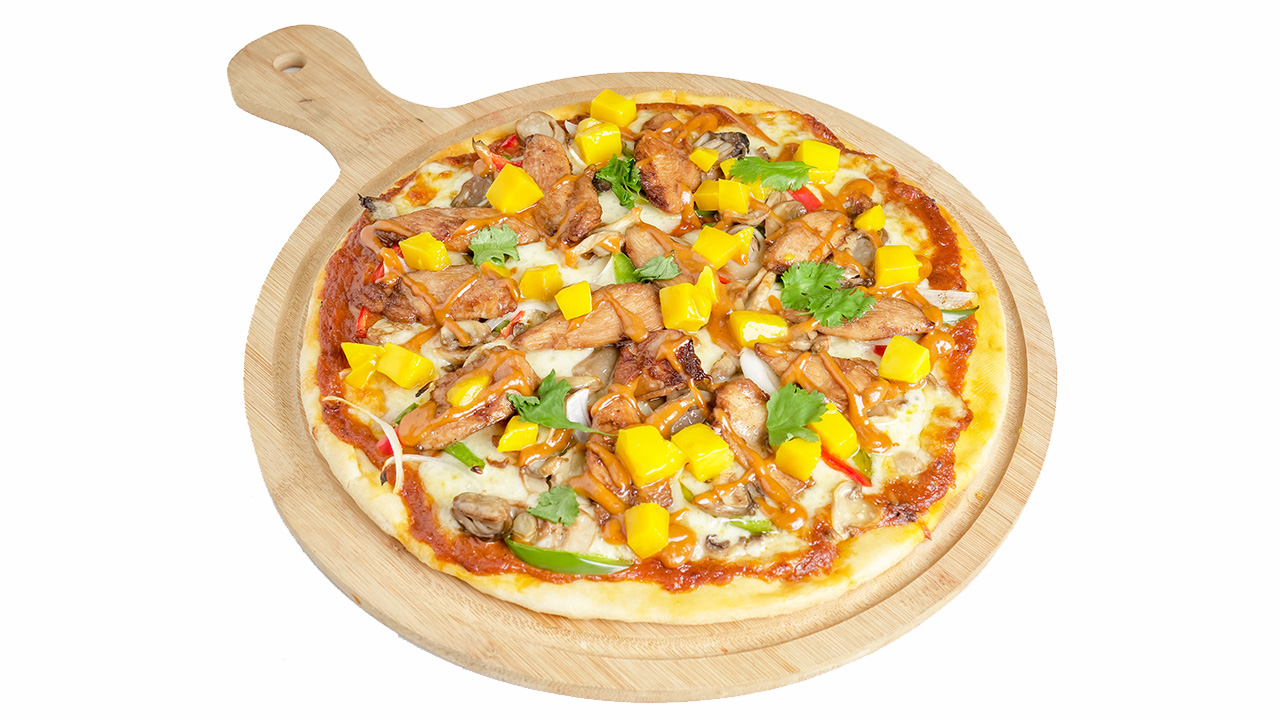
As for Mr. Sarthou, he came out with three new dishes using Skippy peanut butter: Spicy Peanut Chicken Pizza (flatbread-inspired pizza topped with savory chicken tikka strips, vegetables, and mushrooms over a nutty Indian butter chicken sauce); Chicken Satay Burger with Hoisin Peanut Butter (chicken satay with coleslaw in a soft and buttery brioche bun); and Chocolate Peanut Butter Cake (chocolate and creamy peanut butter frosting between layers of moist and nutty chocolate cake; we thought that was Skippy’s birthday cake). These will be available at Azadore from Aug. 5 to 20.

Mr. Sarthou talked about the versatility of peanut butter in an interview. “The objective of Skippy is to see the product beyond just a spread,” he said. “Whenever we need texture, we add the Chunky peanut butter, just to finish,” he said. He said that while Filipino kare-kare (meat and vegetables in a peanut stew) is the obvious candidate for a peanut butter addition, one can add peanut butter to other saucy Filipino dishes (such as caldereta which is meat in a tomato-based sauce). “It serves both as thickener and stabilizer, but also for flavor,” said Mr. Sarthou. — Joseph L. Garcia

Meralco looks at nuclear power as long-term solution

MANILA Electric Co. (Meralco) said it considers nuclear power as a long-term solution to the country’s power needs, while also hinting at discussions with a nuclear firm, its chairman said.

“During the visit of the President to the [United] States, some of our people met with the nuclear manufacturing plants. One of them visited us here in Meralco, two to three months ago. It was a very productive visit,” Manuel V. Pangilinan, chairman and chief executive officer of Meralco, said in a recent media briefing.

President Ferdinand R. Marcos, Jr.’s state visit to Washington, D.C. happened from April 30 to May 4. During his visit, several US companies reportedly pledged to invest in the Philippines.

Mr. Pangilinan said that his team suggested to the nuclear company “if we could buy [or] if they could build a plant here in the Philippines.”

“So, at least we could have a taste of how we can build it and operate it,” he said, describing the move as “progress.”

“We still have to schedule a trip to the States and coordinate with them to get that going,” he added.

Mr. Pangilinan did not specify details of the plan, citing a non-disclosure agreement (NDA) with an entity he identified as Ultra Safe.

“I think we signed an NDA with Ultra Safe. But this is a long-term solution, at least five years away from commercial production of nuclear plants,” he added.

Last year, Meralco said it was applying for a grant from the United States to do a feasibility study on introducing nuclear energy in the Philippines.

The Department of Energy earlier estimated a timeline of about 10 years before the country can add nuclear power into the energy mix. The government is eyeing adopting nuclear power as a new source of energy to address the country’s energy supply issues.

The department has said that it is considering a target of about 2,400 megawatts (MW) in nuclear power capacity by 2035, a goal it plans to incorporate into the Philippine Energy Plan, which is set to be released this year.

At the local bourse on Wednesday, shares in the company fell by P7 centavos or 2.02% to end at P340 apiece.

Meralco’s controlling stakeholder, Beacon Electric Asset Holdings, Inc., is partly owned by PLDT Inc.

Hastings Holdings, Inc., a unit of PLDT Beneficial Trust Fund subsidiary MediaQuest Holdings, Inc., has an interest in BusinessWorld through the Philippine Star Group, which it controls. — Ashley Erika O. Jose

Our perception of wine has more to do with its commercial history than we think

TERRY VLISIDIS-UNSPLASH

CONSUMERS tend to think of wine as a product of culture and authenticity. Because of this, they see it as distinct from other manufactured commercial goods.

As an agricultural product, we think about wine as linked to a place and sometimes to an individual producer. After that it is considered a historical product rooted in the traditions of a region. And finally, wine is treated as an aesthetic product, in a similar way to the arts, with its key consumers, terminology, prominent producers, and specific media attention.

But is wine really distinctive?

In 2021, the value of the global wine market was over $53 billion, with global production around 260 million hectoliters, the equivalent of 34 billion bottles. Of this, about half is exported and therefore consumed outside its place of origin. The main producing countries by volume are Italy, France, Spain, the United States, and Australia.

Yet wine has been a commercial product for 3,000 years. And paradoxically, many of the cultural ideas which shape how we perceive wine today actually stem from its history as a commercial product.

As an anthropologist and professor in the department of social and public communication at Université du Québec à Montréal (UQAM), I see wine as a cultural object. That is to say, wine carries meanings that are socially constructed and through which both producers and consumers think about it in unconscious ways.

I carried out my first anthropological research fieldwork on wine in Calabria, in southern Italy, in 2000-2001, and have returned there three times. I conducted a second anthropological investigation in British Columbia, in the Okanagan Valley, in 2017-2018. I will present some of the results of this research later in The Conversation.

I am also a wine lover and have been running the website sommeliervirtuel.com with my brother Mathieu for over 10 years. Through this activity we have become recognized as wine influencers in Quebec, and I have been able to deepen my knowledge of the wine market and its consumer culture.

In this first article, I demonstrate how some of our cultural conceptions of wine actually arose from the commercial nature of the product.

A central element of wine is that it is attached to place. We can talk about a Bordeaux, a Burgundy, or a Chianti without having to add that we are talking about wine. Yet as far back as ancient Greece, and later in the Middle Ages, it was different elites that created a market for wines from recognized, distant regions.

At the same time, the wine that was produced and consumed locally had no specific identity and was considered a common agricultural product among others.

It was through trade, especially over long distances, that the place of origin of wines became important and significant.

Trade also helps explain why wine production became concentrated in certain regions and not others.

Official speeches (guidebooks, wine books, laws) claim that this is because of the quality of a specific region’s terroir, according to the idea that wine production is concentrated in the places most suitable for quality production. In fact, trade is what explains how vineyards came to be concentrated in certain regions, but not others.

The French geographer and historian Roger Dion has shown how wine production became concentrated in France because of the country’s vanguard position vis-à-vis the markets of northern Europe. He points to how the wine-producing regions were concentrated around rivers, which were essential for the transport of heavy cargoes before the arrival of the train.

So it was actually France’s geographical position that explained the development and historical renown of its wine regions.

Historically, regions that specialized in wine production were able to do so because they had the possibility of selling their production in other markets. That’s because a peasant family could not subsist on wine. The utopic concept of terroir, however, has been used to conceal these origins, attributing the renown of wines to regions and nature, while, historically, their reputations were actually built through trade.

With the development of wine consumer markets in what were then non-producing countries, such as England, Northern Europe, and America, a specific conception of wine emerged.

In these markets, wine was not considered an agricultural product. Wine was a luxury product, reserved for certain social groups. Even when wine spread throughout society, it remained a rare and occasional product.

This view of wine remains the dominant one today, even in the wine-producing countries themselves, where the habit of daily wine consumption has yielded to one of occasional consumption.

The case of the Bordeaux region is instructive and has played a key role in the development of several contemporary notions of wine.

The Bordeaux vineyard developed in response to demand from the English and Dutch markets, which, in turn, controlled the region and its trade starting in the 17th century. In this context, it was the English market that drove consumers and merchants to pay specific attention to vintages, as well as growths, and the crus of Bordeaux, that is to say the Châteaux, such as Ho Bryan (Haut-Brion) or Margose Wine (Margaux) whose first mentions are in English.

The famous classification of Bordeaux wines of 1855, still in force today, was created at the universal exhibition in Paris on the basis of wine prices that were established by the English market.

The emergence of new consumer markets, particularly in Asia, is now putting upward pressure on the wine market and driving up the prices of specific wines from the most sought-after areas or regions. At the same time, China has started to produce and export its own wine, increasing the already strong competition between different wine-producing regions of the world.

In Asian markets, wine remains a prestige product, especially as a gift, for example in Japan. If the conceptions of wine so far are mainly Western, perhaps the Asian markets will influence the way we think about wine in the medium or long term.

These are just a few examples of how the commercial nature of wine, through its long history, has influenced our perception of the product. Is wine perhaps hiding its true nature behind the rhetoric of its authenticity? Because objectively, wine is only fermented grape juice. — The Conversation via Reuters Connect

Vincent Fournier is a Professor in the Department of Social and Public Communication at the Université du Québec à Montréal (UQAM).

AyalaLand Logistics earns P339M, says performance stays ‘sound’

AYALA Land, Inc.’s logistics unit posted a net income of P339 million in the first six months of the year driven by an increase in revenues of its various business segments.

AyalaLand Logistics Holdings Corp. (ALLHC) said in a regulatory filing on Wednesday that its consolidated revenues reached P1.5 billion in the first half.

The company did not disclose comparative figures for last year, but it previously reported a net income of P339.03 million and consolidated revenues of P1.74 billion in the first half of 2022.

“In the first half of the year, the company’s performance remained sound. We remain positive that our diversified real estate portfolio, alongside our up-and-coming projects in the pipeline will propel the business forward,” said ALLHC Chief Operating Officer Patrick C. Avila.

The logistics company’s sales from industrial lots were its largest revenue contributor after increasing 2.7% to P675 million in the first semester from P657 million in the same period last year.

ALLHC’s revenues from cold storage rose 49.1% from P57 million to P85 million, which it said was due to the addition of ALogis Artico’s third facility in its portfolio.

Commercial leasing grew 3.3% to P443 million, while warehouse leasing declined 9% to P331 million.

Mr. Avila said ALLHC will introduce a modern food terminal which will be supported by its cold storage and dry warehouse facilities.

“Farmers from Northern Luzon and Central Luzon can bring their produce, and these can be stored and preserved with the proper facilities. We hope this [will] help all farmers and our supply chain,” he said.

The company also entered the data center industry with its A-FLOW Data Center project, which is currently under development. Its initial rollout will allow a 6-megawatt capacity to be ready for service by the end of 2024.

On the stock exchange on Wednesday, shares in ALLHC closed seven centavos or 2.95% lower to P2.30 apiece.  Justine Irish D. Tabile

Term deposit yields climb on hawkish BSP bets

YIELDS on the Bangko Sentral ng Pilipinas’ (BSP) term deposits climbed on Wednesday amid hawkish signals from the central bank due to risks to the inflation outlook.

Demand for the term deposit facility (TDF) of the central bank totaled P280.088 billion on Wednesday, higher than the P280-billion offering as well as the P258.591 billion in tenders recorded last week for a P230-billion offer.

Broken down, bids for the seven-day term deposits amounted to P151.358 billion, higher than the P150 billion auctioned off by the BSP. It also surpassed the P135.050 billion in tenders for a P130-billion offering seen a week earlier.

Accepted rates ranged from 6.559% to 6.61%, slightly higher than the 6.55% to 6.6075% margin seen in the prior auction. With this, the average rate of the one-week papers rose by 0.82 basis point (bp) to 6.5888% from 6.5806% previously.

Meanwhile, the 14-day papers attracted P128.73 billion in bids against the P130-billion offering, up from the P123.541 billion in tenders seen on July 26 for a P100-billion offer.

Banks asked for yields from 6.55% to 6.62%, higher than the 6.5%-6.609% band recorded a week earlier. This caused the average rate of the two-week term deposit to increase by 0.39 bp to 6.5903% from 6.5864%.

The central bank has not auctioned off 28-day term deposits for more than two years to give way to its weekly offerings of securities with the same tenor.

The TDF and the 28-day bills are used by the BSP to gather excess liquidity in the financial system and to better guide market rates.

Yields on the term deposits were higher amid hawkish signals from central bank officials as inflation risks linger, Rizal Commercial Banking Corp. Chief Economist Michael L. Ricafort said in a Viber message.

BSP Governor Eli M. Remolona last week said it is too early to “declare victory” against inflation, even if it is on its way to the 2-4% target band.

Mr. Remolona said they are ready to resume tightening if needed amid growing threats to the inflation outlook.

The central bank needs to ensure that the downtrend in inflation is “more permanent,” amid persistent upside risks arising from the El Niño weather event and Russia’s invasion of Ukraine, Monetary Board member Bruce J. Tolentino also said last week.

The BSP expects inflation to return to the 2-4% target range by the fourth quarter.

The Monetary Board hiked borrowing costs by a total of 425 bps from May 2022 to March 2023, bringing the key rate to 6.25%.

It will next meet on Aug. 17 to review policy.

Rising rice prices recently due to the agriculture damage brought by typhoons could also lead to some pickup in inflation or dampen the easing trend, Mr. Ricafort said. — K.B. Ta-asan

Dining In/Out (08/03/23)


Newport World Resorts celebrates International Beer Day

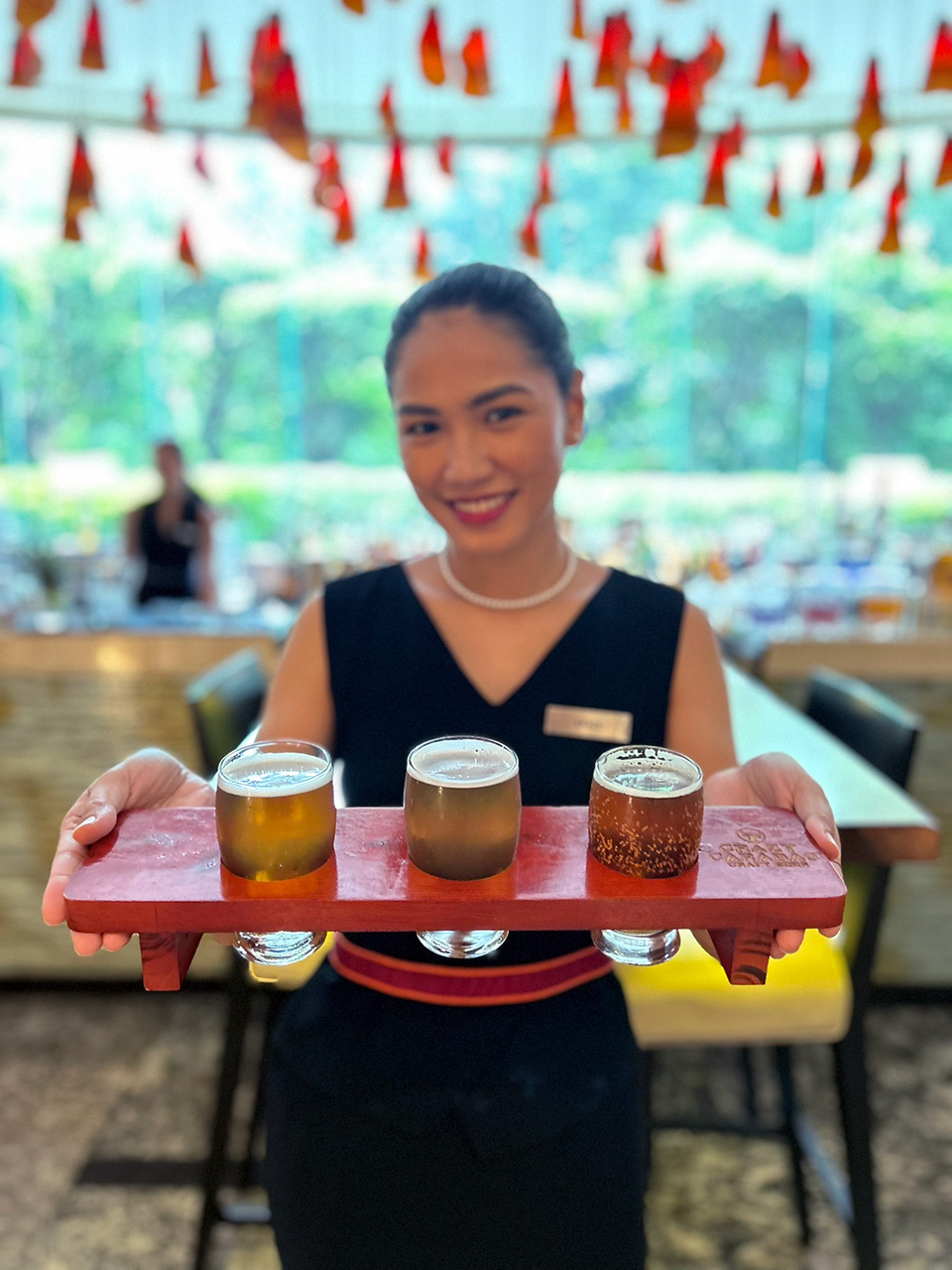
INTERNATIONAL Beer Day is celebrated across the globe on Aug. 4 and Newport World Resorts is celebrating the occasion. Its bars, from The Grand Bar and Lounge at the Newport Grand Wing all the way to Bar 360 at the Newport Garden Wing, will offer promos and deals. Enjoy unlimited draft beer from the tap for P1,200 net per person. Swing by El Calle Food and Music Hall for a fill of draft light beers, with their Buy 1-Get 1 Deal for P150 net. Over at Hilton Manila’s Port Bar, order a Beer Flight and sample four craft beers with a choice of bar bites (including truffle chicken wings, loaded nachos, salt and pepper squid, or soft tuna taco sisig). The Beer Flight set is available for P888++ per order. Port Bar is also running a special of Local Craft Beers for P329 net on 100ml of Double IPA, Pilsner, Honey Ale, and Mango Nation Hazy. At the Marriott Hotel Manila, take a Crazy Carabao Flight for the night and enjoy a sampler of Crazy Carabao’s signature brews of IPA, Golden Ale, and Pilsner. The Crazy Carabao Flight is available at The Greatroom for P300 net. Go international with Beer Day celebrations and have Chimaek, a classic Korean pairing of fried chicken and beer. At Oori, Sheraton Manila Hotel’s specialty Korean restaurant, Korean Beer and Chicken pairings are available for the special occasion. For P999 nett, get two Korean beers and dakgangjung or boneless fried chicken. Head down to The Lounge at the ground floor for Crazy Carabao draft beers available in Indian Pale Ale, Golden Ale, and Pilsner and get a 50% discount on the second round of drinks for every 630ml order. Once the clock hits 5 p.m., party at KAO Manila at The Plaza Garden, Newport Mall. The Beer Happy Hour on Beer Day gives guests one free bottle for every purchase of five Heineken Original or Silver beers. For more information on Newport World Resorts’ International Beer Day offers, visit www.newportworldresorts.com.


AirAsia Philippines introduces plant-based inflight meals

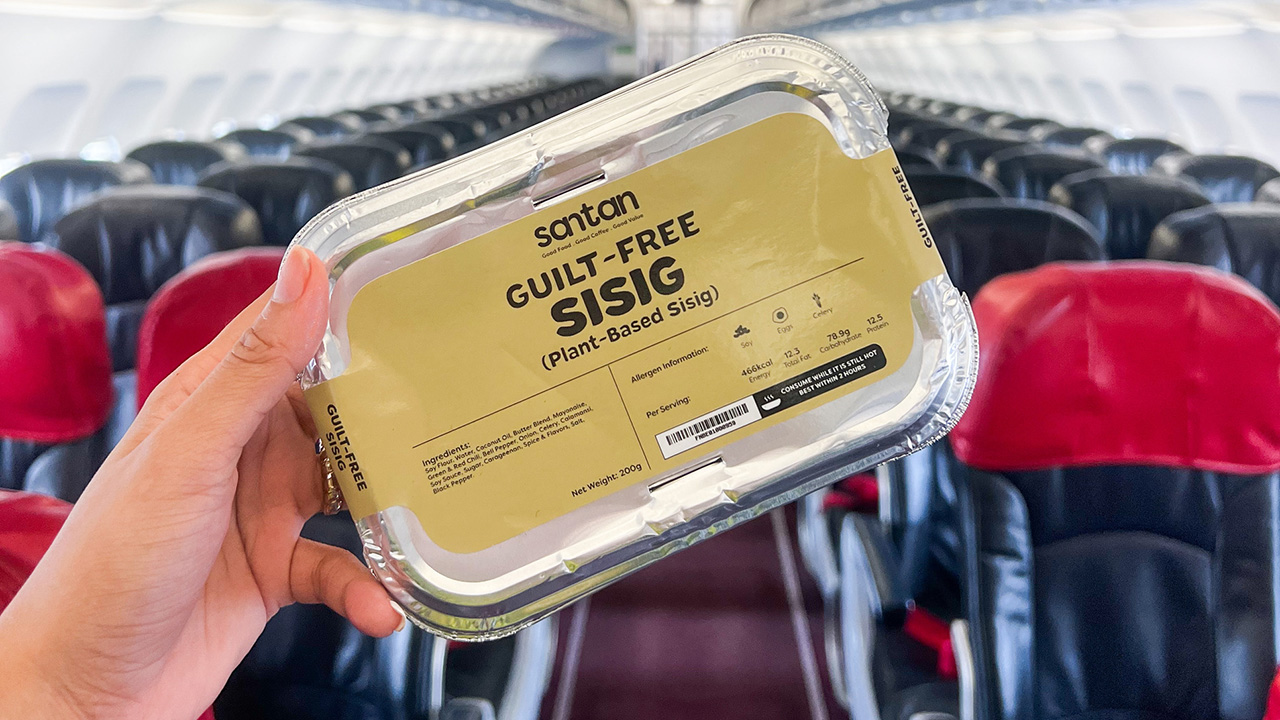
AIRASIA PHILIPPINES, through food services arm Santan, rolls out a healthier, plant-based alternative of its Filipino favorite Sisig Meal for guests flying with the airline. The Guilt-Free Sisig is perfect for vegetarians and passengers looking for a healthier version of the top-selling dish. “With the introduction of AirAsia Philippines’ first plant-based meal, we celebrate the diversity of our guests and ensure that each passenger, whether vegetarian or those aiming to be more health-conscious, can savor the experience of flying with AirAsia,” AirAsia Country Head for Communications and Public Affairs and Spokesperson Steve Dailisan was quoted as saying in a statement. To bring the Guilt-Free Sisig to AirAsia Philippines’ customers, Santan partnered with Green Rebel, an Indonesian-based food tech start-up. According to the brand, Green Rebel’s offerings are clean-labeled and made with natural and non-GMO ingredients and specifically made to mimic the taste and feel of uniquely Asian cuisine. The move by AirAsia Philippines to introduce plant-based in-flight meals is part of a wider effort to bring healthier food options to AirAsia’s passengers across different locations, including Malaysia and Thailand. AirAsia’s Guilt-Free Sisig is available for P190 if pre-booked and P250 if ordered onboard. It is encouraged to book in-flight meals, refreshments, and other flight add-ons at least 24 hours prior to departure.


Krispy Kreme releases M&M’s Collection

ON ITS 86th birthday, Krispy Kreme is collaborating with another childhood favorite, M&M’s. The collection includes a classic Chocolate Iced topped with M&M’s, an unglazed ring doughnut dipped in dark chocolate coating and topped with M&M’s milk chocolate; Chocolate Candy Surprise filled with M&M’s, a shell doughnut filled with M&M’s milk chocolate, dipped in red chocolate coating and topped with “M” candy topper; and the White Chocolate Cake topped with M&M’s, an unglazed vanilla cake dipped in white chocolate, drizzled with red and dark chocolate coating, topped with rainbow nonpareils and M&M’s milk chocolate. Krispy Kreme added the Mini Chocolate Iced topped with M&M’s, an unglazed mini ring doughnut dipped in dark chocolate coating and topped with M&M’s milk chocolate. These are available in all Krispy Kreme stores nationwide until Aug. 31, starting at P70.


The Whisky Library opens at Newport World Resorts

IN JULY, the Newport World Resorts officially opened its newest signature bar, The Whisky Library. Behind the russet brick and mortar facade, the bar-cum-lounge serves fine aged Scottish and international single malt whiskies from leading producers. The collection is highlighted by the Dalmore Constellation Series that can be enjoyed exclusively at The Whisky Library. There are other sought-after brands such as Tamnavulin and an assortment of liquors from brandy and Moutai to wine and beer. An expansive range of premium Old and New World cigars are perfect partners to The Whisky Library’s list of over 240+ selected whiskies. From Cuban puros to robust Nicaraguan and Dominican tobacco, these cigars are kept in tailor-made German humidors. The cigar bar also presents an assortment of gentler beverages and gourmet options for pairing including a USDA Beef Sirloin cooked sous vide garnished with dehydrated mushrooms and dark beer pear chutney. The Whisky Library’s mixologist team offers a bespoke cocktail menu. These are also available in non-alcoholic options. Chandeliers illuminate the two-story lounge, bottles line the 45-seat bar, surrounded by chestnut wood-paneled walls and brick pillars. A spiral staircase leads to the overlooking private nooks. The Whisky Library is open daily from 5 p.m. to 2 a.m., located at the 2F Grand Wing, Newport World Resorts. For more information on The Whisky Library, visit www.newportworldresorts.com.


Lifemalls by Filinvest, Mercato Centrale partner on food fest

OUTDOOR food lifestyle market Mercato Centrale has announced its return to the south via a partnership with Lifemalls by Filinvest. The collaboration kicked off with the launch of the Food Festival by Mercato Centrale at Festival Mall Alabang, the inaugural Lifemall to host the food market. The food festival, which features live music performances from handpicked buskers, has food booths at the mall’s Water Garden Park. The food market features 15 to 20 food booths offering diverse cuisines including Korean, Japanese, Indian, and Middle Eastern. The participating merchants and vendors include Bagnet Patong, Uncle Kim’s, Moyumie Shawarma, Chicago, Steak Garage, JD’s Takoyaki, Supreme Hungarian, For Heaven’s Shake, City of Drinks, El Angelicious Empanada, Grub StrEAT, Mamay’s Ihaw, Royal Tea Shots, Smoke Addict and Crispy Addict. Mercato Centrale at Festival Mall Alabang operates from 4 to 10 p.m., Thursdays to Sundays until Dec. 31. Additionally, Filinvest’s Fora Mall Tagaytay will also host Mercato Centrale from Sept. 4, 2023, to March 31, 2024.


Shopwise opens at the New Gateway Mall 2

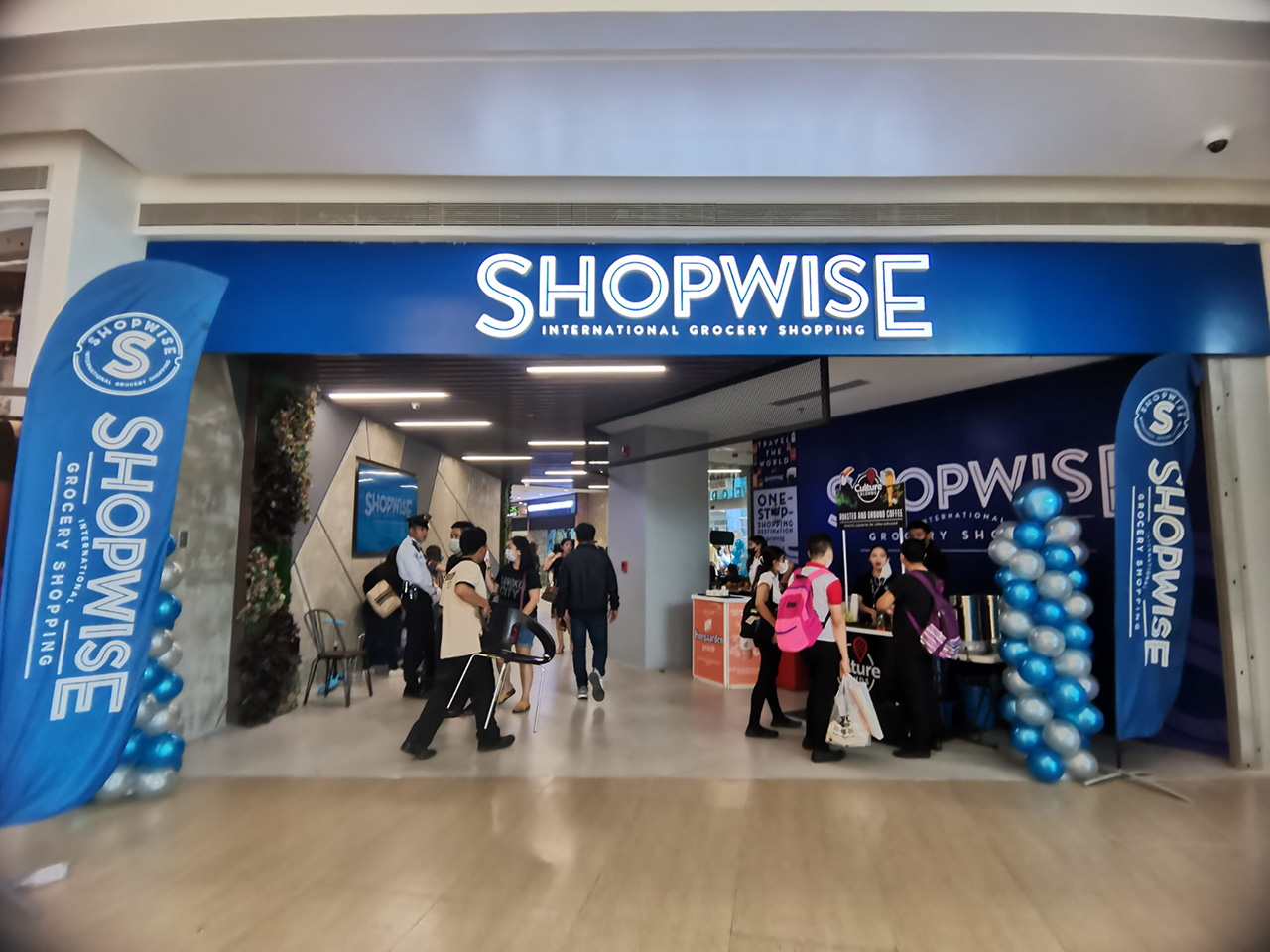
SHOPWISE opened its newest store at the New Gateway Mall 2 in Araneta City on July 28. The newest grocery at the Quezon City area spans around 4,000 sq.m. of the new mall’s lower ground floor, conveniently situated near the mall grand entrance and beside the mall basement parking for better accessibility. Shopwise is a one-stop, no membership fee international shopping destination filled with groceries, general merchandise, home essentials, and appliances from trusted international brands. The new Shopwise houses fresh, locally grown produce straight from the farm as well as brands from across the globe such as Post, Kellogg’s, Stash, Nescafe, Folgers Arizona, Langers, Old Orchard, Pringles, Planters, Wonderful Pistachios, Dr. Pepper, Coke Cherry, Canada Dry, Barq’s root beer, Fanta, Aveeno, and Ecos. Shopwise also has premium chilled beef from Australia, a wide assortment of wines, and a well-stocked deli with a wide selection of cheeses and cold cuts. Asian treats, including Korea’s No Brand and Pan-Asian favorite Meadows. Oster, Martha Stewart, Gibson Home, Pyrex, Corelle, Farberware, Pioneer Woman, and Lauren Taylor are also available for the wise shopper’s home essential needs. Shopwise International Grocery Shopping is among the new mall stores and attractions at the New Gateway Mall 2. The mall will house over 400 brands, about 150 restaurants and food outlets, and attractions like the Quantum Skyview and Sagrada Familia Church — all located in a transit-oriented mixed-used hub.


Google’s Bard is a new assistant in the kitchen

BARD, Google’s artificial intelligence (AI), can be one’s new assistant in the kitchen. Available in over 40 languages, Bard can make recommendations and actual recipes because it has the ability to digest vast amounts of data, including food trends and ingredient combinations. Then the algorithms analyze this information to develop an understanding of flavor profiles and popular dishes. AI does not replace humans in creating recipes, of course. But when undecided on what to cook, trying to come up with a menu, especially with picky kids, Bard can spark inspiration. For 30-minute recipes for rainy days, for example simply ask it with prompts like “What healthy recipes can I cook on a rainy day?” When asked, some of Bard’s rainy-day suggestions were: Chicken Noodle Soup, classic comfort food for a rainy day that is easy to make and can be customized; Beef Stroganoff, a hearty beef dish that is easy to make and can be served over rice or noodles; Pasta with Pesto Sauce, a great way to use up leftover pesto, just boil the noodles; Veggie Omelette; and Grilled Salmon with Roasted Vegetables.

Globe sees 60% decline in cable theft 

GLOBE TELECOM, Inc. saw a 60.2% decline in cable theft to 746 incidents in the first five months of the year from 1,876 in the same period last year.

“This is due to the reduction in existing copper cable lines as part of Globe’s transition to fiber, and the bundling of cables that makes it more difficult to cut. Copper is the type of cable often stolen and sold to junk shops at around P470 per kilo,” Globe said in a press release on Wednesday.

With the number of deliberate cable cuts, the mobile network operator said that 1,600 customers experienced connectivity issues.

“While the reported cases may have decreased, we believe one incident is one too many,” said Raymond Policarpio, vice-president of Globe At Home broadband business.

“Cable theft causes unnecessary inconvenience for our customers,” he said, adding that it is Globe’s customers who ultimately suffer.

To address cable theft, the operator said it had partnered with law enforcement agencies and local government units while allocating P1.4 million to reimburse subscribers affected by outages.

In August 2022, the company allied with “Oplan Kontra Putol” together with other cable and telecom providers to raise public awareness about illegal cable cutting.

It also has a campaign against cable theft through Bantay Kable Program with the Philippine National Police and local government units.

Globe is planning to continuously expand its fiber deployment and migrate from fixed wireless and legacy technology.

Last year, the company installed 1.4 million fiber-to-the-home lines, which it said guarantees access to high-speed and reliable internet while simultaneously mitigating the impact of cable theft.

“Aside from reducing its copper cable footprint, Globe is introducing fiber cable labeling to deter thieves. It is also undertaking vertical clearance correction and tree-trimming initiatives to limit easy access to aerial cables,” it said.

“As we continue to work closely with law enforcers and local government units to stop these thieves, we urge our customers to be vigilant and immediately report cable theft incidents via Globe Security hotlines and bantaykable@globe.com.ph,” said Mr. Policarpio. — Justine Irish D. Tabile

Calamity state

PPA POOL/KRIZ JOHN ROSALES

A declaration of a “state of calamity” allows local government units (LGUs)to start drawing on their “special” funds allocated for emergencies. Without such a declaration, based on an appropriate assessment, these emergency funds cannot be disbursed. Moreover, such funds are earmarked specially for emergency relief and recovery, and cannot be used for other purposes.

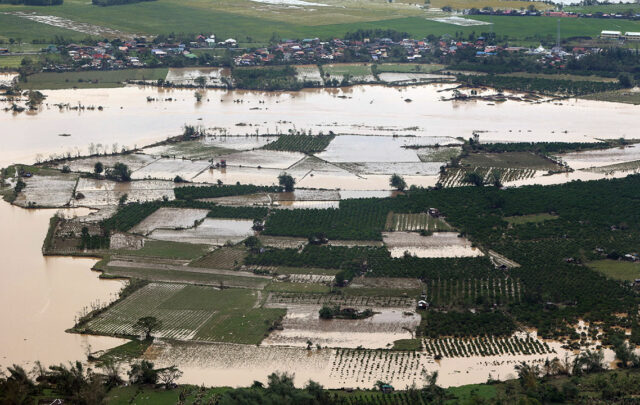
In recent days we have had many Luzon towns and cities, including provinces such as Bulacan and Pampanga, all having local councils declaring a “state of calamity.” All because of strong rains, flooding, and the damage these caused. In Bulacan and Pampanga, the rains were due to the southwest monsoon, as enhanced by typhoons.

Simply put, the rains and flooding, and resulting damage, were not caused by the typhoons directly but by monsoon rains. And not all LGUs, particularly the smaller ones, can afford to budget yearly for disaster relief and recovery. So, they make annual contributions to a “calamity” fund that can be disbursed for the purpose, but only after the official declaration of a state of calamity.

In short, the process of declaration, and the release of funds for disasters, is not an easy process. In the case of Bulacan, the Provincial Council needed to first assess the damage, after the first hit, and then pass Panlalawigang Kapasiyahan Blg. 579-T’2023 for the calamity declaration. And this was after 228,648 residents from 171 barangays were already affected by the rains.

And then there was the Bulacan governor’s call for Congress to prioritize legislation on mitigating the flooding problem in the province, where a new airport is also being erected. News reports indicated that as of Tuesday morning, 16 towns and three cities in Bulacan were still dealing with floods six inches to seven feet deep.

As for Pampanga, the Sangguniang Panlalawigan unanimously approved Resolution No. 8058 on Monday declaring a state of calamity. Without that, the province could not disburse money from its Quick Response Fund for relief efforts. Abra and Apayao made similar moves ahead of Bulacan and Pampanga. The National Disaster Risk Reduction Management Council (NDRRMC) reports that 113 cities and towns have been placed under a state of calamity in at least six regions.

And here lay several problems. I am sure not all LGUs have managed to set aside funds for disaster relief. In some areas, as I had observed when reviewing past audit reports of smaller towns, some LGUs have deficits as far as relief funds are concerned, especially after the COVID-19 pandemic hit. In this line, their getting financial assistance from the National Government will also be like moving a mountain with bare hands.

I suspect that after the pandemic hit in 2020, in succeeding years some LGUs may have stopped contributing to disaster funds because of budget deficits. I am sure local business tax collection went down in 2020 to 2022 after many small businesses closed or suspended operations due to the pandemic. And now that we are grappling with disasters, their treasuries are just as ravaged as well. In this line, the National Government will need to find a way to extend assistance.

The other concern is food supply.

The President already raised the need to import particularly rice, to boost the buffer stock, also because of the El Niño phenomenon. Typhoons tend to impact harvest and supply, resulting in higher prices. In the case of rice, usual rice exporters Vietnam and India have said they are temporarily staying out of the market.

In a press briefing, the President noted that Indonesia was importing, but Vietnam already said it has exported all it could, while India has stopped exports meantime. This leaves Thailand as a possible supplier, but the whole of Southeast Asia is preparing for El Niño’s long droughts. So, all countries are buying at the same time. And this is going to drive up prices.

When rice prices go up again, that is when the real state of calamity begins. And no national declaration or release of “emergency” funds can remedy that situation. Our rice sources like Bulacan and Pampanga are among those hit hard by torrential rains and flooding. The adverse impact on planting and harvest is inevitable.

The present situation, including the negative effects of El Niño, all require urgent but comprehensive and meticulous study and planning, particularly by the Agriculture department. More important, the National Government should be prepared to allocate the necessary resources needed to mitigate higher food prices and its overall impact on inflation.

In this line, there should be clearer lines on responsibility and accountability as far as addressing the rice situation — and food inflation — are concerned. This will entail making somebody else responsible for the problem. Otherwise, in case of failures, the President cannot fire himself as Agriculture chief.

I agree with Senator Grace Poe’s call for a full-time Agriculture Secretary to address the issues hounding the agriculture sector, instead of President Ferdinand “Bongbong” Marcos, Jr. who is concurrently heading the Department of Agriculture. It was only recently that the President, after over a year in office, finally appointed a permanent Health Secretary.

The present situation requires focus by the Agriculture department, and this necessitates the appointment of a permanent Agriculture secretary. The President already has a full plate, and finding an expert to focus on the rice and food situation and to implement long-term solutions can be the difference between declaring a state of calamity and the Philippines becoming a calamity state.


Marvin Tort is a former managing editor of BusinessWorld, and a former chairman of the Philippine Press Council

matort@yahoo.com

PAL Mabuhay Lounge opens at Cebu hub

PHILIPPINE Airlines (PAL) has announced the inauguration of its 114-seat Mabuhay Lounge, located at the ground level of Mactan-Cebu International Airport.

The lounge, designed by Adrian T. Chua Architects and Associates, showcases a fusion of modern Filipino interiors which feature the flag carrier’s signature colors, wooden touches, and sleek furnishing.

“The Mabuhay Lounge serves as a sanctuary of tranquility amidst the hustle and bustle of travel,” said PAL President and Chief Operating Officer Stanley K. Ng.

“The new lounge is part of PAL’s strong commitment to build up Mactan-Cebu as our fastest growing hub — the heart of a robust network of PAL flights linking Cebu with 19 domestic and regional destinations. The Lounge is a new haven in our Cebu home,” he said.

The lounge will be open for PAL’s business class and comfort class passengers and Mabuhay Miles Elite, Premier Elite, and Million Miler members.

Aside from a dining area which has a buffet station and a seating area with lounging chairs, private charging outlets, and WiFi connectivity, the Mabuhay Lounge will also have VIP shower rooms. — Justine Irish Tabile

Metrobank net income rises by 37.05% in Q2

METROPOLITAN Bank & Trust Co. (Metrobank) saw its net income rise by 37.05% year on year in the second quarter, driven mainly by higher net interest earnings.

The lender’s attributable net income stood at P10.42 billion in the second quarter, up from P7.6 billion in the same period last year, according to its financial statement submitted to the local bourse on Wednesday.

“Our core businesses continued to grow and benefit from our strong balance sheet… As the economy further expands, we see more market opportunities that will keep our upward momentum and sustain our efforts to better serve our customers,” Metrobank President Fabian S. Dee said in a statement.

The bank’s second-quarter performance brought its attributable net income for the first half to P20.9 billion, up by 34.08% from P15.59 billion in the same period last year.

This translated to a return on average equity of 12.89% and a return on average assets of 1.46%, up from 10.02% and 1.21% a year prior, respectively.

Metrobank’s net interest income went up by 25.31% to P25.71 billion in the second quarter, driven by higher interest earnings on loans and receivables and trading and investment securities that more than offset a 348.36% jump in interest expenses to P11.9 billion.

The bank’s net interest margin stood at 3.93% at end-June, up from 3.43% a year prior.

Meanwhile, other income inched down by 1.12% to P6.81 billion, even amid a slight increase in service charges, fees and commissions, as it saw a lower net gain from trading, securities, and foreign exchange.

Other expenses went up by 15.3% to P16.78 billion.

As a result, the bank’s cost-to-income ratio stood at 51.77% at end-June, down from 53.78% a year prior.

Metrobank’s gross loans climbed by 8.6% amid a 7.2% rise in commercial loans and 14.1% growth in consumer loans. Net credit card receivables grew by 28.8% and auto loans rose by 17.5%.

Its nonperforming loan (NPL) ratio improved to 1.84% as of June from 1.91% a year prior, which the bank said reflected its “prudence in its lending business.”

“NPL cover is at a high of 184.4% providing a substantial buffer against any risks to the portfolio,” Metrobank said.

The bank set aside loan loss provisions amounting to P2.12 billion in the second quarter, up by 19.09% from P1.78 billion in the same period last year.

On the funding side, deposits expanded by 9.3% year on year to P2.3 trillion, with low-cost current and savings accounts making up 62.2% of the total.

Metrobank’s consolidated assets stood at P2.9 trillion at end-June.

Total equity reached P329.84 billion.

Its capital adequacy ratio stood at 17.90% as of June, up from 17.62% a year prior, while its common equity Tier 1 ratio was at 17.06%, also higher than the 16.77% seen last year.

Meanwhile, its liquidity coverage ratio stood at 243.4%.

Metrobank’s shares dropped by 65 centavos or 1.11% to end at P58 apiece on Wednesday. — A.M.C. Sy