Home Blog Page 4480

‘People are clamoring for it’

Mr. See — PHOTO BY KAP MACEDA AGUILA

Sojitz G Auto PHL VP for Vehicle Sales Reginald ‘Reggie’ See says the GX3 Pro allows Geely to compete in the A crossover segment

Interview by Kap Maceda Aguila

VELOCITY: Out of the Geely models still not here, why was the GX3 Pro chosen specifically to be launched in the Philippines now?

REGGIE SEE: There’s no Geely presence yet in the subcompact SUV segment, so we introduced this car to compete in that A segment. I think that with this car, with its higher ground clearance and features that it provides, it will compete well in the subcompact crossover category.

What are you seeing in this category that you’ve mentioned? Do you see a lot of movement or growth that makes you want to fill this gap? Are people looking for it, at least in the local market?

Yes. That’s one of the reasons why we’re bringing in this model. People are clamoring for it. We have people asking for a more value-added version of the Coolray.

In terms of the electrified offerings of Geely, are we going to see more hybrids or possibly even an EV soon?

Thank you for asking. Actually, that’s in the pipeline. As you know, Geely globally has a lot of EVs and hybrids in its lineup of models. So, we’re studying which models would best suit the Philippine market and in what price point we should come in with these models.

Having said that, can you say about the local market with regard to its appetite for hybrids and even full EVs? Of course, we’re seeing a growing number of brands already releasing electrified options.

It’s gaining momentum. Of course, the charging infrastructure is still not where we it to be. But I think we can slowly ease some EV products into the market right now.


Not all COVID ‘misinformation’ is equal — or even misinformation

HEIKE TRAUTMANN-UNSPLASH

THOUSANDS of Americans have died because they didn’t get COVID vaccinations. A sea of anti-vaccine misinformation contributed to the problem, from rumor-mongering about the shots causing mass death to propaganda touting the benefits of ivermectin. Public health officials seemed powerless to stem the tide of lies. One of the big challenges public health officials now face is how to restore trust so that people listen to future guidance on everything from flu shots to childhood vaccines.

But a new study on COVID misinformation, published this week in the Journal of the American Medical Association (JAMA), makes it clear that doctors and public health experts have some way to go in figuring out how to do that. Overdiagnosing “misinformation” — as the study does — will do more harm than good.

The study, by six researchers at the University of Massachusetts, Amherst, started with a worthy goal: examining the role of doctors in spreading dangerous misinformation on social media. But the study undermines its own purpose by wrongly classifying value judgments and some scientifically valid points as misinformation.

For example, consider this statement, which a doctor posted on Facebook in February 2022: “It’s time to recognize natural immunity as at least as good as vaccinations and end the mandates.”

Paul Offit — who has decades of experience fighting anti-vaccine misinformation — called foul at the JAMA study author’s classification of this statement as misinformation. The first part about natural immunity is true, he said. And the call to end vaccine mandates was one view in a legitimate debate — a value judgment, not a fact.

Offit is a physician, director of the Vaccine Education Center at Children’s Hospital of Philadelphia, and a member of the panel advising the Food and Drug Administration on COVID vaccine policy. He reminded me that when the vaccines were first being rolled out and in limited supply, there were questions about whether healthcare workers who were previously infected should be vaccinated. Those in charge of planning the rollout realized that it was just too cumbersome to test everyone to find out who had already been infected. It was expediency that motivated the policy, he said, not any doubt about infection-induced immunity.

“Vaccines are ineffective at preventing COVID-19 spread,” was another claim posted on social media by a physician that was also listed as misinformation by the JAMA authors. But the clinical trials for vaccines didn’t test participants unless they reported symptomatic disease, so the trials couldn’t determine whether getting vaccinated protected against under-the-radar cases — mild or asymptomatic infections that could potentially spread to others.

Subsequent observational studies did show that while not perfect, the vaccines did reduce the odds of all infections, said Monica Gandhi, an infectious disease doctor at University of California San Francisco. But that changed in the summer of 2021 with the emergence of the delta variant. After that point, she said, the benefit of vaccination was only to protect against severe disease and death.

The JAMA paper also labeled as misinformation statements questioning the efficacy of masks — but that’s just one side of a complex debate, argues Gandhi. Wearing a well-fitted mask can protect the wearer, but there’s disagreement about the costs and benefits of universal masking, especially masking children in day care or at school. Offit says he interprets “masks work” to mean high-quality masks protect the wearer — not that we should go back to forcing cloth masks on toddlers in day care.

The JAMA article also labeled as misinformation statements about downsides of masking. But several studies concluded that having to wear a mask all day can impede the ability of children (and adults) to interact and communicate. It’s not “misinformation” to discuss downsides of public health measures.

Gandhi, author of Endemic: A Post-Pandemic Playbook, says the fight against misinformation has been corrupted by the way Americans tend to send messages in sound bites, from “just say no to drugs” to “vaccines work” to “wear a damn mask.” It’s not helpful or scientific to define misinformation as anything that contradicts such slogans.

And some in public health may wrongly assume people are misinformed because they’ve chosen to accept some degree of infection risk. Yet a public that is unwilling to make every possible sacrifice — indefinitely — to prevent even the tiniest chance of infection isn’t necessarily misguided.

Policing misinformation carefully and thoughtfully is becoming a wider problem in public health. “Respectful scientific discourse and debate is how science was done prior to COVID, and something broke when COVID arrived,” said Shira Doron, an epidemiologist at Tufts University Medical Center.

Public health scientists have to figure out how to get back to the kind of nuanced, thoughtful discussions that were the pre-pandemic norm. Overgeneralizing and politicizing information breeds public distrust, which increases the appeal of contrarians who peddle anti-vaccine rumors and innuendo.

When people at high risk of dying from COVID are more afraid of the vaccine than the disease, something’s gone very wrong. That’s the kind of misinformation that can kill.

BLOOMBERG OPINION

Fisherfolk call for support during closed season

PAMBANSANG LAKAS ng Kilusang Mamamalakaya ng Pilipinas (Pamalakaya), an organization of fisherfolk, said the government’s primary policy response to closed fishing seasons should be to support the fishing communities rendered idle, rather than importing fish.

“It seems like the government isn’t learning when it comes to solving the production crisis,” Pamalakaya Vice Chairman Ronnel Arambulo said in a statement.

“They are aware that the major fishing grounds (observe) a closed fishing season every year, but they don’t have any contingency plan (for the fisherfolk),” he added.

Last week, the Department of Agriculture (DA) approved imports of 35,000 metric tons (MT) of fish for wet markets, which are to be brought in between Oct. 1 and Dec. 31.

The species to be imported are frozen round scad or galunggong, bigeye scad or matang baka, bonito, moonfish, and mackerel.

Bureau of Fisheries and Aquatic Resources (BFAR) spokesman Nazario C. Briguera told reporters that the imports will cover the expected shortfall caused by the closed season.

In its supply and situation outlook, the BFAR estimated a fish deficit of 57,830 MT by the fourth quarter.

Closed fishing seasons are declared to allow fish to spawn and restore their numbers.

“Prior to the three-month closed fishing season every last quarter of the year, local production should be strengthened by providing support to fishers such as fuel subsidies,” Mr. Arambulo said.

He also said that the government should ensure availability of cold storage to ensure the adequate supply of fish during the closed season.

“It is unacceptable that just because there is a temporary ban on catching round scad, it will allow imports,” Mr. Arambulo said.

“The government should take the lead in promoting our local fish instead of imports,” he added.

As of Thursday, DA price monitors put the price of domestically-caught round scad at between P200 and P280 while imported round scad fetched P200.

The prevailing price of tilapia in Metro Manila markets was P120-P160. Milkfish or bangus sold for P150-P240. — Sheldeen Joy Talavera

Wall Street banks rush to reclaim edge in market for buyout debt

WALL STREET’S top banks are rushing back into the lucrative market for leveraged buyouts to reclaim business from private creditors.

Banks are committing financing for a slew of new deals — from the $1-billion loan for the purchase of book publisher Simon & Schuster, Inc. to the roughly $1.7 billion of debt for the acquisition of packaging firm Veritiv Corp. They can win this business, in part, because they’ve cleared out so much of the older debt stuck on their books that made it harder to compete for new offerings.

Investors, meanwhile, are eager to buy syndicated loans, which gives banks more confidence in bidding for deals. Competition is fierce: There’s been just $13.3 billion of leveraged buyout loans issued so far this year in syndicated markets, versus $65 billion in the same period of 2022, according to JPMorgan Chase & Co.

“Money is coming flying into credit,” said Richard Zogheb, head of global debt capital markets at Citigroup. “The real challenge is creating supply.”

Demand for high-yielding assets has been soaring as the US economy proves resilient in the face of the Federal Reserve’s most aggressive monetary tightening in decades.

“There’s a face-off between private lenders and the syndicated market for leveraged buyout transactions,” said Kim Harris, a partner and portfolio manager in liquid and structured credit based at Bain Capital Credit. In the end, private equity sponsors are “going to go with whoever has the best execution.”

Banks, though, have gotten a boost in confidence in the wake of deals like Apollo Global Management, Inc.’s acquisitions of aluminum products maker Arconic Corp. and chemical company Univar Solutions, Inc. Both deals were met with strong demand from investors.

Chris Blum, head of corporate finance at BNP Paribas, said banks have been able to use the success of recent transactions as a way to credibly propose other deals to their risk committees.

That, and the Fed’s current fight against inflation, means investors are more willing to support transactions with lower leverage and more lender-friendly documentation — especially to firms with a credit rating equivalent to a “B2” or above from Moody’s Investors Service.

But not every transaction is ready to rely on bank lending. While banks can often offer more-attractive initial pricing than private creditors, they’ll sometimes rely on step-up clauses that increase costs if transactions take longer to close.

“You could get stuck in transactions for some time,” said Zogheb of Citigroup. “Especially given the current regulatory environment.”

Private creditors, meanwhile, can offer a firmer guarantee on pricing. Banks lost out on a recent €1.5-billion ($1.65-billion) loan package to help fund the buyout of Constantia Flexibles GmbH, with financing instead coming from private lender HPS Investment Partners. — Bloomberg

Yields on gov’t debt drop

YIELDS on government securities (GS) traded in the secondary market fell last week following Tuesday’s auction of fresh 10-year bonds.

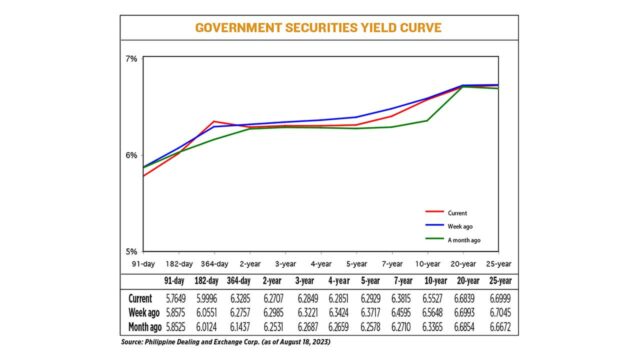
GS yields, which move opposite to prices, dropped by 3.7 basis points (bps) on average week on week, based on PHP Bloomberg Valuation Service Reference Rates as of Aug. 18 published on the Philippine Dealing System’s website.

Rates were mixed across all tenors last week as yields on the 91- and 182- Treasury bills (T-bills) declined by 9.26 bps and 5.55 bps to 5.7649% and 5.9996%, respectively. Meanwhile, the 364-day T-bills went up by 5.28 bps to fetch 6.3285%.

The belly of the curve went down as yields on the two-, three-, four-, five-, and seven-year Treasury bonds (T-bonds) fell by 2.78 bps (6.2707%), 3.72 bps (6.2849%), 5.73 bps (6.2851%), 7.88 bps (6.2929%), and 7.80 bps (6.3815%), respectively.

At the long end, the rates of the 10-, 20-, and 25-year debt papers inched down by 1.21 bps (6.5527%), 1.54 bps (6.6839%) and 0.46 bp (6.6999%), respectively.

Total GS volume traded on Friday amounted to P10.68 billion, higher than the P4.65 billion seen on Aug. 11.

“Yields declined over the week as the new 10-year bond issuance auctioned last Aug. 15 saw strong market participation garnering over [twice] the demand oversubscription into the Bureau of the Treasury’s (BTr) P30-billion bond offering,” Lodevico M. Ulpo, Jr., vice-president and head of Fixed Income Strategies at ATRAM Trust Corp., said in an e-mail.

Yields declined last week following a recent bond maturity, a bond trader said, adding that the latest central bank decision did not have an immediate effect on the market.

Last week, the BTr fully awarded the new 10-year bonds it auctioned off as total bids amounted to P66.824 billion.

The bonds were awarded at a coupon rate of 6.625%. Accepted yields ranged from 6.4% to 6.625% for an average of 6.558%.

Meanwhile, the Bangko Sentral ng Pilipinas (BSP) kept benchmark interest rates steady for a third straight meeting on Thursday, but signaled it is prepared to resume tightening if needed amid risks to inflation.

The Monetary Board left its overnight reverse repurchase rate unchanged at a near 16-year high of 6.25%, as expected by 13 economists in a BusinessWorld poll. Interest rates on the overnight deposit and lending facilities were maintained at 5.75% and 6.75%, respectively.

The BSP has raised borrowing costs by 425 basis points (bps) from May 2022 to March 2023 to tame inflation.

“Post the BSP action, we anticipate markets to focus on global economic data and market movements as medium-term disinflation expectation by the BSP is tempered by near term inflationary risks on food, climate, and energy,” Mr. Ulpo said.

He added that global curve’s steepening may temper the persistent demand for duration, but this may be temporary as the market looks forward to better global and local monetary conditions in 2024 and 2025.

“We expect demand for bonds and duration to persist albeit at specific yield levels given broadly anchored front-end yields,” he said.

For this week, Mr. Ulpo said the 15-year bond reissuance will likely test the market’s resolve.

On Wednesday, the BTr will offer P30 billion in reissued 20-year papers with a remaining life of 15 years and five months. — A.M.P. Yraola

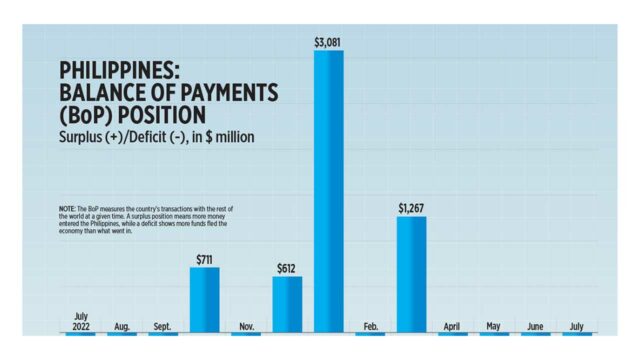
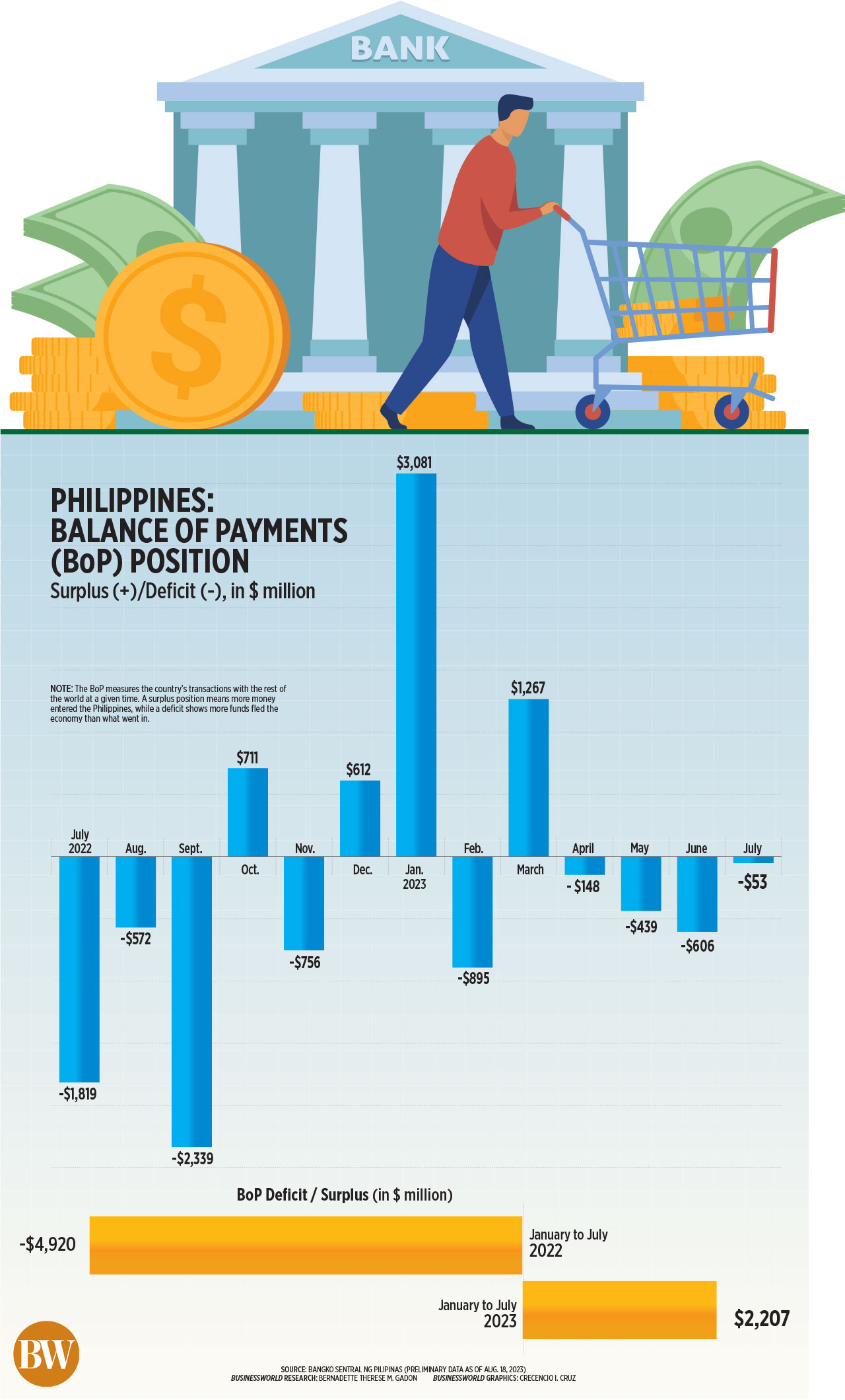
Philippines: Balance of payments (BoP) position

THE OVERALL balance of payments (BoP) deficit sharply narrowed to $53 million in July, as more dollars flowed out of the country to pay for the government’s foreign debt. Read the full story.

SM Investments dips as postponed reclamation project prompts sell-off

SHARES in SM Investments Corp. slipped last week due to a market sell-off prompted by the postponement of the reclamation projects in Manila Bay and the disappointing second-quarter economic growth.

The Sy-led conglomerate was the most actively traded stock with a total of 25.12 million shares worth P21.61 billion having exchanged hands on the trading floor from Aug. 14 to 18, data from the Philippine Stock Exchange showed.

Week on week, SM Investments’ share price declined by 2.5% to P860.00 per share on Friday from its Aug. 11 closing price of P882.50 apiece. Since the start of the year, its share price has fallen by 4.4%.

Philippine National Bank Equity Research Department Head Jonathan J. Latuja said in an e-mail that SM Investments stock’s decline accelerated due to a sell-off amid the disappointing second-quarter of gross domestic product (GDP) growth and regulatory industry-related suspension of reclamation projects in Manila Bay.

“SM Investments is the largest index stock by market capitalization size and typically used as a proxy by investors who want exposure in the Philippine growth story. Sentiment towards the stock turned pessimistic when the weaker-than-expected second-quarter GDP results came out,” said Mr. Latuja.

“Another reason for the sell-off is related to the government’s suspension of reclamation projects in Manila Bay which directly affects SM’s real estate subsidiary, SM Prime Holdings, Inc., given their 360-ha. (hectare) reclamation project in Pasay City,” added Mr. Latuja.

In a Viber message, Mercantile Securities Corp. Head Trader Jeff Radley C. See also said that investors reacted negatively to the government’s announcement of halting reclamation projects on Manila Bay.

“The delay of the planned REIT offering wasn’t really a big influence to the price movement due to the market condition,” said Mr. See.

During the PSE STAR event held last week, the conglomerate announced the postponement of the market listing of its real estate investment trust (REIT) to next year.

Earlier this year, SM Prime said that it was planning to launch its REIT portfolio by the second half of the year.

The company’s target REIT offering is likely to be valued at around $3.5 billion to $4 billion and initially composed of 12 to 15 assets, which will come from the 82 malls it currently has, as 30 to 35 malls are now fully matured.

SM Investment also said that it fully stopped its reclamation operations after the government suspended all Manila Bay reclamation projects to review the environmental and social effects.

In a previous news briefing, President Ferdinand R. Marcos, Jr. suspended all reclamation projects in Manila Bay ahead of a review of their environmental and social effects.

The Philippine Statistics Authority earlier reported that the country’s GDP grew at 4.3% in the second quarter, slower than the 6.4% growth in the first quarter and 7.5% a year ago. It was the slowest growth in over two years.

The slower-than-expected growth as of June was dragged by elevated inflation, the impact of interest rate hikes, and a decline in government spending.

For the second quarter, SM Investment’s attributable net income amounted to P19.23 billion, up 30.7% from P14.72 billion in the comparable three months last year.

Its consolidated revenues also increased by 15.1% to P148.18 billion during the period.

In the first semester, its attributable net income rose 31.8% to P36.53 billion from P27.71 billion last year. Its top line rose by 18% to P286.24 billion in the first half.

“We project a full-year 2023 revenue growth of 13% to P583.4 billion,” Mr. Latuja said.

Mr. See pegged the stock’s support and resistance levels this week at P850.00 and P945.50 per share, respectively.

“Overall, SM group did pretty well but market sentiment weighed down its quarterly results. The stock might move sideways for now,” Mr. See said. — Lourdes O. Pilar

Gov’t expects military pension system to be self-sustaining in 20 years

FILIP ANDREJEVIC-UNSPLASH

By Aaron Michael C. Sy and Beatriz Marie D. Cruz, Reporters

THE GOVERNMENT is expecting the military and uniformed personnel (MUP) pension system to be self-sustaining after 20 years if the proposed bill hiking contributions would be implemented, especially with new entrants in the uniformed services.

According to a proposed bill by the House of Representatives ad hoc committee, all MUPs would now be required to contribute a bigger percentage of their salaries to the pension fund, with new entrants contributing the largest percentage of their salary at 9%.

Under the proposed measure, incremental increases for active personnel would have them contribute 5% of their salary to the fund for the first three years, 7% for the next three years, and 9% thereafter.

The effort will be matched by a larger government contribution to the fund at about 11% of the MUP standard salary. Finance Undersecretary Maria Cielo Magno said this would be equivalent to about P40-P50 billion in the first year of implementation.

Finance Undersecretary Maria Luwalhati C. Dorotan-Tiuseco said the new schedule of contributions from the new entrants will shorten the spending of the government on the pension versus the 60 years it would take for it to be self-sustaining.

Finance Secretary Benjamin E. Diokno said this will help free up the government to spend on other purposes such as health or education.

Meanwhile, Mr. Diokno also said that the Government Service Insurance System (GSIS) will be given assets to liquidate for the management of the MUP pension system.

While there is no decided amount yet on the capital that GSIS will need, Mr. Diokno cited P9 trillion in unfunded liability that could factor into the budget.

Meanwhile, defense and security analyst Chester B. Cabalza said the proposed reform could be revised further to differentiate percentages according to the nature of an MUP’s work.

Mr. Cabalza, founding president of Manila-based International Development and Security Cooperation, said over the weekend that the new pension system will certainly impact the promotion and recruitment system of the MUP because of the increasing percentage of contributions.

However, it would be a scourge to new entrants, since their contributions under the proposal is quite heavy. “If that’s the case, young MUPs will not stay longer in the service and will use the opportunity as a stepping stone to high paying jobs in private firms and abroad,” he said.

Mr. Cabalza said contribution percentages could be set per organization of MUPs, as “all of them differ in the number of recruits, promotions, and retirees,” he said.

“Since there will be differing pension system based on the rate of percentages due to their own respective force structure, the benefits will matter as it becomes more competitive and fruitful to their career or professional development,” he said.

Hansley A. Juliano, a political economy researcher studying at the Nagoya University’s Graduate School of International Development in Japan, urged for more consultations with veteran MUPs themselves.

“Making the reform sustainable, equitable and fair to the affected personnel does require a clear setting of what is the general quality of life of that retired personnel really have,” Mr. Juliano said in a Facebook Messenger chat.

Surviving Beatles join Dolly Parton on ‘Let It Be’ cover

LOS ANGELES — Paul McCartney and Ringo Starr, the two living members of The Beatles, have reunited for a cover of their 1970 hit “Let It Be” on country singer Dolly Parton’s coming rock album.

Parton released the single on Friday ahead of the November debut of her album Rockstar. Mr. McCartney sang and played piano while Mr. Starr played drums on the recording.

Two other music luminaries joined the collaboration, Ms. Parton said. Peter Frampton played guitar and Mick Fleetwood of Fleetwood Mac did percussion.

“I mean, seriously, how much better does it get?” Ms. Parton wrote on X, formerly known as Twitter. The Rockstar album was inspired by Ms. Parton’s induction into the Rock & Roll Hall of Fame last year. It will include nine original songs and 21 covers with an all-star list of collaborators, including Elton John, Miley Cyrus, Stevie Nicks, Debbie Harry, Joan Jett and Chris Stapleton. — Reuters

Sub-P1M crossover Geely GX3 Pro now here

PHOTO BY KAP MACEDA AGUILA

GEELY IN THE PHILIPPINES surely made its bones with the Coolray — a popular crossover that further helped to shore up the reputation of Chinese car makers.

Sojitz G Auto Philippines (or Geely Philippines), local distributor of the Hangzhou, Zhejiang-headquartered automaker, looks to build on its popularity and growing consumer base in the country with the release of the GX3 Pro. The A-segment crossover is said to target the “young and entry-level market,” with a price point well below the P1-million mark.

Measuring 4,005-mm long (with a 2,480-mm wheelbase), 1,760-mm wide, and 1,575-mm tall, the GX3 Pro is powered by a 1.5-liter, 16-valve DOHC mill with DVVT (Dual Variable Valve Timing). Mated to either a five-speed manual (S trim) or CVT (Comfort trim), the engine submits 102hp and 142Nm — the latter achieved from 4,400rpm to 4,800rpm. It clears the ground by 185mm. The five-seater is said to boast a maximum cargo volume of up to 400 liters.

The GX3 Pro gets three driving modes (Normal, Eco, and Sport) and rolls on 16-inch alloys. It wears halogen headlamps, with the Comfort variant getting Auto Headlight Control. Both trims have LED daytime running lamps, power side mirrors, a glass-printed antenna, and silver roof rails.

Inside, its instrument panel boasts a 3.5-inch multi-information display, while the eight-inch infotainment screen can support mobile devices through CarbitLink. Audio content is expressed via two speakers on the S variant and six speakers on the Comfort. The driver can manually adjust his/her seat in six ways, while the front passenger gets four-way manual adjustment.

For safety, Isofix anchors are available in the rear seats, and both trims receive driver and passenger air bags, electronic brake distribution with brake assist, a reversing camera, rear parking sensors, low-tire pressure warning, and a central locking system. The Comfort additionally features traction and stability control, hill start assist, hill descent control, cruise control, and an anti-theft system with immobilizer.

“This model holds a strategic significance for Geely, as it aims to capture an entirely new customer base, particularly Gen Z. With its enticing introductory pricing and an emphasis on an enjoyable driving experience, the GX3 Pro is poised to play a pivotal role in expanding our reach and achieving five-digit annual sales figures,” said Geely Philippines President and CEO Yugo Kiyofuji.

During the launch event held recently, Geely Philippines also stressed its efforts and focus on improving after-sales experience with the launch of the so-called G-Serv+. “(We) take pride in having garnered over 20,000 customers to date, a number that is set to grow exponentially. Over the past year and beyond, we have dedicated significant efforts to revamp our after-sales operations,” continued Mr. Kiyofuji. “With G-Serv+, we are confident that Geely owners will enjoy peace of mind throughout their ownership journey, further solidifying our customer base and fostering a sense of belonging within the Geely family.”

The Geely GX3 Pro is priced at P698,000 for the S variant, and P798,000 for the Comfort. It is available in four exterior colors: red, white, blue, and gray. Geely Philippines says that each purchase comes with a five-year/150,000-km warranty and one year of free emergency roadside assistance. — Kap Maceda Aguila

Empowering patients for enhanced healthcare

FREEPIK

In recent years, patient-centered care has been the center of discussion in the healthcare community as well as a buzzword for excellence in care delivery. Yet patients still have little influence in matters that impact them the most, observed the New England Journal of Medicine (NEJM).

In its publication “The Power of Patient Voice,” NEJM added that patients are said to be the center of healthcare but too often their voices are ignored or put to the side when decisions are being made. These decisions include those relating to their health, their treatment plans, the cost of their care, and more. It asserted that care is patient-centric if input from patients themselves is a core part of the process.

Patient-centered healthcare has emerged in the past decades as an approach for better-functioning healthcare systems. It represents a shift from “doctor knows best” to a new pact between patients and healthcare professionals, where the patient is actively involved in any decisions about their wellbeing. To cite just one example, patients can provide feedback to healthcare professionals about how a medicine is working for them and which ones may be most fit for them.

Patient empowerment is both a pre-requisite for and an outcome of patient-centered healthcare — a goal as well as a process, according to the European Patients Forum (EPF). EPF defines patient empowerment as a “process that helps people gain control over their own lives and increases their capacity to act on issues that they themselves define as important.” Aspects of empowerment include health literacy, shared decision-making, and self-management.

Recognizing the vital importance of a strong patient voice in enhancing healthcare systems, the Philippine Alliance of Patient Organizations (PAPO) in partnership with the Asian Institute of Management (AIM) co-developed the Post-Graduate Certificate Course on Healthcare Leadership and Management.

This first-of-its-kind customized program under the AIM School of Executive Education and Lifelong Learning gives patient leaders the opportunity to hone their leadership skills in creating a people-centered approach to healthcare. It aims to enhance the capabilities of patient leaders and empower them to effectively lead and transform their organizations. By equipping them with the necessary skills and knowledge, patient leaders can play pivotal roles as members of local health boards, actively participate in decision-making processes, and contribute to the improvement of healthcare systems at the grassroots level.

The Universal Health Care (UHC) Act mandates the creation of local health boards that are responsible for setting the overall health policy directions and strategic thrusts, including the development and implementation of the integrated strategic and investment plans of the province-wide and city-wide health system. These health boards also oversee and coordinate the integration and delivery of health services; manage the Special Health Fund (SHF); and exercise administrative and technical supervision over health facilities and health human resources within their respective territorial jurisdiction.

“We want the patient’s voice to be represented in the local health boards, so we need to be prepared. This post-graduate course further enhances our leadership, strategic thinking, and empathy through design thinking,” said PAPO President Karen Alparce-Villanueva.

During the graduation ceremony, five groups presented their Action Learning Projects, which are real-life case studies designed to help ensure classroom learning is implemented in the real world. The patient leaders discussed Project Padayon, a toolkit guide for local health officials in organizing and partnering with patient groups; developing strategic partnerships for people-centered healthcare; automating medical records through mobile application development; increasing access to financing for patients with rare diseases; and enhancing the patient experience in accessing financial assistance through the Malasakit Centers.

PAPO trustee Mel Lamsin said that the course gave them more confidence as it equipped them with knowledge on how to frame problems and propose solutions in a better way.

“We stand with PAPO, AIM, and the broader community in championing patient-centered healthcare for Filipino patients. We laud PAPO for bringing this vision closer to reality by equipping patient leaders through this postgraduate course,” said Andreas Riedel, President and Managing Director, MSD Philippines.

Along with MSD, Roche Philippines, and Boehringer Ingelheim Philippines provided support to the strategic collaboration between PAPO and AIM.

Patient-centric care may be the latest byword for quality healthcare but for us to get there, patients must be part of the conversation and decision-making. Borrowing from PAPO on its discussion about patients: “It is not about us, without us.”


Teodoro B. Padilla is the executive director of Pharmaceutical and Healthcare Association of the Philippines (PHAP). PHAP represents the biopharmaceutical medicines and vaccines industry in the country. Its members are in the forefront of research and development efforts for COVID-19 and other diseases that affect Filipinos.

PFDA opens processing facility at Navotas fish port

THE Philippine Fisheries Development Authority (PFDA) inaugurated the new processing facility at the Navotas Fish Port Complex, which will be operated by a women’s organization producing smoked fish.

In a statement, the PFDA said that Eco-Friendly Women of Navotas Fish Port, Inc. will run the processing facility.

The PFDA also added 44 food stalls to the freshly renovated Market 3.

“This new infrastructure also aims to provide more employment opportunities and an additional sources of income for the members of the association,” the PFDA said.

The PFDA is also looking into constructing additional regional fish port (RFP) complexes and establishing modern fish trading centers elsewhere in the Philippines.

Six ports are being upgraded in Davao, Iloilo, Zamboanga, Camaligan, Camarines Sur, Sual, Pangasinan, as well as Navotas.

Fish landed at RFPs totaled 42,814.19 metric tons in May, down 4.26% from a month earlier, mainly due to the early onset of the rainy season. — Sheldeen Joy Talavera