Home Blog Page 4471

Thailand’s fugitive ex-PM Thaksin returns to jail from years in self-exile
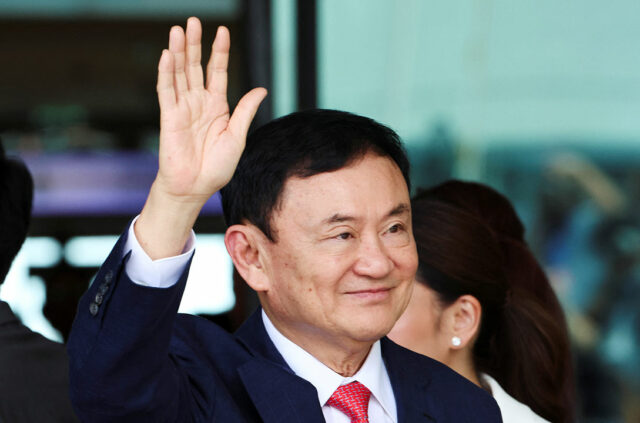
FORMER Thai Prime Minister Thaksin Shinawatra — REUTERS

BANGKOK — Thailand’s fugitive former premier Thaksin Shinawatra on Tuesday set foot on Thai soil for the first time since 2008, returning from self-exile to prison just hours before his allies contest a parliamentary vote in a bid to form a government.

Mr. Thaksin, the billionaire figurehead of the populist juggernaut Pheu Thai Party, fled abroad 15 years ago before he was jailed in absentia for abuse of power, two years after the military toppled him in a coup, alleging corruption and disloyalty to the powerful monarchy, which he refutes.

Mr. Thaksin, 74, appeared briefly with family members at a private jet terminal at Bangkok’s Don Mueang airport, smiling and waving to hundreds of supporters, before he was escorted in a police convoy to the Supreme Court, then taken to prison, where, the court said, he will serve eight years.

As he emerged from the airport wearing a black suit, red tie and yellow lapel pin bearing a royal insignia, Mr. Thaksin clasped his hands together and bowed in a traditional wai greeting before a portrait of the king and queen.

Mr. Thaksin’s daughter, Paetongtarn Shinawatra, confirmed he had arrived safely and posted images on Facebook of a smiling Thaksin with his family, including seven grandchildren.

“Dad has returned to Thailand and has entered the legal process,” Ms. Paetongtarn said.

The vaunted arrival of Thailand’s most famous politician came as the lower house and military-appointed Senate convened ahead of a vote later on Tuesday on prime ministerial candidate Srettha Thavisin, a real estate mogul who was thrust into politics by Pheu Thai just a few months ago.

Thailand has been under a caretaker government since March and its new parliament has been deadlocked for weeks after the anti-establishment winner of a May election, Move Forward, were blocked by conservative lawmakers, leaving heavyweight Pheu Thai to lead a new effort.

A winner of five elections over the past two decades, Pheu Thai, founded by the Shinawatra family, has agreed a contentious alliance including two parties backed by a military that overthrew governments led by Mr. Thaksin and sister Yingluck Shinawatra in 2006 and 2014 coups.

His return has prompted widespread speculation that Pheu Thai’s alliance with its old enemies in the military and the establishment is part of a behind-the-scenes deal to allow him to come back safely.

Mr. Srettha, 60, on Monday said Pheu Thai had not choice but to partner with some rivals that it had earlier vowed not to work with.

“We are not lying to the people, but we have to be realistic,” said Mr. Srettha, who has the support of 317 lawmakers and needs 58 votes from the Senate to secure the requisite backing of half of the legislature.

LOVED AND LOATHED
The return of Mr. Thaksin, who is loved and loathed in equal measure in Thailand, is almost certain to overshadow that vote. Hundreds of red-shirted supporters carrying banners gathered at the airport, outside the court and the prison to greet him, some chanting “PM Thaksin.”

A former policeman, telecoms tycoon and English Premier League football club owner, Mr. Thaksin won the hearts of millions of working-class Thais with populist giveaways ranging from cash handouts and village loans to farm subsidies and universal healthcare.

But his popularity and his support for a new wave of capitalist upstarts put him at odds with a nexus of royalists, military and old money families, triggering an intractable power struggle that is still being played out.

Mr. Thaksin maintains all charges and allegations against him were trumped up to keep him from power and has over the years repeatedly reneged on promises to return home. He has spent 17 years in self-imposed exile since he was toppled in the 2006 coup.

Pheu Thai has denied Mr. Thaksin’s involvement in its bid to form a government and the former leader has for months denied conspiring with the generals who toppled him and sister Ms. Yingluck.

Ms. Yingluck, who also lives in self-imposed exile to avoid a jail term for government negligence, said she backed his decision to return.

“For the past 17 years, you feel isolated, lonely, troubled and missing home but you persevered,” she posted on Facebook.

“I believe that you have spent time thinking before deciding … I respect your decisive decision.” — Reuters

San Francisco Archdiocese files for bankruptcy amid abuse cases

Raimond Spekking/CC BY-SA 4.0/Wikimedia Commons

THE ROMAN Catholic Archdiocese of San Francisco filed for bankruptcy on Monday, saying a Chapter 11 reorganization will facilitate a settlement of about 500 lawsuits accusing the church of enabling childhood sexual abuse by priests.

The filing in US bankruptcy court in San Francisco will put the lawsuits on hold and buy time for settlement talks, Archbishop Salvatore Cordileone said in a statement.

“We believe the bankruptcy process is the best way to provide a compassionate and equitable solution for survivors of abuse while ensuring that we continue the vital ministries to the faithful and to the communities that rely on our services and charity,” Mr. Cordileone said.

The “overwhelming majority” of the alleged abuse occurred in the 1960s and 1970s, involving priests who are deceased or no longer in ministry, Mr. Cordileone said.

The Archdiocese said in its bankruptcy petition that it has between $100 million and $500 million in assets and between $100 million and $500 million in liabilities.

The current wave of lawsuits came after California passed a 2019 law allowing people to bring claims for childhood sexual abuse that otherwise would have been barred due to the expiration of the statute of limitations.

The dioceses of Oakland and Santa Barbara this year also filed for bankruptcy, each citing the impact of hundreds of sex abuse lawsuits.

The Catholic Church has been roiled in the US and abroad by revelations of widespread sexual abuse that occurred for decades. Several US states have passed laws allowing victims to file new lawsuits based on older sexual abuse claims, leading to a wave of Catholic Diocese bankruptcies in states like New York and California.

The Archdiocese serves 442,000 Catholics in San Francisco, San Mateo, and Marin counties.

Jason Amala, a lawyer who represents sexual abuse survivors in lawsuits against dioceses around the US, including about 20 in San Francisco, said he hopes the Archdiocese will quickly move toward a fair settlement rather than lingering in bankruptcy for years.

A successful bankruptcy will depend on the Archdiocese being transparent with its finances and resolving disputes with insurers, who have generally been slow to negotiate in other Catholic bankruptcies around the country, Mr. Amala said. — Reuters

India and ASEAN agree to review trade pact by 2025

ASEAN.ORG

NEW DELHI — India and the Association of Southeast Asian Nations (ASEAN) have agreed to review their trade pact by 2025, the Indian government said on Monday, less than a month after India’s trade minister called the agreement unfair to the Indian industry.

The decision came at a meeting of economic ministers from the two sides in Indonesia on Monday, the statement from Indian government said. The ASEAN-India Trade in Goods Agreement (AITIGA) was signed in 2009.

“The review of AITIGA is expected to enhance and diversify trade while addressing the current asymmetry in the bilateral trade,” the statement said.

In July, India’s Trade Minister Piyush Goyal had termed the pact “ill-conceived” and unfair to Indian industry. — Reuters

Trump plans to turn himself in on Thursday over Georgia indictment

U.S. President Donald Trump — REUTERS/LEAH MILLIS/FILE PHOTO

WASHINGTON — Former US President Donald Trump plans to surrender on Thursday in Atlanta in connection with his indictment in Georgia on charges he sought to overturn his 2020 election loss in the state, he said on social media on Monday.

“I’ll be going to Atlanta, Georgia, on Thursday to be ARRESTED,” Trump, who is running for reelection in 2024, said on his Truth Social platform. He described the indictment as a politically motivated effort to derail his reelection campaign.

CNN earlier reported that Mr. Trump planned to turn himself in at the Fulton County jail in Atlanta on Thursday. The date was set during negotiations between Trump’s lawyers and the Fulton County district attorney’s office on Monday over Trump’s consent bond and release conditions, according to CNN.

In a 98-page Georgia indictment revealed last week, Mr. Trump and 18 other defendants were charged with a total of 41 criminal counts in connection with efforts to reverse his defeat in the state’s 2020 election.

John Eastman, Mr. Trump’s former personal lawyer who has also been indicted in the Georgia case, plans to surrender to Fulton County authorities on Wednesday, a court filing showed on Monday. Eastman had reached a $100,000 bond agreement with Fulton County District Attorney Fani Willis earlier on Monday.

The Georgia case marked Trump’s fourth indictment. He faces a New York state trial in March involving a hush money payment to a porn star and a federal trial in May in Florida for allegedly mishandling federal classified documents.

Another indictment, in Washington federal court, accuses him of illegally seeking to overturn his 2020 election defeat. US Special Counsel Jack Smith has requested a January trial, but a date has not yet been set.

Mr. Trump has pleaded not guilty in all criminal cases and could spend much of next year in court, even as he campaigns to retake the White House.

In Georgia, the former president will face a $200,000 bond and orders not to send threatening social media messages as the he awaits trial, according to a bond agreement on Monday signed by Mr. Trump’s attorneys and the Fulton Country district attorney. Security will be tightened around the jail when Mr. Trump surrenders, the local sheriff’s office said.

Mr. Trump has repeatedly asserted without evidence that indictments against him are “witch hunts.” He has regularly attacked Willis online and called her “radical left” and “corrupt.”

Mr. Trump, the front-runner for the 2024 Republican presidential nomination, and his co-defendants were indicted on Aug. 14. Willis gave them until Friday at noon ET (1600 GMT) to surrender or face arrest.

Prosecutors in the case have proposed that the trial start on March 4, while Mr. Trump’s lawyers have asked for a 2026 trial.

Mr. Trump’s surrender on Thursday will come a day after the first Republican primary presidential debate that the former president does not plan to attend. — Reuters

Investor pressure group urges G20 to reform agricultural subsidies

LONDON — A group of 32 investors managing $7.3 trillion in assets have urged the G20 group of wealthier countries to align agricultural subsidies with their climate and nature goals by the end of the decade, a statement seen by Reuters showed.

The group, which includes Britain’s biggest asset manager Legal & General Investment Managers and the fund arm of BNP Paribas, issued their first ever call to the countries’ finance chiefs ahead of a G20 summit in September in India.

The intervention marks the first time investors have grouped together to tackle global subsidies in this way, they said, and follows a narrower 2021 request to the European Union, amid concern about the risks to investment portfolios of inaction.

A 2021 United Nations report said around 87% of the $540 billion in total annual subsidies to agricultural producers included measures that were price distorting and potentially harmful to nature and human health.

In addition, subsidies caused $4-$6 trillion in damage to nature each year, a landmark 2021 UK report on the economics of biodiversity said.

While a global deal to preserve biodiversity, including reform of subsidies, was struck in December in Montreal, it was crucial that richer countries acted quickly, said Helena Wright, policy director at the FAIRR Initiative, a grouping of investors managing $70 trillion focused on farming issues.

“Investors are calling on the G20 to lead by example and ensure these commitments are met – to the benefit of the climate and nature.”

To help fix the issue, the investors called for governments to link their financial support to the sector with their environmental obligations, including the Paris Agreement on climate change and the pledge to protect biodiversity.

They should also shift incentives to focus on sustainable agriculture; remove subsidies from products with a high impact on climate-damaging emissions, such as dairy or red meat; and increase funding to help workers impacted by the switch.

“We need wholesale transformation of the food system, because it’s one of the most-damaging systems of all to the climate and nature,” Rachel Crossley, head of stewardship for Europe at BNP Paribas Asset Management told Reuters.

Launched in 2016, the FAIRR Initiative provides data, research and advocacy initiatives that address the risks and opportunities in the food sector.

Among its most high-profile wins was the successful lobbying of the UN’s Food and Agriculture Organization to create a global roadmap for the food sector out to 2050, with the results due to be released at November’s COP28 climate talks in Dubai.

A call two years ago for G20 nations to disclose targets to reduce agricultural emissions in their national net-zero plans was also picked up by the COP28 hosts, who are asking governments to sign a declaration that includes such a pledge. — Reuters

BSP sees room to intervene in forex market – deputy gov

BW FILE PHOTO

The Bangko Sentral ng Pilipinas (BSP) could intervene in the foreign exchange market to prevent a repeat of what happened last year when the peso slumped close the 60 per US dollar level, a senior official said on Tuesday.

BSP Deputy Governor Francisco G. Dakila, Jr., speaking during a panel discussion ahead of ASEAN Finance Ministers and Central Bank Governors meeting in Indonesia, said “there is room to have intervention in the forex market.” — Reuters

BSP expects economic growth to miss target

STOCK PHOTO | Image Dmitry Berdnyk from Unsplash

The Philippine central bank expects this year’s gross domestic product growth to miss the government’s goal as economic activity moderates while it’s bringing inflation back to target.

“Economic headwinds along with the impact of the cumulative monetary policy adjustments could result in GDP growth settling below the DBCC’s target of 6%-7% for 2023 and 6.5%-8.0% for 2024 and 2025,” the central bank said in its monetary policy report for August.

The Development Budget Coordination Committee (DBCC) is the target-setting body composed of finance, budget, economic planning and central bank officials.

“The economy is projected to operate close to potential, on average, in 2023,” the central bank also said in the report. “But the strength of economic activity is likely to moderate over the policy horizon as pent-up demand wanes and prior monetary policy tightening manifests its full impact on the economy.”

A relevant timeframe for central banks, policy horizon refers to the time required to bring inflation within target. The monetary authority has raised its key rate by 4.25 percentage points since May last year, moves officials say will have a lagged effect of six months to a year, and kept the rate unchanged for a third straight meeting last week. It targets inflation at 2%-4%.

“The lower growth forecasts reflected the slower-than-expected Q2 2023 GDP growth outturn,” the central bank said. The slower domestic growth prospects for 2023 to 2024 are also partly due to higher crude oil prices, although the upward adjustment in the world gross domestic product growth outlook for 2023 is a mitigating factor, it added.

Excluding the pandemic years, the economy posted its weakest expansion since 2011 at 4.3% in the second quarter, which Bangko Sentral ng Pilipinas Governor Eli Remolona, Jr. has said was mainly due to elevated inflation and government underspending. — Bloomberg

Ayala Land is again top PHL winner at 20th International Business Awards

For the second year in a row, Ayala Land, Inc. (ALI) is the Philippine company with the most number of Stevies won at the 20th annual International Business Awards (IBA). ALI took home a total of 19 Stevies, ranking it among the leading winners from around the globe in the all-encompassing business awards program.

This year’s IBA winners were chosen from more than 3,700 nominations submitted by organizations from 61 nations. The nominations were reviewed and rated by over 200 professionals around the world who participated as members of 11 specialized judging committees.

ALI received multiple Gold Stevie awards, including two for Amaia Land and Alveo Land as Large Real Estate Companies of the Year. AyalaLand Logistics Holdings also won as Medium-Sized Real Estate Company of the Year, while Makati Development Corporation (MDC) won Gold for Health, Safety & Environment Program of the Year.

Under the Events category, ALI received a Gold Stevie for Ayala Malls Centrio’s Filipino Art Thrives in Art Tents creative space. The group also won Bronze Stevies for AyalaLand Estates’ Estates on Fleek and Come Home to Christmas events, as well as for the Avida Towers Riala Amenity Launch and the U.P. Town Center Gunita program.

“Receiving multiple Stevies from the International Business Awards over the past years has encouraged us to work even harder towards developing estates and communities that uplift lives. We are thankful for the recognition of our various projects and campaigns that seek to innovate and increase stakeholder engagement,” said Bernard Vincent O. Dy, president and CEO of Ayala Land.

ALI bagged another Gold Stevie for its 34th anniversary corporate video entitled Ayala Land, Forging Ahead With You, For You, while its Nuvali Fountain of Lights project also won Gold as the Community Relations Campaign of the Year.

Other public relations and marketing awards included a Gold Stevie for AyalaLand Estates’ Promises Fulfilled campaign, and Bronze Stevies for Ayala Malls Abreeza’s Tree of Hope and Avida Land’s Your Next Best Move programs.

Rounding out ALI’s wins were Support and Technology Category Awards such as a Gold Stevie for MDC’s Finance Division and a Silver Stevie for its Strategic Procurement Division as Support Departments of the Year. MDC’s Building Information Modeling Division also won a Bronze Stevie for Technology Department of the Year.

These recognitions reinforce Ayala Land’s commitment to business excellence in management, marketing, public relations, customer service, human resources, and innovation and technology.

The Stevie Awards are considered the world’s premier business awards,  created in 2002 to honor and recognize the achievements and positive contributions of organizations and working professionals worldwide. Stevie Awards competitions receive more than 12,000 entries each year from organizations in more than 70 nations.


Spotlight is BusinessWorld’s sponsored section that allows advertisers to amplify their brand and connect with BusinessWorld’s audience by enabling them to publish their stories directly on the BusinessWorld website. For more information, send an email to online@bworldonline.com.

Join us on Viber at https://bit.ly/3hv6bLA to get more updates and subscribe to BusinessWorld’s titles and get exclusive content through www.bworld-x.com.

Canada considering foreign student visa cap to address housing shortage

PRAVEEN KUMAR NANDAGIRI-UNSPLASH

OTTAWA — The Canadian government, under pressure over the rising cost of housing, could consider capping foreign student visas, which have rocketed in recent years, new Housing Minister Sean Fraser said on Monday.

Official data show there were more than 800,000 foreign students with active visas in 2022, up from 275,000 in 2012. Canada is a popular destination for international students since it is relatively easy to obtain a work permit.

Fraser, who was immigration minister before taking up his job last month, said the sharp rise in the number of students was putting pronounced pressure on some housing markets.

Asked whether a cap could be imposed on the number of foreign students, he said, “I think that is one of the options that we ought to consider.” The government has not yet made a decision, he added.

“We’ve got temporary immigration programs that were never designed to see such explosive growth in such a short period of time,” Fraser told reporters on the sidelines of a cabinet retreat in the Atlantic province of Prince Edward Island.

The official opposition Conservative Party, ahead in the polls of a federal election which must be held by October 2025, say the Liberal government of Prime Minister Justin Trudeau is not doing enough to tackle the housing issue.

Canada, which has a population of around 39.5 million people, plans to take in a record 500,000 new permanent residents in 2025. Fraser said limiting the number of newcomers was not the answer. — Reuters

US FDA approves Pfizer’s maternal RSV vaccine to protect infants

The US Food and Drug Administration on Monday approved Pfizer’s respiratory syncytial virus (RSV) vaccine for use in women during the middle of the third trimester of pregnancy to protect their babies.

The approval allows the vaccine to be given to women 32 to 36 weeks into a pregnancy to prevent lower respiratory tract infection and severe disease in infants until they are six months old, the company said.

An FDA panel of outside experts backed the safety and effectiveness of Pfizer’s RSV vaccine for women in their second and third trimesters earlier in May.

A Pfizer spokesperson could not comment on the FDA’s reasoning for the more limited window for administering the vaccine, but said the company was confident the shot would have a positive impact on public health and RSV rates.

RSV is a common respiratory virus that usually causes mild, cold-like symptoms but can also lead to serious illness and hospitalization.

The vaccine, sold under the brand name Abrysvo, is already approved for use in adults age 60 and older to block infection from the disease that kills an estimated 160,000 people globally each year.

Infants are at greatest risk for severe illness from RSV. An estimated 58,000 to 80,000 children below the age of five years are hospitalized every year due to RSV infection in the US, according to government data.

The US Centers for Disease Control and Prevention still needs to sign off on use of the vaccine, making it the first ever maternal shot against RSV widely available in the United States. That is expected to come shortly after Monday’s approval announcement.

The FDA’s decision was based on data from a late-stage trial with more than 7,000 participants showing the vaccine to be 82% effective in preventing severe infections in infants when given to expecting mothers in the second half of their pregnancy.

Pfizer said the most common side effects in pregnant women were fatigue, headache, pain at the injection site, muscle pain, nausea, joint pain, and diarrhea.

Some experts raised concerns during an advisory committee meeting over the higher number of pre-term births among those who received the vaccine in the clinical trial compared with pregnant women in the placebo group.

Sanofi and partner AstraZeneca in July received US approval of their antibody therapy, nirsevimab, to prevent lower respiratory tract disease in infants and toddlers.

In May, the FDA also gave the green light to GSK’s GSK.L RSV vaccines for older adults, helping it and Pfizer seal their presence in a multibillion-dollar market.

GSK is not seeking approval for its shot in expectant mothers. — Reuters

[B-SIDE Podcast] PHL’s battle against fake news on West Philippine Sea

Follow us on Spotify BusinessWorld B-Side

China’s increased aggression in the South China Sea has made it more challenging for the Philippines, now regarded as an Asian middle power, to ignore the situation, an analyst said.

On Aug. 5, the Chinese Coast Guard, backed by its maritime militia and People’s Liberation Army ships, fired water cannons to block a resupply mission to a Philippine military outpost on Second Thomas Shoal. The shoal is located about 200 kilometers from the Philippine island of Palawan and over 1,000 kilometers from China’s nearest major landmass, Hainan Island.

China’s move prompted a diplomatic protest from the Philippines and statements of concern from countries including the US, Japan, Australia, South Korea and members of the European Union.

But China was quick to counter international backlash, with the Chinese Coast Guard accusing the Philippines of failing to honor a supposed promise to remove its grounded warship from the Second Thomas Shoal, which the Philippines calls Ayungin.

Don McLain Gill, a geopolitical analyst and international studies lecturer at De La Salle University, said that this propaganda is just one aspect of China’s complex strategy in the South China Sea, which aims to avoid direct military conflict.

In particular, China’s narrative on the World War II-era warship named BRP Sierra Madre is a form of psychological warfare that seeks to alter the status quo without the use of overt military force, he told BusinessWorld.

“Information, or disinformation, is a vital tool in altering the narrative on the South China Sea, or the West Philippine Sea in particular,” Mr. Gill said. “If you say something that is not backed by evidence, and you say it over and over again, every single day, you are bound to have people believe in what you are saying. You are bound to have some attractiveness.” 

People who will believe in the narrative “will eventually take part in spreading the word — consciously or subconsciously,” the analyst added, “and it will eventually snowball.”

Mr. Gill said the Philippines needs to counter China’s influence operations by, among others, providing “legitimate information.”

Philippine authorities have already debunked China’s claim, with Mr. Marcos saying he was not aware of an agreement to remove BRP Sierra Madre from the Second Thomas Shoal. 

“And let me go further, if there exists such an agreement, I rescind that agreement now.”

Mr. Gill said China’s provocative actions that stops short of a military confrontation will continue “until a significant cause will be placed on China’s multifaceted strategy.”

In deterring Chinese aggression, the Philippines needs to consider Beijing’s cabbage tactics, which refer to the strategy of seizing control of an island by surrounding and wrapping it in successive layers of Chinese naval and coast guard ships and fishing boats, said Mr. Gill, who noted that China is avoiding moves that could prompt Washington to invoke a 1950s mutual defense treaty with Manila. 

The analyst cited the need for the Philippines to boost its defense partnerships with like-minded nations and expand its economic networks. 

China is the Philippines’ largest trade partner, with their total trade amounting to $3.01 billion in April, according to the local statistics agency. Manila’s exports to China reached $772.47 million in the same month, while its imports from Beijing hit $2.26 billion. 

The Southeast Asian nation also needs to conduct “consistent” joint patrols and military activities in the West Philippine Sea, Mr. Gill said. “The Philippines and its allies must push back by cementing the status quo in the South China Sea.” 

“These must be done with utmost consistency and over a long period of time. The battle now will rely on patience and consistency — above anything else.” — Kyle Aristophere TAtienza

BSP may extend pause until yearend

PHILIPPINE STAR/ MIGUEL DE GUZMAN

By Keisha B. Ta-asan, Reporter

THE PHILIPPINE central bank is more likely to extend its policy pause for the rest of the year, analysts said.

However, a sharp depreciation of the peso due to the US Federal Reserve’s further tightening may prompt the Bangko Sentral ng Pilipinas (BSP) to resume its tightening cycle, they added.

Former BSP Governor Felipe M. Medalla on Friday said current Governor Eli M. Remolona, Jr. will be in a “tough spot” if the US Federal Reserve hikes borrowing costs again this September.

“The Philippines already has a large current account [deficit]. If the borrowing cost of the Philippines is the same with the US, people will prefer to put money in the US, including Filipinos,” Mr. Medalla told reporters on Friday, adding this would lead to the further depreciation of the peso against the US dollar.

He also warned that too much peso depreciation may cause a “backlash” on prices and wages.

The former BSP chief’s statement comes after the Monetary Board paused its tightening cycle for a third straight meeting on Aug. 17. This kept the benchmark policy rate unchanged at 6.25%, the highest in nearly 16 years. From May 2022 to March 2023, the central bank has raised borrowing costs by 425 basis points (bps).

The US Federal Reserve hiked by 25 bps last month to 5.25-5.5%, its highest level in 22 years.

A Reuters poll last week showed a majority of economists believe the Fed is likely done raising rates this year. The Fed’s next meeting is in September.

Security Bank Corp. Chief Economist Robert Dan J. Roces said the BSP is unlikely to tighten policy again this year, although a large rate hike by the Fed may force its hand.

“The main risk for the BSP to move higher, we think, is that if the Fed does so. This will narrow the interest rate differential and likely result in a sharp depreciation of the peso,” he said.

The peso closed at P56.18 on Friday, strengthening by 59 centavos from Thursday’s P56.77 finish. Year to date, the peso depreciated by 0.7% or 42.50 centavos from its P55.755 close on Dec. 29.

Bank of the Philippine Islands Lead Economist Emilio S. Neri, Jr. said a rate cut is “premature” in the Philippines due to the hawkish stance of the US central bank.

“It should be noted that the country’s trade and current account deficit remains wide, which means there is a fundamental tendency for the peso to depreciate. This makes the economy more vulnerable to any actions done by the Fed,” he said.

Based on central bank data, the current account deficit was at $4.3 billion in the first quarter, up from $4 billion a year ago. This is equivalent to -4.3% of gross domestic product (GDP).

The current account deficit is projected to reach $15.1 billion, or -3.4% of GDP, this year.

The wide current account deficit is also the reason why the foreign exchange market is “sensitive” to the interest rate differential, Mr. Neri said.

“It is very uncertain if the Fed is already done with its hiking cycle. Additional rate hikes are still possible given the tight labor market in the US and its impact on wages,” he said.

Meanwhile, Pantheon Chief Emerging Asia Economist Miguel Chanco said he sees BSP cutting policy rates by a total of 50 bps in the fourth quarter. If realized, this will bring the key rate to 5.75% by yearend.

“Inflation should fall below the key 4% mark in October, in time for the (Monetary) Board’s meeting in November,” Mr. Chanco said.

The BSP expects inflation to return to the 2-4% target band by the fourth quarter of 2023.

In July, headline inflation eased for the sixth consecutive month to 4.7%, bringing the seven-month average to 6.8%.

The Philippine economy may also lose momentum in the near term after GDP growth slowed significantly in the second quarter, Mr. Chanco said.

“Our base case is that the Philippines is undergoing a modest technical recession that should last until the third quarter, pulling full-year GDP growth down sharply to 4.5% from 7.6% in 2022,” he said.

Philippine GDP grew by 4.3% in the second quarter, its slowest growth in two years.

For the first half, GDP growth averaged 5.3%, lower than the government’s 6-7% target.

Despite the slower economic growth, Mr. Neri said rate cuts are still premature.

“The recent drop in GDP growth can be attributed mostly to government underspending, which shaved off 1.3% from growth. If government spending did not contract, the economy would have grown by at least 5.5% in the second quarter,” he said.

Mr. Neri said addressing government underspending will bring economic growth close to 6%. This will reduce the need to cut interest rates in order to boost the economy. 

“It is also premature to cut interest rates at this point given the upside risks to inflation. It should be noted that inflation has been above the target of the BSP for almost two years already,” Mr. Neri said.

July inflation marked the 16th straight month that inflation breached the 2-4% target.

“A longer period of above target inflation may affect the BSP’s credibility as an inflation targeting central bank, which in turn may limit their ability to control inflation,” Mr. Neri said.

Last week, the BSP cited several upside risks to the inflation outlook such as supply constraints on key food items, impact of likely higher transport and wage adjustments, and the effects of the El Niño.

“Although we agree that the inflation path is tilted to the upside, we do not see the BSP hiking anymore this cycle as inflation is still bound to come down to the BSP’s target in November (our previous estimate was October),” China Banking Corp. Chief Economist Domini S. Velasquez said.

The BSP slightly raised its average inflation forecast for 2023 to 5.6% (from 5.4% previously) and 3.3% (from 2.9%) for 2024, respectively. It also hiked its 2025 inflation forecast to 3.4% from 3.2%.

The BSP is next scheduled to discuss policy on Sept. 21, Nov. 16, and Dec. 14.

ADVERTISEMENT
ADVERTISEMENT