Home Blog Page 4459

SMC reports P23.3-B net income for first half

San Miguel Corp. (SMC) announced on Tuesday an 18% growth in net income to P23.3 billion for the first half of the year.

This growth was driven by sustained improvements in its beer, spirits, infrastructure, and packaging units, along with contributions from its recent acquisition, Eagle Cement, the company said in an e-mailed statement.

Consolidated operating income also increased by 5% to P69.9 billion, despite challenges from rising raw materials costs, the company noted.

However, the conglomerate saw a 4% decline in consolidated revenues, amounting to P685.2 billion.

This decline was attributed to Petron Corp. being impacted by decreasing crude oil prices, and San Miguel Global Power facing lower volumes, according to the company.

There was a positive note in the form of a 10% increase in consolidated EBITDA (earnings before interest, taxes, depreciation and amortization), reaching P100.1 billion, according to the company’s statement.

“We’re greatly encouraged by the sustained growth we are seeing across most of our businesses. While there are challenges, we’re confident in the programs we have put in place to address them,” SMC President and Chief Executive Officer Ramon S. Ang said.

“We are also keeping our focus on executing on our projects, implementing our growth strategies, and providing our customers the high-quality service they expect from San Miguel,” he added. — Adrian H. Halili

Groundwork for long-term economic growth

PHILIPPINE STAR/EDD GUMBAN

A few months ago, President Ferdinand Marcos, Jr. approved the Philippine Development Plan 2023-2028, which intends to “reinvigorate job creation and accelerate poverty reduction by steering the Philippine economy back to its high-growth trajectory and effect economic and social transformation for a prosperous, inclusive, and resilient society.” This plan is anchored on AmBisyon Natin 2040, an ambitious 25-year vision that hopes to see Filipinos enjoying “strongly rooted, comfortable, and secure lives.”

The plan outlines several socio-economic targets, such as maintaining annual economic growth rates of 6-7% in 2023 and 6.5-8% from 2024 to 2028, creating more resilient jobs, ensuring price stability, enforcing fiscal discipline, transforming production sectors through innovation, and reducing poverty incidence from 18% in 2021 to 8-9% by 2028.

The intended beneficiaries of this master plan are the citizenry, businesses, and related stakeholders in society at large. A critical engine of national growth and development are the businesses that drive the economy and generate jobs for millions of Filipinos.

However, data from the Philippine Statistics Authority (PSA), indicate that there were just over 1.08 million business enterprises operating in the country in 2021. Some 99.58% of these enterprises are micro, small, and medium enterprises (MSMEs). Less than 1% of the total are large enterprises. In view of the wide disparity between the number of large companies and MSMEs, it becomes obvious why the average salaries of many employees in the Philippines are low, given that MSMEs have tight resources to provide for more. Even then, the PDP is aiming at the basic point of creating jobs to help alleviate poverty. The paradox is that, amid this reality, many prospective foreign investors find Philippine wages to be somewhat high, which is why they choose to relocate to India and Vietnam instead. Aside from this, the general sentiment that the cost of doing business in the Philippines is relatively high as well.

Considering the geopolitical dynamics in the region, enterprises, whether big or small, need to be supported by the government and be able to operate in a business-friendly environment for them to flourish and expand. During the Philippine Economic Briefing in Manila following the President Marcos Jr.’s second State of the Nation Address, Department of Finance (DoF) Secretary Benjamin Diokno emphasized that in addition to the economic liberalization measures that opened several sectors to 100% foreign ownership, the Philippine government is further enhancing its policy tools to promote public-private partnerships (PPP). “This will allow us to engage the private sector more effectively in the funding and implementation of high-impact infrastructure flagship projects (IFPs), which will significantly enhance the quality and pace of infrastructure development in critical sectors,” he added.

In the same vein, National Economic and Development Authority (NEDA) Secretary Arsenio Balisacan stated that the government is committed to creating and fostering an enabling policy and regulatory climate that encourages investment, innovation, and high-quality job creation.

Specifically, the government will also continue its initiatives in strengthening the PPP framework, facilitating the efficient assessment of PPPs, establishing a dynamic innovation ecosystem, and monitoring the progress of IFPs and accelerating the country’s infrastructure drive.

Mr. Diokno also noted that the digitalization efforts undertaken by the Bureau of Internal Revenue and the Bureau of Customs have been instrumental in maximizing the government’s revenue potential, simplifying taxpayer compliance, and improving the ease of doing business.

Recently, the Department of Budget and Management (DBM) submitted to Congress the proposed national budget for 2024 amounting to P5.768 trillion, which is 9.5% higher than the current year’s budget. According to the DBM, the 2024 budget will continue to “strengthen the purchasing power of Filipinos, reduce vulnerability and mitigate scarring from the COVID-19 pandemic, and ensure sound macroeconomic fundamentals.”

Notably, among the priorities of next year’s proposed budget is future-proofing the country by improving digital infrastructure and promoting a transparent government that is free from bureaucratic red tape. If successfully implemented, these projects and programs are expected to drive greater efficiency in the delivery of public services and make it easier for businesses to thrive.

Then again, the proper and effective implementation of all these plans and programs is another story. Meaningful outcomes result from a single-minded approach to achieving national goals. Through multi-sectoral collaboration, ambitious targets can be more easily attained, and more stakeholders are likely to benefit.

Given the significant role that businesses play in economic prosperity, such as in boosting productivity, generating jobs, and advancing innovation, it is imperative for the government’s programs and plans to be executed properly and, ultimately, create a business-friendly environment. Aside from initiatives that seek to enhance the bureaucracy’s digital transformation, encourage PPPs, and streamline regulations, it is crucial for the government to ensure transparency and to uphold the rule of law.

From what we see in the way investors plan their operations, job generation alone is not the singular answer to the plight of local workers to get them out of poverty. It requires much more, such as raising the purchasing power of wages through effective control of inflation, lowering the cost of living, reducing the national debt, eliminating corruption, raising tax collection efficiency and proper social interventions to prevent families from falling further in the poverty trap. In other words, good governance.

The real value of national programs can be best judged from actual results. This may be the biggest challenge that policymakers face when they lay down programs whose results will cross decades to reach fruition. As Nelson Mandela once said, “Money won’t create success, the freedom to make it will.”


Venice Isabelle Rañosa is a research manager at Stratbase ADR Institute.

Yoga enthusiasts master the cat pose at kitten yoga session

REUTERS

NEW DELHI — Dressed in gym clothing and armed with foam mats, a group of yoga enthusiasts gathered at a studio in the south of the Indian capital for an hour of yoga with a furry twist.

Kittens wandered around the sunlit studio in Vasant Kunj in New Delhi as the session began, some resting on the mats as soft music filled the air, while others stared curiously at the attendees as they switched between yoga poses.

Yoga involving furry companions is a popular trend around the world, with sessions involving goats and dogs usually drawing crowds looking to bust stress.

“We call this distracted yoga,” says Mona, who organizes the sessions under the initiative, The Paw Hour, adding, “people sometimes take breaks from offices to attend our sessions and go back to work. They leave these classes with big smiles.”

The yoga is self-paced and involves basic stretching to create a relaxed atmosphere to help participants unwind. Kittens weave in and out of the rows of people, sometimes even falling asleep on participants, prompting laughter from the group.

“People walk in stressed and walk out rejuvenated,” says co-organizer Noor, who did not want to use her full name.

Chandreyee Sarkar, a participant, says kittens are what drew her to sign up for the session.

“There are a lot of dog yoga events. This is the first time I’m seeing one with cats involved. As a cat person. I simply had to attend.”

The Paw Hour has teamed up with individual cat rescuers to help cats find homes and to promote awareness about pet adoption. The organizers say they are inundated with requests and queries about adoption at almost every class.

“This is a class full of smiles that usually ends with happy stories of kittens getting adopted,” says yoga teacher Surbhi.

All the kitten yoga sessions held in Delhi this year so far have seen high demand, says Mona, who also only wanted to be identified with one name.

She added that the team is looking to hold similar events in Bengaluru and other Indian cities. — Reuters

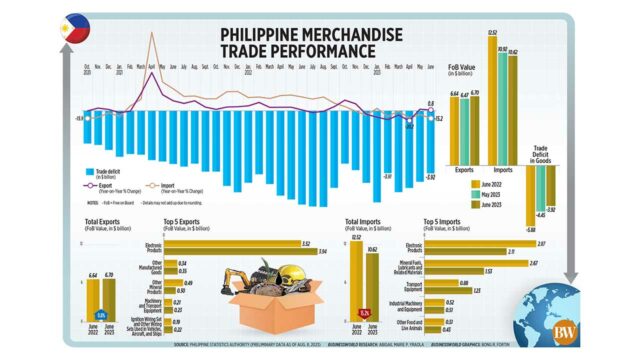
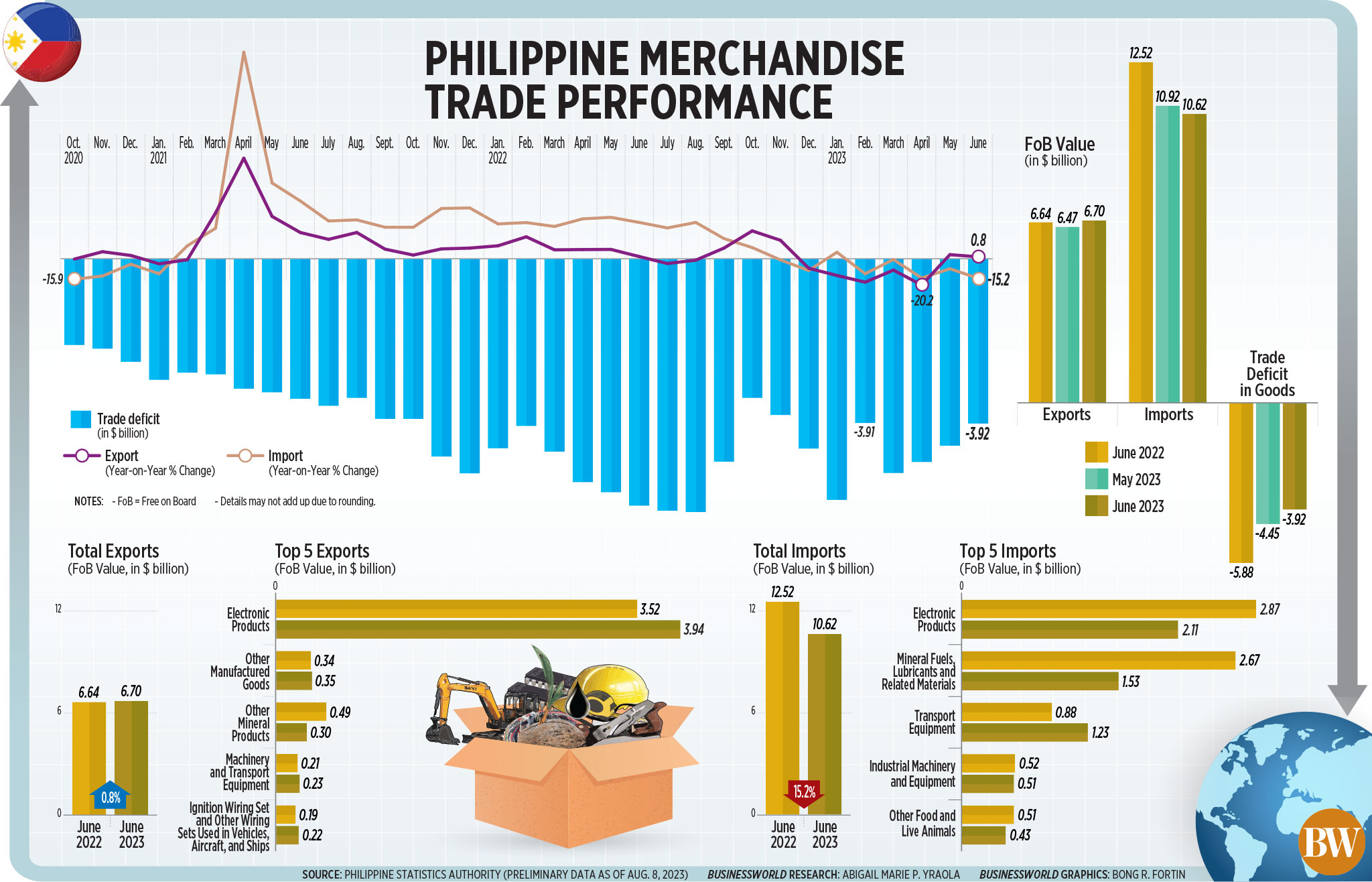
Philippine Merchandise Trade Performance

THE PHILIPPINE trade-in-goods deficit narrowed for a third consecutive month in June as imports contracted to a near three-year low while exports were flat as global demand for goods weakened. Read the full story.

PHL dairy farms hold potential to meet local demand — Carmen’s Best

ICE CREAM BUSINESS Carmen’s Best founder Francisco “Paco” Magsaysay

By Brontë H. Lacsamana, Reporter

PHILIPPINE dairy farms can meet local needs by investing more in production and product development, leading to reduced reliance on dairy imports, according to an industry player.

“The potential is huge, whether it’s in the yogurt, fresh milk, or ice cream categories. These are multibillion-peso industries,” said Francisco “Paco” Magsaysay, founder of ice cream business Carmen’s Best.

Established in 2009, Carmen’s Best harvests milk from its own dairy farms in Bay, Laguna, and produces premium ice cream for the local market.

According to Mr. Magsaysay, the Philippines imports 99.6% of its dairy needs, with only 0.4% being supplied by local dairy farms. This means Carmen’s Best’s position in the niche market is just a fraction of what the country’s dairy industry could fulfill.

This year, Metro Pacific Investments Corp. (MPIC), which now holds a 51% stake in the dairy enterprise, has pledged to focus more on it in anticipation of the high demand and significant potential for local dairy production.

The Carmen’s Best group, including Carmen’s Best Dairy Products, Inc., Carmen’s Best International Dairy Co., Inc., Real Fresh Dairy Farms, Inc., and The Laguna Creamery, Inc., has achieved over 50% year-on-year growth, according to the company.

“We were surprised that the business is growing this much, so we want to push more,” MPIC’s agricultural arm Metro Pacific Agro Ventures (MPAV) President Jovy I. Hernandez said at a stockholders’ meeting in June.

MPAV and Israel’s LR Group are jointly investing P2 billion in a partnership that aims to build a dairy facility in Bay, Laguna. The objective is to produce at least six million liters of milk annually, with the operation expected to commence in late 2025 or early 2026.

Meanwhile, the National Dairy Authority aims for a growth target of 80 million liters per year until 2028. In June, it cited a lack of consistent annual funding, which hampers the industry’s ability to meet the local demand.

HUMBLE BEGINNINGS
Carmen’s Best started off with just milk production, utilizing 27 hectares of farmland with cows imported from New Zealand. The initial intention was to supply milk to people in the area, but it eventually resulted in a surplus.

Mr. Magsaysay said that within the first year of operation, his father former senator Ramon B. Magsaysay, Jr.,  who purchased the farm, asked him to sell the surplus milk they had.

Further product development involving different dairy products revealed the potential to create quality ice cream with the surplus milk.

“More than anything, I enjoyed eating it. I was the main market for the ice cream,” he said. “It all came from the idea of serving the Philippine market with a premium product.”

Carmen’s Best, named after Mr. Magsaysay’s daughter, eventually grew beyond its signature flavors like salted caramel and butter pecan to include alcohol-infused ice cream and even a lower-priced budget version.

“When we started selling ice cream in 2011, there was no real premium ice cream manufacturer targeting the A and B market since the amount of milk our farm produced limited the amount of ice cream we could make,” he said.

STAY UNTIL IT SNOWBALLS
For small businesses, the limited capital and manpower imply that forcing rapid market expansion too soon would be futile.

“The publicly listed companies like Selecta, Magnolia, and Nestlé — we purposely did not want to go head-to-head with them. We didn’t have the capital,” said Mr. Magsaysay.

“From day one, we wanted to make the best ice cream. We were not talking about market share or profitability.”

Starting small and catering to an underserved niche in the market implies that growth will indeed be slow, he noted.

Though Carmen’s Best started selling in 2011, its first full-time employee, a food technician, was only hired in 2014.

“You just have to stick to it. It really takes time for a small business,” he said.

For Mr. Magsaysay, the way they got into a rhythm was by acquiring “low-hanging fruit,” which meant selling to friends or family who owned restaurants or coffee shops.

“Little by little, there will be a snowball effect. We were getting more people to join the bandwagon, to sell the ice cream, to just try it. The product spoke for itself,” he said.

Nickel Asia upbeat on production amid El Niño

NICKEL ASIA Corp. (NAC) expects to benefit from the El Niño weather pattern, which will positively affect its production and shipments due to lower rainfall compared to the previous year, a company official said on Tuesday.

“Last year was an outlier because we had a lot of rains and that impacted production and shipment, so this will be a reverse effect,” Andre L. Dy, vice-president for treasury, investor relations, and sales of NAC, told a briefing.

“El Niño will give us less rains so in terms of our mine planning and production, we will be able to maximize a good weather and thereby for the shipments that could be done in Palawan,” he added.

Mr. Dy said that the “underperfomance” in the production last year could be reversed into “outperformance” due to the less rains brought about by El Niño.

“We haven’t seen the full effect of El Niño, and yet the better weather has just bumped up our ore export shipments by 17% year on year,” he said.

NAC has reported a first-half attributable net income of P1.7 billion, down 56% year on year from P3.8 billion a year earlier, citing lower nickel ore price.

Revenues declined 8% year on year to P10.9 billion against the P11.8 billion in the previous year.

In the six months ending in June, NAC said that its operating mines had sold a combined 7.52 million wet metric tons of nickel ore, up 8%.

NAC saw the London Metal Exchange (LME) prices of nickel to be stable in the short term.

“We expect nickel LME prices to be stable at these price levels in the short term due to the supply-demand dynamics that we are seeing in Class 1 and Class 2 nickel,” Mr. Dy said.

“Both of which have behaved in accordance to the market supply-demand conditions,” he added.

Class 1 nickel are used in electric vehicles batteries which has higher purity compared to Class 2 that is commonly used in stainless steel production.

The average nickel LME price stood at $10.70 per pound for the first half, lower than the $12.54 per pound in the same period last year.

Mr. Dy said that the prices may rise again if the demand would continue to outweigh the supply.

“The nickel ore shipment price which is for stainless steel, we expect price to be flat in the near term. Perhaps the upside is the faster than expected China recovery along with the soft landing in the United States,” he said.

At the local bourse on Tuesday, NAC shares went down by ten centavos or 1.71% to close at P5.75 apiece. — Sheldeen Joy Talavera

Rain Check: Excessive rain as a fortuitous event

PHILIPPINE STAR/MIGUEL DE GUZMAN

As the Philippines enters what is traditionally called the “wet season,” Filipinos across the country must deal with the effects of the torrential rains that accompany the monsoon season. This is not an unfamiliar experience as reports show that on average the Philippines gets hit by 18 to 20 typhoons per year, making it one of the most frequently and severely affected countries worldwide.1 Despite this frequent occurrence, excessive rain often makes it difficult for individuals to carry on with their daily activities. Sometimes, storms and downpours make it impossible to do so. This article explores the legal implications of such inclement weather for the performance of civil obligations. Specifically, it will evaluate what constitutes a fortuitous event, determine whether excessive rain meets such criteria, and discuss the issues in invoking such a defense.

In this jurisdiction, the concept of fortuitous event is enshrined in Article 1174 of the Civil Code which provides that “…no person shall be responsible for those events which could not be foreseen, or which, though foreseen, were inevitable”.2 Legal scholars have referred to these events using various terms such as fortuitous event, force majeure, and caso fortuito.3 Civilist Arturo M. Tolentino adds that “[f]ortuitous events may be produced by two general causes: (1) by nature, such as earthquakes, storms, floods, epidemics, fires, etc. and (2) by the act of man, such as an armed invasion, attack by bandits, governmental prohibitions, robbery, etc.” Excessive rain would fall under the first type of general causes which the Supreme Court has classified as “acts of God.”4

In Nakpil & Sons v. Court of Appeals5, the Supreme Court enumerated the elements of a fortuitous event, as follows:

“(a) the cause of the breach of the obligation must be independent of the will of the debtor; (b) the event must be either unforeseeable or unavoidable; (c) the event must be such as to render it impossible for the debtor to fulfill his obligation in a normal manner; and (d) the debtor must be free from any participation in, or aggravation of the injury to the creditor.”

A successful invocation of a fortuitous event requires all above-quoted elements to be present. This is affirmed by subsequent cases which have adopted these elements.6 Two of the four elements relate to the nature of the event itself: first, it must be unforeseeable or unavoidable, and, second, it must prevent the fulfillment of the obligation in a normal manner.7 Therefore, in evaluating what constitutes a fortuitous event, the nature of the event itself must be considered.

Interestingly, the Supreme Court has on several occasions dealt with the question of whether the nature of excessive rain constitutes a fortuitous event.

As early as 1915, in Yap King Chuan v. Tiaoqui, the Supreme Court had to address an issue on damages caused by heavy rain.8 The Supreme Court absolved the defendant stating:

“No one, neither the defendant nor the plaintiffs, could have foreseen that on the said afternoon of April 14 it was going to rain in torrents and in an extraordinary manner, wherefore it is neither right nor proper to ascribe the wetting of the merchandise of the plaintiff-tenants to negligence, carelessness, or fault on the defendant’s part. It was a case of accident and force majeure which could not have been foreseen and which nobody could have prevented, and the fact that the defendant repaired and fixed the leaks in the roof the next day cannot be taken as proof of his liability, for he did not know and could not have foreseen that it was going to rain in torrents the said afternoon and that the roof of the building would leak and show defects.”9

Evidently, the Supreme Court considered the torrential rain as force majeure or a fortuitous event. The court anchored its reasoning on both the lack of contributory negligence on part of the defendant and the reports from the Weather Bureau which stated that the rainfall on April 14 was 46.5 millimeters in the span of one hour, the highest amount of rainfall in seven years.10 The Supreme Court explicitly stated that “this amount of rain in one hour is a fortuitous event or an ‘act of God’.”11

Subsequently, the Supreme Court quoted Justice Hugo E. Gutierrez’s ponencia which stated that forces of nature such as cyclones, drought, floods, lightning, and perils of the sea are acts of God.12 This was also affirmed in Southeastern College, Inc. v. Court of Appeals where the Supreme Court held that “there is no question that a typhoon or storm is a fortuitous event, a natural occurrence which may be foreseen but is unavoidable despite any amount of foresight, diligence or care.”13

Clearly, jurisprudence discloses that typhoons, storms, and heavy rains could be considered a fortuitous event. However, it must be noted that rain per se does not constitute a fortuitous event. Light rain or a mere drizzle cannot be considered a fortuitous event as it would not render it impossible for the debtor to fulfill his obligation in a normal manner. Thus, it is the severity of the downpour/rainfall and its ability to cause non-fulfillment of the civil obligations that allows one to successfully plead excessive rain as a fortuitous event.

It must be emphasized that the existence of a fortuitous event alone does not necessarily mean the successful invocation of the fortuitous event defense. The fourth element as laid down in Nakpil pertains to the presence of contributory negligence on the part of the debtor invoking the defense of fortuitous event.14 Jurisprudence is clear that a party’s contributory fault prevents him from invoking the fortuitous event defense under Article 1174. Thus, in evaluating a fortuitous event based on excessive rain, the diligence of the parties must be examined.

This has been applied by the Supreme Court in Southeastern College, Inc. v. Court of Appeals, where the court emphasized that in order to be exempt from liability arising from any adverse consequence engendered by the rain, there should have been no human participation amounting to a negligent act.15

In the landmark case of Napocor v. CA, the Supreme Court held that as a general rule, a flood, being caused by heavy rains, is a fortuitous event.16 However, in the event that there is a human intervention that showed negligence, a flood ceases to be a fortuitous event.17 It can therefore be concluded that negligence in dealing with the effects of excessive rain have barred the successful invocation of a fortuitous event. This was the case in Napocor v. Palad, where the court held that Napocor failed to exercise diligence in gradually spilling the water from dam since it anticipated the impending abnormal rise of water.18

As to what constitutes the standard of diligence parties must observe during heavy rainfall, Article 1173 of the Civil Code provides that diligence required of a party is determined by the nature of the obligation and the circumstances of the persons, time, and place.19 Applying this to the context of excessive rain, the degree of diligence would depend on the severity and the duration of the rainfall along with whether the parties had prior warning/knowledge of such rainfall.

In conclusion, whether excessive rain could be considered a fortuitous event requires a case-to-case evaluation of the existence of the factual circumstances and the parties’ acts (or lack thereof) to determine whether the elements of a fortuitous event in Nakpil are satisfied. This involves a consideration not only of the severity of the rainfall itself, but the damage and effects thereof and the diligence exercised by the parties involved. The requirements of Article 1174 of the Civil Code and jurisprudence disclose that excessive rain alone will not wash one’s civil obligations away. Accordingly, anyone who seeks to shield themselves from liability using a rainy day must be prepared to prove why their case warrants it.

This article is for informational and educational purposes only. It is not offered and does not constitute legal advice or legal opinion.

1 www.worlddata.info/asia/philippines/typhoons.

2 Civil Code, Article 1174.

3 Ruben Balane, Jottings and Jurisprudence on Civil Law (Obligations and Contracts) (2018 Ed.).

4 Asset Privatization Trust v. T.J. Enter, G.R. No. 167195, May 8, 2008.

5 G.R. No. L-47851, Oct. 3, 1986.

6 National Power Corp. v. Ct. of Appeals, G.R. No. 103442,  May 21, 1993; Asset Privatization Trust v. T.J. Enter, G.R. No. 167195, May 8, 2008.

7 Czar Matthew Gerard Dayday and Amer Madcasim, Jr., “(Un)Fortuitous Event: The COVID-19 Pandemic as a Fortuitous Event,” 93 (Special Online Feature) PHIL. L.J. 71 (2020).

8 G.R. No. 10006, Sept. 18, 1915.

9, 10, 11 Ibid.

12 Nakpil & Sons v. Court of Appeals, G.R. No. L-47851, Oct. 3, 1986.

13 G.R. No. 126389, July 10, 1998.

14 Nakpil & Sons v. Court of Appeals, G.R. No. L-47851, Oct. 3, 1986.

15 G.R. No. 126389, July 10, 1998.

16 G.R. No. 96410, July 3, 1992.

17 Ibid.

18 G.R. No. 102206, June 25, 1993.

19 Civil Code, Article 1173.


Aloysius Francis M. Bresnan is an associate of the Litigation and Dispute Resolution Department of the Angara Abello Concepcion Regala & Cruz Law Offices (ACCRALAW).

(632) 8830-8000

ambresnan@accralaw.com

Gov’t partially awards reissued 7-year T-bonds

BW FILE PHOTO

THE GOVERNMENT made a partial award of the reissued seven-year Treasury bonds (T-bonds) it auctioned off on Tuesday at a higher average rate amid a rise in yields due to Fitch Ratings’ downgrade of the United States.

The Bureau of the Treasury (BTr) raised just P23.629 billion from the reissued seven-year bonds on Tuesday, below the P30-billion program, even as total bids for the offer reached P43.374 billion.

The bonds, which have a remaining life of six years and two months, were awarded at an average rate of 6.468%, with accepted yields ranging from 6.378% to 6.5%.

The average rate of the reissued bonds was 16.9 basis points (bps) higher than the 6.299% quoted for the papers when they were last offered on July 18.

Still, this was 53.2 bps below the 7% coupon for the series.

The average rate was also 1.1 bps above than the 6.457% quoted for the six-year bond, but 1.8 bps below the 6.486% seen for the same bond series at the secondary market before Tuesday’s auction, based on PHP Bloomberg Valuation Service (BVAL) Reference Rates data provided by the Treasury.

“The Auction Committee partially awarded the reissued 7-year Treasury Bonds at today’s auction. With a remaining term of 6 years and 2 months, the bond (FXTN 07-68) was awarded at an average rate of 6.468%,” the BTr said in a statement on Tuesday.

“The auction was 1.4 times oversubscribed as total submitted bids amounted to P43.4 billion. With its decision, the Committee raised P23.6 billion out of the P30-billion offering, bringing the total outstanding volume for the series to P145.4 billion,” it added.

The bonds fetch higher yields as they “tracked the similar movement in T-bill (Treasury bill) auctions [on Monday] amid the impact of the US sovereign credit rating downgrade,” a trader said in an e-mail.

On Monday, the BTr partially awarded the T-bills it auctioned off as rates rose across the board, tracking the increase in US Treasury yields last week after Fitch’s rating action.

Fitch last week downgraded the United States to “AA+” from “AAA,” citing fiscal deterioration over the next three years and repeated down-the-wire debt ceiling negotiations that threaten the government’s ability to pay its bills, Reuters reported.

The average rate seen for the T-bonds offered on Tuesday were close to secondary market levels amid hawkish signals from the Philippine central bank’s chief, Rizal Commercial Banking Corp. Chief Economist Michael L. Ricafort added in a Viber message.

Bangko Sentral ng Pilipinas (BSP) Governor Eli M. Remolona earlier said it is too early to “declare victory” against inflation, even if it is on its way to the 2-4% target band. 

Mr. Remolona said they are ready to resume tightening if needed amid growing threats to the inflation outlook.

The BSP expects inflation to return to the 2-4% target by the fourth quarter.

The Monetary Board hiked borrowing costs by a total of 425 bps from May 2022 to March 2023, bringing the key rate to 6.25%.

It will next meet on Aug. 17 to review policy.

The BTr wants to raise P225 billion from the domestic market this month, or P75 billion via T-bills and P150 billion via T-bonds.

The government borrows from local and foreign sources to help fund its budget deficit, which is capped at 6.1% of gross domestic product this year. — A.M.C. Sy with Reuters

Roxas and Company, Inc. to hold Annual Meeting of Stockholders on Aug. 30


Spotlight is BusinessWorld’s sponsored section that allows advertisers to amplify their brand and connect with BusinessWorld’s audience by enabling them to publish their stories directly on the BusinessWorld website. For more information, send an email to online@bworldonline.com.

Join us on Viber at https://bit.ly/3hv6bLA to get more updates and subscribe to BusinessWorld’s titles and get exclusive content through www.bworld-x.com.

K-pop star Suga begins process to serve military duty

Suga —WIKIPEDIA

SEOUL — K-pop star Suga, songwriter and rapper for the boy band supergroup BTS, has begun the enlistment process for mandatory military service, the band’s label said on Monday, making him the third band member to go off to perform military duty.

“We would like to inform our fans that SUGA has initiated the military enlistment process by applying for the termination of his enlistment postponement,” Big Hit Music said in a statement.

All able-bodied South Korean men ages 18-28 must serve in the military for about two years.

Under a 2019 revision of the law, globally recognized K-pop stars were allowed to put off their service until the age of 30. Parliament is now debating a new amendment that would allow K-pop stars to do just three weeks of military training. In April, J-Hope, another member of Grammy-nominated BTS, began his mandatory military service, following Jin, the oldest, who joined the military in December.

“We ask you for your continued love and support for SUGA until he completes his military service and safely returns,” the label said.

Suga went on his first solo world tour earlier this year, running his YouTube talk show. — Reuters

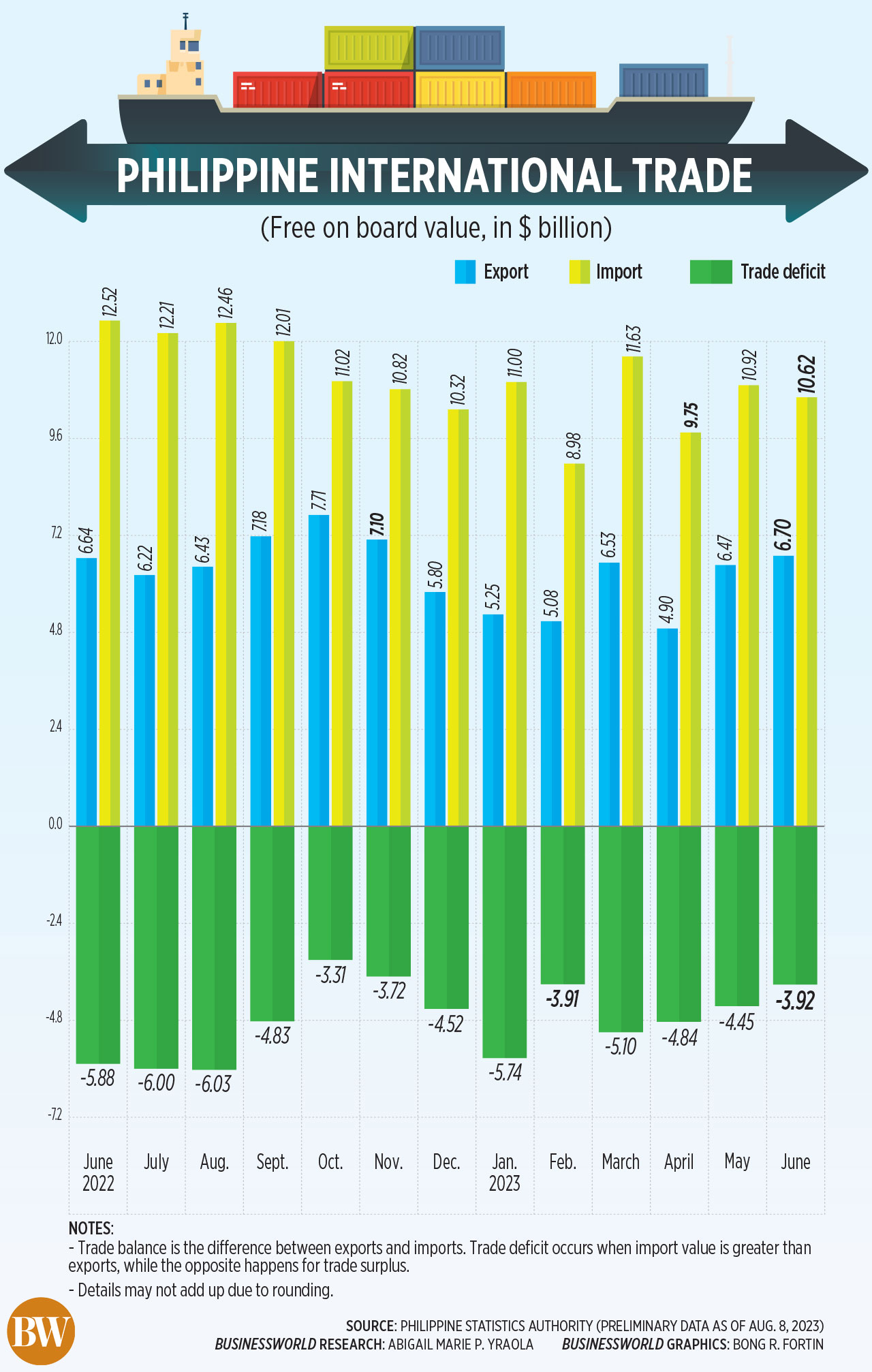
Philippine International Trade

THE PHILIPPINE trade-in-goods deficit narrowed for a third consecutive month in June as imports contracted to a near three-year low while exports were flat as global demand for goods weakened. Read the full story.

Havitas to launch Batangas project

HAVITAS Developments Corp. on Tuesday said that it is planning to develop a two-hectare residential property in Batangas by the fourth quarter.

Havitas Chairman and Co-Founder Alejandro S. Mañalac said in a press briefing that the company is set to introduce its first residential development project in Talisay, Batangas.

Mr. Mañalac said that townhouse units for its Aya Hill project would range at about P10 million spanning between 100 to 110 square meters per lot, with 73 units within the 20 hectare property.

“We saw this property with a commanding view of Taal Lake and immediately realized that we could come up with a unique product, a lifestyle-oriented development of uniquely-designed vacation or staycation homes, with strong income potential from rentals,” he added.

Havitas President and Co-Founder Jonathan F. Caro said that the company is expected to spend around P300 million in development costs for the property.

“We expect that the time table for development would be in the next two to three years and there is room for more expansion in the area,” Mr. Caro added.

The company said that it would focus on pocket developments of vacation homes which have rental income potential. — Adrian H. Halili