Home Blog Page 4434

Max’s Group names new finance chief

LISTED casual dining operator Max’s Group, Inc. (MGI) announced on Tuesday the appointment of a new chief financial officer (CFO) after the previous one stepped down for personal reasons.

In a media release, the company said that its board of directors appointed Roberto Joaquin P. Ramos effective Oct. 2.

“I am pleased to welcome Roberto to the MGI executive management team. His tremendous experience and skilled leadership will be instrumental in realizing our business transformation plans and growth objectives, and will be a valuable contributor in guiding our company forward,” said Max’s President and Chief Executive Officer Robert F. Trota.

The company said that Mr. Ramos has more than 30 years of experience in financial planning, accounting, risk management, and corporate governance.

He was previously the CFO of media investment company Group M. He also held the same position in McDonald’s Philippines operator Golden Arches Development Corp., Philips, and ABB.

The appointment comes after the resignation of the company’s previous CFO Maria Rochelle S. Diaz effective Sept. 15 “to pursue new professional opportunities.”

“I would like to offer our sincere thanks to Rochelle. She has supported us in shaping and steering Max’s Group through a very uncertain environment over the last three years. We wish her the best in her next endeavors,” Mr. Trota said.

Meanwhile, the company reported a 20.6% decline in second-quarter attributable net income to P168.32 million from P239.2 million a year ago.

Its revenues for the three-month period edged up to about P3 billion, 6.4% higher than the P2.82 billion in the same period last year.

For the first half, the company booked an attributable net income of P245.38 million, 12.6% lower than P280.67 million last year.

Its topline rose by 17.5% to P5.85 billion from P4.98 billion, mainly driven by a 14.1% increase in restaurant sales to P4.44 billion from P3.89 billion the prior year

The company’s system-wide sales were at P9.2 billion across both company-owned and franchised stores in its network.

It said that Max’s expanded its business-to-business space by providing its products to 2,585 locations comprising mostly supermarkets and convenience stores nationwide.

“This expansion aligns with the company’s efforts to tap into food retail, which is a promising category to supplement its core restaurant and commissary businesses,” the company added.

As of June 30, Max’s network covers 14 territories with 593 locations in the Philippines and 66 stores across various locations in North America, the Middle East, and Asia.

Max’s brands include Max’s Restaurant, Pancake House, Yellow Cab Pizza, Krispy Kreme, Jamba Juice, Max’s Corner Bakery, Teriyaki Boy, Dencio’s, Meranti, Sizzlin’ Steak, Maple, Kabisera, Le Coeur De France and Singkit. — Adrian H. Halili

Arts&Culture (08/16/23)

JOY ROJAS’ Plantito Plantita

Joy Rojas exhibits at ArtistSpace

ARTISTSPACE presents “Res Ipsa Loquitur: The Lines That Define Me,” Joy Rojas’ showcase of works that experiment with the limitless potential of abstraction through color, shapes, and texture. Unlike traditional pure abstraction, he intertwines elements from the natural world and references landscapes and historical imagery. Also a practicing lawyer under the name Jose Ferdinand M. Rojas II, Joy is a Filipino visual artist who injects his art with an exuberant and joyous quality inspired by encounters with nature during his travels. Presented by JFR II Studio, Salazar Art Agency, and The Saturday Group of Artists, the exhibit is on view until Aug. 27 at ArtistSpace, at the Ground Level of the Ayala Museum Annex, Makati Ave. corner De La Rosa St., Greenbelt Park, Makati City. The gallery is open daily from 11 a.m. to 8 p.m. Admission is free.


Filipinas Heritage Library lowers fees

THE FILIPINAS Heritage Library is celebrating its anniversary this month by lowering its rates until December. Visitors can access the library Wi-Fi, charge their devices, and use the library’s collections and facilities. The price of the regular day pass is now P300 from P400, the student day pass is P150 from P200, the senior/PWDPWD day pass is P210 from P300, while the discounted day pass (for Ayala Museum members, AGC employees, teachers, librarians, cultural workers, graduate students) is now P240 from P340. Meanwhile, the Research passes (up to 30 visits within two months) have also been discounted, with the regular pass now P3,750 from P5,000, the student pass P2,000 from P3,500, the senior/PWD pass P2,600 from P3,750, and the discounted pass P3,000 from P4,250. The library is at the Ayala Museum, Makati Ave., Greenbelt Park, Makati. For more information about the library guidelines and procedures, visit www.filipinaslibrary.org.ph/booking/


Bacolod art on view at JT’s Manukan Grille

FILIPINOART.PH, an online art gallery, collaborates with JT’s Manukan Grille, a chicken inasal restaurant chain, on an exhibit titled “Colors and Flavors of Bacolod.” Ongoing until Oct. 15, the exhibit features acrylic paintings by Roselle Manalastas and Jason Ray Zabat at JT’s Manukan Grille in 32nd Ave. cor. Bonifacio Blvd., BGC, Taguig. The works in Colors and Flavors of Bacolod focus on that city’s cultural heritage, especially its annual celebration of the Masskara Festival. The street festival, which stands as a symbol of the Negrenses’ resilience, started during the sugar crisis of the 1980s. Bacolod native and actor Joel Torre, the owner of JT’s Manukan Grille, wants to use his chains of restaurants as a creative space for Filipino artists. “Our original al-fresco setup wasn’t ideal for displaying traditional visual art due to dust. Nonetheless, we hosted performances and showcased films, aiming to turn the place into an arts hub. We are also transforming our branch in Boracay into an arts community, initiating storytelling, music, painting, and filmmaking workshops. This is our way of giving back to the community.” FilipinoArt.ph has previously partnered with other businesses, including Brewed Specialty Coffee, a third-wave coffee shop in Pasig City, which hosted Sining at Kape, featuring works by Pasigueño artists.


Inclusive literature at the Davao City PHL Book Fest

THE INDIE Publishers Collab PH (TIPC) will feature inclusive literature titles in its booth at the BOOKTOPIA area of the Philippine Book Festival (PBF) to be held at SMX Davao City from Aug. 18-20. “The TIPC booth theme is ‘Book Bridges’ to convey the message that every book by a TIPC publisher is a connection to a more meaningful discovery and a more profound learning. TIPC publishers produce books that address today’s most urgent advocacies and depict the various genres, subjects and languages of Filipino life,” said Ronald Verzo of TIPC and Balangay Productions in a statement. Participating TIPC publishers include: 8Letters, a boutique publishing company based in the Philippines that has over 400 titles focusing on Southeast Asian literature; Linangan sa Imahen, Retorika at Anyo (LIRA), an organization of poets writing in Filipino; Aklat Alamid, an independent publishing house for children’s books and YA books written in the different languages of the Philippines; Aklat Mirasol which publishes materials for children and youth focusing on their development of a positive identity as Filipinos; Alubat Publishing which focuses on stories of illness and healing written by doctors; Isang Balangay Media Productions (Balangay Books), which focuses on local and grassroots literature and readership; LitArt Publishing which focuses on short-form literature; Pawikan Press which specializes in books about Mindanao and Palawan; San Anselmo Publications, Inc., which spotlights Filipino poetry, biography, fiction, non-fiction and reference books; the Ilocos-based Saniata Publications; and Southern Voices Printing Press which serves as an accessible channel to progressive storybooks and biographical works. TIPC is also holding events at PBF Davao — a talk on “Infinite Inclusive Stories” with Leila Rispens-Noel, Renato Tranquilino, Maita Rue, and Andrew Pasaporte on Aug. 19, 2:30 p.m.; a panel discussion on “Writing About Mindanao” with authors Assad Baunto, Jennie Arado, and Xaña Angel Eve Apolinar on Aug. 20, 5 p.m.; and the launch of the book Ang Gamay Nga Prinsipe (The Little Prince) with translator Maria Cora P. Larobis and poet/writer Agustin Pagusara on Aug. 20, 6 p.m. Venue is at PBF’s Booktopia section. For updates, like and follow the Facebook page of The Indie Publishers Collab PH.


Instituto Cervantes screens Peruvian crime thriller

INSTITUTO Cervantes de Manila and the Embassy of Peru in Thailand will hold a film screening of La Pena Maxima (Operation Condor) on Aug. 17, 2 p.m., at Instituto Cervantes’ Intramuros branch (Real St., Plaza San Luis, Intramuros). The film, adapted from the eponymous novel by Santiago Roncagliolo and directed by Michel Gomez in 2022, follows Felix, a conscientious government employee in Lima who embarks on an investigative journey following a murder during the World Cup in Argentina and unearths a labyrinthine international conspiracy of kidnappings, disappearances, and torture. The film will have English subtitles. Admission is free and open on a first-come, first-served basis. For more information, visit Instituto Cervantes’ website http://manila.cervantes.es or its Facebook page at www.facebook.com/InstitutoCervantesManila.


Shorts & Briefs is back for a 9th edition

SHORTS & BRIEFS, an independently produced theater festival of short and brief plays, returns this August at the Draper Startup House in Poblacion, Makati, on all Sundays of August. The festival features original plays by first-time theater makers and performers, each running 12 minutes or under. The plays are: Tim Villanueva’s Mga Nakasusuyang Putahe, directed by Naye Hedriana; Ephraim Villafania’s Save the Coffee Jelly, directed by Cyril Balderama; Aldrich Alcantara’s Grief Registry, directed by Jemuel Satumba; Francis Peralta and Sean Macaraeg’s Latency, directed by Eunice Pacifico; Julay Elloso and Frank Conche’s Ang Tigas ng Ulo Mo, directed by Paulo Almaden; Dino Quintana’s Homecoming, directed by Ciri Clarion; Billie Fuentes’ 11:11,directed by Alecx Lorica; and Wilfredo Alipala’s Bakit Bata, directed by Earl Pingol. There will be performances on Aug. 20 and 27 at 2 and 7 p.m. Tickets, which include a complimentary drink, cost P550 each. For more information, check out Eksena Ph on Facebook or contact 0967-382-8066.


Baranggay Folk Dance Troupe goes on UK tour

THE PHILIPPINE Baranggay Folk Dance Troupe (PB) is embarking on a month-long UK Cultural Dream Tour with a delegation of 15 members. It will start by participating in the Billingham International Folklore Festival of World Dance 2023 from Aug. 12 to 20 at Stockton-on-Tees, followed by a two-week stay in London with UK-affiliate hosts Lahing Kayumanggi Dance Company, Europe’s foremost Philippine cultural ambassadors. They will hold workshops, performances, and barrio fiestas in support of the Philippine Embassy London and the Filipino community in the UK from Aug. 25 to Sept. 3. As a non-profit community group, PB relies entirely on support from families, friends, and sponsors who give donations to fuel the troupe’s mission of promoting Philippine cultural heritage through music, song, and dance. These contributions cover administrative and travel budgets and maintaining PB’s extensive wardrobe of costumes, accessories, and props, along with a comprehensive musical instrument collection. The tour is in part a show of gratitude to these supporters.


Manila International Book Fair returns in September

THE 2023 MANILA International Book Fair (MIBF) will be back on Sept. 14 to 17 at the SMX Convention Center at Mall of Asia, Pasay City. There will be over 100 exhibitors, with participants spanning publishers both mainstream and indie and local and international, from university presses to academic distributors. It will also have the latest titles, many hot off the press and not yet available online or at regular bookstores, some reprinted or updated specifically for the MIBF crowd. Attendees can look forward to signings by various authors and creators. There will also be storytelling sessions, art workshops, book launches, seminars, book awards, and more. A co-located event, School World, will be a one-stop shop of supplies and gadgets for teachers, students, parents, school administrators, young professionals, and working adults, with a wide selection of products and services to choose from as schools transition into new modes of learning in the new normal. For more details, e-mail bookfair@primetradeasia.com, or follow @ManilaBookFair on Facebook and Instagram.


CCP and Arthaland to hold exhibit in Cebu Exchange

ARTHALAND and the Cultural Center of the Philippines (CCP) will hold an exhibition in Cebu City following last year’s collaboration at the Arthaland Century Pacific Tower in Bonifacio Global City, Taguig. From Sept. 14 to Oct. 12, “Udtong Tutok: Art at High Noon” will show “affinities, continuities, and contradictions in Philippine art,” selected from the CCP’s 21st Century Art Museum Collection. It will take place at the Cebu Exchange, Arthaland’s green office development in the city. The title, Udtong Tutok, derives from the Cebuano idiom, symbolizing the exact point at high noon where there is intense heat, glaring brightness, and heightened attention. Notably, this exhibition will be the CCP’s first off-site exhibition outside Metro Manila and the first in the Visayas region due to the ongoing rehabilitation of the CCP Main Theater building.

OFWs as a permanent phenomenon: Taking care of the children

PHILIPPINE STAR/MIGUEL DE GUZMAN

(Part 3)

At least for the duration of the current Administration, the Philippine economy will continue to be highly dependent for its growth in income, employment, and foreign exchange earnings on the 10 million or more OFWs spread out in close to 100 countries all over the world.

Taking a pragmatic view, President Ferdinand Marcos, Jr., in his message on National Migrants Workers Day on June 7, vowed to boost the Philippines’ ties with nations that host Filipino migrant workers. That is a clear signal that he does not expect that under his watch, the Philippines will be less reliant on the earnings of OFWs. He is just being realistic. This does not mean that he is oblivious to the high social costs of sending Filipinos to earn their living abroad. As we have seen in the previous articles in this series, children of OFWs pay high educational, social, and mental costs that can be directly attributed to the absence of one or both parents. A very dramatic presentation of these social, mental, and psychological costs to children can be viewed in the Tagalog movie starring Vilma Santos called Anak. Vilma plays the role of Josie, an OFW working in Hong Kong as a domestic helper, and Claudine Barretto as Carla, her daughter. If these costs are not minimized as much as possible, there will be adverse effects on future generations of workers whose quality may deteriorate because of mental and psychological stresses that they suffered in their youth from parental absenteeism.

Since the dependence of the Philippine economy on OFWs is sure to continue at least for the next decade or so, one obvious policy that the Government must implement is to reduce these social costs as much as possible. One example is the recent House Bill (HB) No. 8560 filed by OFW Rep. Marissa del Magsino called the Overseas Filipino Workers’ Left Behind Children Protection Act. In the bill’s explanatory note, Ms. Magsino cited the case of children who were killed by the partners of the remaining parents while the OFWs were working abroad. There must be a law that would regulate the behavior of those who are supposed to take care of the children left behind by OFW parents. HB 8560 proposes that OFWs leaving their minor children behind be required to designate in writing a temporary guardian who will exercise parental responsibility over the children.

Among of the provisions of HB 8560, any of the following persons may be designated as temporary guardians: surviving grandparents, older siblings more than 21 years old, relatives of the minor child within the third degree of consanguinity, the minor child’s actual custodian who must be more than 21 years old, and any person known to possess a good moral character as certified by the barangay unit having jurisdiction over the residence of the minor child and with no known criminal record or history. To ensure the effectiveness of the system, the bill mandates close monitoring by barangay officials and the Department of Social Welfare and Development.

Individual schools, working closely with the Department of Education, can also provide for the welfare of these left-behind children through appropriate individual and group mentoring and counselling. In a study done by Klent Rodni Delima entitled “Challenge of the Left-Behind Adolescent Children of the Overseas Filipino Worker,” it is recommended that counsellors and educators help the left-behind children who are having a difficult time adjusting to the family situation by assisting them in developing emotional resilience and better understanding of what is happening in their lives. Educators, the guidance center, school administrators, and officials from the Department of Education can establish programs through which left-behind children can benefit in establishing better connection with their OFW parents, learning from other left-behind children’s experiences. They should be given the assurance that they are not alone in this critical stage of their development.

There have also been important initiatives of both religious and secular NGOs to address the problem of the left-behind children. For example, the Catholic Bishop Conference of the Philippines (CBCP) has a formation program for left-behind children that has contributed to sharply decreasing emotional concerns reported by schools attended by the children. One of the more successful programs of the CBCP was the Migration Quiz Bee whose goal is to raise awareness of migration issues and concerns among the children. The program also provides scholarships and livelihood activities. Such lay organizations as Couples for Christ and Marriage Encounter can also organize activities for families of OFWs for their members to find practical ways of strengthening the marriage bond and family spirit, despite the temporary physical separation. Private initiatives among parents, such as the Education for the Upbringing of Children, could offer specialized courses for the left-behind spouses and guardians on how to deal with the upbringing in the homes of children who have at least one parent working abroad. Specific “cases” (like the business cases in an MBA program) can be written to serve as bases for discussing different approaches to situations and problems faced by both the children and parents in the OFW setting. For example, the movie Anak can be shown to the participating parents and then a discussion can ensue on how the different difficult situations portrayed in the film can be addressed as intelligently and prudently as possible.

World Remit, a remittance outfit, came out with some ways OFW parents themselves can support their children’s human development while they are abroad. Among them — together with my own suggestions — are:

1. Schedule regular family bonding activities with the help of such readily available technology as Zoom, Facebook Messenger, and others. For example, there can be weekly movie sessions (especially with the many very entertaining TV series available on Netflix). Parents and children can work on a vlog together; or take a fitness class together. The OFW parent can teach the left-behind child how to cook or to do simple household chores. Time spent together, even if online, is very precious to the child.

2. Encourage deep conversations. Choose serious topics although light banter is also very important. Deep conversation can be about some topics from subjects that are being currently covered in the child’s school curriculum, political and economic events, life goals, or learnings from life’s experiences. The parents should not hesitate to entertain difficult questions. At the right age, there should be education on sexuality, mother to daughter and father to son. Sex education is the prerogative of parents and should not be handled casually in school.

3. Promote safety protocols: reiterate how important it is to follow safety protocols such as staying at home as much as possible, avoiding dangerous districts of the city, wearing masks and face shields if still mandated by the appropriate authority.

4. Provide the necessary equipment with the advent of new educational technology, especially in the post-pandemic era. Be sure the children are ready for a mixture of blended learning: face to face, online, distance, and home schooling. Children should be provided with funds for additional resources, whether it be a laptop, a tablet, or a new phone.

The children have also some responsibilities to assume. In an article by Irene Pajarillo-Aquino on the internet entitled “Children of Overseas Filipino Workers and their Academic Performance,” it was stressed that the left-behind children must also share part of the responsibility of forming themselves despite the absence of one or both parents. They should strive to study hard despite the absence of their parents. The sacrifices their parents are making should inspire them to take their studies seriously and to perform as well as possible in school. The educational institution should provide the students with the necessary guidance and assistance in the form of counselling or mentoring, lessening to the extent possible the feeling of longing and loneliness on the part of the left-behind children.

If properly guided, the children of OFWs may actually be sufficiently encouraged to repay their OFW parents for the sacrifices they are making by being among the top students academically in their respective courses. They may be recipients of additional resources from scholarship programs established by the Overseas Workers Welfare Administration (OWWA). In this regard, the President and Secretary Susan Ople may want to do something about the report of the Commission on Audit that OWWA is not doing a good job in implementing the Project Educational Assistance through Scholarship Emergencies (EASE), a scholarship program for the children of OFWs. For 2022, the implementation rate was only 10.26%. Every possible benefit we can confer on the OFWs is richly deserved.

(To be continued.)


Bernardo M. Villegas has a Ph.D. in Economics from Harvard, is professor emeritus at the University of Asia and the Pacific, and a visiting professor at the IESE Business School in Barcelona, Spain. He was a member of the 1986 Constitutional Commission.

bernardo.villegas@uap.asia

ABS-CBN’s loss widens to P965M

PHILIPPINE STAR/BOY SANTOS

ABS-CBN Corp. suffered a bigger attributable net loss in the second quarter at P965.28 million, which is 24 times larger than the P39.11-million loss incurred in the same period last year.

The bigger loss for the quarter ended June was due to the decline in revenues, which amounted to P4.53 billion, 6.2% lower than P4.83 billion in the previous year.

The company, however, saw a 4.6% decline in its production costs, which totaled P1.78 billion during the April-to-June period from P1.87 billion in 2022.

The cost of services during the quarter was also lower at P1.79 billion, a decrease of 4.9% from P1.89 billion last year.

For the first semester, the company’s net loss widened to P2.13 billion from P1.42 billion in the same period of the previous year.

ABS-CBN’s revenues from January to June reached P8.8 billion, a 7.2% decline from the P9.48 billion booked in 2022.

Advertising revenues in the first half amounted to P2.99 billion, 9.1% lower than the P3.29 billion seen last year

“The absence of the election-related placements resulted in a 9.1% decline, equal to P298 million in advertising revenues,” the company said in its report.

Consumer sales, which constitute 66% of the total revenues, also declined to P5.81 billion, showing a 6.3% dip from P6.19 billion last year.

First-half production costs and cost of services were lower by 3.05% and 3.24% at P3.53 billion and P3.57 billion, respectively.

As of June 30, the company’s capital expenditures and program rights acquisition amounted to P741 million.

On Monday, shares in the company soared by 40 centavos or 9.41% to P4.65 apiece. — Justine Irish DP. Tabile

Market insights startup challenges big players with ‘quality and speed’

TIRACHARDZ-FREEPIK

By Miguel Hanz L. Antivola

BRANDS, especially those operating in the online world, now recognize the crucial role that such data plays in shaping their decision-making processes, according to market insights technology startup Agile Data Solutions, Inc.

Today, the need for efficient and reliable data acquisition is more critical than ever, said Jason Christian B. Gaguan, co-founder and chairman of Agile Data Solutions, in an interview with BusinessWorld.

For market intelligence providers, this means embracing innovative technologies that can streamline the process of obtaining accurate and actionable data, he added.

Mr. Gaguan said that Agile Data Solutions employs a hyper-targeted customer modeling strategy in collecting data. “[W]e get data from people, and we tell them straightforward that we are paying for it.”

He noted that Hustle PH, the company’s data collection app, has gained an active user base of 50,000 acquired organically without any social media marketing spend since its beta version was released in 2021.

Two years later, the company announced an annual net revenue of P27 million, with cost of goods sold (COGS) margins at 37%, down from 50% when it started. “Our COGS margins will continue to decrease,” Mr. Gaguan said, projecting 18% by next year.

Mr. Gaguan noted that the few big long-time players in the market insights industry hold almost 90% of the market, while the smaller players occupy the remaining 10%. Big players include Kantar and Nielsen.

“Our proposition will just seem very weird if the client doesn’t try it,” he said regarding a typical project that costs around 80% less and completes 80% faster than other market players due to the company’s model. “Even if it starts from curiosity, they push through.”

Agile Data Solutions’ strategy, as per Mr. Gaguan, is centered around giving priority to data quality and speed for business clients. This required the company to innovate beyond the current industry practices in order to distinguish itself.

He said that data collection and projecting product distribution in market insights companies, particularly within the fast-moving consumer goods (FMCG) industry, were previously guided by outdated methods such as door-to-door interviews and tapered estimates.

“The lockdowns happened, so house-to-house interviews weren’t conducted,” he said on the COVID-19 pandemic marking a shift in operations. “The FMCGs were crying, ‘This is wrong data.’”

Coupled by a history of data privacy issues on Facebook where user information was used in the platform’s ad-targeting systems and other purposes without permission, transparency became a key concern to address, according to Mr. Gaguan.

Meta, the corporation behind Facebook, is being fined $98,500 per day until Nov. 3 from Aug. 14 by the Norwegian Data Protection Authority or Datatilsynet upon failing to address the privacy breaches the regulator had identified. In May, the Irish Data Protection Commission fined Meta $1.3 billion for data breaches.

“We connected the two problems: data maliciously acquired for free and market research practices,” Mr. Gaguan said on his founding team upon starting the business in June 2020.

Upon confronting deterrents to market research, the current challenge of Agile Data Solutions is to further scale its database according to different clients’ needs.

Mr. Gaguan said that the company is starting to transition to a system platform called software as a service or SAAS — harnessing its serialized database to provide client-specific insights rather than a manually prepared deck. This is aided by artificial intelligence tools which they have rented.

Expected to finish in the fourth quarter of this year, the shift is made to open up market insights to MSMEs (micro, small, and medium enterprises) and other startups, which used to be relatively inefficient, according to Mr. Gaguan.

With industry players catching up on digital ways and means, Mr. Gaguan said that he is hopeful for the startup ecosystem having the edge to navigate through priorities and opportunities for sustainable growth.

“I’m excited about it because everyone now is starting to innovate — good for the total ecosystem,” he said. “The big players are starting to do the right thing. Our challenge right now is to grow faster and faster so they can’t catch up.”

“The difference between a big company and a startup lies in execution. Even though they have the budget, big companies move a little slower,” he added.

“As a small team, we can immediately listen to our customers and change.”

LIMITED CAPITAL
Moving with a straightforward business approach, Agile Data Solutions has seen slow growth and a focus on sustainability given its limited capital.

“We consciously veered away from spending more than what we need,” Mr. Gaguan said, mentioning that the company started out using free online forms to check demand and only posted tasks for ‘hustlers’ upon a client’s request.

Moreover, it also did not have the money to spend on social media marketing — a head turner in this age of digital adoption and transformation.

“Organically, a lot of people and influencers with 500,000 subscribers are sharing our platform on YouTube for free,” Mr. Gaguan said. “We did not spend anything on marketing for those who would use the app.”

The company was also firm with its decision of not seeking initial investment funding upon learning from past startup experiences, according to Mr. Gaguan, who also pioneered business delivery platform Borzo Philippines (ex. MrSpeedy) and hotel booking site OYO Philippines.

“If we get money from investors, they will likely focus on fast growth through ‘sexy metrics’ like traffic and the number of app users and clients,” Mr. Gaguan said. “And they might ask us to discount our prices drastically.”

“It’s not sustainable, and focus on the value is lost,” he added.

“The first main pillar of our company is to give really fast and accurate data,” he said. “The second is to do it sustainably without throwing away money.”

PROPOSITION OVER METRICS
Mr. Gaguan noted an awakening in the business ecosystem, particularly among startups where local and global inflation have shifted priorities to proposition over metrics, given conservative responses to recessionary fears.

An ease in investment deal volume was found in Southeast Asia after an uptick in 2021, according to data from Deal Street Asia and estimates from Kickstart Ventures, Inc. The first quarter of 2022 saw approximately $5 billion in total deal value, from $8 billion in the fourth quarter of 2021, the highest reach of the industry.

This decrease is attributed to the moving threat of recession, following a global surge in oil and food prices caused by the Russia-Ukraine war, where people and investors put their money into safer instruments, Dan I. Siazon, co-founder and senior vice-president at Kickstart, said in an interview.

Incentive- and discount-driven business models have begun veering away from the scene, Mr. Gaguan said, realizing its pure focus on rapid growth as unsustainable and being forced to downsize. Resiliency and self-sufficiency are being seen as determining factors of success.

“During this shift, startups right now are going back to the basics where business proposition becomes the center of the conversation and not the ‘sexy metrics,’” he said.

“From all the previous excitement of ‘sexy metrics’ and hedging on a possible future, startups now are becoming more proposition-oriented, which I think is a good direction,” he added. “And smaller startups have a chance at getting funded.”


PPO chooses a new music director and principal conductor

THE SEARCH for the new music director and principal conductor of the Philippine Philharmonic Orchestra (PPO) has ended. The Cultural Center of the Philippines (CCP) has announced that Polish conductor Grzegorz Nowak will assume the management of the orchestra.

Mr. Nowak takes over from Yoshikazu Fukumura, who concluded his tenure in 2021.

After the Japanese conductor left, the CCP began the search in 2022, forming a search committee to screen candidates for the position. Both the CCP and the PPO were looking for a music director who exemplifies solid musicianship, a strong sense of leadership, artistic discipline and respect for peers, extensive program repertoire, and orchestral rapport.

Mr. Nowak’s first concert with the PPO as its music director and principal conductor will be on Sept. 15, 7:30 p.m., at the Samsung Performing Arts Theater in Circuit, Makati. The concert, which will kick off the 39th concert season, will see the PPO performing French composer Hector Berlioz’s Roman Carnival, Norwegian composer Edvard Grieg’s Piano Concerto, with guest performer pianist Mark Beddington, and Italian composer Ottorino Respighi’s Pini di Roma.

The PPO’s 38th concert season served as the proving ground for five shortlisted conductors, who were potential leaders of the orchestra.

Mr. Nowak conducted the second concert of the series, on Oct. 7, 2022, at the CCP Main Theater. He conducted the PPO as they performed pieces by National Artist Lucio San Pedro, Peter Illich Tchaikovsky, and Igor Stravinsky, featuring young violinist Vincent Owen Romanban as a soloist on Felix Mendelssohn’s Violin Concerto, Op. 64, E minor.

As the new music director, Mr. Nowak will be responsible for the preparation and implementation of the PPO’s thrusts, programs, concert season, training of musicians, and other related activities. He is expected to conduct at least 10 to 12 performances per year, including the regular PPO season, outreach tours, the Young People’s Concert Series, and other special CCP events. He will also be in charge of a development program for the PPO members and ensure that the level of musicianship and artistic quality meets the standard.

Mr. Nowak was principal associate conductor of the Royal Philharmonic Orchestra in London. He was the music director of the Polish National Opera in Warsaw, Poland, from 2017 to 2020, and other orchestras in Poland, Germany, Switzerland, and the USA. He has recorded orchestral music on over 80 CDs that have received awards and five-star ratings.

He studied conducting, composition, and violin at the Ignacy Jan Paderewski Academy of Music in Poznan, Poland, before receiving his doctorate degree at the Eastman School of Music in Rochester, New York. He obtained a Serge Koussevitsky Fellowship at Tanglewood, where he later became Kurt Masur’s assistant. He has conducted various orchestras, including the London Symphony Orchestra, the Orchestre National de France, and the Hong Kong Philharmonic.

He won the Ernest Ansermet Conducting Competition in Geneva, bagging all the special awards, including the Grand Prix Patek Philippe, the Rolex Prize, the Swiss Prize, and the American Patronage Prize. Since then, he has conducted some of the world’s finest orchestras and served as Music Director for the Edmonton Symphony Orchestra, the SWR Radio Orchestra in Germany, the Sinfonia Helvetica in Switzerland, and the Musique et Amitié Festival.

Tickets to the Sept. 15 concerts will be available at CCP Blackbox Theater Box Office and at TicketWorld. Visit the CCP website (www.culturalcenter.gov.ph) for more information.

Handling China’s doublespeak and cognitive dissonance

PHILIPPINE COAST GUARD/FACEBOOK PAGE

On Saturday, Aug. 5, the Chinese Coast Guard fired water cannons at Philippine boats on a resupply mission to the BRP Sierra Madre, off Ayungin Shoal. The incident within our Exclusive Economic Zone was just the latest among the many aggressive moves by China in the West Philippine Sea.

The Philippines, intending to use what had been identified as a direct line between our two countries, reached out to China in the crucial hours of the crisis. There was no answer, leading many to believe that the absence of a response was, in itself, a message.

This incident provided a good backdrop for a workshop organized by the Stratbase ADR Institute a few days later. We, together with our partners the United States Institute of Peace and Australian Aid, held a total of five panel discussions on Aug. 10 and 11. We explored the role of communications during crisis situations. Experts from the government, the academe, and think tanks joined us as we sought to make sense of the past days’ events and how these events fell under the greater context of China’s continued coercive acts in our very own territory.

Former Supreme Court Associate Justice Antonio Carpio identified five flashpoints in Philippine-China relations — Ayungin Shoal, which is right within our Exclusive Economic Zone, is one of them — and said the latter’s recent acts are grounded on China’s new Coast Guard law. The 2021 law authorizes the Chinese Coast Guard to use necessary measures, including force, to assert territorial and maritime claims. This law is a blatant violation of international law which says disputes must be settled peacefully.

Former United States Air Force official and security expert Col. Raymond Powell described China as an “extremely large and aggressive country” while Stratbase non-resident fellow Dr. Robin Garcia said China is the biggest existential threat to the Philippines. Former Foreign Affairs Secretary Jose Rene Almendras said crisis communication with China was “extremely complex.”

Senior analyst Amanda Hsiao of the International Crisis Group said China views communication not as a functional but as a political act that must be performed according to its own pace, and that for the Chinese, the act of initiating communications signals an acceptance of responsibility for its actions.

Dr. Charmaine Willoughby of the De La Salle University said words and syntax have the power to either deter or inflame, and that the Philippines should put more teeth into its words.

Panelists agreed that China’s refusal to engage in dialogue, its apparent doublespeak and cognitive dissonance, are due to its unique mindset. They dwelled on the issue of how we can continue pursuing peaceful means of defending our established territory when the other party refuses to even acknowledge the premise of a dialogue — that they are infringing on what is rightfully ours.

Nobody is saying we should stop talking, and so we should, through whatever means available. Crucial to this effort are our allies who have manifested their support for our arbitral win and their valuable help in boosting our defense capabilities. As former Secretary Almendras said, “it is friends that help get that phone answered.” In this digital age, we should also take active steps to fight disinformation that seeks to deceive Filipinos. We should “civilianize” the issue, according to National Security Council Assistant Director General for Strategic Communications Jonathan Malaya, so that more and more Filipinos would be aware of the stakes.

Finally, geoeconomics could be key. Security issues do not exist on their own; they cannot be decoupled from economic and other equally compelling issues because they are intimately linked with each other. If we can get them to keep talking about economics, we are at least keeping communication lines open.

Our security challenges are many and daunting. Coming from the approach taken by the previous administration, the current leadership’s initial steps have been encouraging. Still, we can afford to send a clearer, firmer message.

Col. Powell said the response has been necessary but not sufficient.

This, then, is the perfect opportunity for President Ferdinand Marcos, Jr. to show that he was not just resorting to rhetoric when he said that only national interest will drive foreign policy.

I take comfort in the fact that the Philippines is a proud part of the community of nations committed to defend the rules-based international order. The threats we face are many, multifaceted, and evolving. Ultimately, we go back to our alliances with countries that share our values and our reverence for what is just, fair, and decent.

Let these common ideals drive us to work together with greater fervor in defending peace. This noble pursuit is something higher and bigger than us all.


Victor Andres “Dindo” C. Manhit is the president of the Stratbase ADR Institute.

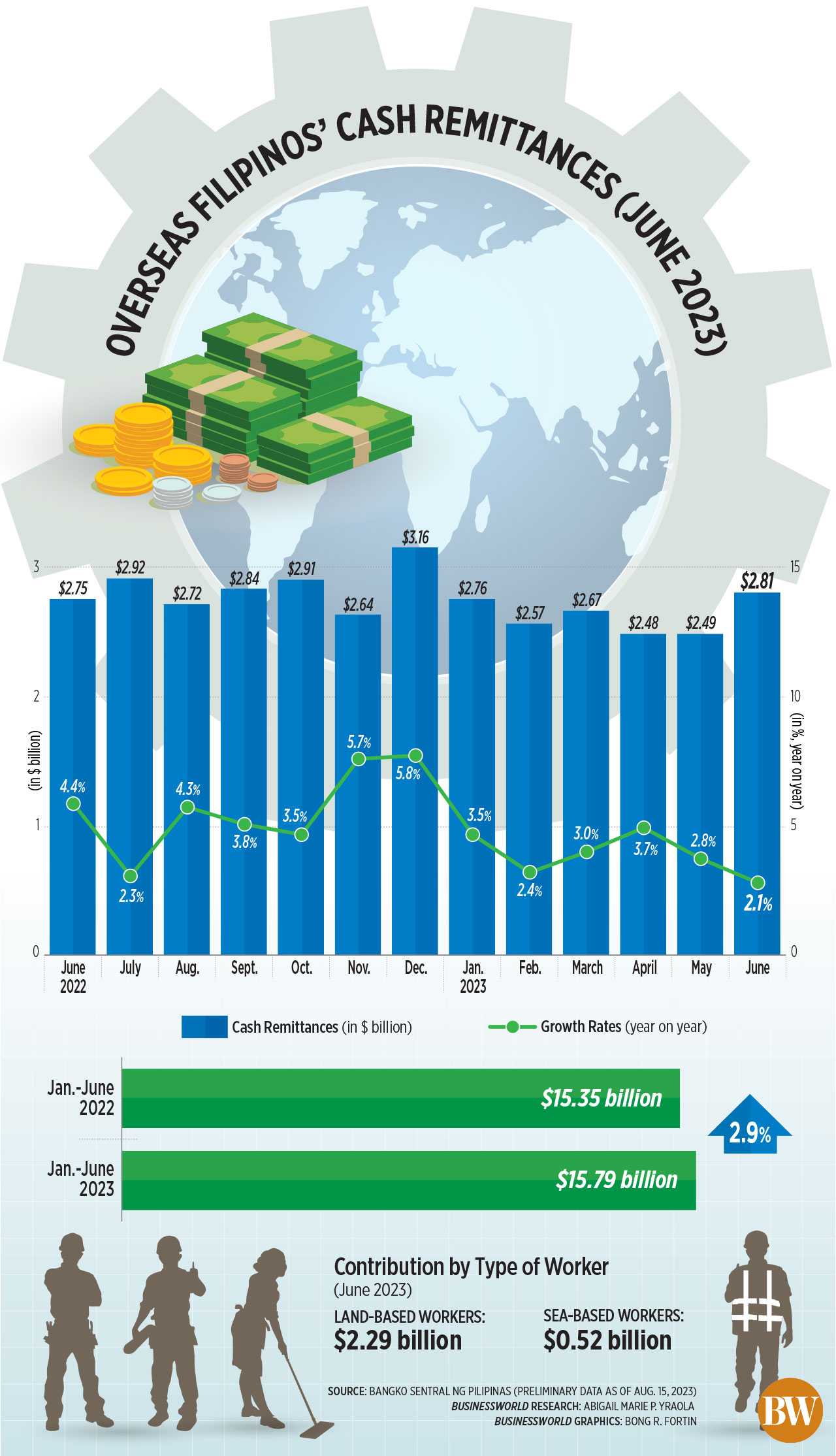
Overseas Filipinos’ cash remittances (June 2023)

MONEY SENT by overseas Filipino workers (OFWs) rose to a six-month high in June, data from the Bangko Sentral ng Pilipinas (BSP) showed. Read the full story.

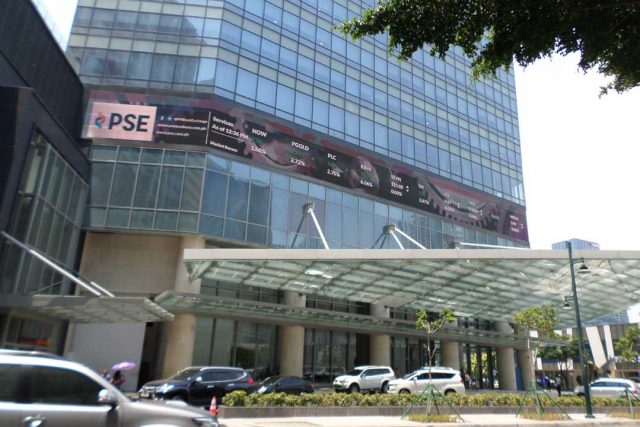
PSE to implement T+2 settlement by Aug. 24

BW FILE PHOTO

Philippine Stock Exchange, Inc. (PSE) said on Tuesday its subsidiary Securities Clearing Corporation of the Philippines (SCCP) is set to implement the two-clearing day initiative for stock market transactions.

In a press release, PSE said the clearing house obtained approval from the Securities and Exchange Commission (SEC) to start implementing the T+2 settlement cycle by Aug. 24.

“The successful roll out by SCCP of its new clearing and settlement infrastructure five months ago has led to this landmark development for our market,” PSE President and Chief Executive Officer Ramon S. Monzon said in a statement.

“We expect the shortened settlement cycle to enhance operational efficiency and reduce risk,” Mr. Monzon added.

The local bourse operator said the move is in line with the T+2 settlement cycle already implemented for financial markets overseas.

“I am optimistic that the compliance rate of clearing members on the delivery of securities and cash obligations will continue to be within the current range,” he said

“Since August 28, Monday, has been declared a national holiday, trades on Aug. 24 will be settled on Aug. 29, Tuesday. That is the same settlement date for trades completed on Aug. 23, the last trading day under the T+3 cycle,” PSE said.

It added that all transactions starting Sept. 12 would be subject to the regular noon settlement deadline.

“Applicable penalties for late settlement under the SCCP Rules shall apply,” it added. — Adrian H. Halili

Government makes full award of new 10-year Treasury bonds

BW FILE PHOTO

THE GOVERNMENT made a full award of the fresh Treasury bonds (T-bonds) it auctioned off on Tuesday on strong market demand, even as the coupon fetched was higher than secondary market levels.

The Bureau of the Treasury (BTr) made a full P30-billion award of the new 10-year bonds it offered on Tuesday as total bids reached P66.824 billion or more than twice the amount on the auction block.

The bonds were awarded at a coupon rate of 6.625%. Accepted yields ranged from 6.4% to 6.625% for an average of 6.558%.

The coupon fetched for the tenor was 4.5 basis points (bps) higher than the 6.58% quoted for the 10-year bond and 8.9 bps above the 6.536% fetched for previously issued 10-year bonds maturing on Sept. 15, 2032 at the secondary market before the auction, based on PHP Bloomberg Valuation Service Reference Rates data provided by the Treasury.

“The Auction Committee fully awarded the new 10-year Treasury Bonds at today’s auction, setting the coupon rate at 6.625%,” the BTr said in a statement on Tuesday.

“The auction was 2.2 times oversubscribed as total submitted bids amounted to P66.8 billion. With its decision, the Committee raised the full program of P30 billion,” it added.

The coupon rate fetched for the new T-bonds was higher than secondary market yields for the same tenor due to a weaker peso recently, which could prompt the Bangko Sentral ng Pilipinas (BSP) to match the US Federal Reserve’s latest hike, Rizal Commercial Banking Corp. Chief Economist Michael L. Ricafort said in a Viber message.

“The higher T-bond rate tracked the higher expectations on domestic bond yields following the recent weakness of the local currency,” a trader likewise said in an e-mail.

The peso sank to an eight-month low against the greenback on Monday due to broad dollar strength and faster US producer inflation last month.

The local currency closed at P56.78 versus the dollar on Monday, weakening by 46.50 centavos from Friday’s P56.315 finish, data from the Bankers Association of the Philippines’ website showed.

This was the peso’s weakest close in over eight months or since its P56.94-a-dollar finish on Nov. 23, 2022.

Meanwhile, the Fed last month raised borrowing costs by 25 bps, bringing its target interest rate to a range between 5.25% and 5.5%.

The US central bank has now hiked rates by a total of 525 bps since March 2022.

The Fed will hold its next policy review on Sept. 19-20.

For its part, the BSP will hold a policy meeting on Thursday.

A BusinessWorld poll last week showed 13 of 15 analysts see the Monetary Board keeping its key interest rate steady at 6.25% this week.

On the other hand, two economists expect the BSP to hike borrowing costs by 25 bps to mirror the Fed’s latest move.

The Monetary Board kept its key policy rate unchanged at a near 16-year high of 6.25% at its last two meetings after hiking borrowing costs by 425 bps from May 2022 to March 2023 to tame inflation.

The BTr wants to raise P225 billion from the domestic market this month, or P75 billion via Treasury bills and P150 billion via T-bonds.

The government borrows from local and foreign sources to help fund its budget deficit, which is capped at 6.1% of gross domestic product this year. — A.M.C. Sy

Russian central bank hikes key rate to support rouble

MOSCOW — Russia’s central bank hiked its key interest rate by 350 basis points to 12% on Tuesday, an emergency move to try and halt the rouble’s recent slide after a public call from the Kremlin for tighter monetary policy.

The extraordinary rate meeting came after the rouble plummeted past the 100 threshold against the dollar on Monday, dragged down by the impact of Western sanctions on Russia’s balance of trade and as military spending soars.

The rouble pared gains after the decision to stand 0.4% weaker at 98.03 by 0829 GMT, but still significantly above lows near 102 on Monday which had not been hit since the early weeks after Russia invaded Ukraine.

President Vladimir Putin’s economic adviser Maxim Oreshkin on Monday rebuked the central bank, blaming what he called its soft monetary policy for weakening the rouble.

Hours after Mr. Oreshkin’s words, the bank announced the emergency meeting, throwing the currency a lifeline.

“Inflationary pressure is building up,” the bank said in a statement on Tuesday. “The decision is aimed at limiting price stability risks.

“The pass-through of the rouble’s depreciation to prices is gaining momentum and inflation expectations are on the rise.”

Central Bank Governor Elvira Nabiullina has won plaudits for her handling of the economy since Russia began what it calls a “special military operation” in Ukraine, but the plunging rouble and high inflation have put her on the back foot, especially among pro-war nationalists.

The Kremlin’s public criticism of her monetary policy on Monday adds further pressure as Russia heads towards a presidential election in March 2024, with consumers battling rising prices for basic goods.

INFLATION PRESSURE
The bank last made an emergency rate hike in late February 2022 with a rate raise to 20% in the immediate fallout of Russia’s despatching troops to Ukraine. The bank then steadily lowered the cost of borrowing to 7.5% as strong inflation pressure eased in the second half of 2022.

Since its last cut in September 2022, the bank had held rates but steadily increased its hawkish rhetoric, eventually hiking by 100 basis points to 8.5% at its last scheduled meeting in July. The next rate decision is due on Sept. 15.

Russia saw double-digit inflation in 2022 and after a deceleration in the spring of 2023 due to that high base effect, annual inflation is now above the central bank’s 4% target once more and quickening.

In annualized terms on a seasonally adjusted basis, current price growth over the last three months amounted to 7.6% on average, the bank said.

The bank removed its signal that it was ready to raise rates further, said Sovcombank chief analyst Mikhail Vasilyev, interpreting that as a sign that rates have peaked.

“We believe that the key rate will remain at the current 12% level until the end of the year,” Mr. Vasilyev said. “A cycle of key rate cuts is likely as early as next year, when inflation starts to slow down.” — Reuters

Hollywood studios offer new concessions to striking screenwriters

NATHAN DEFIESTA-UNSPLASH

HOLLYWOOD studios have made a new offer to striking screenwriters that includes concessions on issues such as the use of artificial intelligence (AI) and access to viewer data, Bloomberg News reported on Monday citing people familiar with the discussions.

The Alliance of Motion Picture & Television Producers has agreed to ensure humans are credited as writers of screenplays, instead of replacing them with AI, the report said, adding that the companies would also share data on the number of hours viewed on streaming services.

Other parts of the offer include a better-than-20% increase in residual payments to writers when their shows appear on networks other than the one they were made for, Bloomberg said.

Netflix Co. Chief Executive Officer Ted Sarandos has emerged as a strong force and Walt Disney Co. Chief Executive Officer Bob Iger, in recent weeks, has joined him in seeking to reach a deal with the writers, the report added.

The union representing striking Hollywood writers said on Friday it had received a counterproposal from the studios that it would consider, an apparent sign of progress in the more than 100-day-old strike.

The strike by Hollywood writers began on May 2 after talks between the WGA and the major studios reached an impasse over compensation, minimum staffing of writers’ rooms and residual payments in the streaming era, among other issues.

The Alliance of Motion Picture & Television Producers and Writers Guild of America didn’t immediately respond to a Reuters request for comment. — Reuters