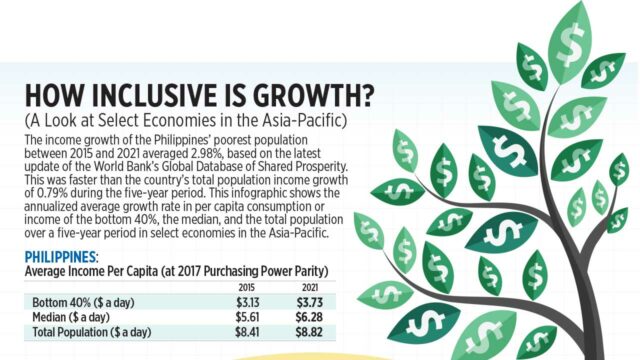
How inclusive is growth?
(A Look at Select Economies in the Asia-Pacific)
The Philippines and South Korea have signed a free trade agreement (FTA), President Ferdinand R. Marcos, Jr. said on Thursday, as his government seeks to further liberalize the economy in the face of supply chain disruptions.
In a video posted on Mr. Marcos’ Facebook page, the President said he had witnessed the signing of the free trade deal on the sidelines of the 43rd Association of Southeast Asian Nations Summit in Jakarta this week.
“The FTA will strengthen our bilateral trade and investment relations with the Republic of Korea,” he said, without providing details.
The deal is a “milestone for our economic friendship,” the President said, adding that it would contribute to the Philippines’ “value proposition as an ideal regional hub for smart and sustainable investments.”
Mr. Marcos said the free trade deal would pave the way for many opportunities of collaboration with South Korea.
The Philippines is also seeking an FTA with the European Union.
Last month, Mr. Marcos said the parties were set to start a “scoping process” to help the Philippines and EU assess the extent of the trade deal. — Kyle Aristophere T. Atienza
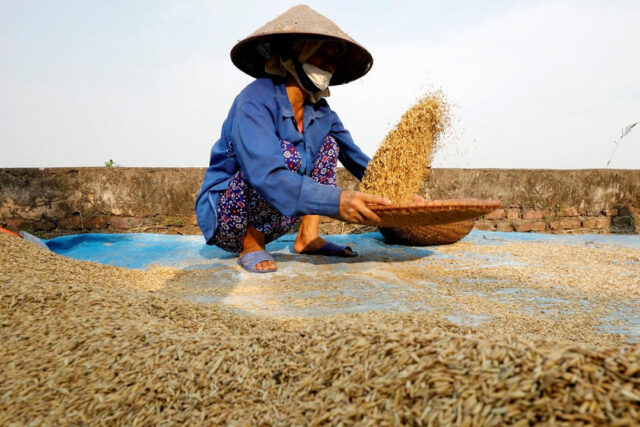
VIETNAMESE Prime Minister Pham Minh Chinh proposed a five-year rice supply deal to President Ferdinand R. Marcos, Jr., subject to negotiation at minister level, the Office of the President said on Thursday.
The proposal could “stabilize rice supply and pricing” in the Philippines “amid the current volatility in supply,” the Palace said in a statement, citing Mr. Marcos.
“I would suggest that the Ministries of Trade and Agriculture of the two countries will work together so that we can come up with a five-year agreement on supply of rice,” Mr. Pham told Mr. Marcos in a bilateral meeting with Mr. Pham on the sidelines of the ASEAN Summit in Jakarta on Thursday.
Mr. Marcos welcomed a long-term supply agreement as an opportunity to dampen volatility in domestic rice prices.
“The suggestion of a longer-term arrangement is an important one because just having that as an assurance will stabilize the situation, not only for the Philippines, but for all of us in the region,” he said.
“We will work continuously (to arrive at an agreement)… I am very confident that we will once again come to a consensus and agree,” he added.
The Philippines signed a rice supply deal with Vietnam in May 2008, with Vietnam selling the Philippines up to 1,500,000 metric tons of rice between 2008 and 2010 in a government-to-government transaction.
A 2019 law liberalized the rice import market, allowing private importers to ship in rice in exchange for the payment of a 35% tariff on grain from Southeast Asia. The law had removed the National Food Authority’s (NFA) role as monopoly rice importer, which it carried out through government-to-government deals.
“While this is a welcome agreement, this does not solve our problems,” Ateneo de Manila economist Leonardo A. Lanzona said, noting that long-term trade agreements “can vary in stability depending on various factors.”
The stability of such a deal would depend on “the parties involved, the nature of the agreement, and external economic or geopolitical conditions,” he said via Facebook Messenger.
“Generally, agreements between stable, economically sound countries are more likely to be honored over the long term,” he said, noting that for middle-income countries like the Philippines and Vietnam, “a significant amount of risk exists.”
“Unforeseen events like economic crises, changes in political leadership, or shifts in international relations can potentially affect the stability of long-term trade agreements,” he said.
He said parties involved in such agreements must have mechanisms for dispute resolution and the flexibility to adapt to changing circumstances.
Vietnam supplies about 90% of the Philippines’ rice imports, with Manila receiving 1.5 million metric tons of rice from its neighbor in the first five months of the year.
The Philippines does not have a rice shortage at the moment, Jayson H. Cainglet of the Samahang Industriya ng Agrikultura (SINAG) said in a Viber message.
“Imports to be secured are only meant to be for buffer stock,” he said, noting that unlimited imports have not reduced the commodity’s retail price. “Only bountiful local harvests have resulted in lower rice prices.”
Agriculture officials, including Mr. Marcos, who serves as the Secretary of Agriculture, said last month that the country’s rice inventory is sufficient for the duration of the El Niño weather pattern, which is expected to persist until next year.
The Department of Agriculture (DA) also reported that an estimated 900,000 MT of rice was harvested in Isabela, Nueva Ecija and North Cotabato.
Agriculture Undersecretary for Rice Industry Development Leocadio S. Sebastian has said that improved yields for palay, or unmilled rice, in late September to October will provide a boost to second-half production, estimated at more than 11 million MT.
Before making a decision on the Vietnam supply deal, the Marcos government needs to disclose to the public the terms of the proposed arrangement, Jayson H. Cainglet of the SINAG said in a Viber message.
“At what price and terms? At what volume? At what tariff rates? What is the mode of importation — government-to-government or private initiative?” he said.
“We hope that discussions with any country for rice imports would NOT be at the expense of local producers and our hapless consumers,” he said.
The government last week imposed a price ceiling on the staple, blaming rising prices on hoarders and smugglers.
Economists have warned that imposing price caps on rice could limit supply and force traders to go underground.
They also said traders might exhibit a reluctance to buy rice from farmers, who will be left with no choice but to lower farmgate prices.
Palay prices fell by P3 per kilo in some areas after the order was announced, according to farmers’ groups.
Following the price cap order, Finance Undersecretary Cielo D. Magno left the administration, telling BusinessWorld on Thursday that her resignation will take effect on Sept. 16.
In a social media post on Thursday, Ms. Magno said, “A wise man told me, if you do your job with integrity, you will be back in UPSE.” She was referring to the University of the Philippines School of Economics.
President Ferdinand R. Marcos, Jr.’s economic managers have backed the price ceiling on rice, including NEDA Secretary Arsenio S. Balisacan, who said the measure would “immediately reduce” the price of rice.
Ms. Magno championed the Philippine Extractive Industries Transparency Initiative in the Finance department under the Marcos administration.
“I am not sure what will happen to PH-EITI,” she told BusinessWorld when asked whether the program will be continued after her departure from government.
Ms. Magno also chairs the DoF’s Fiscal Policy Monitoring Group and the Revenue and Operations Group, and Policy Development and Management Services Group.
She had been leading the government’s push to reform the pension system for retired military and uniformed personnel.
FISHING
Meanwhile, the Palace said Mr. Marcos and his Vietnamese counterpart also discussed the possibility of a fisheries and maritime cooperation agreement to protect the livelihoods of fisherfolk.
“(The) agreement that we are proposing is very important because it (does) not limit itself only to security and defense issues,” Mr. Marcos said.
In 2014, Philippine authorities arrested 11 Vietnamese fishermen found poaching in Philippine waters close to disputed parts of the South China Sea.
“So again, we have an understanding between the two countries so that we will not have any problems between your fishermen and ours,” the Philippine leader told Mr. Pham. — Kyle Aristophere T. Atienza

SOME 95% of retailers are complying with the price controls on rice, the Department of Agriculture (DA) said on Thursday.
“As of (Sept. 6) nare-report nating nagkaron tayo ng 95% success rate, which mean na nag-comply ang ating mga retailers (It has been reported that the price controls have had a 95% success rate, indicating that retailers have been compliant),” DA Director for Legal Services Willie Ann M. Angsiy said at a briefing.
Executive Order No. 39, which took effect on Tuesday, imposed a temporary price ceiling of P41 per kilogram for regular-milled rice and P45 per kilogram for well-milled rice as the government scrambled to contain rice prices.
Ms. Angsiy added the DA is continuing to “disseminate information” to non-compliant retailers on proposed subsidies to compensate dealers who will be selling their rice at a loss due to the price controls.
“Mabibigyan din natin sila ng ayuda basta sumunod lamang sila” (We will give them aid if they follow the price cap),” she said.
The Department of Social Welfare and Development (DSWD) has said that rice retailers will get up to P15,000 in subsidy to cover potential losses resulting from the price ceiling.
Ms. Angsiy said that the DSWD is currently working on the rules governing eligibility for the subsidy.
“But on the part of other government agencies, we are working closely with the local government units. Kinakausap natin ang mga mayor kung maari silang maka-provide ng assistance, (We are speaking with mayors about providing assistance),” she said.
She added that the DA is set to provide logistics services to directly deliver rice from farmers to retailers.
“Meron din tayong market linkages, kung sakaling ma-short ng stock ang ating retailers. Siguradong may dadating na stock,” she said. (There will surely be stock because we are connecting producers to retailers).
She added that the DA is working with the private sector to ensure supply until the start of the harvest in October.
“By the end of October 2023, most of the estimated 2.92 million metric tons of palay will come from 15 provinces,” she said. “We assume that will be enough” to address high prices. — Adrian H. Halili
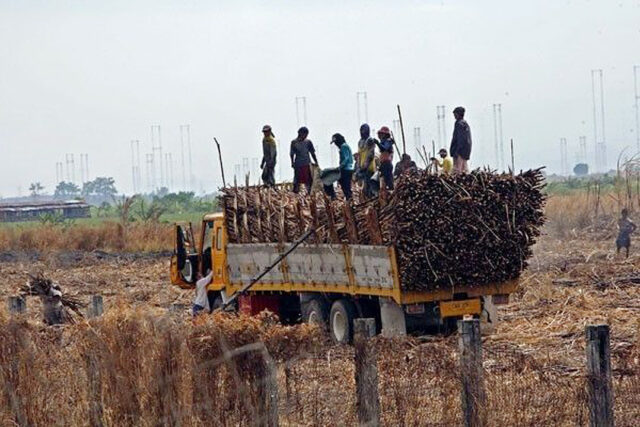
SUGAR production in 2023 is expected to rise slightly, on the assumption that the impact of El Niño isn’t too severe, the Sugar Regulatory Administration (SRA) said.
At an agriculture forum organized by the European Chamber of Commerce on Thursday, SRA Administrator Pablo Luis S. Azcona said sugar production could increase by 50 thousand metric tons (MT).
Mr. Azcona added that the total area planted to sugarcane is estimated to rise by at least 3,000 hectares.
“We have a slight increase in area despite the fact that (output fell) in Batangas because of the closure of the mill,” he said.
In the last crop year, sugar production declined to about 1.8 million MT from the 2.1 million MT previously, due to a number of typhoons affecting cane production, he said.
“For the initial balance of inventory for this crop year, locally produced sugar posted a 450% increase (from a year earlier), he added.
To date, the stock of domestic sugar is at 150 thousand MT, against 27 thousand MT a year earlier.
“With the harvest season having begun, we will see an increase in raw sugar stock,” he said.
The sugar crop season typically begins in September.
A severe El Niño, however, could result in a 10% to 15% decline in output.
“(It) all depends on the El Niño’s severity.” Mr. Azcona said, with the worst of the weather phenomenon, which can cause dry spells, expected to manifest starting around November.
The government weather service expects El Niño to strengthen towards late 2021, persisting until the first quarter of 2024.
“If it’s not so severe, we might even see an increase (because of the timing of) harvest season. Drier weather results in more bags of sugar per ton of sugarcane,” he added. — Adrian H. Halili
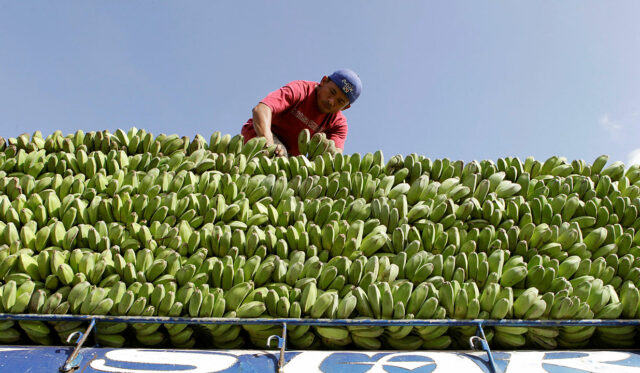
THE production of major Philippine fruits like banana, calamansi, mango, and pineapple, rose during the second quarter, according to the Philippine Statistics Authority (PSA).
In its major fruit crops quarterly bulletin, the PSA said banana production rose 0.1% year on year to 2.27 million metric tons (MT) during the period.
Davao region accounted for 38.3% of banana production or 868.19 thousand MT, followed by Northern Mindanao with 19% or 431.86 thousand MT and Soccsksargen (South Cotabato, Cotabato City, Sultan Kudarat, Sarangani, and General Santos City) with 12.3% or 279.2 thousand MT.
The Cavendish banana was the leading variety at 1.17 million MT, accounting for 51.5% of total banana production during the period.
Output of calamansi, a native citrus, rose 4% to 14.24 thousand MT during the quarter.
Zamboanga Peninsula was the top producer accounting for 21% of total production at three thousand MT, followed by Mimaropa with 18.3% or 2.6 thousand MT and Central Luzon with 12.2% or 1.74 thousand MT.
Output of mango rose 11.4% year on year to 596.34 thousand MT.
Carabao mangoes accounted for 83% of the national total or 495.06 thousand MT.
In the second quarter, Ilocos Region was the top mango producer with 20.5% of total output or 122.30 thousand MT; while Central and Western Visayas produced 89.76 thousand MT and 55.10 thousand MT, respectively.
Pineapple production rose 3.8% to 762.55 thousand MT during the quarter.
Northern Mindanao was the top producer of pineapple with 51.3% of the total or 391.16 thousand MT, while Soccsksargen produced 189.29 thousand MT (24.8%) and Bicol Region 62.13 thousand MT (8.1%). — Adrian H. Halili
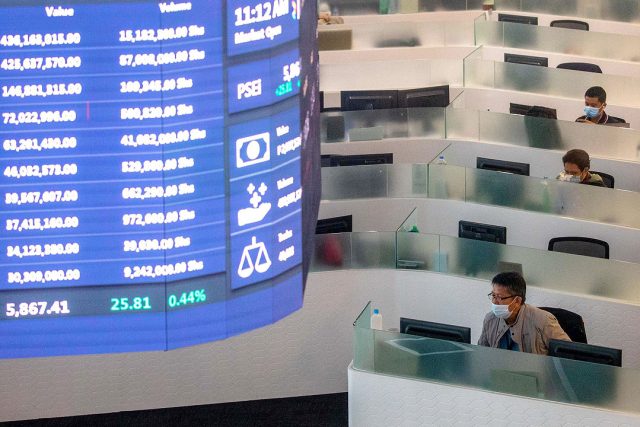
THE MAIN INDEX fell to the 6,100 level anew on Thursday due to inflation concerns and increased selling pressure.
The Philippine Stock Exchange index (PSEi) went down by 58.62 points or 0.93% to end at 6,183.07 on Thursday, while the broader all shares index dropped by 21.26 points or 0.63% to close at 3,346.99.
“Stocks declined due to mounting concerns related to inflationary pressures, with a particular focus on the vulnerability of the Philippines in the face of the prevailing global food situation,” AB Capital Securities, Inc. Vice-President Jovis L. Vistan said in a Viber message.
“The market took a breather after three days of gains, with selling pressure bringing the index back below 6,200. Data from Europe, China, and the US dampened sentiment,” China Bank Capital Corp. Managing Director Juan Paolo E. Colet said in a Viber message.
Philippine headline inflation accelerated to 5.3% in August from 4.7% in July.
Still, it settled within the Bangko Sentral ng Pilipinas’ (BSP) 4.8-5.6% forecast for the month.
For the first eight months, inflation averaged at 6.6%, still above the BSP’s 5.6% forecast and 2-4% target for the year.
“Additionally, the strength of the US dollar against Asian currencies has had a notable impact on the Philippine peso, exacerbating the country’s economic challenges,” Mr. Vistan said.
The dollar index — which measures the currency against six developed-market peers, including the yen and euro — ticked up 0.07% to 104.93, Reuters reported. It jumped to the highest since March 15 on Wednesday at 105.03.
The peso closed at P56.76 per dollar on Thursday, rising by 15 centavos from its P56.94 finish — a near nine-month low — on Wednesday.
“The stronger than expected ISM (Institute for Supply Management) services index for August, which reached 54.4, its highest since February 2023, signaled strong US economic activity and led some investors to scale back expectations of the path of the Federal Reserve’s interest rate cuts next year,” Mr. Colet added.
Most sectoral indices closed lower on Thursday. Holding firms declined by 88.57 points or 1.46% to 5,938.71; property fell by 28.16 points or 1.09% to 2,544.33; financials went down by 19.58 points or 1.07% to 1,800.42; mining and oil dropped by 54.21 points or 0.53% to 10,081.85; and industrials lost 18.03 points or 0.2% to end at 8,816.64.
Meanwhile, services rose by 6.56 points or 0.43% to 1,524.07.
Value turnover went up to P3.85 billion on Thursday with 322.39 million shares changing hands from the P3.84 billion with 459.94 million issues seen on Wednesday.
Decliners outnumbered advancers, 96 to 62, while 50 names closed unchanged.
Net foreign selling rose to P720.31 million on Thursday from P663.89 million on Wednesday.
For Friday, Mr. Vistan placed the PSEi’s support at 6,100 and resistance at 6,300. — SJT with Reuters
OFFSHORE WIND development in emerging markets like the Philippines can be spurred on with concessional finance to bring down costs, the World Bank (WB) said.
“The higher cost of the first projects in a new offshore wind market presents an initial barrier of affordability for developing-country governments and the ratepayers they represent,” it said in a recent report.
“Using concessional finance to reduce the initial cost premium presents a high impact opportunity to enable emerging market governments to commit to offshore wind and accelerate global decarbonization efforts,” it added.
The World Bank said that offshore wind is key to meeting global decarbonization goals and achieving net zero emissions.
“It can provide large-scale, clean, reliable electricity generation with the potential to stimulate valuable economic benefits and industrial development,” it said.
According to some estimates, there will be a need for 2,000 gigawatts (GW) of offshore wind by 2050 for the energy transition.
“The global roll-out of offshore wind is growing quickly, with 21 GW added in 2021 alone; however, developing countries — also known as emerging markets — are yet to deploy offshore wind; progress needs to be accelerated,” it added.
The World Bank noted that emerging markets like the Philippines, Azerbaijan, Brazil, Colombia, India, Poland, Sri Lanka, South Africa, Türkiye, and Vietnam have begun exploring offshore wind.
However, it added that offshore development in emerging markets without public support would likely result in “a cost of power substantially higher than that of developing an onshore wind or solar photovoltaic (PV) project of the same size in the same market.” — Luisa Maria Jacinta C. Jocson
ECONOMIC GROWTH will likely miss the government’s targets this year, according to a policy think tank attached to the House of Representatives.
In a policy brief, the Congressional Policy and Budget Research Department (CPBRD) said gross domestic product (GDP) is likely to expand 5.5% in 2023, missing the 6-7% government target.
The economy expanded by a weaker-than-expected 4.3% in the second quarter, down from the 6.4% reading in the first quarter and the 7.5% posted in the second quarter last year.
This brought GDP growth to 5.3% in the first half.
“While slightly more conservative compared to the multilateral institutions, this outlook still signifies a positive trajectory for the Philippine economy in the upcoming years,” the CPBRD said.
It also expects economic growth to slow to 3.6-4.6% in 2024. This is also below the government’s 6.5-8% target band for next year.
The think tank expects inflation to average 5.3% this year, easing to 3.1-5.1% next year.
Headline inflation accelerated to 5.3% in August from 4.7% in July. This was also above the 4.9% median estimate in a BusinessWorld poll conducted last week.
August also marked the 17th consecutive month that inflation surpassed the central bank’s 2-4% target range.
In the first eight months, inflation averaged 6.6%, still above the central bank’s 5.6% full-year forecast.
“Inflation is on a downward trend in most developing countries due to the stabilization of commodity prices brought about by improved global supply conditions,” it said.
However, the CPBRD cited other risks to the inflation outlook, such as elevated oil and coal prices.
“Global crude oil prices are expected to remain within the $70 to $80 range even with anticipated OPEC supply cuts throughout 2024. The initial supply side impact of the Russian-Ukraine conflict on the global oil market appears to have dissipated given global supply-demand side adjustments,” it said.
The CPBRD noted that the level of exposure of the Philippines to movements in oil prices is a “relevant risk factor to keep in mind especially given the growth in domestic energy demand.”
Global coal prices are also expected to remain above pre-pandemic levels, it said.
“Policymakers, however, need to remain mindful of risks including the growing demand in China and other countries in the region for Indonesian coal as well as export adjustments on the part of Indonesia. These risks are magnified by the dependence of the Philippine energy grid on coal power,” it added. — Luisa Maria Jacinta C. Jocson
THE PESO recovered against the dollar on Thursday on improved manufacturing data and as the Philippines’ gross international reserves (GIR) remained ample.
The local currency closed at P56.79 versus the dollar on Thursday, strengthening by 15 centavos from Wednesday’s P56.94 finish, data from the Bankers Association of the Philippines’ website showed.
The local unit opened Thursday’s session at P56.85 per dollar. Its intraday best was at P56.77, while its weakest showing was at P56.97 against the greenback.
Dollars traded went up to $1.45 billion on Thursday from $1.36 billion recorded on Wednesday.
The peso strengthened against the dollar on Thursday on better manufacturing and “decent” GIR data, Rizal Commercial Banking Corp. Chief Economist Michael L. Ricafort said in a Viber message.
Preliminary results of the Monthly Integrated Survey of Selected Industries (MISSI) showed factory output, as measured by the volume of production index (VoPI), rose by 5.7% year on year in July. This was higher than the revised 3.4% in June and 3.6% in July last year.
July’s VoPI growth was the fastest in two months or since 7.1% in May.
On a monthly basis, July’s VoPI expanded by 3.8% from June’s revised 2.9% contraction. Adjusting for seasonality factors, manufacturing output increased by 3%, a turnaround from 2.1% decline in June.
Year to date, factory output averaged 5.2% in the first seven months of the year.
Meanwhile, the Philippines’ GIR stood at $99.8 billion as of end-August, slipping by 0.2% from the $100 billion as of end-July.
Still, the dollar reserves went up by 2.4% from the $97.44 billion as of end-August 2022.
Mr. Ricafort added that the BSP could have entered the market to prevent the peso from closing at the P57-per-dollar level.
For Thursday, the peso may range from P56.70 to P56.90 per dollar, he said.
Meanwhile, the US dollar was loitering close to its highest point since March against major peers, and touched a fresh 10-month top versus the Japanese yen, the traditional global funding currency where interest rates remain ultra-low, Reuters reported.
The dollar index — which measures the currency against six developed-market peers, including the yen and euro — ticked up 0.07% to 104.93. It jumped to the highest since March 15 on Wednesday at 105.03.
The dollar earlier reached its strongest level since Nov. 4 versus the yen at 147.875.
The currency pair tends to move in step with long-term Treasury yields, which stood at 4.29% on Thursday after pushing to their highest since Aug. 23 at 4.306% in the previous session.
The euro, meanwhile, dropped by 0.1% to $1.0716, following its dip to a three-month trough of $1.0703 on Wednesday.
Elsewhere, the People’s Bank of China continued its bid to shore up the yuan by again setting strong official midpoints for the currency.
Despite those efforts, the yuan continues to hover on the weaker side of the closely watched 7.3 per dollar level in offshore trading, last changing hands at 7.3332. It sank to the lowest since early November at 7.3490 in the middle of last month, undercut by a rapidly deteriorating property sector and the risk of spillover into broader markets.
The Australian dollar, which often trades as a proxy for China, its top trading partner, eased 0.26% to $0.6366, keeping it close to this week’s 10-month low. — AMCS with Reuters
COCA-COLA Co. said that the proposed excise tax on single-use plastics should cover a broader spectrum of packaging.
Kirsten van Zandwijk, sustainability and partnerships director for ASEAN & South Pacific of Coca-Cola, said the success of the excise tax will depend on how it is designed.
“I do think that it is important that it is well designed. The broader it is, the better because you want to preferably have all different packaging types being included,” Ms. Van Zandwijk said.
She said that broadening the coverage of the tax will make it have a long-term and sustainable impact.
“If you discriminate against one packaging type and we use another one that’s maybe cheaper or not taxed or not part of the Extended Producers Responsibility Law, you’re not actually moving into the right direction,” she said.
“In general, if we work with industry and with governments, we always say let’s make it as broad as possible so you can create a full impact across all the different industries and packaging types,” she added.
Asked for her policy recommendations for the Philippine government, she said a campaign to reduce and reuse plastics will be critical.
“It’s my first time in the Philippines, and I’ve been talking to some customers here for example, and they all say the biggest challenge we have is information and education,” she said.
She added that although every individual can reuse and reduce, there remains an opportunity for governments to step up.
“I think that is (already) happening, but it’s about being consistent and making sure that you reach everyone. We see that the next generation is really willing to step up and do something against climate change. So, I think we have huge potential with the generation to come,” she added.
President Ferdinand R. Marcos, Jr. sought the support of Congress for the passage of tax measures, including the tax on single-use plastics, during his second State of the Nation Address.
House Bill 4102 or the proposed Single-Use Plastic Bags Tax Act, which seeks to impose an excise tax of P100 per kilogram on single-use plastic bags, had been approved by the House in November.
However, the Senate version of the bill remains pending at committee level. — Justine Irish D. Tabile
THE Department of Energy (DoE) said it released a draft circular outlining proposed amendments to the implementing rules and regulations (IRR) of the renewable energy (RE) law, which will clear the way for foreign investment in these two segments.
The circular set the eligibility rules for parties interested in exploring, developing, and using hydropower and ocean energy resources, opening up service contracts for the two segments to foreigners alongside the rest of the RE industry, where foreign ownership rules have already been liberalized.
According to the draft circular, an applicant may be “a Filipino and/or foreign-owned corporation or association which is authorized by its articles or deed of incorporation” to engage in the exploration, development, and utilization of hydropower and ocean energy resources.
In November, Energy Secretary Raphael P.M. Lotilla signed a circular amending the IRR of the RE Act of 2008 to allow 100% foreign ownership in RE projects.
Foreign ownership of RE projects had previously been subject to the 40% limit specified in the Constitution.
The “appropriation of water direct from a natural source” had been reserved to “Filipino citizens or corporations or associations at least sixty percent (60%) of whose capital is owned by Filipinos.”
The draft circular requires members of joint venture or consortia to register as Philippine corporations under the Republic Act No. 11232 or the Revised Corporation Code of the Philippines.
Awarding of hydropower and ocean service contracts must be conducted via an open and competitive selection process. — Sheldeen Joy Talavera