Home Blog Page 4239

Reforms could boost World Bank lending to developing countries by nearly $190 bln -study

REUTERS

 – Reforming the World Bank‘s approach to risk could unlock nearly $190 billion in additional urgently needed lending for developing countries without jeopardizing its AAA credit rating, a study commissioned by the Rockefeller Foundation found.

The study, carried out by international finance analytics firm Risk Control, found the bank‘s two main lending arms, the International Bank for Reconstruction and Development (IBRD) and the International Development Association (IDA), have “significant headroom” to boost lending.

Rockefeller hired Risk Control to review and quantify key recommendations made in 2022 by an independent Group of 20 panel, which said easing the bank‘s strict capital adequacy framework could free up hundreds of billions in additional lending to combat climate change and advance development.

The report, to be published early Wednesday, comes as the United States, China and other World Bank shareholders prepare to meet in Marrakech, Morocco next month to review and advance initial reforms already underway at the bank.

The study said the IBRD could boost lending by $162 billion over a decade or less before triggering a downgrade by global credit rating agencies, while IDA, which lends to the poorest countries, could boost lending by $21 billion to $27 billion.

In fiscal 2023, which ended June 30, IBRD made net new lending commitments of $38.6 billion, while IDA committed $34.2 billion.

It said IBRD and IDA could boost lending to nearly $900 billion if the rating agencies changed their processes and modified the allowance they make for “callable capital,” commitments by shareholders to supply additional resources in the event of severe financial problems.

Use of innovative approaches, including hybrid capital, could provide further funds, the study concluded, while securitizing 10% of IBRD and IDA’s portfolios could generate additional lending headroom of $29 billion to $41 billion.

The bank has already increased its leverage ratio to squeeze out an additional $50 billion in lending over a decade, but World Bank President Ajay Banga on Tuesday said the bank could potentially double that amount with international contributions.

Eric Pelofsky, vice president at the Rockefeller Foundation, said Risk Control conducted a math-based and transparent analysis that confirmed additional lending capacity was possible, even beyond the levels mapped out to date.

“This is the math, absolutely as detailed and transparent as you could possibly get, that says there’s more room,” he said. “It very clearly says that there are actions that can be done now while we consider other more long-term reforms to the bank.”

Hans Peter Lankes, a professor at the London School of Economics and member of the G20 panel, said the study provided “timely benchmarks” for shareholders and World Bank management as they scoped out ways to boost lending.

Some experts argue that developing and emerging economies need $2.4 trillion per year to meet global climate challenges.

“We need this because the developing world is pitching off a cliff in terms of debt, available climate finance, development needs,” Pelofsky said. “And from a geopolitical standpoint, the Bank, the Fund, the regional development banks are infinitely more transparent than some of the obvious alternatives.”

The Biden administration is pushing the World Bank as a “credible alternative” to China’s overseas lending, which U.S. officials say is often not transparent and often uses collateralized loans that pose risks to countries later. – Reuters

Russia mulls joining China in banning Japanese seafood imports

STOCK PHOTO | Image by Jason Goh from Pixabay

Russia may join China in banning Japanese seafood imports after Japan released treated radioactive water from the wrecked Fukushima nuclear power plant into the sea, and Moscow is seeking talks with Japan, a Russian regulator said on Tuesday.

Japan started releasing the water from the plant into the ocean last month, drawing strong criticism from China. In retaliation, China imposed a blanket ban on all aquatic imports from Japan.

Russian food safety watchdog Rosselkhoznadzor on Tuesday said it had discussed Japanese food exports with its Chinese counterparts. Russia is one of the biggest marine product suppliers to China and is seeking to increase its market share.

“Taking into account the possible risks of radiation contamination of products, Rosselkhoznadzor is considering the possibility of joining with Chinese restrictions on supplies of fish products from Japan,” Rosselkhoznadzor said in a statement. “The final decision will be made after negotiations with the Japanese side.”

So far this year, Russia has imported 118 tonnes of Japanese seafood, the regulator said.

Rosselkhoznadzor said it had sent a letter to Japan on the need to hold talks and requesting information on Japan’s radiological testing of exported fish products by Oct. 16, including tritium.

Japan will scrutinize Tuesday’s announcement by Russia, the top Japanese government spokesperson Hirokazu Matsuno said on Wednesday.

Japan says the water is safe after being treated to remove most radioactive elements except tritium, a radionuclide difficult to separate from water. It is then diluted to internationally accepted levels before being released.

Japan has said criticism from Russia and China was unsupported by scientific evidence.

“We strongly ask Russia to act based on scientific evidence,” Matsuno told a Wednesday press conference, adding that Russia was a member of the International Atomic Energy Agency (IAEA)’s Fukushima expert team, which in July greenlighted the water release plan.

On Monday, in its latest report on water testing, Japan’s Ministry of Environment said analysis results of seawater, sampled on Sept. 19, showed the tritium concentrations were below the lower limit of detection at all 11 sampling points and would have no adverse impact on human health and the environment.

Russia has also detected no irregularities in marine samples used for tests in Russian regions that are relatively close to where the treated water was released, Rosselkhoznadzor’s far eastern branch said on Tuesday, Interfax reported.

Russia exported 2.3 million metric tons of marine products last year worth about $6.1 billion, around half its overall catch, with China, South Korea and Japan being the biggest importers, according to Russia‘s fisheries agency. – Reuters

China’s central bank to use ‘precise, forceful’ policy to bolster recovery

A WOMAN walks across the street during morning rush hour in Chaoyang District, Beijing, China Nov. 21, 2022. — REUTERS

 – China’s central bank said on Wednesday it would step up policy adjustments and implement monetary policy in a “precise and forceful” manner to support an economy whose recovery was improving with “increasing momentum”.

The People’s Bank of China (PBOC) will keep liquidity reasonably ample and maintain stable credit expansion, the bank said in a statement after a quarterly meeting of its monetary policy committee.

“The current external environment is becoming more complex and severe, international economic trade and investment are slowing down, inflation is still high, and interest rates in developed countries remain high,” the central bank said.

“The domestic economy continues to recover and improve, with increasing momentum, but it still faces challenges such as insufficient demand.”

“We need to continue to work hard and take advantage of the improving momentum, step up macro policy adjustments, implement the prudent monetary policy in a precise and forceful manner,” the PBOC said.

The wording in the latest comments was consistent with the line taken earlier by the central bank, though the remarks on the economy appeared slightly more positive as the PBOC had said in its April statement that the recovery lacked solid foundations.

The world’s second-largest economy is showing some signs of stabilizing after a flurry of modest policy measures, but the outlook is clouded by a property downturn, aging demographics, high debt and geopolitical tensions.

The central bank will guide banks to lower borrowing costs for companies and households and support banks to replenish capital, it said.

China will step up government investment and policy incentives to spur private investment and promote a recovery in prices from a low level, the central bank said.

The PBOC reaffirmed its stance of keeping the yuan CNY=CFXS stable and preventing the risk of currency overshooting.

The central bank also pledged to promote the healthy and stable development of the property market, implementing policies to lower down payment ratios and mortgages rates for some home buyers.

The central bank will step up its support for the building of public infrastructure for both normal and emergency use in megacities, the transformation of “urban villages“, or underdeveloped areas, and affordable housing, it said.

The cabinet has announced guidelines to boost investment in such areas as part of efforts to support the economy. – Reuters

Musk’s X disabled feature for reporting electoral misinformation – researcher

REUTERS

 – Elon Musk’s X, formerly called Twitter, disabled a feature that let users report misinformation about elections, a research organisation said on Wednesday, throwing fresh concern about false claims spreading just before major US and Australian votes.

After introducing a feature in 2022 for users to report a post they considered misleading about politics, X in the past week removed the “politics” category from its drop-down menu in every jurisdiction but the European Union, said the researcher Reset.Tech Australia.

Users could still report posts to X globally for a host of other complaints such as promoting violence or hate speech, the researcher added.

X was not immediately available for comment.

Removing a way for people to report suspected political misinformation may limit intervention at a time when social media platforms are under pressure to curtail falsehoods about electoral integrity, which have grown rapidly in recent years.

It comes less than three weeks before Australia holds a referendum, its first in a quarter century, on whether to change the constitution to establish an Indigenous advisory body to parliament and 14 months before a US presidential election.

“It would be helpful to understand why X have seemingly gone backwards on their commitments to mitigating the kind of serious misinformation that has translated into real political instability in the US, especially on the eve of the ‘bumper year’ of elections globally,” said Alice Dawkins, executive director of Reset.Tech Australia.

In a letter to X’s managing director for Australia, Angus Keene, Reset.Tech Australia said the change may leave content that violates X’s own policy banning electoral misinformation online without an appropriate review process.

“It is extremely concerning that Australians would lose the ability to report serious misinformation weeks away from a major referendum,” said the letter which was published online.

Since Mr. Musk took Twitter, as it was then known, private in late 2022, the company, which cut most of its workforce, has been accused of allowing the proliferation of antisemitism, hate speech and misinformation.

As previously reported by Reuters, Reset.Tech Australia found X failed to remove or label a single post containing misinformation about the Australian referendum over a three-week period, including after it was reported using the now-disabled feature.

Mr. Musk has said X’s “Community Notes” feature, which allows users to comment on posts to flag false or misleading content, is a better way of fact checking. But those notes are only made public when they are rated as helpful by a range of contributors with varying points of view, according to X’s website.

Australia’s internet safety regulator wrote to X in June demanding an explanation for an explosion in hate speech on the platform, noting it had reinstated some 62,000 high profile accounts of individuals who espouse Nazi rhetoric.

The Australian Electoral Commission (AEC), which will oversee the Oct. 14 referendum, has said the spread of electoral misinformation is the worst it has seen.

The commission said it was still able to report posts containing political misinformation directly to X, even after the feature was disabled. For other users, the AEC was “available for people to ask questions or seek information”. – Reuters

Philippines urges fishermen to keep up presence at China-held shoal 

PHILIPPINE STAR/ MICHAEL VARCAS

The coastguard of the Philippines urged the country’s fishermen on Wednesday to keep operating at the disputed Scarborough Shoal and other sites in the South China Sea, pledging to step up patrols there despite an imposing Chinese presence.

Philippine vessels were unable to maintain a constant presence but were committed to protecting the rights of fishermen inside the country’s exclusive economic zone (EEZ), Coastguard Spokesperson Commodore Jay Tarriela said.

“We’re going to increase patrols in Bajo de Masinloc and other areas where Filipino fishermen are,” he told DZRH radio, referring to the shoal, one of Asia’s most contested maritime features, by its Philippine name.

On Monday, the coastguard cut a 300-meter floating barrier installed by China that blocked access to the Scarborough Shoal, a bold response in an area Beijing has controlled for more than a decade with coastguard ships and a fleet of large fishing vessels.

China’s response has been measured, with its foreign ministry advising Manila on Tuesday to avoid provocations and not cause trouble.

Defense Secretary Gilbert Teodoro said the Philippines’ cutting of the cordon was not a provocation.

“We are reacting to their action,” he said during a senate hearing on Wednesday. “They moved first, they blocked our fishers.”

The rocky, mid-sea outcrop is the site of numerous diplomatic rows. Both countries claim sovereignty over the shoal, a prime fishing spot about 200 kilometers off the Philippines and 850 kilometers from mainland China and its southern island of Hainan.

Close to shipping lanes that transport an estimated $3.4 trillion of annual commerce, control of the shoal is strategic for Beijing, which claims sovereignty over most of the South China Sea.

Those claims complicate fisheries and offshore oil and gas activities by its Southeast Asian neighbors, however.

Mr. Tarriela said the Philippine fisheries bureau had successfully anchored a vessel just 300 meters from the Scarborough Shoal’s lagoon, its closest point to the atoll since China seized it in 2012.

It is unclear whether China’s use of a barrier represents a change to a status quo that has existed since 2017 in which Beijing’s coastguard allowed Filipinos to operate there, albeit on a far smaller scale than China. 

It comes amid soured relations, with the Philippines increasingly assertive over the conduct of China’s coastguard in its EEZ, as it strengthens military ties with ally the United States by expanding access to its bases. 

“The Scarborough Shoal is closer to the Philippines,” said fisherman Pepito Fabros who had come ashore in the province of Zambales between trips to sea.

“Why are they stopping us from entering?” — Reuters

Elevate your banking experience with RCBC Hexagon Club Priority

Rizal Commercial Banking Corp. (RCBC), one of the leading and award-winning commercial banks in the Philippines, proudly presents its latest premium offering that promises to deliver an exceptional banking experience, tailored to meet the diverse financial needs and desires of its clientele.

Driven by a goal of delivering a premium service that is a cut above the rest, RCBC introduces the Hexagon Club Priority, an innovative and unique program that offers priority services, tailored wealth solutions, wide range of insurance options, versatile debit access, and exclusive credit card benefits.

The Hexagon Club Priority is a remarkable and cutting-edge offering that not only sets itself apart in terms of quality, but also represents a revolutionary step towards transforming conventional banking services for the affluent segment. With its six-angled approach that includes saving, investing, borrowing, insurance, everyday banking, and rewards, the Hexagon Club Priority is a trusted partner of elite bankers, enabling them to enhance their financial journey in every way possible.

It takes continuous effort to give the best banking experience and maintain a good relationship between a bank and its highly-valued customers. Aiming to sustain such relationships with RCBC’s esteemed clients, the Hexagon Club Priority intends to help clients with their everyday banking needs through exclusive services.

One of these is a dedicated lane for Hexagon Club Priority members, where they will be prioritized whenever they visit or need to transact at an RCBC branch. Members can also enjoy their access to a dedicated phone line where they can experience quicker response for their queries and concerns.

Moreover, through Hexagon Club Priority, members can enjoy waived banking fees including interregional and inter-branch over-the-counter fees, free checkbooks, manager’s checks, free bank certificates, free bank statements, and free demand drafts.

For their borrowing needs, the Hexagon Club Priority aims to strengthen financial management of members by providing lower rates and special perks on loans, which include free gas allowance on auto loan, waived appraisal fee on home loan, and waived processing fee on personal loan.

Seeking to help elite members in saving and investing, the Hexagon Club Priority provides preferential rates on time deposit and foreign exchange. Moreover, it also offers premium wealth management services that will enable them to maximize their portfolios while receiving valuable market insights, financial guidance and access to various investment options. Whether clients are on a short or long-term journey to reach their goals, preserving their assets or planning for the future generation, Hexagon Club Priority members can trust  that their portfolio will be managed by professionals and tailored to fit their needs.

Additionally, members are also provided with a dedicated relationship manager who serves as the clients’ main contact person for their financial and banking needs. Supporting their relationship manager is a dedicated team of financial experts and product specialists, who can also provide fresh perspective and strategies so that their portfolios are well-positioned for success. With this feature, customers are introduced to a unique way of banking that provides them with financial growth opportunities while simultaneously optimizing their time and catering to all their banking needs.

The Hexagon Club Priority does not only prioritize the wealth of its members but also their well-being. Making it more distinct among products of the same type is the free life insurance coverage it provides to customers between the ages of 18 and 65 of up to P5 million.

Members will be able to live life more freely and to the fullest through the exclusive products that RCBC Hexagon Club Priority offers. With the RCBC Hexagon Club Priority Platinum Mastercard debit card, members can enjoy free ATM withdrawals here and abroad, free card insurance that provides protection against financial loss and inconveniences from unexpected debit card-related events, and access to 24/7 concierge services via Mastercard’s Travel and Lifestyle Services.

With the free-for-life RCBC Hexagon Club Priority World Mastercard credit card, members are also treated to free access to PAGSS International airport lounges in NAIA Terminals 1 and 3, a complimentary Priority Pass membership card that gives the cardholders access to over 1,300 airport lounges in over 148 countries, free Travel Insurance with Purchase Protection, where purchases are covered for possible losses and damages.

By joining Hexagon Club Priority, you’ll experience a banking service that not only recognizes the value of your hard work but also provides you with exclusive perks and privileges. Hexagon Club empowers you to take control of your banking with a personalized, convenient and highly rewarding experience. Why settle for the ordinary when you can elevate to the extraordinary?

Enroll in RCBC Hexagon Club Priority today or learn more about it by going to www.rcbc.com/hexagon-priority.


Spotlight is BusinessWorld’s sponsored section that allows advertisers to amplify their brand and connect with BusinessWorld’s audience by enabling them to publish their stories directly on the BusinessWorld website. For more information, send an email to online@bworldonline.com.

Join us on Viber at https://bit.ly/3hv6bLA to get more updates and subscribe to BusinessWorld’s titles and get exclusive content through www.bworld-x.com.

Celebrating excellence: Philippine Finest Business Awards and Outstanding Achievers 2023

Honoring exceptional individuals, companies, and achievements

The stage is set for an extraordinary celebration of excellence as the prestigious “Philippine Finest Business Awards and Outstanding Achievers 2023” gears up to recognize and honor exceptional individuals, companies, and achievements that have made a significant impact on the business landscape.

Organized by La Visual Corp. and SIRBISU Channel, the “Philippine Finest Business Awards and Outstanding Achievers 2023” is a testament to the pursuit of excellence, innovation, and dedication to outstanding business practices. This remarkable event will take place on Sept. 8, 2023 at The Hexagon Events Place in Penthouse Floor Hexagon Corporate Center, 1471 Quezon Ave. West Triangle, Quezon City, Philippines, promising an evening of glamour, recognition, and inspiration.

The awards ceremony aims to honor businesses and individuals that have demonstrated unwavering commitment to consumer welfare, product quality, and outstanding customer service. With categories ranging from “Business Excellence” to “Outstanding Individual Achievements,” the event seeks to highlight and applaud a diverse array of accomplishments across various industries.


“We are thrilled to bring together exceptional individuals, companies, and achievers under one roof to celebrate their remarkable contributions to the business world,” at La Visual Corp. “This event is not just about awards; it’s a platform to inspire others to strive for excellence and foster a stronger business community.”

Adding to the excitement, the event is proud to have the support of esteemed media partners such as Business Mirror, BusinessWorld, The Market Monitor, Malaya Business Insight, Philippine Graphic, Pilipino Mirror, Pasyal Tayo, Light TV, 98.4 LOVE FM Teleradyo, Win Radio 91.5 Manila, Media House Express, Daily Tribune, Amazing Manila Journal, 97.9 Home Radio, DWIZ 882 AM, Manila Bulletin, and Aliw Channel 23, whose presence guarantees extensive exposure to a wider audience. The “Philippine Finest Business Awards and Outstanding Achievers 2023” promises an evening filled with excitement, inspiration, and the celebration of exceptional success stories.


Spotlight is BusinessWorld’s sponsored section that allows advertisers to amplify their brand and connect with BusinessWorld’s audience by enabling them to publish their stories directly on the BusinessWorld website. For more information, send an email to online@bworldonline.com.

Join us on Viber at https://bit.ly/3hv6bLA to get more updates and subscribe to BusinessWorld’s titles and get exclusive content through www.bworld-x.com.

BSP chief open to off-cycle increase

The Bangko Sentral ng Pilipinas (BSP) recently raised its average inflation forecast for 2023 to 5.8% (from 5.6%) and to 3.5% (from 3.3%) for 2024. — PHILIPPINE STAR/EDD GUMBAN

BANGKO SENTRAL ng Pilipinas (BSP) Governor Eli M. Remolona, Jr. on Monday said he is open to an off-cycle interest rate increase before the Monetary Board’s policy meeting on Nov. 16.

Upside risks to inflation may prompt the BSP to hike rates by 25 basis points (bps) earlier than November, analysts told BusinessWorld.

“I am open to an off-cycle increase,” Mr. Remolona said in an interview with Bloomberg News in Manila on Monday, acknowledging that his rhetoric has become “more hawkish” since taking office in July (Full story on https://www.bworldonline.com/bloomberg/2023/09/26/547814/remolona-open-to-an-off-cycle-rate-hike/ ).

Mr. Remolona also said that it would be “too soon” to pivot to cutting the policy rate in the first six months of 2024, and that he is “willing to stake” his credibility that an easing won’t happen during that period. 

“For a rate cut, you need the economy to slow down significantly and inflation to maybe go below the target range,” said Mr. Remolona. “That’s why I don’t think there will be a rate cut that soon.”

The Monetary Board kept the benchmark interest rate steady for a fourth straight meeting at a near 16-year high of 6.25%. It was also the second meeting led by Mr. Remolona.

Even after consumer prices rose for the first time in seven months in August, the BSP still projects inflation to return to the 2-4% target by November. 

ING Bank N.V. Manila Senior Economist Nicholas Antonio T. Mapa said in an e-mail that upside risks to the inflation outlook such as hikes in oil, electricity and wages could prompt an off-cycle increase.

“Despite BSP projections for inflation to dip back within target by November and (Mr. Remolona’s) own indications that the peso is not at all under any undue pressure, he appears to be pining to hike rates to deal with projected risks to the inflation outlook,” Mr. Mapa said.

However, an off-cycle rate hike may affect the BSP’s reputation as an inflation fighter, especially when there are no “compelling reasons” to do so, as the central bank intends to hike rates amid supply-side price pressures, Mr. Mapa said. 

“We will likely see rate hikes continue with little impact on the actual inflation path. Thus, we can say, the governor is clearly a hawk with real rates his primary objective, with less regard for the source of price pressure nor the impact of tightening on growth,” he said. 

On the other hand, an off-cycle rate increase may improve the central bank’s credibility given many uncertainties in the outlook, Bank of the Philippine Islands (BPI) Lead Economist Emilio S. Neri, Jr. said in a Viber message.

“A relentless surge in commodity prices, or a rapid strengthening of the dollar, or a reacceleration of US inflation which could fuel inflationary expectations are just a few examples of what can trigger an off-cycle adjustment before November,” he said. 

Mr. Neri added that a more hawkish bias from the BSP will reduce the likelihood of panic, as it discourages excessive risk-taking among market players.

China Banking Corp. Chief Economist Domini S. Velasquez said the BSP may consider a possible offcycle hike amid recent pressures on the peso against the dollar. 

“However, as the fourth quarter nears, we think that remittances will relieve some of the pressure on the currency and that there would not be a need for an off-cycle rate hike,” Ms. Velasquez said. 

Remittances typically surge in December as migrant Filipinos usually send more money to their relatives during the holidays. Cash remittances jumped to a record-high of $32.54 billion in 2022.

“It would be prudent to wait for the regular policy meeting of the BSP than conduct an off-cycle hike to avoid market speculations, unless warranted by a sudden unanticipated shock,” Ms. Velasquez said.

Meanwhile, Mr. Mapa said he expects Philippine GDP to slow to 4.8% this year and 4.7% for 2024. Both projections are below the government’s growth target of 6-7% for 2023 and 6.5-8% for next year. 

He also sees full-year inflation to settle at 6% this year, before easing to 3.7% in 2024. These estimates are also higher compared with the BSP’s revised 5.8% and 3.5% forecasts. 

“The tradeoff is clear, we will need to brace for an extended period of higher rates and slower growth, something the new governor indicates he is willing to accept. Rate hikes and growth clearly do not mix,” Mr. Mapa said.Keisha B. Ta-asan with Bloomberg

Marcos rejects proposal to cut rice tariffs

PHILIPPINE STAR/EDD GUMBAN

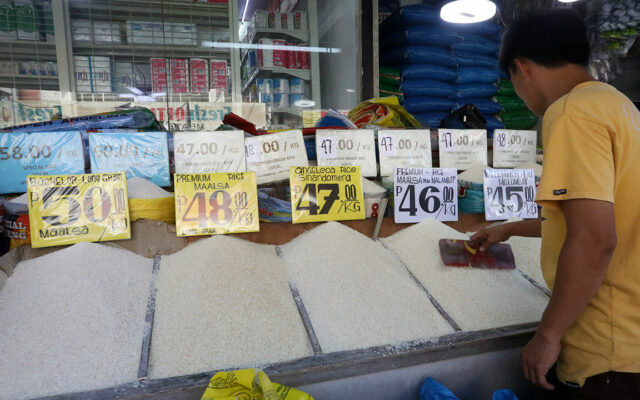
Philippine President Ferdinand R. Marcos, Jr. has turned down his economic managers’ proposal to temporarily cut duties on rice imports amid spiraling prices.

In a Palace press release after his meeting with his Cabinet, Mr. Marcos said “it was not the right time to lower the tariff rates because the projection of world rice prices is that it will go down.”

The National Economic Development Authority (NEDA) had proposed to cut the tariff rates to as low as 0% from 35%.

During the Tuesday meeting, NEDA Secretary Arsenio A. Balisacan and Agriculture Undersecretaries Leocadio Sebastian and Mercedita Sombilla “agreed that it was not the right time to lower tariff rates because of the downtrend of rice prices in the world market,” the presidential palace said.

At the meeting, the President said the executive order that set a price cap of P45 a kilo for well-milled rice and P41 for regular milled rice would remain in effect.

“Let’s study it carefully,” he said in Filipino, referring to his order that took effect on Sept. 5.

Mr. Marcos has been saying that the country has enough supply of rice, blaming smugglers and hoarders for increasing prices.

Philippine palay output hit 4.25 million metric tons (MT) in the second quarter from 4.2 million MT a year earlier. — Kyle Aristophere T. Atienza

Mining fiscal regime bill hurdles House

A view of nickel ore stockpiles at a port in Sta Cruz, Zambales, Feb. 8, 2017. — REUTERS/ERIK DE CASTRO

By Beatriz Marie D. Cruz, Reporter

THE HOUSE of Representatives on Tuesday passed on third and final reading a bill that seeks to establish a new fiscal regime for the Philippine mining industry by imposing margin-based royalties and windfall profit tax on large-scale miners.

House Bill (HB) No. 8937, which congressmen approved past midnight, is supposed to simplify the mining tax system and make the Philippines competitive with other countries in attracting investments into the capital-intensive sector.

Under the measure, large-scale metallic mining operations inside mineral reservations will pay the government 4% of their gross output.

Margin-based royalties on income from metallic operations will be imposed on those outside mineral reservation areas. For instance, miners with margins of 1% up to 10% would be subject to a 1% rate. This royalty rate can go up to as high as 5% for those with margins above 70%.

Meanwhile, small-scale miners will be slapped royalties equivalent to a 10th of 1% of their gross output.

Under the bill, mining income will be subjected to a margin-based windfall profits tax. Miners with margins of more than 35% up to 40% would face a tax rate of 1%, while those with margins of more than 80% will be imposed a 10% rate.

“While we maintain that the current mining tax regime is already substantial (we are already taxed higher than far bigger mining countries such as Indonesia, the world’s top nickel producer; as well as Chile and Peru, biggest copper producers globally), we are relieved that the additional tax burden on the industry being proposed in HB 8937 is not punishingly high,” Chamber of Mines of the Philippines (CoMP) Vice-Chairman Gerard H. Brimo said in a Viber chat.

Mining companies in the country currently must pay corporate income tax, excise tax, royalty, local business tax, real property tax, and fees to indigenous communities.

However, Party-list Rep. Arlene D. Brosas, who was one of four solons who voted against HB 8937, said tax collection from mining firms “will never compensate for the long-term disastrous implications” of large mining operations in the country.

“The supposed tax intake from the mining industry cannot also be a substitute for foregone mineral ores which are exported to other countries, and which will never be taken back,” she said.

Maya Quirino, advocacy coordinator of research group Legal Rights and Natural Resources Center said mining tax rates in mineral reservations should be maintained, instead of reduced.

“On the other hand, the proposed graduated tax thresholds for windfall profits require stringent monitoring mechanisms to prevent companies from underreporting revenue. Taxes should be applied on outputs instead of revenue,” she said in a Facebook Messenger chat.

The bill approved by the House on final reading is vastly different from the Department of Finance (DoF)-proposed version that sought to bring the country’s effective tax rate on mining (considering all taxes) to 51%, up from 38% under the current system.

The DoF-backed version also sought to impose a royalty tax of 5% on the market value of gross output of all large-scale mining operations, and a 10% export tax on the market value of mineral ore exports.

Last week, the Legislative-Executive Development Advisory Council included the mining fiscal regime bill in the common legislative agenda of the 19th Congress.

In his State of the Nation Address last July, President Ferdinand R. Marcos, Jr. said the mining fiscal regime is one of his administration’s priority measures.

PHL economy likely to bounce back in 2024

The Philippine economy is expected to perform better in 2024. — PHILIPPINE STAR/MIGUEL DE GUZMAN

By Keisha B. Ta-asan, Reporter

PHILIPPINE economic growth is expected to return to above 6% in 2024 as the impact of elevated inflation and high borrowing costs likely eases, analysts said.

“As the impact of inflation and rates dissipates next year, growth will likely return to above 6% in the medium term, still buoyed by strong underlying domestic demand and favorable demographics,” S&P Global Ratings Senior Economist Vincent Conti said in an e-mail.

S&P Global Ratings raised its 2024 GDP projection to 6.1% from 5.9% previously. However, this is still short of the government’s 6.5-8% target for 2024.

Economic growth may be stronger in 2024 due to a better outlook for inflation and monetary policy, University of Asia and the Pacific Senior Economist Cid L. Terosa said in an e-mail.

“I expect inflation to be within the 3.5% to 4% range next year. As inflation becomes tamer, we expect monetary easing to follow suit,” Mr. Terosa said.

The Bangko Sentral ng Pilipinas (BSP) last week raised its 2024 inflation forecast to 3.5% from 3.3% previously. Still, this is within the central bank’s 2-4% target range.

“Economic growth next year will be driven by better prices, business, and investor environments. I am optimistic that the Philippines can achieve at least 6% growth next year. The odds of achieving a 6.6-8% growth rate next year appear to be moderately high,” he said.

For this year, Mr. Terosa said it would be hard for the Philippines to achieve its 6-7% growth target. He expects GDP to grow by 5-5.7% this year.

“With a lower than 6% growth rate this year, the Philippines may not be able to achieve high middle-income status in the next two years. We need to grow by 6% for two to three consecutive years to have a clear shot at high middle-income status,” he said.

The government is targeting to reach upper middle-income status by 2025. The Philippines is currently classified as a lower middle-income country with a gross national income per capita at $3,950 in 2022.

S&P Global Ratings had also slashed its Philippine GDP forecast to just 5.2% this year, slower than the 5.9% forecast given in June. This after GDP expanded by 4.3% in the second quarter, its slowest growth in two years.

“We see this as a reflection of the simultaneous impact on household wealth and disposable incomes from the maturation of post-pandemic dissaving coupled with high inflation and the resulting rate hikes,” Mr. Conti said.

The BSP’s Monetary Board hiked borrowing costs by 425 basis points (bps) from May 2022 to March 2023. It opted to leave interest rates unchanged for a fourth straight time last week.

“These were also happening at the same time as fiscal consolidation, and together, these weigh on private investor sentiments,” Mr. Conti said.

Meanwhile, Philippine Exporters Confederation, Inc. President Sergio R. Ortiz-Luis, Jr. said it may be hard for the Philippines to meet its 2023 and 2024 growth targets amid dampened investor sentiment.

In a phone interview, Mr. Ortiz-Luis said aside from elevated inflation and uncertainties in food and fuel prices, investors are concerned with higher-than-expected wage increases.

“The Senate is still threatening to pass the P150 minimum wage increase by December. So, our investors, even the local ones, adopted a wait-and-see approach,” he said in mixed English and Filipino. 

In March, Senate President Juan Miguel F. Zubiri filed a bill seeking to increase the minimum wage for all daily wage earners by P150.

Finance Secretary Benjamin E. Diokno and National Economic and Development Authority Secretary Arsenio M. Balisacan have warned against the proposed wage hike as this may stoke inflation.

Mr. Ortiz-Luis also cited the government’s suspension of 22 reclamation projects in Manila Bay earlier in August. All projects are under review for their environmental and social impact.

He noted that a lot of investors have decided to look for partners in Vietnam and Taiwan instead of the Philippines.

House OK’s military pension reform measure on 3rd reading

The House of Representatives passed the Military and Uniformed Personnel Pension System Act on Tuesday. — PHILIPPINE STAR/EDD GUMBAN

THE HOUSE of Representatives approved on third and final reading a bill seeking to reform the pension system for military and uniformed personnel (MUP), but without requiring mandatory contributions from active personnel.

Lawmakers voted on House Bill No. 8969 or the Military and Uniformed Personnel Pension System Act past midnight on Tuesday, with 272 in favor, four against and one abstention.

The House-approved version requires only new entrants to contribute to the pension fund. New entrants will have to contribute 9% of their monthly salary as their share, while the National Government (NG) will provide 12%.

“The share of the MUP and the NG may be reduced by the Development Budget Coordination Committee (DBCC) due to adverse fiscal and economic conditions of fiscal constraints of the NG,” the bill stated.

The bill also provides for the automatic indexation of MUP pensions at 100% of the increase in the base pay of active personnel. However, the President is authorized to adjust the pension and survivorship pension at lower rates “due to adverse fiscal or economic conditions,” as certified by the DBCC.

Lawmakers had amended the bill during the plenary last week after Defense Secretary Gilberto C. Teodoro, Jr. objected to the committee report that had capped the indexation of the MUP pension at 50% and required all active personnel and new entrants to contribute to the pension fund.

“The MUP agencies are already very happy with this reform which also significantly improves our fiscal position. It also makes the fiscal risks of the MUP pension system very predictable,” said Albay Rep. Jose Ma. Clemente S. Salceda, who chaired the ad hoc committee on the MUP pension, in a statement.

However, Albay Rep. Edcel C. Lagman, who voted against the bill, said military and uniformed personnel should not be exempted from making contributions to their pension fund.

“It is not a valid reason to exempt MUPs from contribution because they die in line of duty because more employees in the civilian service and the private sector die of work-related causes. Moreover, if military morale matters, so does civilian morale. Why must civilian employees pay through their taxes the pension benefits of MUP retirees,” Mr. Lagman said.

Party-list Rep. Raoul Danniel A. Manuel, who also voted against the bill, said exempting active MUPs from contributing to the pension will be “too burdensome” for the government.

The Department of Finance (DoF) had earlier pushed for a version of the bill that required contributions from all active personnel and new entrants, and removed the full indexation of pensions. 

Finance Secretary Benjamin E. Diokno previously insisted that there is a need to overhaul the MUP pension system, noting that there is a risk of “fiscal collapse.”

“It will not qualify as a reform if indexation will continue and the active members will not contribute. We have to reduce the fiscal impact of the MUP pension program and the contribution of active members will greatly help in managing that,” Mr. Diokno said last month.

At present, all MUPs do not contribute to their pension fund, which is fully funded by the National Government.

Under the measure, all MUPs would be guaranteed a 3% annual adjustment of their base pay over 10 years.

The bill also creates the MUP trust funds, composed of the Armed Forces of the Philippines (AFP) Trust Fund and the Uniformed Personnel Services Trust Fund.

The measure also seeks to include residual assets of the AFP-Retirement and Separation Benefits System (RSBS) as one of the funding sources for the AFP Trust Fund.

The MUP pension program covers members of the AFP, Philippine National Police, the Bureau of Jail Management and Penology, Bureau of Fire Protection, Philippine Public Safety College, the Philippine Coast Guard, and Bureau of Corrections.

The bill is part of the Legislative-Executive Development Advisory Council’s list of 20 priority measures that Congress committed to approve by December. — Beatriz Marie D. Cruz