Home Blog Page 4222

Hamas has already lost the war of images

MOHAMMED IBRAHIM-UNSPLASH

TWO VIDEOS capture how Hamas lost the war of images last Saturday.

In the first, a young woman, stripped nearly naked, lies in the back of a pick-up truck. Her face is turned away from the camera. Two men sit behind the woman; one is holding a rocket-propelled grenade launcher and has a leg casually draped over her, the other seems to be clutching a fistful of her braided hair. Two other men are standing farther back, one of them waving an assault rifle in the air. All four men are cheering, “Allahu akbar!” as are those gathered around the vehicle. As the truck pulls away, one man leans in to spit on the supine woman.

In the second video, an elderly woman in a tan-colored T-shirt and wrapped in what appears to be a pink, patterned tablecloth sits in a golf cart, looking alternatively defiant and bemused. Behind her is a man in black, holding aloft an assault rifle. On a motorcycle ahead of the buggy, the pillion rider is also brandishing a weapon. As this small convoy moves slowly forward, celebratory ululations are heard off camera.

When these scenes were being videotaped, presumably in Gaza, the celebrants were exulting what they may have regarded as Hamas’ greatest victory: a brazen assault in which its fighters killed more than 1,000 Israelis, the largest single-day death toll in the country’s history, injured thousands more and took at least 150 hostage. Within hours of the attack, Hamas was posting videos to show off its stunning “success.” As with the kinetic operations, it was keen to draw first blood in the war of images, to inspire its supporters and demoralize its enemy.

But the videos of the two female victims had the opposite effect. The women were quickly identified as civilians: German tourist Shani Louk, in the pickup truck, and Israeli Yaffa Adar, a resident of the Nir Oz kibbutz near the border with Gaza. At the time of this writing, we don’t know whether either of them is alive.

Their treatment at the hands of their captors drew widespread revulsion and reprobation, and if anything, strengthened Israeli resolve to exact retribution. Because of the videos, Hamas lost any right to claim the attack was a manifestation of “legitimate resistance.” Instead, the group was exposed before the horrified world as the terrorist organization it has always been.

In making a spectacle of these two women, Hamas lost the war of images before its day of triumph was out. And worse was to come. News photographs and video emerging from Israel since the weekend show a pattern of attacks against civilians in the villages and kibbutzim near Gaza. Especially heinous was the attack on the Nova Festival, a music concert being held outside Kibbutz Re’im, where Louk had been enjoying herself. Hamas slaughtered at least 260 people there.

Rather than demonstrate patriotic resistance by brave Palestinian fighters, the images invited comparisons with the brutal terrorists of the Islamic State. It was hard not to draw parallels between the Nova Festival and the Bataclan in Paris, where an IS attack in November 2015 killed nearly 90 people attending a rock concert. Nor could anyone looking at the video of Louk on that truck not be reminded of the Yezidi women captured by IS in Sinjar, in 2014.

As the identities of the scores of hostages — many of them thought to be women and children — emerge in the days ahead, Hamas will look more and more like IS. The group’s threat to kill hostages, on camera, if Israel strikes civilian homes in Gaza carries echoes of Islamic State executions.

Hamas’ defeat in the war of images will have consequences for the real war Israel has declared against the group and for the Palestinian civilians who, as ever, are bearing the brunt of Israel’s vengeance. In previous instances of Israeli offensives on Gaza, Hamas could count on images of piteous noncombatant victims to draw international sympathy and pressure on Israel to end its attacks.

With the balance of sympathy now on the Israeli side, the world will likely take longer to intervene. Many more Palestinians will die as a result of those two videos.

BLOOMBERG OPINION

PAL says Cebu-Laoag route to start on Dec. 15

PHILIPPINE AIRLINES (PAL) is launching flights from Cebu to Laoag in December as part of its efforts to bring connectivity between Luzon and Visayas, the flag carrier said on Thursday.

“This brand-new service will help us open up a new market for tourist and business travelers by connecting the Ilocos Region via nonstop flights to Cebu, and beyond to other cities in the Visayas and Mindanao,” Stanley K. Ng, PAL president and chief operating officer, said in a media release.

PAL said on Dec. 15, it will start to operate its Cebu and Laoag flights twice a week.

The airline added that it is also anticipating more Mactan-Cebu flights in the future to accommodate the growing market demand.

“You can expect more convenient connections that boost tourism and help spur economic development in different areas of the Philippines, as we progressively expand our domestic network. We expect to mount more flights in and out of our Mactan-Cebu hub in the coming months,” Mr. Ng said.

Earlier this week, PAL said it would reopen more routes from Cebu to Bicol and Mindanao as it is expecting more passengers during the holiday season.

In May, PAL launched two special flights between Cebu and Laoag. Currently, it operates four times weekly Cebu-Baguio and Baguio-Cebu flights.

Data from the Manila International Airport Authority showed that domestic and international passenger volume at the Ninoy Aquino International Airport climbed 33.76 million as of September this year, exceeding 2022’s full-year tally.

The passenger tally at the end of the period surpassed the 30.94 million full-year total in 2022. It was up 59% against the year-earlier period. — Ashley Erika O. Jose

Financial sector ‘highly vulnerable’ to climate risks

STOCK PHOTO | Image Dmitry Berdnyk from Unsplash

THE PHILIPPINE financial sector is “highly vulnerable” to climate risks, the World Bank said.

“Financial institutions operating in the Philippines face high operational risks from natural disasters,” the World Bank said in a background paper for its Country Climate and Development Report.

“The Bangko Sentral ng Pilipinas (BSP) reports that in the aftermath of storms and natural disasters, banks are faced with severe disruptions of operations resulting from damage to infrastructure and branches,” it added.

Natural disasters also affect the “soundness of financial institutions and stability of the overall financial system,” the World Bank said.

Citing data from AIR Worldwide, the World Bank said typhoons alone cause losses in public and private assets equivalent to 0.71% of gross domestic product annually.

“Typhoons could increase market risks in the Philippines’ financial sector, where banks hold sizeable investment portfolios, totaling 20% of total assets as of end-December 2018,” it added.

The occurrence and size of a typhoon “significantly” impacted nonperforming loan (NPL) ratios in the Philippines, it added.

World Bank data showed that for a 1% rise in the typhoon damage ratio, the NPL ratio would rise by 0.66% in the same year on average.

“During interviews with BSP and banks, it was reported that rural and agricultural exposure, and therewith rural and cooperative banks, are most significantly affected by the impacts of typhoons. In contrast to universal banks, these banks predominantly operate in the regions and hold sizeable exposures in loans for the agricultural sector (17.5%).”

The insurance sector also faces “increasing underwriting risks” due to climate issues, the World Bank added.

“Large scale disasters can affect an insurer’s ability to pay out claims. During interviews, industry stakeholders reported difficulties following large typhoons,” it said.

“The aftermath of Yolanda showed that the sector was significantly affected by claims as a result of typhoon damages, even though catastrophe insurance penetration is low. Yolanda also affected the micro insurance sector, which paid out over P500 million in claims,” it added.

The financial sector is vulnerable to both physical risks and transition risks due to climate change, the World Bank said.

“Physical risks are already highly material for the Philippine financial sector. Typhoons, floods, droughts, as well as geological events like earthquakes and volcanic eruptions, can affect — and in fact are already affecting — credit, market, operational and underwriter risks, therewith threatening the profitability and solvency of banks and insurers,” the World Bank said.

To mitigate these risks, the government should strengthen post-disaster mechanisms and scaling up financial risk management of public assets., it said.

The government should also prepare for the increasing cost of climate disasters, it added. — LMJCJ

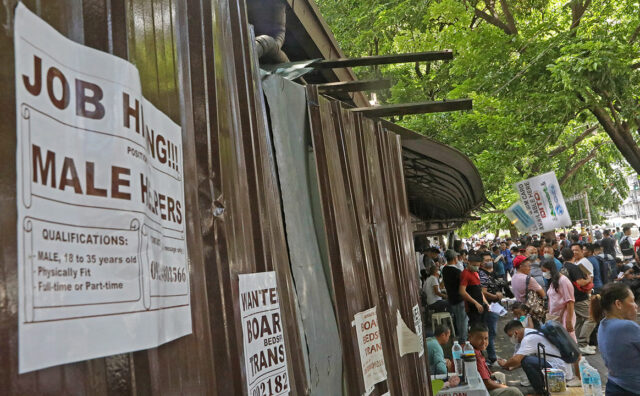
Seasonal temp jobs seen behind decline in Aug. unemployment

PHILIPPINE STAR/ EDD GUMBAN

By John Victor D. Ordoñez, Reporter

EMPLOYERS hired more temporary workers in August, causing unemployment to fall that month, a labor group said.

“The latest drop in the unemployment rate may be attributed to the increase in the hiring of temporary workers in anticipation of the increase in demand of goods and services for the coming Christmas season, as such, temporary,” Partidong Manggagawa Chairman Renato B. Magtubo said in a Viber message.

The unemployment rate in August hit a three-month low of 4.4% from 4.8% a month earlier, the Philippine Statistics Authority (PSA) reported on Oct. 6. The year-earlier reading had been 5.3%.

Job quality improved that month as the underemployment rate — a measure of workers seeking additional hours or an additional job — decreased to 11.7% from 15.89% in July. This was also lower than the 14.7% from a year earlier.

“If the country wants to generate more sustainable and quality jobs, our economic managers should provide more support for homegrown industries and fast-track their development,” he said.

Mr. Magtubo added the government must continue to keep the manufacturing and agriculture sectors competitive to generate more jobs.

Manufacturing output rose to a seven-month high in August, posting growth of 8.5%, against the year-earlier 4.6%, the PSA said in a separate report on Oct. 6.

Agriculture and forestry drove the month-on-month improvement in employment that month, with the sector posting an increase of 1.97 million employees.

National Economic and Development Authority (NEDA) Secretary Arsenio M. Balisacan on Friday told reporters that he expects the Philippine Development Plan to foster “the creation of high-quality jobs offering everyone decent pay.”

“We need nothing less than a massive investment to create high-quality jobs,” Mr. Balisacan said. 

“That’s why our economic team, and our President, have been marketing the country not only to entrepreneurs here but also to foreign investors… That’s what will create high-quality jobs.”

President Ferdinand R. Marcos, Jr. in January signed an executive order that adopted the plan, which he said will help the Philippines achieve its goal of becoming an upper middle-income economy by 2025.

Last month, the President signed into law a bill authorizing the creation of a national employment roadmap and an inter-agency body to draft a national strategy for job generation.

The council, which will be headed by the NEDA as well as the Trade and Labor secretaries, will be tasked with assisting local government units in implementing job recovery programs.

Asia-Pacific women lagging in workforce participation

THE Asia-Pacific region must improve female workforce participation rates and address inequality, the Asian Development Bank (ADB) and International Labour Organization (ILO) said.

“Going forward, a comprehensive approach is required that begins with the recognition and implementation of measures designed to foster gender equality within the broader labor market and economic framework,” the ADB and ILO said in its ‘Where women work in Asia and the Pacific’ report.

“There is an urgent need to change gender norms regarding unpaid work and to work towards a more equal distribution of domestic responsibilities between men and women,” it added.

The report cited policies that address structural constraints to working women in the Philippines.

“Overall, the maternity leave policy in the Philippines is designed to provide support and protection to women during the crucial time of childbirth and recovery, while also promoting gender equality and work-life balance in the workplace.”

In 2019, the Philippines extended paid maternity leave to 15 weeks from 8.5 weeks, with an option for an additional unpaid 30 days.

“The law also provides for an optional allocation of seven days of the 15-week maternity leave benefits to the child’s father or an alternate caregiver (as identified by the mother) to encourage shared responsibility and promote gender equality in the workplace and in the home,” it said.

However, the report noted that while these benefits are positive, coverage is still limited to paid workers, which poses a “significant barrier to women’s productive capacity in the country.”

The ADB and ILO said gender gaps persist in the region despite improvements in recent years.

“Women in Asia and the Pacific face numerous structural obstacles that impede their full engagement in the labor market. A significant issue, not unique to the region, is the unequal distribution of unpaid care or domestic responsibilities placed on women regardless of their employment status or sector of employment,” the report said.

They said women in Asia and the Pacific region worked the longest hours when both paid and unpaid work is considered, compared to other regions.

“The absence of support for women’s caregiving duties not only leads to fewer paid work hours and less income but also deters women from entering or rejoining the workforce,” it said.

“The gap in participation rates between men and women, at close to 25 percentage points, remains elevated and 5 percentage points higher than the gap present in Latin America and the Caribbean or at the global level,” it added.

The ADB and ILO recommended measures such as gender-responsive fiscal policy that can address gender biases; gender-inclusive government spending that will prioritize investments in high-quality childcare; and gender-sensitive social protection measures.

“Policies of this nature can improve gender equality by identifying and rectifying gender biases in public spending and revenue collection,” it said.

The ADB and ILO said that governments must make the effort to remove barriers preventing women from pursuing non-traditional, high-paying jobs.

“A life course approach that addresses how girls can pursue science, technology, engineering and mathematics (STEM) and technical vocational education and training programs can support subject segregation that leads to occupational segregation,” it said.

“Policies to tackle gender discrimination within the workplace (recruitment, retention, promotion) and which recognize and support women’s ability to balance their care responsibilities are key to making labor markets more equitable,” it added.

The report also noted that working conditions must also be improved. These include strengthening wage legislation; equal pay policies; and improved access to credit and financial services, especially for women working in agriculture. — Luisa Maria Jacinta C. Jocson

Nitin Sawhney unites different voices in new album celebrating identity

Nitin Sawhney —NORMANRECORDS.COM

LONDON — Nitin Sawhney celebrates identity in his new album, bringing together different voices from singers Joss Stone and Guy Garvey to Asian women asylum seekers and television host Gary Lineker.

The award-winning British Indian musician, composer and producer, who has worked with the likes of Paul McCartney and Sting and scored numerous films and television series, releases his latest studio album Identity on Friday, where identity theft, judgment and fears are among themes addressed.

“Identity as a subject of discourse or debate on social media and mainstream media has become increasingly distorted so that it’s very much about a kind of pejorative judgment … of people’s identity … quite often on the basis of prejudice rather than understanding,” Mr. Sawhney told Reuters.

“So I thought it would be great to actually make an album that’s a celebration of identity effectively and it’s really … inviting a lot of people that I respect and admire as artists to participate in a collective, kind of, speaking out about how they feel about their own identities.”

The album features surprise collaborator Mr. Lineker, whom Mr. Sawhney approached after Britain’s BBC suspended the presenter for criticizing state immigration policy.

The suspension brought a public backlash and near mutiny at the public broadcaster and the BBC later reinstated Mr. Lineker as host of flagship Premier League highlights show Match Of The Day.

“I thought … here’s a safe space that you could actually express whatever you want to and he did,” Mr. Sawhney said.

The result is track “Illegal,” which also features the voices of Asian women asylum seekers and concludes with Mr. Lineker saying “No one is illegal.”

Another song, “This Is Our Home,” featuring composer and singer Ayanna Witter-Johnson, celebrates the “Windrush generation” of post-war migrants to Britain from the Caribbean.

Mr. Sawhney, whose previous album was called Immigrants, is known for playing different instruments and working in various genres.

“What I wanted to do by choosing titles with every album I’ve made is to work around a theme or an idea so that … all the different influences I have musically aren’t necessarily silenced by trying to make just one work in one genre, but … that I’m serving an idea,” he said. — Reuters

Unlocking the Philippines: Celebrating blockchain pioneers

FREEPIK

In the heart of the Philippines’ dynamic blockchain landscape, the second Philippine Block Awards recently lit up the scene. As the president of the Blockchain Council of the Philippines, I am happy to share insights from this fantastic event that acknowledges the trailblazers of blockchain technology and innovation.

Held on Sept. 20 at the Marriott Grand Ballroom in Pasay, this remarkable event coincided with Philippine Blockchain Week, an initiative that continues to illuminate the path to a technologically empowered future.

The Philippine Block Awards is a grand showcase of appreciation for individuals and entities that have made an indelible mark on our blockchain ecosystem. It is the first of its kind, and there are very few awards (if ever there are) in the world that recognize leaders that push the movement of blockchain forward. These Blockchain Champions are at the forefront of innovation, driving change in various sectors, from government to the private industry.

This year, we recognized two outstanding individuals who have been instrumental in pushing our blockchain ecosystem forward. They are:

• John Ivan Uy, Secretary of the Department of Information and Communications Technology (DICT): Under his leadership, the DICT has been a strong supporter of Philippine Blockchain Week and various other blockchain initiatives, including being the driving force of various educational programs conducted by the DICT for government officials and students.

• Renz Carlo Chong, CEO of BreederDAO: A true industry visionary, young as he is, Renz Carlo Chong has made significant waves not only in the Philippines but across Asia. His leadership has brought blockchain to the forefront, fostering growth and making a profound impact on our society.

The Philippine Block Awards serve as a reminder that our nation stands at the forefront of blockchain technology and innovation. This annual event is supported by the DICT and is an integral part of Philippine Blockchain Week.

We also acknowledge the outstanding contributions and pioneering efforts of the Blockchain Champions who are shaping the blockchain industry.

• Maria Frances Del Rosario, Undersecretary of Department of Budget and Management (DBM): She has been instrumental in developing and implementing blockchain-based solutions for government agencies. Her work is focused on improving transparency and efficiency in the use of public funds. The DBM’s Project Marissa, a blockchain-based initiative to enhance the security of budget data, is a testament to their commitment to innovation.

• Emmanuel Diwa Pineda, Undersecretary of the Department of Human Settlements and Urban Development (DHSUD): He has been at the forefront of using blockchain for urban development, making cities smarter and more efficient. His efforts are transforming the urban landscape and creating more sustainable and inclusive communities.

• Christopher Verceles, CEO of XC Labs: As an entrepreneur with a vision, his work in blockchain technology is forging new paths and shaping our digital future. Under his leadership, XC Labs is pushing the boundaries of what is possible in the blockchain space.

• Michael Vincent Mislos, Editor-in-Chief of BitPinas: A media thought leader, his insights have played a key role in educating the public and fostering a blockchain-savvy community. BitPinas is a leading source of blockchain and cryptocurrency news in the Philippines, and Mislos’ contributions have been instrumental in its growth.

• Paul Soliman, CEO of Bayanichain: A leader who is empowering communities with blockchain, bridging gaps, and creating opportunities for all. Bayanichain is making blockchain accessible to the masses, driving social change, and fostering economic growth.

• Jay Ricky Villarante, CEO of Moneybees: A pioneer in the crypto world since 2012, he continues to drive innovation and foster growth in the industry. Under his guidance, Moneybees has become a key player in the blockchain and crypto space.

• Alvin Wong, Head of Growth and Product Strategy/Head of Invest of Maya: His work is revolutionizing the financial industry, making it more inclusive and accessible to everyone. Maya is helping Filipinos take control of their financial future and navigate the complexities of the modern financial landscape.

• Jiro Reyes, CEO of Bitskwela: An inspirational figure who started a passion project that has grown into something truly remarkable. Bitskwela’s dedication to blockchain education is empowering individuals and creating a more informed and skilled blockchain community.

• Galeria Paloma, represented by Kimberly Rocha-Delgado, Mia Rocha-Launchengco, and Georgia Rocha: A team dedicated to fostering creativity and innovation, leveraging blockchain for the betterment of the art world. Their work is redefining how art is created, shared, and valued.

These individuals and entities have made significant contributions in their respective fields, further propelling the Philippines as a vanguard of blockchain innovation. They are our inspiration, and also our light as we position our country to become a blockchain capital of Asia.

This is an exciting time for blockchain in the Philippines as we harness the potential of this transformative technology for the benefit of our nation and the world. The blockchain ecosystem in the Philippines is flourishing, and I am excited to see how these people will drive our country’s tech forward.


Dr. Donald Patrick Lim is the founding president of the Blockchain Council of the Philippines and the lead convenor of the Philippine Blockchain Week. He is also the Asian anchor of FintechTV.

PLDT unit launches first sovereign cloud in PHL 

BW FILE PHOTO

PLDT Inc. through its information and communications technology subsidiary ePLDT, Inc. has launched its “sovereign cloud,” which will hold highly sensitive government data and applications.

“We are proud to take the lead in launching ePLDT Pilipinas Cloud, the Philippines’ first sovereign cloud infrastructure. This affirms our support for the government’s digitalization push and our commitment to continuously power the digital future,” Alfredo S. Panlilio, president and chief executive officer (CEO) of PLDT said in a statement.

On Thursday, the PLDT unit said ePLDT Pilipinas Cloud  infrastructure will serve as the host of “highly sensitive government data and applications” by storing it in a secured cloud environment.

A sovereign cloud is a cloud-based infrastructure that ensures data is stored in a safe and secure environment.

“This infrastructure provides a secure, flexible, and cost-effective platform to store and process data strictly within the host country’s borders and is subject to local data protection laws and regulations,” PLDT said.

Sovereign cloud also ensures that data must remain under one jurisdiction by utilizing emerging technology solutions.

“With ePLDT’s technical expertise and experience in delivering multi-cloud and data center solutions, backed up by our unique understanding of the Philippine government’s requirements, we are confident we can ensure the seamless deployment and management of the country’s first sovereign cloud aligned with global standards,” Victor S. Genuino, president and CEO of ePLDT said.

At the local bourse on Thursday, shares in the company fell by P5 or 0.4% to end at P1,230 apiece.

Hastings Holdings, Inc., a unit of PLDT Beneficial Trust Fund subsidiary MediaQuest Holdings, Inc., has a majority stake in BusinessWorld through the Philippine Star Group, which it controls. — Ashley Erika O. Jose

HSBC Savings ceases operations

HSBC SAVINGS Bank, (Philippines), Inc. has received approval from monetary authorities to surrender its banking license to the Bangko Sentral ng Pilipinas (BSP).

HSBC Savings Bank has stopped operating effective Oct. 2, BSP Deputy Governor Chuchi G. Fonacier said in a circular letter dated Oct. 9.

“The Monetary Board, in its Resolution No. 1274 dated Sept. 28, 2023, approved the voluntary surrender by HSBC Savings Bank (Philippines), Inc. of its banking license to the BSP,” the central bank said.

HSBC Savings Bank is a wholly owned subsidiary of the Hongkong and Shanghai Banking Corp. Ltd. (HSBC) group and is classified as a thrift bank in the Philippines.

HSBC Philippines said in December that it is simplifying its banking structure in the country to support the growth of its retail banking customer base and has combined the retail operations of HSBC Savings Bank and HSBC Philippines under the latter.

This involved opening new accounts in HSBC Philippines for all clients of its thrift arm. The lender also rebranded the HSBC Savings Bank branch in Alabang, Muntinlupa City and closed branches in San Juan City and Makati City.

Services related to investment and insurance were centralized through the bank’s wealth management business, HSBC Investment and Insurance Brokerage, Philippines, Inc., which was established in September 2022.

“The restructuring and addition of the HSBC Savings Bank branches will fit in with HSBC’s plan to enhance its retail banking business in the Philippines, where the Group has been expanding and upgrading its branches across the Philippines over the past two year,” HSBC earlier said. 

HSBC has branches in Metro Manila, Cebu and Davao. — KBT

Author Arundhati Roy faces prosecution in India over 2010 speech — local media

DELHI  — The Booker prize-winning author Arundhati Roy faces prosecution in India for a speech about Kashmir she gave 13 years ago after a top official approved the move, local media reported on Wednesday.

A social activist from Kashmir filed a police complaint in 2010 following speeches by Ms. Roy and three others at a conference organized by a rights group, the reports said.

Ms. Roy, a fierce critic of India’s policy in Kashmir, is accused of saying at the conference that the disputed Himalayan territory was not an integral part of India.

Under Indian laws, the state government’s permission is needed for prosecution of certain crimes, including hate speech, sedition, and promoting enmity.

Vinai Kumar Saxena, the federally-appointed lieutenant-governor (LG), has allowed Delhi Police to prosecute Ms. Roy and Central University of Kashmir professor Sheikh Showkat Hussain under laws relating to promoting enmity, making assertions prejudicial to national integration and causing public mischief, the reports said.

Another professor and a hardline Kashmiri separatist leader named in the complaint have since died.

The reports did not say why Saxena approved the prosecution after 13 years.

His office did not respond to calls and emails from Reuters requesting comment.

Ms. Roy, 61, won the Booker Prize for fiction in 1997. She is also an outspoken political and rights activist and regularly writes in Indian and foreign publications.

There was no reaction from her to the developments and she could not be reached for comment.

Although the case was registered before Prime Minister Narendra Modi’s nationalist Bharatiya Janata Party government came to power in 2014, the sanction has once again stoked concerns about freedom of speech under Mr. Modi’s government.

Opposition leaders and writers came out in support of Ms. Roy.

“It is obvious that the LG (and his masters) have no place in their regime for tolerance or forbearance; or for that matter the essentials of democracy,” P. Chidambaram, a senior leader of the main opposition Congress party who was India’s home (interior) minister in 2010, posted on X.  Reuters

Don’t believe climate activists. Fossil fuels are good

MARKUS SPISKE-UNSPLASH

The road to hell is said to be paved with good intentions. In the case of climate activists, their good intentions paved, painted, and furnished it as well. It wouldn’t have been so bad if their annoying earnestness were limited to gluing themselves in public places. But the truth is that their alarmism can destroy lives and livelihood as well.

It also proceeds from bad premises: thus, the claim is made that climate change costs the Philippines around 1.2% of GDP growth, amounting to something like P506.1 billion from climate-related hazards in a 10-year span. The problem here is that climate activists are essentially resorting to a causal chain argument: not only are such losses allegedly caused by climate change but that such arise from man-made causes.

The point then is that — contrary to what has been normally touted by climate activists — the science is “not settled” as to the causes of climate change and, as such, the remedies to it cannot be definitively applied when ranged against the possible foreseen and unforeseen consequences that such measures could bring.

Thus, the fact previously given here in this column (“Climate change, climate fraud,” September 2023), considering that the Philippines contributes merely 0.35% share in fossil CO2 emissions (as of 2016), that “even if the Paris Agreement targets are met, it still wouldn’t mean much in terms of climate effects but humongously so in terms of economics. There is really no point in bankrupting Philippine business when doing so won’t even save the planet.”

Again, the biggest casualty, if the climate activists are to be followed, is our transportation sector, which has been dubbed as “the largest source of air pollution and energy-related Greenhouse gases (GHG) (34% of total GHG emissions) in the Philippines, whereby road transport is the largest contributor (with over 80%). In October 2015, the Philippines submitted their official conditional GHG mitigation target to the United Nations Framework Convention on Climate Change (UNFCCC) as Intended Nationally Determined Contribution (INDC), in which the Government stated an emission reduction target of 70% until 2030 with international support” (see transferproject.org).

However, note that the “Philippines, like many countries around the world, is facing skyrocketing food inflation due to supply issues and high fuel costs.” Furthermore, “Filipinos pay some of the highest electricity rates in Asia, behind only Japan and Singapore. Compared to its ASEAN neighbors, the country’s electricity is between 25% and 87.5% more expensive. And the rates keep increasing. For example, January 2023 marked the third consecutive month of electricity rate hikes. The trend continued throughout the year, with September being the latest month when electricity prices increased” (see “Why the Philippines is so vulnerable to food inflation,” Carnegie Endowment, July 2022; also “The Environmental Issues Surrounding San Miguel Corp. Are Deterring Investors,” energytracker.asia, Sept. 27, 2023).

The foregoing should thus make the demonization of fossil fuels highly eccentric. Inasmuch as energy plays a crucial role in keeping the Philippine economy afloat, to impose drastic changes without a viable and practical alternative is utterly imprudent.

Take the case, for example, of SMCGP. “SMC Global Power (SMCGP), SMC’s power generation business arm, [which] has a total capacity of 4.7 GW. Fossil fuels make up 87%, with hydropower at 12% and battery energy storage and peaking points at 1%.” Despite the obvious necessity of its operations, “over the years, SMC has faced opposition in many of its projects from frontline communities, civil society organizations, environmentalists and faith-based organizations. From the 2017 Break Free campaign against coal projects to protests from fisherfolk and farming communities in June 2023, SMC’s brand has been consistently associated with environmental disasters, facing strong public opposition and even violent protests.”

Which is precisely what energy commentator Alex Epstein, in his 2014 book, The Moral Case for Fossil Fuels, would likely label as misguided: “fossil fuels are easy to misunderstand and demonize, but they are absolutely good to use. And they absolutely need to be championed … Mankind’s use of fossil fuels is supremely virtuous — because human life is the standard of value and because using fossil fuels transforms our environment to make it wonderful for human life.”

Epstein addresses three myths: that fossil fuels are “dirty,” that fossil fuels are unsustainable and thus require a change to “renewable” solar and wind, and that fossil fuels are hurting the developing world.

But the truth, as Epstein points out, is that the environmental benefits of using fossil fuels far outweigh the risks. Fossil fuels don’t take a naturally clean environment and make it dirty; they take a naturally dirty environment and make it clean. They don’t take a naturally safe climate and make it dangerous; they take a naturally dangerous climate and make it safer.

Regarding so-called “renewable” energy, Epstein illustrates the intermittent nature of energy derived from the sun and wind, necessitating backup from a reliable (and cheaper) source of energy — usually fossil fuels.

And, finally, Epstein cogently argues that fossil fuels are the key to improving the quality of life for billions of people in the developing world. Withholding them would see access to clean water plummeting, critical medical machines like incubators becoming impossible to operate, and life expectancy dropping significantly. Thus, a call to “get off fossil fuels” is essentially a call to degrade the lives of innocent developing country people that merely want the same opportunities enjoyed in the West.


Jemy Gatdula read international law at the University of Cambridge and is a Philippine Judicial Academy lecturer for constitutional philosophy and jurisprudence.

https://www.facebook.com/jigatdula/

Twitter  @jemygatdula

Marcos wants poultry farm in Bangsamoro region

ARTEM BELIAIKIN-UNSPLASH

PRESIDENT Ferdinand R. Marcos, Jr. on Thursday urged San Miguel Corp. (SMC) to consider establishing a poultry farm in the Bangsamoro region, as the company expands its food operations in the country.

“That will help the stability in the BARMM (Bangsamoro Autonomous Region in Muslim Mindanao),” he said as he led the inauguration of San Miguel Food’s poultry farm in Davao del Sur.

San Miguel Foods is a unit of SMC.

The poultry farm is equipped with controlled climate technology and biosecurity measures. It has an automated feeding and watering system, an air quality monitoring system, and an automated harvesting system.

It is one of the 12 massive facilities that will be constructed across the country.

“This facility is also expected to provide jobs to more than 1,000 Filipinos and [generate] multiple opportunities for our micro, small and medium enterprises, our farmers, their families, as well as other sectors in Hagonoy and the nearby areas,” he added.

SMC President and Chief Executive Officer Ramon S. Ang, in a speech, said the Davao del Sur poultry farm would give local corn and cassava producers a “big opportunity” as the company seeks to tap them for raw materials for feed production.

“This means they benefit from having a steady market for their goods, and at better selling prices compared to what they would get from middlemen,” he said.

In a press release, the company said it is “taking care not to impact small growers, by carefully selecting areas where farms will be built, and producing mostly dressed chickens for value-added poultry products and institutional customers.”

SMC said the Magnolia Poultry Farm in Hagonoy town could produce up to 80 million birds annually, equivalent to 200 million kilograms in terms of live weight.

“Food security is one of the most important issues of our time. Today, we reinforce our support for the Marcos administration in ensuring a food-secure Philippines. Our goal is to provide every Filipino with access to high-quality food at prices within their means. Poultry, one of the most economical source of protein, is vital to achieving this,” Mr. Ang said.

SMC said the new poultry farm also has an integrated rainwater harvesting and a comprehensive waste management system.

“Manure produced by the birds will be utilized as fertilizer for cultivating corn and cassava, essential raw materials in the production of chicken feeds,” it said.

Meanwhile, Mr. Marcos said the Philippines will soon acquire an anti-bird flu vaccine, which he said is one of the timely interventions to mitigate the adverse effects of diseases on the poultry sector.

“There is a vaccine for Avian Influenza now. So, we will acquire the Avian Influenza vaccine,” he said in Filipino.

“The vaccine for Avian Flu looks effective — we will buy to reduce the number of those being culled due to Avian Flu),” he added.

Mr. Marcos noted that the vaccine for swine flu has yet to be rolled out.

On Thursday, SMC shares at the local bourse dropped P1.20 or 1.14% to P103.80 apiece.— Kyle Aristophere Atienza and Revin Mikhael Ochave

ADVERTISEMENT
ADVERTISEMENT