Home Blog Page 409

Peso hits 1-month high on dollar’s slump

BW FILE PHOTO

THE PESO jumped to a one-month high against the dollar on Wednesday as US President Donald J. Trump said the greenback’s value remains “great” despite its recent slide.

The local unit ended at P58.74 versus the dollar, surging by 34.5 centavos from its P59.085 finish on Tuesday, data from the Bankers Association of the Philippines showed.

This was the peso’s strongest close in more than a month or since ending at P58.71 on Dec. 26.

The local currency opened Wednesday’s trading session stronger at P58.85 against the dollar. Its intraday best was at P58.69, while its worst showing was at just P58.90 against the greenback.

Dollars traded rose to $1.46 billion from $1 billion on Tuesday.

“The dollar-peso closed lower, dragged by broad dollar weakness due to Trump’s ‘Sell America’ rhetoric and potential joint intervention by the US and Japan in the foreign exchange market [to correct the yen’s slide],” a trader said by phone.

The peso jumped as the dollar hit a four-year low on Mr. Trump’s comments, Rizal Commercial Banking Corp. Chief Economist Michael L. Ricafort said in a Viber message.

For Thursday, the trader sees the peso ranging from P58.50 to P58.90 per dollar, while Mr. Ricafort expects it to move between P58.65 and P58.85.

The dollar headed for its biggest weekly fall since last April on Wednesday after Mr. Trump brushed off this month’s slide, triggering even deeper losses against the euro, yen and pound ahead of the Federal Reserve policy decision, Reuters reported.

The dollar index, which tracks the performance of the US currency against six others, was 0.22% higher at 96.114, but it remained near four-year lows, having lost nearly 2.8% since last Wednesday, its steepest weekly decline since last April’s “Liberation Day” market turmoil.

Mr. Trump said on Tuesday the value of the dollar was “great,” when asked whether he thought it had declined too much. Traders took his comments as a signal to intensify dollar selling.

While the president’s comments were not exactly new, they came at a time when the dollar has been under pressure as traders braced for a possible coordinated currency intervention by US and Japanese authorities to stabilize the yen.

“It shows there’s a crisis of confidence in the US dollar,” said Kyle Rodda, a senior market analyst at Capital.com. “It would appear that while the Trump administration sticks with its erratic trade, foreign and economic policy, this weakness could persist.”

The dollar tumbled over 9% in 2025 and has started the year on the back foot, already down about 2.3% in January as investors grappled with Mr. Trump’s erratic approach to trade and international diplomacy, fears over the Federal Reserve’s independence and huge increases in public spending.

Investors’ focus will be on the Federal Reserve’s policy decision later in the day, where the central bank is expected to stand pat in a pause that investors see lasting beyond US central bank chief Jerome H. Powell’s final meetings in March and April. — Aaron Michael C. Sy with Reuters

Landers Fairview ‘temporarily’ closes following fire

QUEZONCITY.GOV.PH

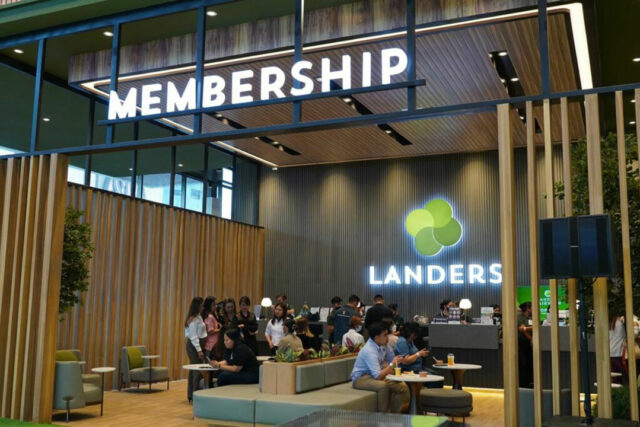
LANDERS SUPERSTORE announced the temporary closure of its Fairview branch in Quezon City after a fire broke out on Wednesday.

In a Facebook post, the company said: “Landers Fairview is temporarily closed. We apologize for the inconvenience.”

“In the meantime, you can still shop at Landers Balintawak, Landers UP Town Center, or any Landers Superstore branch near you,” it added.

Many netizens expressed dismay at the closure and hope for its reopening soon, citing the supermarket’s proximity to their homes.

“For renovation na ulit ang Landers Fairview, kung kailan mag-two years na this February” (Landers Fairview is undergoing renovation again, just as it is turning two years this February), a netizen said.

Landers Fairview began operations in February 2024 at Belfast corner Quirino Highway, Brgy. Pasong Putik, Novaliches, Quezon City.

The fire erupted on Wednesday, reaching fifth alarm less than an hour after the first alarm was declared.

According to the Bureau of Fire Protection, the fire was declared under first alarm at 4:44 a.m., raised to fifth alarm at 5:16 a.m., and declared under control at 7:59 a.m.

Asked about reopening plans, the company said: “We will announce it once we have the details.”

A members-only retail store, Landers Superstore also has branches in Cavite, Aseana City, Davao City, Naga City, Taguig City, Pampanga, Laguna, Bacolod, Bonifacio Global City, Manila, Cebu, Pasig, and Alabang. — Justine Irish D. Tabile

Regulating and insuring automated driving

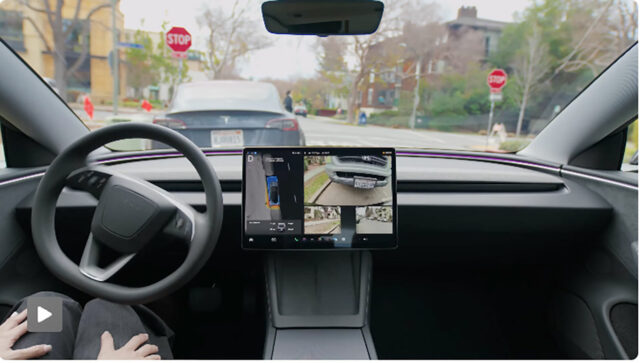
A VIDEO SCREENSHOT of a supervised automated parking of a Tesla vehicle. — TESLA.COM

I recently watched a video of a Tesla in the United States navigating a parking lot by itself while its owner sat in the driver’s seat. Other than pushing a button, the owner did nothing. The car eased between parking markers on its own. It looked like magic, until you imagine it happening here.

If that car hit another vehicle while it parked, who would we blame in the Philippines? We would blame the person in the seat. Our laws give us no other choice. We would deem that driver at fault even if he never touched the steering wheel or the pedals.

Carmakers now sell not just metal and batteries, but software-defined driving. They market self-parking, highway automation, and hands-off capability, even if most systems on the road today still require driver supervision. Still, we are surely moving from driver assistance toward conditional automation.

Philippine traffic law assumes there is a human driver at all times. Republic Act No. 4136, the Land Transportation and Traffic Code, defines a driver as every licensed operator of a motor vehicle. Republic Act No. 10913, the Anti-Distracted Driving Act, penalizes the use of mobile communications devices and electronic entertainment or computing devices while driving, subject to limited exceptions. These statutes were written for a world where a person controls the steering wheel and pedals.

So the moment a vehicle truly drives itself, even for a short interval like parking, our enforcement choices become muddled. If the system steers and brakes, does the person still “operate” the vehicle in the sense the law means? If a crash happens, do we hold the human liable for the machine’s driving decision? If the system demands a takeover and the person ignores it, should we treat that failure as the core fault rather than the manner of driving?

The United Kingdom offers a useful approach. Its Automated Vehicles Act 2024 recognizes a “user in charge” (UiC) when an authorized self-driving feature is engaged. In that mode, the UiC is generally not held criminally liable for offenses arising from self-driving activities.

At the same time, the law assigns responsibility for the self-driving system to an Authorized Self-Driving Entity (ASDE), a regulated entity behind the feature. The UiC retains non-driving duties, including being fit and ready to take over when the vehicle issues a transition demand.

The UK also keeps an important safeguard. Even with authorized self-driving engaged, mobile phone use remains prohibited for the UiC. I agree with that. The law shifts liability for the vehicle’s manner of driving to the ASDE, but it does not excuse careless behavior inside the cabin.

Japan also illustrates the same logic. Conditional automated driving has been allowed on public roads there in practice since April 2020, but drivers must take over immediately and properly when conditions require it. The system performs the driving task within defined conditions, while the driver remains the fallback.

Germany goes further. It allows driverless operation in defined operating areas and requires “technical supervision” by a human who can monitor and intervene even from outside the vehicle. Germany assigns accountability to a role that fits the technology.

These changes reflect a market and governance reality. Carmakers cannot credibly sell self-driving if the person inside remains legally treated as the driver for every consequence of the machine’s decisions. Regulators, on the other hand, cannot accept a future where nobody carries responsibility. So these jurisdictions defined roles and tied them to strict conditions.

The next step, as a matter of course, is insurance. After an accident, the question that matters most is not philosophical liability but who pays, and how fast. We need a process that compensates victims quickly, then determines liability, whether human or machine.

We should not spend years proving whether a sensor failed, a software update misfired, or a human ignored a takeover request. Yet that is what will happen if we treat automated driving as a simple negligence case against the person in the driver’s seat.

Philippine road crash liability remains largely fault-based. But our compulsory motor vehicle liability insurance already includes a limited no-fault indemnity for death or bodily injury, payable without the need to prove fault or negligence, but subject to set limits. For bigger claims, disputes still tend to turn on proving who was legally liable.

At the same time, compulsory liability insurance does not yet speak clearly to automated driving and the possibility of product or software failure causing an accident. When an automated system drives, a crash can result from defective code, training data, mapping, calibration, or cybersecurity vulnerabilities.

Pay-first, argue-later should remain the default posture even for incidents involving authorized self-driving. The UK offers an instructive model. When an insured automated vehicle causes an accident while it is “driving itself,” the insurer pays in the first instance, then uses mechanisms that preserve recovery rights and allocate responsibility after compensation.

Evidence sits at the heart of all of this. Every automated driving dispute begins with a question: who controlled the vehicle at the time, the human or the system? We can investigate and question human drivers. But we also need a credible way to examine automated driving systems, and to assign responsibility when the system, not the human, drove.

We should start by clearly distinguishing driver assistance from conditional automation. If a driving system merely assists, the human remains the driver under existing rules. If a system performs the dynamic driving task within a defined operational design domain, the law should recognize that mode and assign a status like UiC.

A competent authority should also approve which features qualify as self-driving, under which conditions, and on which roads. We can start with allowing initially only low-speed applications like parking in controlled environments, then widen coverage as standards and infrastructure mature.

A conditional system always ends with a question: can the human take over when the system asks? We should specify what counts as a valid transition demand, what minimum warning time applies, and what the UiC must do. If the person fails to respond and an accident follows, liability should attach to that failure.

More important, we need reliable event data. Mode engagement, alerts, and takeover demands must be recorded in a form insurers, regulators, and courts can access under clear privacy safeguards. Without this, every serious claim becomes a guessing game. Automated cars will need black boxes or event data recorders that can establish, at a minimum, whether the system or the human controlled the vehicle during the accident.

Also, no-fault indemnity under existing compulsory insurance should extend to authorized self-driving incidents so victims get compensated quickly. Then insurers should be able to recover from the responsible entity when the system, not the human, caused the loss.

The easiest policy failure is the lazy one. We either ban automated driving out of fear, or we allow it to spread quietly and then blame the human occupant for everything when something goes wrong. Both paths will create a messy market and invite unjust outcomes when accidents happen.

I would rather we do the harder work. We should now calibrate regulation and authorize what we believe can safely operate locally, define the roles, assign accountability to the entity behind the automated system when the system drives, and make sure victims get paid quickly when accidents happen.


Marvin Tort is a former managing editor of BusinessWorld, and a former chairman of the Philippine Press Council

matort@yahoo.com

One Battle After Another leads BAFTA nominations; Sinners also recognized

One Battle After Another (2025)

LONDON — Action-packed dark comedy One Battle After Another led nominations for the BAFTA Film Awards on Tuesday, with vampire thriller and box office smash Sinners also widely recognized at Britain’s top movie honors.

One Battle After Another, in which Leonardo DiCaprio plays a washed-up revolutionary whose daughter is kidnapped, secured 14 nods, of which five were for its cast including Mr. DiCaprio and Chase Infiniti, who plays his daughter, in the leading acting categories. Their co-stars Teyana Taylor, Sean Penn, and Benicio del Toro were nominated in supporting acting categories.

The critically acclaimed movie also secured a best director nod for Paul Thomas Anderson and is up for the awards’ top prize, best film, alongside Sinners, Hamnet, Marty Supreme, and Sentimental Value.

SINNERS RECEIVES 13 NOMINATIONS, HAMNET 11
Sinners, celebrating blues music and Black culture in the Segregation-era US South, received 13 nods, including for actor Michael B. Jordan who plays twins returning to their hometown to set up a juke joint. Director Ryan Coogler was nominated in the directing and original screenplay categories while cast member Wunmi Mosaku is up for supporting actress.

“It’s a great year for filmmaking, and I think what we see is that it’s a year of really strong, bold storytelling,” Chief Executive Officer of BAFTA Jane Millichip told Reuters.

“There’s a group of movies that I would say are tackling quite big geopolitical subjects, and they’re doing it through very different lenses… And then you have a group of movies which are much more personal.”

Hamnet, which fictionalizes the relationship between William Shakespeare and his wife Agnes and the death of their son, followed with 11 nods.

Jessie Buckley was nominated for leading actress for playing Shakespeare’s wife, Agnes, while Paul Mescal received a supporting actor nod for his portrayal of the bard. Chloe Zhao was the only woman in the best director category. Adapted from Maggie O’Farrell’s bestselling 2020 novel of the same name, the film follows the highs and lows of their love story as well as the grief over the loss of their son Hamnet, which leads Shakespeare to write Hamlet.

Hamnet is the most nominated film directed by a woman in all BAFTA history. So that’s something really positive,” Chair of BAFTA, Sara Putt, said when asked about the recognition of female filmmakers this year.

“I think we’re still on a journey. We’re very pleased we have the intervention at long-listing stage to make sure that more films are being watched and therefore more films being directed by women are being watched. Cutting the cake in a different way, there are 46 films nominated and over a quarter of those films were directed by women.”

COMPETITION FOR BEST DIRECTOR
Alongside Mr. Anderson and Mr. Coogler, Ms. Zhao faces competition from Josh Safdie for table tennis tale Marty Supreme, Yorgos Lanthimos for absurdist comedy sci-fi Bugonia, and Joachim Trier for Norwegian family drama Sentimental Value for the best director prize.

Marty Supreme secured 11 nominations in total, including expected recognition for Timothee Chalamet in the title role.

The leading actor category also includes Robert Aramayo for playing a Tourette’s syndrome campaigner in I Swear, Ethan Hawke as lyricist Lorenz Hart in Blue Moon, and Jesse Plemons for Bugonia, in which his character kidnaps a female pharmaceuticals boss, played by Emma Stone, believing she is an alien.

Ms. Stone was recognized in the leading actress category, alongside Rose Byrne for her portrayal of a mother whose life is unravelling in If I Had Legs I’d Kick You, Kate Hudson for Song Sung Blue, the story of a Neil Diamond tribute band, and Renate Reinsve for Sentimental Value.

Cynthia Erivo and Ariana Grande were snubbed in the acting categories for their performances in Wicked: For Good.

The musical sequel was only nominated for costume design and makeup and hair, although that was better than the Academy Awards, where it has scored zero nods. Its predecessor received seven BAFTA nominations.

The BAFTA Film Awards will be handed out at a ceremony in London on Feb. 22. — Reuters

Term deposit yield slips as demand wanes

BW FILE PHOTO

THE BANGKO SENTRAL ng Pilipinas’ (BSP) one-week term deposits fetched a slightly lower average yield on Wednesday even as the offer was undersubscribed, as likely weak fourth-quarter economic growth fueled bets for further monetary policy easing.

The central bank’s seven-day term deposits attracted bids amounting to P106.037 billion, below the P110-billion offer and the P162.768 billion in tenders for the same volume placed on the auction block last week.

This resulted in a bid-to-cover ratio of 0.9640 times, down from the previous 1.4797 ratio. This was the first time since Dec. 23 that the term deposit facility (TDF) offering was undersubscribed.

The BSP only accepted P83.899 billion in bids to keep the average rate low.

Accepted yields ranged from 4.45% to 4.5125%, a tad higher than the 4.44% to 4.5075% logged a week earlier. With this, the weighted average rate of the one-week papers slipped by 0.09 basis point (bp) week on week to 4.4973% from 4.4982%.

Expectations of a rate cut from the BSP next month due to likely soft fourth-quarter and full-year 2025 Philippine gross domestic product (GDP) growth caused term deposit yields to inch lower, Rizal Commercial Banking Corp. Chief Economist Michael L. Ricafort said in a Viber message.

He said further easing would “help spur local economic growth… alongside expansionary fiscal spending through catch-up government spending, especially on infrastructure.”

Last week, BSP Governor Eli M. Remolona, Jr. said that another cut remains uncertain, adding that while they will consider the latest Philippine GDP data when the Monetary Board meets on Feb. 19, weaker-than-expected growth wouldn’t automatically warrant further easing as inflation remains their primary concern.

The central bank has slashed benchmark borrowing costs by a total of 200 bps since its rate cut cycle began in August 2024, bringing the policy rate to 4.5%.

The government will release fourth-quarter and full-year 2025 GDP data on Thursday, Jan. 29.

The Philippine economy likely expanded by 4.2% in the fourth quarter, based on a BusinessWorld poll of 18 economists and analysts. This would put full-year growth at 4.8%, below the government’s 5.5%-6.5% target.

Meanwhile, Mr. Ricafort said the undersubscription seen on Wednesday was likely due to reduced liquidity in the financial system amid the strong demand seen for the Bureau of the Treasury’s recent auctions of government securities and its $2.75-billion triple-tranche global bond issue that was settled on Tuesday.

The central bank uses the TDF and BSP bills to mop up excess liquidity in the financial system and better guide market rates towards the policy rate.

It last auctioned off both the seven-day and 14-day deposits on Oct. 29. It has not offered 28-day term deposits for over five years to give way to its weekly offerings of securities with the same tenor.

Based on the BSP’s latest monetary policy report, its market operations have absorbed P1.5 trillion in liquidity as of mid-November 2025, with 5.4% of this being siphoned off via the term deposit facility. — Katherine K. Chan

Samsung Galaxy A07 5G launched in the Philippines

SAMSUNG.COM.PH

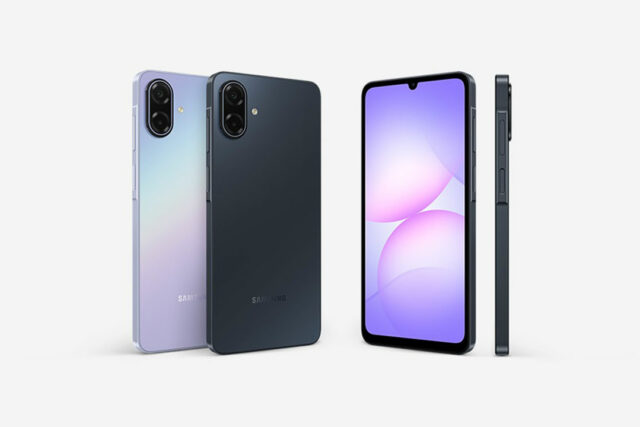
SAMSUNG Electronics this week launched in the Philippines its latest entry-level smartphone, the Galaxy A07 5G.

The latest addition to the Galaxy A series is priced at P8,290 for the 64GB variant and P9,990 for the 128GB model. It is available in two colors: Black and Light Violet.

Based on the brand’s website, the Galaxy A07 5G has a 6.7-inch PLS LCD display with a refresh rate of up to 120Hz. It is 8.2mm thick and weighs 199 grams.

It’s powered by a MediaTek Dimensity 6300 chipset that Samsung said supports faster loading and a smooth user experience, and a 6,000mAh battery.

The phone also has an IP54 water and dust resistance rating.

“Its superior surface durability, such as Glass Fiber Reinforced Polymer for the back also provides protection against scratches or breakage,” it added.

The Galaxy A07 5G also features a dual rear camera setup with a 50-megapixel (MP) wide lens and a 2MP depth lens.

“Producing crisp and sharp photos, the advanced image processor balances light and shadow for clear results in various conditions so you’ll never miss the essence of any detail. Equipped with a depth camera, you can also look forward to adding a natural bokeh effect to your images,” Samsung said.

Meanwhile, it also has an 8MP front camera.

The device also comes with enhanced AI features, including Gemini and Circle to Search.

Samsung said the Galaxy A07 5G will get six generations of Android OS upgrades and six years of security updates. It is also equipped with Samsung Knox Vault for data protection. — BVR

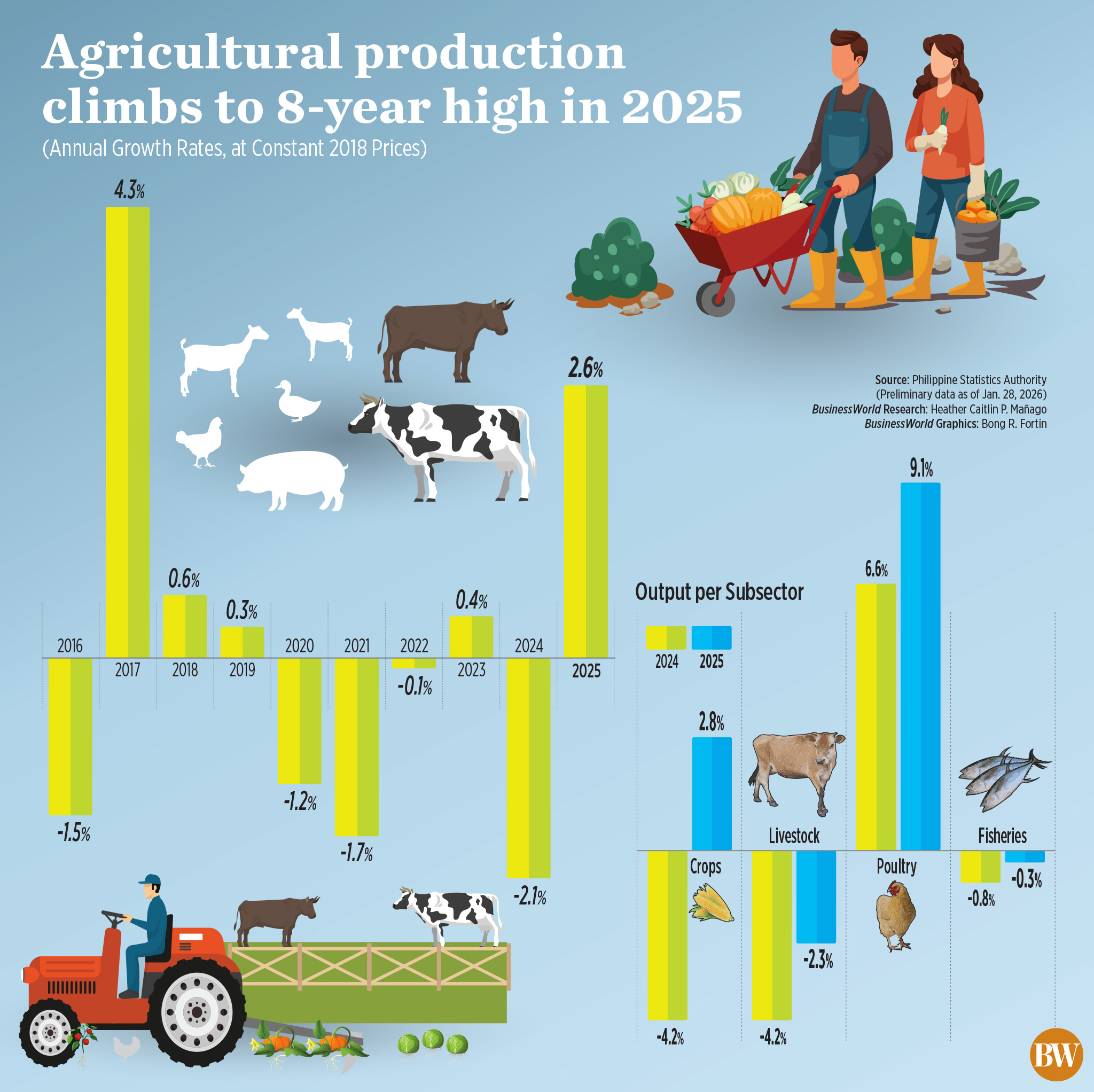
Agricultural production climbs to 8-year high in 2025

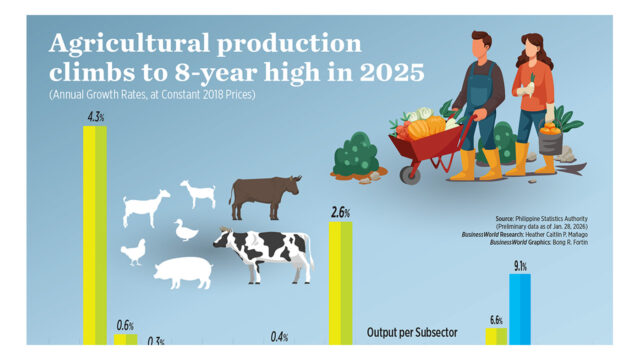
THE PHILIPPINES’ agricultural production grew by 2.6% in 2025, the fastest pace in eight years, as gains in crop output and strong poultry performance offset the decline in livestock and fisheries, the Philippine Statistics Authority (PSA) said. Read the full story.

Xurpas to sell 49% stake in Indonesian unit for P17.6M

STOCK PHOTO | Image by Docusign from Unsplash

LISTED technology firm Xurpas, Inc. has approved the sale of its 49% equity interest in Indonesian company PT Sembilan Digital Investama (SDI) for about P17.6 million.

“Target timeline for the signing of the share purchase agreement is sometime in February 2026,” the company said in a disclosure on Wednesday.

PT SDI wholly owns PT Ninelives Interactive, its licensed mobile content and distribution arm in Indonesia.

Xurpas said the proceeds would be used to fund the company’s general and working capital needs.

In March 2015, the company acquired a 49% stake in SDI for P10.83 million.

Last year, Xurpas began exploring the sale of its stake in SDI to boost liquidity and address negative equity, which could risk involuntary delisting from the Philippine Stock Exchange.

The company had earlier disclosed preliminary talks with a prospective buyer, with proceeds earmarked for operations to improve financial performance and support long-term equity recovery.

Xurpas shares fell 3.61% to P0.240 apiece on Wednesday. — Alexandria Grace C. Magno

The AI memory crunch is coming for your wallet

STOCK PHOTO | Image by Benzoix from Freepik

By Dave Lee

ONE frustrating characteristic of the AI boom seems to be that everyone must pay for it, regardless of any interest in using it. For some, it will be through rising utility bills as data centers strain the grid. For even more of us, it will be increasing costs of just about every electronic product you can think of: laptops, smartphones, televisions — perhaps even cars.

The reason is a dire global shortage of memory chips that’s projected to intensify this year and beyond, crippling the tech supply chain for everyone except the largest and richest AI hyperscalers that can buy their way to the front of the line. The clamor for these key components has paved the way for the “longest and most stable upturn in history,” Chae Minsook, an analyst at Korea Investment & Securities, wrote in a note.

The shortage is due to shifting priorities among the three largest memory makers. SK Hynix, Inc., Micron Technology, Inc. and Samsung Electronics Co., which are collectively responsible for more than 90% of global production of dynamic random access memory (DRAM), have diverted capacity to building the high-bandwidth memory (HBM) needed for AI chips, enjoying much higher profit margins as they go. Describing it as a “hyper-bull” market, Counterpoint Research highlighted the cost of 64GB RDIMM, a type of memory used in servers, “which jumped from $255 in Q3 2025 to $450 in Q4 2025” and is “targeted to reach $700 by March 2026.”

This month, Samsung reported a tripling of quarterly profits off the back of soaring memory prices. The Korean giant is also on the cusp of a huge deal to supply memory to Nvidia Corp. Demand is far outstripping supply, however: SK Hynix, the market leader, said it had sold out its 2026 allocation of memory already. Analysts with Capital Securities project the memory crunch will last through 2027.

The reallocation of resources means the kind of memory found in other tech products is now in extremely short supply, a fact you might come face-to-face with the next time you try to buy a piece of consumer technology. “This is a zero-sum game,” noted analysts at IDC. “Every wafer allocated to an HBM stack for an Nvidia GPU is a wafer denied” to a smartphone or laptop.

The impacts are set to weigh heavily throughout earnings season for tech companies exposed to memory price pressures. Intel Corp., which produces CPUs for the majority of PCs sold worldwide, warned on Thursday that memory shortages “could limit our revenue opportunity this year.” Smaller players in the market were “scrambling” to find memory, Chief Executive Officer Lip-Bu Tan said, affecting their ability to finish making products that use Intel chips.

Leading device makers have made efforts to mitigate the shortage, but even the most aggressive stockpilers can only do so much. Lenovo, the world’s largest PC maker, has stashed away memory at about 50% above its usual levels, its chief financial officer told Bloomberg, but added the company would need to work at balancing price and availability in 2026. Samsung has the benefit of being able to make chips for itself, but its president, Wonjin Lee, acknowledged that “we’re going to be at a point where we have to actually consider repricing our products.”

Apple, Inc.’s premium price point and long-term supply agreements give it some insulation. But UBS analyst David Vogt warned that “risk does increase in the June and September quarters as production of the next gen of iPhones ramp, impacting cost and margin.”

Estimates from Bloomberg Intelligence suggest PC prices could rise as much as 20%. Smartphones could experience a similar increase, IDC analyst Francisco Jeronimo told me, with a disproportionate impact on lower-end models that stand to get both more expensive and less powerful. Chinese smartphone makers, the backbone of the budget Android market, are “slashing their 2026 shipment targets by tens of millions of units,” according to the South China Morning Post. Overall, IDC projected a decline in the global market for smartphones and PCs.

In addition, analysts at UBS have warned that auto production could be disrupted in the second quarter, with the price of memory chips used in cars doubling.

The obvious way out of the memory crunch is to make more of it. Efforts are well underway, but it will be a while before the additional capacity makes a difference. Micron, for instance, has used money from President Joe Biden’s Chips Act to build a new facility in Idaho, though it won’t come online until 2027. The company’s promised $200-billion investment in the US has a timeline best laid out in decades. Micron also signed a letter of intent to buy a chip fabrication site in Taiwan for $1.8 billion, expecting “meaningful” output in the second half of next year, Bloomberg reported. Counterpoint Research projected DRAM production will increase 24% in 2026 compared with output last year, well short of demand.

While we wait for all that, the market for secondhand tech is already booming. New York-based Computer Overhauls, a seller of secondhand computing products, said it was seeing unprecedented increases in value for DRAM, a component that often went overlooked when stripping old PCs for parts. “It wasn’t even something we paid a whole lot of attention to because the value was relatively minimal,” said Adam Sanderson, the store’s founder. “We sold a 16 gig set for $160 today; a year or so ago it certainly wouldn’t have been anywhere near that.”

Big Data Supply, Inc., a California-based recycler of old data center equipment, told me revenue for January is up 300%, driven largely by secondhand memory gaining new appeal. “With the amount of inbound inquiries, it feels like there is no end in near sight,” said Brian Musil, the company’s CEO.

No end in near sight is the most often-repeated phrase from those watching the industry closely. Consumers would be wise to get ahead on any big tech purchases now before what seems certain to be sweeping price increases across the board. For the foreseeable future, the AI boom will turn on its head our expectation that technology gets both cheaper and more powerful as time goes on. The memory crunch is just one more way in which consumers are carrying some of the burden for AI giants’ rush to build out their ambitions.

BLOOMBERG OPINION

Little Women musical premieres in London after three-decade wait

JOTHEMUSICAL.COM

DECADES after three Californian youth theater students decided to write a musical based on Louisa May Alcott’s coming-of-age classic Little Women, they have achieved a sell-out world premiere at London’s Theatre Royal.

“We were the age of the kids when we wrote it,” said composer Dan Redfeld, speaking before Sunday’s concert performance. “Now we’re coming back to it at the age of the adults.”

Jo – The Little Women Musical began when Redfeld saw and loved the 1994 film of Little Women, starring Winona Ryder as the young heroine Jo March and Susan Sarandon as her mother Marmee.

“As you do in youth theater,” Mr. Redfeld said, he thought: “Let’s write a musical.”

Together with lyricists Christina Harding and John Gabriel Koladziej, he did. That was the easy part.

WORKSHOPPING WITH ELAINE STRITCH
Years of false starts followed, including workshopping the project with Broadway star Elaine Stritch.

The 9/11 attacks in 2001 led funding to disappear. After that, COVID slowed their attempt to revive it, but gave them time to revise.

The show at last has funders and big stars. Following Sunday’s one-night premiere, the team is working to arrange more performances, but said they could not yet disclose details.

A selling point is the show’s lush sound provided by a nearly 30-strong orchestra that harks back to the West End musicals of the late eighties and nineties that were the creators’ influences when they began writing Jo.

Kerry Ellis, who sings Marmee, and has previously starred in dozens of major musicals, said such “luscious orchestras” have become rare. “This is very special because of that,” she said.

The West End premiere was preceded by an album, released last year, and recordings at London’s Abbey Road Studios, where The Beatles and so many others have gone before.

For everyone in the show, Abbey Road Studios is a setting they never take for granted. Working there was full of “pinch me moments,” Mr. Koladziej said after a rehearsal session at the Studios late last week. — Reuters

In the doldrums

STOCK PHOTO | Image from Freepik

THE eponymous expression refers to a mental state of inactivity and listlessness that is hopefully temporary. The “doldrums” refer to a nautical term. As a term for lethargy, it is synonymous to the more contemporary slang of a “bad hair day.” This equivalent though hints of irritability and snarling behavior.

There are just random days that feel blah. There’s nothing in the appointment calendar to get excited about, nothing to look forward to. (What’s for dinner?)

Even tycoons at the peak of their powers can get caught in a day where nothing seems to go right. There are no goals that have been surpassed, no empires to acquire with debt, and no ambush interviews.

One is feeling lost. Being in the doldrums involves a sense of malaise, ennui, tedium, and listlessness. This may be caused by something totally out of one’s control like the outcome of a tennis game, the indifference of a chat group, or having a persistent cough.

An ordinary day just feels lost. It’s not yet Holy Week, but everything seems to be in slow motion. Nothing to be worried about. A bad-hair day requires the grooming of the spirit.

How do you snap out of the doldrums?

Meditate. Contemplation gives you a chance to catch up on your reading. Try Marcus Aurelius who takes a long view of things. He advises eating a raw frog in the morning, so that the rest of your day will seem more pleasant in comparison. (What could be worse?) This kind of advice is part of his Meditations. Maybe, it’s not just any kind of frog?

Have coffee with long lost friends. They have forgotten your sense of humor and its manifest absence. They will not ask — why are you in the doldrums? What do they know? Go out with accountants, constitutional lawyers, or a proselytizer for AI and how robots will replace real reservation clerks. Your silence will not bother them. And you don’t really have to listen closely to what they’re saying. Just nod every three minutes.

Check out your former preoccupations. There are always unread books that have been downloaded and waiting to be given some attention. It’s a good time to catch up and get back into the rhythm of diverse subjects to delve into, like mysteries and biographies of famous people.

It’s all right to be a recluse. People will mistake your isolation for being in the doghouse, which is an entirely different experience and involves having lost out in some competition. Saying “regrets” to all sorts of invitations for dinner or out-of-town fireworks displays from high school classmates is not as strange as it seems. Expect the invitations from the Viber group to abate after a while. (Can you put me back in the chat group?)

While it is true that there is a region of the ocean near the equator designated as the Doldrums and characterized by calm and gentle breezes, tedium is not a place at all. So you can leave it anytime. The doldrums are a mental signal, much like the low percentage of remaining charge of a hand phone that needs to be plugged in.

The body too needs to be turned off temporarily and recharged. This process of rebooting may be in the form of physical exercise. It may be traveling to a new place or joining a support group like Doldrums Anonymous. Recharging your mental and physical batteries probably entails new experiences and getting out of a rut.

A pause, hopefully not indefinitely stretched into a depression, is useful for taking stock and acquiring perspective.

Isn’t this what a closed retreat is supposed to achieve? This is usually an out-of-town respite of prayers and short talks accompanied by silence. It’s a scheduled pause that has a designated beginning and end.

How do you know that the doldrums are over?

You get back your appetite and resume your scheduled peristaltic movements every morning. You don’t go back to sleep after waking up to the alarm clock.

Being in the doldrums is a temporary state. Sometimes, it’s over before you realize you were ever there. Anyway, like Sagada, the blahs are a nice place to visit, even if you don’t really want to live there.


Tony Samson is chairman and CEO of TOUCH xda

ar.samson@yahoo.com

PCC clears FPG-Mercantile merger

THE Philippine Competition Commission (PCC) said on Wednesday that it has cleared the proposed merger between nonlife insurers FPG Insurance Co., Inc. and The Mercantile Insurance Co., Inc.

In a statement, the PCC said its Mergers and Acquisitions Office Review Team found that the merger “likely poses no substantial lessening of competition in the relevant markets.”

“The parties’ combined market shares remain low, preventing them from unilaterally influencing market conditions or engaging in foreclosure strategies,” it added.

It added that they have multiple competitors, which gives consumers various options for insurance providers.

“The commission’s approval allows the merger to proceed, with the finding that competitive dynamics in the relevant markets will be preserved, thereby protecting consumer interests and maintaining a competitive marketplace,” it added.

The PCC was first notified about the merger on Nov. 19. Under the law, the agency reviews consolidations to ensure that they do not harm competition in their respective sectors.

For the Mercantile Insurance-FPG Insurance transaction, the PCC looked at the merger’s potential impact on the provision of aviation, fire, marine, motor car, casualty, engineering, personal accident, and suretyship nonlife insurance locally and globally.

The companies announced their plan in August last year. The merged company will be named FPG Mercantile and will have estimated combined gross written premiums of P10 billion, which would place it among the top four nonlife insurers in the Philippines, they earlier said. — Justine Irish D. Tabile

ADVERTISEMENT
ADVERTISEMENT