Home Blog Page 390

BIR, TikTok expand tax education

THE Bureau of Internal Revenue is working with TikTok to expand its campign on digital tax education. — BUREAU OF INTERNAL REVENUE PHILIPPINE FACEOOK PAGE

THE Bureau of Internal Revenue (BIR) is in talks with social media platform TikTok to expand digital tax education and voluntary compliance, as part of the government’s 2026 National Tax Campaign.

Under this, the BIR said the platform would support the bureau in disseminating tax messages through short-form and platform-appropriate content by creators during Tax Awareness Month, it said in a statement on Thursday.

The agency will also hold on-site and online workshops with TikTok, covering taxpayer registration, taxable income streams, filing and payment procedures, and common compliance issues.

“Information dissemination in digital platforms is no longer optional — it is necessary. We must go where the new generation of taxpayers are,” BIR Commissioner Charlie R. Mendoza said.
Mr. Mendoza met with bureau officials and Yves Gonzalez, TikTok’s head of public policy in the Philippines, along with the platform’s team, at the BIR National Office on Jan. 13.

“This initiative complements our ongoing digitalization efforts and is in line with the President’s directive to make government transactions easier, as well as the guidance of the secretary of Finance to create all possible means to strengthen tax collection while providing better assistance to taxpayers,” he added.

BIR said both parties agreed to identify focal persons and set an initial timeline for the rollout of collaborative content, workshops and the launch of the official BIR TikTok account in the coming weeks.
“We look forward to supporting the BIR in transforming the way they connect with the public through accessible, relatable, and engaging content through their official TikTok channel,” said Ms. Gonzalez said. — Aubrey Rose A. Inosante

Bill seeks tripartite jobs body to boost employment

Commuters wait for public transportation along Ortigas Extension in Cainta, Rizal, Sept. 14, 2022. — PHILIPPINE STAR/ WALTER BOLLOZOS

A MEASURE establishing a tripartite body to tackle unemployment and underemployment was filed in the House of Representatives last month, as recent government jobs data showed sluggishness despite an expected holiday season lift.

House Bill No. 6844 proposed to set up a council of government, academic and industry representatives, which will be mandated to study labor market trends to inform policies and allow them to devise strategies to boost employment.

“The problems of unemployment, underemployment, and the continuing mismatch between the skills of workers and the demands of available jobs remain urgent concerns that hinder inclusive growth and national development,” Taguig-Pateros Rep. Ricardo S. Cruz, Jr. said in the measure’s explanatory note.

Unemployment rose unexpectedly in November despite the holiday hiring season, with 2.25 million jobless putting the rate at 4.4%, up from 3.2% a year earlier.

The proposed jobs council would be required to meet quarterly, conducting regular assessments of student and graduate skills against labor market needs. It would also have authority to recommend policies to the President and lawmakers to address unemployment, underemployment and jobs mismatches. — Kenneth Christiane L. Basilio

No contingency plans yet as US halts immigrant visas, ambassador to the US says

THE Philippine government has not drawn up contingency measures should the United States suspend visa processing for Filipinos, Ambassador to Washington Jose Manuel G. Romualdez said, following the Trump administration’s freeze on immigrant visas for several countries.

“There are no plans as of now unless Filipinos are placed on the watch list,” Mr. Romualdez told BusinessWorld in a WhatsApp message.

The envoy also confirmed that the Philippines will not be affected by the pause on visa processing.

The US State Department announced that starting Jan. 21, immigrant visa applications from citizens of 75 countries will be halted as part of US President Donald J. Trump’s stricter immigration policy.

The US government has tightened its grip on immigration since Mr. Trump returned in January last year.

The measure does not cover nonimmigrant visas, such as temporary tourist or business travel permits.

The United States remains one of the Philippines’ oldest treaty allies, with the two countries conducting annual joint military drills under the Balikatan (shoulder-to-shoulder) exercises.

An estimated 4.6 million Filipinos reside in the US, according to the Department of Foreign Affairs as of 2024. — Adrian H. Halili

BCDA extends John Hay Golf’s interim management

THE Bases Conversion and Development Authority (BCDA) has extended the interim operations and maintenance contract of John Hay Golf in Camp John Hay.

“Extending the interim management ensures the uninterrupted operation of the John Hay Golf Course all while safeguarding public access and maintaining the quality of services expected by golfers and visitors,” said BCDA President and Chief Executive Officer Joshua M. Bingcang in a statement on Thursday.

His statement follows BCDA’s approval of a one-year extension of its contract with Golfplus Management, Inc. and Duck Sports and Music Productions, Inc.

“The extension secures uninterrupted operations through 2026, following the successful transition of John Hay Golf into a public golf facility,” the agency said.

“This ensures continued access for golfers, residents, and visitors while BCDA undertakes longer-term arrangements for its sustainable management,” it added.

Under the extended arrangement, Golfplus and Duck Sports will organize the BCDA Chairman’s Cup in 2026 and implement facility and amenity improvements.

“The management is likewise set to sustain the hosting of major events, tournaments, and related activities, further strengthening the golf course’s role as a premier sports and recreation destination in Baguio City,” it said.

Amid this arrangement, the agency ensured that the golf course will remain open to the public, subject to the payment of applicable green fees.

Beyond this, John Hay Golf has also partnered with the Philippine Sports Commission and the National Golf Association of the Philippines in granting free access to boys and girls aged 18 and below to support early talent discovery and long-term athlete development.

In a separate release, the BCDA said that it has granted the Supreme Court usufructuary rights for the construction and development of a Hall of Justice at Camp John Hay.

“Through this grant, BCDA and the Supreme Court affirmed their shared vision of a justice system that is accessible, responsive, and efficient — serving not only Baguio City but also the municipalities within the court’s jurisdiction,” it added. — Justine Irish D. Tabile

Philippine shares rebound on World Bank forecast

PHILIPPINE STAR/KRIZ JOHN ROSALES

PHILIPPINE STOCKS climbed back above the 6,400 level on Thursday, boosted by the World Bank’s growth forecast for 2026 and speculation that the Bangko Sentral ng Pilipinas (BSP) could trim interest rates.

The benchmark Philippine Stock Exchange index (PSEi) rose 1.52% or 97.72 points to 6,487.53, its strongest finish in six months. The broader all-share index gained 0.68% or 24.76 points to 3,660.7.

Foreign investors were net buyers, pumping P1.31 billion into the market, up from P291.46 million a day earlier.

“The local bourse surged on the back of a massive foreign buying spree after the World Bank forecast of a 5.3% GDP (gross domestic product) growth for fiscal year 2026 renewed investors’ confidence in buying the Philippine consumer growth story,” AP Securities, Inc. said in a market note.”

The World Bank expects the economy to expand 5.3% in 2026 — within the government’s 5-6% target — and 5.4% in 2027, below the 5.5-6.5% goal, citing governance challenges.

Investors also speculated that the BSP might cut rates at its Feb. 19 policy meeting, although Governor Eli M. Remolona, Jr. has said the benchmark is already “very close” to its desired level.

“Buying was supported by hopes that the BSP will go for another rate cut in their upcoming policy meeting, and that the local economy would eventually be able get back to its fast growth pace,” Philstocks Financial Research Manager Japhet Louis O. Tantiangco said in a Viber message.

Sector gains were broad-based. Services led the rally with a 2.01% gain, followed by property at 1.53%, financials at 1.44%, holding firms at 1.13% and industrials at 0.18%.

On the other hand, mining and oil fell 1.01%.

DigiPlus Interactive Corp. led index members, climbing 4.59% to P16.40, while JG Summit Holdings, Inc. fell 1.34% to P25.85 amid profit-taking.

Trading was active, with value turnover rising to P7.3 billion from P6.92 billion and 2.02 billion shares changing hands, compared with 1.86 billion on Wednesday.

Advancers outnumbered decliners 115 to 96, with 58 stocks unchanged.

Market analysts said foreign inflows and optimism over consumer spending were key drivers of the rebound.

“Broad-based buying prevailed in today’s session, which was mainly led by services and property, while mining and oil headed the opposite direction,” AP Securities said. — Alexandria Grace C. Magno

Marcos touts promise of PHL yards building ‘green’ vessels

PHILSTAR FILE PHOTO

PRESIDENT Ferdinand R. Marcos, Jr. said the shipbuilding industry is positioning itself to take part in the shift to low-carbon maritime transport after helping launch a methanol dual-fuel bulk carrier in Cebu.

Speaking on Thursday at the Tsuneishi Heavy Industries, Inc. yard in Balamban, Cebu, Mr. Marcos said the delivery of the 81,200-deadweight-ton vessel underscores the Philippines’ readiness to compete in greener shipbuilding as global emissions rules tighten. 

The vessel conforms to the Kamsarmax standard, making it suitable to call at many shallow ports such as the Port of Kansas in Guinea.

“This Administration also remains fully committed to strengthening the shipbuilding and ship repair industry by enhancing its competitiveness, sustainability, and strategic capacity,” he said, citing incentives under the Corporate Recovery and Tax Incentives for Enterprises law to spur modernization, low-carbon technologies and higher-value manufacturing.

The ship, built through a partnership between Japan’s Tsuneishi Group and the Philippines’ Aboitiz Group, is designed to significantly cut carbon dioxide, nitrogen oxides and sulfur oxides, in compliance with International Maritime Organization decarbonization targets.

Mr. Marcos said demand for low-emission and alternative-fuel vessels is expected to grow as global regulations become more stringent, opening access for Philippine shipyards to higher-value export markets and sustainability-linked financing, including green bonds and climate funds.

He added that the shift toward green shipping would also spur growth in related industries such as advanced marine components, coatings, and energy-efficient systems.

The Philippines had more than 130 registered shipyards as of November, employing over 11,000 workers, including about 70% in skilled trades such as welders and fitters.

The Philippines built 484 vessels in 2024, including fishing boats and cargo and passenger ships. — Chloe Mari A. Hufana

Biz chamber urges PHL to aspire for 8% annual growth rate

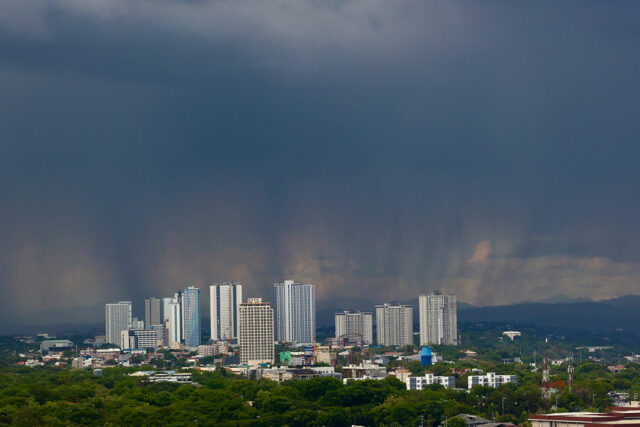
Clouds hover over buildings in Quezon City, April 28, 2025. — PHILIPPINE STAR/MIGUEL DE GUZMAN

THE Philippines needs to aim for at least 8% annual growth rate to ensure that any economic expansion is sufficiently inclusive, the Federation of Filipino Chinese Chambers of Commerce and Industry, Inc. (FFCCCII) said.

FFCCCII President Victor R. Lim said that while the recent revision of growth projections shows the administration’s “acknowledgement of real headwinds,” the government should choose ambition over accommodation.

“We noted the cited causes — the corrosive aftermath of the flood control corruption scandal and its dampening effect on confidence as well as global trade uncertainties,” he said in a statement on Thursday.

“We must categorically reject the notion that these new targets — 5% to 6% in 2026, scaling to 6% to 7% by 2028 — should represent the limit of our national economic ambition,” he added.

He said the Philippines should seek to achieve a sustained annual growth of 8% and beyond, after neighbor Vietnam posted 8% growth in 2025.

“This is the minimum viable ambition for a nation of our potential. The goal of 8% remains the ideal benchmark of transformative progress, because a steadfast and collective drive toward 8% is the critical, immediate step that will change our momentum and define this decade,” he added.

He said that as the Philippines recalibrates growth targets downward, Vietnam aims for 10% growth this year.

“Their success in attracting investment, boosting tourism, and raising per capita income underscores a critical truth: global capital and opportunity flow decisively to destinations perceived as dynamic, disciplined, efficient, reformist, and relentlessly forward moving,” he said.

“The lingering shadow of a massive corruption scandal must be dispelled not by lowered expectations, but by demonstrably higher standards of governance and performance,” he added.

The revised forecast, he said, signals the need to implement urgent reforms that will focus on six areas: human investment, anti-corruption, industrial and agricultural renaissance, foreign policy, infrastructure, and tourism and creative sectors.

In particular, Mr. Lim said that the Philippines should double down on education and public health.

“We support the budget focus but urge a shift from input-based to outcome-based spending, ensuring every peso spent truly builds a healthier, smarter, and more competitive workforce,” he said.

He also cited the need for an institutional anti-corruption overhaul following the public works scandal.

“We vigorously renew our call for creating an independent, powerful, and well-resourced anti-corruption agency to restore domestic and international confidence,” he said.

He also proposed support for domestic manufacturing and agro-industrial development, including strategic incentives as well as serious and sustained action against smuggling, high costs, and unfair import competition.

“We must create jobs here, add value here, and feed our nation with our own produce,” he added.

Meanwhile, he said the Philippines should pursue an independent, balanced foreign policy that ensures its national interests are protected while fostering stable relations and opening markets for Philippine goods and services.

He said that the Philippines should launch a national strategy for digital transformation, research and development, and green technology, while continuing critical infrastructure with renewed transparency and efficiency.

He called for a national tourism strategy that leverages cultural and natural assets while creating millions of jobs.

“Aiming for and achieving 8% growth is a realistic and necessary goal. It is a target within our grasp if we summon the collective will to reform, invest, and execute with unity and precision,” he said.

“It represents the threshold where growth begins to meaningfully transform lives and reshape our national destiny,” he added. — Justine Irish D. Tabile


PHL seen indirectly affected by Trump’s 25% tariff on some chips

Semiconductor chips are seen on a circuit board of a computer in this illustration picture taken on Feb. 25, 2022. — REUTERS

US PRESIDENT Donald J. Trump’s 25% tariff on certain semiconductors, particularly on advanced computing chips, is likely to affect Philippine manufacturers only indirectly, an analyst said.

John Paolo R. Rivera, senior research fellow at the Philippine Institute for Development Studies, said the US move is “unlikely to have a large immediate impact on Philippine exports.”

“Most of the country’s electronics shipments are assembly, testing, and components that are often covered by the World Trade Organization Information Technology Agreement or not directly targeted,” he said via Viber.

He said that the bigger risk is the indirect effect, which includes heightened US protectionism.

“That could disrupt global semiconductor value chains, raise costs, or prompt firms to reconfigure sourcing,” he said.

“Over time, Philippine exporters tied to US-centric supply chains should watch for spillovers, but for now the effect is more sentiment- and strategy-driven than a direct export hit,” he added.

In a proclamation dated Jan. 14, Mr. Trump laid down his plan of action to address the threatened impairment of national security stemming from imports of semiconductors, semiconductor manufacturing equipment, and their derivative products.

Under the two-phase plan, which follows an investigation under Section 232 of the Trade Expansion Act of 1962, the US is expected to pursue negotiation of agreements with any foreign jurisdictions.

“I have also determined that it is necessary and appropriate to impose an immediate 25% ad valorem duty on the import of certain advanced computing chips and derivative products when such importation does not contribute to the buildout of the US technology supply chain and the strengthening of domestic manufacturing capacity for derivatives of semiconductors,” he added.

However, Mr. Trump clarified that the tariff excludes chips used for US data centers, startups, and non-data center consumer applications, among others.

University of Asia and the Pacific Associate Professor George N. Manzano said Mr. Trump’s announcement does not indicate a blanket tariff on all types of semiconductors.

“The document mentions that the high tariffs will apply to a very narrow category of semiconductors that are an important element of (the Trump administration’s) artificial intelligence and technology policies,” he said.

“I think these are the chips incorporating more advanced technology. This will significantly impact the exports of countries that make these advanced or high-performance chips or computer systems,” he added.

Michael L. Ricafort, chief economist at Rizal Commercial Banking Corp., said the proclamation could potentially slow Philippine semiconductor exports.

However, he said that the industry is still adopting a wait-and-see stance on Mr. Trump’s previous threats of as much as a 300% tariff on electronics.

“Thus, there is a need for the Philippines to diversify further its export markets and products,” he said via Viber.

“This could also be seen as a negotiating tactic by Trump to get more concessions or investments for the US,” he added. — Justine Irish D. Tabile

Labor market experiencing fallout from infra scandals

Portions of the revetment wall along the Tullahan River collapsed in North Fairview, Quezon City, Aug. 29, 2025. — PHILIPPINE STAR/MIGUEL DE GUZMAN

UNRESOLVED governance issues and slow public investments that continue to weaken the economy are now weighing on the labor market, GlobalSource Partners said.

In a commentary dated Jan. 13, GlobalSource Country Analysts Diwa C. Guinigundo and Wilhelmina C. Mañalac noted that the ongoing flood control corruption scandal has led to weaker labor force participation and higher unemployment, especially in construction.

“These labor market outcomes are consistent with the broader slowdown in economic growth observed in the third quarter of 2025,” the GlobalSource analysts said. “Growth decelerated primarily due to reduced public construction activity linked to unresolved issues surrounding flood control projects.”

In November, the jobless rate climbed to 4.4% from 3.2% a year earlier — a development the Department of Labor and Employment said was unprecedented as the year-end holiday season typically boosts hiring.

However, Mr. Guinigundo and Ms. Mañalac said the slowdown reflects lingering governance concerns and still-sluggish public spending during the period.

“The slowdown highlights how governance bottlenecks and delayed public investment can transmit directly to employment outcomes, especially in construction and related sectors with strong multiplier effects,” they added.

Last year, extensive flooding uncovered substandard or non-existent flood control projects across the country, triggering investigations that linked government officials and private contractors to corruption.

The economy thus slump to its weakest growth in over four years — 4% in the third quarter. In the first nine months, gross domestic product growth averaged 5%, undershooting the government’s 5.5%-6.5% target.

GlobalSource said the weak labor market likewise shows weakening business conditions, noting the over four-year low S&P Global Philippines Manufacturing Purchasing Managers’ Index (PMI) reading of 47.4 in November.

“These developments point to subdued labor demand, particularly in sectors that traditionally absorb a large share of the workforce,” Mr. Guinigundo and Ms. Mañalac said.

However, the PMI also indicated that factory activity recovered to 50.2 in December.

Meanwhile, GlobalSource said the job market may remain vulnerable without meaningful government reforms to revive economic growth.

“These governance challenges have eroded investor confidence and constrained the economy’s capacity to generate stable, quality jobs,” Mr. Guinigundo and Ms. Mañalac said. “Without credible reforms, labor market vulnerabilities are likely to persist, leaving workers increasingly exposed to growth slowdowns and external shocks.” — Katherine K. Chan

Free WiFi launched on EDSA Busway

PHILIPPINE STAR/EDD GUMBAN

THE departments of Transportation (DoTr) and Information and Communications Technology (DICT), said they jointly launched the Free WiFi for All program at Epifanio de los Santos Avenue (EDSA) Busway stations.

“Basic services like transport and internet should also progress because it has now become a necessity for the public,” Information and Communications Technology Secretary Henry Rhoel R. Aguda said on Thursday.

The DICT’s “Free WiFi for All” program provides free public internet services in public areas like schools, health facilities, and underserved markets to help bridge the digital divide. 

The DoTr said free internet access will only be available at 17 stations for now — Balintawak, Kaingin, Fernando Poe, Jr., SM North EDSA, North Avenue, PHilAm, Quezon Avenue, Kamuning, Nepa Q-Mart, Main Avenue, Ortigas, Buendia, Ayala, Tramo, Taft Avenue, Roxas Boulevard, and SM Mall of Asia.

The remaining three EDSA Busway stations such as Monumento, Bagong Barrio, and Guadalupe will soon be part of the program after rehabilitation work is completed.

The program provides commuters between 40 and 60 megabits per second of free internet service, the DICT said.

The DICT said last year that it is hoping to establish up to 70,000 free WiFi sites after having launched 19,000 such sites as of August 2025. 

For 2025, the DoTr reported ridership of 66.67 million on the EDSA Busway.

The DoTr expects to carry more than 70 million passengers this year, reflecting greater efficiencies due to modernization.

Since its launch in June 2020, the EDSA Busway has served 341.31 million passengers.

The DoTr is also working on the expansion of the EDSA Busway, it said, with three more stations set to start construction within the first quarter.

The additional stations are in Cubao, Magallanes and the Parañaque Integrated Terminal Exchange, the DoTr said, adding that the new stations are expected to be completed by the fourth quarter. — Ashley Erika O. Jose

Growth in NCR building-material retail prices accelerates in December

WILCON

RETAIL price growth of construction materials in Metro Manila accelerated to a four-month high in December, the Philippine Statistics Authority (PSA) reported on Thursday.

The PSA reported that the construction materials retail price index (CMRPI) in the National Capital Region (NCR) was 1% in December, against 0.9% in November.

This was the strongest reading since the 1.1% posted in August. The recent high was 1.5% in December 2024.

In 2025, CMRPI growth averaged 1%, easing from 1.2% in 2024.

The CMRPI is based on 2012 constant prices.

The PSA attributed the expansion in December to the stronger increase in plumbing material prices, which came in at 0.5% from 0.3% a month earlier.

Stronger retail price growth was also noted in electrical materials (1.9% from 1.8%), painting materials and related compounds (2.2% from 2.1%), and miscellaneous construction materials (0.8% from 0.6%).

Growth in the carpentry materials sub-index slowed to 0.5% in December from 0.6% in November.

Marco Antonio C. Agonia, an economist at the University of Asia and the Pacific, attributed the retail price growth acceleration in December partly to holiday spending, “where consumers may have been repairing facades and putting up Christmas decorations for the season.”

“On the yearly easing, milder consumer demand compared to Q4-2024’s growth performance may have explained the slower increase,” he added.

In terms of supply, Mr. Agonia noted that “discounted and diverted construction material exports from China and Vietnam as a result of US tariffs may have increased the available supply in the Philippine market, leading to lower price pressures.”

He expects the price growth of construction materials at the retail level to remain stable in 2026.

“With construction projects being deferred and key global industrial input prices (iron and oil) somewhat stable, the usual price growth of around one percent may persist, all other things held equal,” he added. — Isa Jane D. Acabal

UPLB testing chemical, biological agents against onion fungal disease

BOC PHOTO

RESEARCHERS at the University of the Philippines Los Baños (UPLB) are developing sustainable chemical and biological control methods to curb onion anthracnose-twister disease, a major threat to the crop in Nueva Ecija.

Known as kulot by farmers, the fungal disease causes leaf spotting, twisting, and neck elongation, and can cut onion yields by as much as 80%, resulting in significant losses for onion cultivators.

Nueva Ecija, the top onion-producing province, accounted for 148,097 metric tons (MT) out of Philippine output of 264,323 MT in 2024, according to the Philippine Statistics Authority.

The research project, being carried out by the UPLB National Crop Protection Center, is evaluating biological control agents such as Trichoderma, as an environmentally sustainable alternative to chemical fungicides.

Trichoderma is a soil fungus known for acting as a biocontrol agent against plant pathogens.

The study, supported by the Philippine Council for Agriculture, Aquatic and Natural Resources Research and Development (PCAARRD), aims to determine how these agents suppress disease-causing fungi and whether they can help strengthen onion plants’ resistance to future infections.

Field assessments revealed that most growers cultivating red onion varieties rely heavily on chemical fungicides to manage the disease, while only a few have adopted Trichoderma as a biological control agent.

The researchers also collected fungal isolates, particularly Colletotrichum and Fusarium species, that are being tested against a range of fungicides to identify the most effective chemical treatments and to assess potential resistance among aggressive strains.

PCAARRD said the researchers also identified several possible alternative host plants, including barnyard grass, spreading dayflower, and sedges. Cross-infection studies will be conducted to determine whether these plants contribute to the spread of the disease. — Vonn Andrei E. Villamiel